Chapter 10 Budgetary Planning and Control
10–41
154. The results of operations for the Budget Pesticides, for the fourth quarter of 2017 were
as follows:
Sales of bug spray $600,000
Variable cost of goods sold 280,000
Contribution margin 320,000
Fixed production costs $70,000
Fixed selling and administrative expenses 30,000 100,000
Income before taxes 220,000
Income taxes 88,000
Net income $132,000
Budget Pesticide uses the variable costing method. The company’s balance sheet
reported the following amounts as of the end of the fourth quarter of 2017:
Cash
$ 30,000
Accounts payable
$ 44,800
Accounts receivable
300,000
Common stock
140,200
Fixtures and equipment
130,000
Retained earnings
195,000
Accumulated depreciation
80,000
Additional information:
1. Sales and variable costs of sales are expected to increase by 5% in the next
quarter.
2. All sales are on credit with 50% collected in the quarter of sale and 50% collected
in the following quarter.
3. Variable cost of sales consists of 40% materials, 40% direct labor, and 20%
variable overhead.
4. All materials are purchased on credit and 60% are paid for in the quarter of
purchase and the remaining amount is paid for in the quarter after purchase.
There is no beginning or ending inventory.
5. Direct labor and variable overhead are paid in the quarter the expenses are
incurred.
6. Fixed production costs include $3,000 of depreciation. Fixed production costs are
paid in the quarter they are incurred.
7. Fixed selling and administrative costs, other than $4,000 of depreciation
expense, are expected to increase by 2% per quarter. Fixed selling and
administrative costs are paid in the quarter they are incurred.
8. The tax rate is expected to be 40%. All taxes are paid in the quarter they are
incurred.
How much is the budgeted Accounts Payable for materials at the end of the first quarter
of 2018?
A. $47,040
B. $117,600
C. $70,500
D. $291,760
Test Bank to accompany Jiambalvo Managerial Accounting, 6th Edition
10–42
155. The results of operations for the Budget Pesticides, for the fourth quarter of 2017 were
as follows:
Sales of bug spray $600,000
Variable cost of goods sold 280,000
Contribution margin 320,000
Fixed production costs $70,000
Fixed selling and administrative expenses 30,000 100,000
Income before taxes 220,000
Income taxes 88,000
Net income $132,000
Budget Pesticide uses the variable costing method. The company’s balance sheet
reported the following amounts as of the end of the fourth quarter of 2017:
Cash
$ 30,000
Accounts payable
$ 44,800
Accounts receivable
300,000
Common stock
140,200
Fixtures and equipment
130,000
Retained earnings
195,000
Accumulated depreciation
80,000
Additional information:
1. Sales and variable costs of sales are expected to increase by 5% in the next
quarter.
2. All sales are on credit with 50% collected in the quarter of sale and 50% collected
in the following quarter.
3. Variable cost of sales consists of 40% materials, 40% direct labor, and 20%
variable overhead.
4. All materials are purchased on credit and 60% are paid for in the quarter of
purchase and the remaining amount is paid for in the quarter after purchase.
There is no beginning or ending inventory.
5. Direct labor and variable overhead are paid in the quarter the expenses are
incurred.
6. Fixed production costs include $3,000 of depreciation. Fixed production costs are
paid in the quarter they are incurred.
7. Fixed selling and administrative costs, other than $4,000 of depreciation
expense, are expected to increase by 2% per quarter. Fixed selling and
administrative costs are paid in the quarter they are incurred.
8. The tax rate is expected to be 40%. All taxes are paid in the quarter they are
incurred.
No new plant assets were acquired. How much is the budgeted book value of the plant
assets at the end of the first quarter of 2018?
A. $46,000
B. $47,000
C. $43,000
D. $53,000
Chapter 10 Budgetary Planning and Control
10–43
156. The results of operations for the Budget Pesticides, for the fourth quarter of 2017 were
as follows:
Sales of bug spray $600,000
Variable cost of goods sold 280,000
Contribution margin 320,000
Fixed production costs $70,000
Fixed selling and administrative expenses 30,000 100,000
Income before taxes 220,000
Income taxes 88,000
Net income $132,000
Budget Pesticide uses the variable costing method. The company’s balance sheet
reported the following amounts as of the end of the fourth quarter of 2017:
Cash
$ 30,000
Accounts payable
$ 44,800
Accounts receivable
300,000
Common stock
140,200
Fixtures and equipment
130,000
Retained earnings
195,000
Accumulated depreciation
80,000
Additional information:
1. Sales and variable costs of sales are expected to increase by 5% in the next
quarter.
2. All sales are on credit with 50% collected in the quarter of sale and 50% collected
in the following quarter.
3. Variable cost of sales consists of 40% materials, 40% direct labor, and 20%
variable overhead.
4. All materials are purchased on credit and 60% are paid for in the quarter of
purchase and the remaining amount is paid for in the quarter after purchase.
There is no beginning or ending inventory.
5. Direct labor and variable overhead are paid in the quarter the expenses are
incurred.
6. Fixed production costs include $3,000 of depreciation. Fixed production costs are
paid in the quarter they are incurred.
7. Fixed selling and administrative costs, other than $4,000 of depreciation
expense, are expected to increase by 2% per quarter. Fixed selling and
administrative costs are paid in the quarter they are incurred.
8. The tax rate is expected to be 40%. All taxes are paid in the quarter they are
incurred.
How much is budgeted total assets at March 31, 2018?
A. $523,528
B. $658,000
C. $350,000
D. None of these answer choices are correct.
Test Bank to accompany Jiambalvo Managerial Accounting, 6th Edition
10–44
157. E-Book Trading Company budgets $100,000 in fixed overhead and $11.00 per book in
variable overhead each month. For May, E-Book expected to license and sell 14,000 e-
books but because of unexpected demand actually sold 16,000 units. The actual
overhead cost was $256,000. What will a flexible budget performance report for May
likely indicate?
A. E-Book Trading had a $2,000 unfavorable variance for overhead for the month
B. E-Book Trading had a $20,000 favorable variance for overhead for the month
C. E-Book Trading had a $20,000 unfavorable variance for overhead for the month
D. E-Book Trading had a $2,000 favorable variance for overhead for the month
158. Prodigy Products’ expected manufacturing costs for trash cans for the month when
3,000 cans are produced are summarized below:
Direct material $2.40 per unit
Direct labor $1.60 per unit
Variable overhead $ 6,000
Factory depreciation 10,500
Supervisory salaries 4,800
Other fixed factory costs 1,500
What is the flexible budget amount for a month when 3,200 units are produced?
A. $36,000
B. $37,120
C. $34,800
D. $35,600
159. Prodigy Products’ expected manufacturing costs for trash cans for the month when
3,000 cans are produced are summarized below:
Direct material $2.40 per unit
Direct labor $1.60 per unit
Variable overhead $ 6,000
Factory depreciation 10,500
Supervisory salaries 4,800
Other fixed factory costs 1,500
What is the flexible budget amount for a month when 4,000 units are produced?
A. $34,800
B. $38,800
C. $46,400
D. $40,800
Chapter 10 Budgetary Planning and Control
10–45
160. Prodigy Products’ expected manufacturing costs for trash cans for the month when
3,000 cans are produced are summarized below:
Direct material $2.40 per unit
Direct labor $1.60 per unit
Variable overhead $ 6,000
Factory depreciation 10,500
Supervisory salaries 4,800
Other fixed factory costs 1,500
Which of the following is the flexible budget equation for Prodigy Products?
A. $4.00 × number of units produced
B. $16,800 + ($6.00 × number of units produced)
C. $11.60 × number of units produced
D. $22,800 + ($4.00 × number of units produced)
161. Belk Shoes planned to make 8,000 pairs of shoes using $40,000 on leather during
February. Due to higher than anticipated demand for shoes, Belk produced 9,000 pairs
of shoes and spent $44,500 on leather. Leather prices during the period were as
expected in the budget. Which of the following statements is a fair statement regarding
Belk’s performance on leather use?
A. Belk’s flexible budget for comparative purposes for February is $45,000.
B. Belk used more leather per shoe than was allowed in the budget.
C. Belk paid more for each yard of leather than allowed in the budget.
D. Belk spent $500 more for leather than allowed under the flexible budget.
162. Xanine Company budgets $200,000 in fixed overhead and $6.00 per unit in variable
overhead. For June, Xanine expected to produce 11,000 units but because of
unexpected demand actually produced 13,000 units. The actual overhead cost was
$280,000. A flexible budget performance report for May would indicate that
A. Xanine generated a $2,000 favorable overhead variance for the month.
B. Xanine was $12,000 under budget for overhead for the month.
C. Xanine was $2,000 over budget for overhead for the month.
D. Xanine generated a $12,000 unfavorable overhead variance for the month.
Test Bank to accompany Jiambalvo Managerial Accounting, 6th Edition
10–46

Chapter 10 Budgetary Planning and Control
10–47
MATCHING
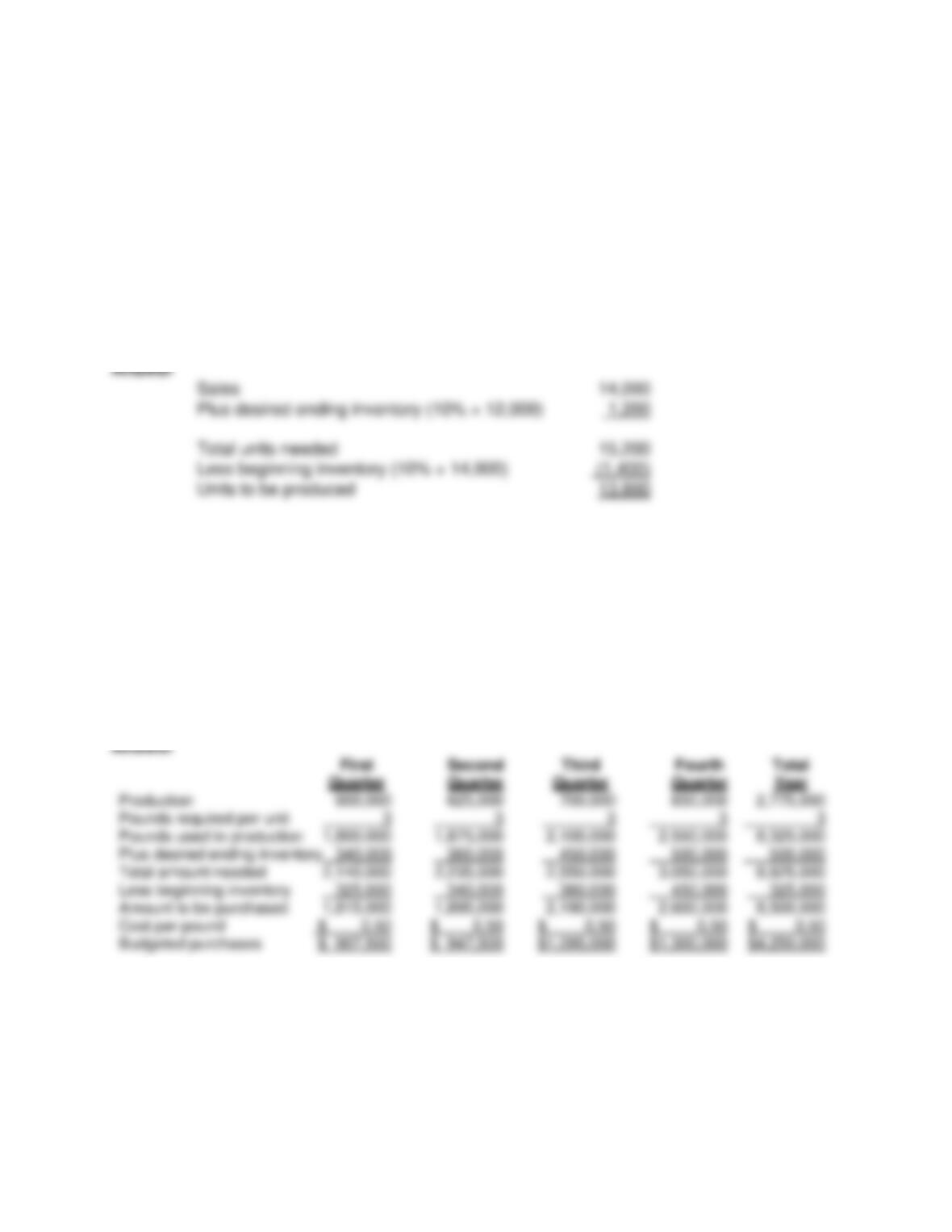
163. Match each of the following terms with the phrase that most closely describes it. Each
answer may be used only once.
_____ 1. Budgeted income statement
_____ 2. Budgets
_____ 3. Budget variances
_____ 4. Capital acquisitions budget
_____ 5. Flexible budget
_____ 6. Budget slack
_____ 7. Master budget
_____ 8. Sales budget
_____ 9. Static budget
_____ 10. Income shifting
_____ 11. Management by exception
_____ 12. Zero-based budgeting
A. Differences between actual and budgeted amounts
B. A comprehensive planning document that incorporates a number of individual budgets
C. Approach in which managers only investigate exceptional variances
D. Set of budget relationships that can be adjusted to various activity levels
E. Setting budget targets that are easy to achieve
F. Moving income from one period to another to achieve budget targets
G. Method of budget preparation that requires each amount to be justified, even if it was
supported in previous periods
H. Budget showing plans to purchase property, plant, and equipment
I. Formal documents that quantify a company’s plans for achieving its goals
J. A budget that is only valid for a single level of activity
K. Summarizes sales, cost of goods sold, and other expenses to project net income
L. First budget that is prepared since other budgets depend upon it
Answers to Matching
Test Bank to accompany Jiambalvo Managerial Accounting, 6th Edition
10–48
EXERCISES
164. Galvin Production is beginning the budgeting process for 2017. The sales forecast for
the first three months of 2017 in units follows:
January
10,000
February
14,000
March
12,000
The company desires to have 10% of the next month’s anticipated unit sales in inventory
at the end of a month. December’s ending inventory reflects this policy. April’s sales are
budgeted at 15,000 units. Prepare a production budget in good form for February. Omit
the heading.
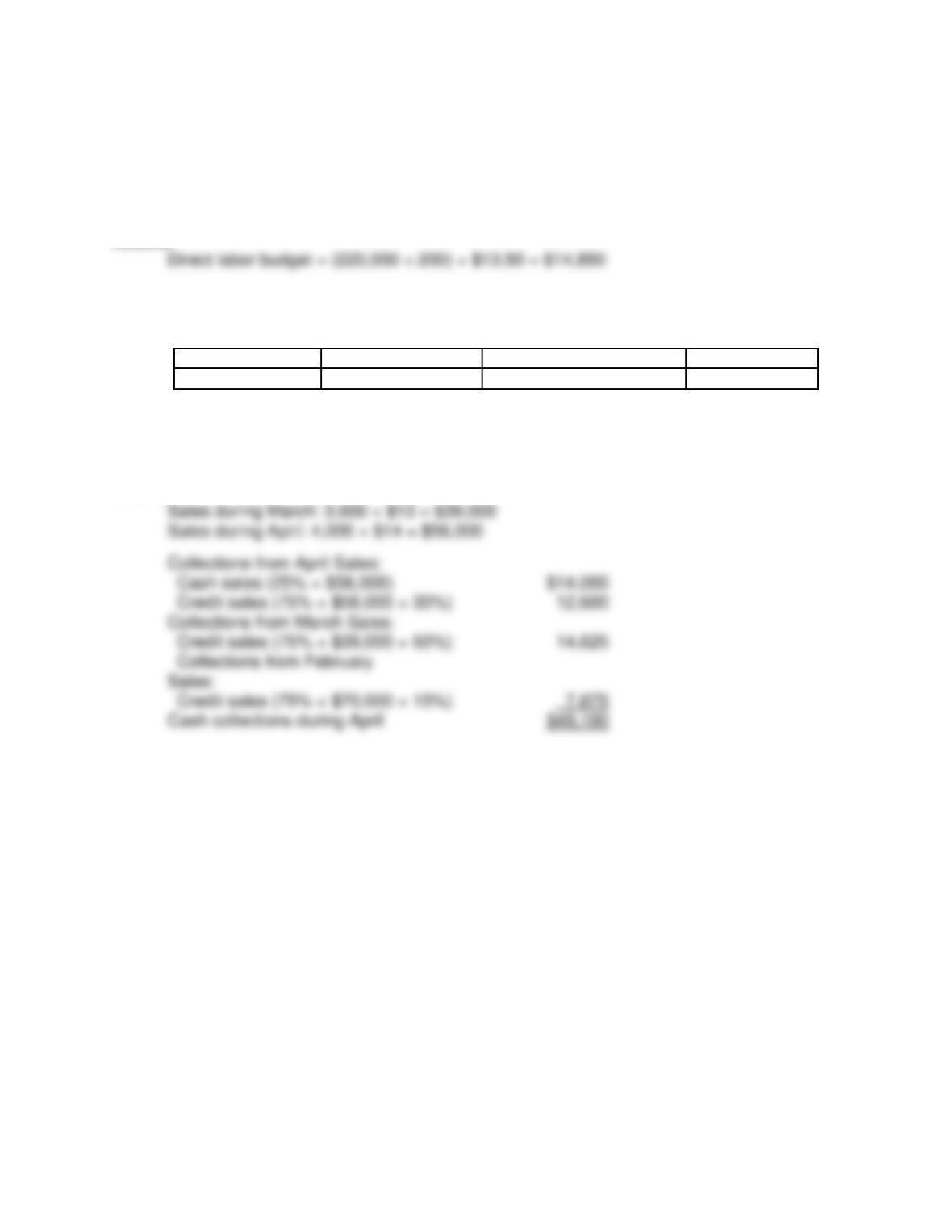
165. Swisher Toys is preparing its budget for 2017. Production for the first quarter is expected
to be 600,000 toy dump trucks. Production for the subsequent quarters will be 625,000
trucks, 700,000 trucks, and 850,000 trucks.
Each truck requires 3.0 pounds of resin, which is used to produce the trucks.
Each pound of resin costs $0.50. Swisher will have 325,000 pounds of resin on hand at
the end of 2017 and wants to have 500,000 pounds of resin in inventory at the end of
2018. Ending inventory for resin for the first, second, and third quarters will be 340,000
pounds, 360,000 pounds, and 450,000 pounds. Prepare the direct materials budget by
quarter and in total for 2018.
Chapter 10 Budgetary Planning and Control
10–49
166. Captain Fizzy plans to produce 800,000 fizzy drinks during 2017, with 120,000 of them
during the first quarter, 250,000 during the second quarter, 220,000 during the third
quarter, and 210,000 during the fourth quarter. Employees are paid $13.50 per hour and
can produce 200 fizzy drinks each hour. Determine Captain Fizzy’s direct labor budget
for the third quarter of 2017.
Answer
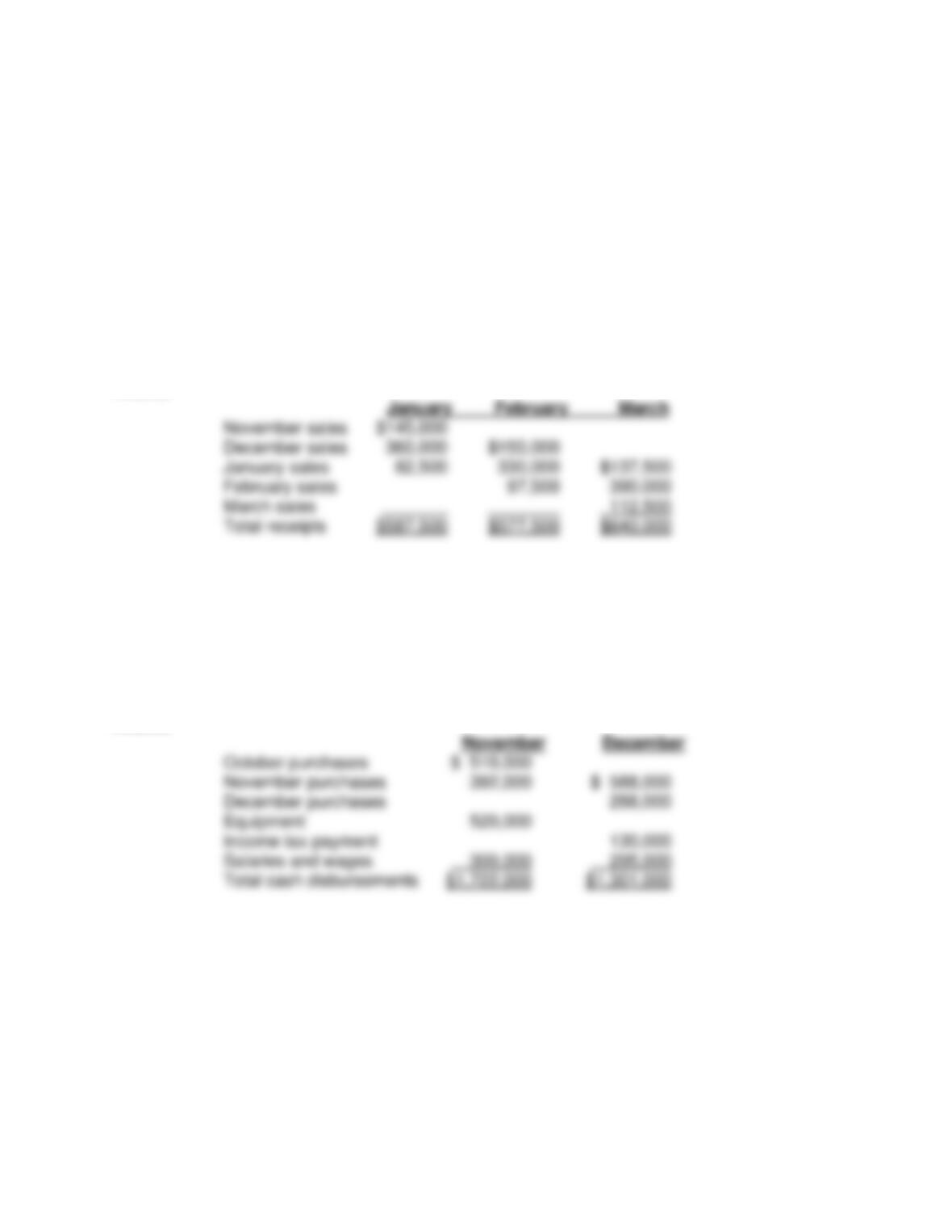
167. Martinez Corporation’s sales of gizmos are 25% for cash and 75% on credit. Past
collection history indicates that credit sales are collected as follows:
Month of Sale
Month After Sale
Second Month After Sale
Uncollectible
30%
50%
15%
5%
In January, sales were $80,000 and February sales were $70,000. Projected sales for
March are 3,000 gizmos at $13 each. Projected sales for April are 4,000 gizmos at $14
each. Calculate the budgeted cash collections for April.
Answer
$14,000
12,600
$49,100
Test Bank to accompany Jiambalvo Managerial Accounting, 6th Edition
10–50
168. All of Gaylord Boutique’s sales are on account. In the past, 15% of the amounts charged
have been paid in the same month as the sale, 60% were paid in the following month,
and the rest were paid in the second month following the sale. Sales for selected months
are given below:
November 2017 $580,000
December 2017 600,000
January 2018 550,000
February 2018 650,000
March 2018 750,000
April 2018 725,000
May 2018 700,000
Prepare the cash receipts budget for the first three months of 2018.
Answer
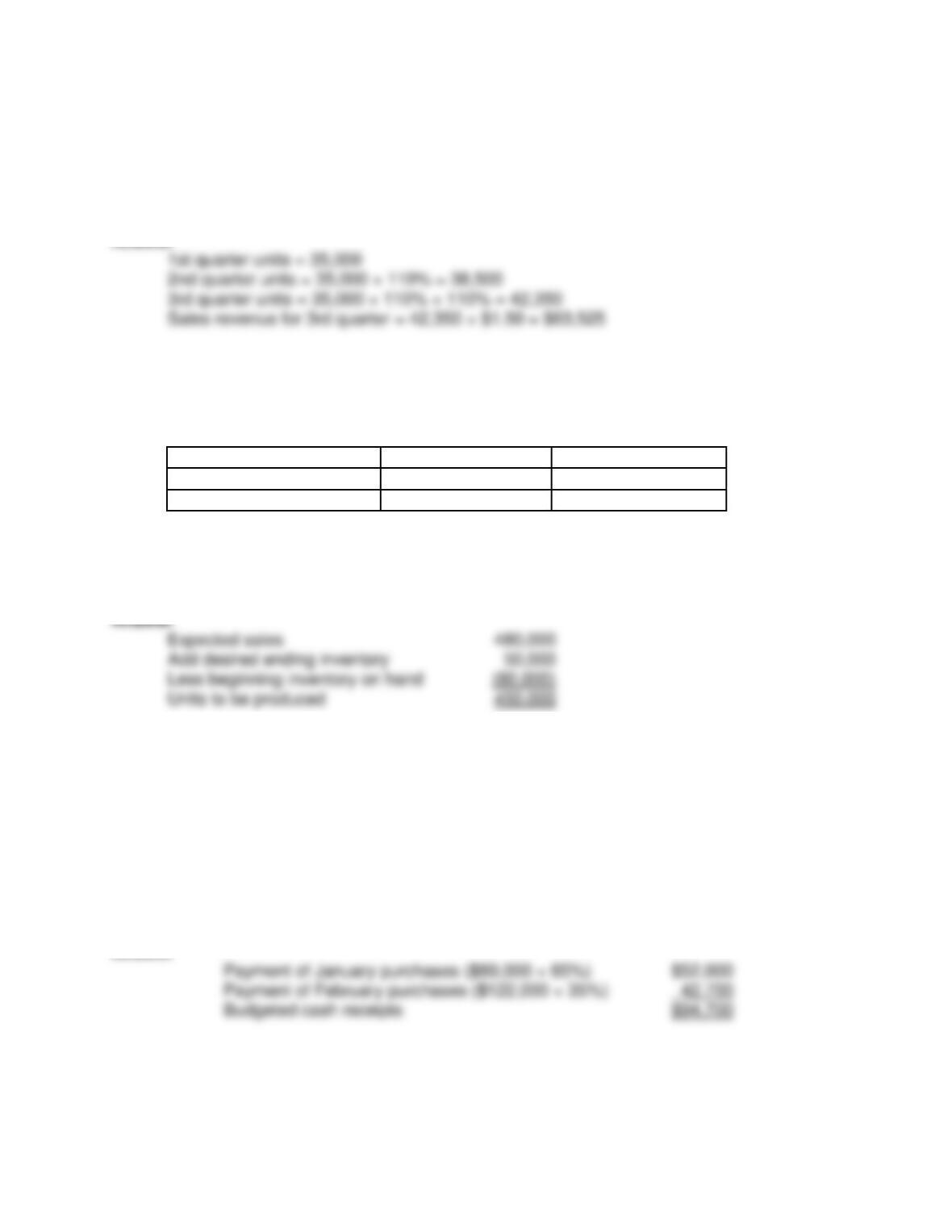
169. Billy Bob Tacos pays for 40% of its inventory purchases in the month of the purchase
and the remainder in the following month. The company’s inventory purchases totaled
$850,000 in October, $980,000 in November, and $720,000 in December. The company
also paid for new equipment with a total cost of $520,000 in November and made an
income tax payment of $130,000 in December. Salaries and wages were paid as
follows: $310,000 in October, $300,000 in November and $295,000 in December.
Determine the company’s cash disbursements for November and December.
Answer
Chapter 10 Budgetary Planning and Control
10–51
170. At January 1, 2017, Wallace, Inc. has beginning inventory of 4,000 widgets. Wallace
estimates it will sell 35,000 units during the first quarter of 2017 with a 10% increase in
unit sales each quarter. Wallace’s policy is to maintain an ending inventory equal to 25%
of the next quarter’s sales. Each widget costs $1 to purchase and is sold for $1.50. How
much is budgeted sales revenue for the third quarter of 2017?
Answer
171. Clips, Inc. budgets on an annual basis for its fiscal year. The company produces widgets
using the raw material, oximate. The following beginning and ending inventory levels are
planned for the fiscal year ending June 30, 2017:
July 1, 2017
June 30, 2018
Oximate
40,000 pounds
36,000 pounds
Widgets
80,000 units
50,000 units
Three pounds of oximate are needed to produce each widget. If Clips plans to sell
480,000 widgets during the year ending June 30, 2018, how many widgets will it need to
produce during the year?
172. East Lansing Mall expects to make purchases in the first quarter of 2018 as follows:
January $ 80,000
February 122,000
March 74,000
Purchases in December of 2017 are expected to be $93,000. The company expects that
35% of a month’s purchases will be paid in the month of purchase and the balance will
be paid in the following month. Calculate budgeted cash disbursements related to
purchases for February of 2018.
Answer
Test Bank to accompany Jiambalvo Managerial Accounting, 6th Edition
10–52
173. ProSlade expects credit sales in the next quarter as follows:
April $ 90,000
May 110,000
June 113,000
Prior experience has shown that 30% of a month’s sales are collected in the month of
sale, 40% in the month following sale, and 28% in the second month following sale.
February and March sales were $90,000 and $100,000, respectively. Uncollectible
accounts are written off under the allowance method at 80 days after the end of the
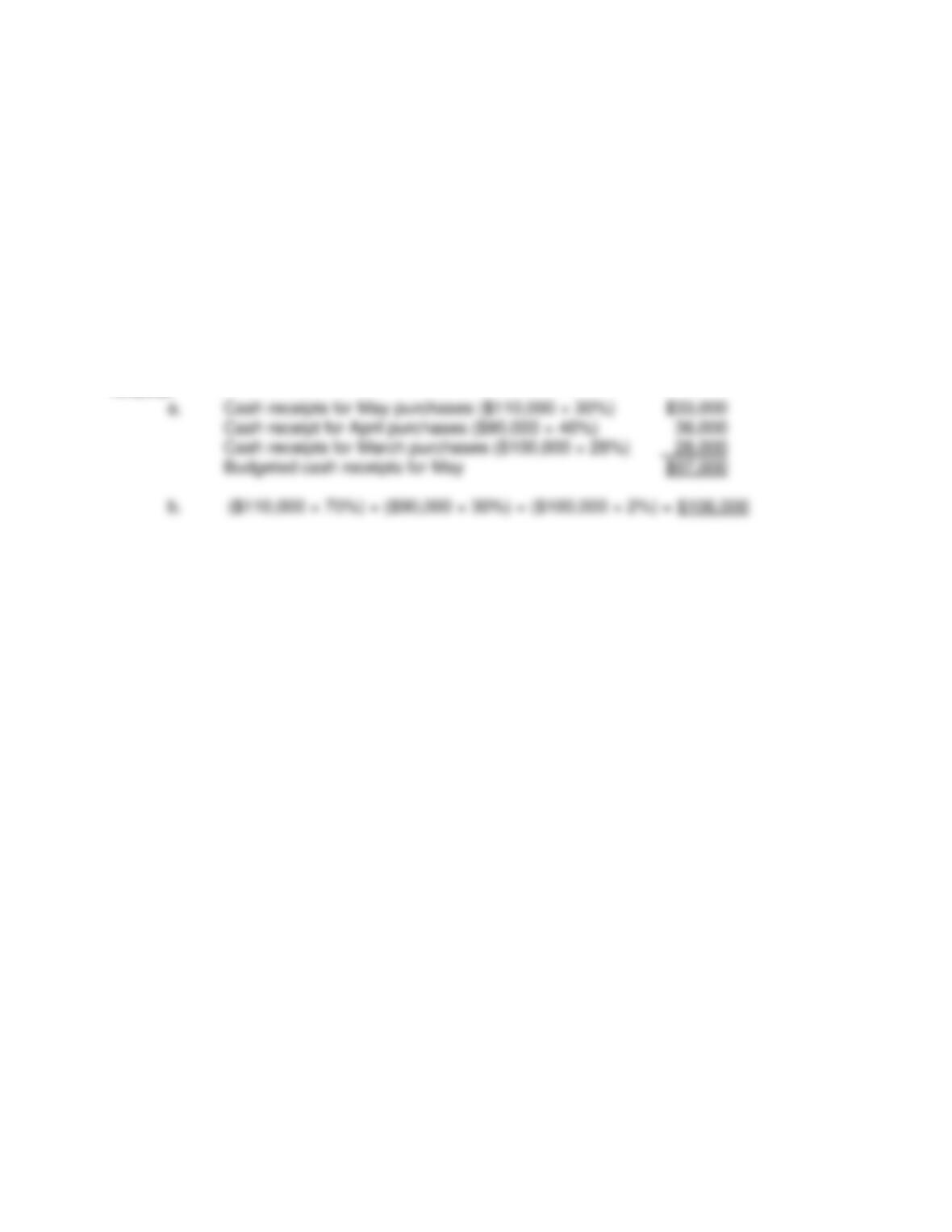
month in which the sale was made.
a. Calculate budgeted cash receipts for May.
b. How much is Accounts Receivable on ProSlade’s May 31 balance sheet?
Answer
Chapter 10 Budgetary Planning and Control
10–53
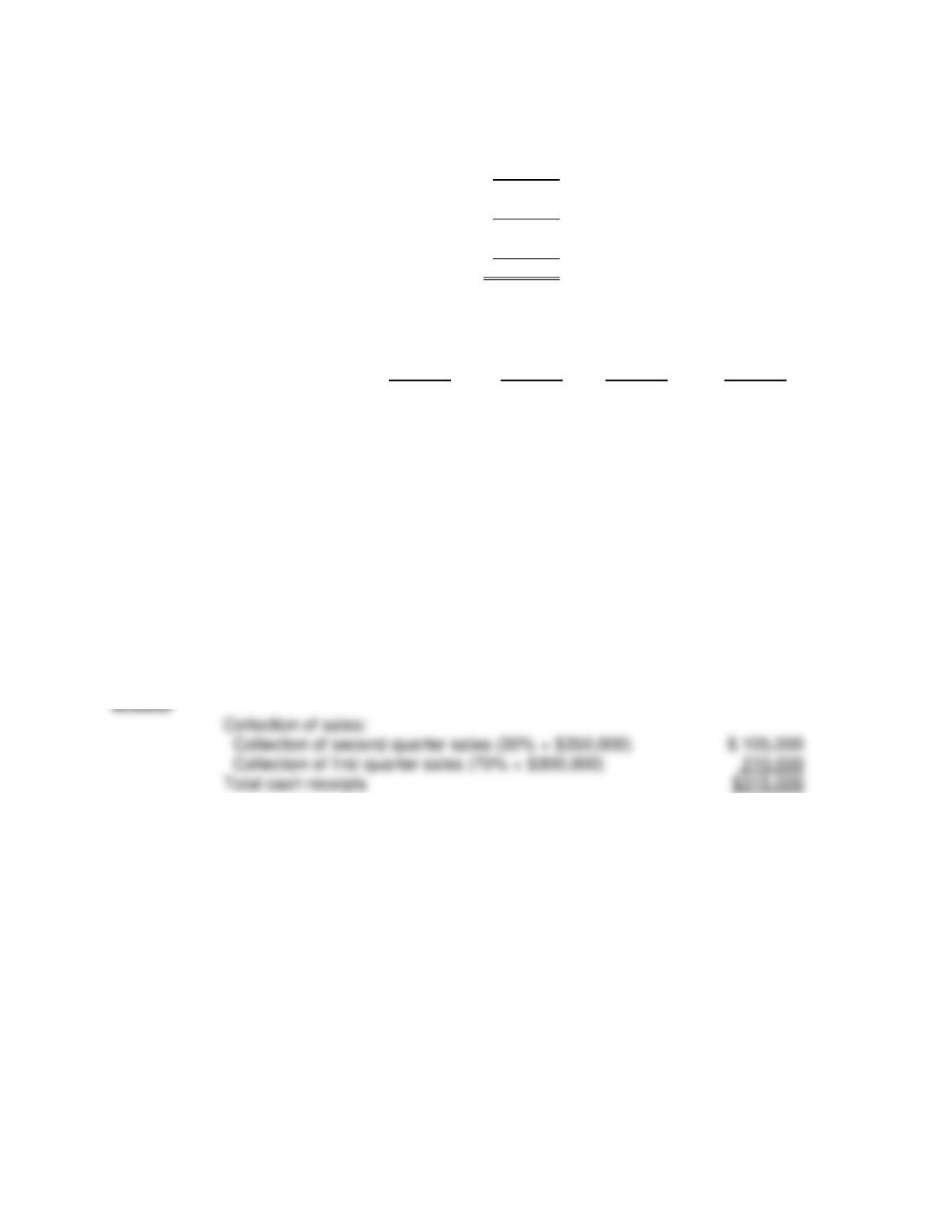
174. In the fourth quarter of 2017, Winston Wheels had the following net income:
Sales $400,000
Less cost of sales 150,000
Gross margin 250,000
Selling and administration costs 110,000
Income before taxes 140,000
Income taxes 42,000
Net income $ 98,000
Purchases in the fourth quarter of 2017 amounted to $170,000. Estimated data for 2018
follow:
First Second Third Fourth
Quarter Quarter Quarter Quarter
Sales $300,000 $350,000 $400,000 $450,000
Cost of sales 170,000 200,000 230,000 150,000
Purchases 200,000 230,000 250,000 280,000
Selling and admin. 110,000 110,000 110,000 110,000
• Taxes are 30% of pretax income and are paid in the month of accrual.
• All sales are on credit and 30% are collected in the quarter of sale and 70% are
collected in the next quarter.
• 40% of purchases are paid in the quarter of purchase and 60% in the next
quarter.
• Selling and administrative expenses are paid in the quarter incurred.
• There is $11,000 of depreciation included in selling and administrative expense.
• A capital expenditure for $40,000 is planned for the fourth quarter of 2018.
Calculate total cash receipts for the second quarter of 2018.