118) On January 1, a company issued and sold a $400,000, 7%, 10-year bond payable, and
received proceeds of $396,000. Interest is payable each June 30 and December 31. The company
uses the straight-line method to amortize the discount. The carrying value of the bonds
immediately after the first interest payment is:
A) $400,000.
B) $399,800.
C) $400,200.
D) $395,800.
E) $396,200.
119) On January 1, a company issued and sold a $400,000, 7%, 10-year bond payable, and
received proceeds of $396,000. Interest is payable each June 30 and December 31. The company
uses the straight-line method to amortize the discount. The carrying value of the bonds
immediately after the second interest payment is:
A) $400,000.
B) $399,800.
C) $396,400.
D) $395,800.
E) $396,200.
120) A company issued 10-year, 7% bonds with a par value of $100,000. The company received
$96,526 for the bonds. Using the straight-line method, the amount of interest expense for the first
semiannual interest period is:
A) $3,326.00.
B) $3,500.00.
C) $3,673.70.
D) $7,000.00.
E) $7,347.40.
121) The effective interest amortization method:
A) Allocates bond interest expense over the bond’s life using a changing interest rate.
B) Allocates bond interest expense over the bond’s life using a constant interest rate.
C) Allocates a decreasing amount of interest over the life of a discounted bond.
D) Allocates bond interest expense using the current market rate for each interest period.
E) Is not allowed by the FASB.
122) A company issued 7%, 5-year bonds with a par value of $100,000. The market rate when
the bonds were issued was 7.5%. The company received $97,947 cash for the bonds. Using the
effective interest method, the amount of interest expense for the first semiannual interest period
is:
A) $3,500.00.
B) $3,673.01.
C) $3,705.30.
D) $7,000.00.
E) $7,346.03.
123) A company issued 7%, 5-year bonds with a par value of $100,000. The market rate when
the bonds were issued was 7.5%. The company received $97,946.80 cash for the bonds. Using
the effective interest method, the amount of interest expense for the second semiannual interest
period is:
A) $3,500.00.
B) $3,679.49.
C) $3,673.01.
D) $7,000.00.
E) $7,346.03.
124) A company issues bonds with a $100,000 par value, an 8% annual contract rate, semiannual
interest payments, and a five year life. The bonds sold for $107,850. The entry to record the
issuance of the bonds will include:
A) A credit to Premium on Bonds Payable of $7,850.
B) A debit to Discount on Bonds Payable of $7,850.
C) A credit to Cash of $100,000.
D) A credit to Bonds Payable of $107,850.
E) A debit to Interest Expense of $7,850.
125) The Premium on Bonds Payable account is a(n):
A) Revenue account.
B) Adjunct liability account.
C) Contra revenue account.
D) Contra asset account.
E) Equity account.
126) Adonis Corporation issued 10-year, 8% bonds with a par value of $200,000. Interest is paid
semiannually. The market rate on the issue date was 7.5%. Adonis received $206,948 in cash
proceeds. Which of the following statements is true?
A) Adonis must pay $200,000 at maturity and no interest payments.
B) Adonis must pay $206,948 at maturity and no interest payments.
C) Adonis must pay $200,000 at maturity plus 20 interest payments of $8,000 each.
D) Adonis must pay $206,948 at maturity plus 20 interest payments of $8,000 each.
E) Adonis must pay $200,000 at maturity plus 20 interest payments of $7,500 each.
127) A company received cash proceeds of $206,948 on a bond issue with a par value of
$200,000. The difference between par value and issue price for this bond is recorded as a:
A) Credit to Interest Income.
B) Credit to Premium on Bonds Payable.
C) Credit to Discount on Bonds Payable.
D) Debit to Premium on Bonds Payable.
E) Debit to Discount on Bonds Payable.
128) If an issuer sells bonds at a premium:
A) The carrying value of the bond stays constant over time.
B) The carrying value increases from the par value to the issue price over the bond’s term.
C) The carrying value decreases from the par value to the issue price over the bond’s term.
D) The carrying value increases from the issue price to the par value over the bond’s term.
E) The carrying value decreases from the issue price to the par value over the bond’s term.
129) A company issues 9%, 5-year bonds with a par value of $100,000 on January 1 at a price of
$106,160, when the market rate of interest was 8%. The bonds pay interest semiannually. The
amount of each semiannual interest payment is:
A) $9,000.
B) $8,000.
C) $4,000.
D) $4,500.
E) $0.
130) A company issues 8% bonds with a par value of $40,000 at par on January 1. The market
rate on the date of issuance was 7%. The bonds pay interest semiannually on January 1 and July
1. The cash paid on July 1 to the bond holder(s) is:
A) $3,200.
B) $2,800.
C) $1,600.
D) $1,400.
E) $0.
131) A company issued 5-year, 7% bonds with a par value of $100,000. The market rate when
the bonds were issued was 6.5%. The company received $102,105 cash for the bonds. Using the
straight-line method, the amount of recorded interest expense for the first semiannual interest
period is:
A) $3,289.50.
B) $3,500.00.
C) $3,613,70.
D) $6,633.70.
E) $7,000.00.
132) A company issued 5-year, 7% bonds with a par value of $100,000. The market rate when
the bonds were issued was 6.5%. The company received $102,105 cash for the bonds. Using the
effective interest method, the amount of recorded interest expense for the first semiannual
interest period is:
A) $3,500.00.
B) $7,000.00.
C) $3,318.41.
D) $6,573.90.
E) $1,750.00.
133) A company may retire bonds by all but which of the following means?
A) Exercising a call option.
B) The holders converting them to stock.
C) Purchasing the bonds on the open market.
D) Paying them off at maturity.
E) Paying all future interest and cancelling the debt.
134) Bonds that give the issuer an option of retiring them before they mature are:
A) Debentures.
B) Serial bonds.
C) Sinking fund bonds.
D) Registered bonds.
E) Callable bonds.
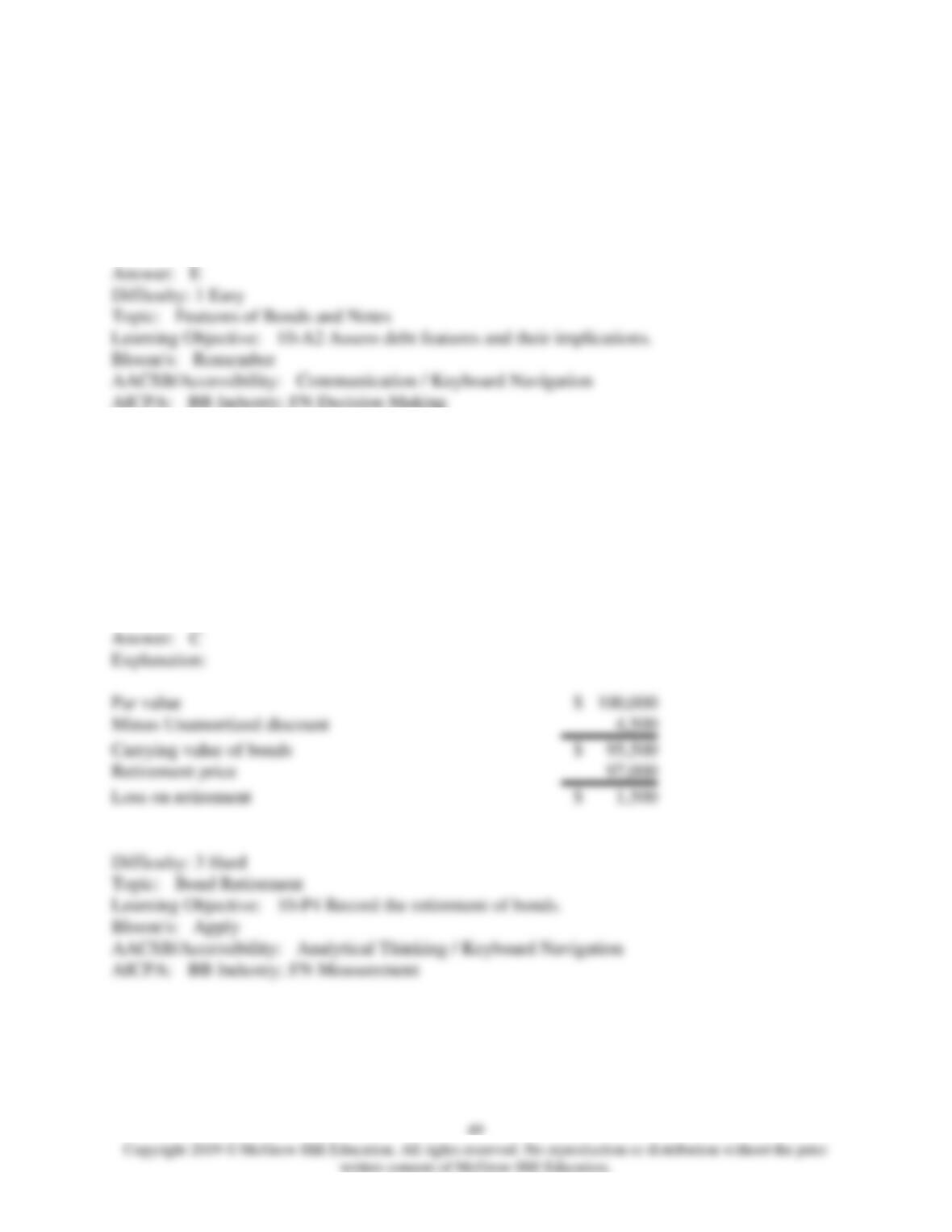
135) A company has bonds outstanding with a par value of $100,000. The unamortized discount
on these bonds is $4,500. The company calls these bonds at a price of $97,000, the gain or loss
on retirement is:
A) $0 gain or loss.
B) $1,500 gain.
C) $1,500 loss.
D) $3,000 gain.
E) $3,000 loss.
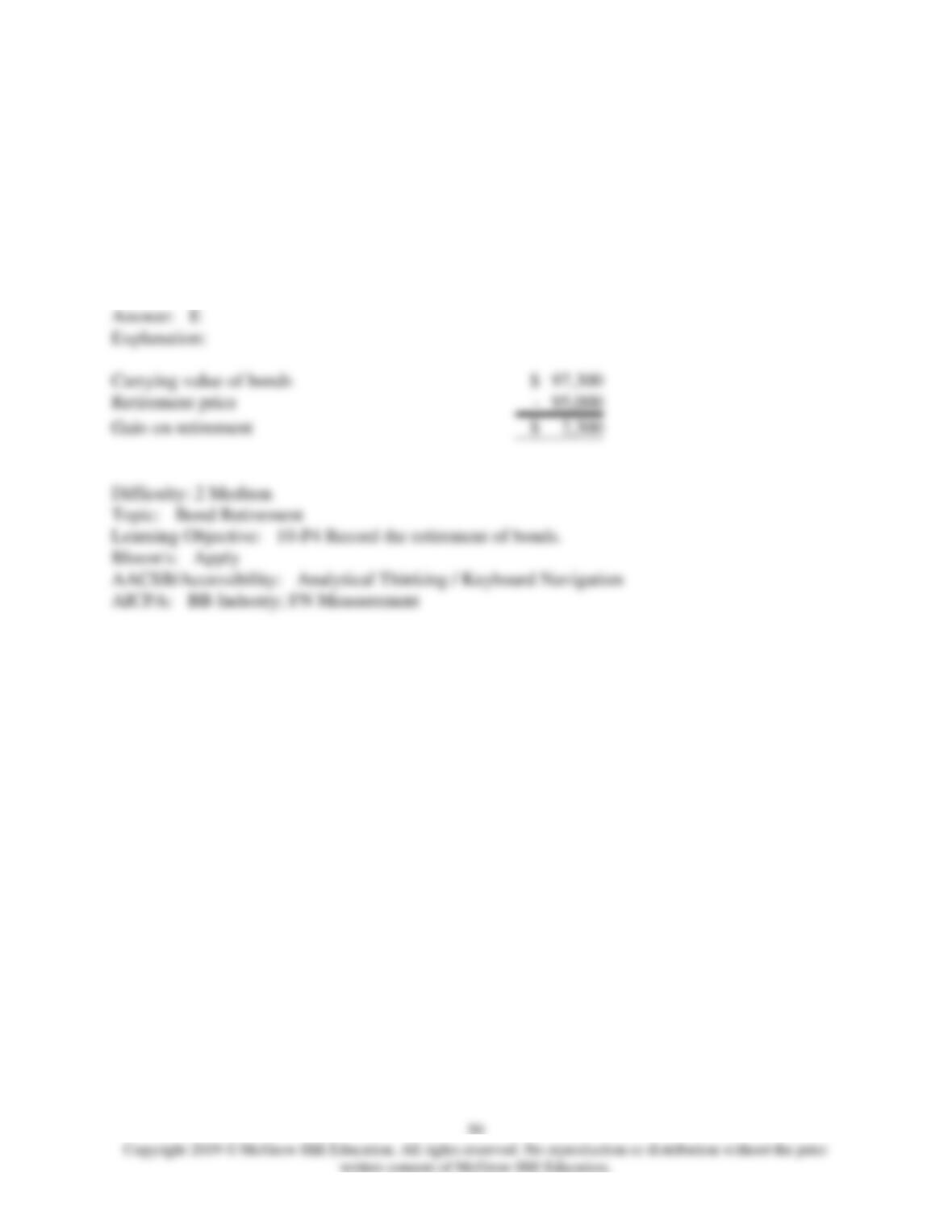
136) Clabber Company has bonds outstanding with a par value of $100,000 and a carrying value
of $97,300. If the company calls these bonds at a price of $95,000, the gain or loss on retirement
is:
A) $5,000 loss.
B) $2,700 gain.
C) $2,700 loss.
D) $2,300 loss.
E) $2,300 gain.
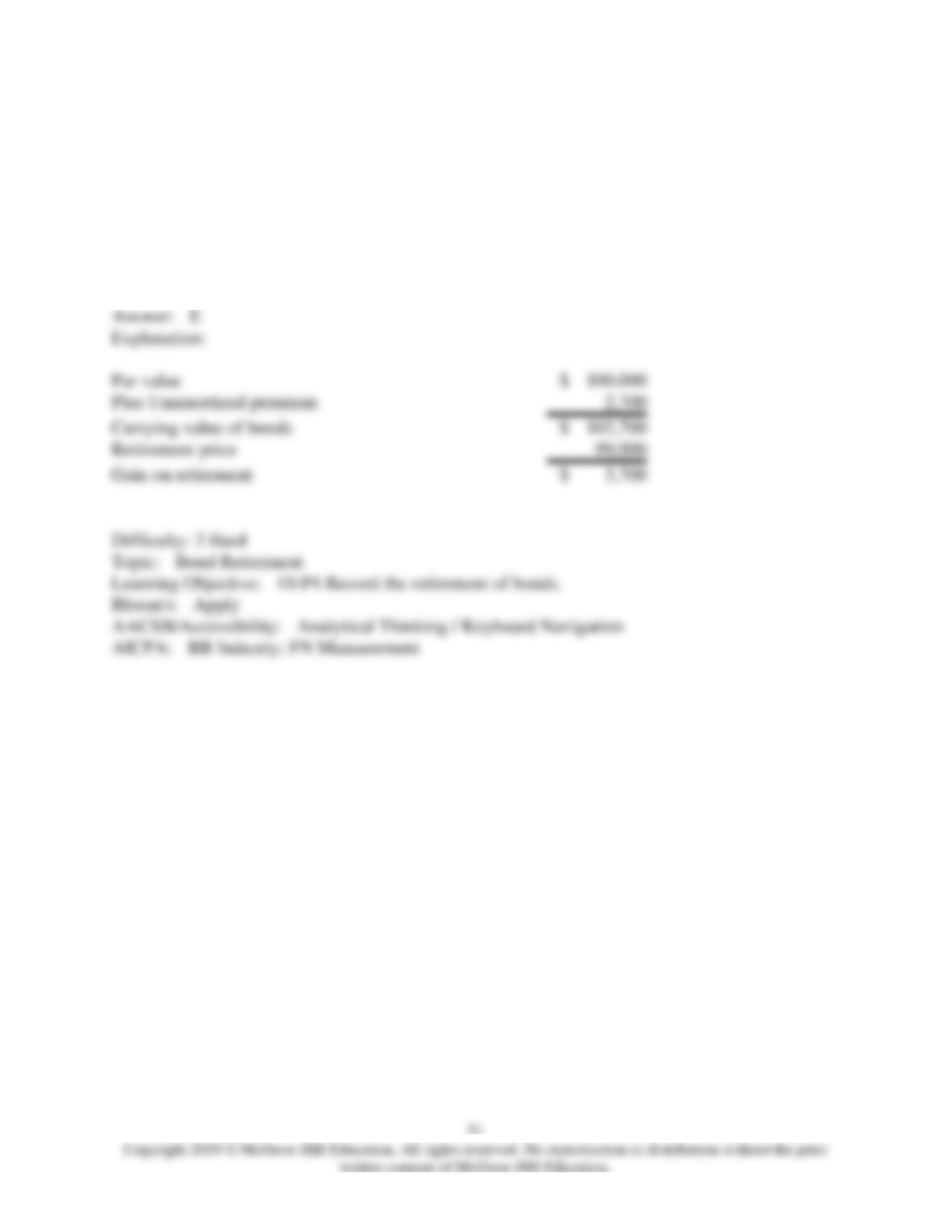
137) A company has bonds outstanding with a par value of $100,000. The unamortized premium
on these bonds is $2,700. If the company retired these bonds at a call price of $99,000, the gain
or loss on this retirement is:
A) $1,000 gain.
B) $1,000 loss.
C) $2,700 loss.
D) $2,700 gain.
E) $3,700 gain.
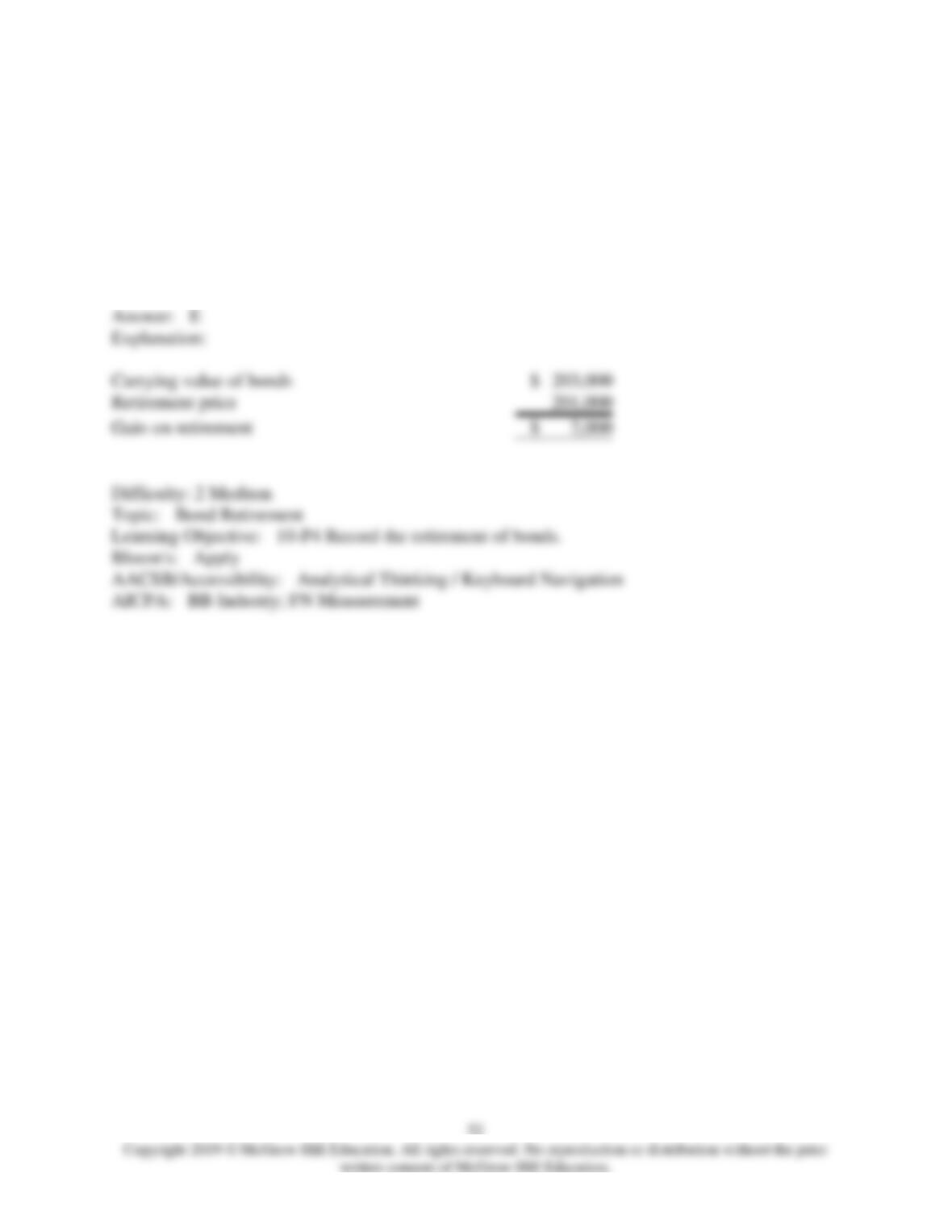
138) Chang Industries has bonds outstanding with a par value of $200,000 and a carrying value
of $203,000. If the company calls these bonds at a price of $201,000, the gain or loss on
retirement is:
A) $1,000 gain.
B) $2,000 loss.
C) $3,000 gain.
D) $1,000 loss.
E) $2,000 gain.
139) A company calls its bonds at a price of $105,000. The face value is $100,000 and the
carrying value of the bonds at the retirement date is $103,745. The issuer’s journal entry to
record the retirement will include a:
A) Debit to Premium on Bonds.
B) Credit to Premium on Bonds.
C) Debit to Discount on Bonds.
D) Credit to Gain on Bond Retirement.
E) Credit to Bonds Payable.
140) A corporation issued 8% bonds with a par value of $1,000,000, receiving a $20,000
premium. On the interest date 5 years later, after the bond interest was paid and after 40% of the
premium had been amortized, the corporation called the bonds at $990,000. The gain or loss on
this retirement is:
A) $0.
B) $10,000 gain.
C) $10,000 loss.
D) $22,000 gain.
E) $22,000 loss.
141) On August 1, a $30,000, 6%, 3-year installment note payable is issued by a company. The
note requires equal payments of principal plus accrued interest of $11,223.34. The entry to
record the first payment on July 31 would include:
A) Debit to Notes Payable of $11,223.34
B) Debit to Interest Expense of $1,800.
C) Debit to Cash of $11,223.34.
D) Credit to Notes Payable of $11,223.34
E) Credit to Cash $9,423.34
142) On July 1, Shady Creek Resort borrowed $250,000 cash by signing a 10-year, 8%
installment note requiring equal payments each June 30 of $37,258. What is the appropriate
journal entry to record the issuance of the note?
A) Debit Cash $250,000; debit Interest Expense $37,258; credit Notes Payable $287,258.
B) Debit Notes Payable $250,000; credit Cash $250,000.
C) Debit Cash $37,258; credit Notes Payable $37,258.
D) Debit Cash $250,000; credit Notes Payable $250,000.
E) Debit Cash $287,258; credit Interest Payable $37,258; credit Notes Payable $250,000.
143) On July 1, Shady Creek Resort borrowed $250,000 cash by signing a 10-year, 8%
installment note requiring equal payments each June 30 of $37,258. What amount of interest
expense will be included in the first annual payment?
A) $20,000
B) $37,258
C) $25,000
D) $17,258
E) $232,742
144) On July 1, Shady Creek Resort borrowed $250,000 cash by signing a 10-year, 8%
installment note requiring equal payments each June 30 of $37,258. What amount of principal
will be included in the first annual payment?
A) $20,000
B) $37,258
C) $25,000
D) $232,742
E) $17,258
145) On July 1, Shady Creek Resort borrowed $250,000 cash by signing a 10-year, 8%
installment note requiring equal payments each June 30 of $37,258. What is the journal entry to
record the first annual payment?
A) Debit Cash $250,000; debit Interest Expense $37,258; credit Notes Payable $287,258.
B) Debit Interest Expense $37,258; credit Cash $37,258.
C) Debit Interest Expense $20,000; credit Cash $20,000.
D) Debit Interest Expense $20,000; debit Interest Payable $17,258; credit Cash $37,258.
E) Debit Interest Expense $20,000; debit Notes Payable $17,258; credit Cash $37,258.
146) A corporation borrowed $125,000 cash by signing a 5-year, 9% installment note requiring
equal annual payments each December 31 of $32,136. What journal entry would the issuer
record for the first payment?
A) Debit Interest Expense $7,136; debit Notes Payable $25,000; credit Cash $32,136.
B) Debit Notes Payable $32,136; debit Interest Payable $11,250; credit Cash $43,386.
C) Debit Interest Expense $11,250; debit Notes Payable $20,886; credit Cash $32,136.
D) Debit Notes Payable $32,136; credit Cash $32,136.
E) Debit Notes Payable $11,250; credit Cash $11,250.
147) On January 1, Year 1, Stratton Company borrowed $100,000 on a 10-year, 7% installment
note payable. The terms of the note require Stratton to pay 10 equal payments of $14,238 each
December 31 for 10 years. The required general journal entry to record the first payment on the
note on December 31, Year 1 is:
A) Debit Interest Expense $7,000; debit Notes Payable $7,238; credit Cash $14,238.
B) Debit Notes Payable $7,000; debit Interest Expense $7,238; credit Cash $14,238.
C) Debit Notes Payable $10,000; debit Interest Expense $7,000; credit Cash $17,000.
D) Debit Notes Payable $14,238; credit Cash $14,238.
E) Debit Notes Payable $10,000; debit Interest Expense $4,238; credit Cash $14,238.
148) On January 1, Year 1, Stratton Company borrowed $100,000 on a 10-year, 7% installment
note payable. The terms of the note require Stratton to pay 10 equal payments of $14,238 each
December 31 for 10 years. The required general journal entry to record the payment on the note
on December 31, Year 2 is:
A) Debit Interest Expense $7,000; debit Notes Payable $7,238; credit Cash $14,238.
B) Debit Notes Payable $7,000; debit Interest Expense $7,238; credit Cash $14,238.
C) Debit Interest Expense $6,493; debit Notes Payable $7,745; credit Cash $14,238.
D) Debit Notes Payable $14,238; credit Cash $14,238.
E) Debit Notes Payable $10,000; debit Interest Expense $4,238; credit Cash $14,238.
149) On January 1, a company issues bonds dated January 1 with a par value of $300,000. The
bonds mature in 5 years. The contract rate is 9%, and interest is paid semiannually on June 30
and December 31. The market rate is 8% and the bonds are sold for $312,177. The journal entry
to record the issuance of the bond is:
A) Debit Cash $312,177; credit Discount on Bonds Payable $12,177; credit Bonds Payable
$300,000.
B) Debit Cash $300,000; debit Premium on Bonds Payable $12,177; credit Bonds Payable
$312,177.
C) Debit Bonds Payable $300,000; debit Bond Interest Expense $12,177; credit Cash $312,177.
D) Debit Cash $312,177; credit Premium on Bonds Payable $12,177; credit Bonds Payable
$300,000.
E) Debit Cash $312,177; credit Bonds Payable $312,177.
150) On January 1, a company issues bonds dated January 1 with a par value of $300,000. The
bonds mature in 5 years. The contract rate is 9%, and interest is paid semiannually on June 30
and December 31. The market rate is 8% and the bonds are sold for $312,177. The journal entry
to record the first interest payment using straight-line amortization is:
A) Debit Interest Payable $13,500; credit Cash $13,500.00.
B) Debit Bond Interest Expense $12,282.30; debit Discount on Bonds Payable $1,217.70; credit
Cash $13,500.00.
C) Debit Bond Interest Expense $14,717.70; credit Premium on Bonds Payable $1,217.70; credit
Cash $13,500.00.
D) Debit Bond Interest Expense $14,717.70; credit Discount on Bonds Payable $1,217.70; credit
Cash $13,500.00.
E) Debit Bond Interest Expense $12,282.30; debit Premium on Bonds Payable $1,217.70; credit
Cash $13,500.00.