10-136
142. Thompson Metal Corporation (TMC) supplies various types of machine tools to
manufacturing companies. TMC has always paid a lot of attention to the quality of its products.
Recently, an outside supplier has approached TMC to supply an important and intricate
component of one of its more advanced tools that TMC has been manufacturing in-house. Sam
Weiss, a junior accountant at TMC, has collected the following information regarding this
proposal.
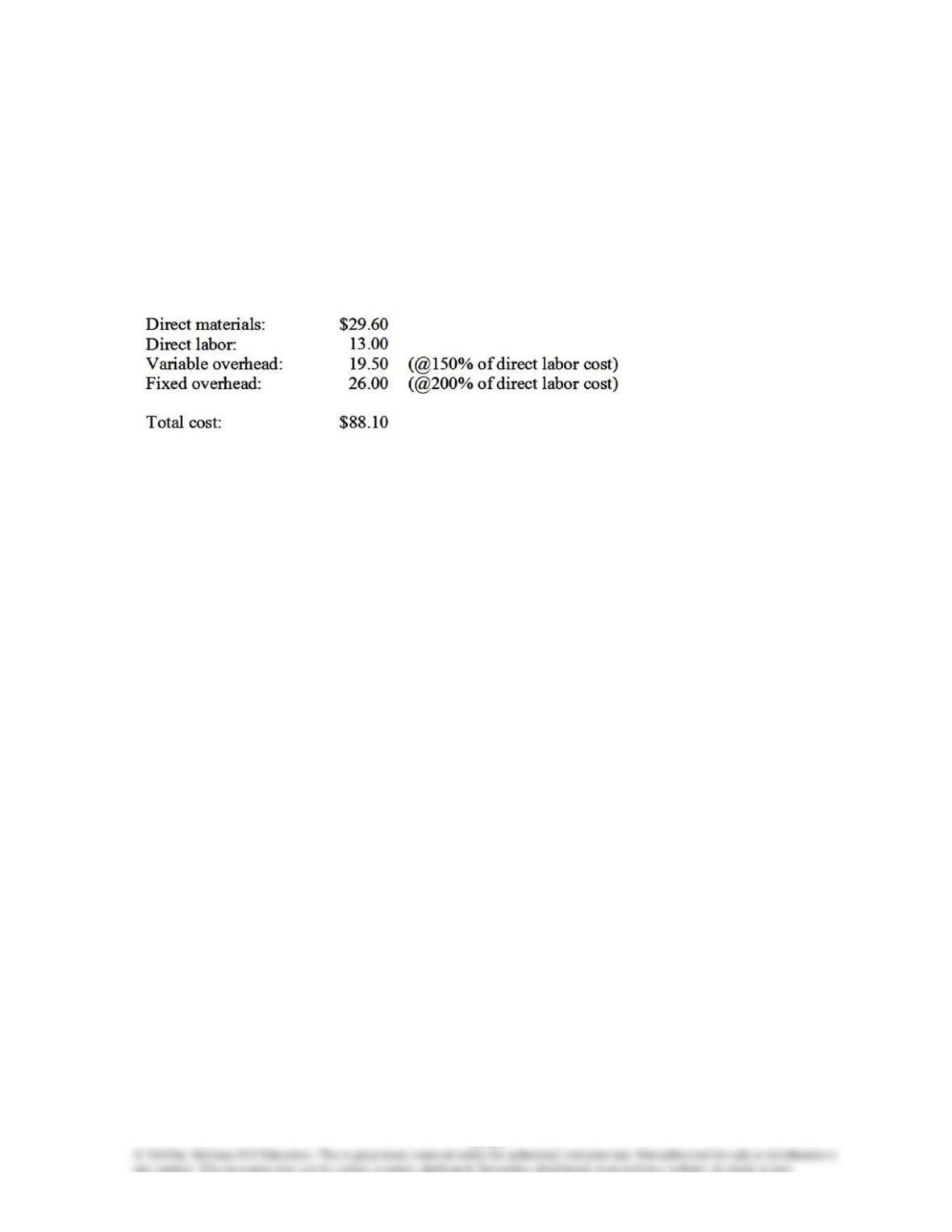
The cost of manufacturing one unit of this component internally are as follows:
The outside supplier has quoted a price of $90 per unit for supplying this component. The
following is a conversation that took place among the manufacturing manager (Dana Rice), buyer
(Emily Scanlon), and Sam Weiss.
Weiss: I think that we should continue to manufacture internally because we can save $1.90 per
unit on this component.
Rice: According to your report, we would save $1.90 per unit, but I do not agree with those
numbers.
Weiss: What do you mean? I have followed the same costing guidelines this company has used for
years. I have even cross-checked my numbers with historical data and know for sure that the
overhead rates which I have used are correct.
Rice: I am sure you have done your job thoroughly, but I think that our costing system is archaic.
This component is complex and difficult to manufacture. I believe that our overhead allocation
method does not accurately capture the production difficulties and the additional resources that
are devoted to the manufacture of this component. For example, a significant portion of our
quality problems are due to this component. We spend close to a third of our quality inspection
time on just this component alone, but that is not reflected. These quality problems cause delays
in getting this component to the assembly department, and that causes a delay in getting the final
product to the customers. Many of our customers are expecting just–in-time deliveries, and they
get upset when we’re late.
Scanlon: I know that the supplier that has approached us has a strong reputation for quality.
Therefore, we can rest assured that we will have negligible quality problems.
Rice: Sam, your report does not consider this additional benefit from buying outside. I would
appreciate if you can rework your numbers to better reflect the true costs associated with
manufacturing this component internally.
10-137
Required:
(a) Assume the role of Sam Weiss. What are the different elements of costs that are likely to be
associated with the manufacture of the component? Does the current costing system capture
these costs?
(b) Recommend improvements in the costing system.
(c) How can Weiss quantify “qualitative” benefits such as quality and on-time delivery?
10-138
143. Burns Corporation manufactures large kitchen appliances. The following represents
financial information for two years:
Required:
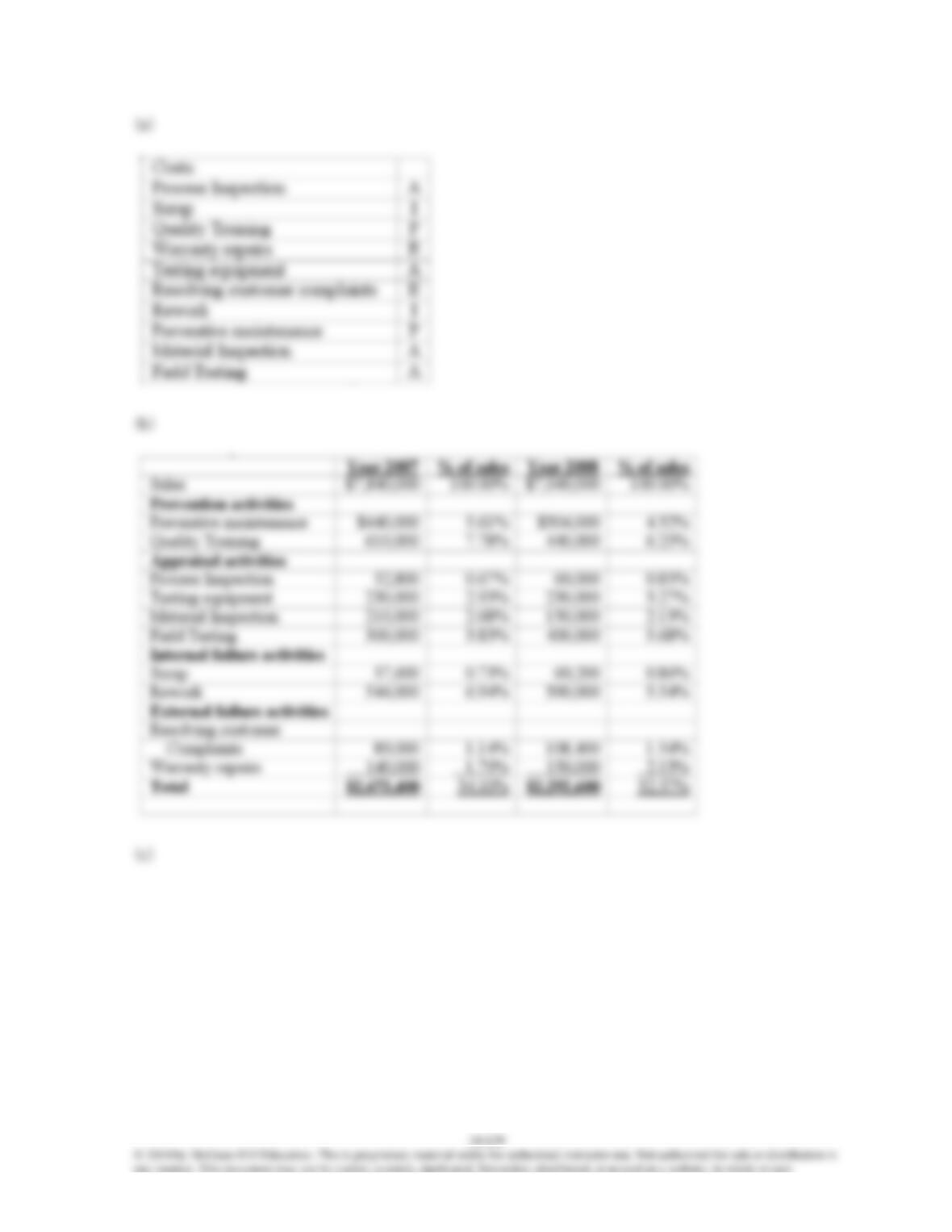
(a) Classify these items into costs of prevention (P), appraisal (A), internal failure(I) or external
failure (E) activities.
(b) Calculate the ratio of prevention, appraisal, internal failure, and external failure costs to sales
for 2007 and 2008.
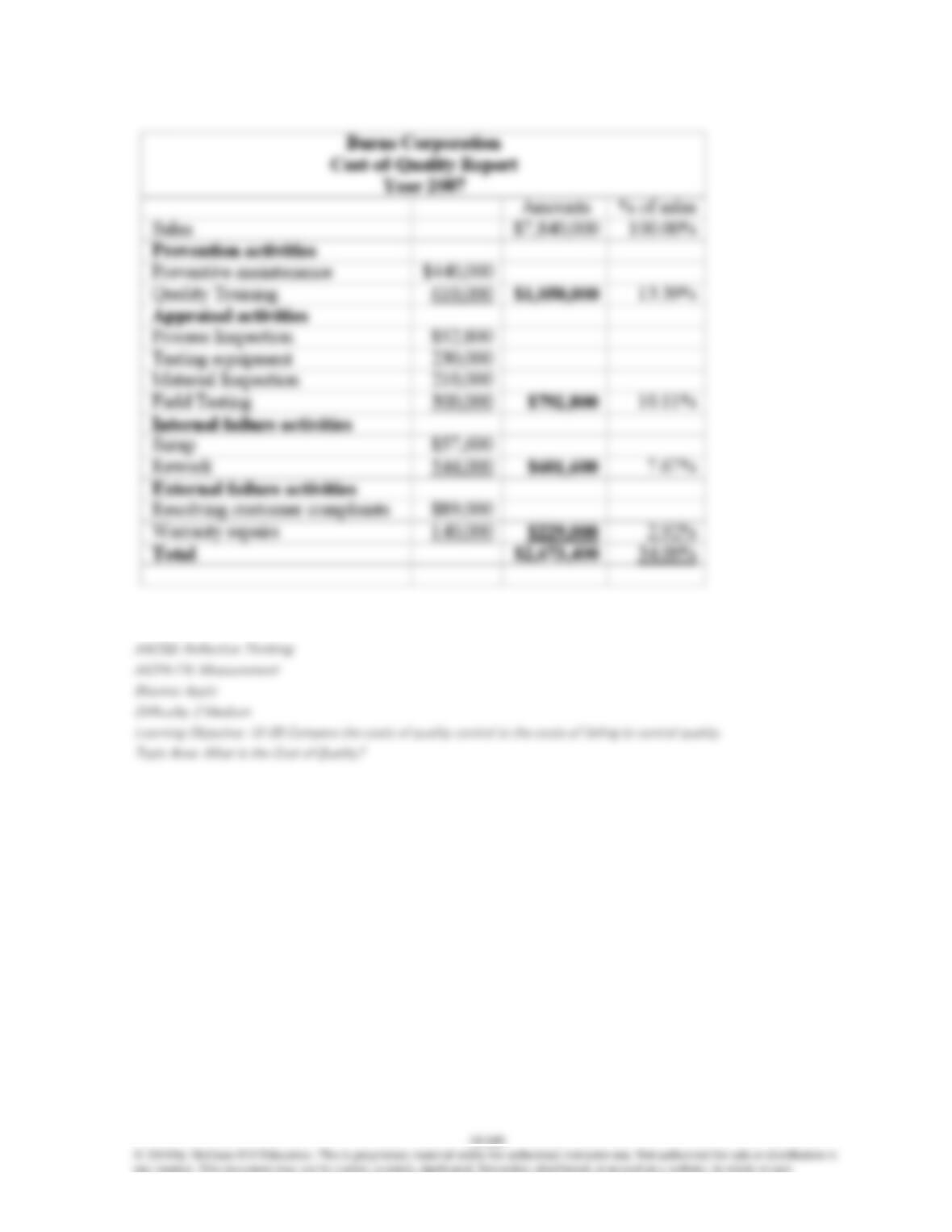
(c) Prepare a cost of quality report for 2007.

10-141
144. Companies are continuously seeking ways to improve the quality of production and reduce
costs. One of the areas is to work with suppliers to improve the quality and reliability of parts and
products shipped. In an article entitled “In Defense of Activity-Based Cost Management,” Robert
S. Kaplan says:
An ABC model can play a major role in improving supplier relationships as well. These
relationships must be a vital part of any quality and cycle-time improvement program. A key
insight is to use ABC to distinguish between low-price and low-cost suppliers. Traditional cost
accounting, with its emphasis on purchase price variances, encourages purchasing people to
continually scan the population of potential suppliers to obtain low price quotations. Most
companies have learned, the hard way, that many of their low-price suppliers are actually
extremely high-cost suppliers. (Source: Management Accounting: November, 1992)
Required:
(a) Explain what Kaplan means by “many of their low-price suppliers are actually extremely high–
cost suppliers.”
(b) What general prevention and appraisal activities can be used to improve the quality and
reliability of parts and products shipped from suppliers?
145. Traditionally, companies in the United States have employed a “push” manufacturing
style. Studies in Activity Based Management and Quality Control have indicated that this
approach is filled with many non-value-added activities, which increase overall costs and reduce
profits. The “push” style is being replaced with a “pull” approach.
Required:
Briefly describe the major differences between the push and pull approaches. What non-value
added activities are eliminated in a pull manufacturing system?

10-144
146. Dayton Extruded Plastics is a company involved in the injection molding process of plastic
extruders. The company had a process of inspection, checking line work, and handling returns
from customers to identify and correct quality problems. Scrapped extruders were ground into
powder and fed back to the extruders as raw material; thus, all scrapped extruders were reused at
some point. The company’s cost accounting system indicated that the cost of scrap was “zero,” a
view also held by Dayton Extruded’s management. (Source: “Activity Based management” by
Peter B. B. Turney published in Management Accounting)
Required:
a) Comment on the view that scrap costs were zero at Dayton Extruded Plastics.
b) Identify internal and external failure activities that were required by Dayton Extruded.
c) Identify prevention and appraisal activities that could have been employed.
147. What is the relationship between customer profitability analysis and ABC?

10-147
148. Cost allocation bases are factors that cost management analysts use to assign indirect
costs to cost objects. Ideally, cost-allocation bases should reflect a cause-and-effect relationship
between resource spending and use. Ideally, an Activity-Based-Costing (ABC) approach will
provide a more accurate and useful accounting for an organization’s resources. Recent studies
have found that, in spite of increasing costs and diminishing resources, very few Higher Education
Institutions use the tools and techniques of an ABC cost allocation system to assign costs to
academic departments. While direct costs, such as faculty salaries, are traceable to individual
academic departments or courses, many indirect costs, such as facility use, computer use, and
student support services, are more difficult to assign. In a traditional approach, many higher
education institutions assign such costs based on a single factor, such as the number of courses
taught in the university. (Source: Activity-Based Costing for Higher Education Institutions,
Management Accounting Quarterly, Winter, 2001)
Required:
(a) Explain why the use of a single-cost driver such as the number of courses may result in
inaccurate management information as to the cost of running courses in individual academic
departments.
(b) For each of the indirect costs listed below, identify an appropriate cost-driver that might be
used to allocate costs to determine the cost of offering a single course in an academic department
if an Activity-Based-Costing model were used.
• Computer use
• Facility use
• Student services
• Course design
• Lecturing/class meeting time
• Assignment grading