131. Joe Green Enterprises has met all production requirements for the current month and has
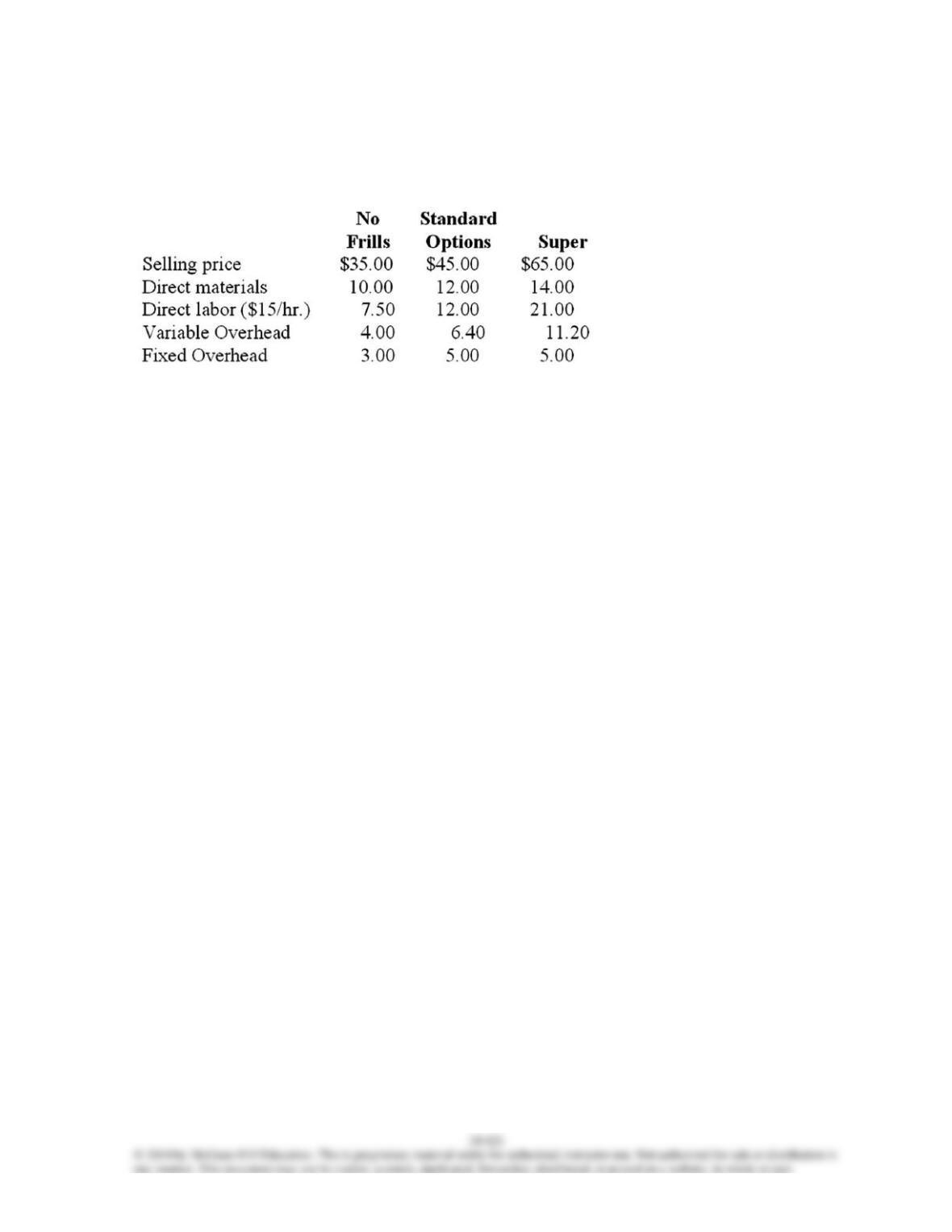
an opportunity to produce additional units of product with its excess capacity. Unit selling prices
and costs for three models of one of its product lines are as follows:
Variable overhead is charged to products on the basis of direct labor dollars, and fixed overhead is
charged to products on the basis of machine hours.
Required:
(1) If Joe Green Enterprises has excess machine capacity and can add more labor as needed
(neither machine capacity nor labor is a constraint), the excess production capacity should be
devoted to producing which product or products?
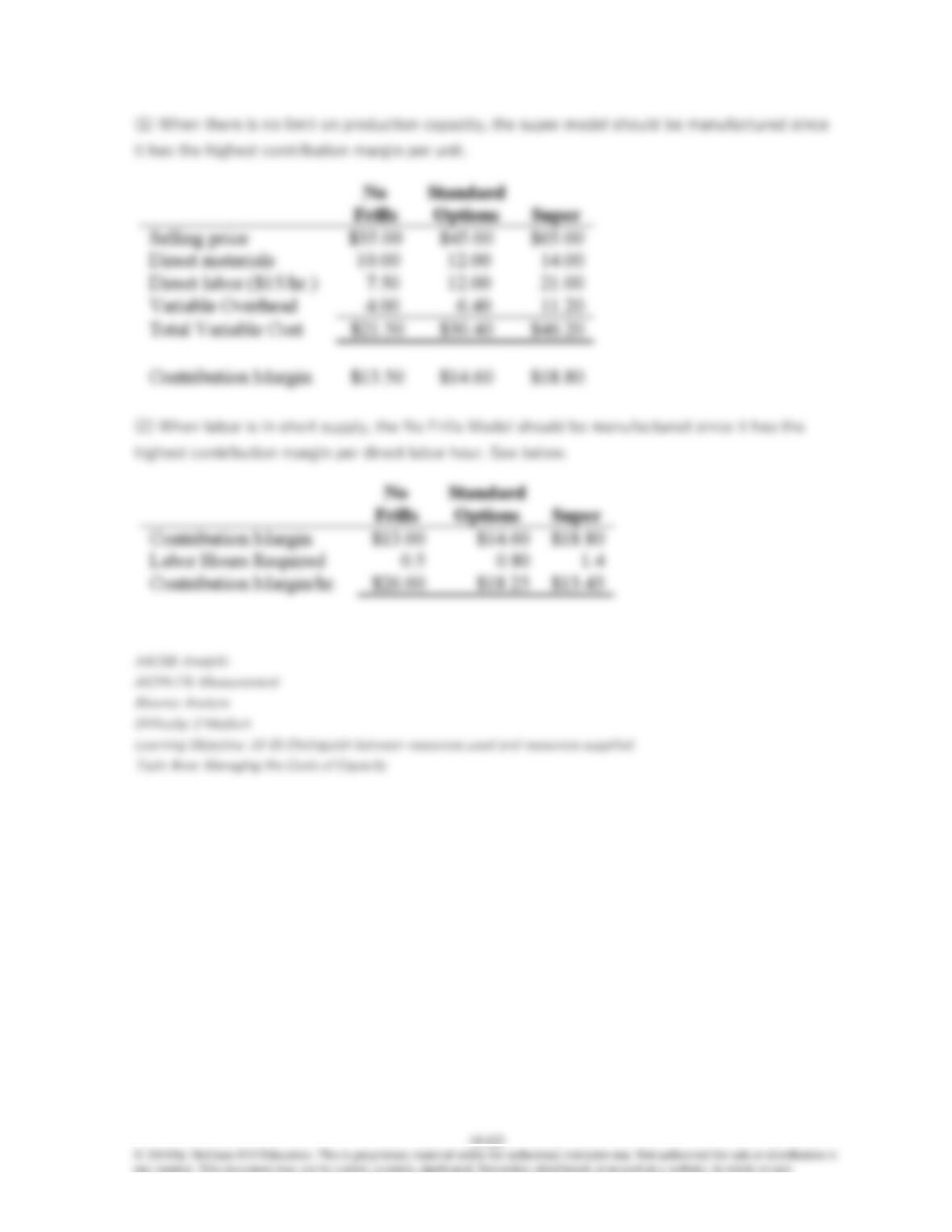
(2) If Joe Green Enterprises has excess machine capacity but a limited amount of labor time, the
production capacity should be devoted to producing which product or products?

10-123
132. Feel the Difference, Inc. manufactures bath and beauty products such as soaps, skin
creams, lotions, and other products primarily for people with dry and sensitive skin. It has just
introduced a new line of product that removes the spotting and wrinkling in skin associated with
aging. It sells these products in pharmacies and department stores at prices slightly higher than
those of other brands because of Feel the Difference’s excellent reputation for quality and
effectiveness.
Feel the Difference currently has very low utilization of plant capacity. Two years ago, in
anticipation of rapid growth, the company opened a new large manufacturing plant, which has yet
to be utilized more than 50 percent. Partly for this reason, Feel the Difference has sought new
partners and was able, with the help of financial analysts, to locate suitable business partners.
The first potential partner identified in this search was a large supermarket chain, All-Mart, which
is interested in the partnership because it wants Feel the Difference to manufacture an age cream
to sell in its stores. The product would be essentially the same as the Feel the Difference product
but would be packaged in the All-Mart brand name. The agreement would pay Feel the Difference
$2.00 per unit and would allow All-Mart a limited right to advertise the product as manufactured
for All-Mart by Feel the Difference. Feel the Difference’s CFO has made some calculations and
has determined that the direct materials, direct labor, and other variable costs needed for the All–
Mart order would be about $1.00 per unit as compared to the full cost of $2.50 (materials, labor,
and overhead) for the equivalent Feel the Difference product.
Required:
Should Feel the Difference accept the proposal from All-Mart? Why or why not? (Include strategic
considerations)
133. Quality costs can be divided into two categories: conformance and nonconformance.
Explain the difference between the two and give two examples of each.
134. Describe the four types of quality costs and give an example of each.
135. Describe the four steps that are taken in an activity analysis.
136. Explain the differences between
resources used
,
resources supplied
, and
unused resource
capacity
.
137. Explain the difference between
actual activity, theoretical capacity, practical capacity, and
normal activity
.
10-128
138. Cleary Yard Equipment Corporation manufactures lawn mowers and snow blowers. It also
manufactures engines that are used by the Lawn Mower Assembly Division (LMAD). The Engine
Division (ED) also sells about 40% of its output to the outside market (these are multipurpose
engines). Its annual capacity is 150,000 units and annual output is 135,000 units. All engines sold
internally to the LMAD are priced at cost plus 20% markup.
In January 2011, the Snow Blower Assembly Division (SBAD) approached the ED to ‘buy’ 20,000
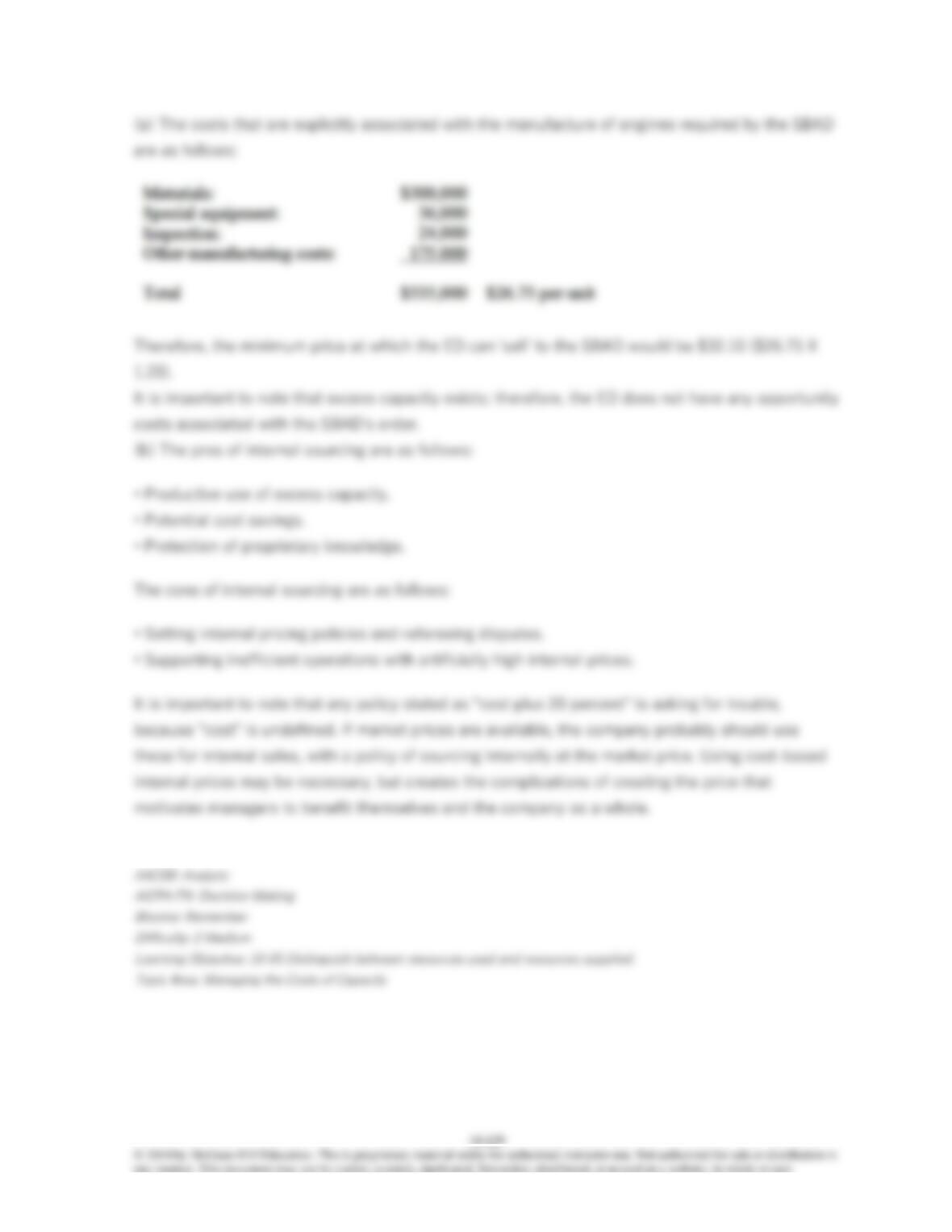
engines. Diane Holinger, the controller of ED, computed the costs of manufacturing these engines
as follows:
Holinger quoted a price of $66.60 for each engine transferred to the SBAD. John Hargreaves, the
manager of SBAD, was furious to note that the ED was “trying to make money off a sister
division.” He argued that the price must include only the cost of materials, as all other costs will
be incurred irrespective of whether or not SBAD places the order for 20,000 engines. Matt Hall,
the production manager of ED, pointed out that the special equipment will be purchased only for
fulfilling this internal order. Moreover, he argued that inspection must also be done just like on all
other engines; therefore, the inspection costs must also be included. Labor is paid a flat monthly
salary. Other manufacturing costs include both variable and fixed components (in roughly equal
proportion).
Required:
(a) Given that excess capacity exists, what is the minimum price that the ED must charge to the
SBAD?
(b) What are the pros and cons of internal sourcing?

10-130
139. Lyon Toys, Inc. (LTI) manufactures a variety of electronic toys for children aged 3 to 14
years. The company started as a Ma & Pa basement operation, and grew steadily over the last
nine years. It now employs over 100 people and has sales revenue of over $250 million. Katie
Burger, the CEO of LTI also recognizes that competition has increased during this period;
therefore, future growth will not be easy.
Burger recognizes that one of the areas of weakness is the accounting and costing system.
Burger’s maternal uncle, Martin, had maintained the accounts for the company. He meticulously
kept track of all the invoices that were received, payments made, and painstakingly prepared
crude annual reports. With Martin passing away at the age of 85, Burger decided to hire a
professional cost management expert to keep track of the company’s costs. She hired Molly
Wright, who had just completed her CMA.
After acquainting Wright with the company and its people, Burger decided to get down to
business. She called Wright to her office to have a serious conversation about accounting and
costing, in particular.
Burger: Molly, I would like you to pay particular attention to developing an official costing system.
Currently, we don’t have one. I believe this should be your first priority because competition is
rising and if we do not understand our costs, we might start losing business to our rivals.
Wright: I understand your point very well, Ms. Burger.
Burger: Call me Katie.
Wright: Very well, Katie. I have a few ideas that I picked up from my CMA courses that I think are
worth implementing. However, it looks like we need to start with the basics.
Required:
Assume the role of Molly Wright. Write a brief report outlining the basics of a cost management
information system. Include in your report the following:
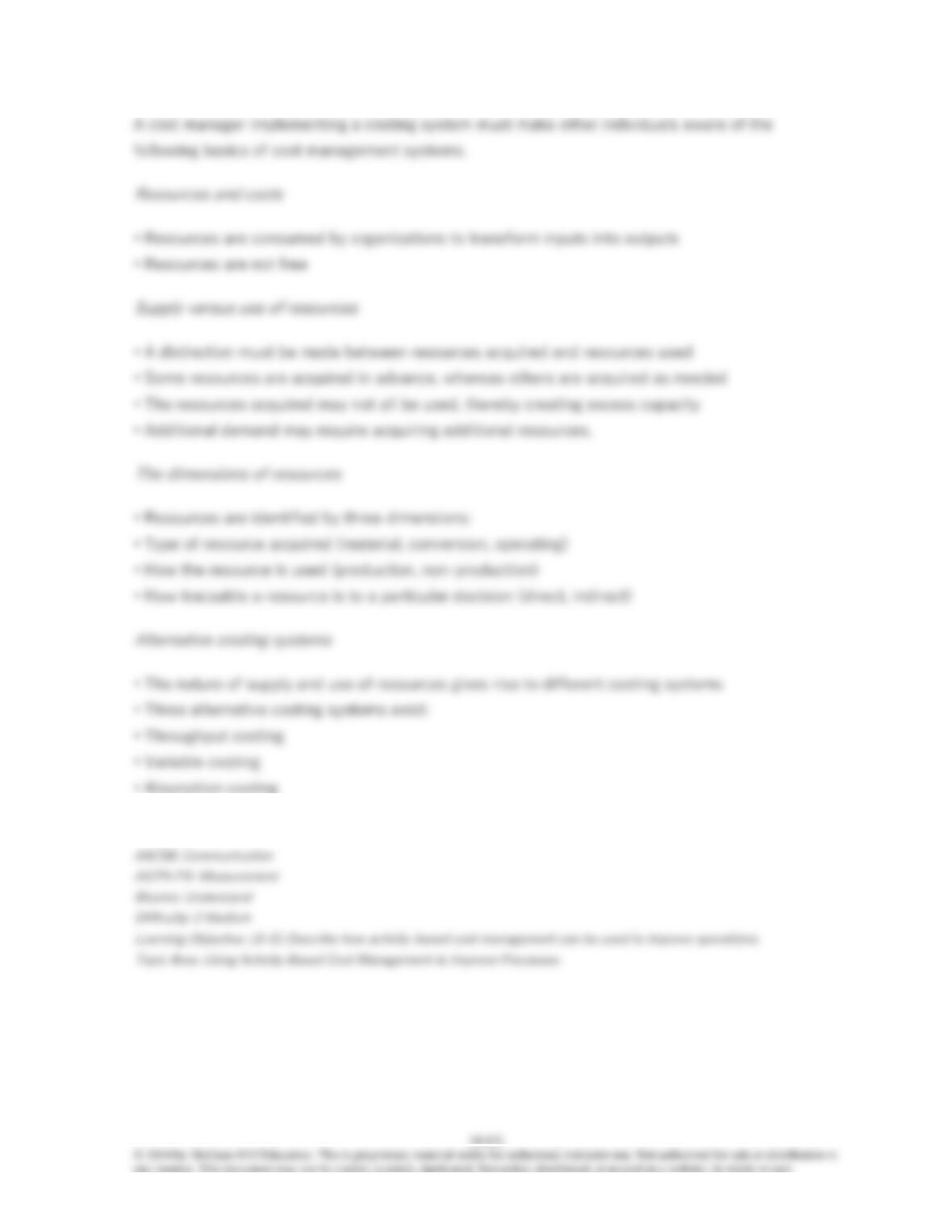
• Resources and costs
• Supply of resources vs. the use of resources
• Classification of costs (three dimensions of resources)
• Alternative costing systems
10-132
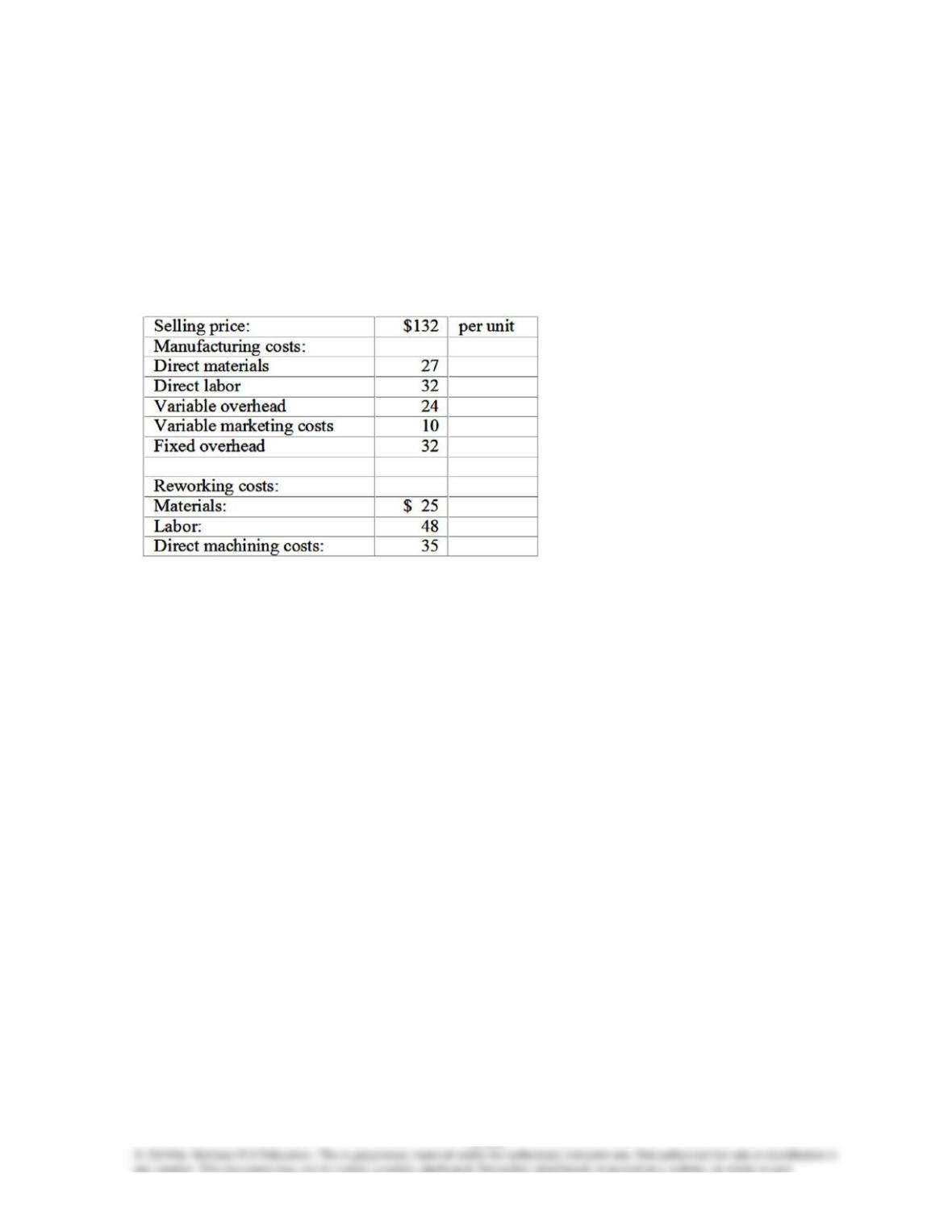
140. Julie King, the production manager of Mussell Corporation is frustrated by the company’s
policy of not scrapping defective units but reworking them. She has pointed out several times to
senior management that some units are beyond rework and should be scrapped. According to her,
in most cases, it would be cheaper to scrap and build a new unit from scratch rather than trying to
rework a defective unit. However, Paul Oasis, the CEO, is not convinced. He wants his controller,
Mandie Castagna, to gather some information.
After researching the problem, Castagna provides the following information:
Castagna also observes that reworking a defective product consumes more labor time than
making a unit from scratch. As a result, for every three units reworked, Mussell forgoes the
production and sale of two units.
Required:
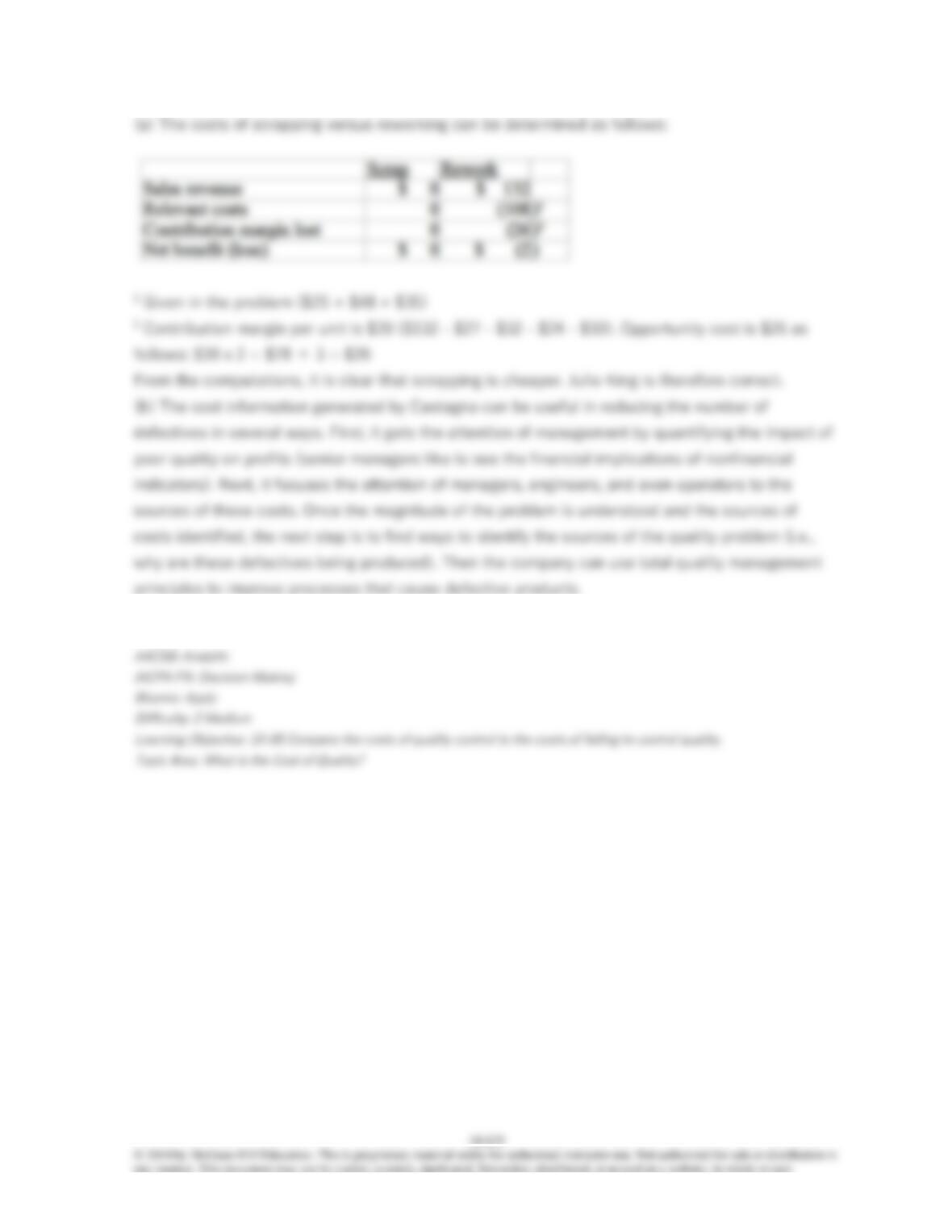
(a) Do you agree with Julie King that it is cheaper to scrap than rework a defective unit? Show
your computations.
(b) How can the cost information generated by Castagna be useful in reducing the number of
defectives?

10-134
141. Laurie Riley is a purchasing agent for a motorcycle manufacturer. Laurie is evaluating two
potential suppliers of seats for the company’s motercycles. One supplier (A) quotes a price of
$165 per seat and assures 100% quality and delivery standards. The second supplier (B) quotes a
price of $135 per seat but does not give any written assurances on quality or delivery. Riley is not
sure which supplier should be awarded the contract.
Assume you are the management accountant for the motorcycle manufacturer. Riley asks you to
prepare an estimate of the related costs of buying the seats from supplier B. She tells you that the
estimate is needed because unless dollar estimates are attached to nonfinancial factors, such as
lost production costs, her supervisor will not give it full attention. Riley provides you with the
following information:
• Production output is 2,000 motorcycles per year based on 250 production days a year.
• Production time per day is 8 hours at a cost of $4,000 per hour to run the production line.
• Lost production time due to poor quality is 1%.
• Satisfied customers purchase, on average, three motorcycles during a lifetime.
• Satisfied customers recommend the product, on average, to 5 other people.
• Marketing estimates that using the seat from supplier B will result in 5 lost customers per year
from repeat business and referrals.
• Average contribution margin per motorcycle is $5,000.
Required:
Estimate the costs of buying motorcycle seats from supplier B. (
Note:
This problem requires you
to think creatively and make reasonable estimates; therefore, there is more than one correct
answer.)