117
136) Franklin Industrial Equipment Corporation manufactures lawn mowers and snow blowers.
It also manufactures engines that are used by the Lawn Mower Assembly Division (LMAD). The
Engine Division (ED) also sells about 40% of its output to the outside market (these are
multipurpose engines). Its annual capacity is 150,000 units and annual output is 135,000 units.
All engines sold internally to the LMAD are priced at cost plus 20% markup.
In January 2020, the Snow Blower Assembly Division (SBAD) approached the ED to ‘buy’
20,000 engines. Jean Wyse, the controller of ED, computed the costs of manufacturing these
engines as follows:
Total Per unit
Materials $ 300,000 $ 15.00
Labor 400,000 20.00
Special equipment 36,000 1.80
Quality inspection 24,000 1.20
Other manufacturing costs 350,000 17.50
Total costs $ 1,110,000 $ 55.50
Wyse quoted a price of $66.60 for each engine transferred to the SBAD. Jeb Hart, the manager
of SBAD, was furious to note that the ED was “trying to make money off a sister division.” He
argued that the price must include only the cost of materials, as all other costs will be incurred
irrespective of whether or not SBAD places the order for 20,000 engines. Mark Matley, the
production manager of ED, pointed out that the special equipment will be purchased only for
fulfilling this internal order. Moreover, he argued that inspection must also be done just like on
all other engines; therefore, the inspection costs must also be included. Labor is paid a flat
monthly salary. Other manufacturing costs include both variable and fixed components (in
roughly equal proportion).
Required:
(a) Given that excess capacity exists, what is the minimum price that the ED should charge to the
SBAD?
(b) What are the pros and cons of internal sourcing?
137) Quality costs can be divided into two categories: conformance and nonconformance.
Explain the difference between the two and give two examples of each.
138) Describe the four types of quality costs and give an example of each.
139) Explain the difference between actual activity, theoretical capacity, practical capacity, and
normal activity.
121
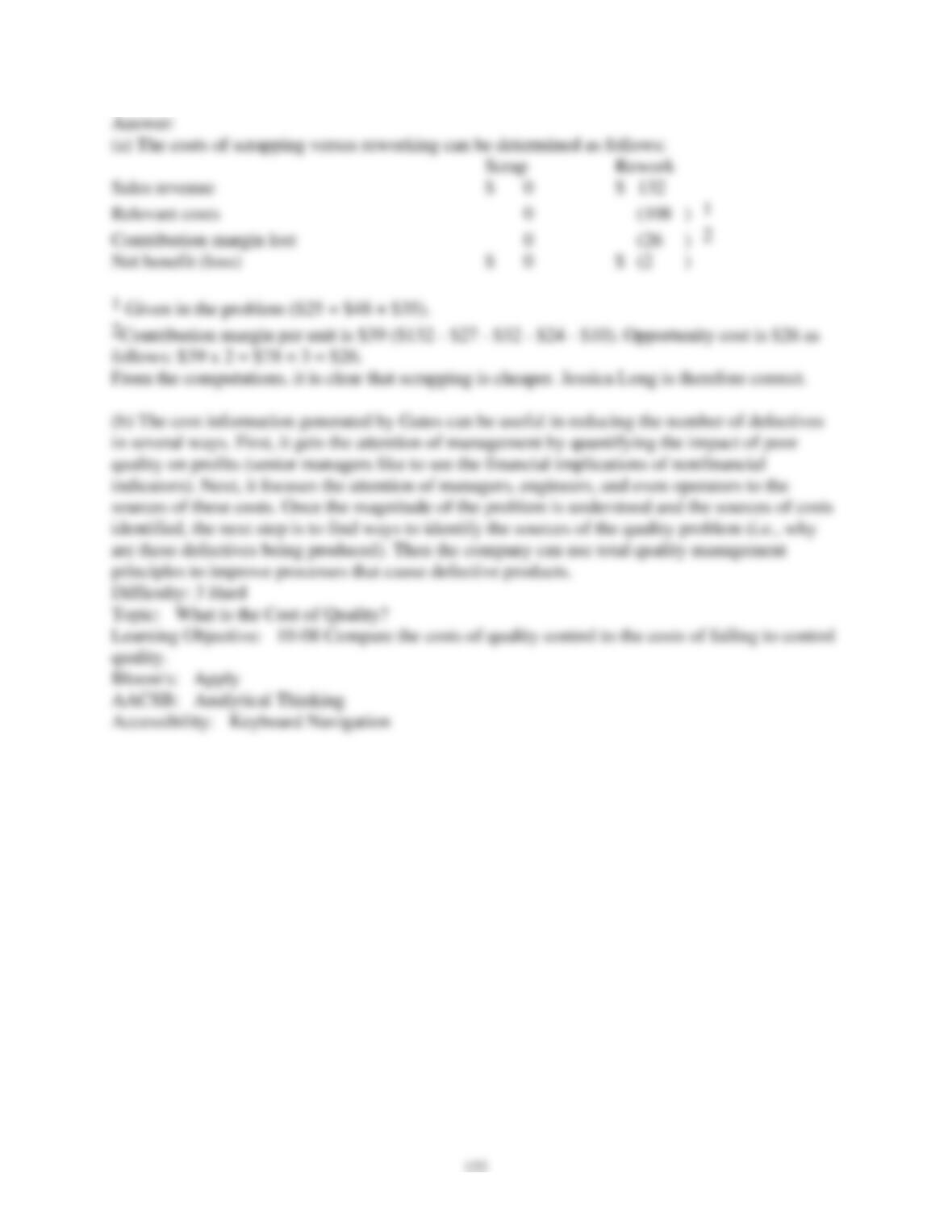
140) Jessica Long, the production manager of Maxim Corporation is frustrated by the company’s
policy of not scrapping defective units but reworking them. She has pointed out several times to
senior management that some units are beyond rework and should be scrapped. According to her,
in most cases, it would be cheaper to scrap and build a new unit from scratch rather than trying to
rework a defective unit. However, Peter Crouch, the CEO, is not convinced. He wants his
controller, Melinda Gates, to gather some information.
After researching the problem, Gates provides the following information:
Selling price: $ 132 per unit
Manufacturing costs:
Direct materials 27
Direct labor 32
Variable overhead 24
Variable marketing costs 10
Fixed overhead 32
Reworking costs:
Materials $ 25
Labor 48
Direct machining costs 35
Gates also observes that reworking a defective product consumes more labor time than making a
unit from scratch. As a result, for every three units reworked, Maxim forgoes the production and
sale of two units.
Required:
(a) Do you agree with Jessica Long that it is cheaper to scrap than rework a defective unit? Show
your computations.
(b) How can the cost information generated by Gates be useful in reducing the number of
defectives?
123
141) Stella McDonald is a purchasing agent for a motorcycle manufacturer. Stella is evaluating
two potential suppliers of seats for the company’s motorcycles. One supplier (A) quotes a price
of $165 per seat and assures 100% quality and delivery standards. The second supplier (B)
quotes a price of $135 per seat but does not give any written assurances on quality or delivery.
McDonald is not sure which supplier should be awarded the contract.
Assume you are the management accountant for the motorcycle manufacturer. McDonald asks
you to prepare an estimate of the related costs of buying the seats from supplier B. She tells you
that the estimate is needed because unless dollar estimates are attached to nonfinancial factors,
such as lost production costs, her supervisor will not give it full attention. McDonald provides
you with the following information:
∙ Production output is 2,000 motorcycles per year based on 250 production days a year.
∙ Production time per day is 8 hours at a cost of $4,000 per hour to run the production line.
∙ Lost production time due to poor quality is 1%.
∙ Satisfied customers purchase, on average, three motorcycles during a lifetime.
∙ Satisfied customers recommend the product, on average, to 5 other people.
∙ Marketing estimates that using the seat from supplier B will result in 5 lost customers per year
from repeat business and referrals.
∙ Average contribution margin per motorcycle is $5,000.
Required:
Estimate the costs of buying motorcycle seats from supplier B. (Note: This problem requires you
to think creatively and make reasonable estimates; therefore, there is more than one correct
answer.)
125
142) Thompson Metal Corporation (TMC) supplies various types of machine tools to
manufacturing companies. TMC has always paid a lot of attention to the quality of its products.
Recently, an outside supplier has approached TMC to supply an important and intricate
component of one of its more advanced tools that TMC has been manufacturing in-house. Sam
Weiss, a junior accountant at TMC, has collected the following information regarding this
proposal.
The cost of manufacturing one unit of this component internally are as follows:
Direct materials: $ 29.60
Direct labor: 13.00
Variable overhead: 19.50 (@150% of direct labor cost)
Fixed overhead: 26.00 (@200% of direct labor cost)
Total cost: $ 88.10
The outside supplier has quoted a price of $90 per unit for supplying this component. The
following is a conversation that took place among the manufacturing manager (Dana Rice),
buyer (Emily Scanlon), and Sam Weiss.
Weiss: I think that we should continue to manufacture internally because we can save $1.90 per
unit on this component.
Rice: According to your report, we would save $1.90 per unit, but I do not agree with those
numbers.
Weiss: What do you mean? I have followed the same costing guidelines this company has used
for years. I have even cross-checked my numbers with historical data and know for sure that the
overhead rates which I have used are correct.
Rice: I am sure you have done your job thoroughly, but I think that our costing system is archaic.
This component is complex and difficult to manufacture. I believe that our overhead allocation
method does not accurately capture the production difficulties and the additional resources that
are devoted to the manufacture of this component. For example, a significant portion of our
quality problems are due to this component. We spend close to a third of our quality inspection
time on just this component alone, but that is not reflected. These quality problems cause delays
in getting this component to the assembly department, and that causes a delay in getting the final
product to the customers. Many of our customers are expecting just-in-time deliveries, and they
get upset when we’re late.
Scanlon: I know that the supplier that has approached us has a strong reputation for quality.
Therefore, we can rest assured that we will have negligible quality problems.
Rice: Sam, your report does not consider this additional benefit from buying outside. I would
appreciate if you can rework your numbers to better reflect the true costs associated with
manufacturing this component internally.
126
Required:
(a) Assume the role of Sam Weiss. What are the different elements of costs that are likely to be
associated with the manufacture of the component? Does the current costing system capture
these costs?
(b) Recommend improvements in the costing system.
(c) How can Weiss quantify “qualitative” benefits such as quality and on-time delivery?
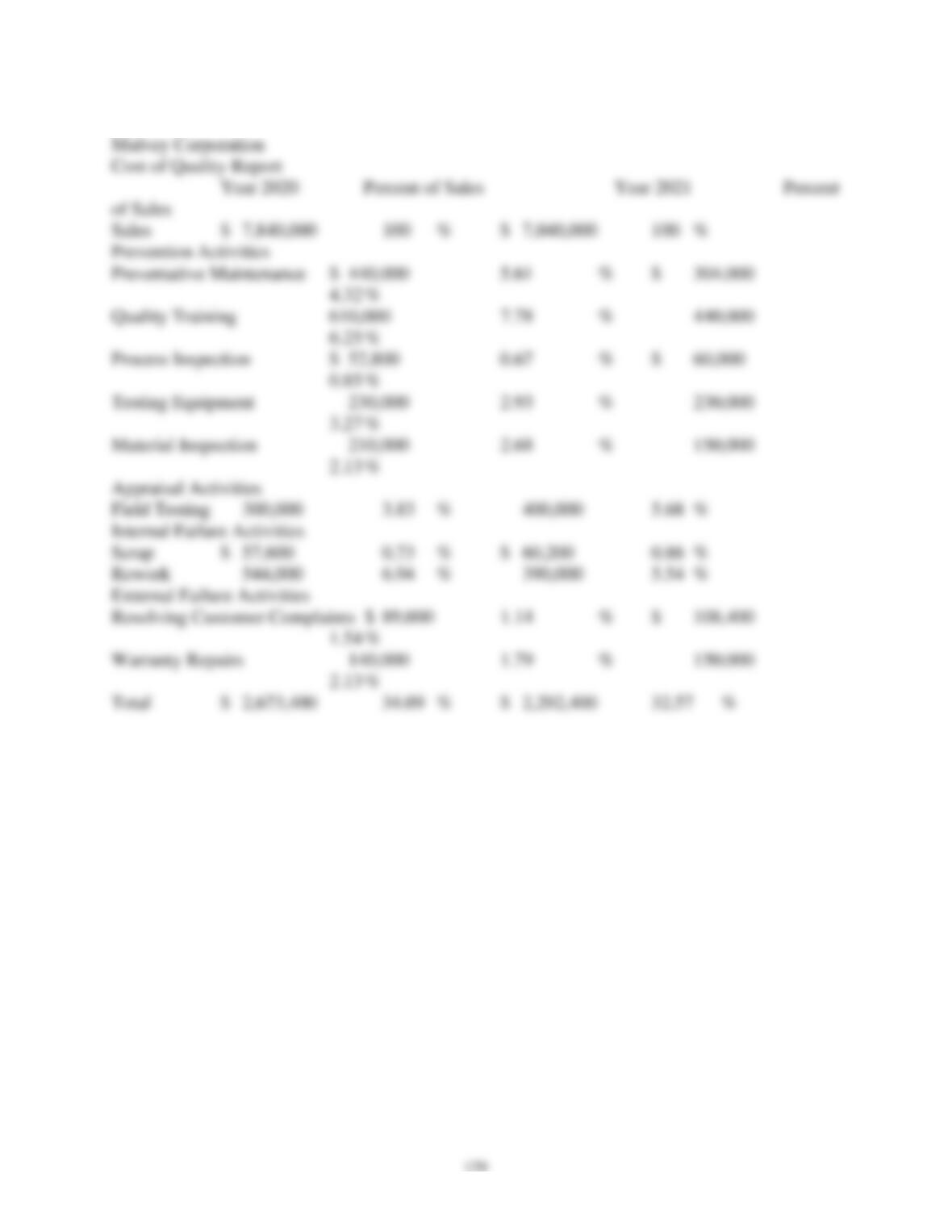
143) Mulvey Corporation manufactures large kitchen appliances. The following represents
financial information for two years:
2020 2021
Sales $ 7,840,000 $ 7,040,000
Costs:
Process Inspection 52,800 60,000
Scrap 57,600 60,200
Quality Training 610,000 440,000
Warranty Repairs 140,000 150,000
Testing Equipment 230,000 230,000
Resolving Customer Complaints 89,000 108,400
Rework 544,000 390,000
Preventative Maintenance 440,000 304,000
Material Inspection 210,000 150,000
Field Testing 300,000 400,000
Total costs $ 2,673,400 $ 2,292,600
Required:
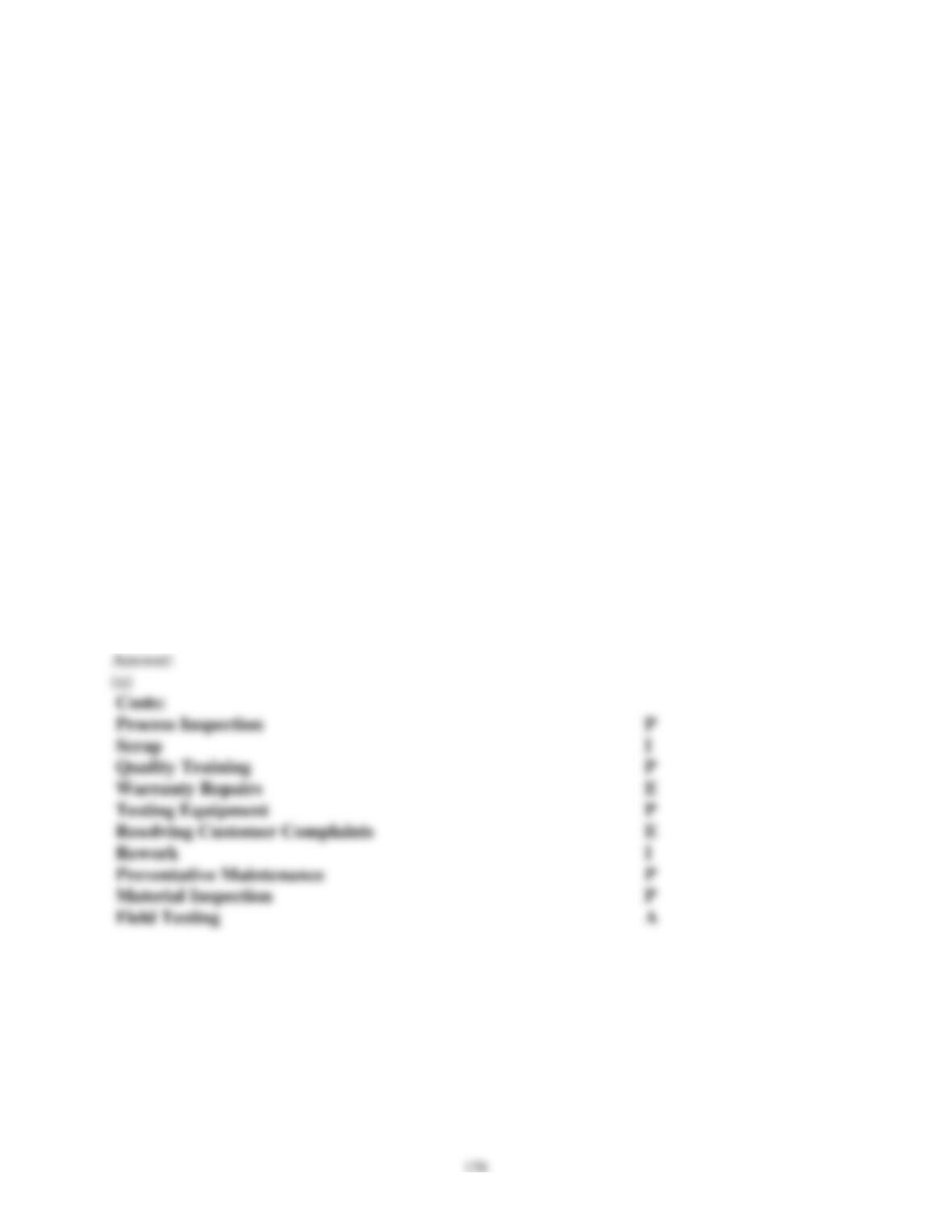
(a) Classify these cost items as prevention (P), appraisal (A), internal failure (I) or external
failure (E) activities.
(b) Calculate the ratio of prevention, appraisal, internal failure, and external failure costs to sales
for 2020 and 2021.
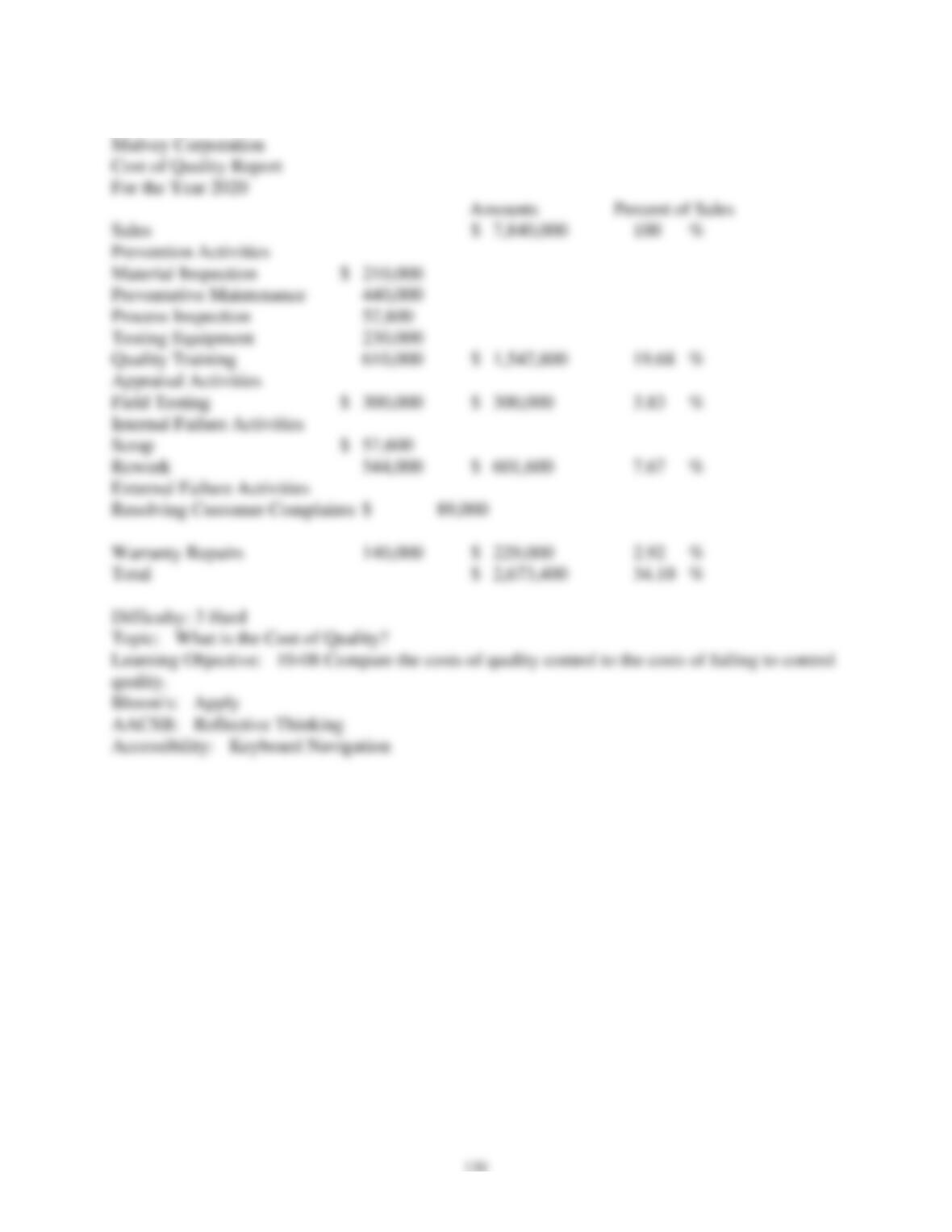
(c) Prepare a cost of quality report for 2020.
(b)
(c)
131
144) Scranton Extruded Plastics is a company involved in the injection molding process of
plastic extruders. The company had a process of inspection, checking line work, and handling
returns from customers to identify and correct quality problems. Scrapped extruders are ground
into powder and fed back to the extruders as raw material; thus, all scrapped extruders are reused
at some point. The company’s cost accounting system indicates that the cost of scrap is “zero,” a
view also held by Scranton’s management. (Source: “Activity Based management” by Peter B. B.
Turney published in Management Accounting)
Required:
a) Comment on the view that scrap costs is zero at Scranton Extruded Plastics.
b) Identify internal and external failure activities that were required by Scranton.
c) Identify prevention and appraisal activities that could have been employed.