102
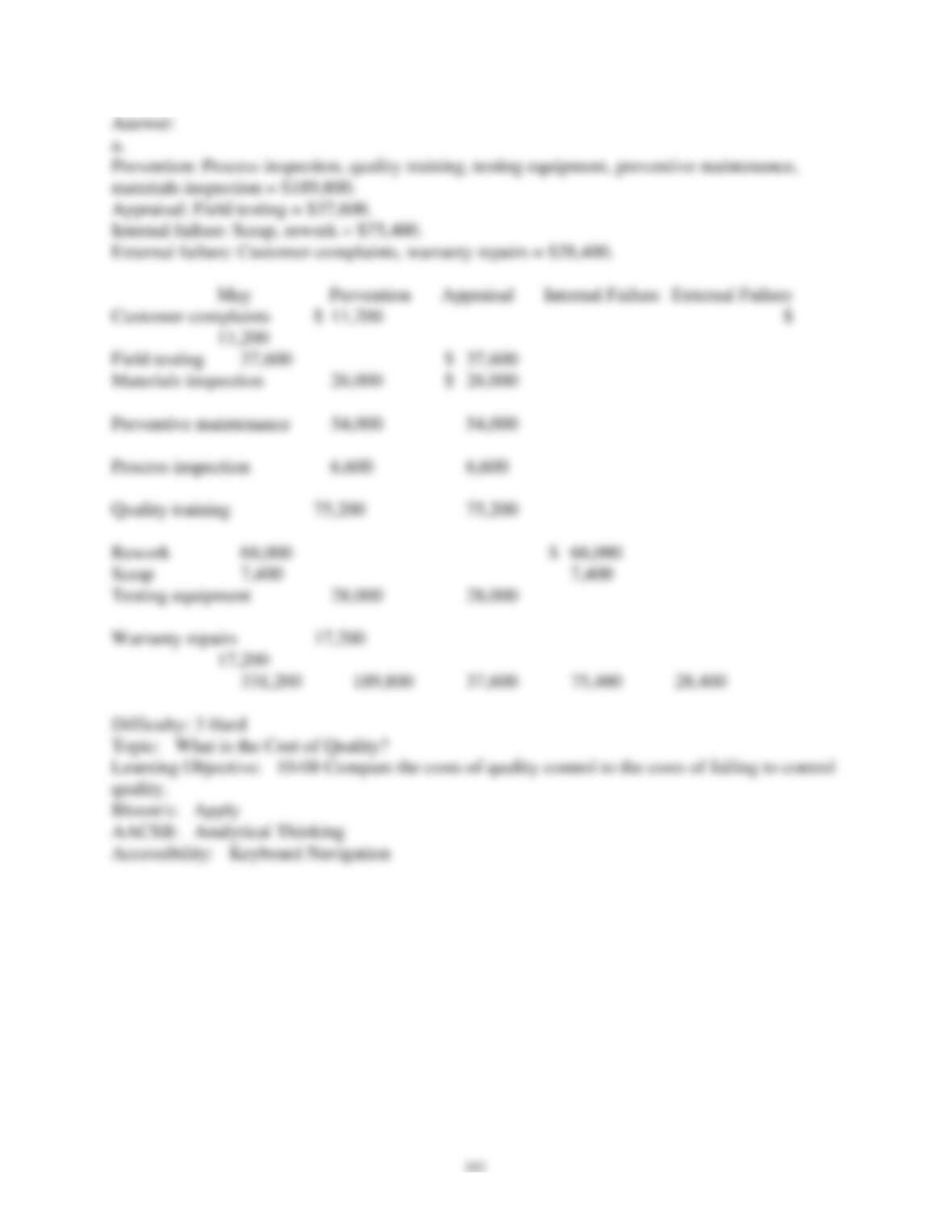
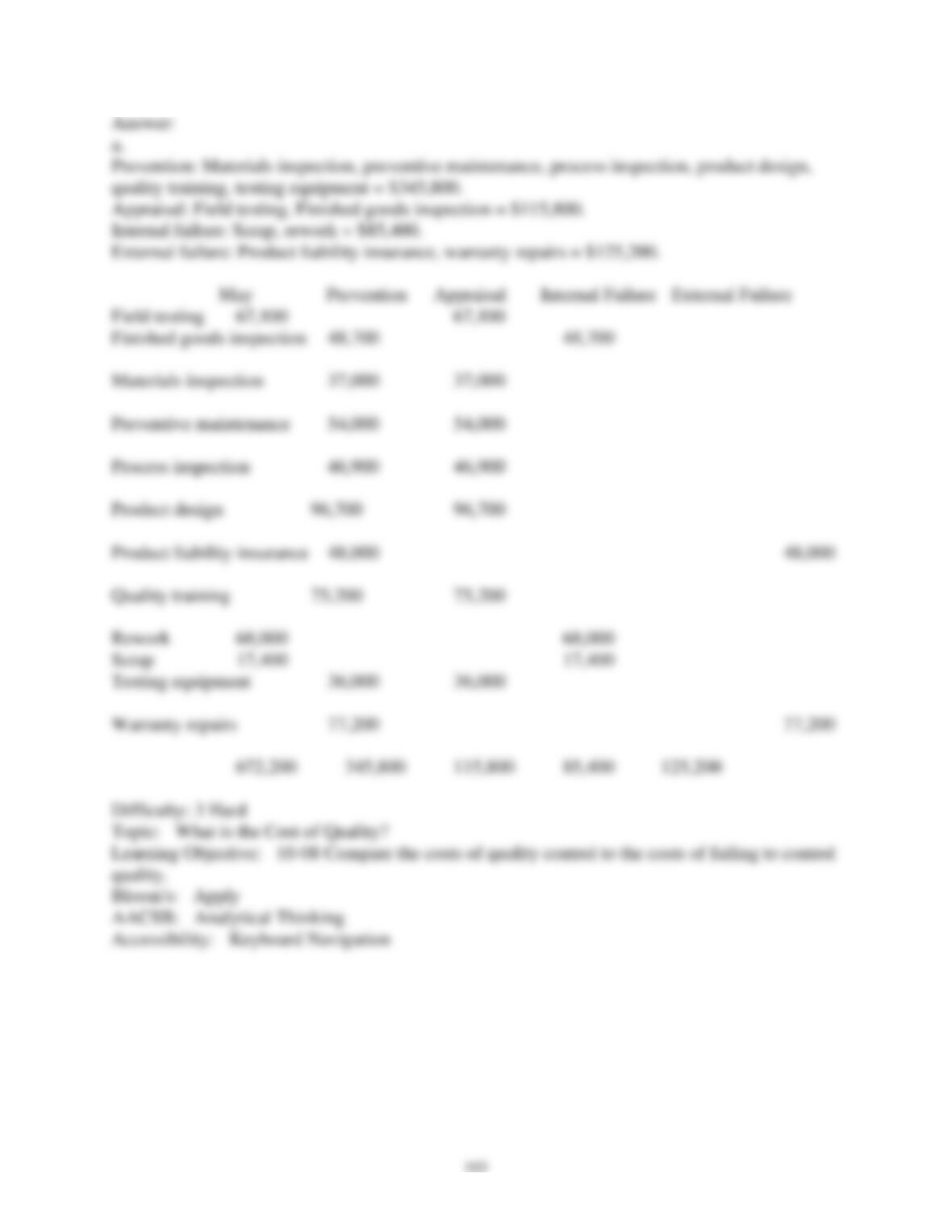
124) The following represents quality cost data for Monnett Corporation:
Field testing $ 67,100
Finished goods inspection 48,700
Materials inspection 37,000
Preventive maintenance 54,000
Process inspection 46,900
Product design 96,700
Product liability insurance 48,000
Quality training 75,200
Rework 68,000
Scrap 17,400
Testing equipment 36,000
Warranty repairs 77,200
Required:
a. Classify these items into prevention, appraisal, internal failure, or external failure costs and
determine the total cost of each category.
104
125) Fine Grape produces premium wine. Its success in the industry is due to its quality,
although all of its customers, wine shops and specialty grocery stores, are very cost conscious
and negotiate for price cuts on all large orders. Noting that the wine industry is becoming
increasingly competitive, Fine Grape is looking for a way to meet the challenge. It is negotiating
with Culinary Delights, a regional specialty grocery store, to purchase a large order of wine. Fine
Grape is currently producing under-capacity and would like to keep its production facilities,
gaining better economies of scale by increasing production. Culinary Delights has agreed to a
large order but only at a price of $39 per bottle. The special order can be produced in one batch
with available capacity. Fine Grape has prepared the following data related to next month’s
operations (per unit, for 10,000 bottles, made in 10 batches of 1,000 each)
Sales price $ 55
Per unit costs
Variable manufacturing costs 22
Batch-related costs 5
Variable marketing costs 10
Fixed manufacturing costs 6
Fixed marketing costs 2
Special order information (order is produced in one batch)
Sales units 2,000
Sales price per bottle $ 39
No variable marketing costs are associated with this order, but Fine Grape has spent $2,500
during the past two months trying to get Culinary Delights to place the special order.
Required:
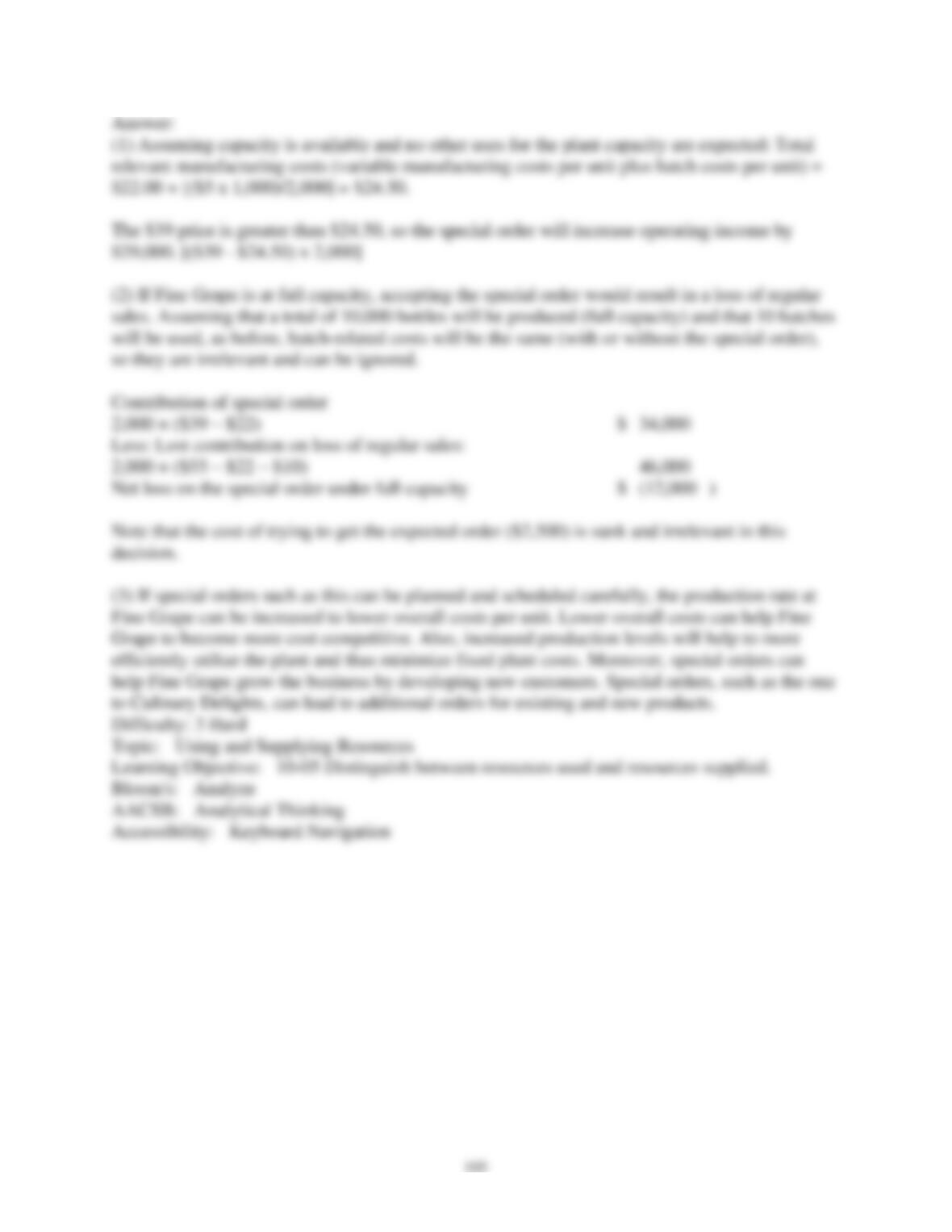
(1) How much will the special order change Fine Grape’s total operating income?
(2) How much would the special order change Fine Grape’s total operating income if fine Grape
is operating at full capacity and would lose the sale of the 2,000 bottles to regular customers?
(3) How might the special order fit into Fine Grape’s competitive strategy?
106
126) Joseph Hutton Enterprises has met all production requirements for the current month and
has an opportunity to produce additional units of product with its excess capacity. Unit selling
prices and costs for three models of one of its product lines are as follows:
No Frills Standard Options Super
Selling price $ 35.00 $ 45.00 $ 65.00
Direct materials 10.00 12.00 14.00
Direct labor ($15/hr.) 7.50 12.00 21.00
Variable Overhead 4.00 6.40 11.20
Fixed Overhead 3.00 5.00 5.00
Variable overhead is charged to products on the basis of direct labor dollars, and fixed overhead
is charged to products on the basis of machine hours.
Required:
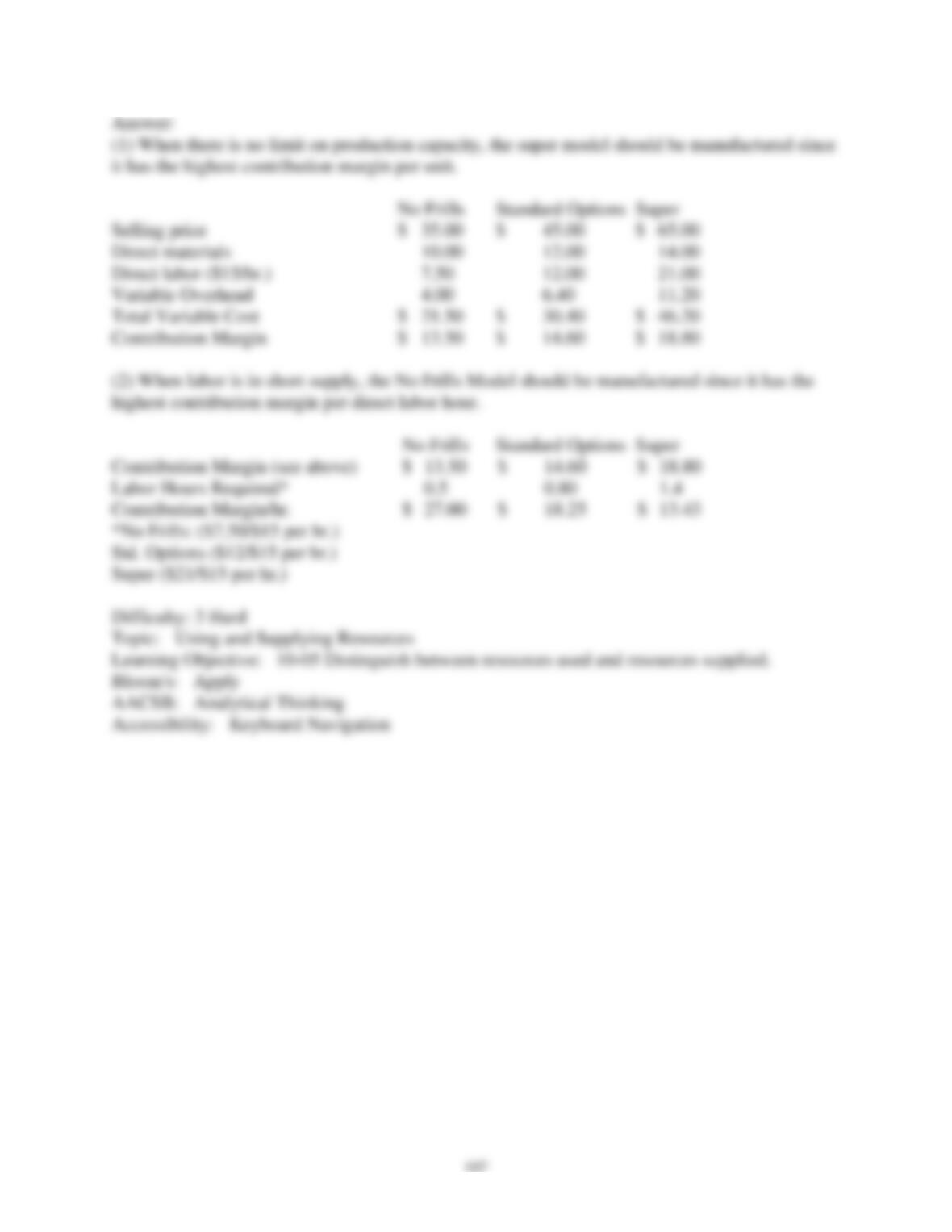
(1) If Joseph Hutton Enterprises has excess machine capacity and can add more labor as needed
(neither machine capacity nor labor is a constraint), the excess production capacity should be
devoted to producing which product or products?
(2) If Joseph Hutton Enterprises has excess machine capacity but a limited amount of labor time,
the production capacity should be devoted to producing which product or products?
127) Smooth, Inc. manufactures bath and beauty products such as soaps, skin creams, lotions,
and other products primarily for people with dry and sensitive skin. It has just introduced a new
line of product that removes the spotting and wrinkling in skin associated with aging. It sells
these products in pharmacies and department stores at prices slightly higher than those of other
brands because of Smooth’s excellent reputation for quality and effectiveness.
Smooth currently has very low utilization of plant capacity. Two years ago, in anticipation of
rapid growth, the company opened a new large manufacturing plant, which has yet to be utilized
more than 50 percent. Partly for this reason, Smooth has sought new partners and was able, with
the help of financial analysts, to locate suitable business partners. The first potential partner
identified in this search was a large supermarket chain, Price-Mart, which is interested in the
partnership because it wants Smooth to manufacture an age cream to sell in its stores. The
product would be essentially the same as the Smooth product but would be packaged in the
Price-Mart brand name. The agreement would pay Smooth $2.00 per unit and would allow Price-
Mart a limited right to advertise the product as manufactured for Price-Mart by Smooth.
Smooth’s CFO has made some calculations and has determined that the direct materials, direct
labor, and other variable costs needed for the Price-Mart order would be about $1.00 per unit as
compared to the full cost of $2.50 (materials, labor, and overhead) for the equivalent Smooth
product.
Required:
Should Smooth Inc. accept the proposal from Price-Mart? Why or why not? (Include strategic
considerations)
128) Stonehouse Corporation developed the following information regarding quality for the first
quarter of the year 2020:
Sales $ 6,800,000
Wasted time 285,600
Training 102,000
Inspecting finished goods 340,000
Performance reviews 85,000
Resolving customer complaints 38,760
Certifying suppliers 170,000
Total $ 1,021,360
Required:
Prepare a cost of quality report sorting costs by quality activity and expressing in relevant
percentage terms.
129) Identify each of the following as Prevention Activities (P), Appraisal Activities (A),
Internal Failure Activities (I) or External Failure Activities (E):
(1) Field Testing
(2) Statistical process control
(3) Sampling at the end of process
(4) Disposing of scrap
(5) Quality evaluations
(6) Retesting
(7) Settling product liability
(8) Resolving customer complaints
(9) Lost sales
(10) Restoring reputation
130) For each of the following products or services, indicate the most important customer quality
attributes and the most important customer quality tradeoffs.
(a) Personal computer
(b) Legal representation in divorce court
(c) New home purchase
(d) Meals in a fast food restaurant
(e) Airline travel
(f) Prom dress
(g) Cruise ship vacation
(h) Auto repair
131) Describe the six steps that are taken in an activity analysis.
113
132) Companies are continuously seeking ways to improve the quality of production and reduce
costs. One of the areas is to work with suppliers to improve the quality and reliability of parts
and products shipped. In an article entitled “In Defense of Activity-Based Cost Management,”
Robert S. Kaplan says:
An ABC model can play a major role in improving supplier relationships as well. These
relationships must be a vital part of any quality and cycle-time improvement program. A key
insight is to use ABC to distinguish between low-price and low-cost suppliers. Traditional cost
accounting, with its emphasis on purchase price variances, encourages purchasing people to
continually scan the population of potential suppliers to obtain low price quotations. Most
companies have learned, the hard way, that many of their low-price suppliers are actually
extremely high-cost suppliers. (Source: Management Accounting: November, 1992)
Required:
(a) Explain what Kaplan means by “many of their low-price suppliers are actually extremely
high-cost suppliers.”
(b) What general prevention and appraisal activities can be used to improve the quality and
reliability of parts and products shipped from suppliers?
133) What is the relationship between customer profitability analysis and ABC?
115
134) Cost allocation bases are factors that cost management analysts use to assign indirect costs
to cost objects. Ideally, cost-allocation bases should reflect a cause-and-effect relationship
between resource spending and use. Ideally, an Activity-Based Costing (ABC) approach will
provide a more accurate and useful accounting for an organization’s resources. Recent studies
have found that, in spite of increasing costs and diminishing resources, very few Higher
Education Institutions use the tools and techniques of an ABC cost allocation system to assign
costs to academic departments. While direct costs, such as faculty salaries, are traceable to
individual academic departments or courses, many indirect costs, such as facility use, computer
use, and student support services, are more difficult to assign. In a traditional approach, many
higher education institutions assign such costs based on a single factor, such as the number of
courses taught in the university. (Source: Activity-Based Costing for Higher Education
Institutions, Management Accounting Quarterly, Winter, 2001)
Required:
(a) Explain why the use of a single-cost driver such as the number of courses may result in
inaccurate management information as to the cost of offering courses in individual academic
departments.
(b) For each of the indirect costs listed below, identify an appropriate cost-driver that might be
used to allocate costs to determine the cost of offering a single course in an academic department
if an Activity-Based-Costing model were used.
∙ Computer use
∙ Facility use
∙ Student services
∙ Course design
∙ Lecturing/class meeting time
∙ Assignment grading
135) Explain the differences between resources used, resources supplied, and unused resource
capacity.