82
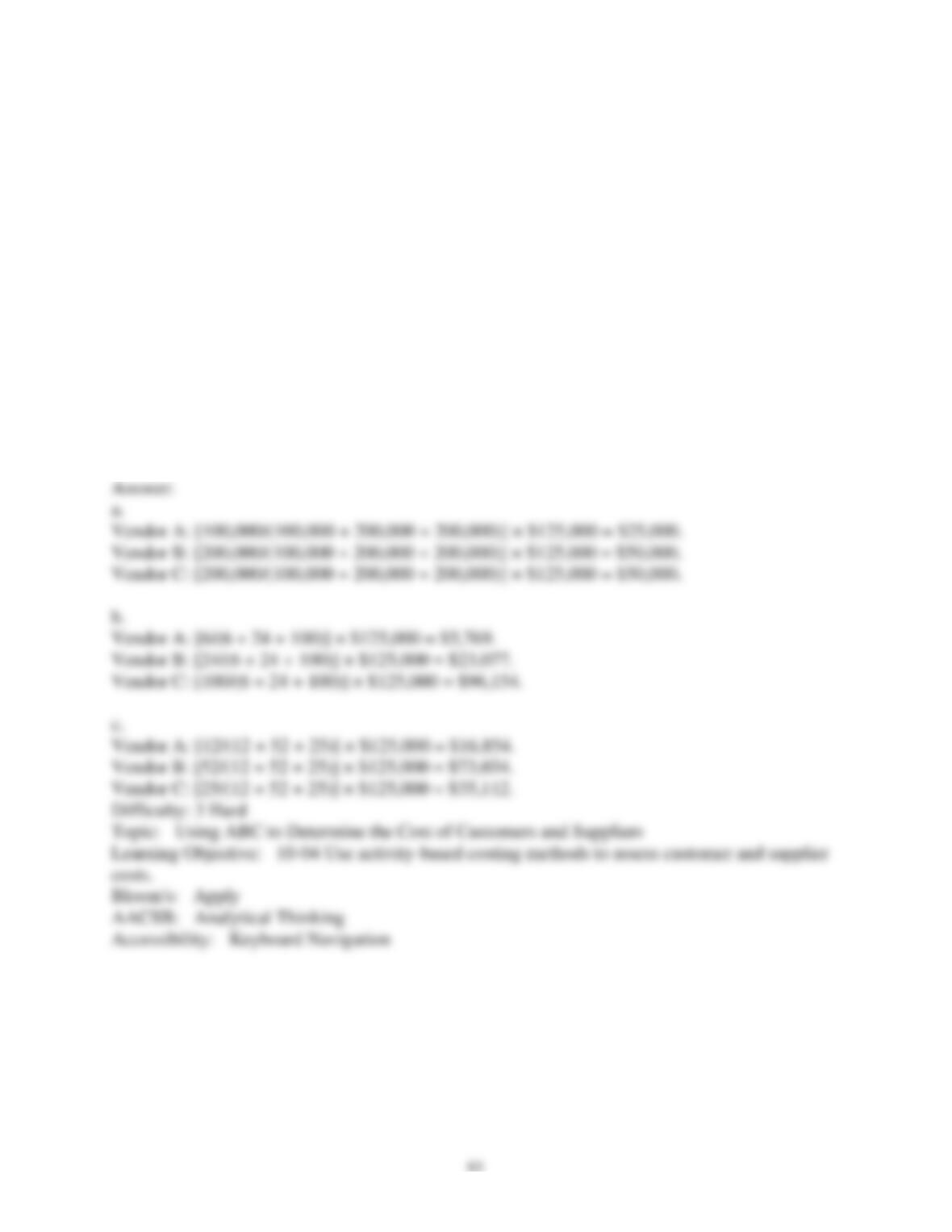
111) Mobile Repair Company is preparing its annual profit plan. As part of its analysis of the
cost of its purchasing activity, management estimates that the $125,000 for purchasing support
should be assigned to the individual vendors from the information given as follows:
Vendor A Vendor B Vendor C
Units purchased 100,000 200,000 200,000
Purchase orders (annual) 6 24 100
Number of shipments received 12 52 25
Required:
a. Allocate the purchasing costs to the three vendors, assuming Mobile Repair uses units
purchased to compute activity-based costs.
b. Allocate the purchasing costs to the three vendors, assuming Mobile Repair uses purchases
orders to compute activity-based costs.
c. Allocate the purchasing costs to the three vendors, assuming Mobile Repair uses number of
shipments to compute activity-based costs.
84
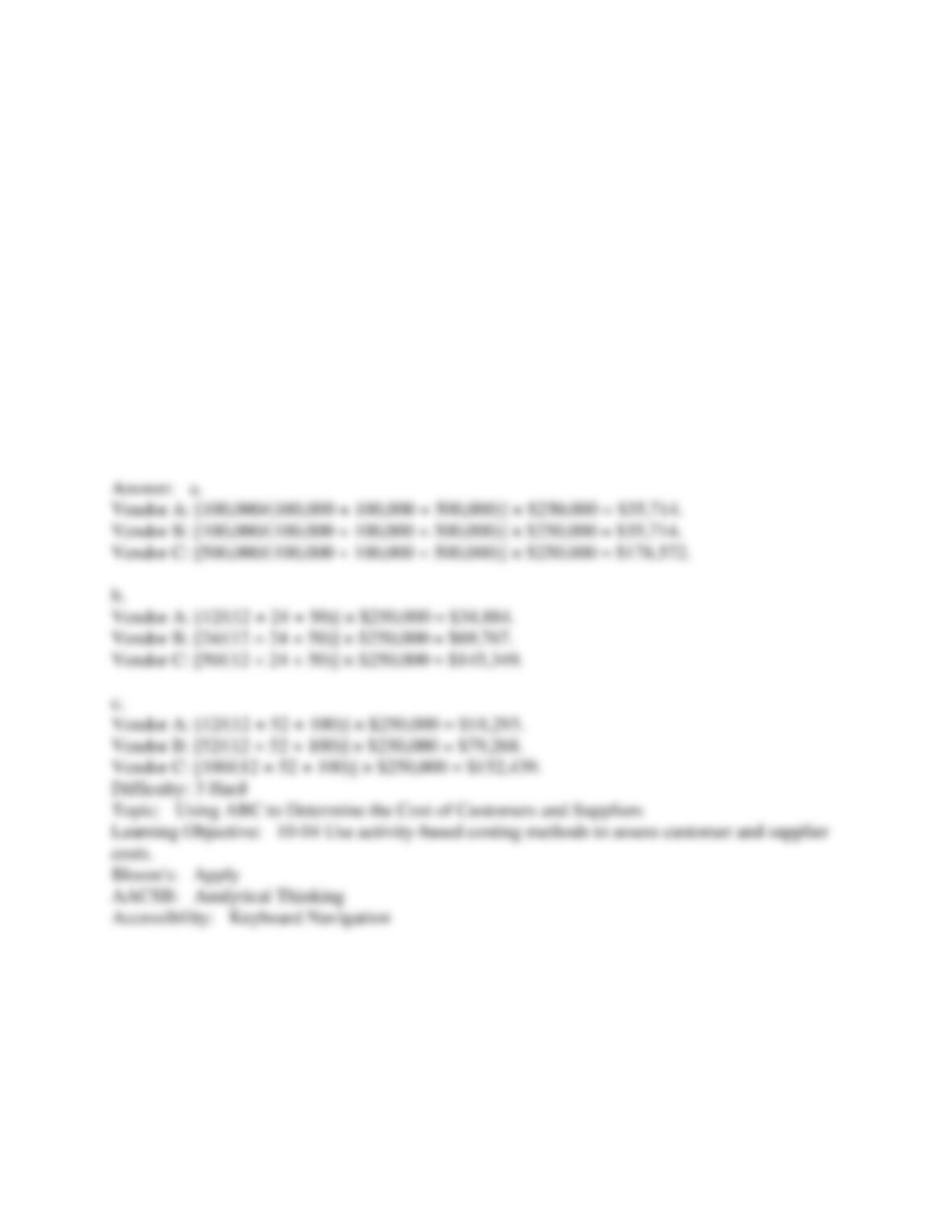
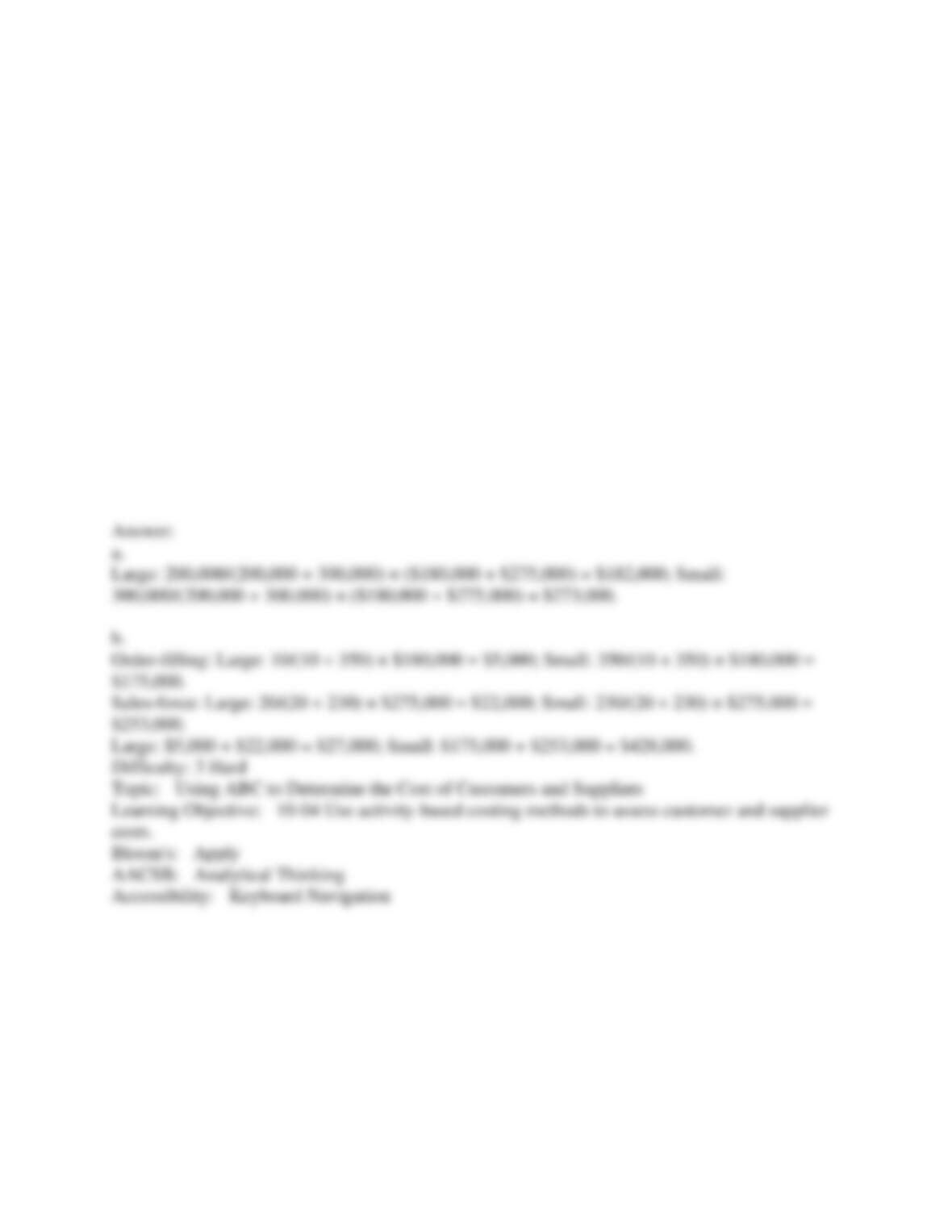
112) Bison Creek Company is preparing its annual profit plan. As part of its analysis of the cost
of its purchasing activity, management estimates that the $250,000 for purchasing support should
be assigned to the individual vendors from the information given as follows:
Vendor A Vendor B Vendor C
Units purchased 100,000 100,000 500,000
Purchase orders (annual) 12 24 50
Number of shipments received 12 52 100
Required:
a. Allocate the purchasing costs to the three vendors, assuming Bison Creek uses units purchased
to compute activity-based costs.
b. Allocate the purchasing costs to the three vendors, assuming Bison Creek uses purchases
orders to compute activity-based costs.
c. Allocate the purchasing costs to the three vendors, assuming Bison Creek uses number of
shipments to compute activity-based costs.
85
113) Hidden Valley Company produces precision components. Hidden Valley has six customers,
one of which accounts for 40 percent of the sales, with the remaining five accounting for the rest
of the sales. The five smaller customers purchase components in roughly equal quantities. Orders
placed by the smaller customers are about the same size. Data concerning Hidden Valley ‘s
customer activity follow:
Large Customer Five Small Customers
Units purchased 200,000 300,000
Orders placed 10 350
Number of sales calls 20 230
Manufacturing cost $ 600,000 $ 900,000
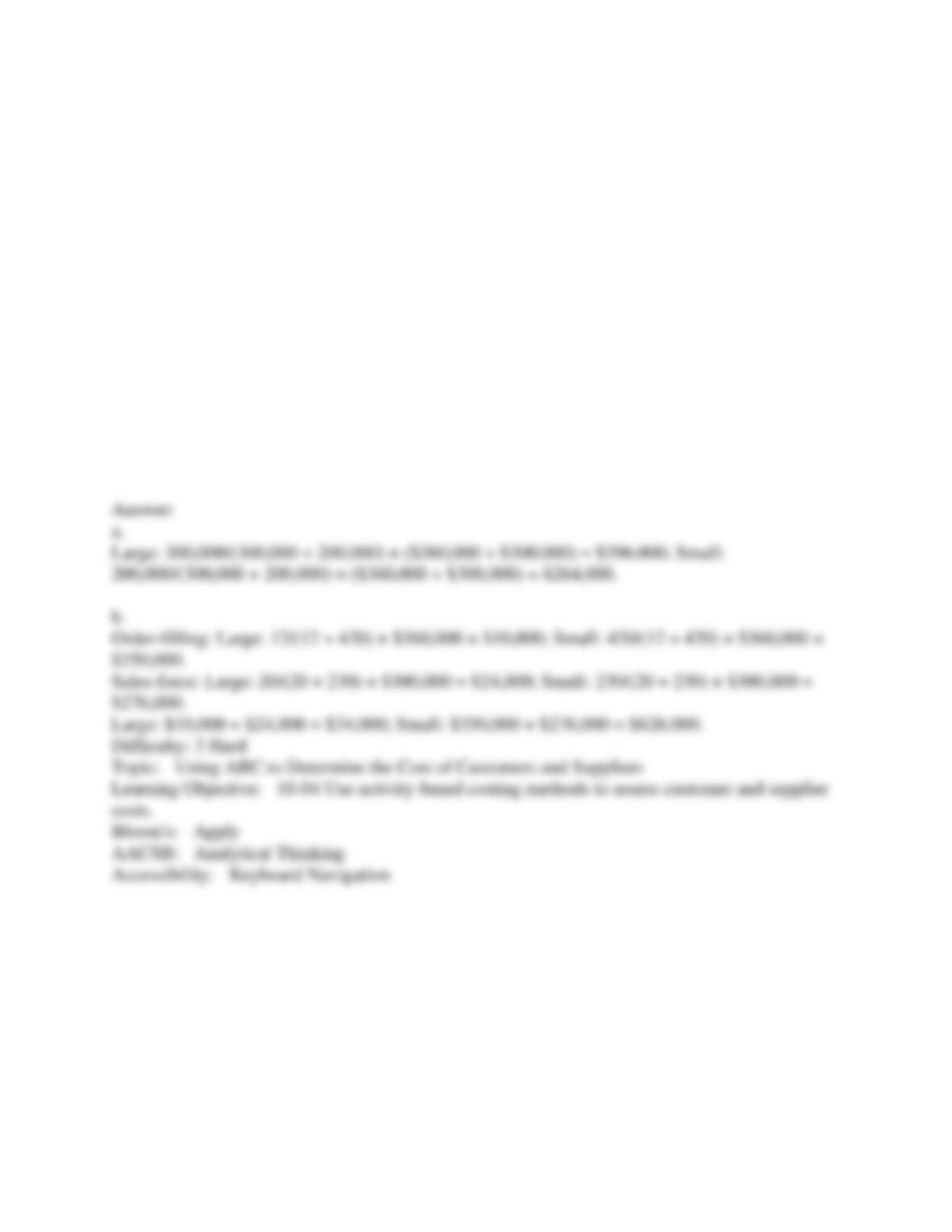
Order-filling costs for Hidden Valley Company total $180,000, and sales-force costs are
$275,000.
Required:
a. Allocate the order-filling and sales force costs to the customers based on sales volume.
b. Allocate the order-filling and sales force costs to the customers using an activity-based costing
approach.
86
114) Kingston Company produces precision components. Kingston has 11 customers, one of
which accounts for 60 percent of the sales, with the remaining ten accounting for the rest of the
sales. The ten smaller customers purchase components in roughly equal quantities. Orders placed
by the smaller customers are about the same size. Data concerning Kingston’s customer activity
follow:
Large Customer Ten Small Customers
Units purchased 300,000 200,000
Orders placed 12 420
Number of sales calls 20 230
Manufacturing cost $ 900,000 $ 600,000
Order-filling costs for Kingston Company total $360,000, and sales-force costs are $300,000.
Required:
a. Allocate the order-filling and sales force costs to the customers based on sales volume.
b. Allocate the order-filling and sales force costs to the customers using an activity-based costing
approach.
87
115) Kingston Company produces precision components. Kingston has 11 customers, one of
which accounts for 60 percent of the sales, with the remaining ten accounting for the rest of the
sales. The ten smaller customers purchase components in roughly equal quantities. Orders placed
by the smaller customers are about the same size. Data concerning Kingston’s customer activity
follow:
Large Customer Ten Small Customers
Units purchased 300,000 200,000
Orders placed 12 420
Number of sales calls 20 230
Manufacturing cost $ 900,000 $ 600,000
Sales $ 1,800,000 $ 1,200,000
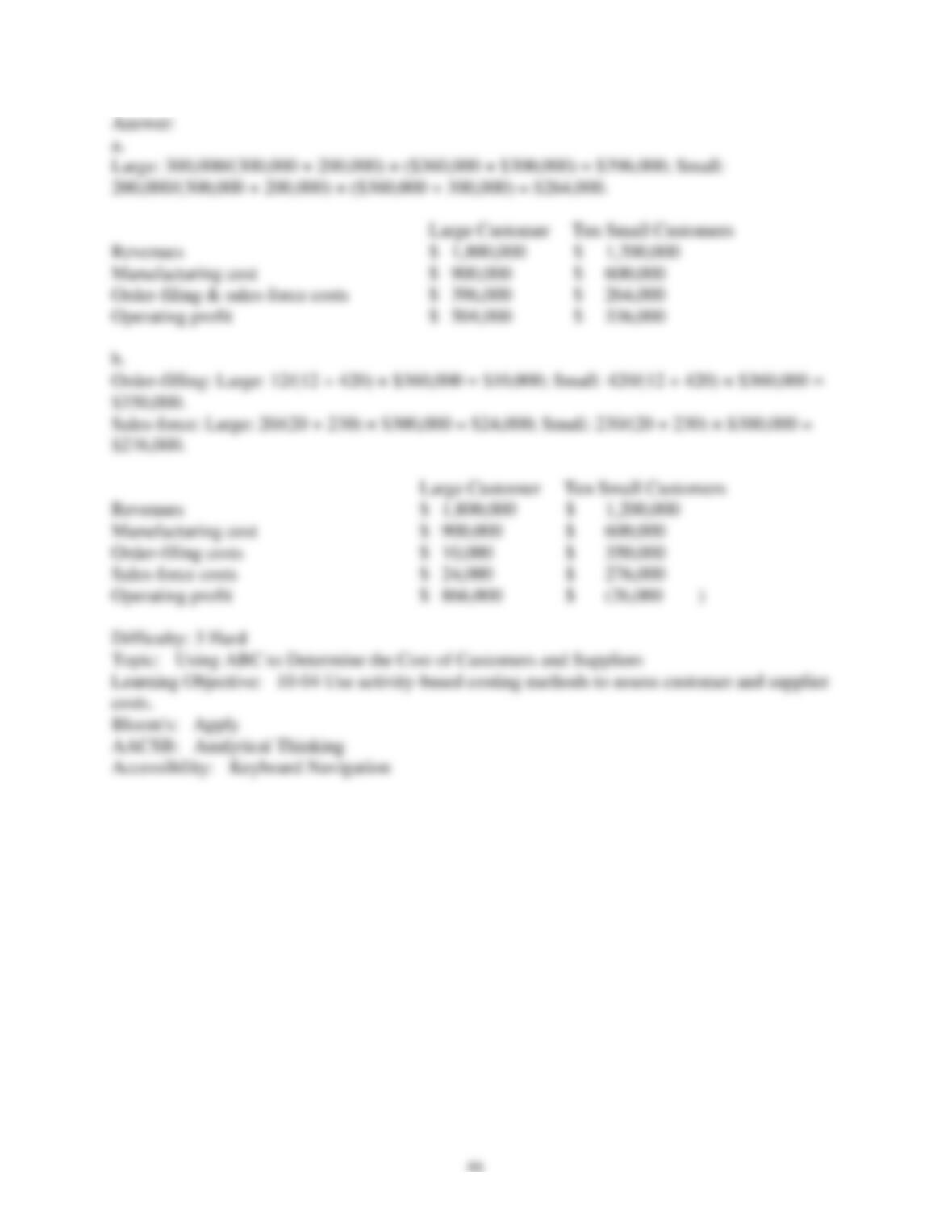
Order-filling costs for Kingston Company total $360,000, and sales-force costs are $300,000.
Required:
a. Determine the profitability of each of the two classes of customers (large and small). Allocate
the order-filling and sales force costs to the customers based on sales volume.
b. Determine the profitability of each of the two classes of customers (large and small). Allocate
the order-filling and sales force costs to the customers using an activity-based costing approach.
89
116) Bountiful Harvest Distribution delivers supplies to small grocers throughout the region.
Bountiful currently adds 5% to the order cost to cover the delivery cost. The delivery fee is
meant to just cover the cost of delivery. A consultant has analyzed the delivery service using
activity-based costing methods and identified four activities. Data on these activities are:
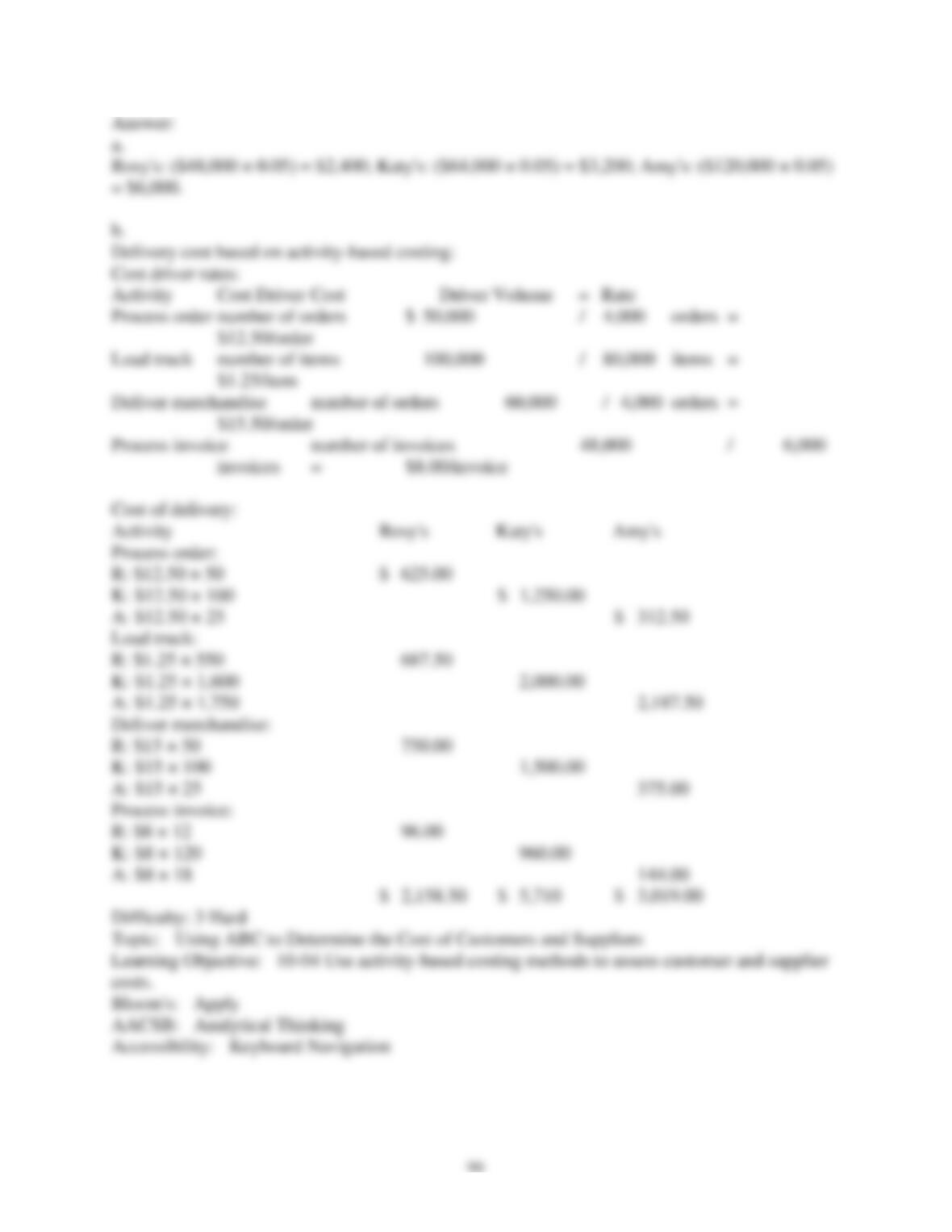
Activity Cost Driver Cost Driver Volume
Process order number of orders $ 50,000 4,000 orders
Load truck number of items 100,000 80,000 items
Deliver goods number of orders 60,000 4,000 orders
Process invoice number of invoices 48,000 6,000 invoices
Total overhead $ 258,000
Three of Bountiful’s customers are Rosy’s Corner Market, Katy’s Fine Foods, and Amy’s City
Market. Below are data on orders and deliveries to these three customers:
Rosy’s Katy’s Amy’s
Order value $ 48,000 $ 64,000 $ 120,000
Number of orders 50 100 25
Number of items 550 1,600 1,750
Number of invoices 12 120 18
Required:
(a) What would be the delivery charge for each customer under the current policy of 5% of order
value?
(b) What would the activity-based costing system estimate for the cost of delivering to each
customer?
91
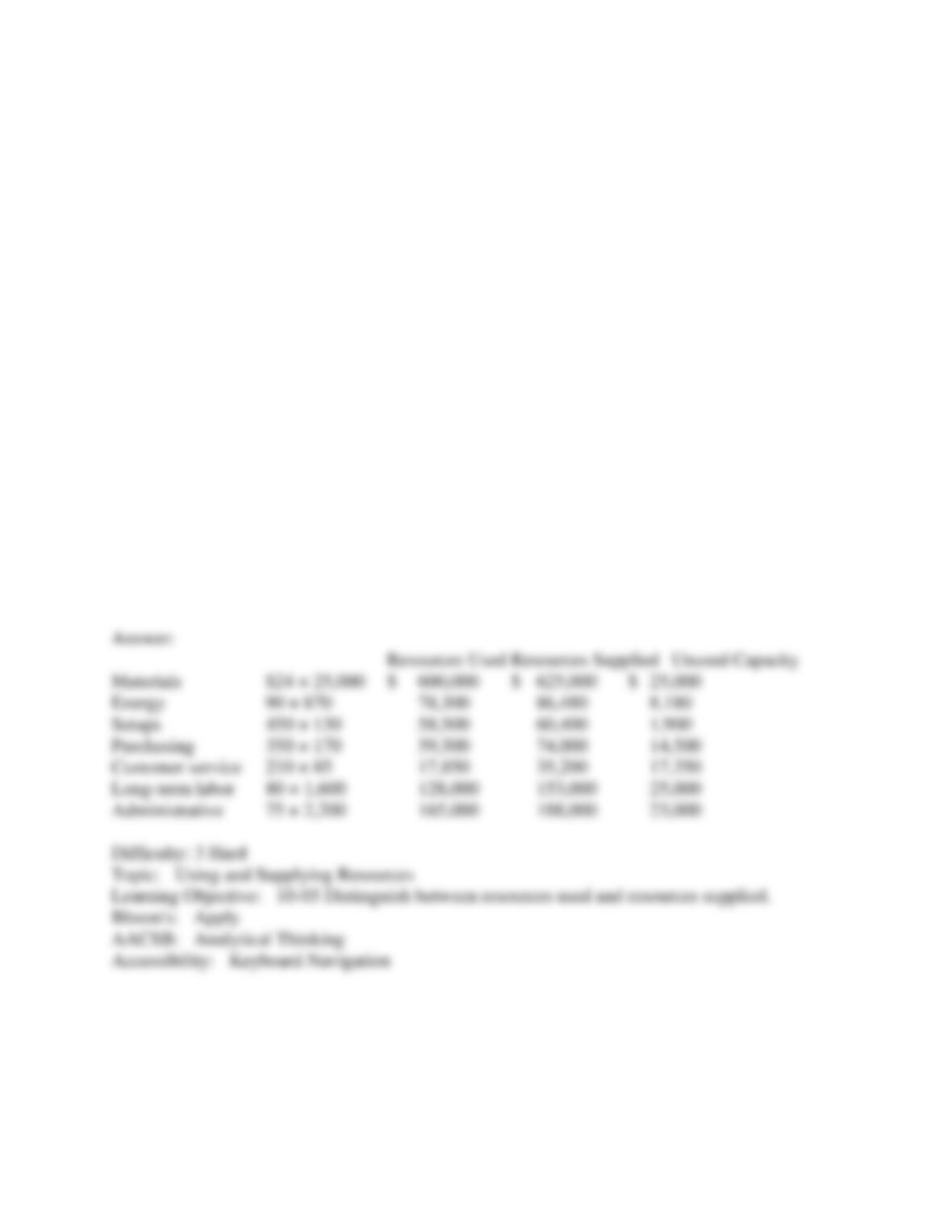
117) Gruber Industries provides the following information about resources:
Cost Driver Rate Cost Driver Volume
Resources used
Materials $ 12 15,000 pounds
Energy 48 675 machine hours
Setups 300 150 setups
Purchasing 240 160 purchase orders
Customer service 160 175 returns
Long-term labor 80 640 labor hours
Administrative 60 840 administrative hours
Resources supplied
Materials $ 192,000
Energy 36,480
Setups 50,400
Purchasing 44,000
Customer service 35,200
Long-term labor 53,000
Administrative 54,000
In addition, sales for the period totaled $600,000.
Required:
Compute the unused resource capacity for each preceding item.
92
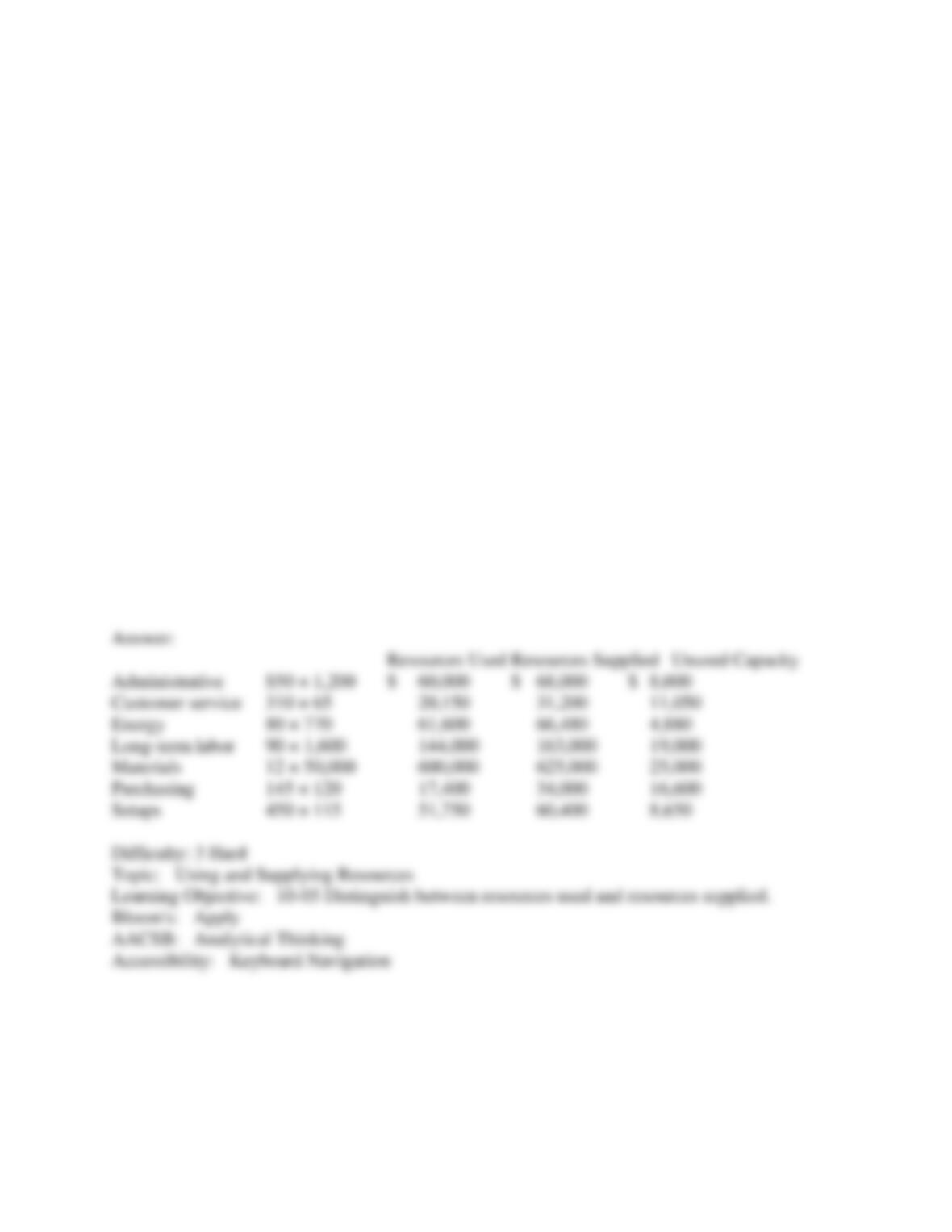
118) Jones Industries provides the following information about resources:
Cost Driver Rate Cost Driver Volume
Resources used
Materials $ 24 25,000 gallons
Energy 90 870 machine hours
Setups 450 130 setups
Purchasing 350 170 purchase orders
Customer service 210 85 returns
Long-term labor 80 1,600 labor hours
Administrative 75 2,200 administrative hours
Resources supplied
Materials $ 625,000
Energy 86,480
Setups 60,400
Purchasing 74,000
Customer service 35,200
Long-term labor 153,000
Administrative 188,000
Required:
Compute the unused resource capacity for each preceding item.
93
119) Morrison Supply provides the following information about resources:
Cost Driver Rate Cost Driver Volume
Resources used
Administrative $ 50 1,200 administrative hours
Customer service 310 65 returns
Energy 80 770 machine hours
Long-term labor 90 1,600 labor hours
Materials 12 50,000 units
Purchasing 145 120 purchase orders
Setups 450 115 setups
Resources used
Administrative $ 68,000
Customer service 31,200
Energy 66,480
Long-term labor 163,000
Materials 625,000
Purchasing 34,000
Setups 60,400
Required:
Compute the unused resource capacity for each preceding item.
94
120) The following represents the financial information of Fabriz Corporation, a manufacturer of
electronic components, for two months:
March April
Sales $ 539,000 $ 495,000
Costs:
Process inspection 3,300 3,760
Scrap 3,700 3,860
Quality training 37,600 26,000
Warranty repairs 8,600 9,600
Testing equipment 14,000 14,000
Customer complaints 5,600 6,800
Rework 34,000 37,000
Preventive maintenance 27,000 19,000
Materials inspection 13,000 9,600
Field testing 18,800 24,800
Required:
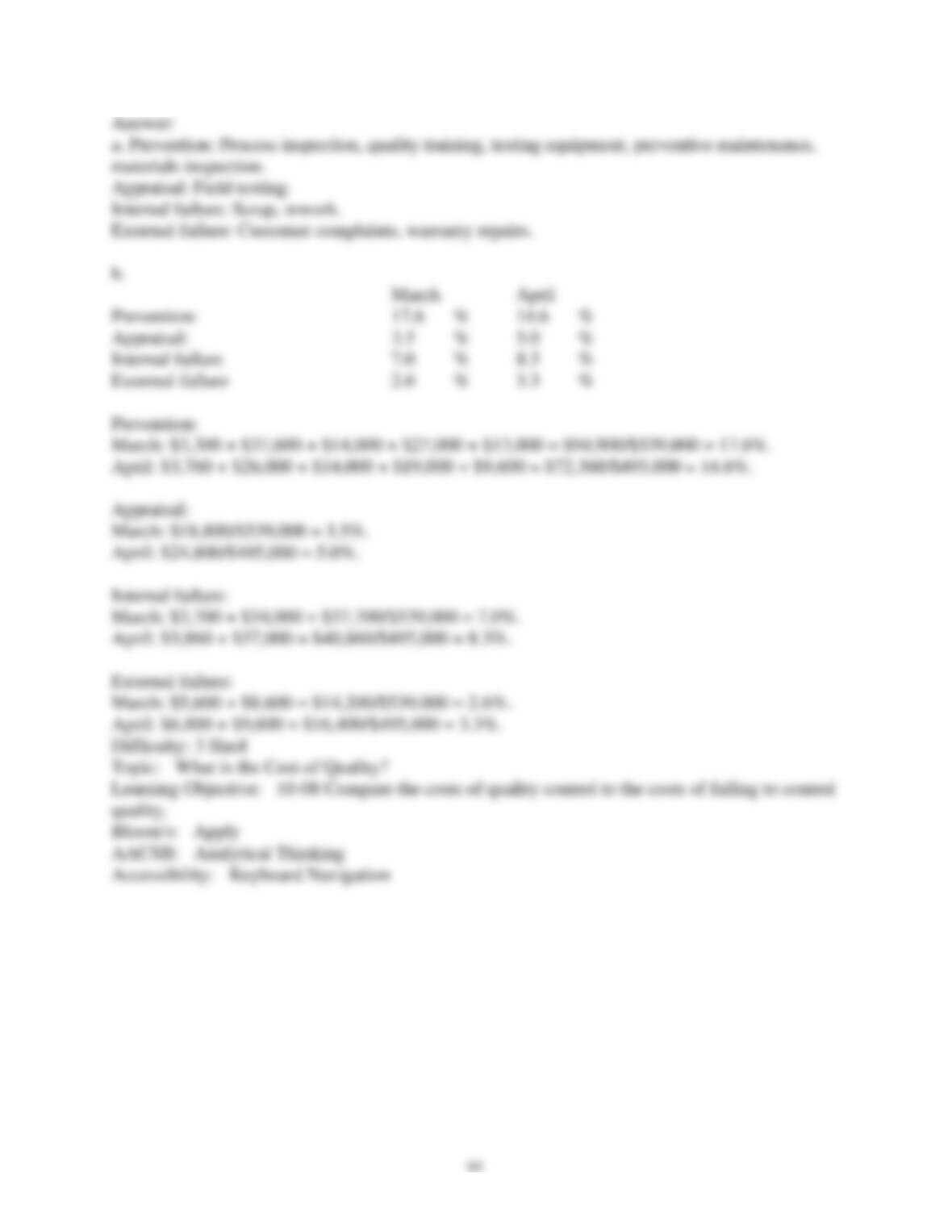
a. Classify these items into prevention, appraisal, internal failure, or external failure costs.
b. Calculate the ratio of the prevention, appraisal, internal failure, and external failure costs to
sales for March and April.
96
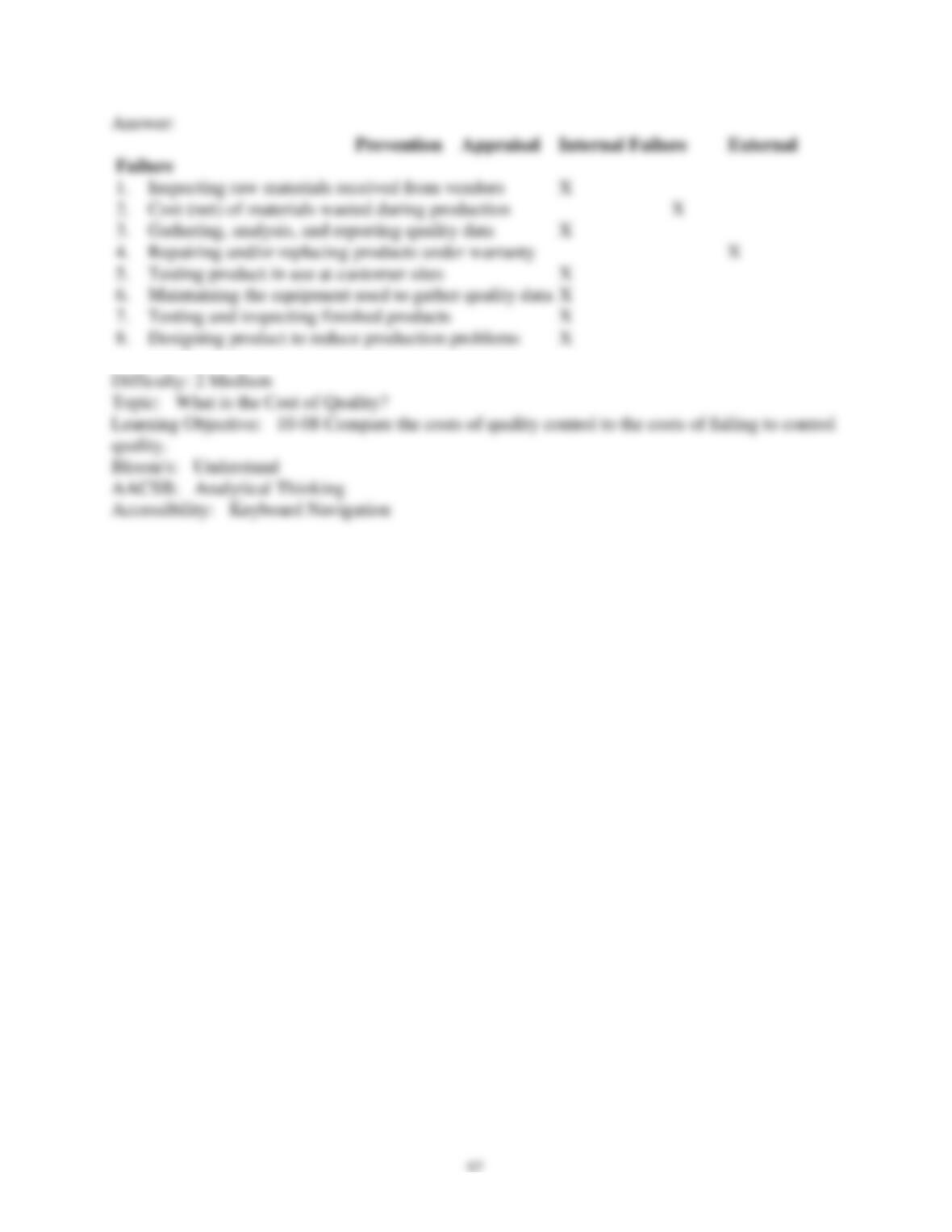
121) Categorize each of the following quality activities by placing an X in the appropriate
column.
Required:
Prevention Appraisal Internal Failure External
Failure
1. Inspecting raw materials received from vendors
2. Cost (net) of materials wasted during production
3. Gathering, analysis, and reporting quality data
4. Repairing and/or replacing products under warranty
5. Testing product in use at customer sites
6. Maintaining the equipment used to gather quality data
7. Testing and inspecting finished products
8. Designing product to reduce production problems
98
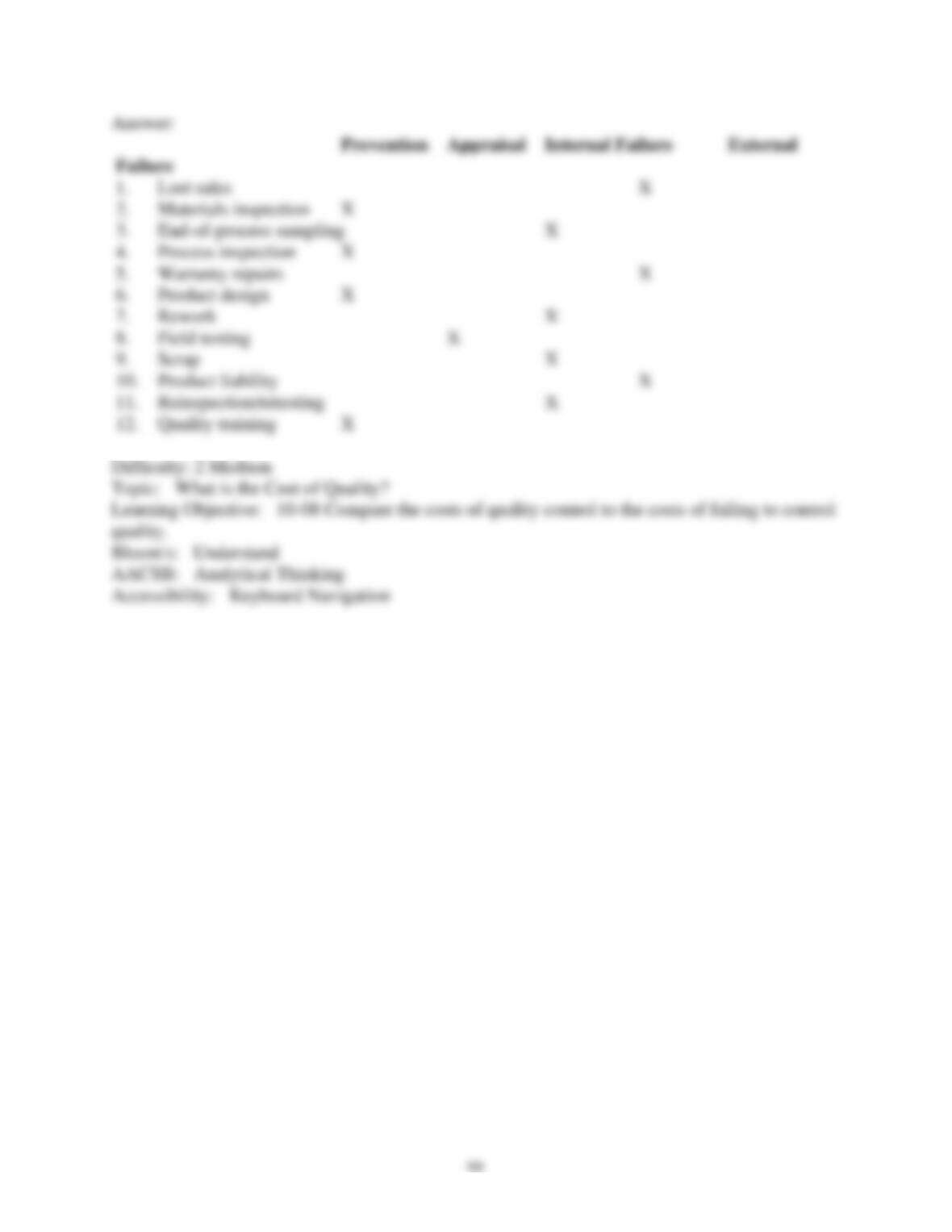
122) Categorize each of the following quality activities by placing an X in the appropriate
column.
Required:
Prevention Appraisal Internal Failure External
Failure
1. Lost sales
2. Materials inspection
3. End-of-process sampling
4. Process inspection
5. Warranty repairs
6. Product design
7. Rework
8. Field testing
9. Scrap
10. Product liability
11. Reinspection/retesting
12. Quality training
100
123) The following represents the financial information of Madison Tool Corporation, a
manufacturer of testing equipment:
May
Customer complaints $ 11,200
Field testing 37,600
Materials inspection 26,000
Preventive maintenance 54,000
Process inspection 6,600
Quality training 75,200
Rework 68,000
Scrap 7,400
Testing equipment 28,000
Warranty repairs 17,200
Required:
a. Classify these items into prevention, appraisal, internal failure, or external failure costs and
determine the total cost of each category.