Chapter 10 – Reporting and Interpreting Bonds
Chapter 10 – Reporting and Interpreting Bonds
107. On January 1, 2010, Mendez Corporation issued 400 of its $1,000, ten-year, 9% bonds.
The bonds were dated January 1, 2010, and interest is paid annually each December 31. The
bonds were issued at 99.
Requirements:
Part A: Prepare the entry to record the issuance of the bonds on January 1, 2010:
Part B: Were the bonds issued at par, at a premium, or at a discount? How did you arrive at
your answer?
Chapter 10 – Reporting and Interpreting Bonds
10–58
108. Consider the following statement: “Issuing bonds at a discount is bad for the issuing
corporation.” Discuss the statement and comment on its validity.
109. On January 1, 2011, Schultz Corporation issued $100,000 of its ten-year, 6% bonds
payable at $98,000. The bonds were dated January 1, 2011, and interest is paid each
December 31.
Requirements:
A. Give the entry for the sale of the bonds.
B. Give the entry to record the first interest payment. Assume straight-line amortization and
no adjusting journal entries were made during the year.
Chapter 10 – Reporting and Interpreting Bonds
110. Houston Company authorized a $1,000,000, 10-year, 6% bond issue dated July 1, 2010,
with annual interest to be paid each December 31. On July 1, 2010, the bonds were issued for
$886,500. Houston Company has a December 31 year-end.
Requirements:
A. Prepare the journal entry to record the sale of the bonds.
B. Prepare the required journal entry on December 31, 2010 to record amortization (use
straight-line.) No adjusting journal entries were made during the year.
C. Was the bond issued at par, at a discount, or at a premium?
D. Will interest expense be greater than or less than the cash payments for interest?
Chapter 10 – Reporting and Interpreting Bonds
10–60
111. On March 1, 2010, Jose, Inc. issued a $1,000, 8%, five-year bond for $1,060. The bond
was dated on March 1, 2010, and interest is payable each February 28. Jose, Inc. has a
December 31 year-end.
Requirements:
A. Prepare the journal entry required on March 1, 2010.
B. Prepare the journal entry required on December 31, 2010. No adjusting journal entries
were made during the year.
C. Prepare the entry required on February 28, 2011.
D. Was the bond issued at par, at a premium, or at a discount?
E. What is the carrying value or book value of the bond on December 31, 2010?
F. Where in the financial statements does the carrying value of the bond appear? (Be specific).
G. On what date does the bond issue mature?
Chapter 10 – Reporting and Interpreting Bonds
112. Northridge Company prepared a bond issue dated January 1, 2010. On January 1, 2010,
the company issued $100,000 of its par value bonds for $103,000. The bonds mature in thirty
years and have a stated rate of interest of 8% per year. Interest is payable annually on
December 31. Straight-line amortization is used (round to the nearest dollar).
A. Prepare the journal entry to record the sale of bonds on January 1, 2010.
B. Prepare the journal entry to record interest expense at December 31, 2010 (end of the
annual accounting period). No adjusting journal entries have been made during the year.
C. Show how the bonds would be reported on the balance sheet of Northridge Company dated
December 31, 2012.
Chapter 10 – Reporting and Interpreting Bonds
113. On January 1, 2010, Lauren Corporation issued $40,000, 9%, ten-year bonds payable at
108. Interest is payable each December 31.
Requirements:
A. Prepare the journal entry to record the issuance of the bonds on January 1, 2010.
B. Prepare the journal entry to record the first interest payment on December 31, 2010. Use
straight-line amortization. No adjusting journal entries have been made during the year.
C. What would the carrying value of the bonds be on December 31, 2011?
Chapter 10 – Reporting and Interpreting Bonds
114. Newton Corporation issued its $1,000,000, 7%, ten-year bonds to the public on January
1, 2010. The bonds pay interest annually, beginning on December 31, 2010. Newton
Corporation received $1,153,420 in cash at the issuance of the bonds. The market rate of
interest when the bonds were issued was 5%. Newton Corporation has a December 31 year-
end. Assume that no adjusting journal entries have been made during the year.
A. Compute the amount of the premium that Newton Corporation should amortize on
December 31, 2010, assuming the “effective-interest” method is used.
B. Compute the amount of the premium that Newton Corporation should amortize on
December 31, 2010, assuming the “straight-line” method is used.
C. Which method above is theoretically the better to use for amortizing a bond premium?
Chapter 10 – Reporting and Interpreting Bonds
115. Grand Company authorized $150,000 of 5-year bonds dated January 1, 2011. The stated
rate of interest was 14%, payable annually each December 31. The bonds were issued on
January 1, 2009, when the market interest rate was 12%. Assume effective-interest
amortization. (The present value factor for $1 at 6% for 10 periods is 0.5584, for $1 at 7% for
10 periods is 0.5083, for $1 at 14% for 5 periods is 0.5194, and for $1 at 12% for 5 periods is
0.5674. The present value of an annuity of $1 for 10 periods at 6% is 7.3601, for 10 periods at
7% is 7.0236, for 5 periods at 6% is 4.2124, for 5 periods at 7% is 4.1002, and for 5 periods at
12% is 3.6048). Round to the nearest dollar.
Requirements:
A. What would be the amount of premium amortization for December 31, 2011? No adjusting
journal entries have been made during the year.
B. What would be the amount of the interest payment on December 31, 2011?
Chapter 10 – Reporting and Interpreting Bonds
116. On March 31, 2011 Ridgetop Corp. retired bonds early by repurchasing them in the
market for $9,700,000. The total face value of the bonds retired equaled $10 million and there
was $450,000 of unamortized discount on these bonds. Record the journal entry to retire the
bonds.
Chapter 10 – Reporting and Interpreting Bonds
117. TreeTop Corporation had issued $5,000,000 of 10-year bonds with a 12% stated rate and
interest to be paid annually. They were issued on January 1, 2004 at 96 and have been
amortized using the straight-line method through December 31, 2010. On June 30, 2011,
TreeTop retired all the bonds by exercising the call feature. The call price was 101. Record
the journal entry for the call of the bonds on June 30, 2011. (Remember to amortize the
discount and update the book value of the bonds for the half-year prior to retirement).
Chapter 10 – Reporting and Interpreting Bonds
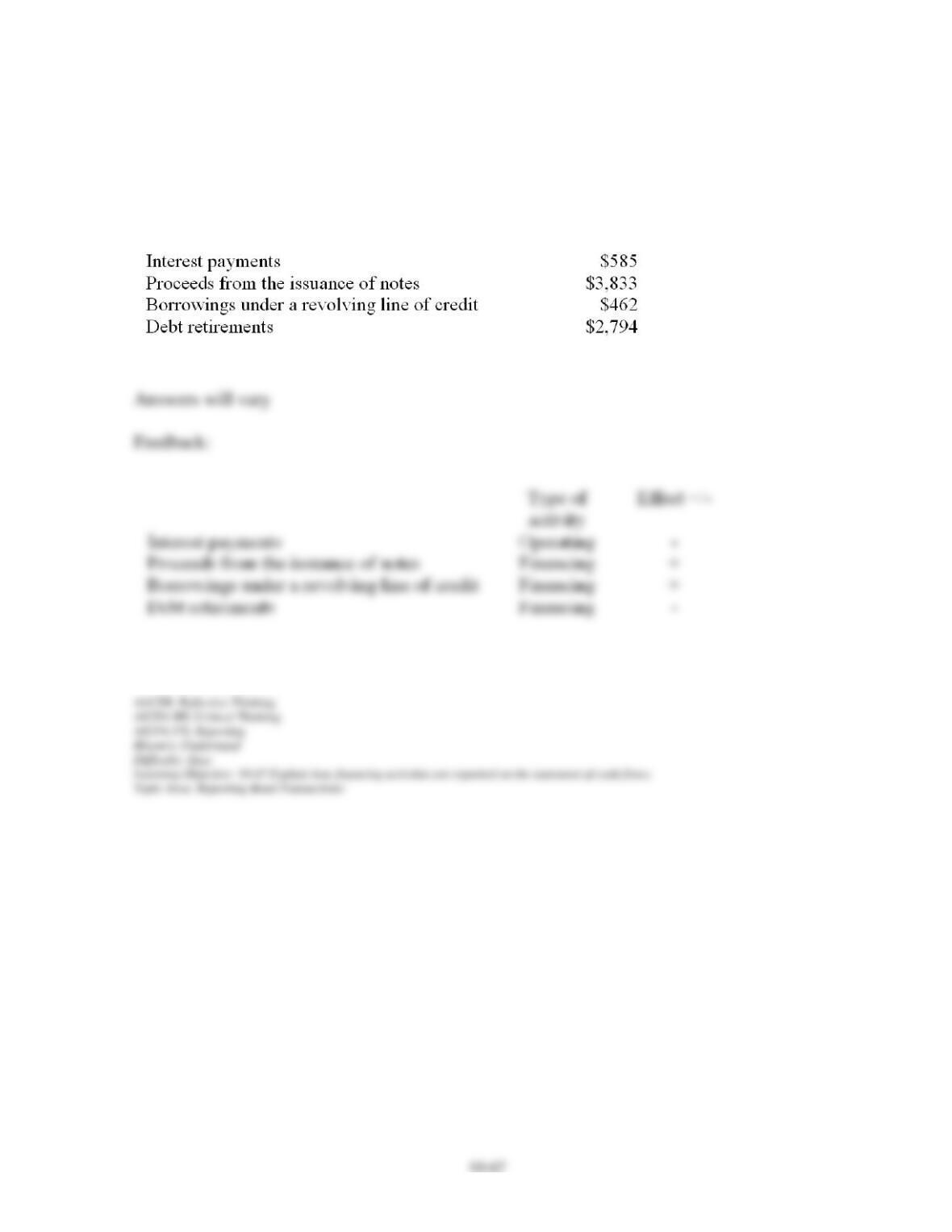
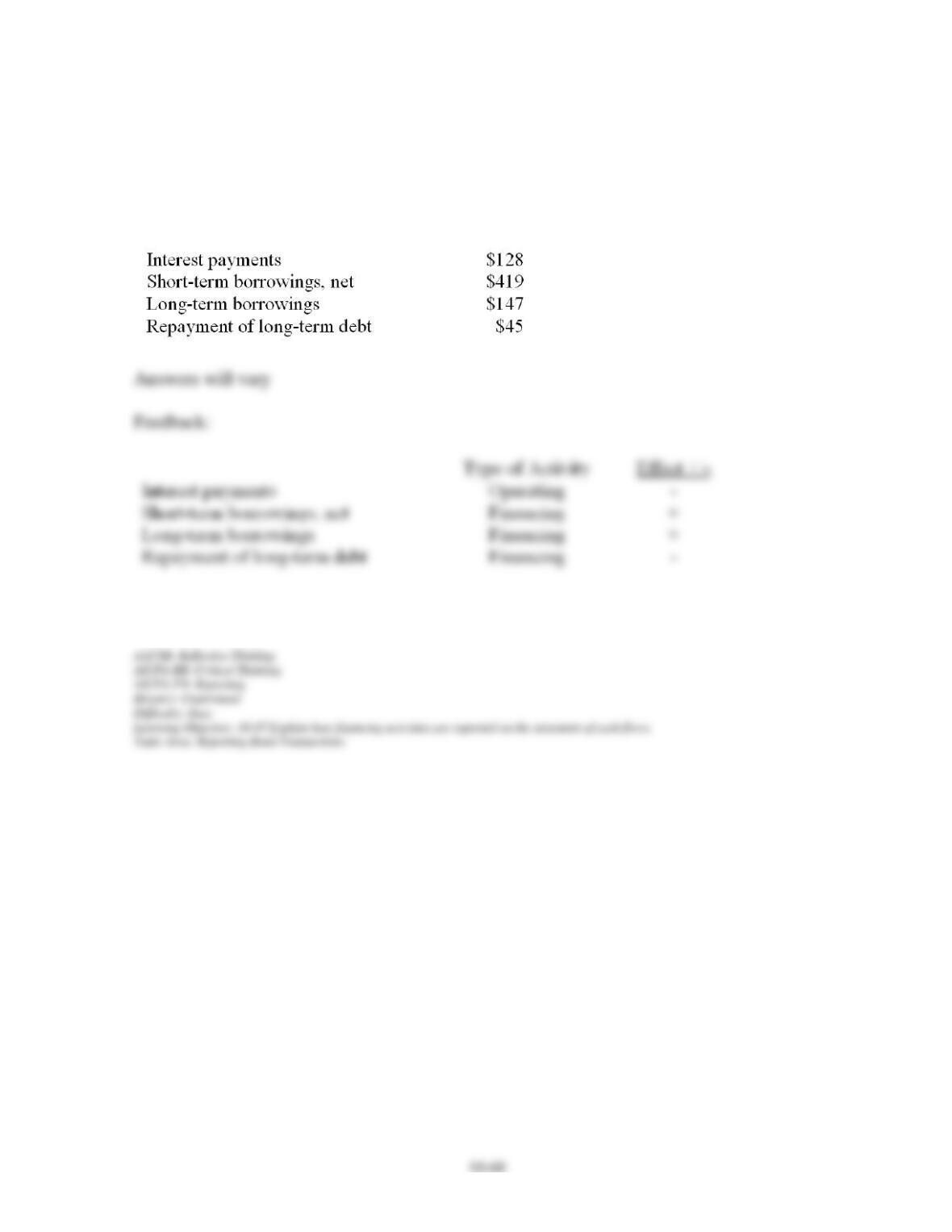
118. Fence Company reported the following information for 2011 (in millions). Identify
where these items would be classified on the statement of cash flows, (operating, investing, or
financing) and whether they would be added or deducted in those sections.
Chapter 10 – Reporting and Interpreting Bonds
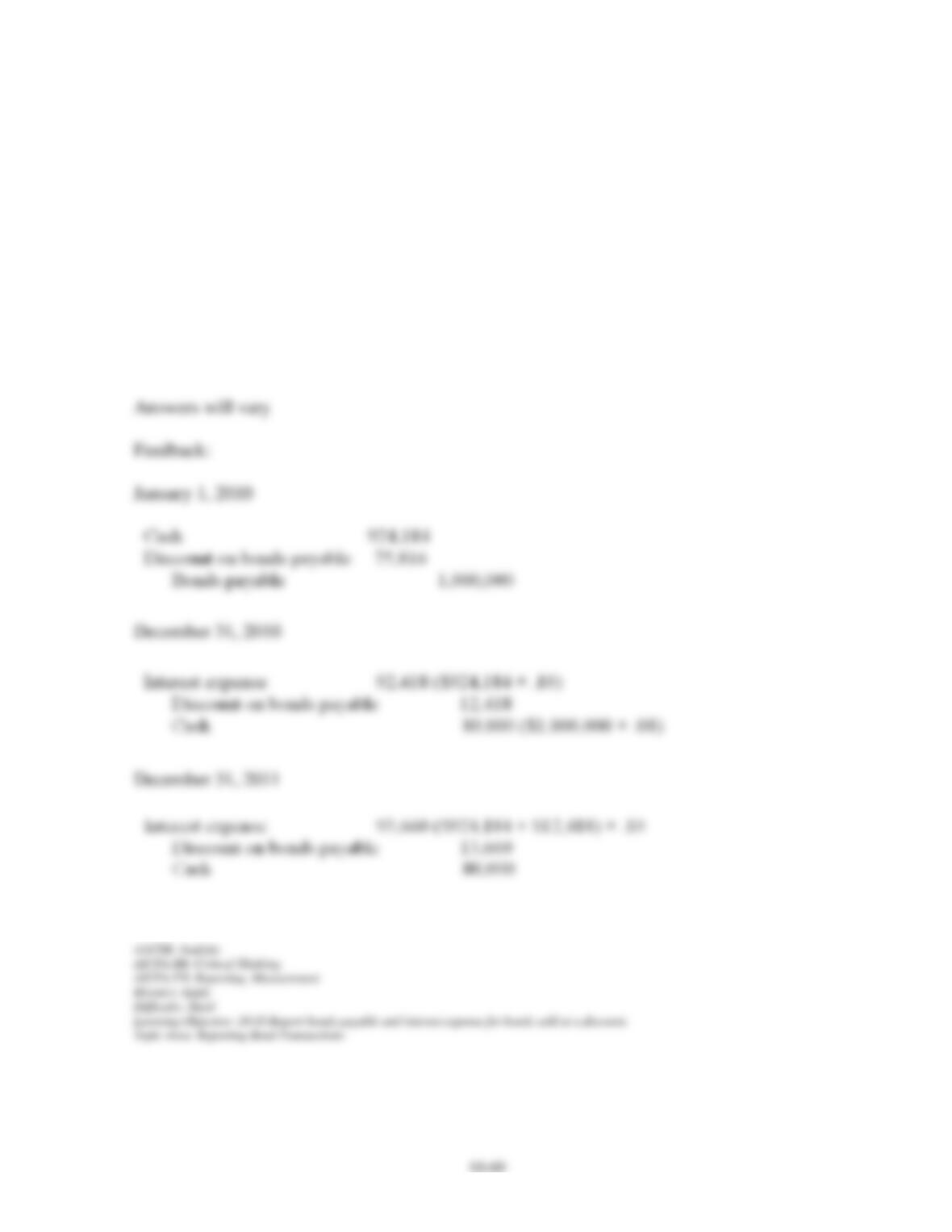
119. In a recent year, Tommy Toys reported the following amounts (in millions). Identify
where these items would be classified on the statement of cash flows (operating, investing or
financing)? Also, indicate whether each amount would be added or deducted.
Chapter 10 – Reporting and Interpreting Bonds
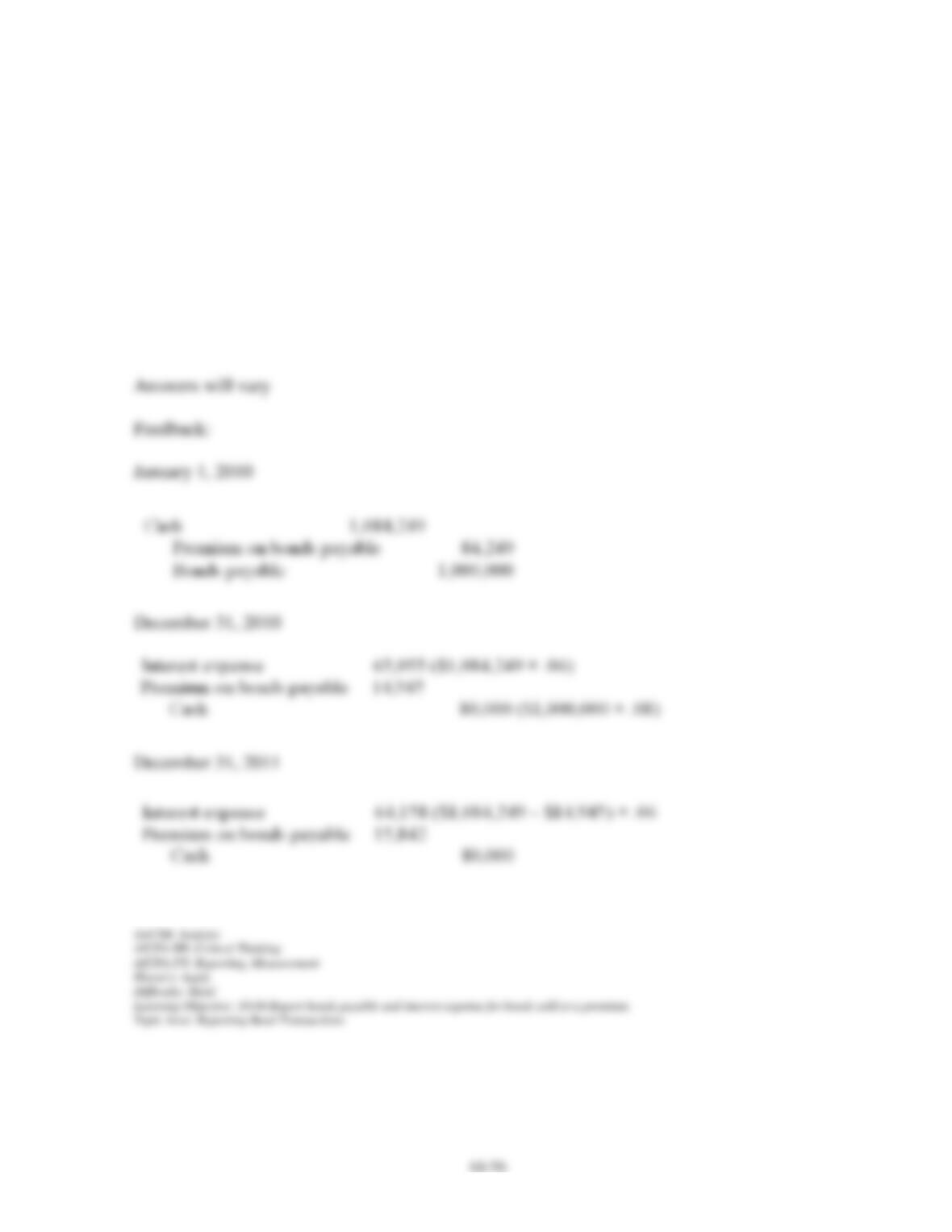
120. Rock Company issued a $1,000,000 bond on January 1, 2010. The bond was dated
January 1, 2010, had an 8% stated rate, pays interest annually on December 31, and sold for
$924,184 at a time when the market rate of interest was 10%. Rock uses the effective-interest
method to account for its bonds.
Prepare the necessary journal entry for each of the following dates (assuming that no
adjusting journal entries have been made during the year):
January 1, 2010
December 31, 2010
December 31, 2010
Chapter 10 – Reporting and Interpreting Bonds
121. Stone Company issued a $1,000,000 bond on January 1, 2010. The bond was dated
January 1, 2010, had an 8% stated rate, pays interest annually on December 31, and sold for
$1,084,249 at a time when the market rate of interest was 6%. Stone uses the effective-interest
method to account for its bonds.
Prepare the necessary journal entry for each of the following dates:
January 1, 2010
December 31, 2010
December 31, 2010