96. Treasury stock is a contra-equity account since treasury stock increases total stockholders’
equity.
97. When we reissue treasury stock, we report the difference between its cost and the cash
received as an increase/decrease in additional paid-in capital.
98. Retained earnings represent the earnings retained in the corporation – earnings not paid out
as dividends to stockholders.
99. The amount of retained earnings equals net income minus dividends for the current year.
100. If a company has expenses that are more than revenues, the net loss decreases retained
earnings.
101. Dividends are paid on all shares issued by the company including treasury stock.
102. Total assets, total liabilities, and total stockholders’ equity do not change as a result of a
stock dividend.
103. Small stock dividends are recorded by debiting Retained Earnings for the par value per
share.
104. No journal entry is made to record a stock split.
105. A stock split has no effect on the total of any account in stockholders’ equity.
106. Common stock is listed before preferred stock in the balance sheet.
107. We can estimate the average purchase cost of treasury stock per share by dividing the
treasury stock balance by the number of shares repurchased.
108. The statement of stockholders’ equity shows how each equity account changed during the
year.
109. The stockholders’ equity section of the balance sheet shows how each equity account
changed during the year.
110. The return on equity measures the ability of company management to generate earnings
from the resources that owners provide.
111. We compute the return on equity ratio by dividing net income by ending stockholders’
equity.
112. Earnings per share (EPS) measures the net income earned per share of common stock
outstanding.
113. We calculate earnings per share as net income divided by the average shares outstanding
during the period.
114. Earnings per share is useful in comparing earnings performance across companies.
115. We calculate the PE ratio as the stock price divided by earnings per share so that both
stock price and earnings are expressed on a per share basis.
116. Match (by number) the following terms with their definitions. Each letter is used only
once.
1. Designed to serve as a guide to states in the
development of their corporate statutes
2. Allows for legal treatment as a corporation, but tax
treatment as a partnership
3. Describe (a) the nature of the firm’s business
activities, (b) the shares to be issued, and (c) the
composition of the initial board of directors
4. Corporate earnings are taxed twice – at the corporate
level and individual stockholder level
5. Has stock traded on a stock exchange such as the New
York Stock Exchange (NYSE)
6. Stockholders can lose no more than the amount they
invest in the company
7. Like an S corporation, but there are no limitations on
the number of owners as in an S corporation.
(A) S Corporation.
(B) Limited liability
company.
(C) Model Business
Corporation Act.
(D) Publicly held
corporation.
(E) Double
taxation.
(F) Articles of
Incorporation.
(G) Limited
liability.

117. Match (by number) the following terms with their definitions. Each letter is used only
once.
1. Shares held by investors
2. Shareholders can lose no more than the amount they
invested in the company
3. The amount invested by stockholders
4. The corporation’s own stock that it reacquired
5. Shares receive priority for future dividends, if dividends
are not paid in a given year
6. Shares actually sold
7. Shares can be returned to the corporation at a
predetermined price
8. The earnings not paid out in dividends
9. Wealthy individuals in the business community willing
to risk investment funds on a promising business venture
10. Shares available to sell
(A) Angel
investors.
(B) Paid-in
capital.
(C) Issued
stock.
(D) Authorized
stock.
(E) Redeemable.
(F) Cumulative.
(G) Retained
earnings.
(H) Limited
liability.
(I) Treasury
stock.
(J) Outstanding
stock.


118. Listed below are ten terms followed by a list of phrases that describe or characterize the
terms. Match each phrase with the best term placing the number designating the term in the
space provided.
1. Dividends
2. Organization chart
3. Retained earnings
4. Venture capital
firms
5. Stock dividends
6. Additional paid-in
capital
7. Stock split
8. Articles of
incorporation
9. Preferred stock
10. Statement of
stockholders’ equity
(A) Provide additional financing, often in the
millions, for a percentage ownership in the company.
(B) A mixture of attributes somewhere between
common stock and bonds payable.
(C) Summarizes the changes in the balance in each
stockholders’ equity account over a period of time.
(D) Traces the line of authority for a typical
corporation.
(E) The portion of the cash proceeds above par
value.
(F) A large stock dividend that includes a reduction
in the par or stated value per share.
(G) Represents all net income, less all dividends,
since the company began.
(H) Distributions by a corporation to its
stockholders.
(I) Additional shares of the companies’ own stock
given to stockholders.
(J) Describes the nature of the firm’s business
activities, the shares to be issued, and the composition
of the initial board of directors.
119. Match each of the following preferred stock features with its description.
1. Shares can be sold at a predetermined price
2. Shares can be exchanged for common stock
3. Shares receive dividend priority, if dividend not paid
(A) Convertible.
(B) Redeemable.
(C) Cumulative.
120. Match (by number) the following terms with their definitions. Each letter is used only
once.
1. The corporation’s own stock that it
reacquired
2. Effectively the same as a 2-for-1 stock split
3. Summarizes the changes in the balance in
each stockholders’ equity account over a period
of time
4. The earnings not paid out in dividends
5. Priced high in relation to current earnings as
investors expect future earnings to be higher
6. A debit balance in retained earnings
7. Measures the ability of company management
to generate earnings from the resources that
owners provide
8. Priced low in relation to current earnings
9. Shows the balance in each equity account at a
point in time
10. The stock price divided by earnings per
share
(A)Statement of
stockholders’ equity.
(B)Treasury stock.
(C)Value stocks.
(D)Retained earnings.
(E)PE ratio.
(F)Stockholders’ equity
section of the balance sheet.
(G)Return on equity.
(H)Growth stocks.
(I)100% stock dividend.
(J)Accumulated deficit.
121. Corporations typically do not start raising capital by issuing stock to the general public.
What are the common stages of equity financing leading to an initial public offering (IPO)?
122. Describe the primary advantages and disadvantages of a corporation in comparison to a
sole-proprietorship or partnership.
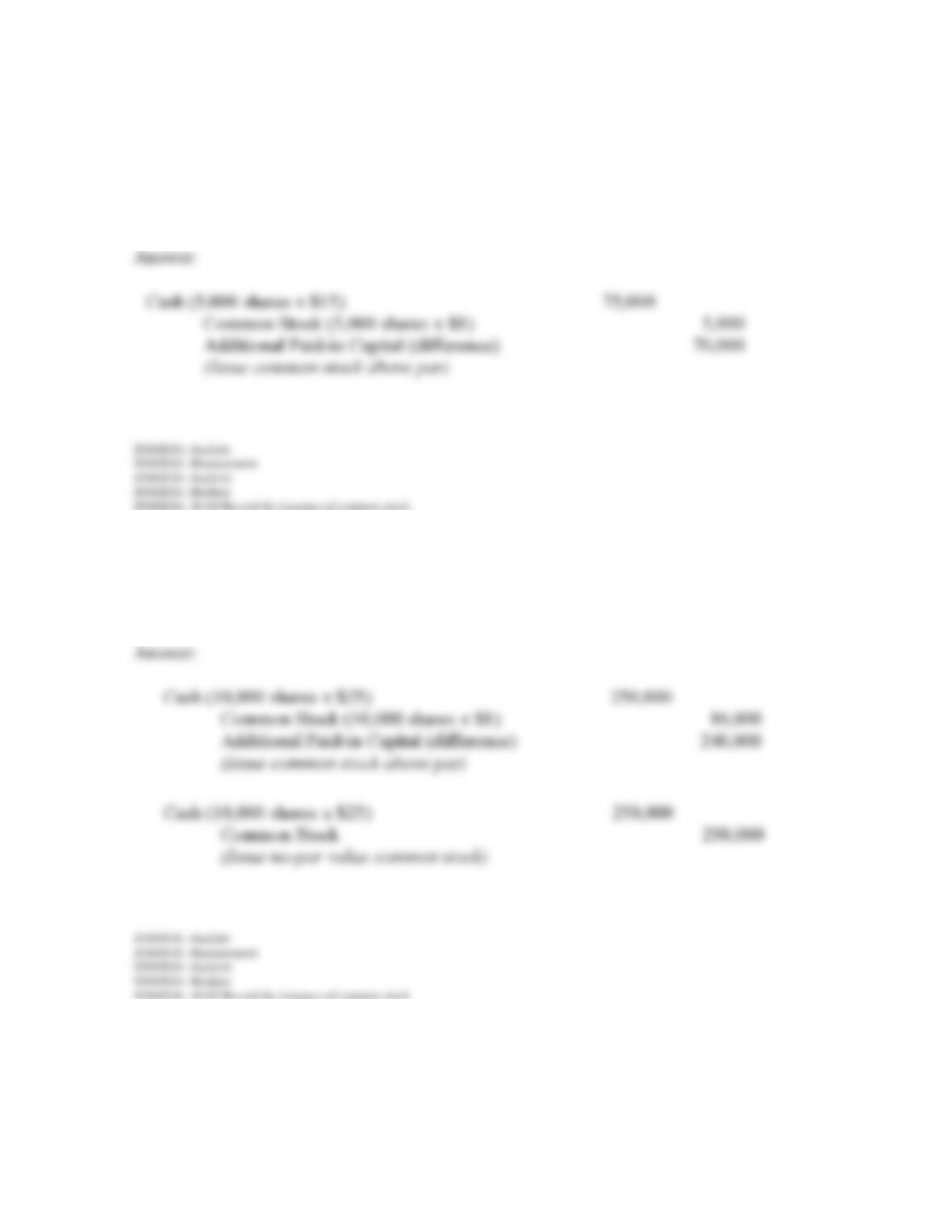
123. Hamilton International issues 5,000 shares of its $1 par value common stock to provide
funds for further expansion. If the issue price is $15 per share, what is the entry to record the
issuance of the stock?
124. Environmental Designs issues 10,000 shares of its $1 par value common stock at $25 per
share. (1) Record the issuance of the stock. (2) Record the issuance of the stock assuming it is
no-par value stock.
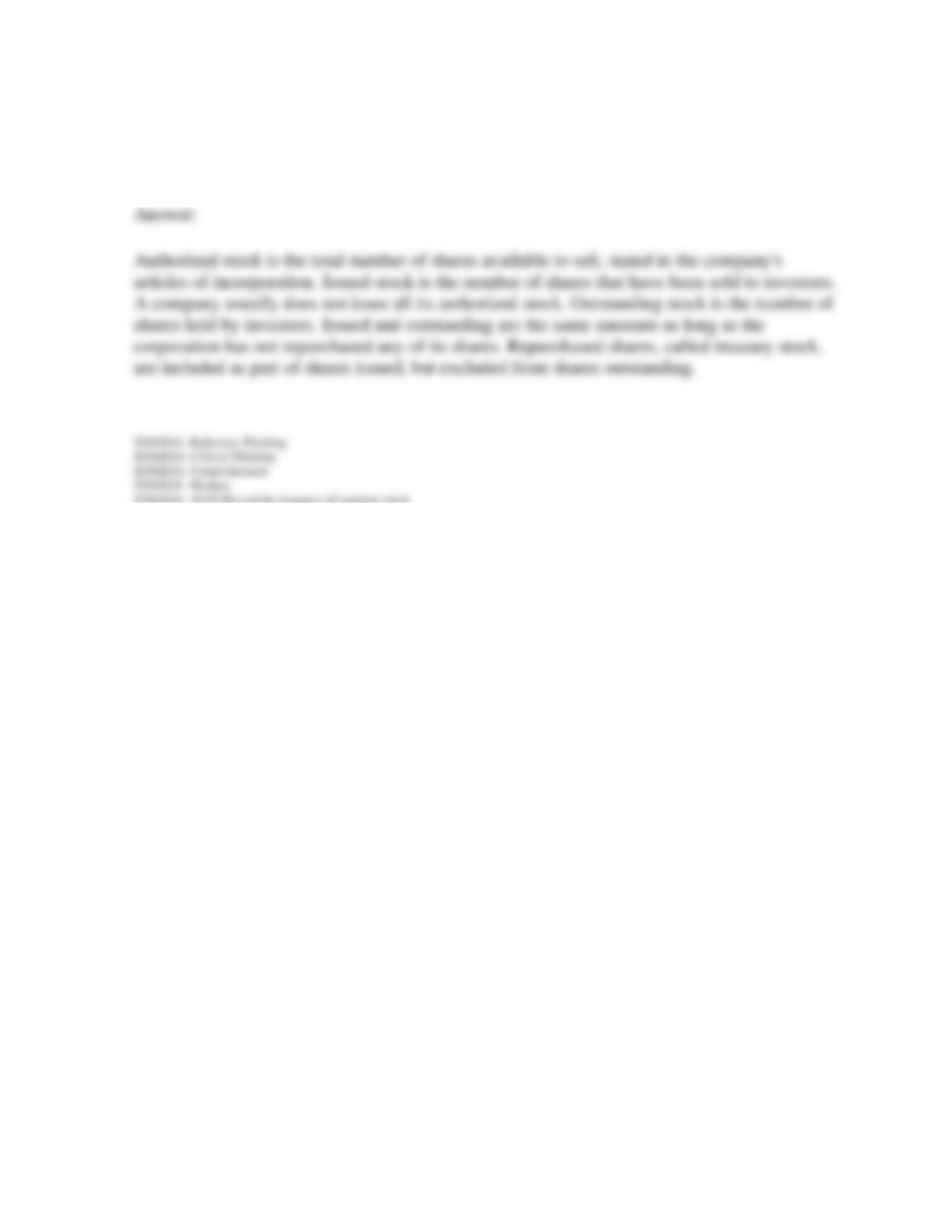
125. Explain the difference between authorized, issued, and outstanding shares.