Chapter 10 – Standard Costing and Analysis of Direct Costs
83. At the end of the accounting period, most companies close variance accounts to:

Chapter 10 – Standard Costing and Analysis of Direct Costs
10–42
Essay Questions
84. During June, Fraser Company’s material purchases amounted to 6,000 pounds at a price
of $7.35 per pound. Actual costs incurred in the production of 2,000 units were as follows:
Direct labor:
$116,935 ($18.20 per hour)
Direct material:
$32,340 ($7.35 per pound)
The standards for one unit of Fraser Company’s product are as follows:
Direct labor:
Direct material:
Quantity, 3.1 hours per unit
Quantity, 2.1 pounds per unit
Rate, $18 per hour
Price, $7.10 per pound
Required:
Compute the direct-material price and quantity variances, the direct-material purchase price
variance, and the direct-labor rate and efficiency variances. Indicate whether each variance is
favorable or unfavorable.
85. James at the Mill Barn Woods produces handcrafted frames. A standard-size 11 x 14 inch
frame requires 6 board feet of rustic barn wood in the finished product. In addition, 1 board
foot of scrap lumber is normally left from the production of one frame. James pays a
demolition company $1.50 per board foot, plus $1.00 in transportation charges per board foot.
Required:
Compute the standard direct-material cost of a frame.
Solution:
10–45
86. Due to evaporation during production, X-treme Building Styrofoam Company requires 5
pounds of material input for every 4 pounds of styrofoam sheets manufactured. During
March, the company produced 3,800 pounds of good sheets.
Required:
Compute the total standard allowed input quantity, given the good output produced.
Solution:
87. Jared, Inc. produces glass shelves that are used in furniture. Each shelf requires 3.6
pounds of raw material at a cost of $2 per pound. Unfortunately, given the nature of the
manufacturing process, one out of every five shelves is chipped, scratched, or broken at the
beginning of production and has to be scrapped.
On average, 20 good shelves are completed during each hour. Laborers who work on these
units are paid $15 per hour.
Required:
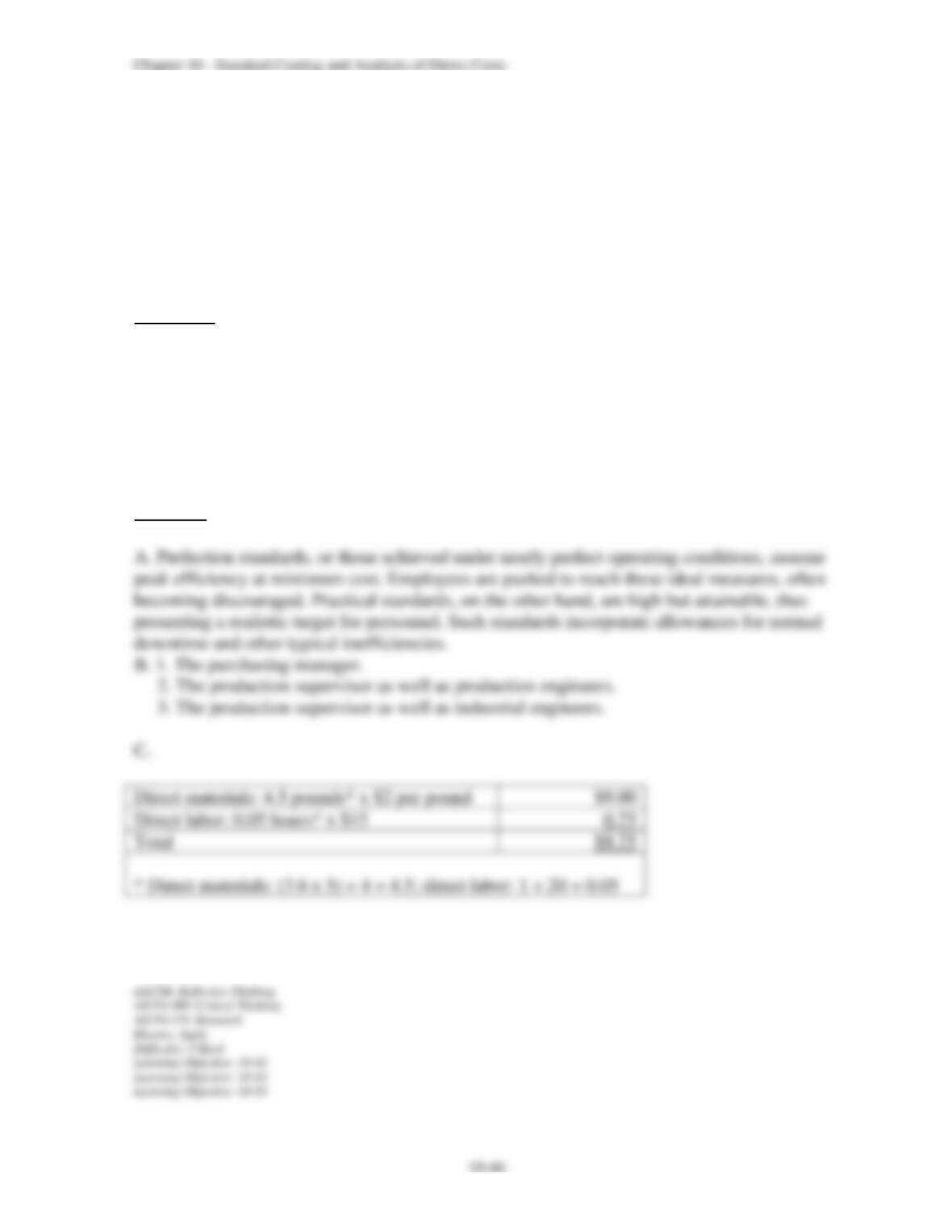
A. Distinguish between perfection standards and practical standards.
B. Who within an organization would be in the best position to assist in setting the:
1. direct-material price standard?
2. direct-material quantity standard?
3. direct-labor efficiency standard?
C. Calculate a practical direct-material and direct-labor standard for each good shelf
produced.
Solution:

10–47
88. Donath Corporation manufactures a variety of liquid lawn fertilizers, including a very
popular product called Luxury Green. Data about Luxury Green and Sheen, a major
ingredient, follow.
Expected operations:
· Sheen is purchased in 55-gallon drums at a cost of $65 per drum. A 2% cash discount is
offered by Sheen’s manufacturer for prompt payment of invoices, and Donath takes advantage
of all discounts offered.
· Donath normally purchases 200 drums of Sheen at a time, paying shipping fees of $2,660
per shipment.
· Each gallon of Luxury Green requires three quarts of Sheen; however, because of
evaporation and spills, Donath loses 4% of all Sheen that enters production. (Recall that there
are four quarts in a gallon.)
Actual operations:
· For the period just ended, Donath purchased 1,500 drums of Sheen at a total cost of
$118,100, which reflects discounts and shipping. There was no beginning inventory, but an
end-of-period inventory revealed that 30 drums were still on hand.
· Manufacturing activity output totaled 104,000 gallons of Luxury Green.
Assume that the company computes variances at the earliest point in time.
Required:
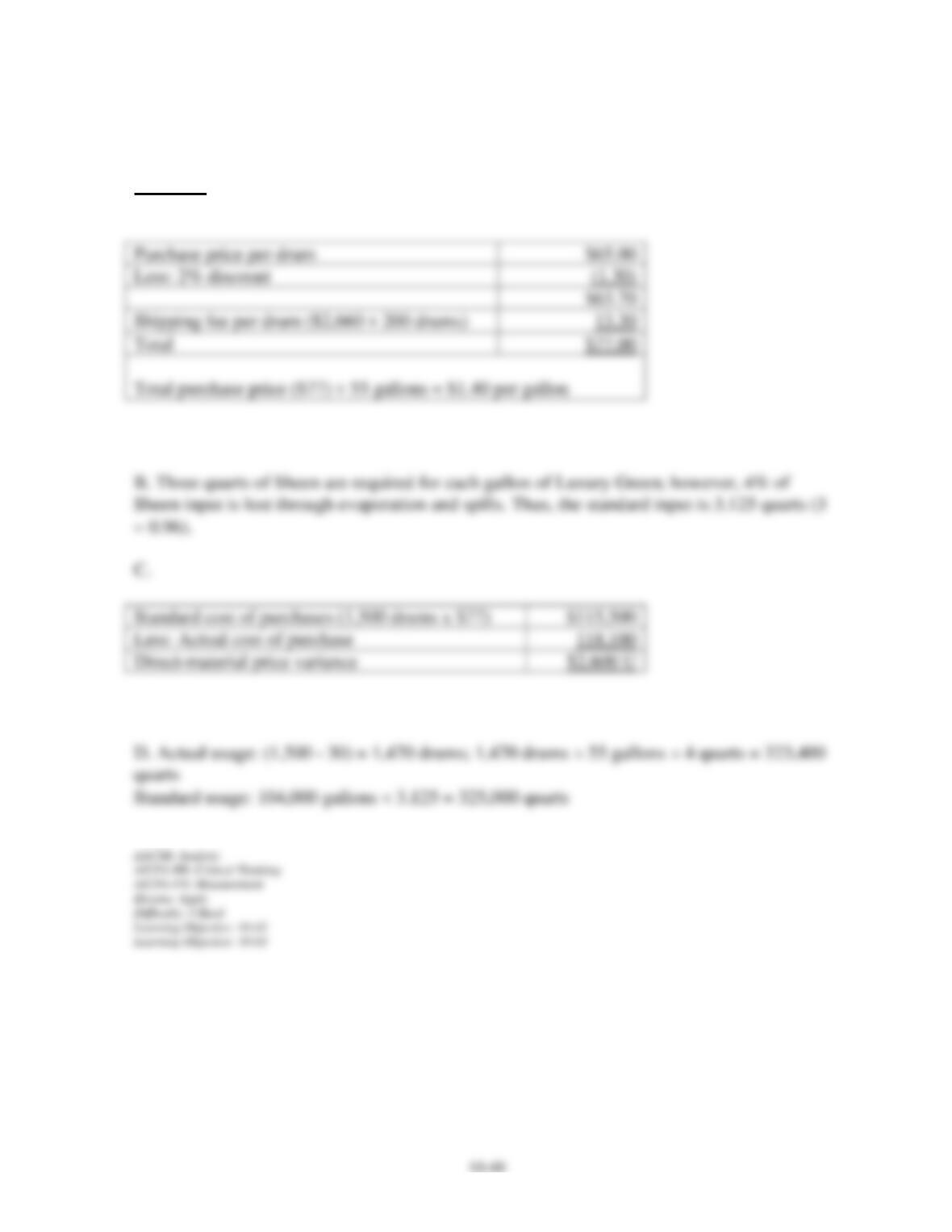
A. Compute the standard purchase price for one gallon of Sheen.
B. Compute the standard quantity of Sheen to be used in producing one gallon of Luxury
Green. Express your answer in quarts.
C. Compute the direct-material price variance for Sheen.
D. How much Sheen was used in manufacturing activity and how much should have been
used? Express your answer in quarts.
Chapter 10 – Standard Costing and Analysis of Direct Costs
Solution:
89. Quinton Company has set the following standards for one unit of product:
Direct material
Quantity: 6.2 pounds per unit
Price per pound: $11 per pound
Direct labor
Quantity: 6 hours per unit
Rate per hour: $23 per hour
Actual costs incurred in the production of 2,800 units were as follows:
Direct material: $194,350 ($11.50 per pound)
Direct labor: $393,750 ($22.50 per hour)
All materials purchased were consumed during the period.
Required:
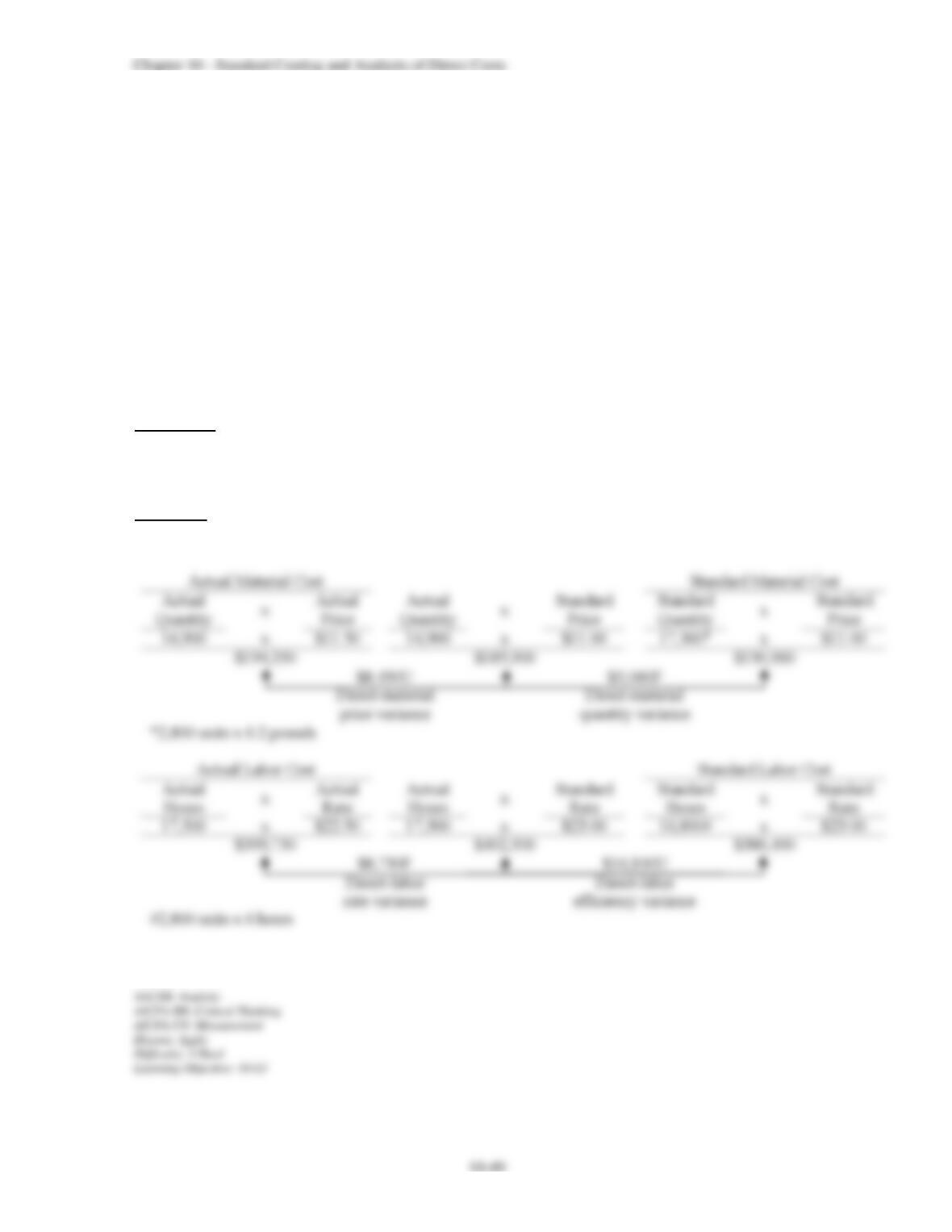
Calculate the direct-material price and quantity variances, and the direct-labor rate and
efficiency variances. Indicate whether each variance is favorable or unfavorable.
Solution:
10–50
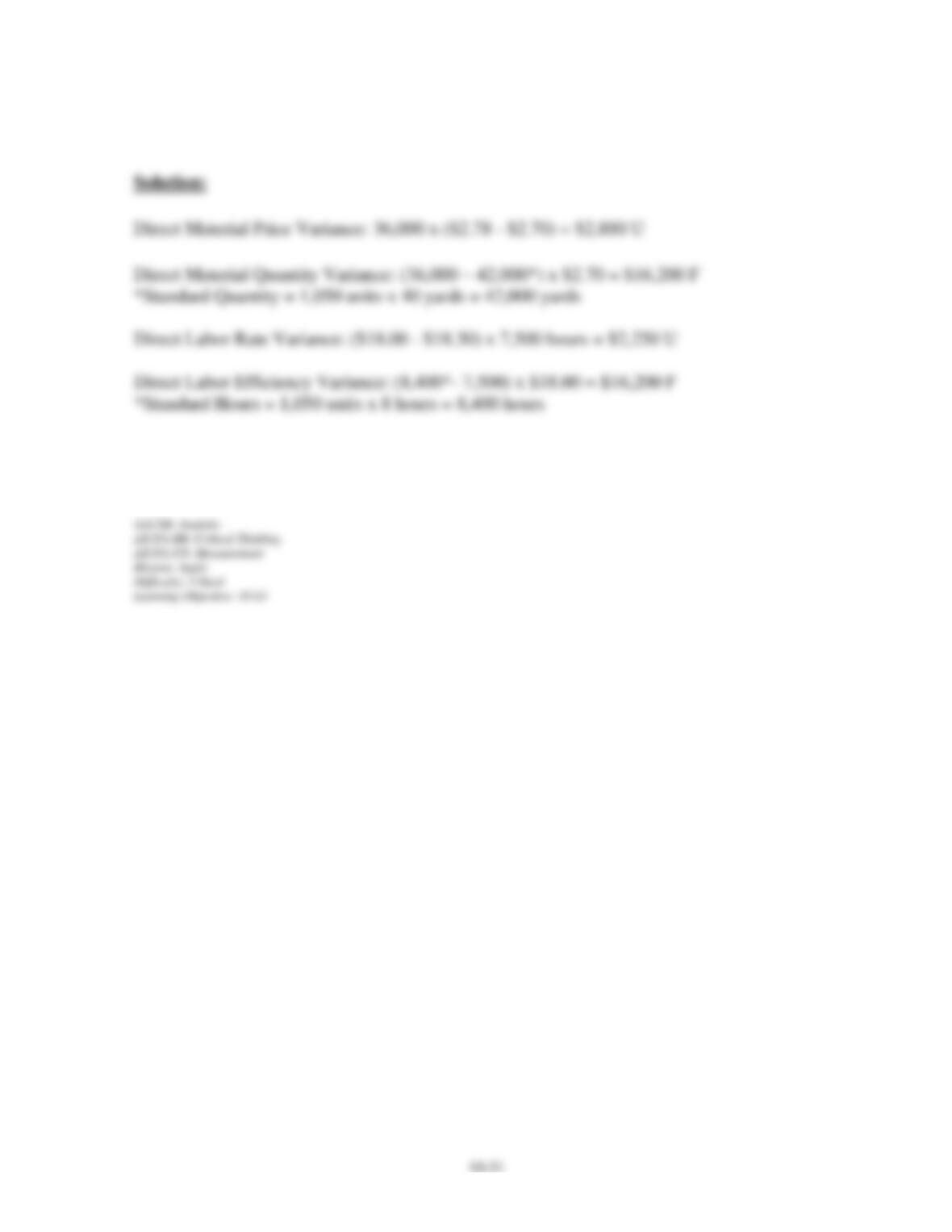
90. Maki, Inc. manufactures a product that has the following standard costs:
Direct materials: 40 yards at $2.70 per yard
$108
Direct labor: 8 hours at $18.00 per hour
144
Total
$252
The following information pertains to July:
Direct material purchased: 42,500 yards at $2.78 per yard, or $118,150
Direct material used: 36,000 yards
Direct labor: 7,500 hours at $18.30 per hour, or $137,250
Actual completed production: 1,050 units
Assume that the company computes variances at the earliest point in time.
Required:
Calculate the direct-material price and quantity variances, and the direct-labor rate and
efficiency variances. Indicate whether each variance is favorable or unfavorable.
Chapter 10 – Standard Costing and Analysis of Direct Costs

10–52
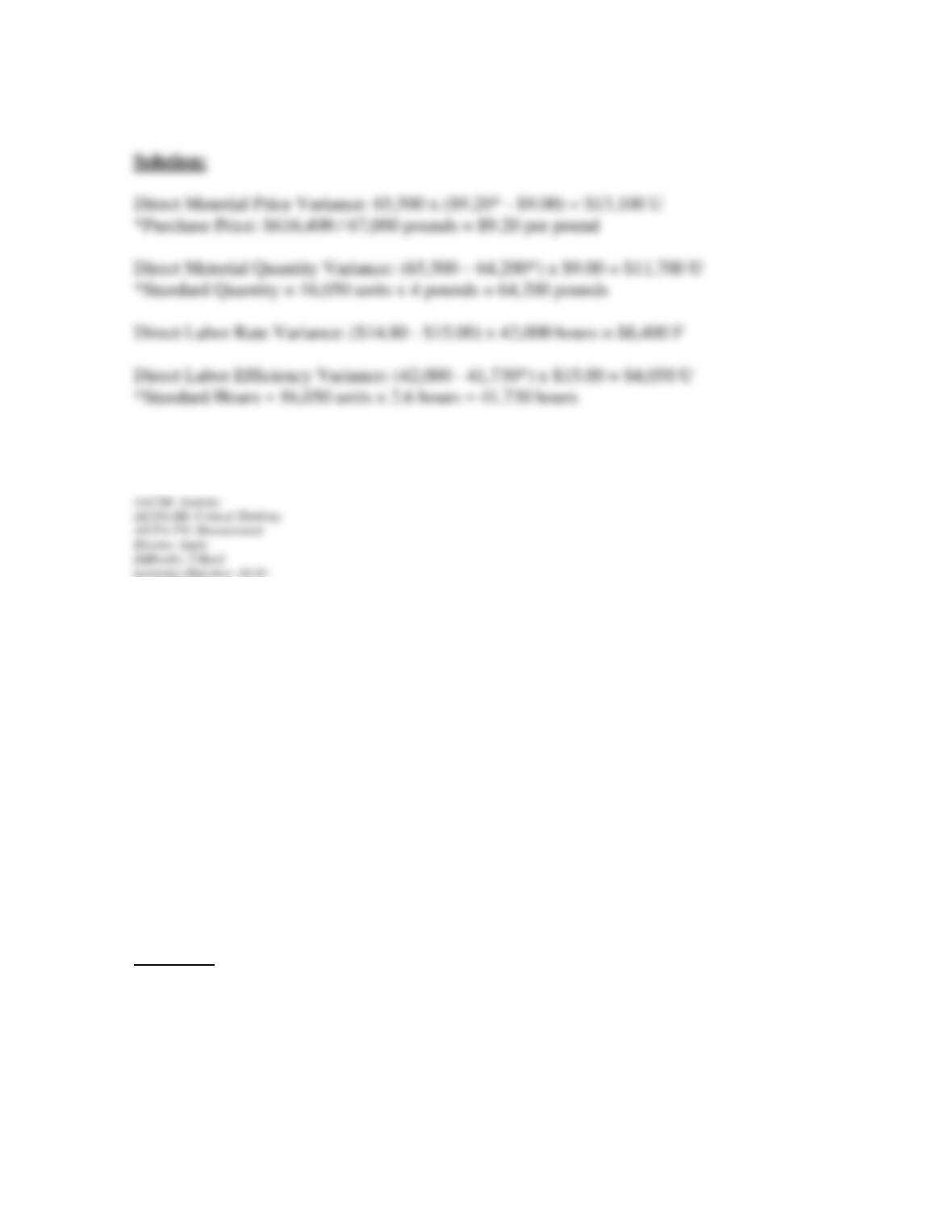
91. Timber Enterprises purchased 67,000 pounds (cost = $616,400) of direct material to be
used in the manufacture of the company’s only product. According to the production
specifications, each completed unit requires four pounds of direct material at a standard cost
of $9 per pound. Direct materials consumed by the end of the period totaled 65,500 pounds in
the manufacture of 16,050 finished units.
An examination of Timber’s payroll records revealed that the company worked 42,000 labor
hours (cost = $621,600) during the period, and specifications called for each completed unit
requiring 2.6 hours of labor at a standard cost of $15 per hour.
Assume that the company computes variances at the earliest point in time.
Required:
Calculate the direct-material price and quantity variances, and the direct-labor rate and
efficiency variances. Indicate whether each variance is favorable or unfavorable.
Chapter 10 – Standard Costing and Analysis of Direct Costs
10–53
92. Alberto Gonzalez operates a commercial painting business in Tampa, which has a very
tight labor market. Much of his work focuses on newly constructed apartments and
townhouses.
The following data relate to crew no. 5 for a recently concluded period when 85 apartment
units were painted:
· Three new employees were assigned to crew no. 5. Wages averaged $18.80 per hour for
each employee; the crew took 2,550 hours to complete the work.
· Based on his knowledge of the operation, articles in trade journals, and conversations with
other painters, Gonzalez established the following standards:
Typical hourly wage rate of crew personnel: $15
Anticipated crew time for each unit: 34 hours
· The paint quantity variance was $6,070F.
· The operation did not go as smoothly as planned, with customer complaints and problems
being much higher than expected.
Required:
A. Compute Gonzalez’s direct-labor variances.
B. Is the direct-labor rate variance consistent with what you might expect in a tight labor
market? Explain.
C. Analyze the information given and that you calculated, and determine what likely
happened that would give rise to customer complaints.