43) A company has 300,000 shares issued and outstanding of $1 par common stock. After a 2-for-1 stock
split, which of the following statements is FALSE?
A) The par value per share decreases to $0.50 per share.
B) The number of shares issued is 600,000.
C) The number of shares outstanding is 600,000.
D) The number of shares issued is 150,000.
44) How does the declaration and distribution of a 15% stock dividend affect stockholders’ equity?
A) The total amount of stockholders’ equity will increase.
B) The total amount of stockholders’ equity will decrease.
C) The balances of different accounts in stockholders’ equity will change, but total stockholders’ equity
is unchanged.
D) There is no change.
45) Pillsbury Company declares and distributes a 30% common stock dividend when it has 10,000
shares of $10 par common stock outstanding. The market price per share is $60 at the date of
declaration. Which journal entry is prepared?
A) debit Retained Earnings $180,000, credit Common Stock $30,000 and credit Paid-in Capital in Excess
of Par—Common $150,000
B) debit Retained Earnings $180,000, credit Paid-in Capital in Excess of Par—Common $180,000
C) debit Retained Earnings $180,000 and credit Common Stock $180,000
D) debit Retained Earnings $30,000 and credit Common Stock $30,000
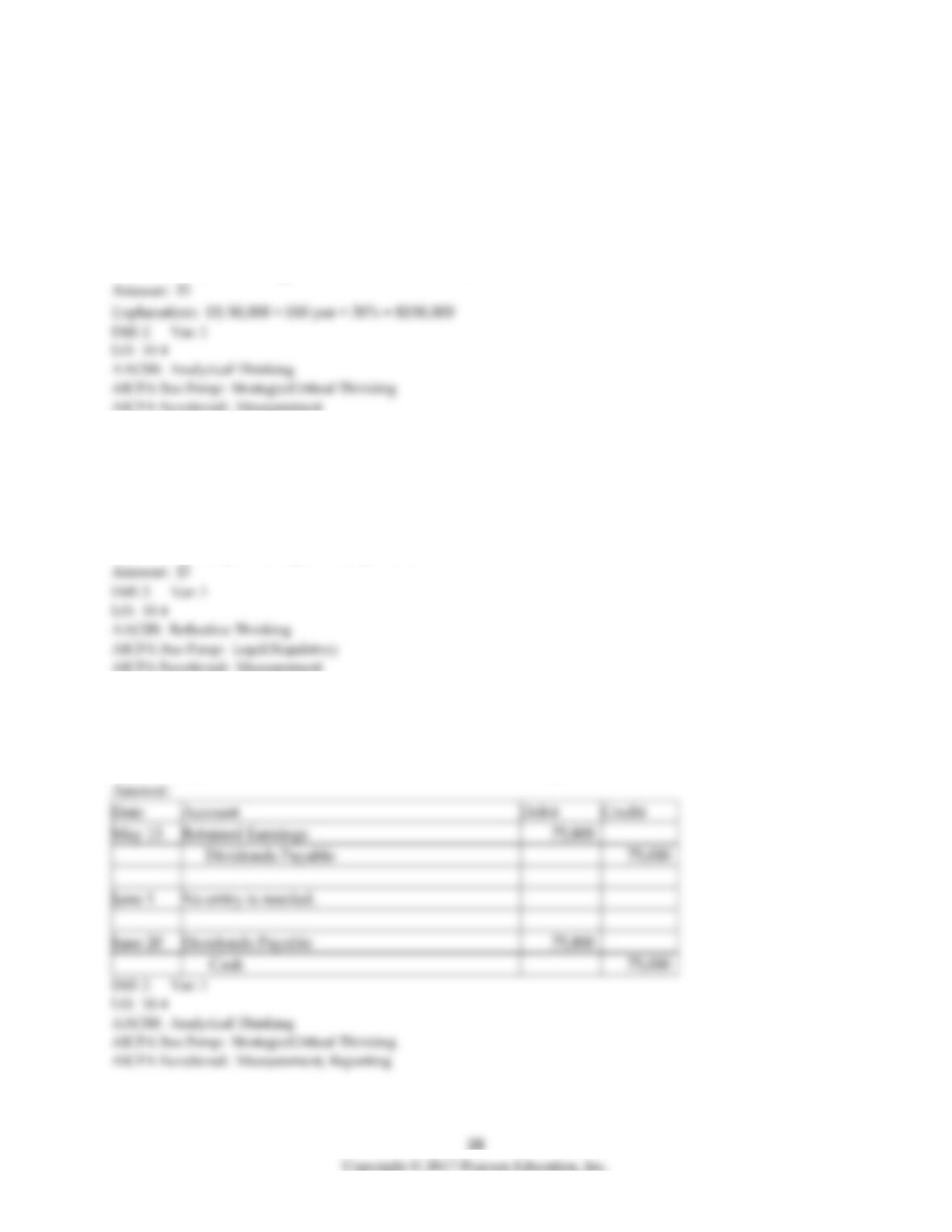
46) Dolanski Company declares and distributes a 30% common stock dividend when it has 50,000
shares of $10 par common stock outstanding. The market price per share is $30 at the date of
declaration. Which journal entry is prepared?
A) debit Retained Earnings $450,000, credit Common Stock $150,000 and credit Paid-in Capital in Excess
of Par—Common $300,000
B) debit Retained Earnings $450,000, credit Paid-in Capital in Excess of Par—Common $500,000
C) debit Retained Earnings $450,000 and credit Common Stock $450,000
D) debit Retained Earnings $150,000 and credit Common Stock $150,000
47) To record a 3% stock dividend, accountants use ________. To record a 60% stock dividend,
accountants use ________.
A) market price per share; market price per share
B) par value per share; par value per share
C) par value per share; market price per share
D) market price per share; par value per share
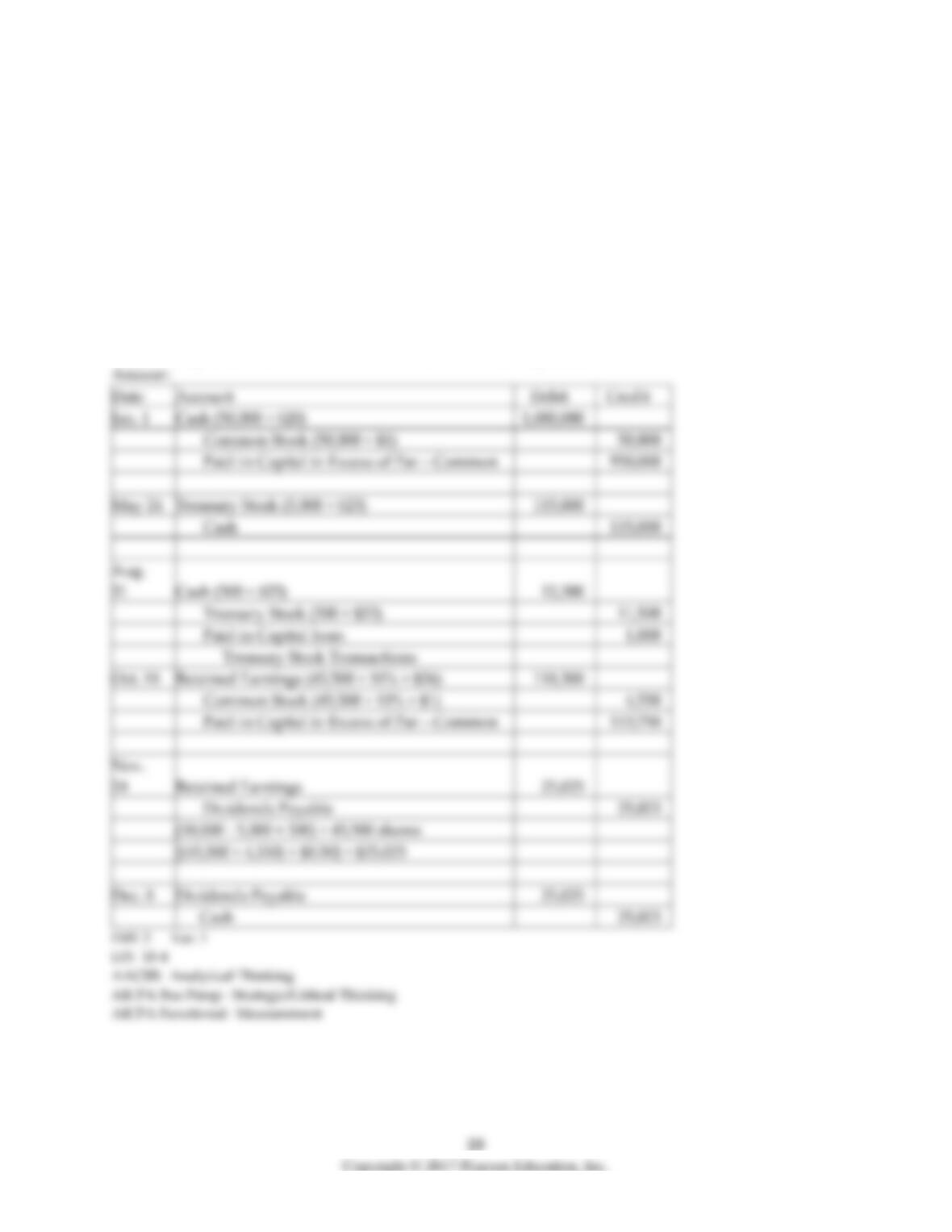
48) On May 15, the board of directors declared a cash dividend of $75,000. The date of record is June 1
and the payment date is June 20.
Prepare the journal entries to record this cash dividend. Omit explanations.
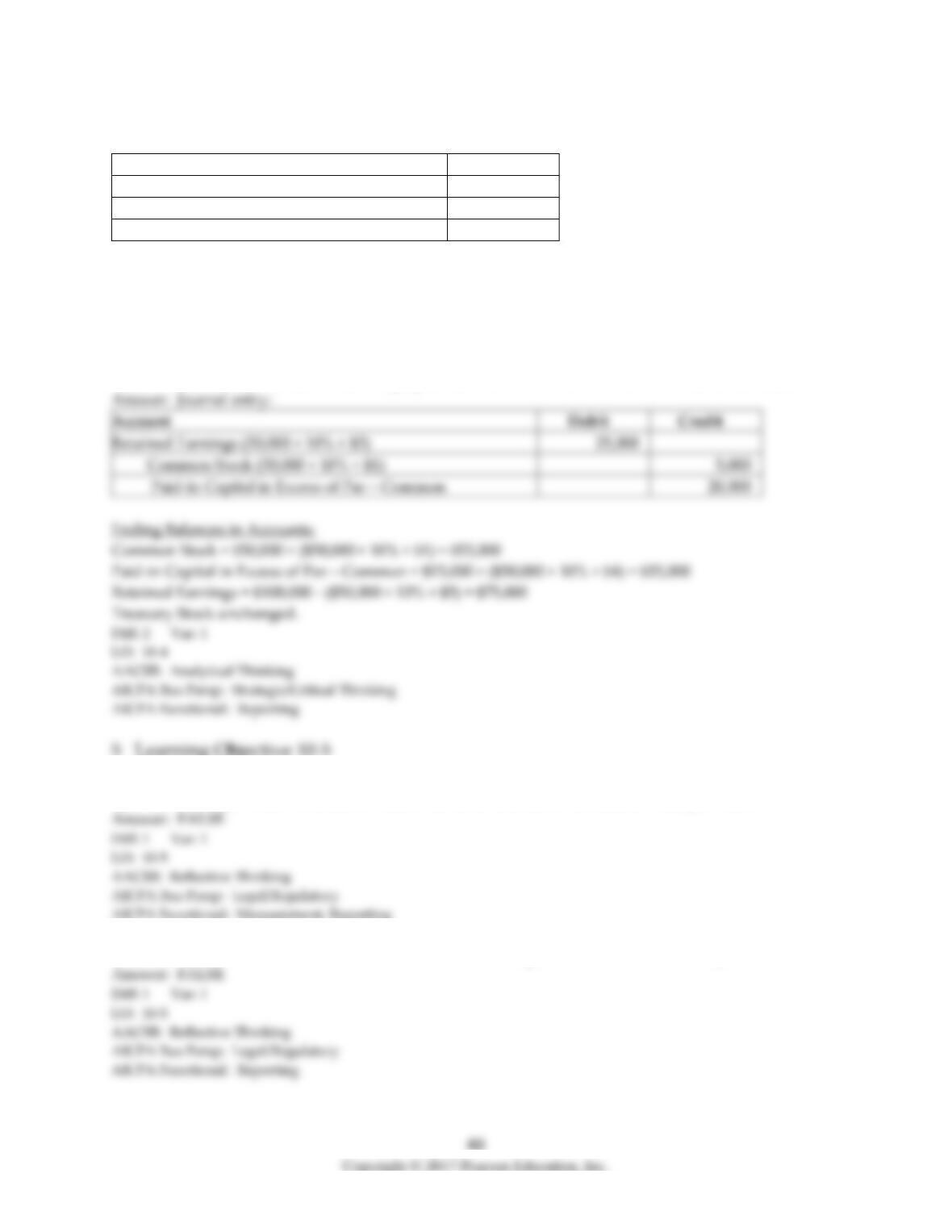
49) During the first year of operations, New York Corporation had the following transactions:
∙ Jan. 1 — Issued 50,000 shares of $1 par value common stock at $20 per share.
∙ May 24 — Reacquired 5,000 shares of common stock sold on Jan. 1 for $23 per share.
∙ Aug. 31 — Sold 500 shares of its treasury stock purchased on May 24 for $25 per share.
∙ Oct. 18 — The board of directors declared and distributed a 10% common stock dividend. The
market price of the common stock was $26 per share at the time of the declaration.
∙ Nov. 24 — The board of directors declared a cash dividend of $0.50 per share payable to
stockholders on December 8.
∙ Dec. 8 — Paid the cash dividends declared on November 24.
Required:
Prepare the journal entries for the above transactions. Omit explanations.
50) On February 4, Osterheld Corporation’s stockholders’ equity section appears as follows:
Common Stock, $1 par value
$50,000
Paid-in Capital in Excess of Par—Common
15,000
Retained Earnings
100,000
Treasury Stock
(10,000)
On February 4, Osterheld Corporation declares and distributes a 10% stock dividend when the market
value of the stock is $5.
Required:
Prepare the journal entry for the stock dividend.
Show the balances in the stockholders’ equity accounts after the stock dividend has been distributed.
Retained Earnings (50,000 × 10% × $5)
25,000
20,000
1) A book value per share of common stock is the same amount as the market value per share.
2) In most cases, stockholders are more concerned about the par value of a stock than any other value.
3) The book value per share of common stock is the amount of common stockholders’ equity on the
company’s books for each share of its stock.
4) If a company only has common stock outstanding, book value per share of common stock is
computed by dividing:
A) total paid-in capital divided by the number of common shares of stock issued.
B) total paid-in capital divided by the number of common shares of stock outstanding.
C) total stockholders’ equity divided by the number of common shares of stock issued.
D) total stockholders’ equity divided by the number of common shares of stock outstanding.
5) The amount of stockholders’ equity attributable to each share of common stock is known as the
________ per share.
A) earnings
B) book value
C) market value
D) preferred value
6) Redeemable preferred stock:
A) obligates the company to pay to retire the stock at a set price.
B) is really not stockholders’ equity and thus is recorded as a liability.
C) is redeemed at its liquidation value.
D) A and B are correct.
7) On December 31, Anway Corporation reports the following amounts in the stockholders’ equity
section of the balance sheet:
Common Stock, $20 par
$2,000,000
Paid-in Capital in Excess of Par—Common
4,000,000
Retained Earnings
4,300,000
Treasury Stock, 50,000 shares
(200,000)
What is the book value per share? (Round your final answer to the nearest cent.)
A) $20.00
B) $80.00
C) $202.00
D) $24.00
8) On December 31, Schmid Corporation reports the following amounts in the stockholders’ equity
section of the balance sheet:
5% Preferred Stock, $50 par
$1,000,000
Common Stock, $20 par
$4,000,000
Paid-in Capital in Excess of Par—Common
3,000,000
Retained Earnings
4,325,000
Treasury Stock, 50,000 shares
(200,000)
There are no preferred dividends in arrears. What is the book value per share? (Round your final
answer to the nearest cent.)
A) $20.00
B) $4.00
C) $74.17
D) $24.00
9) On December 31, Elker Corporation reports the following amounts under stockholders’ equity on the
balance sheet:
5% Preferred Stock, $50 par
$1,000,000
Common Stock, $10 par
4,400,000
Paid-in Capital in Excess of Par—Common
1,000,000
Retained Earnings
4,125,000
Treasury Stock, 50,000 shares
(200,000)
There are no preferred dividends in arrears. The redemption value of the preferred stock is $1,600,000.
What is the book value per share? (Round your final answer to the nearest cent.)
A) $26.99
B) $19.81
C) $22.37
D) $31.60
10) On December 31, Clorine Corporation has the following data available:
Net Income
$190,000
Interest expense
20,000
Preferred dividends
30,000
Total assets at the beginning of the year
810,000
Total assets at the end of the year
750,000
Total stockholders’ equity at the beginning of the year
600,000
Total stockholders’ equity at the end of the year
480,000
What is return on assets? (Round your final answer to two decimal places, X.XX%)
A) 20.51%
B) 28.21%
C) 40.74%
D) 29.63%
11) On December 31, Mercury Corporation has the following data available:
Net Income
$200,000
Interest expense
20,000
Preferred dividends
20,000
Total assets at the beginning of the year
850,000
Total assets at the end of the year
780,000
Total common stockholders’ equity at the beginning of
the year
550,000
Total common stockholders’ equity at the end of the year
490,000
What is return on common equity? (Round your final answer to two decimal places, X.XX%)
A) 34.62%
B) 42.31%
C) 38.46%
D) 22.09%
12) On December 31, Copper Corporation has the following data available:
Net Income
$200,000
Interest expense
20,000
Preferred dividends
20,000
Total assets at the beginning of the year
840,000
Total assets at the end of the year
750,000
Total common stockholders’ equity at the beginning of
the year
570,000
Total common stockholders’ equity at the end of the year
490,000
What is the leverage ratio? (Round your final answer to two decimal places.)
A) 0.67
B) 1.53
C) 1.50
D) 0.38
13) If a company has common stock and preferred stock outstanding, book value per share is calculated
as:
A) total paid-in capital divided by the number of common shares of stock outstanding.
B) total paid-in capital divided by the number of common shares issued.
C) total stockholders’ equity minus preferred equity divided by the number of common shares
outstanding.
D) total stockholders’ equity minus preferred equity divided by the number of common shares issued.
14) On December 31, Sulfur Corporation has the following data available:
Net Income
$120,000
Interest expense
40,000
Preferred dividends
20,000
Total assets at the beginning of the year
790,000
Total assets at the end of the year
870,000
Total stockholders’ equity at the beginning of the year
410,000
Total stockholders’ equity at the end of the year
250,000
What is return on assets? (Round your final answer to two decimal places, X.XX%)
A) 7.23%
B) 12.05%
C) 30.30%
D) 14.46%
15) On December 31, Sulfur Corporation has the following data available:
Net Income
$200,000
Interest expense
20,000
Preferred dividends
20,000
Total assets at the beginning of the year
770,000
Total assets at the end of the year
870,000
Total common stockholders’ equity at the beginning of
the year
500,000
Total common stockholders’ equity at the end of the year
210,000
What is return on common equity? (Round your final answer to two decimal places, X.XX%.)
A) 21.95%
B) 50.70%
C) 45.07%
D) 56.34%
16) On December 31, Sulfur Corporation has the following data available:
Net Income
$100,000
Interest expense
30,000
Preferred dividends
20,000
Total assets at the beginning of the year
780,000
Total assets at the end of the year
890,000
Total common stockholders’ equity at the beginning of
the year
410,000
Total common stockholders’ equity at the end of the year
210,000
What is the leverage ratio? (Round your final answer to two decimal places.)
A) 8.90
B) 4.24
C) 2.69
D) 2.10
17) Using DuPont Analysis, what are the components of return on stockholders’ equity?
A) Return on Sales and Leverage Ratio
B) Return on Sales, Debt Ratio and Asset Turnover Ratio
C) Return on Assets and Debt Ratio
D) Net Profit Margin Ratio, Asset Turnover Ratio, and Leverage Ratio
18) Using DuPont Analysis, what are the components of return on assets?
A) Return on Sales and Debt Ratio
B) Return on Sales and Leverage Ratio
C) Return on Sales and Total Asset Turnover Ratio
D) Total Asset Turnover Ratio and Leverage Ratio
19) Return on equity:
A) shows the relationship between net income and net assets.
B) is computed for both common and preferred stock.
C) is a standard measure used to compare companies of different sizes.
D) is computed by dividing net income plus preferred dividends by average common stockholders’
equity.
20) What is the formula for the price-earnings ratio? What does this ratio measure?
6 Learning Objective 10-6
1) The purchase of treasury stock is reported on the statement of cash flows as a financing activity.
2) Dividend payments are a type of financing activity because the company is paying stockholders for
the use of their money.
3) On the stockholders‘ equity section of the Balance Sheet, Common Stock is listed before Preferred
Stock.
4) The sale of treasury stock is reported as a cash inflow in the financing activities section of a statement
of cash flows.
5) The issuance of common stock in exchange for cash will be reported in:
A) the noncash financing section of the statement of cash flows.
B) the operating activities section of the statement of cash flows.
C) the investing activities section of the statement of cash flows.
D) the financing activities section of the statement of cash flows.
6) The purchase of treasury stock is reported on the statement of cash flows as a:
A) positive amount in the financing activities section.
B) negative amount in the financing activities section.
C) positive amount in the investing activities section.
D) negative amount in the investing activities section.
7) The payment of dividends will be reported on the statement of cash flows as a:
A) positive amount in the investing activities section.
B) negative amount in the investing activities section.
C) positive amount in the financing activities section.
D) negative amount in the financing activities section.
8) Where are stock dividends reported on the statement of cash flows?
A) do not appear anywhere in the statement of cash flows
B) operating activities section
C) financing activities section
D) investing activities section
9) In general, the order of reporting stockholders’ equity on the balance sheet is:
A) Common Stock, Preferred Stock, Paid-in Capital in Excess of Par, Retained Earnings, Treasury Stock.
B) Preferred Stock, Common Stock, Treasury Stock, Paid-in Capital in Excess of Par, Retained Earnings.
C) Preferred Stock, Common Stock, Paid-in Capital in Excess of Par, Retained Earnings, Treasury Stock.
D) Retained Earnings, Preferred Stock, Common Stock, Paid-in Capital in Excess of Par, Treasury Stock.
10) A company has Total Paid-in Capital of $100,000, Retained Earnings of $200,000, Treasury Stock of
$10,000 and Accumulated Other Comprehensive Income of $200,000. What is the CORRECT statement
about listing these accounts on the balance sheet?
A) Retained Earnings should be the last line before Total Stockholders’ Equity.
B) Total Paid-in Capital should be the last line before Total Stockholders’ Equity.
C) Treasury Stock or Accumulated Other Comprehensive Income should be the last line before Total
Stockholders’ Equity.
D) There is no specific order used by Generally Accepted Accounting Principles.
11) The Statement of Stockholders’ Equity includes:
A) each revenue and expense account.
B) each asset account.
C) each liability account.
D) each stockholders’ equity account.
12) The Statement of Stockholders‘ Equity does NOT include:
A) Retained Earnings.
B) Accumulated Other Comprehensive Income.
C) Treasury Stock.
D) Equity-Method Investments.
13) Many businesses present a detailed vertical analysis of the activity in each separate account in the
Statement of Stockholders’ Equity. This statement reports all of the following transactions EXCEPT:
A) cash dividends declared and distributed.
B) stock dividends declared and distributed.
C) purchase of treasury stock.
D) realized gains on reissuing treasury stock.
14) Regarding the Statement of Stockholders‘ Equity, which of the following statements is
INCORRECT?
A) If preferred stock exists, it is listed first and is usually reported as a single amount.
B) Common stock lists par value per share, the number of shares authorized, the number of shares
issued and the number of shares outstanding.
C) Treasury stock is reported, usually at cost, as a deduction.
D) Accumulated other comprehensive income is deducted and may be listed either before or after
Treasury Stock.
15) Regarding the real-world format of the Statement of Stockholders’ Equity, which of the following
statements is INCORRECT?
A) Retained earnings comes after the paid-in capital accounts.
B) Outstanding stock equals issued stock plus treasury stock.
C) The balance of the Common Stock account is determined by multiplying the number of shares issued
by the par value per share.
D) Additional paid-in capital combines Paid-in capital in excess of par plus Paid-in capital from other
sources.