10.4-27 A share of 6% preference shares has a par value of $100 and market value of $120. The
owners of the preference shares will receive a dividend of:
A) $100.
B) $12.
C) $6.
D) $10.
10.4-28 Passed dividends on cumulative preference shares:
A) are referred to as dividends in arrears.
B) are considered a liability until paid.
C) must be paid by January 1 of the following year by law.
D) are referred to as a liability and must be paid by January 1 of the following year by law.
10.4-29 When the board of directors declares a cash dividend, the owners of noncumulative
preference shares must receive:
A) neither the current year’s dividend nor dividends in arrears.
B) dividends in arrears, but not the current year’s dividend.
C) all dividends in arrears plus the current year’s dividend.
D) the current year’s dividend, but no dividends in arrears.
10.4.30 Dividends in arrears on cumulative preference shares are:
A) ignored on the financial statements.
B) disclosed in notes to the financial statements.
C) reported as a current liability on the balance sheet.
D) reported as a long-term liability on the balance sheet.
10.4.31 There can be dividends in arrears on:
A) cumulative preference shares.
B) noncumulative participating preference shares.
C) noncumulative preference shares.
D) noncumulative no-par value preference shares.
10.4.32 Preference shares whose owners must receive all dividends in arrears before the
corporation can pay dividends to the ordinary shareholders are called:
A) participating preference shares.
B) cumulative preference shares.
C) par value preference shares.
D) outstanding preference shares.
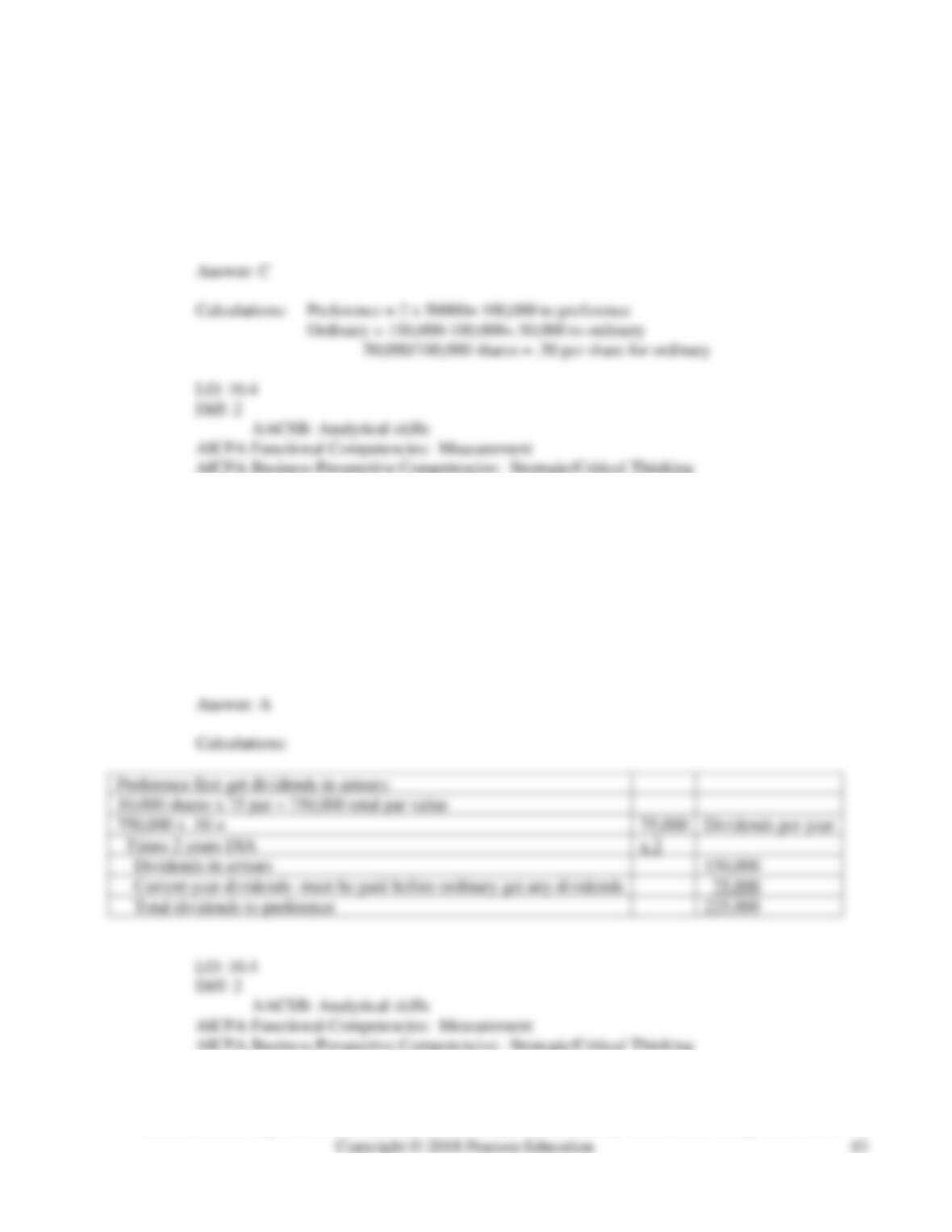
10.4-33 The Floristan Company has 50,000 preference shares outstanding, with annual dividends
paid at
the rate of $2 per share. Floristan also has 100,000 ordinary shares outstanding. If the Floristan
Company declares a $150,000 dividend, each outstanding ordinary shares would receive:
A) $1.50.
B) $1.00.
C) $0.50.
D) $2.00.
10.4-34 The Kendo Corporation has 10,000 shares of 10%, $75 par value, cumulative preference shares
outstanding and 50,000 shares of $5 par value ordinary shares outstanding. There are currently
two years’ dividends in arrears on the preference shares. The board of directors wants to give the
ordinary shareholders a $1.50 dividend per share. The total dividends to be paid to preference
shareholders are:
A) $225,000.
B) $300,000.
C) $75,000.
D) $150,000.
10.4-35 Sabik Corporation has had 7,500 shares of 6%, $50 par value, cumulative preference
shares outstanding as well as 28,000 shares of $10 par value ordinary shares outstanding since it was
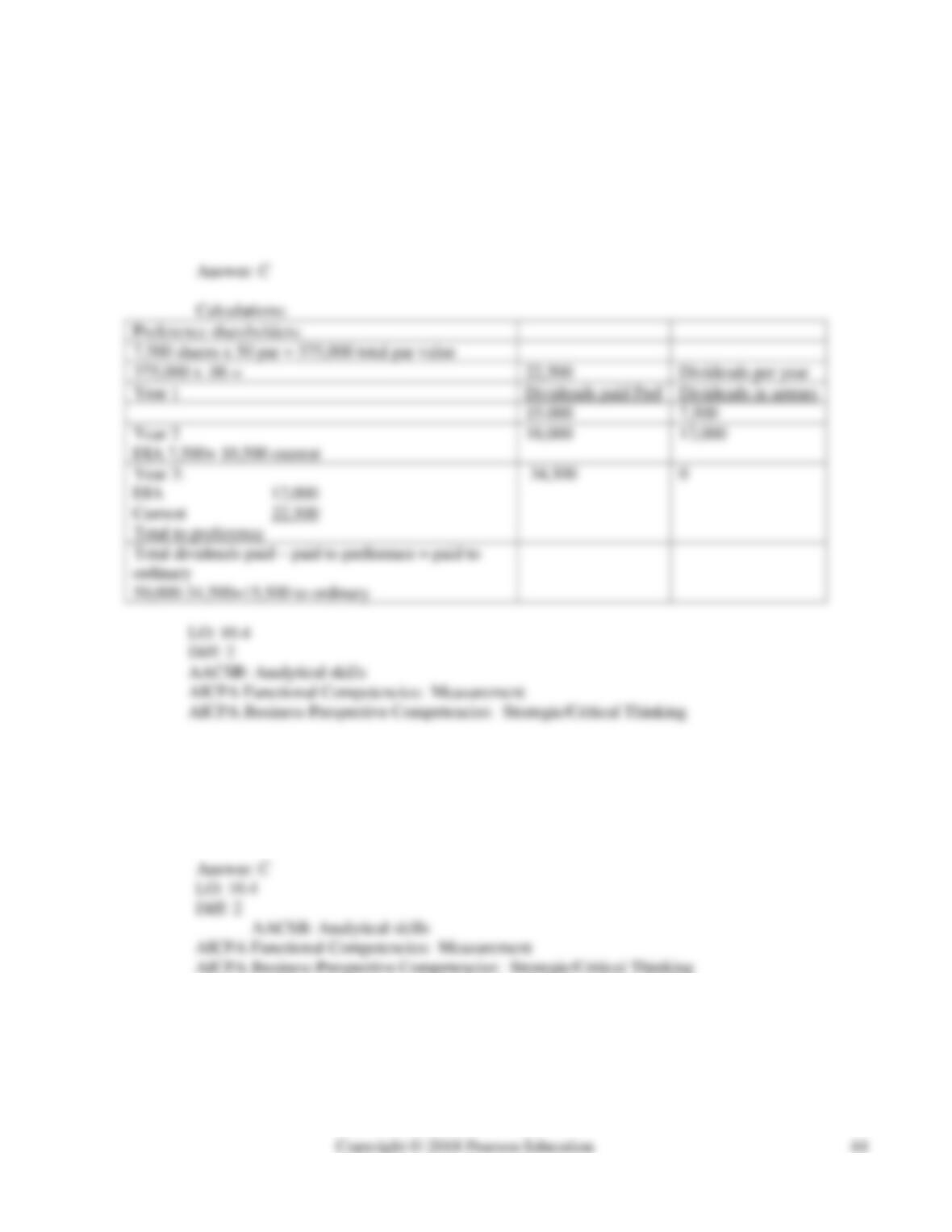
incorporated.) During the first, second, and third years of operations, $15,000, $18,000, and
$50,000 in dividends, respectively, was paid. The dividends paid to the ordinary shareholders of
Sabik Corporation in year three amounted to:
A) $27,500.
B) $0.
C) $15,500.
D) an undetermined amount. The ordinary share dividend cannot be determined from the given
information.
10.4-36 A proportional distribution by a corporation of its own shares to its shareholders is called:
A) treasury shares.
B) cash dividend.
C) share dividend.
D) property dividend.
10.4-37 Declaring and distributing share dividends:
A) increases the total liabilities of the corporation and decreases the total shareholders’ equity.
B) is the distribution of cash to the shareholders.
C) has no effect on total shareholders’ equity.
D) reduces the total assets of the corporation.
10.4-38 Declaration and distribution of share dividends:
A) increases the total liabilities of the corporation and decreases the total shareholders’ equity.
B) increases the shares account and decreases retained earnings.
C) reduces the total liabilities of the corporation.
D) reduces the total assets of the corporation.
10.4-39 Mary, a shareholder in the Doggy Boutique, owns 500 share of their ordinary shares.
Mary receives a 10% share dividend. After the share dividend, Mary will have:
A) a total of 50 Doggy Boutique ordinary shares.
B) a total of 500 Doggy Boutique ordinary shares.
C) a total of 550 Doggy Boutique ordinary shares.
D) an undetermined number of shares, since the number of shares cannot be determined from the
information given.
10.4-40 Mary, a shareholder in the Doggy Boutique, owns 500 share of their ordinary shares,
which represents 20% of the outstanding ordinary shares of Doggy Boutique. Mary receives a 10%
share dividend. After the share dividend, Mary will have:
A) a 30 % ownership in Doggy Boutique’s ordinary shares.
B) a 20% ownership in Doggy Boutique’s ordinary shares.
C) a 10% ownership in Doggy Boutique’s ordinary shares.
D) an undetermined ownership percentage in Doggy Boutique.
10.4-41 A share dividend is usually issued because:
A) the company wants to increase the market price of its share.
B) the company wants to improve its earnings per share ratio.
C) the company wants to continue dividends but conserve cash.
D) the company wants to reduce the liquidity of the shares in the market.
10.4-42 The entry to record the declaration and distribution of a share dividend includes a:
A) credit to Ordinary shares and a debit to Retained Earnings.
B) debit to Share dividends Payable and a credit to Share dividends.
C) debit to Share dividends Payable and a credit to Retained Earnings.
D) debit to Retained Earnings and a credit to Share dividends Payable.
10.4-43 A large share dividend will:
A) increase total owners’ equity.
B) reduce total assets.
C) have no effect on total assets or total owners’ equity.
D) reduce total owners’ equity.
10.4-44 The value of a share dividend is computed as:
A) current market value times the number of shares to be distributed.
B) liquidation value times the number of shares to be distributed.
C) par value times the number of shares to be distributed.
D) book value times the number of shares to be distributed.
10.4-45 An increase in the number of authorized, issued and outstanding shares coupled with a
proportionate reduction in the shares’ par value is a:
A) stock split.
B) share dividend.
C) cash dividend .
D) deficit.
10.4-46 Wallendo Corporation issued 5,000 shares of its $1 par value ordinary shares as a share
dividend when the shares were selling for $10 per share. At the time of the dividend, Wallendo
had 100,000 ordinary shares outstanding. These shares were originally issued for $5 per share. The
entry to record the share dividend includes a debit to Retained Earnings for:
A) $50,000.
B) $5,000.
C) $100,000.
D) $105,000.
10.4-47 Which of the following statements regarding stock splits is INCORRECT?
A) A stock split is an increase in the number of authorized, issued and outstanding shares.
B) A stock split decreases the market price of the shares.
C) A stock split involves a reduction in the shares’s par value.
D) A stock split increases total owners’ equity.
10.4-48 A stock split:
A) has no effect on total equity.
B) increases Ordinary shares and decreases Paid-in Capital.
C) increases assets and decreases equity.
D) decreases Retained Earnings and increases Paid-in Capital.
10.4-49 A company may declare a stock split to:
A) reduce retained earnings.
B) avoid paying a cash dividend.
C) reduce total equity.
D) decrease the market value of the shares.
10.4-50 Hillerbert Company declared a 2-for-1 stock split on its 200,000 shares of $10 par value
ordinary shares. As a result of this transaction:
A) Paid-in Capital increases by $2,000.
B) Ordinary shares increases to $4,000,000.
C) both A and B are correct.
D) none of these answers is correct.
10.4-51 Hubert Company declared a 2-for-1 stock split on its 200,000 shares of $10 par value
ordinary shares. As a result of this transaction:
A) the number of shares increases to 400,000 and the par value remains at $10 per share.
B) the number of shares increases to 400,000 and the par value is reduced to $5 per share.
C) the number of shares is reduced to 200,000 and the par value increases to $20 per share.
D) none of these answers is correct.
10.4-52 The B. Spaniel Company has Ordinary shares with a $5 par value. 100,000 shares were
authorized and 25,000 shares were issued. Ordinary shares are currently selling at $13 per share.
The entry to record the distribution of a 15% ordinary share dividend includes a:
A) debit to Retained Earnings for $37,500.
B) credit to Ordinary shares for $37,400.
C) credit to Paid-in Capital in Excess of Par Value–Ordinary for $30,000.
D) debit to Paid-in Capital in Excess of Par Value–Ordinary for $30,000.
10.4-53 The B. Spaniel Company has ordinary shares with a $5 par value. 100,000 shares were
authorized and 25,000 shares were issued. Ordinary shares is currently selling at $13 per share.
The entry to record the distribution of a 15% ordinary share dividend includes:
A) a debit to Dividends Payable for $30,000.
B) a debit to Ordinary shares for $18,750.
C) a credit to Retained Earnings for $48,750.
D) both a credit to Ordinary shares for $18,750 and debit to Retained Earnings for $48,750.
10.4-54 The B. Spaniel Company has ordinary shares with a $5 par value. 100,000 shares were
authorized and 25,000 shares were issued. Ordinary shares are currently selling at $13 per share.
The number of ordinary shares authorized and issued after the distribution of a 15% ordinary
share dividend is:
A) 115,000 and 28,750.
B) 115,000 and 25,000.
C) 100,000 and 25,000.
D) 100,000 and 28,750.
10.4-55 The entry to record the declaration and distribution of a share dividend includes a credit to Paid–
in Capital when the company:
A) issues a cash dividend.
B) issues a share dividend.
C) announce a stock split.
D) purchase treasury shares.
10..5-1 The book value of a share is the amount of shareholders’ equity on the company’s books for each
share.
10.5-2 In most cases, shareholders are more concerned about the market value of a share than any other
value.
10.5-3 If the company has both preference and ordinary shares outstanding, the ordinary shareholders
have the first claim to owners’ equity.
10.5-4 The redemption value of cumulative preference shares is the par value of the shares less any
dividends in arrears.