Version 1 13
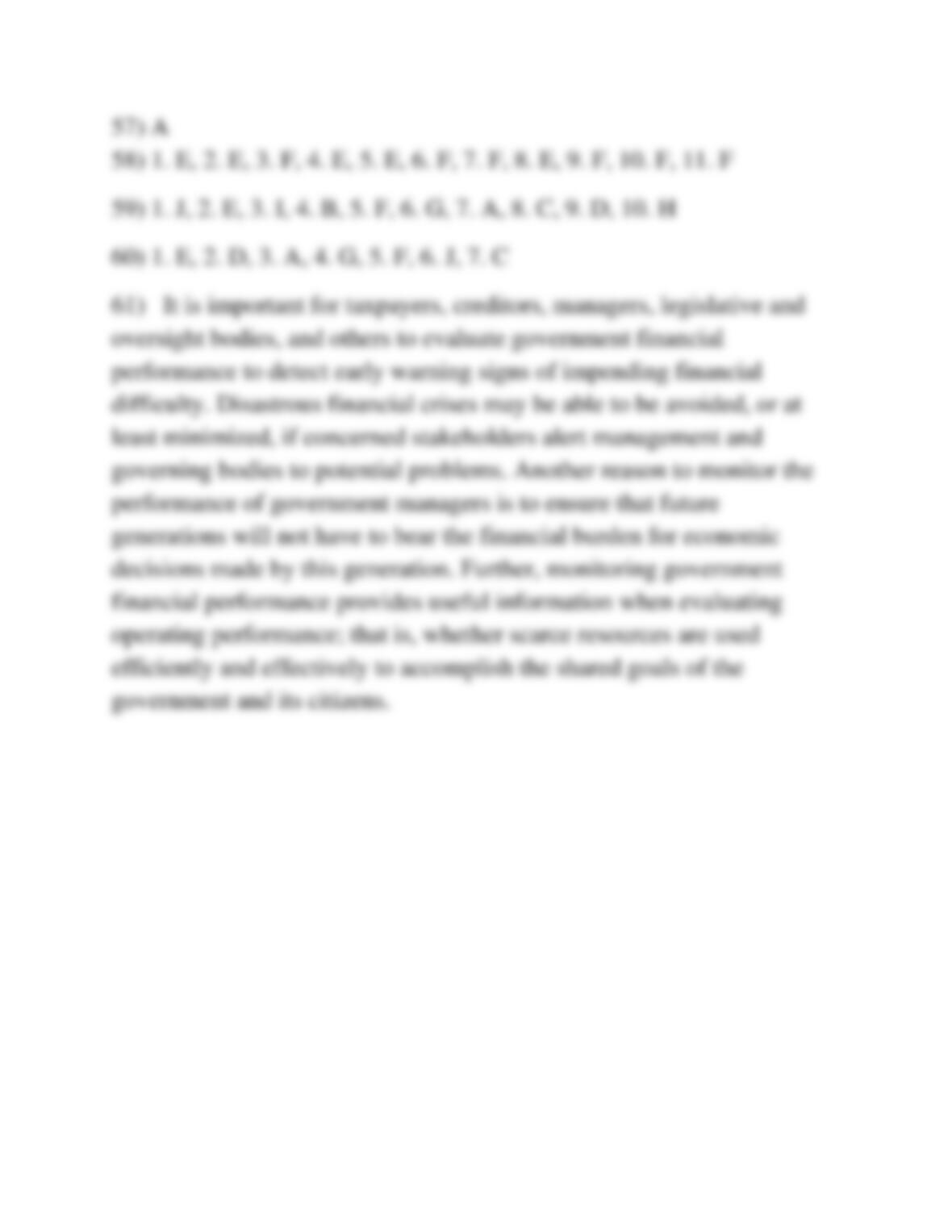
59) For each of the following financial ratios that are based on comprehensive annual
financial report (CAFR) information select the appropriate letter for the explanation of that ratio.
Answers can only be used once.
A.An indicator of interperiod equity.
B.An indicator of the government’s commitment to replacement of capital assets.
C.An indicator of the government’s reliance on revenues it does not directly control.
D.A measure of the degree to which government assets have been funded with debt.
E.An indicator of the government’s ability to pay its 60- to 90-day obligations.
F.A measure of the government’s capacity to issue debt.
G.A measure of capital asset useful service life.
H.A measure of the government’s liquidity.
I.An indicator of taxpayer debt burden.
J.An indicator of the government’s ability to withstand financial emergencies.
_____ 1. General fund balances/General Fund operating revenues.
_____ 2. (Cash + short-term investments)/Current liabilities.
_____ 3. General obligation long-term debt/Assessed valuation.
_____ 4. Capital outlay from operating funds/Operating expenditures.
_____ 5. General bonded debt/Legal debt limit.
_____ 6. Accumulated depreciation/Average cost of depreciable assets.
_____ 7. Net revenues/Total expenses.
_____ 8. Charges for services/Total revenues.
_____ 9. Total liabilities/Total assets.
_____ 10. Current assets/Current liabilities.
Version 1 14
60) For the following definitions, select the key term that best relates to the definition.
A.Benchmarking
B.Budgetary solvency
C.Cash solvency
D.Economic condition
E.Financial condition
F.Financial position
G.Fiscal capacity
H.Long-run solvency
I.Service capacity
J.Service-level solvency
_____ 1. The probability that a government will meet its financial obligations as they become
due and its service obligations to constituencies.
_____ 2. A composite of a government’s financial health and its ability and willingness to meet
its financial obligations and its commitments to provide services.
_____ 3. The method of identifying a number that represents a target to which actual results are
compared, or a basis for comparison.
_____ 4. The government’s ongoing ability and willingness to raise revenues, incur debt, and
meet its financial obligations as they become due.
_____ 5. The adequacy of cash and short-term claims to cash to meet current obligations and
those expected in the near future.
_____ 6. A government’s ability to provide services at the level and quality that citizens desire.
_____ 7. A government’s ability to generate enough cash over a 30- or 60-day period to pay its
bills.
61) Explain the importance of evaluating government financial performance.
Version 1 15
62) Distinguish and describe key financial performance concepts, such as financial position,
financial condition, and economic condition.
63) Explain the relationships among environmental factors, organizational factors, and
financial factors in determining government financial condition.
64) Describe how financial performance is related to the operating performance of a
government entity.
65) Discuss how despite significant improvements in the quality of government financial
reporting over the years there are still serious, high profile public sector financial crises. How
does the quality of financial reporting affect the ability to evaluate financial condition?
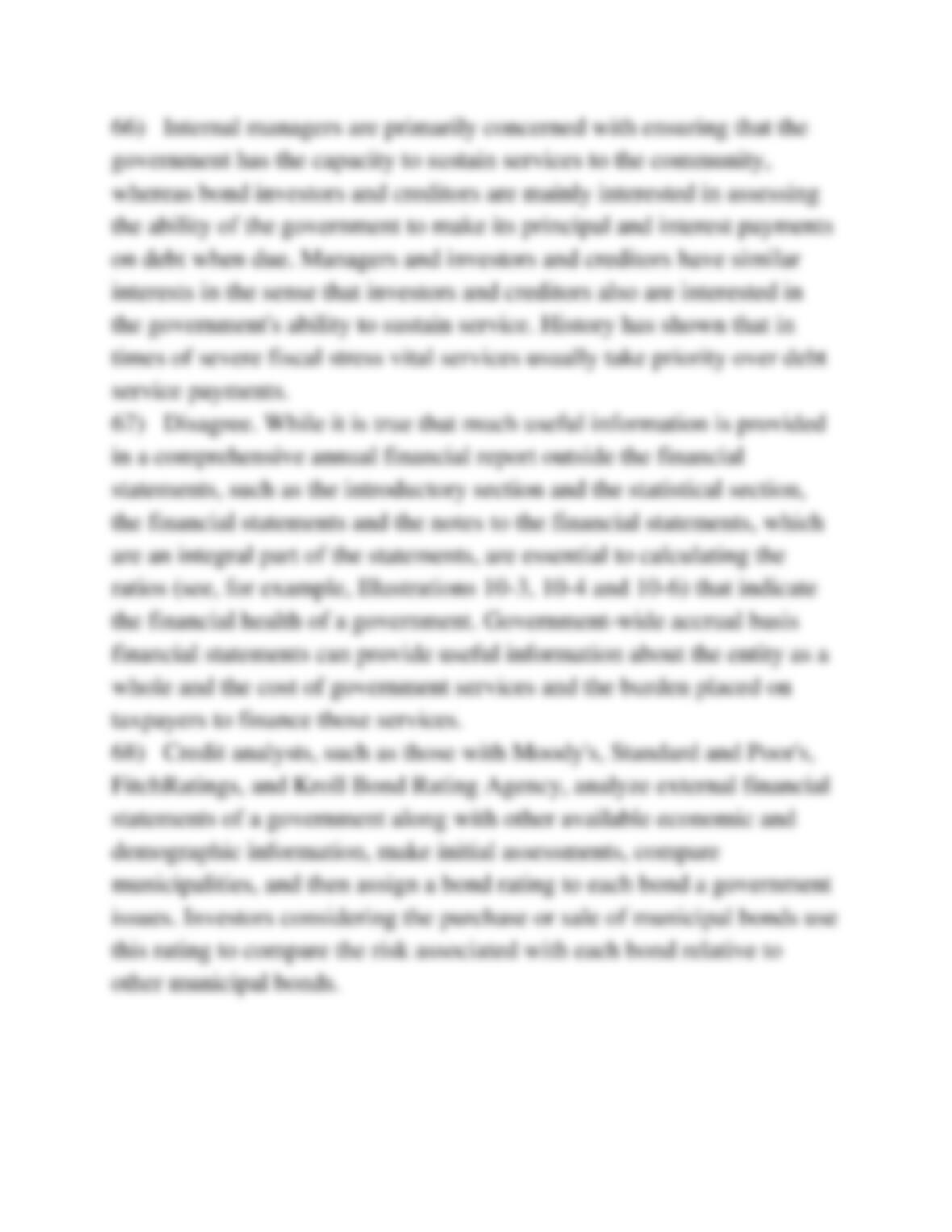
66) How do the objectives of evaluating financial condition differ between internal managers
and credit analysts? How are their objectives similar?
Version 1 16
67) “Financial statements are virtually useless in evaluating a city’s financial condition.” Do
you agree with this statement? Why or why not?
68) How do credit analysts assist decision makers in evaluating the credit worthiness of a
state or local government?
69) “Benchmarking is a simple method for comparing one government to another.” Do you
agree or disagree with this statement? Explain.
70) Describe some ratios that can be calculated using the basic financial statements that will
help a decision maker assess the financial position of the government.
Version 1 17
Version 1 18
Answer Key
Test name: chapter 10
Version 1 19
Version 1 20

Version 1 21

Version 1 22
Version 1 23
Version 1 24