24) The purchase of treasury stock returns ________ to the stockholders but also ________.
A) stock; increases their ownership of the company.
B) stock; decreases their ownership of the company.
C) cash; increases their ownership of the company.
D) cash; decreases their ownership of the company.
25) A company buys treasury stock for $10 per share. The company later sells the treasury stock for $11
per share. What is the difference between the resale price and the cost of the treasury stock called?
A) Gain on Sale of Treasury Stock
B) Loss on Sale of Treasury Stock
C) Paid-in Capital in Excess of Par
D) Paid-in Capital from Treasury Stock Transactions
26) Which of the following statements regarding treasury stock is CORRECT?
A) Treasury Stock is reported beneath the Retained Earnings account on the balance sheet as a positive
amount.
B) If the amounts received from resale of treasury stock are less than amounts originally paid, the
difference is shown on the income statement as a loss on treasury stock transactions.
C) Treasury stock is recorded as an asset at the stock’s market value on the date of purchase.
D) Repurchasing treasury stock provides a way for public companies to return cash to shareholders
other than through dividends.
27) Xanadu Manufacturing Company has total stockholders’ equity of $22 billion. Retained Earnings is
$24 billion. How can total stockholders‘ equity be less than Retained Earnings?
A) Because Retained Earnings is a deficit.
B) Because the company is going out of business.
C) Because the company has a large amount of paid-in capital.
D) Because the company has a large amount of treasury stock.
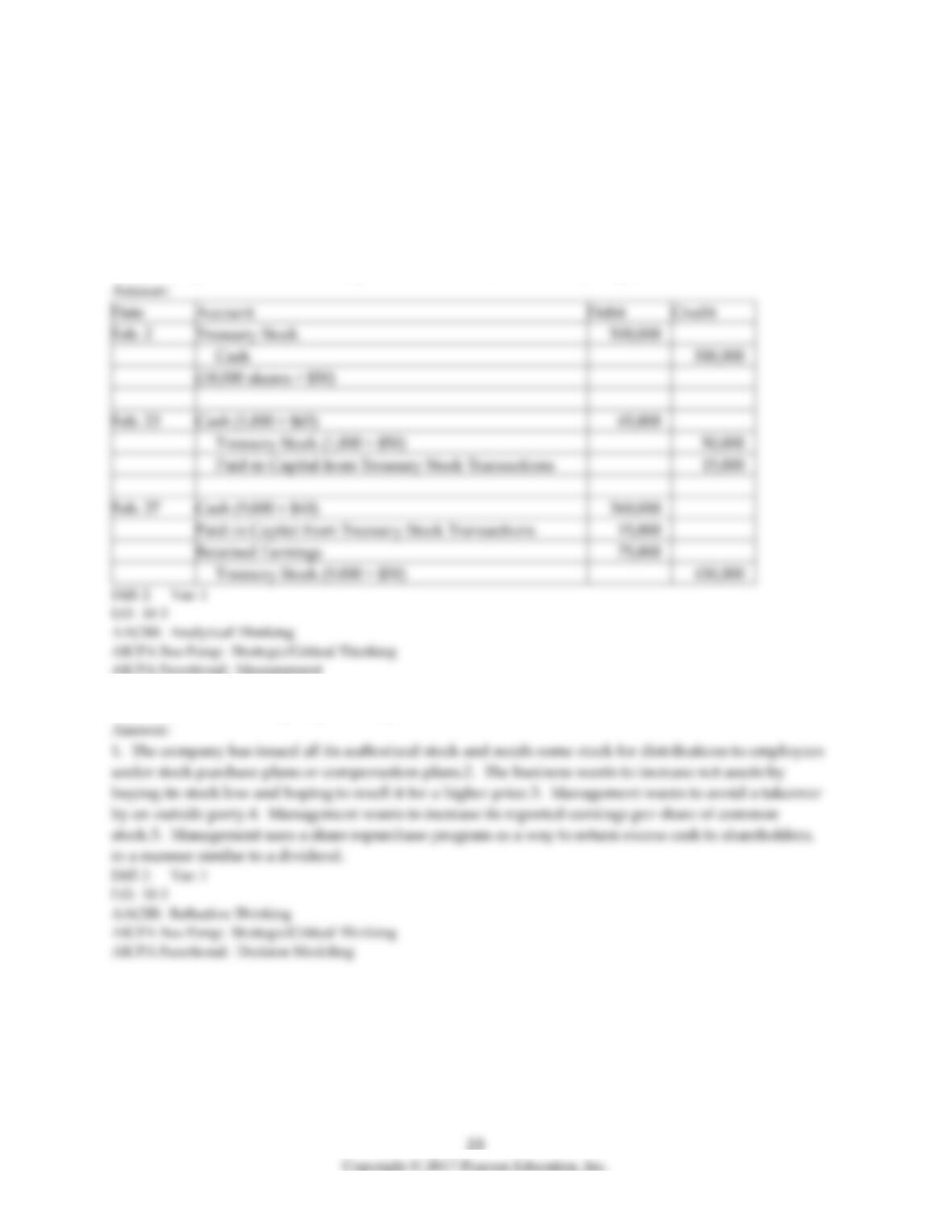
28) On February 3, 2017, Bombard Corporation acquired 4,000 shares of its own $1 par value common
stock for $30 per share. On May 24, 2017, 1,500 shares of the treasury stock were sold for $35 per share.
Required:
Prepare the journal entries to record the purchase and sale of the treasury stock. Omit explanations.
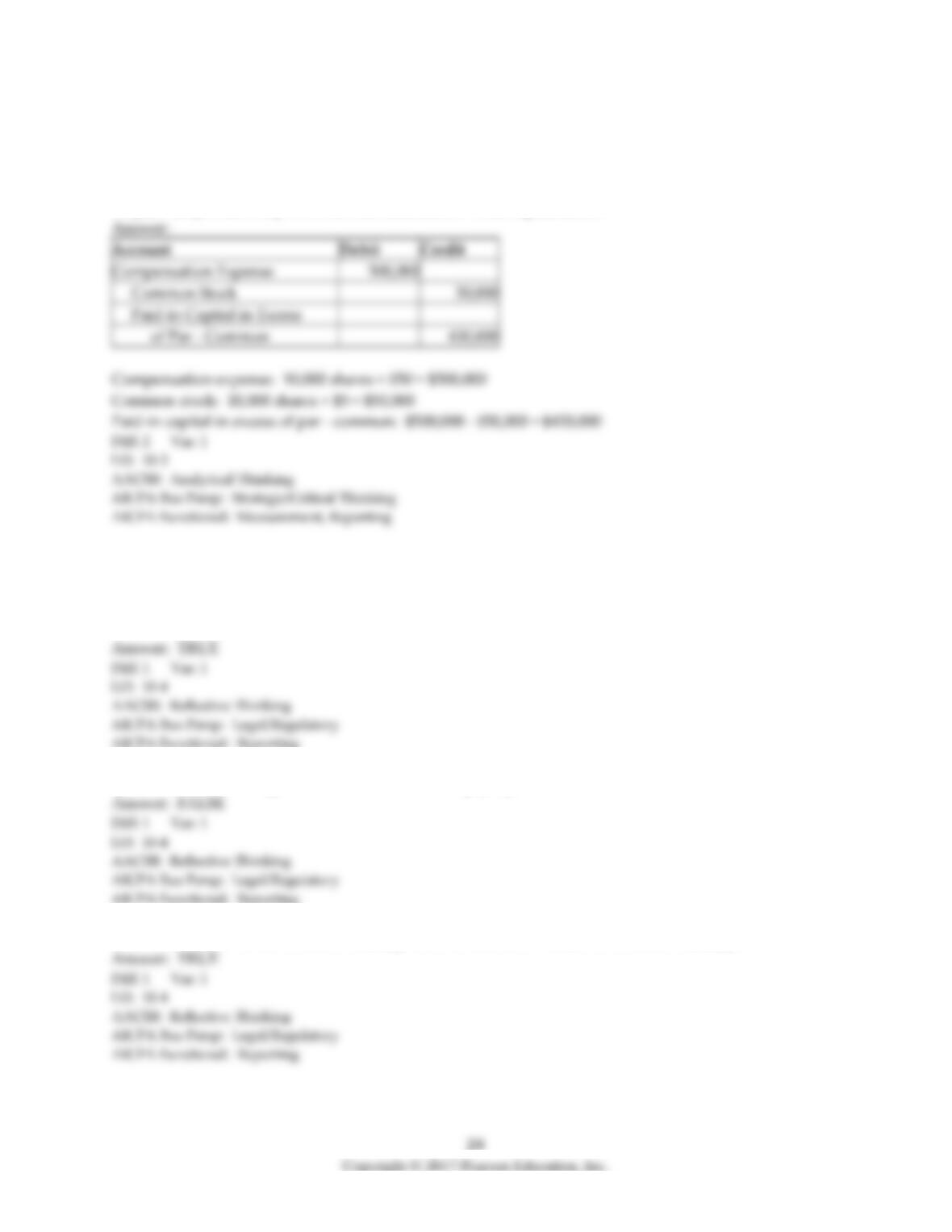
29) On February 1, United Delivery Services reports Common Stock of $1 million, Paid-in Capital in
Excess of Par—Common of $9 million and Retained Earnings of $10 million. On February 2, United
Delivery Services reacquired 10,000 shares of its $10 par value common stock at $50 per share. On
February 23, United Delivery Services sold 1,000 of the reacquired shares at $65 per share. On February
27, the remaining 9,000 shares were sold at $40 per share.
Required:
Prepare the journal entries necessary to record these transactions. Omit explanations.
30) List three reasons why corporations purchase their own stock.
31) Bryant Corporation issued 10,000 new shares of its $5 par common stock in conjunction with an
employee stock compensation plan. On the date of issuance, the market value of the stock was $50 per
share.
Prepare the journal entry to record this transaction. Omit explanations.
4 Learning Objective 10-4
1) A credit balance in Retained Earnings indicates that a company’s lifetime earnings exceeded its
lifetime losses and dividends declared.
2) The Retained Earnings account contains cash for paying dividends to the stockholders.
3) A debit balance in the Retained Earnings account indicates a deficit in Retained Earnings.
4) Passed dividends on cumulative preferred stock are recorded as a liability.
5) Common stockholders receive dividends even if the total dividend is not large enough to pay the
preferred stockholders first.
6) For cash dividends, no journal entry is made on the date of record.
7) Only stockholders holding stock on the record date will receive a dividend.
8) Small stock dividends are recorded at market value per share and large stock dividends are recorded
at par value per share.
9) The Vice President of Finance has the authority to declare a dividend.
10) The total stockholders’ equity remains the same before and after a stock split.
11) A 2-for-1 stock split will decrease total assets.
12) If a company has a deficit in retained earnings:
A) then retained earnings has a credit balance.
B) the deficit is subtracted to determine total stockholders’ equity on the balance sheet.
C) the deficit is added to determine total stockholders’ equity on the balance sheet.
D) then the corporation’s lifetime earnings exceed lifetime losses and dividends.
13) The authority to declare a dividend lies with the:
A) Chief Financial Officer.
B) President of the company.
C) Chief Executive Officer.
D) Board of Directors.
14) How does the declaration of a cash dividend affect the accounting equation?
A) increase to liabilities and a decrease to stockholders’ equity
B) increase to liabilities and a decrease to assets
C) increase to assets and a decrease to liabilities
D) increase to stockholders’ equity and a decrease to assets
15) The date on which a cash dividend becomes a legal obligation is the:
A) date of record.
B) declaration date.
C) last day of the fiscal year.
D) payment date.
16) If a corporation declares a $100,000 cash dividend, the account to be debited on the date of
declaration is:
A) Common Stock.
B) Dividends Payable.
C) Retained Earnings or Dividends.
D) Paid-in Capital in Excess of Par.
17) For cash dividends, the journal entry on the date of record is:
A) non-existent. No journal entry is required on the date of record.
B) debit Retained Earnings and credit Dividends Payable.
C) debit Dividends and credit Cash.
D) debit Dividends Payable and credit Cash.
18) Before a company can pay dividends to the common stockholders, the owners of cumulative
preferred stock must receive:
A) the current year’s dividends, but not dividends in arrears.
B) neither the current year’s dividends nor dividends in arrears.
C) all dividends in arrears plus the current year’s dividends.
D) all dividends in arrears, but not the current year’s dividends.
19) A share of 5% preferred stock has a par value of $50 and market value of $80. The owners of the
preferred stock will receive a dividend of: (Round your answer to the nearest cent.)
A) $2.50 per share.
B) $30 per share.
C) $4.00 per share.
D) $50.00 per share.
20) Wininger Corporation has 1500 shares of 6%, $50 par value, cumulative preferred stock and 25,000
shares of $1 par value common stock outstanding on December 31, 2017 and December 31, 2018. The
board of directors declared and paid a $2,000 dividend in 2017. In 2018, $14,000 of dividends are
declared and paid. What are the dividends received by the common stockholders in 2018?
A) $4500
B) $7000
C) $2500
D) $14,000
21) Wetzel, Inc. has 20,000 shares of cumulative preferred stock outstanding, with annual dividends
paid at a rate of $1 per share. Wetzel, Inc. also has 40,000 shares of common stock outstanding. Preferred
dividends were passed in the prior year. If Wetzel, Inc. declares a $700,000 dividend, each outstanding
share of common stock would receive: (Round your answer to the nearest cent.)
A) $1.00
B) $16.50
C) $17.00
D) $17.50
22) Nichols, Inc. has 8000 shares of 4%, $100 par value, cumulative preferred stock and 75,000 shares of
$1 par value common stock outstanding at December 31, 2017. What is the annual dividend that will be
paid to the preferred stockholders?
A) $8000
B) $32,000
C) $800,000
D) $0. Preferred stockholders are not guaranteed an annual dividend payment.
23) Corrao Foods Corporation has 5000 shares of 7%, $15 par value, cumulative preferred stock and
150,000 shares of $1 par value common stock outstanding at December 31, 2017 and December 31, 2018.
In 2017, a $2000 dividend was declared and paid. In 2018, $39,000 of dividends are declared and paid.
What are the dividends received by the preferred stockholders in 2018?
A) $39,000
B) $5250
C) $8500
D) $10,500
24) Declaring and distributing stock dividends:
A) increases retained earnings.
B) increases the total liabilities of the corporation and decreases the total stockholders’ equity.
C) reduces the total assets of the corporation.
D) has no effect on total stockholders’ equity.
25) Corporations may choose to distribute stock dividends in order to:
A) increase the per-share market price of its stock.
B) reduce the per-share market price of its stock.
C) continue dividends but conserve cash.
D) Both B and C are correct.
26) Mr. Jorgensen, a shareholder in the Best Corporation, owns 10,000 shares of its common stock. Mr.
Jorgensen receives a 6% stock dividend. After the stock dividend, Mr. Jorgensen will have a:
A) total of 600 shares of Best Corporation’s common stock.
B) total of 9400 shares of Best Corporation’s common stock.
C) total of 10,000 shares of Best Corporation’s common stock.
D) total of 10,600 shares of Best Corporation’s common stock.
27) Mr. Seider, a shareholder in the Greenfield Corporation, owns 9000 shares of their common stock,
which represents 25% of the outstanding common stock of Greenfield Corporation. Mr. Seider receives
a 5% stock dividend. After the stock dividend, what is Mr. Seider’s ownership in Greenfield
Corporation’s common stock?
A) 5% ownership
B) 20% ownership
C) 25% ownership
D) 30% ownership
28) A stock dividend is considered small when it is a dividend of:
A) less than 30% but greater than 25% of the corporation’s outstanding stock.
B) between 20% and 50% of the corporation‘s outstanding stock.
C) more than 30% of the corporation’s outstanding stock.
D) 25% or less of the corporation’s outstanding stock.
29) A small stock dividend will:
A) reduce total assets.
B) reduce total stockholders’ equity.
C) increase total stockholders’ equity.
D) have no effect on total assets or total stockholders’ equity.
30) Arnold, Inc. declares and distributes a 10% common stock dividend when it has 70,000 shares of
$100 par value common stock outstanding. If the market value of the common stock is $20, the journal
entry to record the stock dividend would include a:
A) debit to Retained Earnings $140,000.
B) debit to Retained Earnings $700,000.
C) credit to Paid-in Capital in Excess of Par—Common $140,000.
D) credit to Paid-in Capital in Excess of Par—Common $700,000.
31) Zeman, Inc. declares and distributes a 10% common stock dividend when it has 20,000 shares of $20
par value common stock outstanding. If the market value of the common stock is $30, the journal entry
to record the stock dividend would include a:
A) credit to Common Stock $100,000.
B) credit to Common Stock $20,000.
C) credit to Paid-in Capital in Excess of Par—Common $20,000.
D) credit to Paid-in Capital in Excess of Par—Common $40,000.
32) Williamson Company declared and distributed a 10% stock dividend when it had 200,000 shares of
$1 par value common stock outstanding. The market price per share of common stock was $60 per share
when the dividend was declared. The journal entry to record the stock dividend would include a credit
to:
A) Retained Earnings $200,000.
B) Paid-in Capital in Excess of Par—Common $1,180,000.
C) Common Stock $200,000.
D) Retained Earnings $20,000.
33) An increase in the number of issued and outstanding shares of stock along with a proportional
reduction in the stock’s par value is a:
A) deficit.
B) stock dividend.
C) stock split.
D) cash dividend.
34) A stock split:
A) increases assets and decreases stockholders’ equity.
B) decreases assets and increases stockholders’ equity.
C) increases assets and stockholders’ equity.
D) has no effect on total stockholders’ equity.
35) Regarding the retained earnings account, which of the following statements is INCORRECT?
A) Net income is the only item that increases retained earnings.
B) From time to time, some corporations might record prior-period adjustments to retained earnings.
C) Other adjustments to retained earnings are usually relatively minor and relatively rare.
D) Net losses are the only item that decreases retained earnings.
36) Burkert Company has 50,000 shares of $1 par value common stock issued and outstanding. The
company also has 9000 shares of $100 par value, 4% cumulative preferred stock outstanding. Burkert
did not pay the preferred dividends in 2016 and 2017. For the common stockholders to receive a
dividend in 2018, the board of directors must declare dividends in excess of:
A) $36,000.
B) $72,000.
C) $108,000.
D) $144,000.
37) On February 1, a corporation has 50,000 shares of $1 par value common stock issued and
outstanding. The corporation also has Additional Paid-in Capital of $300,000 and Retained Earnings of
$300,000. On February 1, the corporation declared a 2-for-1 stock split. After the split, what is the total
par value of the common stock and the total stockholders’ equity, respectively?
A) $100,000; $650,000
B) $50,000; $650,000
C) $25,000; $650,000
D) $50,000; $350,000
38) The chronological order of dates for cash dividends are:
A) date of record, date of declaration, date of payment.
B) date of annual Board of Directors meeting, date of payment, date of record, date of declaration.
C) date of annual Board of Directors meeting, date of record, date of declaration, date of payment.
D) date of declaration, date of record, date of payment.
39) On December 31, 2017, Pilozzi Company has the following information available:
Common Stock
$5 million
Additional Paid-in Capital
$4 million
Retained Earnings
$7 million
Cash
$7 million
Investment in Trading Securities
$50,000
On December 31, 2017, can the Board of Directors declare a cash dividend of $8 million?
A) Yes, if they can borrow some money, or liquidate some assets.
B) No, the cash balance is below $8 million.
C) No, Retained Earnings is below $8 million.
D) No, Cash and Retained Earnings are both below $8 million.
40) How does the declaration and payment of cash dividends affect the accounting equation?
A) increase assets and stockholders’ equity
B) decrease assets and stockholders’ equity
C) increase assets and decrease stockholders‘ equity
D) decrease assets and increase stockholders’ equity
41) The Home Store reported the following figures:
Retained Earnings, February 1, 2017………..$18 million
Retained Earnings, February 1, 2016………..$19 million
The company’s fiscal year ends on February 1 each year. Net income for the fiscal year ending February
1, 2017 is $22 million. What is the amount of dividends declared for the fiscal year ending February 1,
2017?
A) $19 million
B) $23 million
C) $3 million
D) $22 million
42) The Good Word Store reported the following figures:
Retained Earnings, January 31, 2017…………………….$38,000,000
Retained Earnings, January 31, 2018…………………….$15,000,000
Total Stockholders’ Equity, January 31, 2017………..$30,000,000
Total Stockholders’ Equity, January 31, 2018………..$26,000,000
The company’s fiscal year ends on January 31 each year. Dividends declared for the fiscal year ending
January 31, 2018 are $9,000,000. What is the net income or net loss for the fiscal year ending January 31,
2018?
A) $9,000,000 net loss
B) $14,000,000 net loss
C) $23,000,000 net loss
D) $6,000,000 net loss