1. Which of the following accounts is not reported in the stockholders’ equity section of the
balance sheet?
2. Which of the following stages of equity financing comes last in the traditional order of
progression?
3. In terms of total sales, assets, and earnings, the dominant form of business organization is
the:
4. Common stockholders usually have all of the following rights except:
5. Which of the following is a reason that a corporation would prefer to issue stock instead of
bonds?
6. Advantages of the corporate form that have led to the growth of this form of business
ownership include all of the following except:
7. Advantages of the corporate form of business include which of the following?
I. Double taxation
II. Ability to raise capital
III. Lack of mutual agency
IV. More paperwork
V. Limited liability
8. Which of the following statements regarding the corporate form of business is correct?
9. The disadvantages of the corporate form of business include:
10. The correct order from the smallest number of shares to the largest number of shares is:
11. Outstanding common stock refers to the total number of shares:
12. Authorized common stock refers to the total number of shares:
13. Outstanding common stock is:
14. Issued stock refers to the number of shares:
15. The par value of shares issued is normally recorded in the:
16. The par value of common stock represents:
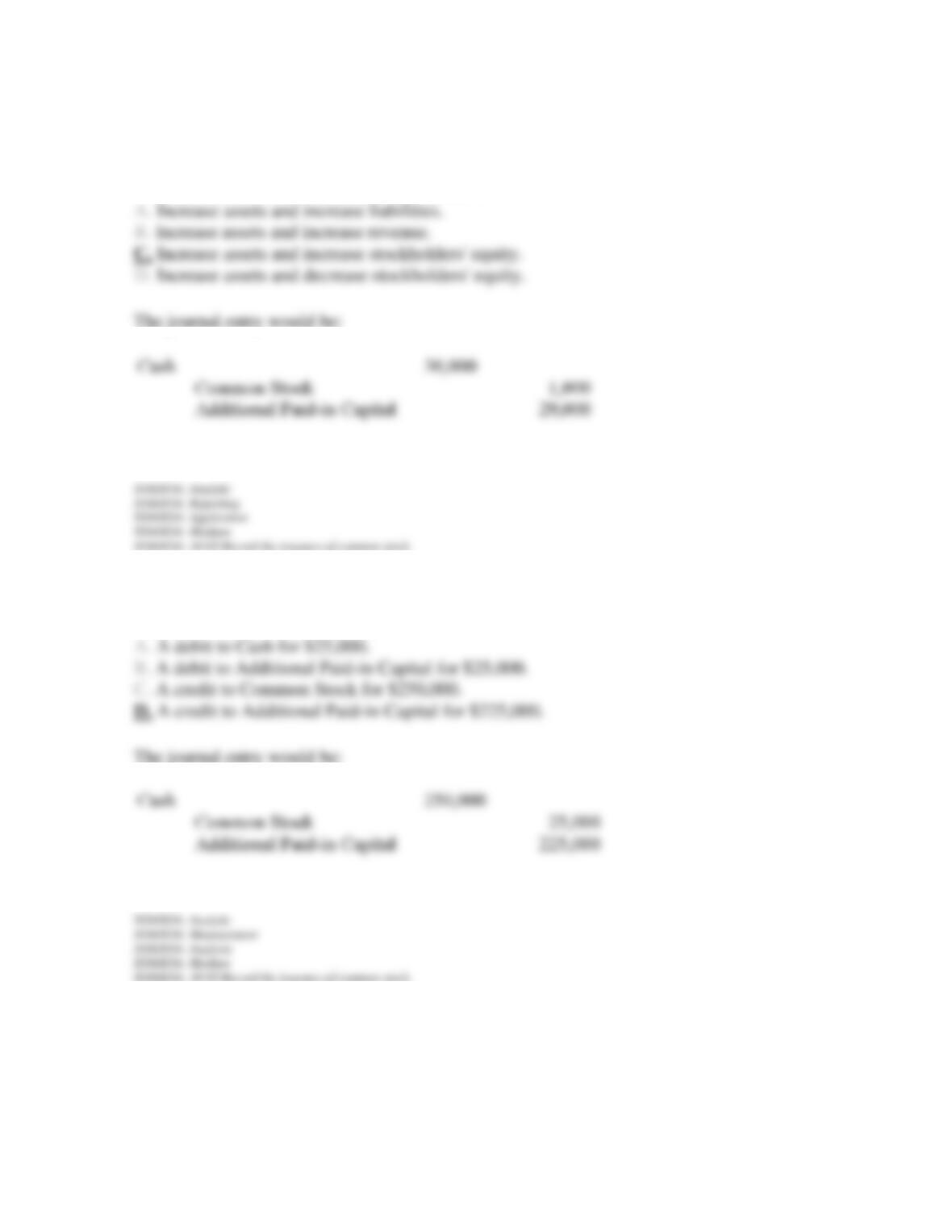
17. If a company issues 1,000 shares of $1 par value common stock for $30 per share, what
would be the effect on the accounting equation?
18. When a company issues 25,000 shares of $1 par value common stock for $10 per share,
the journal entry for this issuance would include:
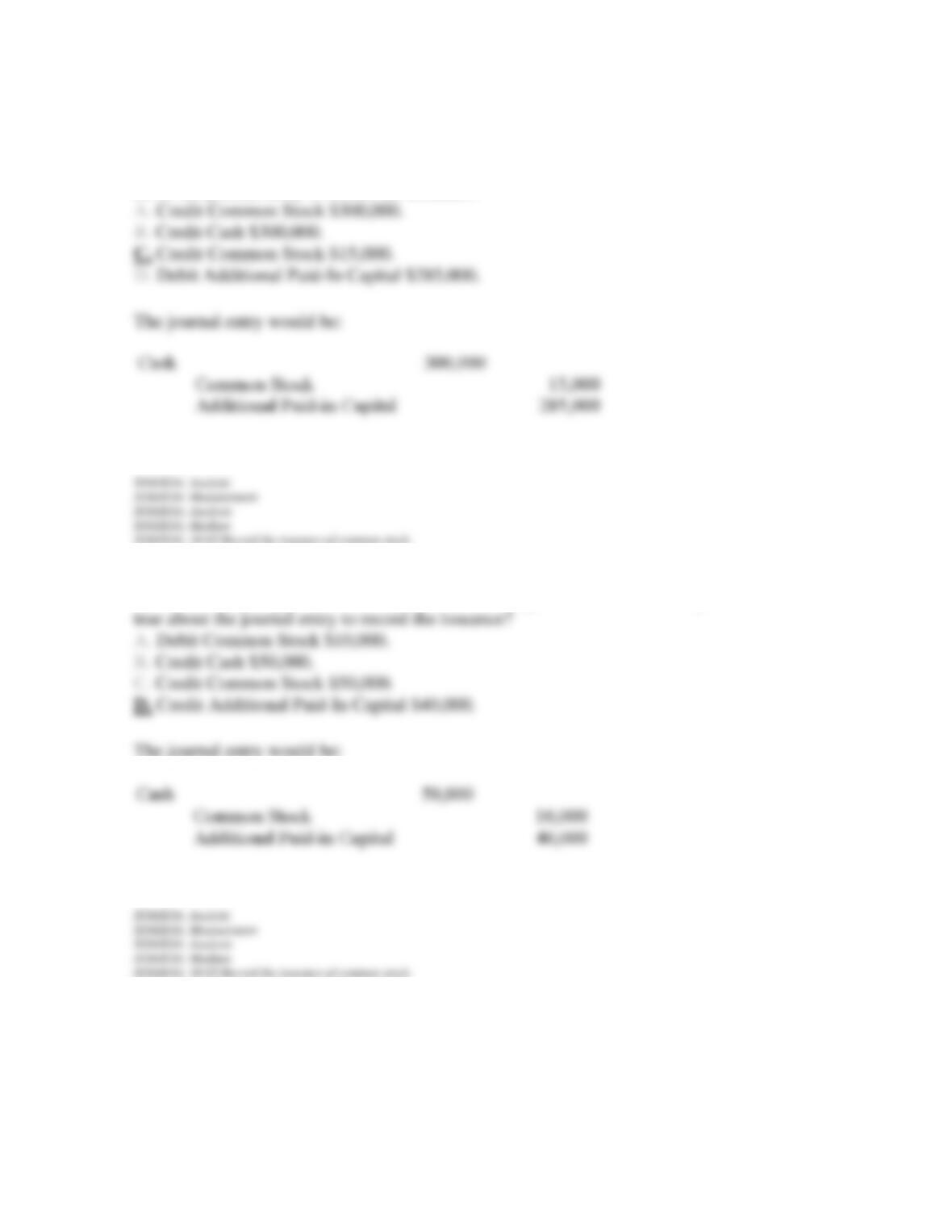
19. Jade Jewelers issued 15,000 shares of $1 par value stock for $20 per share. What is true
about the journal entry to record the issuance?
20. South Beach Apparel issued 10,000 shares of $1 par value stock for $5 per share. What is
21. Hayes Corporation issues 100 shares of its $1 par value common stock for $15 per share.
The entry to record the issuance will not include a:
22. Preferred stock is called preferred because it usually has two preferences over common
stock. These preferences relate to:
23. Preferred stock:
24. Which of the following financing alternatives has the highest preference of payment in a
case where the company liquidates its assets?
25. Which of the following is not a potential feature of preferred stock?
26. Which of the following has the highest expected return to the investor?
27. A company issued 1,000 shares of $1 par value preferred stock for $5 per share. What is
true about the journal entry to record the issuance?
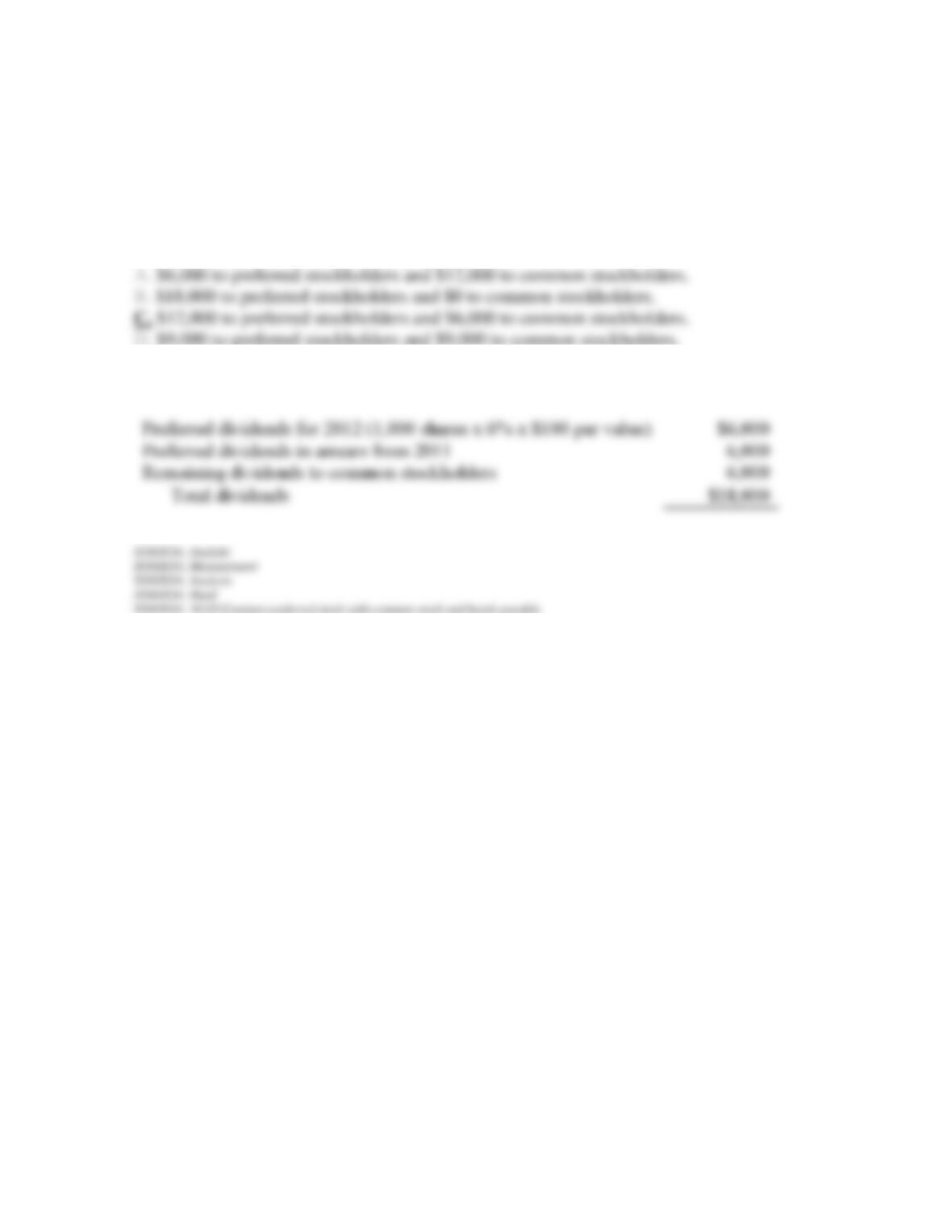
28. The Surf’s Up issues 1,000 shares of 6%, $100 par value preferred stock at the beginning
of 2011. All remaining shares are common stock. The company was not able to pay dividends
in 2011, but plans to pay dividends of $18,000 in 2012. Assuming the preferred stock is
cumulative, how much of the $18,000 dividend will be paid to preferred stockholders and how
much will be paid to common stockholders in 2012?
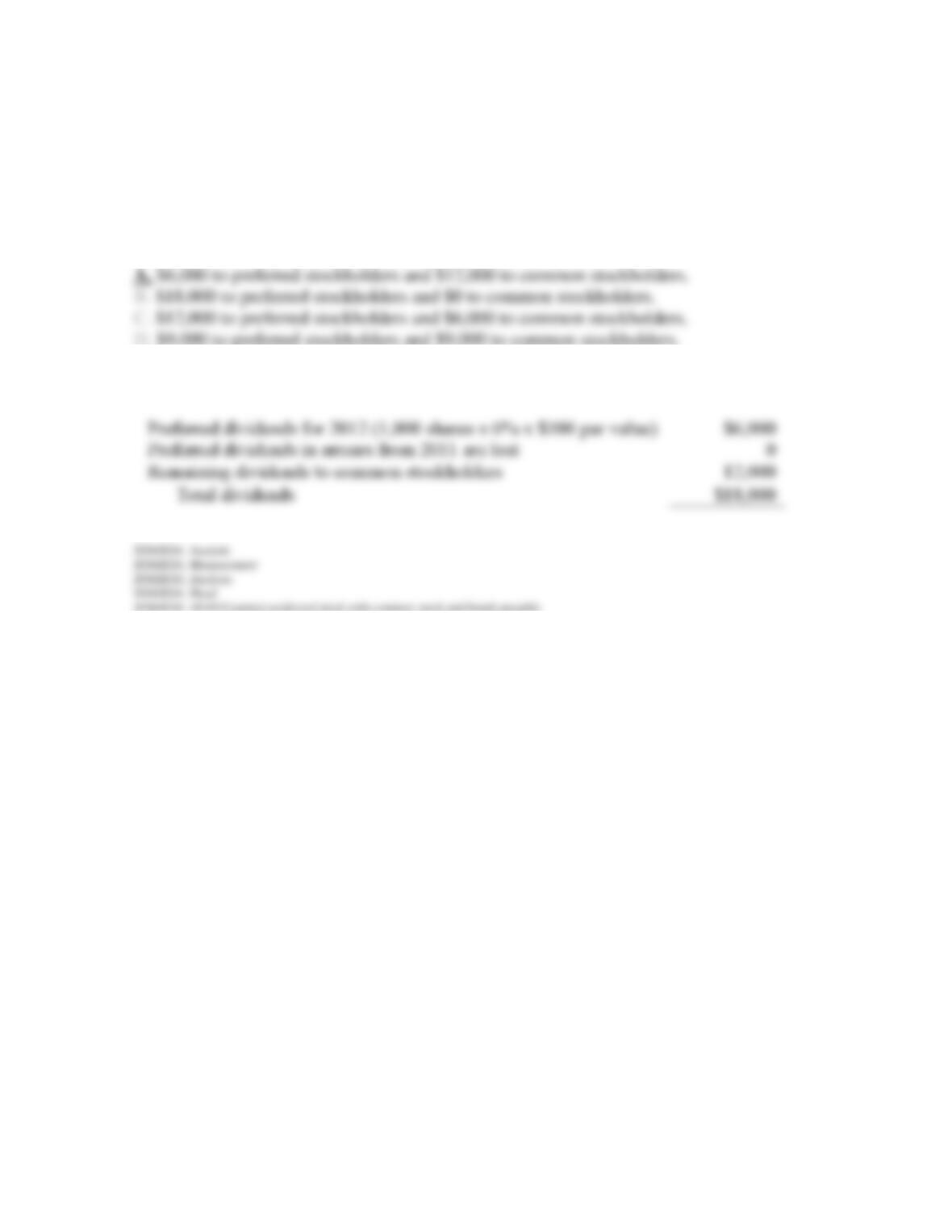
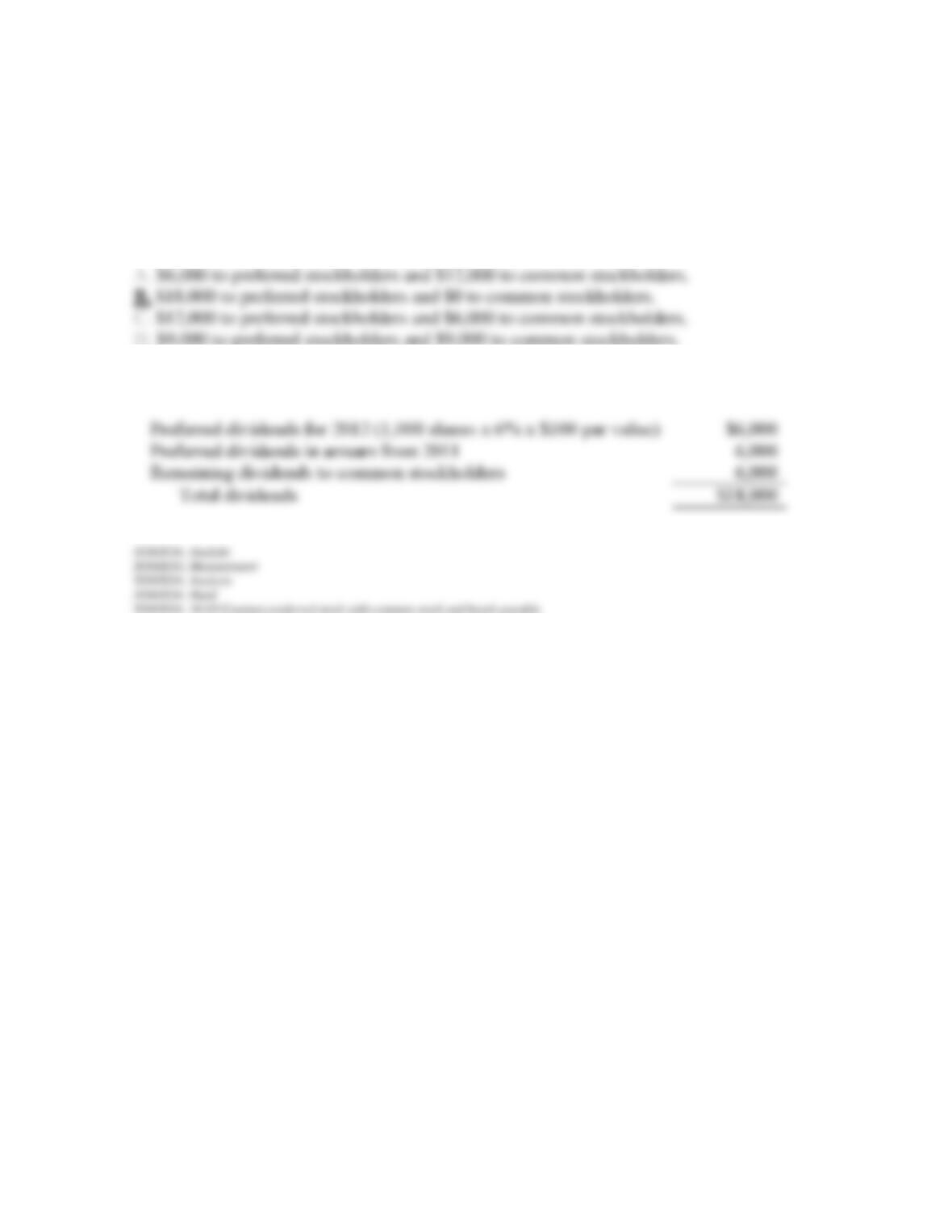
29. The Surf’s Up issues 1,000 shares of 6%, $100 par value preferred stock at the beginning
of 2011. All remaining shares are common stock. The company was not able to pay dividends
in 2011, but plans to pay dividends of $18,000 in 2012. Assuming the preferred stock is
noncumulative, how much of the $18,000 dividend will be paid to preferred stockholders and
how much will be paid to common stockholders in 2012?
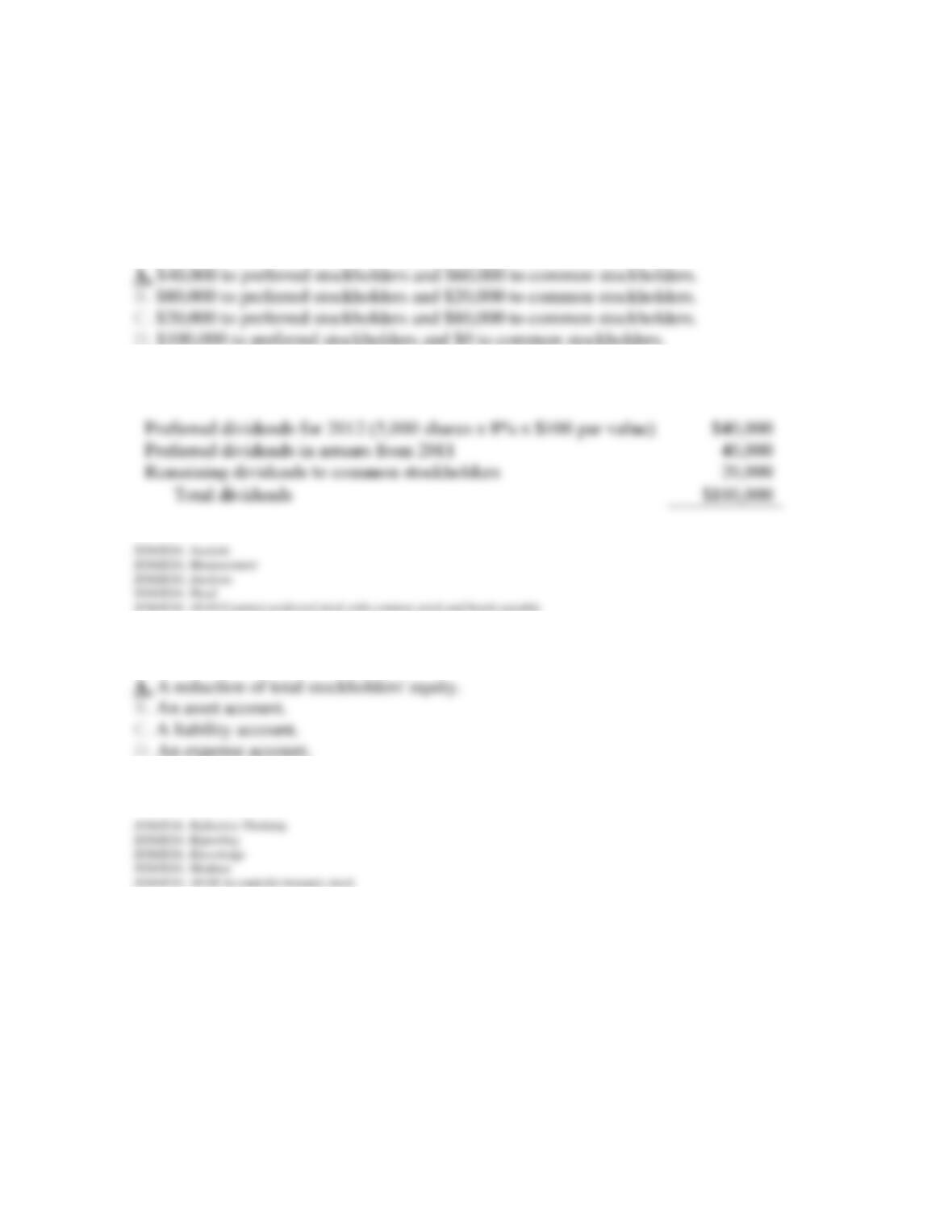
30. California Adventures issues 5,000 shares of 8%, $100 par value preferred stock at the
beginning of 2011. All remaining shares are common stock. The company was not able to pay
dividends in 2011, but plans to pay dividends of $100,000 in 2012. Assuming the preferred
stock is cumulative, how much of the $100,000 dividend will be paid to preferred
stockholders and how much will be paid to common stockholders in 2012?
31. California Adventures issues 5,000 shares of 8%, $100 par value preferred stock at the
beginning of 2011. All remaining shares are common stock. The company was not able to pay
dividends in 2011, but plans to pay dividends of $100,000 in 2012. Assuming the preferred
stock is noncumulative, how much of the $100,000 dividend will be paid to preferred
stockholders and how much will be paid to common stockholders in 2012?
32. Treasury Stock is normally reported as:
33. When treasury stock is resold at a price above cost:
34. When treasury stock is resold at a price below cost:
35. When treasury stock is purchased, what is the effect on assets and stockholders’ equity?
36. When treasury stock is purchased, what is the effect on total stockholders’ equity?
37. Treasury Stock:
38. Which of the following statements about treasury stock transactions is true?
39. Which of the following is TRUE regarding the accounting for treasury stock?
40. What would be the impact on the accounting equation when a company purchases treasury
stock?
41. The corporation’s own stock that has been issued and then repurchased by the company is
referred to as:
42. When treasury stock is resold at a gain, the difference between its cost and the cash
received when resold:
43. Crossroads Mall had 100,000 outstanding shares of common stock. On June 16, 2012,
Crossroads repurchased 20,000 shares of its own stock at $30 per share. On July 23, 2012,
Crossroads resold 10,000 shares at $28 per share. What net effect did the repurchase and the
resell of common stock have on the accounting equation?
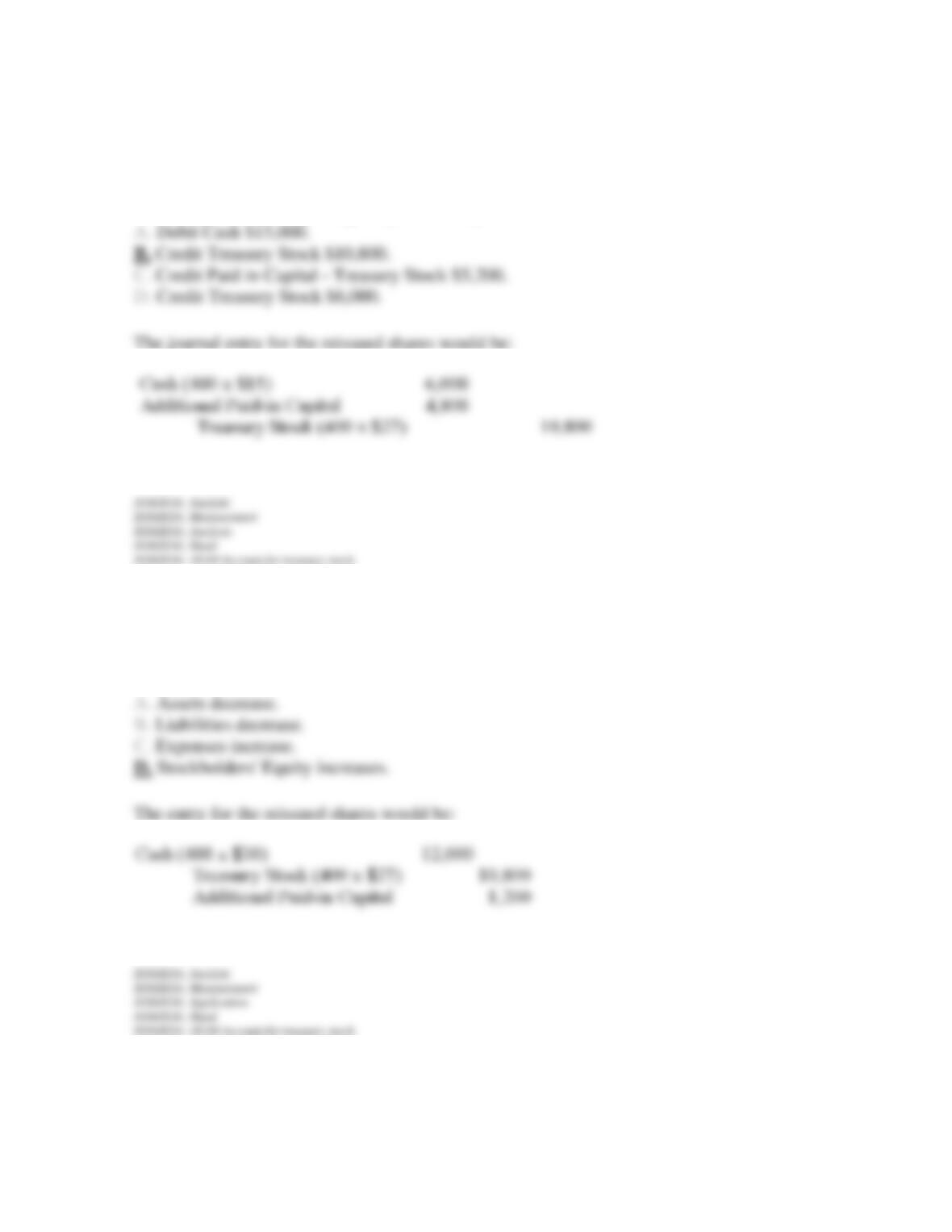
44. On December 2, Coley Corp. reacquired 1,000 shares of its $2 par value common stock
for $27 each. On December 20, Coley Corp. reissued 400 shares for $15 each. Which of the
following is correct regarding the journal entry for the reissued shares?
45. On November 6, Coleman Corp. reacquired 1,000 shares of its $2 par value common
stock for $27 each. On November 20, Coleman Corp. reissued 400 shares for $30 each.
Which of the following is correct regarding the effect of the journal entry for the reissued
shares?