
Chapter 10—INTERNATIONAL ACCOUNTING
TRUE/FALSE
1. The two general financial reporting models that have evolved in economically advanced
countries are the Anglo-Saxon model and the European Model.
2. Accounting may be called “the language of business.”
3. The Anglo-Saxon model of reporting features the use of judgment to make financial statements
useful.
4. The continental model of financial reporting generally presents a strong accounting profession.
5. Professional accounting societies first arose in the United Kingdom in the middle of the 19th
century.
6. The Accounting Standards Board (ASB) in the UK operates along the lines of the FASB.
7. The Accounting Standards Steering Committee (ASSC) is the United Kingdom equivalent of the
Securities and Exchange Commission.
8. The continental model of financial reporting generally reflects a strong governmental influence
on accounting regulation.
9. In the United States, the term “present fairly” in opinions of American auditing firms is the same
as the “true and fair view” of international financial reporting.
10. Financial accounting standard setting in New Zealand has remained within the private sector.

Chapter 10—INTERNATIONAL ACCOUNTING
11. The ASEAN is a group of developing nations in Southeast Asia whose goal is to foster trade and
development both within and outside the region.
12. The Netherlands is a continental nation with a largely Anglo-Saxon accounting model.
13. Within the continental model of financial reporting, Germany has the closest approach to a
uniform national accounting system.
14. Harmonization of accounting standards refers to the degree of coordination or similarity among
the various sets of national accounting standards and methods and the formats of financial
reporting.
15. Many continental model countries, such as France and Germany, have viewed harmonization as
an opportunity to coordinate their accounting standards with those of the US.
16. The International Accounting Standards Committee was formed in an attempt at economic
integration of member countries.
17. The United States is not a member of the G4 +1.
18. British standard setters blazed the trail of accounting regulation being centered in the private
sector.
19. Countries following the continental model include most major countries of Western Europe as
well as Japan.
20. The key factor of difference between the Anglo-Saxon and continental models appears to be
between capital-based financial markets and credit-based financial markets.

Chapter 10—INTERNATIONAL ACCOUNTING
21. Financial reporting is independent of the legal system of a nation.
22. Principles-based standards are more highly detailed than rules-based standards.
23. The IASB has not yet promulgated a conceptual framework.
24. The European Union has extended consolidation accounting to firms within its member states
under a very wide group of circumstances where one firm has substantive control over one or
more other firms.
25. Because of important national differences, a strong drive for harmonization of accounting
standards has not yet been possible.
26. The IASB operates within an organizational structure akin to the FASB.
27. The ISB has increased disclosure requirements and is seen as being close to U.S. GAAP from the
standpoint of harmonization.
28. The IASB has greatly increased the allowed number of treatments in particular event areas.
29. The Norwalk Agreement stated the IASB’s and FASB’s common goal of developing accounting
standards usable for both domestic and cross-border financial reporting.
30. A major difference between the IASB’s conceptual framework and FASB’s is that the IASB’s
primary user group is limited to investors and creditors.
31. A false sense of comparability may develop during translation of an IFRS from English into
another language.

Chapter 10—INTERNATIONAL ACCOUNTING
MULTIPLE CHOICE
1. Which of the following characteristics does not describe the Anglo-Saxon model of financial
reporting?
a. A strong accounting profession
b. Strong governmental influence
c. The importance of securities markets for raising equity capital
d. An emphasis upon the true and fair view of audited financial statements
2. Which of the following does not describe the continental model of financial reporting?
a. A weak accounting profession
b. Strong governmental influence
c. The primacy of investor needs over tax influences and creditor needs
d. Emphasis of debt financing over equity capital
3. Which of the following is true regarding the Accounting Standards Board (ASB) in the UK?
a. The US has a greater influence on the standard-setting apparatus in the UK than does the
European Union.
b. ASB board members serve on a part-time basis without salary.
c. The Emerging Issues Task Force (EITF) serves both the US and the UK standards-setting
boards.
d. The ASB issues accounting standards on its own authority.
4. Which of the following countries is a continental nation, but more closely follows the Anglo-
Saxon financial reporting model?
a. France
b. Japan
c. The Netherlands
d. Australia
5. Which of the following is a continental model country with some signs of moving toward the
Anglo-Saxon view?
a. Germany
b. France
c. Canada
d. Japan

Chapter 10—INTERNATIONAL ACCOUNTING
6. Which of the following is a financial reporting model that features the presence of a strong
accounting profession?
a. The Anglo-Saxon model
b. The continental model
c. The ASEAN model
d. The international model
7. The US is an example of:
a. the Anglo-Saxon model.
b. the continental model.
c. the ASEAN model.
d. the international model.
8. Anglo-Saxon versus continental differences have been summarized using all but which of the
following characteristics?
a. Strength of the accounting profession
b. Population size
c. Strong equity markets as opposed to credit financing from major banking institutions
d. The importance of the country’s legal system relative to the setting of accounting rules
9. The “true and fair view” refers to:
a. the use of judgment to make financial statements useful.
b. the same thing as “present fairly” in opinions of American auditing firms.
c. the fact that financial statements are in accordance with GAAP
d. the fact that financial statements are presented correctly in accordance with the law.
10. Which country has the oldest professional accounting organizations?
a. The UK
b. The US
c. France
d. Germany
11. Which country has the closest approach to a uniform national accounting system?
a. The UK
b. The US
c. France
d. Germany

Chapter 10—INTERNATIONAL ACCOUNTING
12. Which of the following statements are not required under Germany’s accounting standards?
a. The Balance Sheet
b. The Income Statement
c. The Cash Flow Statement
d. All of the above are required
13. Which of the following is true regarding American securities exchanges?
a. The US and the UK have a system of reciprocity in place for listing the securities on one
another’s stock exchanges.
b. The SEC does not allow foreign companies that do not use U.S. GAAP to be listed on
American stock exchanges.
c. Most Japanese firms listed for trading on American securities exchanges use U.S. GAAP.
d. Canadian companies may list existing shares for trading on American stock exchanges, but
may not list new stock issues.
14. Which of the following terms is used to refer to harmonization among accounting practice of
different enterprises?
a. Formal harmonization
b. Material harmonization
c. De jure harmonization.
d. Convergence
15. Which of the following terms is used to refer to the harmonization present among the accounting
rules of different countries?
a. Formal harmonization
b. De jure harmonization
c. Convergence
d. All of the above
16. Which of the following is a characteristic of rules-based accounting standards?
a. They are highly detailed.
b. They rely heavily on judgment by management or the auditor.
c. They are shorter than rules-based standards.
d. They are required by Sarbanes-Oxley.
17. The SEC drafted report required by Sarbanes-Oxley used which of the following terms to refer to
a principles-based approach to standards?
a. Bright line standards
b. Rule-oriented standards
c. Objective-oriented standards
d. Systematic and rational standards

Chapter 10—INTERNATIONAL ACCOUNTING
18. Benston, Bromwich, and Wagenhofer believe that the principles-based approach would work
better in tandem with:
a. a fair value measurement orientation.
b. a revenue-expense orientation.
c. an asset-liability orientation.
d. all of the above.
19. Which of the following is not a true statement regarding harmonization of accounting standards?
a. Harmonization refers to the degree of coordination or similarity among the various sets of
national accounting standards and methods and the formats of financial reporting.
b. Among the factors underlying the desire for harmonization is the rise in importance of the
multinational firm.
c. The issue of harmonization is closely tied to the efforts of the IASB as well as activities of
the EU.
d. Many continental model countries, such as France and Germany, have viewed harmonization
as an opportunity to coordinate their accounting standards with those of the US.
20. Which of the following is not a true statement regarding the IASB?
a. The IASB has promulgated a conceptual framework.
b. The IASB is playing an important role in the drive toward harmonization.
c. Several European nations have surrendered their standard-setting powers to the IASB.
d. Members of the IASB have pledged to use their best endeavors to bring the adoption of IASB
standards to their countries.
21. Which of the following organizations was formed in an attempt at economic integration, and has
also been concerned with harmonization of accounting standard of its member nations?
a. The International Accounting Standards Committee
b. The International Federation of Accountants
c. The European Union
d. The International Organization of Security Commissions
22. Which of the following is not a member of the G4+1?
a. IASB
b. Australia
c. The US
d. France

Chapter 10—INTERNATIONAL ACCOUNTING
23. Which of the following is true?
a. Convergence of IASB and FASB standards will be a major step towards international
harmonization.
b. The IASB has reduced disclosure requirements.
c. The IASB has increased the allowed number of treatment in particular event areas.
d. FASB and the IASB have not yet committed to convergence of IFRS and U.S. GAAP.
24. The IAS designation for the preferred accounting treatment is referred to as:
a. benchmarking.
b. conformity.
c. reconciliation.
d. convergence.
25. The term International Financial Reporting Standard (IFRS) refers to:
a. the new numbered series of pronouncements that the IASB is issuing.
b. the entire body of IASB pronouncements, including International Accounting Standards
issued between 1973 and 2001.
c. both a and b.
d. none of the above.
26. Harmonization of IASB and FASB standards is now being called:
a. benchmarking.
b. conformity.
c. uniformity.
d. convergence.
27. Which of the following is a major difference between the IASB’s conceptual framework and the
FASB’s conceptual framework?
a. The IASB prefers replacement cost over historical cost as a measurement basis.
b. FASB limits primary user groups to investors and creditors.
c. FASB’s conceptual framework is considerably shorter than the IASB’s.
d. The IASB’s framework is in the form of a series of concept statements rather than a single
framework.
28. Which of the following possible measurement bases listed by the IASB in the most prevalent?
a. Present value
b. Exit value
c. Replacement cost
d. Historical cost
Chapter 10—INTERNATIONAL ACCOUNTING
29. Which of the following does not accurately characterize the IFAC?
a. It produces international financial reporting standards.
b. Its guidelines cannot be imposed on any member organization or nation.
c. Its board produces international standards for ethics, education, and public sector accounting.
d. It produces international standards for auditing and assurance.
30. Which of the following characterizes the United Nations involvement in financial reporting?
a. The UN has developed significant regulations relative to financial reporting for
multinationals.
b. The US and the UK have expressed a desire to have the UN participate in developing
qualifications to sit for professional accounting exams.
c. The UN has shown interest in prescribing an accounting curriculum.
d. The UN has had a greater role in establishing international accounting standards than the
IASB.
ESSAY
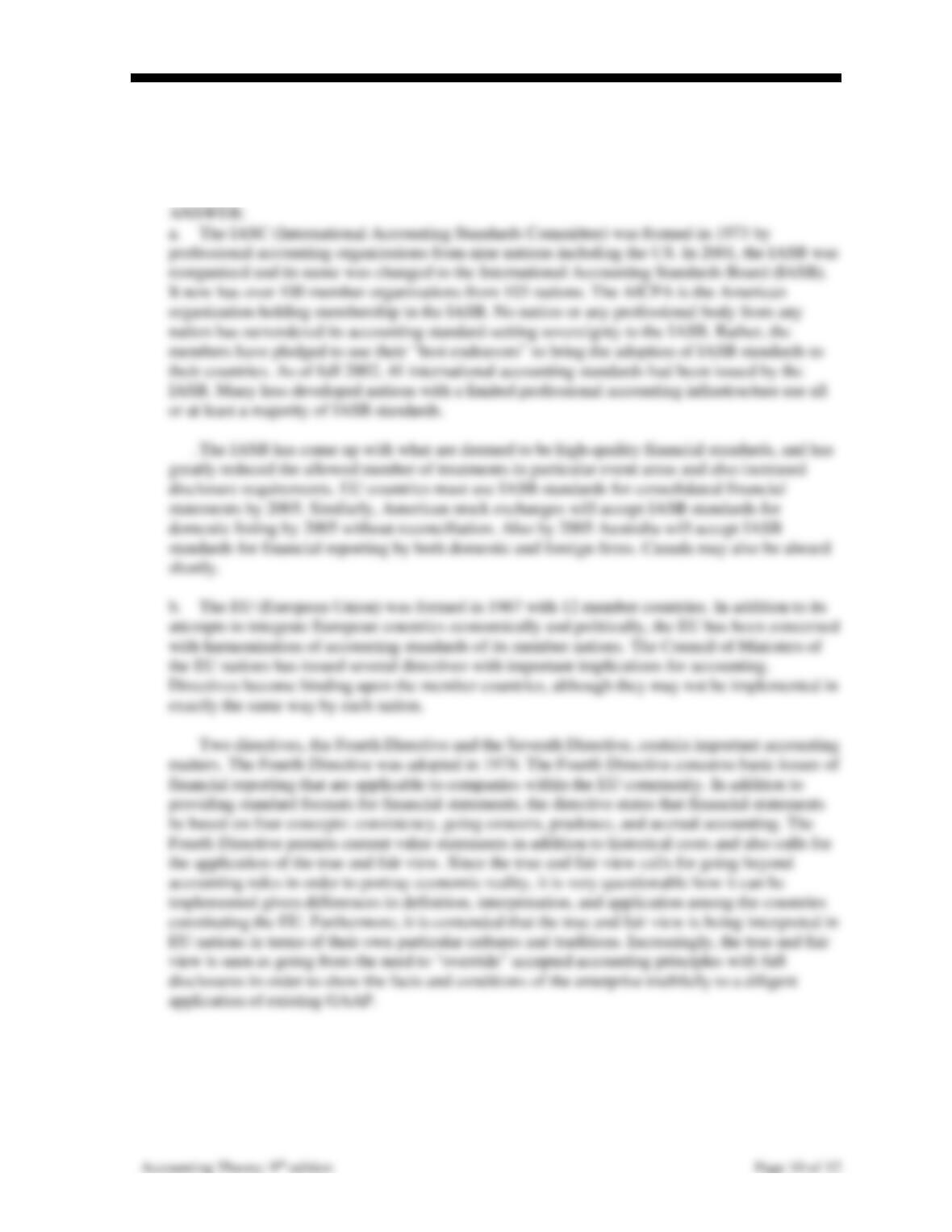
1. Compare and contrast the Anglo-Saxon financial reporting model with the continental model.
2. What does harmonization of accounting standards mean, and what are the two aspects of
harmonization?
Chapter 10—INTERNATIONAL ACCOUNTING
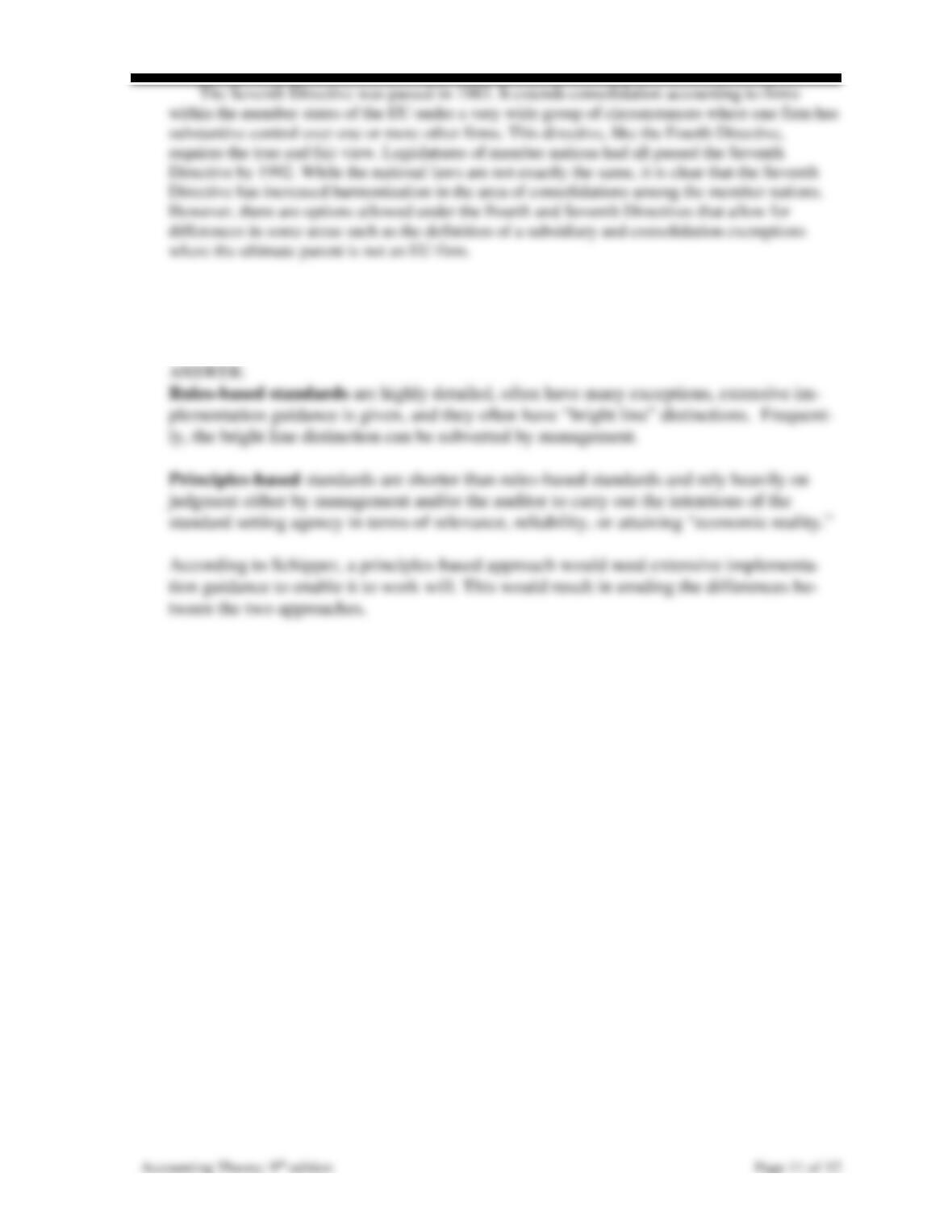
3. Identify the following organizations and describe the role each plays in the drive toward
harmonization:
a. The IASB
b. The EU
Chapter 10—INTERNATIONAL ACCOUNTING
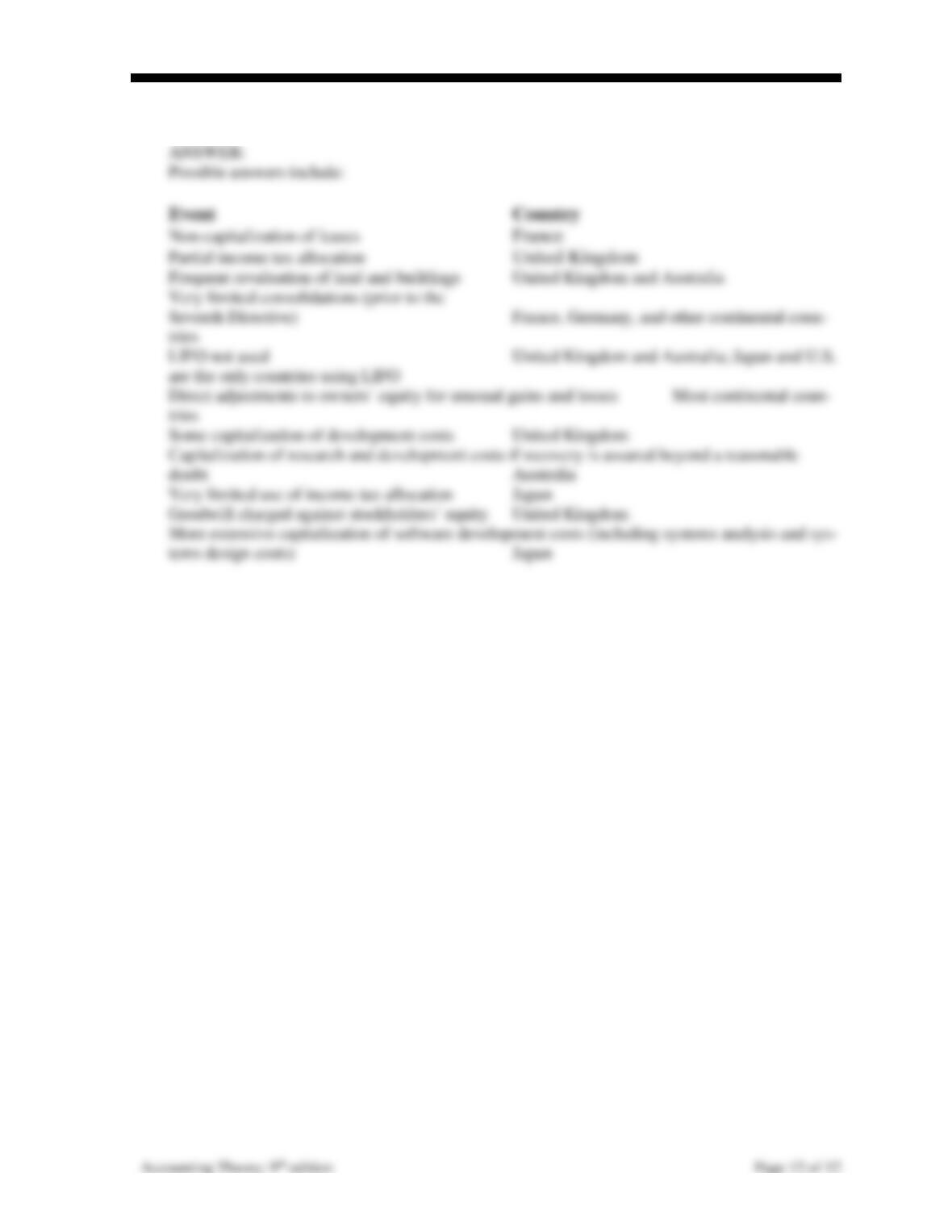
4. Contrast principles-based and rules-based accounting standards. Why do these approaches to
standard setting tend to converge according to Schipper?
Chapter 10—INTERNATIONAL ACCOUNTING
5. List five differences in accounting practices between the US and other countries.