Chapter 10 – Standard Costing and Analysis of Direct Costs
10-1
Chapter 10
Standard Costing and Analysis of Direct Costs
Answer Key
True / False Questions
1. Variances are computed by taking the difference between the product cost and standard
cost.
2. Significant departures investigated, when using management by exception, are uniform
across all size and types of organizations with varying production processes.
3. Normal defect rates in an assembly process would be considered if a company desires to
establish a series of practical manufacturing standards.
Chapter 10 – Standard Costing and Analysis of Direct Costs
10-2
4. Managerial accountants use either task analysis or an analysis of historical data to set cost
standards.
5. A favorable labor efficiency variance is created when actual labor hours worked exceed
standard hours allowed.
6. When spending is lower than expected for direct materials, the amount by which spending
is less than planned is called an unfavorable direct-material variance (U).
Chapter 10 – Standard Costing and Analysis of Direct Costs
10-3
7. The absolute size of a variance is more important than the relative size when trying to
decide what variances to investigate.
8. A manager is more likely to investigate the variance for a cost that is controllable by
someone in the organization than one that is not.
9. The Purchasing Department would normally begin an investigation regarding an
unfavorable materials quantity variance.
Chapter 10 – Standard Costing and Analysis of Direct Costs
10-4
10. Interactions among variances often occur, making it even more difficult to determine the
responsibility for a particular variance.
11. Product costs are used only in managerial accounting.
12. Product costing is the process of accumulating the costs of a production process and
assigning them to the completed products.
Chapter 10 – Standard Costing and Analysis of Direct Costs
10-5
13. A drawback of standard costing is that standard costs often fluctuate erratically.
14. The aggregate nature of the variances in standard costing is a drawback in the advanced manufacturing
setting that makes it difficult for managers to determine their cause.
15. One of the most important conditions for the successful use of standard costing is a stable
production process.
Chapter 10 – Standard Costing and Analysis of Direct Costs
10-6
16. Most companies close their variance accounts directly into Cost of Goods Sold.
17. Variance proration is the process of closing all variance accounts directly into Cost of
Goods Sold.
Chapter 10 – Standard Costing and Analysis of Direct Costs
10-7
Multiple Choice Questions
18. A standard cost:
19. Which of the following is a predetermined estimated cost that can be used in the
calculation of a variance?
Feedback E: This is not the correct term.
Chapter 10 – Standard Costing and Analysis of Direct Costs
10-8
20. Variances are computed by taking the difference between which of the following?
21. The term “management by exception” is best defined as:
Chapter 10 – Standard Costing and Analysis of Direct Costs
10-9
22. Which of the following are methods for setting standards?
23. Which of the following individuals is least likely to become involved in the setting of
either direct material standards or direct labor standards?
Chapter 10 – Standard Costing and Analysis of Direct Costs
10–10
24. A perfection standard:
A. tends to motivate employees over a long period of time.
25. Consider the following statements:
I. Behavioral scientists find that perfection standards often discourage employees and result in
low worker morale.
II. Practical standards are also known as attainable standards.
III. Practical standards incorporate a certain amount of inefficiency such as that caused by an
occasional machine breakdown.
Which of the above statements is (are) true?
A. I only.
Chapter 10 – Standard Costing and Analysis of Direct Costs
10–11
26. Which of the following would be considered if a company desires to establish a series of
practical manufacturing standards?
A. The productivity loss associated with a short-term worker slowdown.
27. Which of the following would not be considered if a company desires to establish a series
of practical manufacturing standards?
Chapter 10 – Standard Costing and Analysis of Direct Costs
10–12
28. Which of the following choices correctly notes a characteristic associated with perfection
standards and one associated with practical standards?
Perfection Standards
Practical Standards
A.
Attainable in an ideal environment.
Incorporate abnormal occurrences when
setting quantity and efficiency targets.
29. Consider the following statements:
I. The standard cost per unit of materials is used to calculate a materials price variance.
II. The standard cost per unit of materials is used to calculate a materials quantity variance.
III. The standard cost per unit of materials cannot be determined until the end of the period.
Which of the above statements is (are) true?
long-run.
scientists.
D.
Generally, are easily achieved by workers.
Result in both favorable and unfavorable
variances.
Generally, are preferred by behavioral
scientists.
Are easier to achieve than perfection
standards.
Chapter 10 – Standard Costing and Analysis of Direct Costs
10–13
30. Which of the following choices correctly indicates the use of the standard price per unit of
direct material when calculating the materials price variance and the material quantity
variance?
31. Most companies base the calculation of the material price variance on the:
A. quantity of direct materials purchased.
Chapter 10 – Standard Costing and Analysis of Direct Costs
10–14
32. When the quantity of materials purchased is not equal to the quantity of material used,
most companies base the calculation of the material quantity variance on the:
Feedback E: This answer choice is wrong, because there is a correct answer listed.
33. Which of the following correctly lists all the information needed to calculate a labor rate
variance?
Chapter 10 – Standard Costing and Analysis of Direct Costs
10–15
34. Which of the following variances are most similar with respect to the manner in which
they are calculated?
35. Which of the following variances are most similar with respect to the manner in which
they are calculated?
Chapter 10 – Standard Costing and Analysis of Direct Costs
10–16
36. Which of the following variances cannot occur together during the same accounting
period?
37. If a company has an unfavorable direct-material quantity variance, then:
A. the direct-material price variance is favorable.
Chapter 10 – Standard Costing and Analysis of Direct Costs
10–17
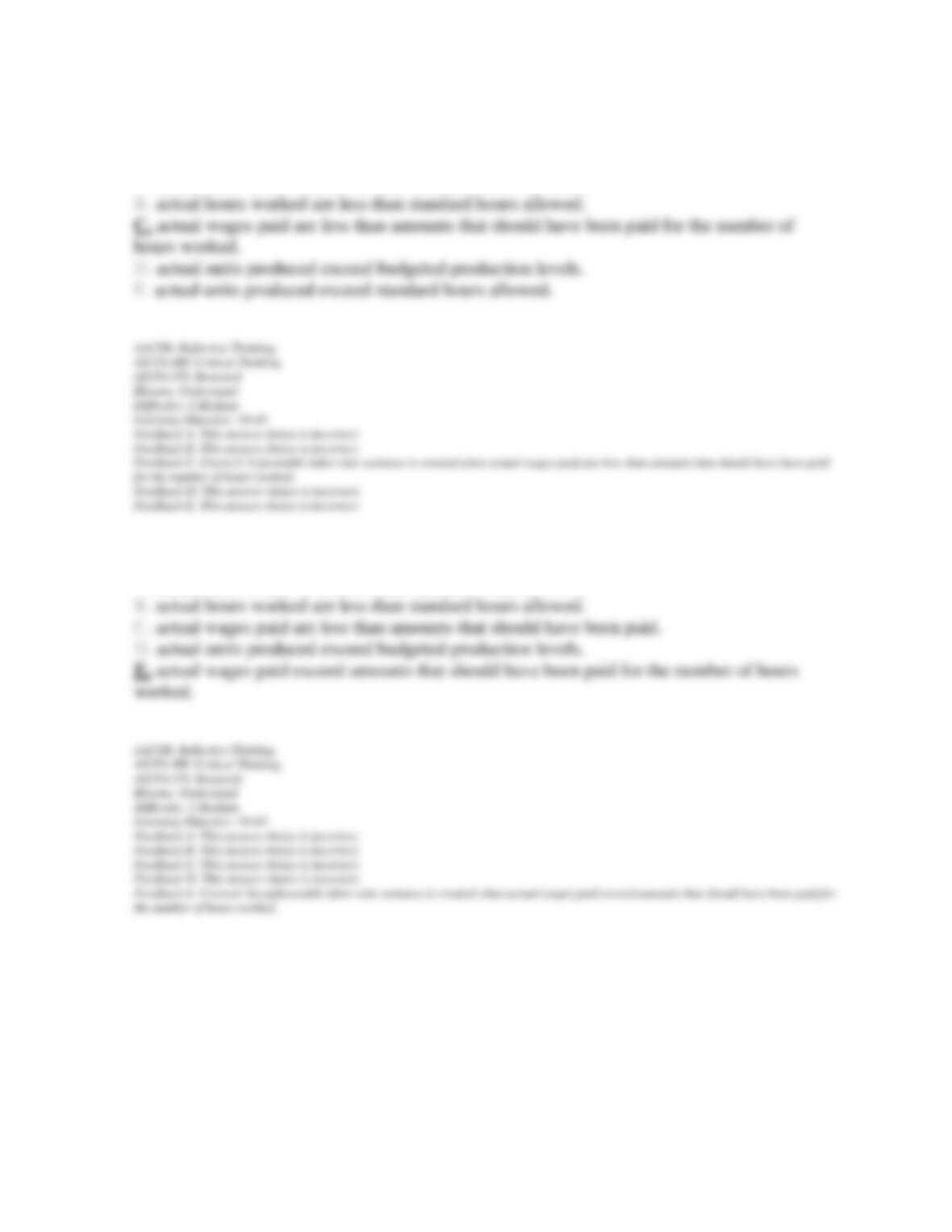
38. A favorable labor efficiency variance is created when:
A. actual labor hours worked exceed standard hours allowed.
39. An unfavorable labor efficiency variance is created when:
Chapter 10 – Standard Costing and Analysis of Direct Costs
10–18
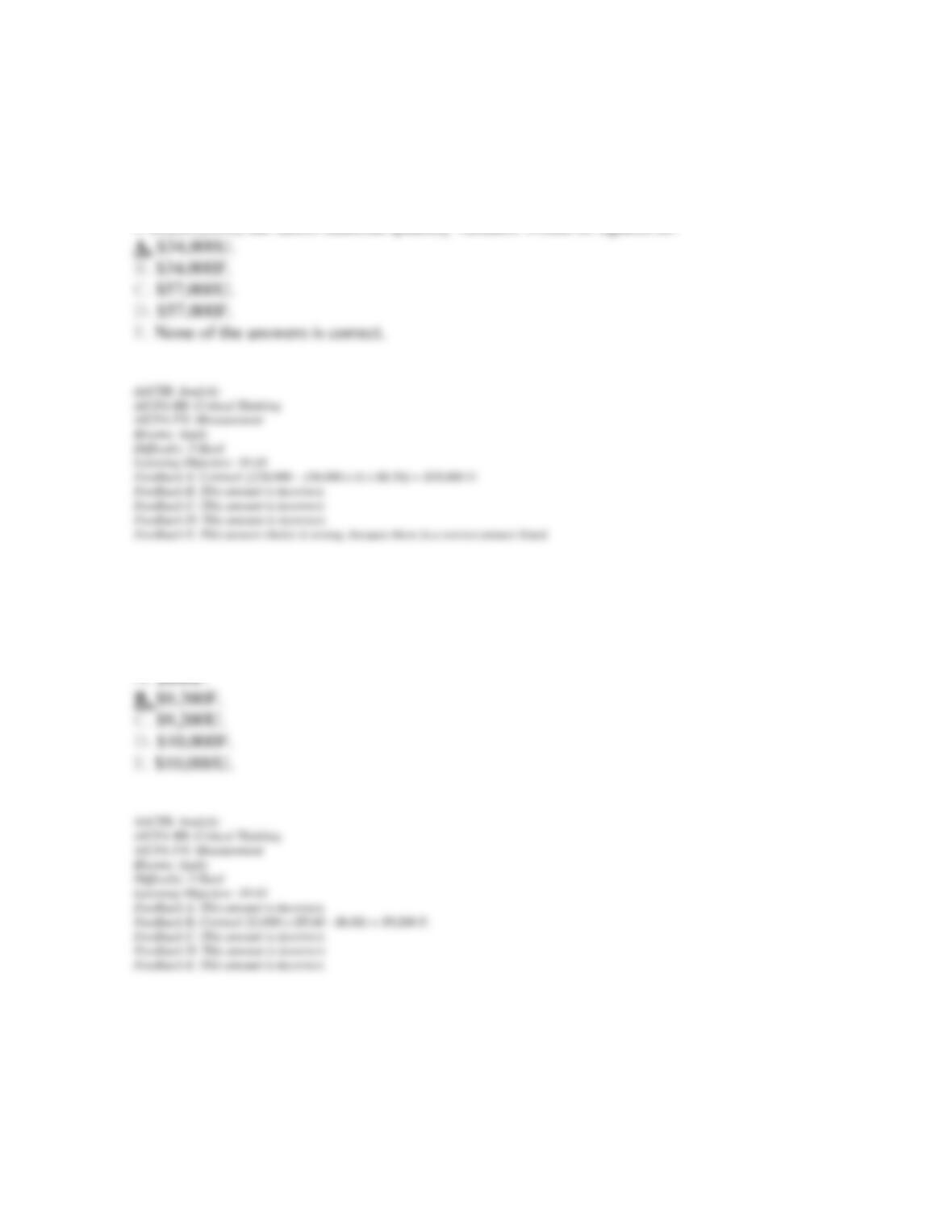
40. A favorable labor rate variance is created when:
A. actual labor hours worked exceed standard hours allowed.
41. An unfavorable labor rate variance is created when:
A. actual labor hours worked exceed standard hours allowed.
Chapter 10 – Standard Costing and Analysis of Direct Costs
10–19
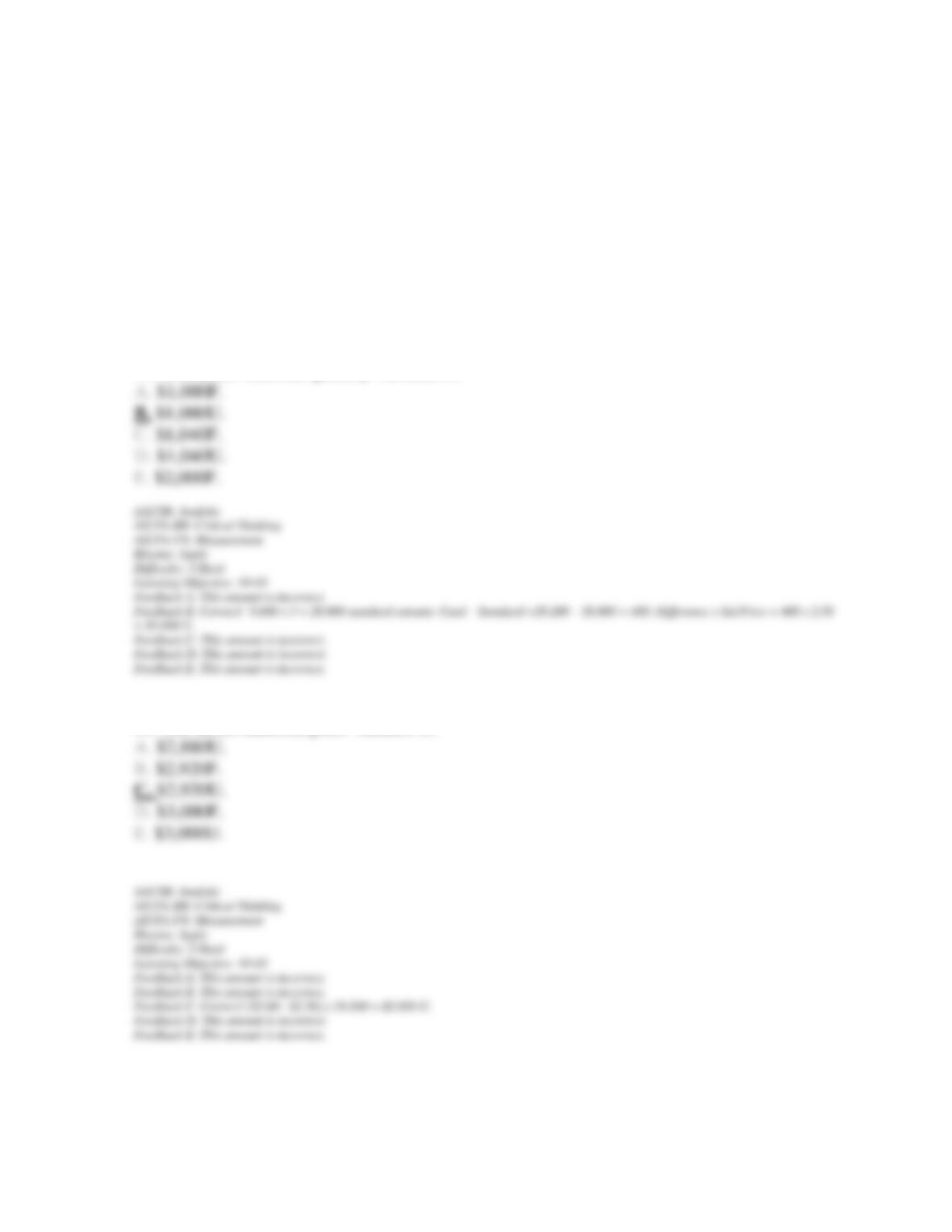
42. Perez, Inc. recently completed 56,000 units of a product that was expected to consume
four pounds of direct material per finished unit. The standard price of the direct material was
$8.50 per pound. If the firm purchased and consumed 228,000 pounds in manufacturing (cost
= $1,881,000), the direct-material quantity variance would be figured as:
43. Joiner Corporation recently purchased 25,000 gallons of direct material at $5.60 per
gallon. Usage by the end of the period amounted to 23,000 gallons. If the standard cost is
$6.00 per gallon and the company believes in computing variances at the earliest point
possible, the direct-material price variance would be calculated as:
Chapter 10 – Standard Costing and Analysis of Direct Costs
10–20
Use the following data that relate to product no. 89 of Mansion Corporation to answer
Questions 44 & 45:
Direct material standard: 3 square feet at $2.50 per square foot
Direct material purchased: 30,000 square feet at $2.60 per square foot
Direct material consumed: 29,200 square feet
Manufacturing activity: 9,600 units completed
Assume that the company computes variances at the earliest point in time.
44. The direct-material quantity variance is:
45. The direct-material price variance is: