Chapter 10—The Order Entry/Sales (OE/S) Process Key
1. The order entry/sales (OE/S) process includes the first four steps in the order-to-cash process: presales activities;
sales order processing; picking and packing the goods; and shipping.
2. The first step in the order-to-cash process is sales order processing.
3. A customer request for goods might take the physical form of a telephone call, an EDI transmission, an entry on
a Web site, or a faxed or mailed customer order.
4. The OE/S process helps support the decision needs of the accounting department.
5. One of the primary functions of the OE/S is to create information flows which support the repetitive work
routines of the sales order department, credit department, and shipping department.
6. The flow of information from OE/S to marketing managers is an example of horizontal information flows.
7. The flow of information from OE/S to the credit department is an example of vertical information flows.
8. For companies using enterprise systems, CRM systems often share the same underlying database.
9. Data warehousing applications in organizations are usually viewed as being focused on either operational or
analytical applications.
10. CRM software is designed to manage all the data related to customers, such as marketing, field service, and
contact management data.
11. Sell-side systems use the Internet to automate and manage corporate vendors and purchases.
12. Buy-side systems are designed to allow a company to market, sell, deliver and service goods and services to
customers throughout the world via the Internet.
13. Sales-force automation software may be used to route calls to a particular sales representative who has
previously worked with the customer.
14. A customer order triggers the OE/S process.
15. Analytical applications, which include data mining, are intended to allow the use of sophisticated statistical
and other analytical software to help an organization’s members develop insights about customers, processes, and
markets.
16. If a check of the customer master data shows that the goods requested on a customer order are not in stock, an
exception routine called a back order is initiated.

17. A packing slip authorizes the warehouse to remove goods from the warehouse and send them to the shipping
department.
18. A picking ticket is affixed to the inventory package sent to the customer and identifies the customer and the
contents of the package.
19. Vendor acknowledgements are sent to vendors to notify them that their orders have been accepted and to
inform them of the expected delivery date.
20. A bill of lading is the document representing the contract between the shipping company and the common
carrier.
21. The OE/S process sends the sales order notification to the billing department to notify them of a pending
shipment.
22. If a customer refuses to accept a back order, then the sales event is terminated and the sales order is accepted.
23. A customer acknowledgement is sent to the customer to notify him or her of the order’s acceptance and the
expected shipping date.
24. A customer acknowledgement is sent to the billing department to notify them of a pending shipment.
25. In the E-R diagram for OE/S, SALES_ORDERS activates the STOCK_PICK.

26. In the E-R diagram for OE/S, STOCK_PICK triggers the SALES_INVOICES.
27. In the E-R diagram for OE/S, SHIPMENTS generate the SALES_INVOICES.
28. The marketing data is a repository of a variety of sales-oriented data, some of which result from recording sales
events and some of which originate from activities that do not culminate in completed sales, such as presales
activities.
29. The inventory master data normally contains standing data about each customer, such as name, billing and
ship-to addresses, and telephone number.
30. The customer master data is a data store that contains data identifying the particular characteristics of each
customer.
31. The completed picking ticket file provides an audit trail of authorized inventory transfers made between the
warehouse and the shipping department.
32. Depending on how the OE/S process is designed, the sales order master data may be updated at least
33. Optical character recognition (OCR) devices use light reflection to read differences in code patterns in order to
identify a labeled item.
34. Bar code readers are used to recognize patterns of handwritten or printed characters.
35. Output devices that capture printed images or documents and convert them into electronic digital signals that
can be stored in computer media are called scanners.
36. When a customer service representative enters data into the OE/S system, the first screen prompt is usually for
the customer number.
TRUE
37. A tickler file is one that is reviewed on a current and regular basis for the purpose of taking action to clear the
items from that file.
38. Preformatted screens in the OE/S process are a control plan that involves the detailed comparison of the
individual elements appearing on two source documents.
39. One-for-one checking in the OE/S process is a control plan that simplifies the data entry process, and may
prevent the customer service representative from omitting data, to fill in certain fields, and reject incorrectly
formatted fields to reduce input errors.
40. Online prompting in the OE/S process is a control plan that advises the customer service representative to
check their data entries for accuracy before moving on.
41. Confirm input acceptance in the OE/S process is a control plan that tells the customer service representative
that the order has been accepted.
42. Customer credit check is a control plan that ensures that the organization protects its resources by dealing only
with customers who have demonstrated an ability to satisfy their liabilities.
43. Customer Relationship Management (CRM) tools can be used by marketing managers to connect with
customers, to learn what they like and don’t like, and about new products that they want.
44. The OE/S process is part of the ____ process.
45. The OE/S process handles the processing and shipment of a customer order while another process actually bills
the customer. With such a configuration, you would not expect the OE/S system to interface directly with the
____.
A. billing/accounts receivable/cash receipts process
46. The OE/S process includes the first four steps in the order-to-sales process. The order of these four steps is:
47. The primary function of the OE/S process is to create information flows that support:
A. decision making of sales personnel
48. In addition to the warehousing function, the three primary departments that you would expect to be part of a
typical OE/S process are:
49. The ultimate goal of the OE/S process is:
50. When the sales order department acknowledges a customer order, it is an example of a:
51. When the sales-related data are captured in the sales order department and then the information flows to the
managers housed in the marketing department, it is an example of a:
52. Which of the following is a horizontal information flow?
A. sales order department requests credit approval from credit department
53. With companies facing global competition, firms are recognizing that their most important asset is:
A. inventory
54. The OE/S process addresses the decision needs of managers of various sales and marketing functions through
the use of:
A. vertical information flows
55. The grouping of customers into categories based on key characteristics is called:
56. ____ applications in organizations are usually viewed as being focused on either operational or analytical
applications.
57. Analytical applications, which include ____, are intended to allow the use of sophisticated statistical and other
analytical software to help an organization’s members develop insights about customers, processes, and markets.
58. ____ systems use the Internet to automate and manage purchases and the vendors from which these purchases
are made with the predominate technology being electronic data interchange (EDI).
59. ____ applications can handle both B2B and B2C business transactions.
60. The concept behind ____ is to cultivate customer relationships by prospecting, acquiring, servicing, and
retaining customers.
61. A data flow or event that causes a process to begin is called a:
62. A specific type of reject stub is called a(n):
63. An example of an “exception routine” is a(n):
64. Assuming that we separate the shipping and billing processes, which of the following data stores would you
expect to be updated by an OE/S process called execute shipping notice?
A. accounts receivable master data
65. In a logical DFD for the OE/S process, which of the following data stores is least likely to interact with the
process validate sales order?
66. In a typical OE/S process, validating a sales order likely would involve all of the following processes except:
A. checking the customer’s credit
67. A valid shipping notice input is one that is supported by both:
68. Assuming that we separate the shipping and billing processes, which of the following data stores provides data
to the typical OE/S process but is not updated by the process?
A. general ledger master data
69. For a typical OE/S process to check a customer’s credit, all of the following data stores likely would be
consulted except the:
70. A document that is used when filling a sales order to authorize the movement of goods from a warehouse to
shipping is called a:
71. At the time that the shipping notice is prepared and disseminated in an OE/S process, to the following entities
are notified:
72. At the time that the shipping notice is prepared and disseminated, two data stores within the OE/S process are
normally updated. Those two data stores are the:
A. customer master data and accounts receivable master data
73. Which of the following documents represents a contract between two parties?
A. shipping’s inventory notification
74. Which of the following data stores is designed primarily to serve the vertical information needs of the
organization rather than the horizontal information flows?
75. Which of the following data is least likely to be stored in the customer master data?
A. customer number
76. In an entity-relationship (E-R) diagram for the OE/S process, you would expect that the word trigger would
appear in the diamond showing the relationship between which of the following pairs of entities?
77. Bar code readers:
78. Which of the following goals is not an example of an operations process goal of the typical OE/S process?
79. In constructing a control matrix for an OE/S process, the principal data input(s) to the information system
likely would be:
80. The file most important for ensuring validity of customer order inputs is the:
81. The control plan preformatted screens is directed primarily toward achieving the information process control
goal of ensuring:
82. The control plan confirm input acceptance helps to achieve the sales order input control goal of:
83. In the OE/S process, the document that represents an independent authorization to ship goods to the customer
is the:
84. In the control matrix of the OE/S process, regarding shipping notice inputs, which of the following control
goals is ensured by comparing the shipping notice input to the sales order master data?
85. Digital image processing systems are capable of performing all of the following except:
A. capture of data
86. The system that enables users of an ERP system to view source documents from any location is:
87. The order entry/sales (OE/S) process includes the first four steps in the ______________________________
process.
88. The first step in the OE/S process is typically a data flow from a(n) ______________________________.
89. ______________________________ expect convenient and timely access to information about their order
from order initiation, through product delivery, and until after the bill had been paid.
90. The OE/S process helps support the decision needs of the ______________________________ and
______________________________ functions.
91. One of the primary functions of the ______________________________ is to create information flows which
support the repetitive work routines of the sales order, shipping, and credit departments.
92. The flow of information from the OE/S process to marketing managers is an example of
______________________________ information flows.
93. The flow of information from OE/S to the credit department is an example of
______________________________ information flows.
94. For companies using enterprise systems, customer relationship management (CRM) systems often share the
same underlying ______________________________.
95. The concept behind ______________________________ is to cultivate customer relationships by prospecting,
acquiring, servicing, and retaining customers.
96. ______________________________ systems use the Internet to automate and manage purchases and the
vendors from which these purchases are made.

97. ______________________________ systems are designed to allow a company to market, sell, deliver, and
service goods and services to customers throughout the world via the Internet.
98. The buzzword in CRM which means the grouping of customers into categories based on key characteristics is
______________________________.
99. In the OE/S process, the one input that creates the six outputs of general ledger inventory sales update, sales
order notification, bill of lading, completed packing slip, shipping’s billing notification, and customer
acknowledgement is the ______________________________.
100. When a source document provides authority for a business activity to occur, the source document is said to
______________________________ the activity.
101. If a check of the inventory master data shows that the goods requested on a customer order are not in stock,
an exception routine called a(n) ______________________________ process is initiated.
102. A(n) ______________________________ authorizes the warehouse to remove goods from the warehouse
and send them to the shipping department.
103. A(n) ______________________________ is affixed to the inventory package sent to the customer and
identifies the customer and the contents of the package.
104. ______________________________ are sent to customers to notify them that their orders have been
accepted and to inform them of the expected shipping date.

105. A(n) ______________________________ is the document representing the contract between the shipping
company and the carrier.
106. The OE/S process sends the ______________________________ notification to the billing/accounts
receivable/cash receipts process to notify that process of a pending shipment.
107. When a transaction is terminated because of an error or other exception condition, such as when a customer
refuses to accept a back order in the OE/S process, the transaction termination is shown on a DFD by a(n)
108. In the ER diagram for OE/S, SALES_ORDERS activates ______________________________.
109. In the ER diagram for OE/S, STOCK_PICK triggers ______________________________.
110. In the ER diagram for OE/S, SHIPMENTS generates ______________________________.
111. The ______________________________ data is the repository of a variety of sales-oriented data, some of
which result from recording sales events and some of which originate from activities that do not culminate in
completed sales, such as presales activities.
112. The ______________________________ master data normally contains standing data about each customer,
such as name, address, and telephone number.

113. The ______________________________ master data is updated to reflect the fact that the goods have been
picked, packed, and shipped.
114. ______________________________ are devices that use light reflection to read differences in code patterns
in order to identify a labeled item.
115. ______________________________ is used to recognize patterns of handwritten or printed characters.
116. Input devices that capture printed images or documents and convert them into electronic digital signals that
can be stored in computer media are called ______________________________.
117. A(n) ______________________________ file is one that is reviewed on a current and regular basis for the
purpose of taking action to clear the items from that file.
118. One-for-one checking of ______________________________with the goods ensures that the correct goods
are picked from the shelf and that any errors are detected and corrected in a timely manner (e.g., before the goods
get to the shipping department).
119. ______________________________ may reduce input errors by populating certain fields and rejecting
incorrectly formatted fields, thereby preventing the customer service representative from omitting data or entering
data with errors.
120. ______________________________ advises customer service representatives to check data entries for
accuracy before moving on.

121. ______________________________ ensures that the organization protects its resources by dealing only with
customers who have demonstrated an ability to satisfy their liabilities.
122. ______________________________ master data contains a record of each item that is stocked in the
warehouse or regularly ordered from a vendor.
123. ______________________________ is a control plan that establishes, for shipping personnel, that someone
other than warehouse personnel authorized a shipment.
124. ______________________________ segregates duties between the personnel who create the customer record
and the personnel who create the sales order.
125. ______________________________ tools can be used by marketing managers to connect with customers, to
learn what they like and don’t like, and about new products that they want.
126. ______________________________ systems are computer-based systems for the capture, storage, retrieval,
and presentation of images of objects such as pictures and documents.
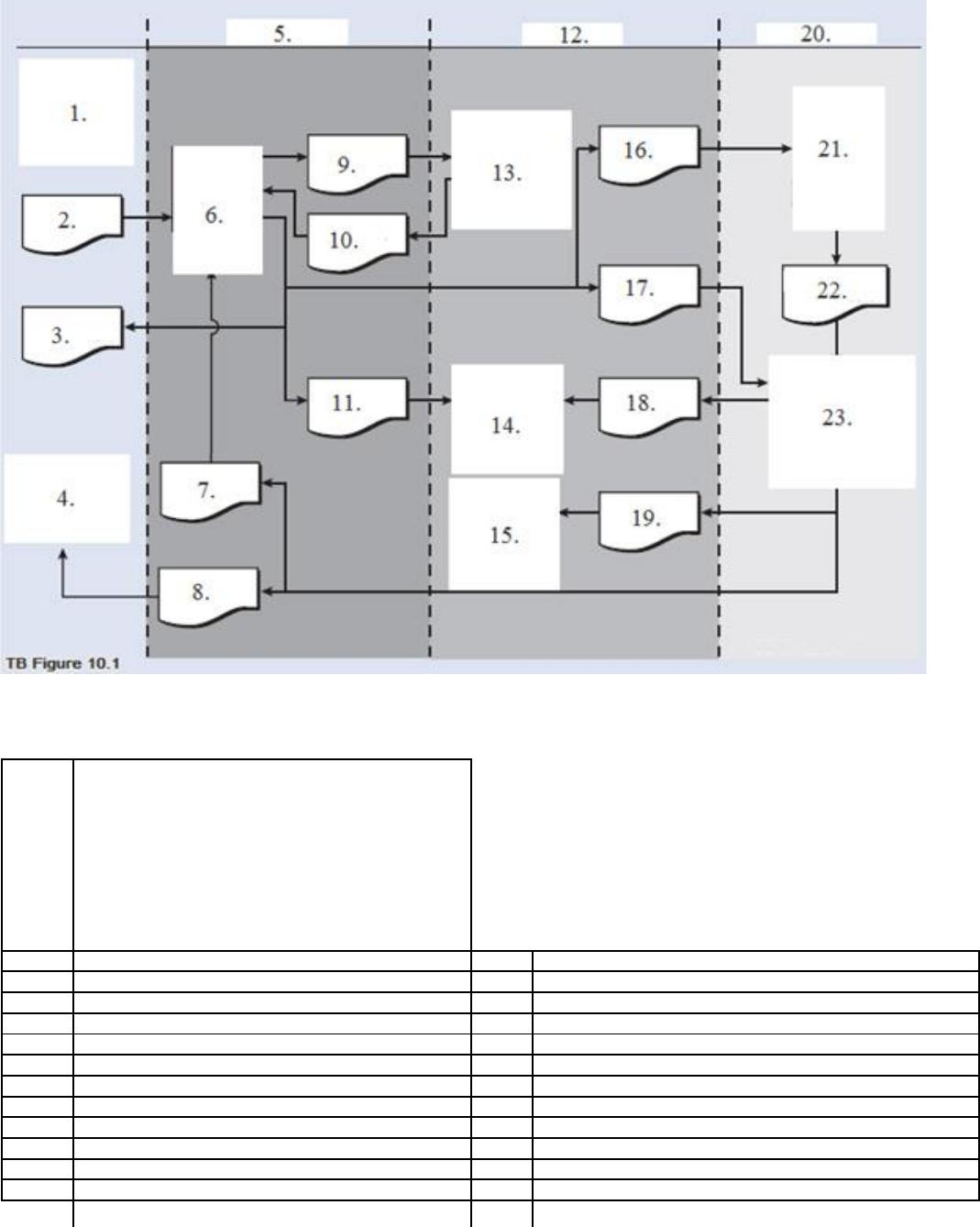
127. TB Figure 10.1 below shows the horizontal perspective of an OE/S process. Functional titles and information
flows, depicted as documents, generated or captured by the OE/S process have been omitted from the figured and
listed underneath it.
Functiona
l titles
(for OE/S
structures
and
entities
with
which the
process
interacts)
Information Flows
(depicted as documents)
A.
Credit department
L.
Customer order
B.
Sales order department
M.
Credit request
C.
Shipping department
N.
Credit approval
D.
VP finance
O.
Acknowledgement (to customer)
E.
VP logistics
P.
Picking ticket (to warehouse)
F.
B/AR/CR process
Q.
Completed picking ticket (to shipping)
G.
Carrier
R.
Sales order (to B/AR/CR)
H.
Customer
S.
Shipping notice (to B/AR/CR)
I.
General ledger
T.
Shipping notice (to sales order dept.)
J.
Warehouse
U.
Shipping notice (to carrier)
K.
VP marketing
V.
Shipping notice (to general ledger)
W.
Sales order (to shipping)
Required:
Number your paper from 1 to 23 Match the letter from the list to the appropriate number in TB Figure 10.1.
128. Below is a narrative of the “Validate sales order” portion (i.e., bubble 1.0) of the order entry/sales process.
Narrative Description
How does the OE/S process then validate a customer order? First, process 1.1 verifies the availability of the
requested inventory by consulting the inventory master data. If a sufficient level of inventory is on hand to satisfy
the request, the order is forwarded for further processing, as depicted by the data flow “Inventory available order.”
Conversely, if a customer orders goods that are not in stock, process 1.1 runs a special back order routine. This
routine determines the inventory requirement necessary to satisfy the order and then sends the back order request
to the purchasing department. This activity is depicted by the “Back order” data flow, which in reality is a specific
type of exception routine (i.e., a specific type of reject stub). If the customer refuses to accept a back order, then
the sales event is terminated and the order is rejected, as shown by the “Reject” data flow. Information from the
order (e.g., sales region, customer demographics, and order characteristics that reflect buying habits) that has
potential value to marketing is recorded in the marketing data store.
After assuring inventory availability, process 1.2 establishes the customer’s existence and then evaluates credit.
The credit check adds the amount of the order to accounts receivable balances and open sales orders (i.e., orders
about to be receivables), and compare that total to the credit limit. If the customer has exceeded their credit limit,
the order is rejected.
Upon a successful credit approval, process 1.3 performs the following activities simultaneously:
·
Updates the inventory master data to allocate the quantity ordered to the sales order. The inventory balance could actually be reduced at
this time to save a later update of the inventory master data.
·
Updates the sales order master data to indicate that a completed sales order has been created.
·
Disseminates the sales order.
L
N
S
O
R
V
G
D
E
B
F
Q
T
I
C
U
P