Financial Accounting, 11e (Harrison/Horngren/Thomas)
Chapter 10 Stockholders’ Equity
1 Learning Objective 10-1
1) A corporation is an entity that is not separate from its owners.
2) A corporation acts under its own name and not the name of its stockholders.
3) If a corporation pays taxes on its income, then the stockholders will not have to pay taxes on the
dividends received from that corporation.
4) Stockholders have limited liability for a corporation’s debts.
5) A new corporation forms every time there is a change in ownership in the shares of common stock.
6) A stockholder has the right to vote in the election of the board of directors.
7) The charter reveals the number of shares of common stock a corporation is authorized to issue.
8) Which of the following is NOT considered to be an advantage of forming a corporation?
A) continuous life
B) government regulation
C) ability to raise more capital than a partnership or proprietorship
D) limited liability of stockholders for corporation’s debts
9) Double taxation means that the:
A) corporation’s income tax is allocated to the shareholders based on ownership percentage.
B) corporate earnings are subject to state and federal income tax.
C) corporation pays taxes on its earnings and the shareholders pay taxes on the dividends received from
the corporation.
D) shareholders’ dividends are taxed at the corporate tax rate.
10) Stockholders of a corporation directly elect the:
A) Board of directors.
B) President of the corporation.
C) Chief Financial Officer of the corporation.
D) Chairperson of the Board.
11) The chairperson of the board of directors often has the title of:
A) Chief Financial Officer (CFO).
B) President.
C) Chief Executive Officer (CEO).
D) Chief Operating Officer (COO).
12) The basic form of capital stock is:
A) a share of preferred stock.
B) a share of common stock.
C) par value stock.
D) the corporate charter.
13) Which one of the following is NOT a stockholder’s right of ownership in a corporation?
A) the right to participate in management by voting on matters that come before the stockholders
B) the right to receive a proportionate share of the assets remaining after all liabilities are paid upon
liquidation
C) the right to maintain one’s proportionate share of ownership in the corporation
D) the right to decide if a dividend should be distributed
14) Stockholders’ equity is divided into:
A) retained earnings and paid-in capital.
B) retained earnings and common stock.
C) assets and liabilities.
D) common stock and preferred stock.
15) If a corporation has only one class of stock, it is understood to be:
A) preferred stock.
B) common stock.
C) participating stock.
D) redeemable stock.
16) Dividends are declared by the:
A) Chief Accounting Officer.
B) Chief Financial Officer.
C) President.
D) Board of directors.
17) The arbitrary amount assigned by a company to a share of its stock is the:
A) stated value per share.
B) par value per share.
C) book value per share.
D) A and B
18) Which statement is FALSE?
A) Preferred stockholders receive dividends before the common stockholders only if the preferred stock
is cumulative.
B) Preferred stockholders receive dividends before the common stockholders.
C) Preferred stockholders receive assets before the common stockholders if the corporation liquidates.
D) Preferred stockholders have the same basic four rights as common stockholders, unless a right is
taken away.
19) Which statement about corporations is FALSE?
A) The ease of transferring ownership is an advantage.
B) A greater ability to raise capital than other forms of organization is an advantage.
C) Limited life is an advantage.
D) Double taxation of distributed profits is a disadvantage.
20) Preferred stock that must be redeemed by a corporation is reported as a(n) ________ on the balance
sheet.
A) component of stockholders’ equity
B) contra account in stockholders’ equity
C) liability
D) asset
21) Legal capital for a corporation equals:
A) the selling price of stock that has been issued.
B) the par value of stock that has been authorized.
C) the par value of stock that has been issued.
D) the par value of stock that is outstanding.
22) Preferred stock is NOT similar to debt because:
A) preferred dividends are not tax-deductible whereas interest expense is tax-deductible.
B) preferred dividends do not have to be paid whereas interest expense must be paid.
C) preferred stock does not have a maturity date whereas debt usually has a maturity date.
D) all of the above.
2 Learning Objective 10-2
1) Corporations may either sell stock directly to the stockholders or use the service of an underwriter.
2) A company can issue common stock in exchange for assets other than cash.
3) When common stock is issued for services provided to the corporation, the corporation usually
recognizes an expense for the fair market value of the services provided.
4) Another name for Paid-in Capital in Excess of Par is Additional Paid-in Capital.
5) Convertible preferred stock is usually convertible into the issuer’s common stock at the discretion of
the preferred stockholder.
6) When a corporation issues stock and receives an asset other than cash, the value of the asset received
can create an ethical challenge.
7) When a company issues common stock at a price per share greater than its par value per share, the
excess should be credited to:
A) Retained Earnings.
B) Common Stock.
C) Paid-in Capital in Excess of Par—Common.
D) Excess Capital.
8) The difference between the issue price per share of common stock and the par value per share of the
stock is credited to:
A) Retained Earnings.
B) Common Stock.
C) Paid-in Capital in Excess of Par—Common.
D) Goodwill.
9) If a corporation issues 2000 shares of $1 par value common stock for $8000, the journal entry would
include a credit to:
A) Common Stock for $8000.
B) Paid-in Capital in Excess of Par—Common for $8000.
C) Common Stock for $2000.
D) Retained Earnings for $2000.
10) If a corporation issues 6000 shares of $5 par value common stock for $91,000, the journal entry
would include a credit to:
A) Common Stock for $91,000.
B) Paid-in Capital in Excess of Par—Common for $91,000.
C) Common Stock for $61,000.
D) Paid-in Capital in Excess of Par—Common for $61,000.
11) The journal entry to record common stock issued at its par value includes a credit to:
A) Paid-in Capital—Par Value.
B) Common Stock.
C) Common Stock Revenue.
D) Retained Earnings
12) When 200 shares of $1 par value Common Stock are issued at $29 per share, Paid-in Capital in
Excess of Par—Common will:
A) increase $200.
B) decrease $5800.
C) increase $5600.
D) stay the same.
13) If stock is issued for an asset other than cash, the asset should be recorded on the books of the
corporation at the:
A) current market value of the asset.
B) book value of the asset.
C) par value of the stock.
D) fair market value of the stock minus the par value of the stock.
14) Badger Corporation issued 9000 shares of its $5 par value common stock in payment for attorney
services billed at $108,000. Badger Corporation’s stock has been actively trading at $12 per share. The
journal entry for this transaction would include a:
A) debit to Legal Expense $45,000.
B) debit to Legal Expense $108,000.
C) credit to Common Stock $63,000.
D) credit to Paid-in Capital in Excess of Par—Common $108,000.
15) Miller Corporation issued 12,000 shares of its $5 par value common stock in payment for attorney
services billed at $180,000. Miller Corporation’s stock has been actively trading at $15 per share. The
journal entry for this transaction would include a credit to:
A) Paid-in Capital in Excess of Par—Common for $180,000.
B) Paid-in Capital in Excess of Par—Common for $120,000.
C) Legal Expense for $180,000.
D) Common Stock for $180,000.
16) When reporting stockholders’ equity on the balance sheet, a corporation lists the accounts in the
following order:
A) Retained Earnings, Preferred Stock, Common Stock.
B) Common Stock, Preferred Stock, Additional Paid-in Capital, Retained Earnings.
C) Preferred Stock, Common Stock, Additional Paid-in Capital, Retained Earnings.
D) Retained Earnings, Common Stock, Paid-in Capital in Excess of Par—Common.
17) The number of shares of authorized stock of a corporation:
A) changes every time stock is sold.
B) is stated in the charter.
C) has no limit.
D) must be recorded as a journal entry.
18) Apple Inc. issued 5 million shares of no-par common stock for $5 million. What journal entry is
prepared?
A) debit Cash $5 million and credit Paid-in Capital in Excess of Par $5 million
B) debit Cash $5 million and credit Retained Earnings $5 million
C) debit Cash $5 million and credit Paid–in Capital in Excess of Stated Value $5 million
D) debit Cash $5 million and credit Common Stock $5 million
19) Paltrowski Company issued 1 million shares of no-par common stock with a stated value of $2. The
issue price was $54 per share. Which journal entry is prepared?
A) debit Cash $54 million and credit Common Stock $54 million
B) debit Cash $54 million, credit Common Stock $2 million and credit Paid-in Capital in Excess of Par—
Common $52 million
C) debit Cash $54 million, credit Common Stock $2 million and credit Paid-in Capital in Excess of Stated
Value—Common $52 million
D) debit Cash $54 million and credit Retained Earnings $54 million
20) Lewandowski Company reports the following information at the fiscal year end of December 31,
2017:
Common Stock, $0.10 par value per share
$98 million
Paid-in Capital in Excess of Par-Common
400 million
Retained Earnings
900 million
Total Stockholders’ Equity
$1398 million
What is the total paid-in capital for this company at December 31, 2017?
A) $98 million
B) $498 million
C) $998 million
D) $1398 million
21) Lisa Laskowski Company reports the following information at the fiscal year end of December 31,
2017:
Common Stock, $0.10 par value per share
$88 million
Paid-in Capital in Excess of Par-Common
600 million
Retained Earnings
900 million
Total Stockholders’ Equity
$1588 million
What was the average selling price for the common stock issued? (Round your final answer to the
nearest cent.)
A) $0.68 per share
B) $0.10 per share
C) $0.78 per share
D) $1.02 per share
22) Buetters Company reports the following information at the fiscal year end of December 31, 2017:
Common Stock, $0.10 par value per share
$94 million
Paid-in Capital in Excess of Par-Common
600 million
Retained Earnings
700 million
Total Stockholders’ Equity
$1394 million
How many shares of common stock were issued?
A) 9.4 million
B) 94 million
C) 694 million
D) 940 million
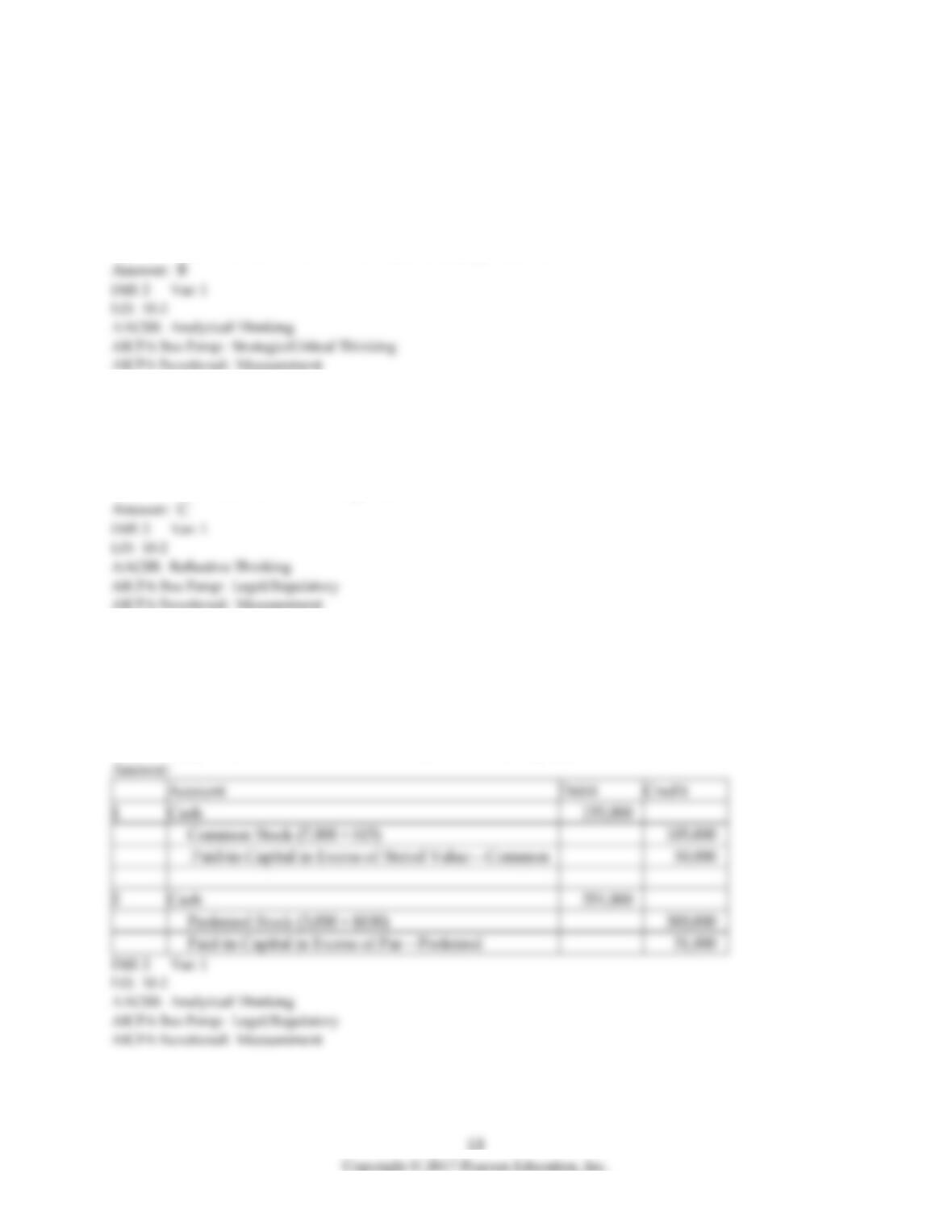
23) A company issues 1,000,000 shares of $0.50 par value, cumulative preferred stock for $12,000,000.
The stated dividend is $1 per share. Which journal entry is needed for the sale?
A) debit Cash $12,000,000 and credit Preferred Stock $12,000,000
B) debit Cash $12,000,000, credit Preferred Stock $900,000 and credit Paid-in Capital in Excess of Par—
Preferred $11,100,000
C) debit Cash $12,000,000 and credit Paid-in Capital in Excess of Par—Preferred $12,000,000
D) debit Cash $12,000,000 and credit Retained Earnings $12,000,000
24) The calculation to determine the number of outstanding shares of stock is the number of:
A) treasury stock shares plus number of issued shares.
B) authorized shares minus number of issued shares.
C) issued shares minus number of treasury shares.
D) authorized shares minus treasury shares.
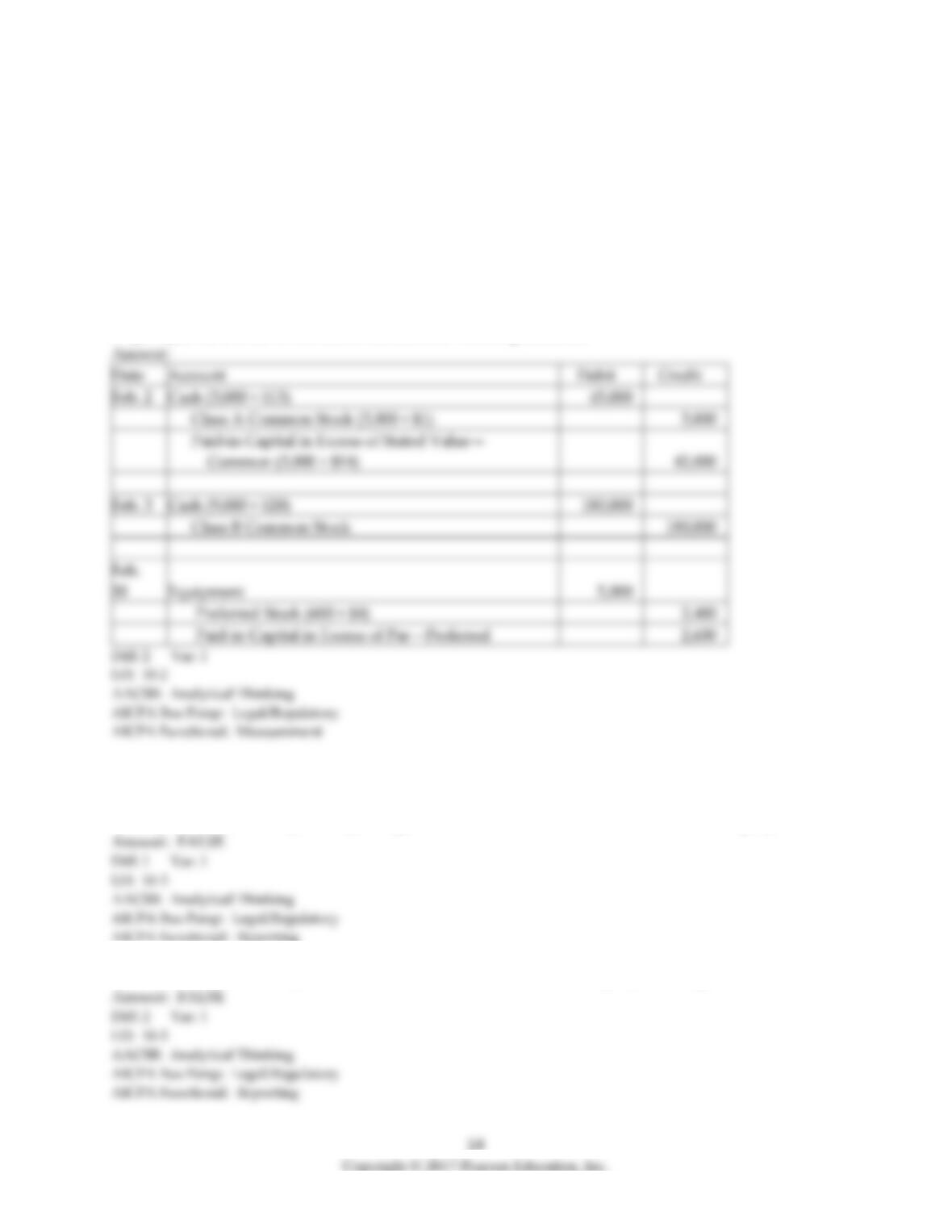
25) Johnson Corporation had the following transactions:
1. Issued 7,000 shares of no-par common stock with a stated value of $15 per share for $155,000.
2. Issued 3,000 shares of $100 par value preferred stock at $117 per share for cash.
Required:
Prepare the journal entries for the above transactions. Omit explanations.
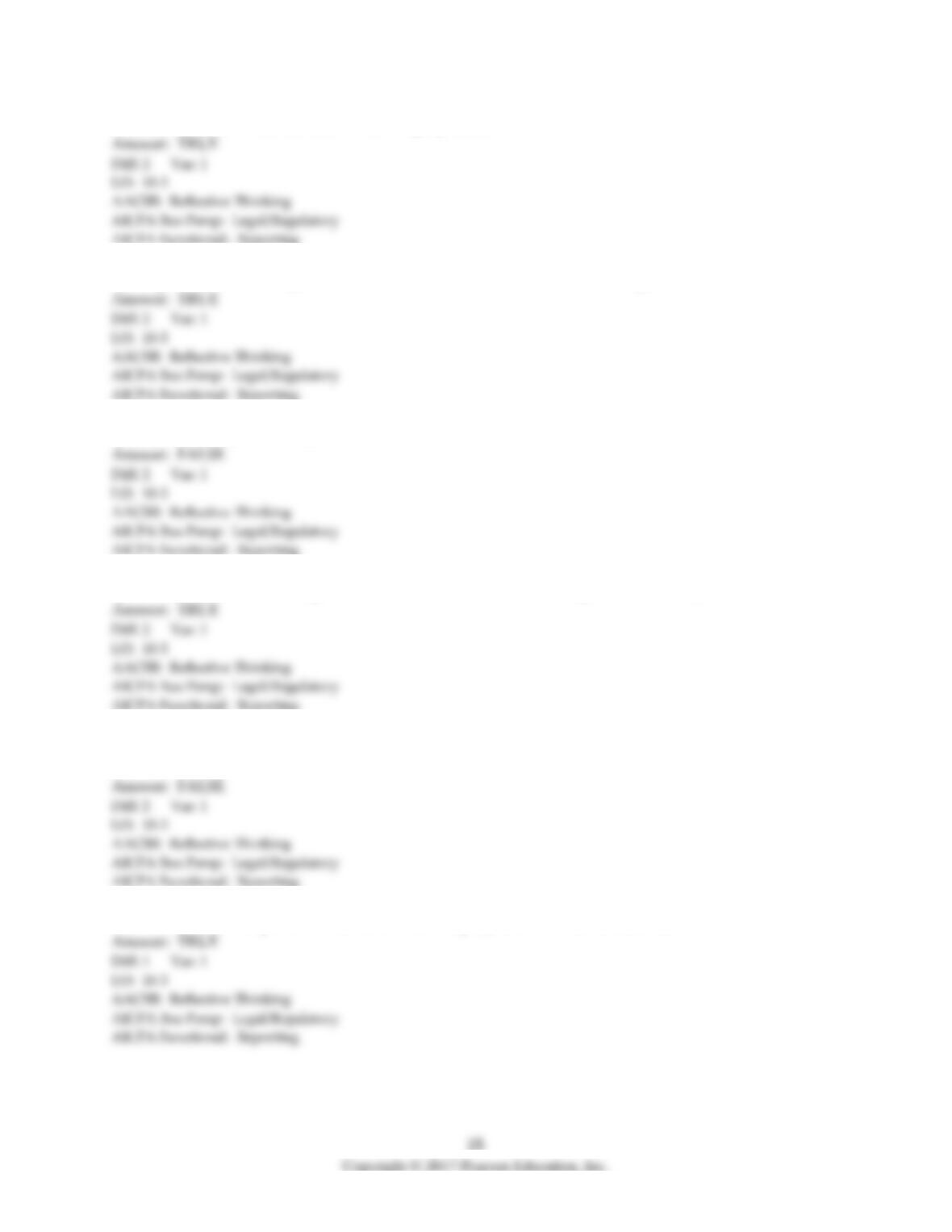
26) During the month of February, B & B Builders, Inc. completed the following transactions related to
its stock:
∙ February 2: Issued 3,000 shares of no-par, Class A common stock with a stated value of $1 for $15
cash per share.
∙ February 3: Issued 9,000 shares of no-par, Class B common stock with no stated value for $20 per
share.
∙ February 20: Issued 600 shares of $4 par value preferred stock for equipment with a fair market
value of $5,000.
Required:
Prepare journal entries for the above transactions. Omit explanations.
3 Learning Objective 10-3
1) The purchase of treasury stock by a corporation increases total assets and stockholders’ equity.
2) The purchase of treasury stock has the same effect on stockholders’ equity as issuing stock.
3) Treasury stock is a contra-stockholders’ equity account.
4) The purchase of treasury stock decreases the number of shares outstanding.
5) Retired stock can be reissued.
6) A company never records gains or losses on transactions involving its own treasury stock.
7) U.S. GAAP prohibits companies from supplementing employee salaries by granting shares of stock
rather than cash.
8) Treasury stock is reported in the stockholders’ equity section of the balance sheet.
9) Previously issued stock that a corporation purchases from shareholders is called:
A) outstanding stock.
B) authorized stock.
C) issued stock.
D) treasury stock.
10) Gruber Law Offices paid $60,000 to buy back 15,000 shares of its $1 par value common stock. The
stock was sold later at a selling price of $16 per share. The journal entry to record the sale would include
a:
A) credit to Paid-in Capital from Treasury Stock Transactions $60,000.
B) debit to Common Stock $60,000.
C) credit to Paid-in Capital from Treasury Stock Transactions $180,000.
D) credit to Common Stock $180,000.
11) Reasons that a company would purchase treasury stock include all of the following EXCEPT:
A) management wants to avoid a takeover by an outside party.
B) it needs the stock for distribution to employees under stock purchase plans.
C) it wants to increase net assets by buying its stock low and reselling it at a higher price.
D) management wants to decrease earnings per share of common stock.
12) Peter’s Computers purchased 2000 shares of its own $10 par value common stock for $97,000. As a
result of this transaction:
A) Peter’s stockholders’ equity increased $77,000.
B) Peter’s stockholders’ equity increased $20,000.
C) Peter’s stockholders’ equity decreased $97,000.
D) Peter’s stockholders’ equity increased $97,000.
13) Treasury stock accounts for the difference between the number of:
A) issued shares and authorized shares.
B) issued shares and preferred shares.
C) outstanding shares and issued shares.
D) authorized shares and outstanding shares.
14) Amber Corporation purchases 50,000 shares of its own $10 par value common stock for $50 per
share. What will be the effect on stockholders’ equity?
A) increase $500,000
B) increase $2,500,000
C) decrease $500,000
D) decrease $2,500,000
15) If treasury stock is sold at a price greater than its reacquisition cost, the difference is:
A) debited to Paid-in Capital from Treasury Stock Transactions
B) credited to Paid-in Capital from Treasury Stock Transactions
C) debited to Retained Earnings
D) credited to Retained Earnings
16) Smith Corporation purchases 10,000 shares of its own $20 par value common stock for $30 per share.
What will be the effect on stockholders’ equity?
A) increase $200,000
B) decrease $200,000
C) increase $300,000
D) decrease $300,000
17) Treasury stock has a:
A) debit balance, the opposite of other stockholders’ equity accounts.
B) credit balance, the same as other stockholders’ equity accounts.
C) credit balance, the opposite of other stockholders’ equity accounts.
D) debit balance, the same as other stockholders’ equity accounts.
18) Marvin Corporation has the following information reported on the balance sheet as of December 31,
2017:
Common Stock, $10 par value (authorized 20,000
shares)
$50,000
Treasury Stock (4000 shares)
$30,000
Based on the information above, how many shares of common stock are outstanding?
A) 40,000
B) 5000
C) 1000
D) 4000
19) Mews Corporation has the following information reported on the balance sheet as of December 31,
2017:
Common Stock, $10 par value (authorized 20,000
shares)
$90,000
Treasury Stock (2000 shares)
$30,000
Based on the information above, how many shares of common stock have been issued?
A) 11,000
B) 9000
C) 7000
D) 2000
20) Kunze Corporation has $1 par value Common Stock with 100,000 shares authorized and 25,000
shares issued. The journal entry to record Kunze’s purchase of 5000 shares of common stock at $4 per
share would be:
A) debit Common Stock for $5000, debit Paid-in Capital in Excess of Par—Common for 15,000 and
credit Cash for $20,000.
B) debit Common Stock for $20,000 and credit Cash for $20,000.
C) debit Cash for $20,000, credit Common Stock for $5000 and credit Paid-in Capital in Excess of Par—
Common for $15,000.
D) debit Treasury Stock for $20,000 and credit Cash for $20,000.
21) Orlando Corporation incorporated on January 2, 2017. During 2017, Orlando had the following
transactions:
∙ issued 20,000 shares of common stock at $25 per share. The par value per share is $1.
∙ purchased 4000 shares of treasury stock at $28 per share
∙ had net income of $400,000.
What is the total amount of stockholders‘ equity as of December 31, 2017?
A) $612,000
B) $500,000
C) $788,000
D) $900,000
22) Bloom Corporation issued 40,000 shares of common stock. Bloom purchased 8000 shares and later
reissued 900 shares. How many shares are issued and outstanding?
A) 32,000 issued and 32,000 outstanding
B) 40,000 issued and 32,000 outstanding
C) 32,900 issued and 32,900 outstanding
D) 40,000 issued and 32,900 outstanding
23) When treasury stock is purchased, accountants record treasury stock at:
A) the stock’s par value.
B) the stock’s original selling price.
C) the stock’s current market value.
D) the difference between the original selling price and the par value.