Accounting, 9e (Horngren)
Chapter 10 Current Liabilities and Payroll
Learning Objective 10-1
1) If a note payable has installments due within a year, the entire note is treated as a current liability.
2) Amounts owed for products or services purchased on account are contingent liabilities.
3) Unearned revenue is an obligation to provide goods or services to the customer.
4) Notes payable are considered short-term if they are due within the current operating cycle.
5) An accrued expense is an expense that has been incurred, but has not yet been paid.
6) When a note is payable in installments, the installments must be separately recorded in two different accounts—
Short-term notes payable and Long-term notes payable—depending on the due dates of the installments.
7) Which of the following is an amount for products or services purchased on account?
A) Accounts payable
B) Unearned revenue
C) Accrued expense
D) Estimated warranty payable
8) Which of the following is a characteristic of a current liability?
A) A current liability is a liability that is due within 30 days.
B) A current liability is a liability that is due within one year or one operating cycle, whichever is longer.
C) A current liability is a liability that is due within 10 days.
D) A current liability is a liability that is due in longer than a one-year period, or one operating cycle.
9) Which of the following occurs when a company records accrued interest expense on a note payable?
A) Interest expense is credited.
B) Note payable is credited.
C) Cash is debited.
D) Interest payable is credited.
10) Which of the following correctly describes the unearned revenue account?
A) The unearned revenue account represents revenue that has been collected, but not yet earned.
B) The unearned revenue account represents revenue that has been earned and collected.
C) The unearned revenue account represents revenue that has been earned, but not yet collected.
D) The unearned revenue account represents revenue that has neither been earned nor collected.
11) Which of the following is a liability created when a company receives cash for services to be provided in the
future?
A) Unearned revenue
B) Accrued liability
C) Service revenue
D) Estimated warranty payable
12) Sales revenue for a sporting goods store amounted to $215,000 for the current period. All sales are on account
and are subject to a sales tax of 7%. Which of the following would be included in the journal entry to record these
sales?
A) A debit to Sales revenue for $215,000
B) A credit to Accounts receivable for $215,000
C) A debit to Sales tax payable for $15,050
D) A debit to Accounts receivable for $230,050
13) Which of the following would be included in the journal entry to record the payment of accrued sales tax?
A) A debit to Sales tax payable
B) A credit to Sales tax expense
C) A debit to Sales tax expense
D) A credit to Sales tax payable
14) Which of the following correctly describes Interest payable?
A) Interest payable is shown on the balance sheet as a current liability.
B) Interest payable is shown on the income statement as an operating expense.
C) Interest payable is shown on the balance sheet as a current asset.
D) Interest payable is shown on the balance sheet as a long–term liability.
15) Where does Unearned subscription revenue appear on the balance sheet?
A) Under Long-term investments
B) Under Current liabilities or Long-term liabilities
C) Under Current assets or Long-term investments
D) Under Long-term assets
16) A $20,000, 3-month, 8% note payable was issued on November 1, 2015. What is the amount of accrued interest
on December 31, 2015?
A) $200
B) $267
C) $133
D) $800
17) A $20,000, 3-month, 8% note payable was issued on November 1, 2015. What is the amount of interest expense
recorded in the year 2016?
A) $800
B) $133
C) $200
D) $267
18) A $20,000, 3-month, 8% note payable was issued on November 1, 2015. Which of the following would be
included in the journal entry required on the note’s maturity date?
A) A credit to Note payable for $20,400
B) A credit to Cash for $10,000
C) A debit to Interest expense for $133
D) A debit to Interest payable for $133
19) Which of the following is associated with cash received in advance for services to be performed in the future?
A) Accounts payable
B) Estimated warranty payable
C) Accrued expense
D) Unearned revenue
20) Joe signs a $5,000, 8%, 6-month note dated September 1, 2012. What is Joe’s 2013 interest expense for this
note?
A) $133
B) $200
C) $400
D) $67
21) ABC Company signed a 5-year note payable for $80,000 at 9% annual interest. What is the interest expense for
December 31, 2012 if the note was signed on May 1, 2012?
A) $7,200
B) $4,800
C) $2,400
D) $36,000
22) ABC signed a 5-year, 9% note payable for $80,000 on May 1, 2012. Which account will be credited when the
note paid at maturity?
A) Note payable
B) Interest expense
C) Interest payable
D) Cash
23) The face amount of a promissory note is called the:
A) discount of the note.
B) time of the note.
C) interest rate of the note.
D) principal of the note.
24) The journal entry for accrued interest on a note payable includes:
A) debiting Interest expense and crediting Cash.
B) debiting Interest expense and crediting Accrued interest payable.
C) debiting Accrued interest expense and crediting Cash.
D) crediting Accrued interest expense.
25) Face value of a note payable plus total interest is called:
A) maturity value.
B) face value.
C) proceeds.
D) principal.
26) The person who promises to pay a certain amount of money at a specified date in the future is called the:
A) endorser of the note.
B) maker of the note.
C) discounter of the note.
D) payee of the note.
27) RGF Manufacturing recently signed a $200,000, 4-month note on June 22. The interest rate is 5%. How much
total interest will be due on the note?
A) $10,000
B) $3,833
C) $3,333
D) $203,780
28) Archie’s had sales of $6,758. The state sales tax rate is 7%. All sales are cash. What amount will be credited to
Sales revenue?
A) $6,758.00
B) $7,231.06
C) $473.06
D) $458.00
29) Archie’s had sales of $6,758. The state sales tax rate is 7%. All sales are cash. What amount will be debited to
Cash?
A) $6,758.00
B) $7,231.06
C) $473.06
D) $866.06
30) Carter Company records sales on account of $950,500. The company operates in a state that imposes a 5% sales
tax. Which of the following would be the amount of the Sales tax payable to the state?
A) $47,525
B) $50,500
C) $45,000
D) $55,000
31) On June 20, 2013, Parker Services received $2,400 in advance from a customer for one month‘s service. The
journal entry to record the receipt of cash would be which of the following?
A) Debit Unearned service revenue $2,400 and credit Cash $2,400.
B) Debit Cash $2,400 and credit Service revenue $2,400.
C) Debit Unearned service revenue $2,400 and credit Service revenue $2,400.
D) Debit Cash $2,400 and credit Unearned service revenue $2,400.
32) On June 20, 2013, Parker Services received $2,400 in advance from a customer for one month’s service. The
journal entry to adjust the accounts at the end of June would be which of the following?
A) Debit Service revenue $1,600 and credit Unearned service revenue $1,600.
B) Debit Unearned service revenue $800 and credit Service revenue $800.
C) Debit Unearned service revenue $2,400 and credit Service revenue $2,400.
D) Debit Service revenue $800 and credit Accounts receivable $800.
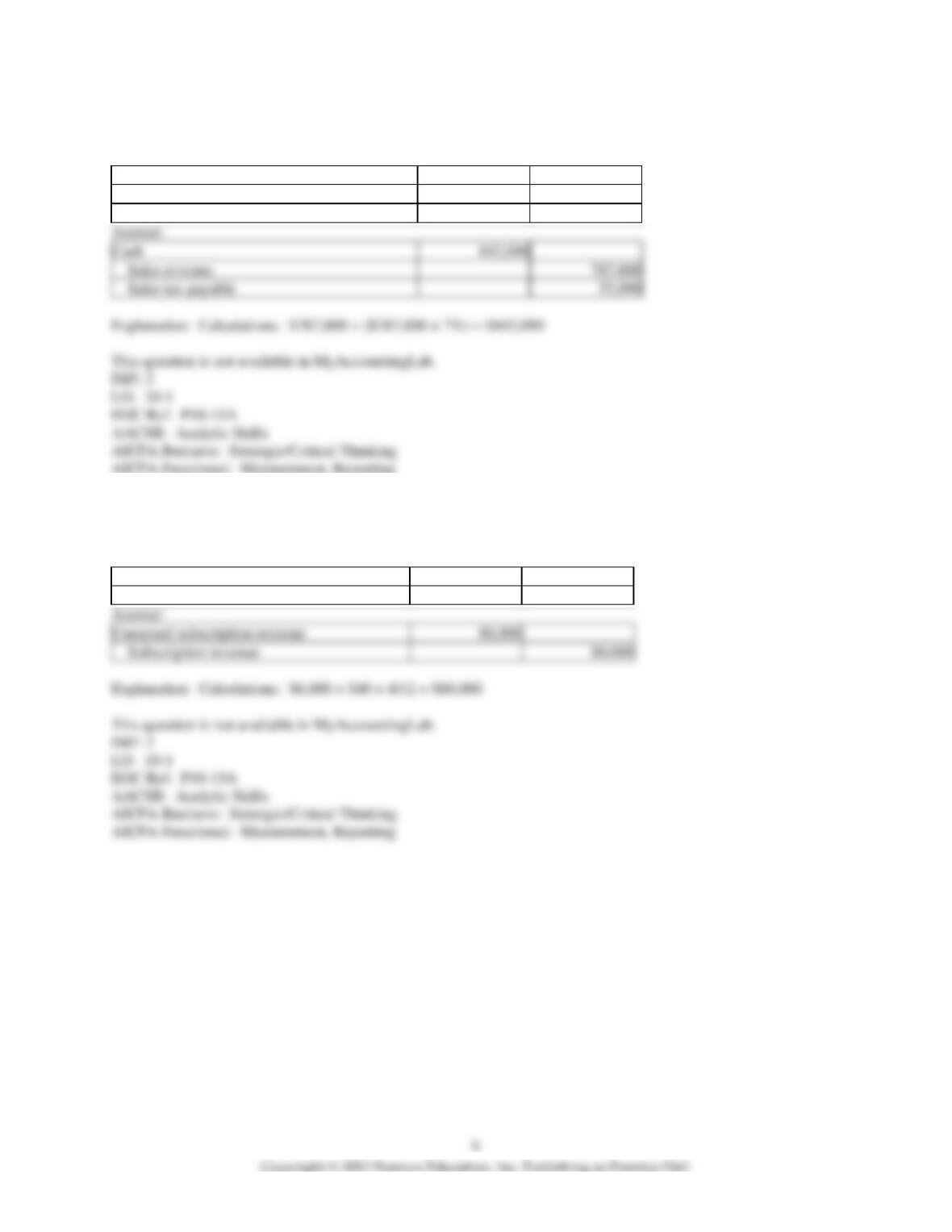
33) Associated Foods had cash sales of $787,000 during the month of August. Sales taxes of 7% were collected on
the sales. Prepare an aggregate journal entry to record the sales revenue and sales tax for the month.
Cash
34) Model Maker sold 6,000 one-year prepaid subscriptions to its monthly magazine for $40 per subscription. The
subscription year runs from September to August. What is the December 31 adjusting entry for subscription
revenue?
Unearned subscription revenue
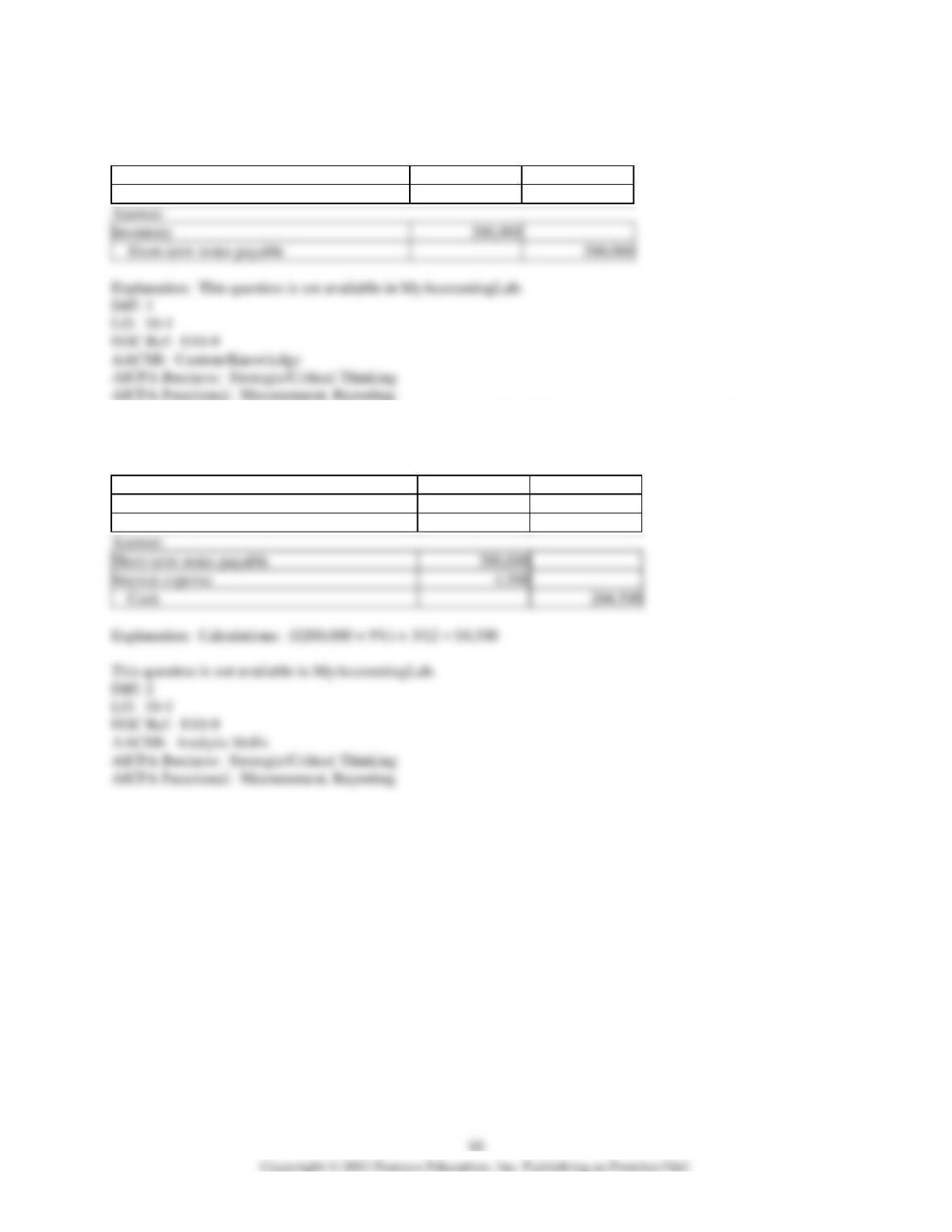
35) On March 1, 2012, Archer Sales purchases inventory for $200,000 by signing a note payable. The note is for 3
months and bears interest at a rate of 9%. Please provide the journal entry for this transaction.
Inventory
36) On March 1, 2012, Archer Sales purchases inventory for $200,000 by signing a note payable. The note is for 3
months and bears interest at a rate of 9%. Please provide the journal entry at the end of May when the note is
settled.
Interest expense
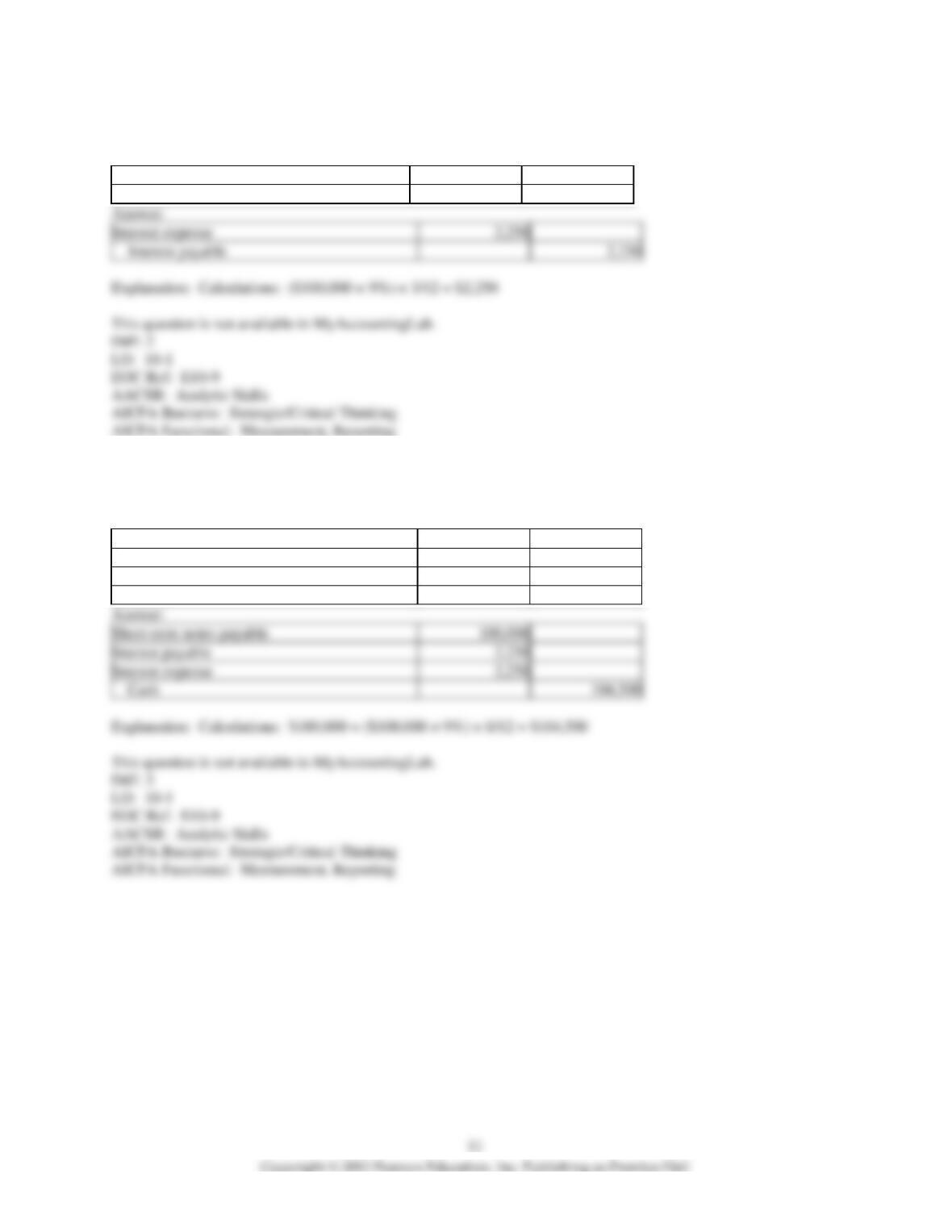
37) On October 1, 2012, Archer Sales borrows $100,000 by signing a note payable. The note is for 6 months and
bears interest at a rate of 9%. Please provide the journal entry to accrue interest expense at the end of 2012.
Interest expense
38) On October 1, 2012, Archer Sales borrows $100,000 by signing a note payable. The note is for 6 months and
bears interest at a rate of 9%. Archer properly accrued interest at the end of 2012. Please provide the journal entry
made at the end of March, 2013 when Archer settles the note.
Short-term notes payable
Interest payable
Interest expense
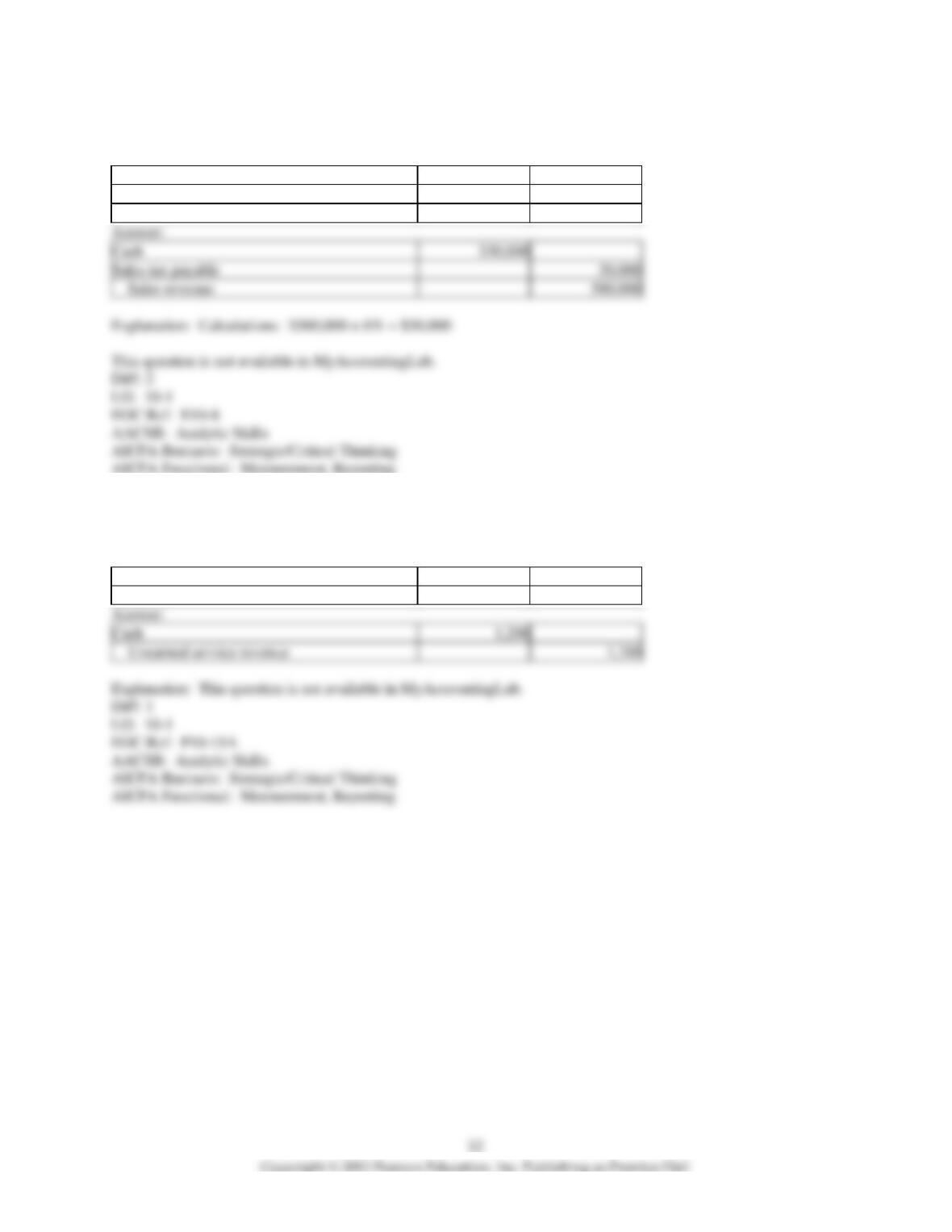
39) Barnaby Sales made total cash sales in January of $500,000, and they are subject to a 6% sales tax. Please
provide the summary entry to record sales revenues and sales tax payable.
Cash
Sales tax payable
40) Charter Services sells a service plan for commercial computer maintenance. The price is $1,200 per year, paid
in advance. On December 1, 2013, Charter sells a service plan to a new customer for cash. Please provide the
journal entry to record this transaction.
Cash
41) Charter Services sells a service plan for commercial computer maintenance. The price is $1,200 per year, paid
in advance. On December 1, 2013, Charter sells a service plan to a new customer for cash. Please provide the
journal entry to record the adjustment needed on December 31, 2013.
Unearned service revenue
Learning Objective 10-2
1) Warranties pose an accounting challenge because a company does not know which or how many products will
have to be repaired.
2) The entry to estimate warranty payable includes a credit to Warranty expense.
3) A contingent liability that has a remote possibility of becoming an actual loss is included in a note to the financial
statements.
4) A contingent liability that will probably become an actual liability, and can be reasonably estimated, must be
recorded as an expense.
5) Contingent liabilities sometimes pose an ethical challenge because they are not real liabilities and are easy to
overlook.
6) When the likelihood of an actual loss is probable, and the amount can be estimated, it should be recorded as an
expense and as a liability.
7) Estimated warranty payable would be included in the liability section of the balance sheet.
8) Estimated warranty payable would be included in the operating expense section of the income statement.
9) Warranty expense would be included in the liability section of the balance sheet.
10) Warranty expense would be included in the operating expense section of the income statement.
11) A certain contingent liability was evaluated at year-end, and considered to have a remote possibility of
becoming an actual liability. If the accountant decided NOT to report it on the balance sheet or in the notes to the
financial statement, this could be considered unethical behavior.
12) A certain contingent liability was evaluated at year-end, and considered to have a reasonable possibility of
becoming an actual liability. If the accountant decided NOT to report it on the balance sheet or in the notes to the
financial statement, this could be considered unethical behavior.
13) A certain contingent liability was evaluated at year-end; the company felt it was probable that it would become
an actual liability, and the amount could be reasonably estimated. If the accountant decided NOT to report it on the
balance sheet or in the notes to the financial statement, this could be considered unethical behavior.
14) Which of the following principles requires that warranty expense be recorded in the period that revenue is
recorded?
A) Consistency principle
B) Matching principle
C) Revenue principle
D) Materiality concept
15) A company has been sued for product failures allegedly resulting in injuries to the individuals bringing the
lawsuit. The company’s lawyers believe it is more than remote, but less than probable, that the lawsuit will result in
an actual liability. Which of the following actions should be taken by the company’s management?
A) The liability should be estimated and recorded as an expense.
B) The situation should be described in a note to the financial statements.
C) The possible liability should be ignored.
D) Management should consider resigning.
16) A restaurant has been sued because a customer claims to have found a bug in her chili. The company’s lawyers
believe there is only a remote possibility that the lawsuit will result in an actual liability. Which of the following
actions should be taken by the company’s management?
A) The situation should be described in a note to the financial statements.
B) The possible liability should be ignored.
C) The liability should be estimated and recorded as an expense.
D) Management should consider resigning.
17) Which of the following is TRUE of a contingent liability?
A) It is a potential liability that depends on a future event.
B) It is an actual liability that is difficult to estimate.
C) It is an actual liability that depends on a past event.
D) It is a liability resulting from a lawsuit settled in court.
18) Ace Appliances sells dishwashers with a 3-year warranty. In 2013, there are $90,000 of sales revenues for
dishwashers. The company estimates warranty expense at 3% of revenues. What is the total estimated warranty
payable for Ace regarding the sales in 2013?
A) $2,700
B) $600
C) $1,400
D) $3,000
19) Ace Appliances sells dishwashers with a 3-year warranty. In 2013, there are $90,000 of sales revenues for
dishwashers. The company estimates warranty expense at 3% of revenues. What is the 2013 warranty expense?
A) $2,700
B) $800
C) $0
D) $3,000
20) In which of the following periods should the expense for warranty costs be recorded?
A) The period when the product is sold
B) The period when the product is repaired or replaced
C) The period when cash is paid to repair or replace the product
D) The period when cash is collected for the sale of the product
18
21) Which of the following accounting principles requires that warranty expenses must be estimated and recognized
in the same period as the related sales revenue is recognized?
A) The matching principle
B) The disclosure principle
C) The revenue principle
D) The consistency principle
22) Booker Company reported sales revenue for 2013 of $800,000. The products were sold with a six-month
warranty. Members of Booker’s management estimate the cost of the warranty will be equal to 3% of sales revenue.
Which of the following is included in the entry to record the actual amounts paid out as a result of warranty claims?
A) A debit to Estimated warranty payable for the actual amount of payments
B) A credit to Estimated warranty payable for $24,000
C) A debit to Estimated warranty payable for $24,000
D) A debit to Warranty expense for the actual amount of payments
23) Which of the following is included in the entry to record warranty expense?
A) A debit to Warranty expense
B) A credit to Inventory
C) A credit to Warranty expense
D) A debit to Estimated warranty payable
24) Which of the following is included in the entry to record estimated warranty payable?
A) A credit to Estimated warranty payable
B) A credit to Inventory
C) A credit to Warranty expense
D) A debit to Estimated warranty payable
25) In which of the following periods should the estimated warranty liability be debited?
A) The period when cash is paid to repair or replace the product
B) The period when the product is sold
C) The period when cash is collected for the sale of the product
D) The period when the product is shipped to the customer
26) Which of the following is NOT an exact liability?
A) FICA tax payable
B) Income tax payable
C) Warranty payable
D) Accounts payable
27) Which of the following is the proper treatment for a liability that exists, but the exact amount of which is not
known?
A) The liability should be treated as a contingent liability.
B) The amount of the liability should be estimated and recorded.
C) The liability should be ignored.
D) The liability should be reported in the notes to the financial statements.
28) Franconia Sales offers warranties on all their electronic goods. Warranty expense is estimated at 2% of sales
revenue. In 2013, Franconia had $500,000 of sales. In the same year, Franconia paid out $7,500 of warranty
payments. Which of the following is the entry needed to record the estimated warranty expense?
A)
Estimated warranty payable
7,500
Cash
7,500
B)
Warranty expense
7,500
Estimated warranty payable
7,500
C)
Warranty expense
10,000
Estimated warranty payable
10,000
D)
Warranty expense
10,000
Sales revenue
10,000
29) Franconia Sales offers warranties on all their electronic goods. Warranty expense is estimated at 2% of sales
revenue. In 2013, Franconia had $500,000 of sales. In the same year, Franconia paid out $7,500 of warranty
payments. Which of the following is the entry needed to record the disbursement of warranty payments?
A)
Estimated warranty payable
7,500
Cash
7,500
B)
Warranty expense
7,500
Estimated warranty payable
7,500
C)
Warranty expense
10,000
Estimated warranty payable
10,000
D)
Warranty expense
10,000
Sales revenue
10,000