CHAPTER 1
FINANCIAL ACCOUNTING AND
ACCOUNTING STANDARDS
IFRS questions are available at the end of this chapter.
TRUE-FALSE—Conceptual
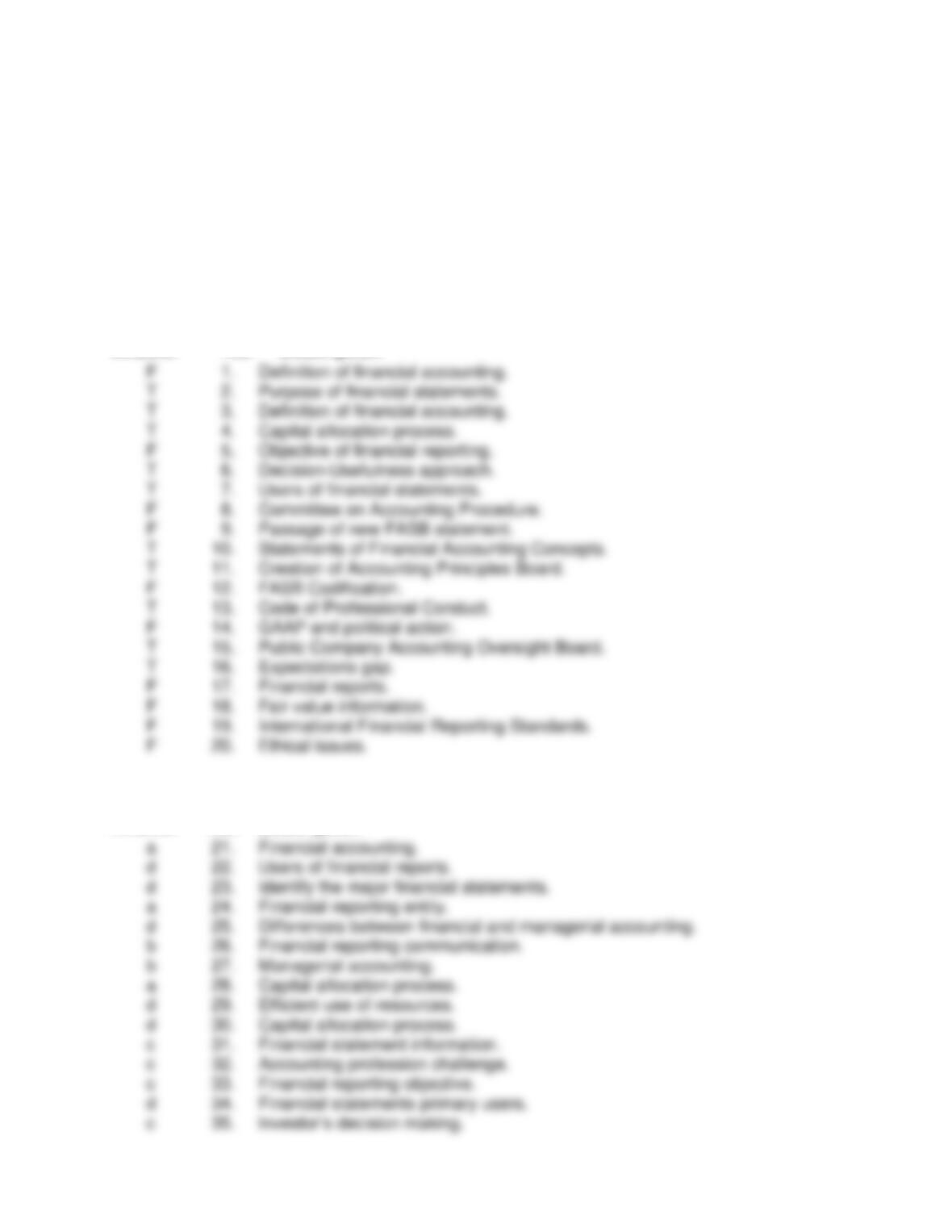
Answer No. Description
MULTIPLE CHOICE—Conceptual
Answer No. Description
Test Bank for Intermediate Accounting, Seventeenth Edition
1 – 2
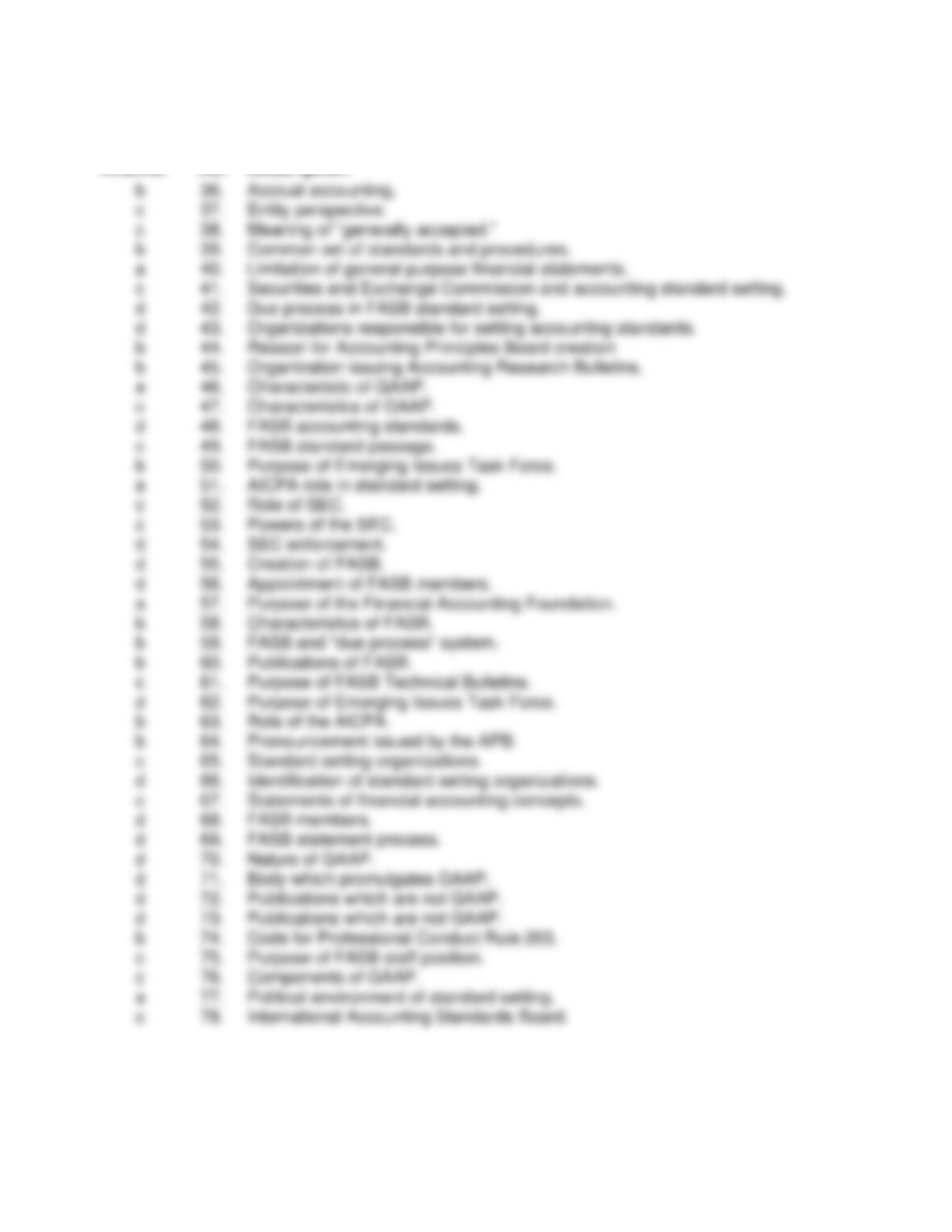
MULTIPLE CHOICE—Conceptual (cont.)
Answer No. Description
Financial Accounting and Accounting Standards
1 – 3
MULTIPLE CHOICE—Conceptual (cont.)
Answer No. Description
EXERCISES
Item Description
E1–85 Objectives of financial reporting.
E1–86 Development of accounting principles.
E1–87 Publications and organizations.
E1–88 FASB.
E1-89 Evolution of a statement of financial accounting standards.
CHAPTER LEARNING OBJECTIVES
1. Describe the financial reporting environment.
2. Identify the major policy-setting bodies and their role in the standard-setting process.
3. Explain the meaning of generally accepted accounting principles (GAAP) and the role of the
Codification for GAAP.
4. Describe major challenges in the financial reporting environment.
5. Compare the procedures related to financial accounting and accounting standards under
GAAP and IFRS.

Test Bank for Intermediate Accounting, Seventeenth Edition
1 – 4
SUMMARY OF QUESTIONS BY LEARNING OBJECTIVES AND BLOOM’S TAXONOMY
Item
LO
BT
Item
LO
BT
Item
LO
BT
Item
LO
BT
Item
LO
BT
TRUE-FALSE STATEMENTS
1.
1
K
5.
1
K
9.
2
K
13.
3
K
17.
4
K
2.
1
K
6.
1
K
10.
2
K
14.
4
K
18.
4
K
3.
1
K
7.
1
K
11.
2
K
15.
4
K
19.
4
K
4.
1
K
8.
2
K
12.
3
K
16.
4
K
20.
4
K
MULTIPLE CHOICE QUESTIONS
21.
1
K
34.
1
K
47.
2
K
60.
2
K
73.
3
K
22.
1
K
35.
1
K
48.
2
C
61.
2
C
74.
3
K
23.
1
K
36.
1
K
49.
2
K
62.
3
K
75.
3
C
24.
1
K
37.
1
K
50.
2
K
63.
2
K
76.
3
C
25.
1
C
38.
1
C
51.
2
K
64.
2
K
77.
4
C
26.
1
K
39.
1
K
52.
2
K
65.
2
K
78.
4
K
27.
1
K
40.
1
C
53.
2
K
66.
2
K
79.
4
K
28.
1
K
41.
2
C
54.
2
K
67.
2
K
80.
4
C
29.
1
K
42.
2
K
55.
2
K
68.
2
K
81.
4
K
30.
1
K
43.
2
K
56.
2
K
69.
2
C
82.
4
K
31.
4
K
44.
2
K
57.
2
K
70.
3
C
83.
4
C
32.
4
K
45.
2
K
58.
2
C
71.
3
K
84.
4
K
33.
1
K
46.
2
K
59.
2
K
72.
3
K
EXERCISES
85.
1
C
86.
1, 2
E
87.
2
K
88.
2
C
89.
2
K
Financial Accounting and Accounting Standards
1 – 5
TRUE-FALSE—Conceptual
1. Financial accounting is the process of identifying, measuring, analyzing, and
communicating financial information needed by management to plan, evaluate, and control a
company’s operations.
2. Financial statements are the principal means through which a company communicates its
financial information to those outside it.
3. Users of financial reports of a company use the information provided by these reports to
make their capital allocation decisions.
4. An effective process of capital allocation promotes productivity and provides an efficient
market for buying and selling securities and obtaining and granting credit.
5. The objective of financial reporting is to report the plans made by a company to improve the
productivity of its employees.
6. Investors are interested in financial reporting because it provides information that is useful
for making decisions.
7. Users of financial accounting statements have both coinciding and conflicting needs for
information of various types.
8. The Securities and Exchange Commission appointed the Committee on Accounting
Procedure.
9. The passage of a new FASB Accounting Standards Update requires the support of five of
the seven board members.
10. Statements of Financial Accounting Concepts set forth fundamental objectives and
concepts that are used by the FASB in developing future standards of financial accounting
and reporting.
11. The AICPA created the Accounting Principles Board in 1959.
Test Bank for Intermediate Accounting, Seventeenth Edition
1 – 6
12. The FASB’s Codification creates a new set of GAAP.
13. The AICPA’s Code of Professional Conduct requires that members prepare financial
statements in accordance with generally accepted accounting principles.
14. GAAP is a product of careful logic or empirical findings and is not influenced by political
action.
15. The Public Company Accounting Oversight Board has oversight and enforcement authority
and establishes auditing and independence standards and rules.
16. The expectations gap is due to the difference between what the public thinks accountants
should do and what accountants think they can do.
17. Financial reports in the early 21st century did not provide any information about a
company’s soft assets (intangibles).
18. Accounting standards are now less likely to require the recording or disclosure of fair value
information.
19. U.S. companies that list overseas are required to use International Financial Reporting
Standards, issued by the International Accounting Standards Board.
20. Ethical issues in financial accounting are governed by the AICPA.
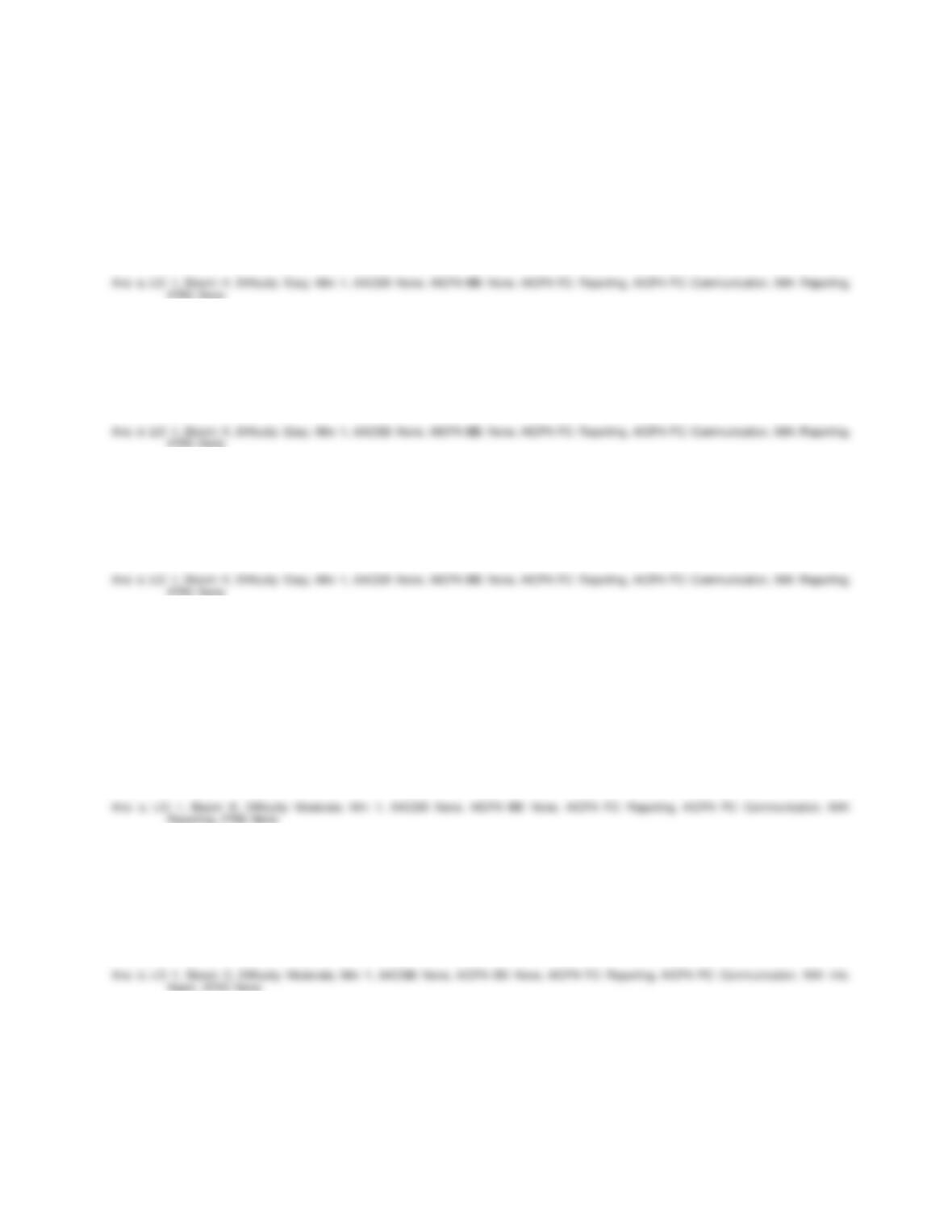
True-False Answers—Conceptual
Item
Ans.
Item
Ans.
Item
Ans.
Item
Ans.
Financial Accounting and Accounting Standards
1 – 7
MULTIPLE CHOICE—Conceptual
21. General-purpose financial statements are the product of
a. financial accounting.
b. managerial accounting.
c. both financial and managerial accounting.
d. neither financial nor managerial accounting.
22. Which of the following is not a user of financial reports?
a. Creditors.
b. Government agencies.
c. Unions.
d. Employees.
23. The financial statements most frequently provided include all of the following except the
a. balance sheet.
b. income statement.
c. statement of cash flows.
d. statement of retained earnings.
24. The information provided by financial reporting pertains to
a. individual business enterprises, rather than to industries or an economy as a whole or
to members of society as consumers.
b. business industries, rather than to individual enterprises or an economy as a whole or
to members of society as consumers.
c. individual business enterprises, industries, and an economy as a whole, rather than to
members of society as consumers.
d. an economy as a whole and to members of society as consumers, rather than to
individual enterprises or industries.
25. All the following are ways in which accounting information is used by financial accounting
users except to
a. buy, sell, hold equity and debt instruments.
b. decide whether to invest in the company.
c. evaluate borrowing capacity to determine the extent of a loan to grant.
d. plan and control company’s operations.
Test Bank for Intermediate Accounting, Seventeenth Edition
1 – 8
26. Which of the following represents a form of communication through financial reporting but
not through financial statements?
a. Balance sheet.
b. President’s letter.
c. Income statement.
d. Notes to financial statements.
P27. The process of identifying, measuring, analyzing, and communicating financial information
needed by management to plan, evaluate, and control an organization’s operations is
called
a. financial accounting.
b. managerial accounting.
c. tax accounting.
d. auditing.
28. How does accounting help the capital allocation process attract investment capital?
a. By providing timely, relevant information.
b. By encouraging innovation.
c. By promoting productivity.
d. By providing timely, relevant information and by encouraging innovation.
29. Which of the following does not help in determining whether a business thrives?
a. Markets.
b. Free enterprise.
c. Competition.
d. Lack of innovation.
30. Which of the following is NOT related to an effective capital allocation?
a. Promoting productivity.
b. Encouraging innovation.
c. Providing an efficient market for buying and selling securities.
d. Provides timely, relevant information and encourages innovation.
31. Financial statements in the early 2000s focused on financial information related to
a. nonfinancial measurements.
b. forward-looking data.
c. hard assets (inventory and plant assets).
d. soft assets.
Financial Accounting and Accounting Standards
1 – 9
32. Which of the following is not a major challenge facing the accounting profession?
a. Nonfinancial measurements.
b. Timeliness.
c. Accounting for hard assets.
d. Forward-looking information.
33. What is the objective of financial reporting?
a. Provide information that is useful to management in making decisions.
b. Provide information that clearly portrays nonfinancial transactions.
c. Provide information about the reporting entity that is useful to present and potential
equity investors, lenders, and other creditors.
d. Provide information that excludes claims to the resources.
34. Primary users for general-purpose financial statements include each of the following
except
a. creditors.
b. suppliers.
c. investors.
d. employees.
35. Which of the following is of interest to investors in decision-making?
a. Assessing the company’s ability to generate net cash inflows.
b. Assessing management’s ability to protect and enhance the capital providers’
investments.
c. Both assessing the company’s ability to generate net cash inflows and assessing
management’s ability to protect and enhance the capital provider’s investments.
d. Assessing the company’s ability to collect debts.
36. Accrual accounting is used because
a. cash flows are considered less important.
b. it provides a better indication of a company’s ability to generate cash flows over time
than the cash basis.
c. it recognizes revenues when cash is received and expenses when cash is paid.
d. it provides past ability to generate negative cash flows.
37. Which perspective is adopted as a part of the objective of general-purpose financial
reporting?
a. A decision-usefulness perspective.
b. A proprietary perspective.
c. An entity perspective.
d. A financial reporting perspective.
Test Bank for Intermediate Accounting, Seventeenth Edition
1 – 10
38. Which of the following is a requirement for an accounting principle to be called “generally
accepted”?
a. An authoritative accounting rule-making body has established it in an official
pronouncement.
b. The principle has been accepted as appropriate because of its universal application.
c. An authoritative accounting rule-making body has established it and it has been
accepted because of its universal application.
d. Each company develops its own standards.
39. A common set of accounting standards and procedures is called
a. financial accounting standards.
b. generally accepted accounting principles.
c. objectives of financial reporting.
d. statements of financial accounting concepts.
40. Which of the following is a general limitation of “general purpose financial statements”?
a. General purpose financial statements may not be the most informative for a specific
enterprise.
b. General purpose financial statements are not comparable.
c. General purpose financial statements do not fairly present a company’s financial
operations.
d. General purpose financial statements provide financial reporting information to a wide
variety of users.
41. What is the relationship between the Securities and Exchange Commission and
accounting standard setting in the United States?
a. The SEC requires all companies listed on an exchange to submit their financial
statements to the SEC.
b. The SEC coordinates with the AICPA in establishing accounting standards.
c. The SEC has a mandate to establish accounting standards for enterprises under its
jurisdiction.
d. The SEC reviews financial statements for compliance.
42. What is not due process in the context of standard setting at the FASB?
a. The FASB operates in full view of the public.
b. Public hearings are held on proposed accounting standards.
c. Interested parties can make their views known.
d. No public hearings are held on proposed accounting standards.
Financial Accounting and Accounting Standards
1 – 11
43. Which of the following organizations has been responsible for setting U.S. accounting
standards?
a. The Accounting Principles Board.
b. The Committee on Accounting Procedure.
c. The Financial Accounting Standards Board.
d. All of the answer choices are correct.
44. Why did the AICPA create the Accounting Principles Board?
a. The SEC disbanded the previous standard setting organization.
b. The previous standard setting organization did not provide a structured set of
accounting principles.
c. No such organization existed in the past.
d. The reason was to revert to the written expression of accounting principles.
45. Which organization was responsible for issuing Accounting Research Bulletins?
a. The Accounting Principles Board.
b. The Committee on Accounting Procedure.
c. The SEC.
d. The FASB.
46. A characteristic of generally accepted accounting principles includes:
a. a common set of standards and principles.
b. standards and principles are based on federal statutes.
c. acceptance requires an affirmative vote of Certified Public Accountants.
d. practices that become accepted for at least a year by all industry members.
47. Characteristics of generally accepted accounting principles include all of the following
except
a. authoritative accounting that the rule-making body has established as a principle of
reporting.
b. standards are considered useful by the profession.
c. each principle is approved by the SEC.
d. practice has become universally accepted over time.
48. Why was it believed that accounting standards that were issued by the Financial
Accounting Standards Board would carry more weight than standards previously issued?
a. The FASB board had a smaller membership.
b. The FASB board members were well-paid.
c. The FASB board members were CPAs.
d. The FASB follows due process.
Test Bank for Intermediate Accounting, Seventeenth Edition
1 – 12
49. The passage of a new FASB Accounting Standards Update requires the support of
a. seven Board members.
b. three Board members.
c. four Board members.
d. five Board members.
50. What is the purpose of Emerging Issues Task Force?
a. Provide interpretation of existing standards.
b. Provide implementation guidance within the Codification framework to reduce diversity
in practice on a timely basis.
c. Provide interpretive guidance.
d. Provide timely guidance on select issues.
51. Which organization is responsible for issuing Emerging Issues Task Force Statements?
a. The FASB
b. The CAP
c. The APB
d. The SEC
52. Each of the following are true of the Securities and Exchange Commission except that
a. it is a federal agency.
b. the SEC’s involvement in the development of accounting standards varies.
c. the FASB relies on the SEC to develop accounting standards.
d. the SEC requires registrants to adhere to GAAP.
53. The body that has the power to prescribe the accounting practices and standards to be
employed by companies that fall under its jurisdiction is the
a. FASB.
b. AICPA.
c. SEC.
d. APB.
54. Companies that are listed on a stock exchange are required to submit their financial
statements to the
a. AICPA.
b. APB
c. FASB.
d. SEC.