AUDITING
MILLICHAMP & TAYLOR
PRACTICE EXAM – CHAPTERS 1–10
ANSWERS
Note: Some of these answers are indicative rather than prescriptive and
lecturers should use their own resources to aid student learning
1. Which of these statements is true?
An audit benefits a company because
a) It reassures the shareholders that the accounts are accurate
b) Makes the management accountable to the shareholders
c) Guarantees that the accounts are free from fraud or error
d) Guarantees that the financial information shown is true and fair
2 Explain the responsibilities of
• the directors
• the auditors
in connection with the preparation and publication of a company’s
financial statements
Answer
3. Explain in no more than 200 words The Theory of Rational
Expectations developed by Professor Limperg
Answer
4. State whether the following statements are true or false in respect of
external auditors’ responsibilities
• Auditors are responsible for the financial content of the annual
accounts (false)
• Auditors do not have to have absolute assurance that the
figures they audit are correct (true)
5 Mautz and Sharaf set out a series of postulates and assumptions on
which their theory of auditing was based. Set out in not more than
500words the basis of their approach and the problems which
subsequent commentators have indicated with their approach. Note it is
not necessary for you to set out the postulates in detail merely use them
to indicate points in your answer where necessary.
Answer
6. Which one of the following best describes the role of the
International Auditing and Assurance Board (IAASB)?
The IAASB is responsible for:
a) Setting auditing standards which are compulsory throughout the
world
b) Monitoring auditors to ensure that they comply with auditing
standards
c) Investigating and disciplining auditors who fail to comply with
auditing standards
d) Setting auditing standards which facilitate the convergence of
national and international auditing standards
7. Explain in not more than 200 words the basic principles of Agency
Theory and the role the auditor plays
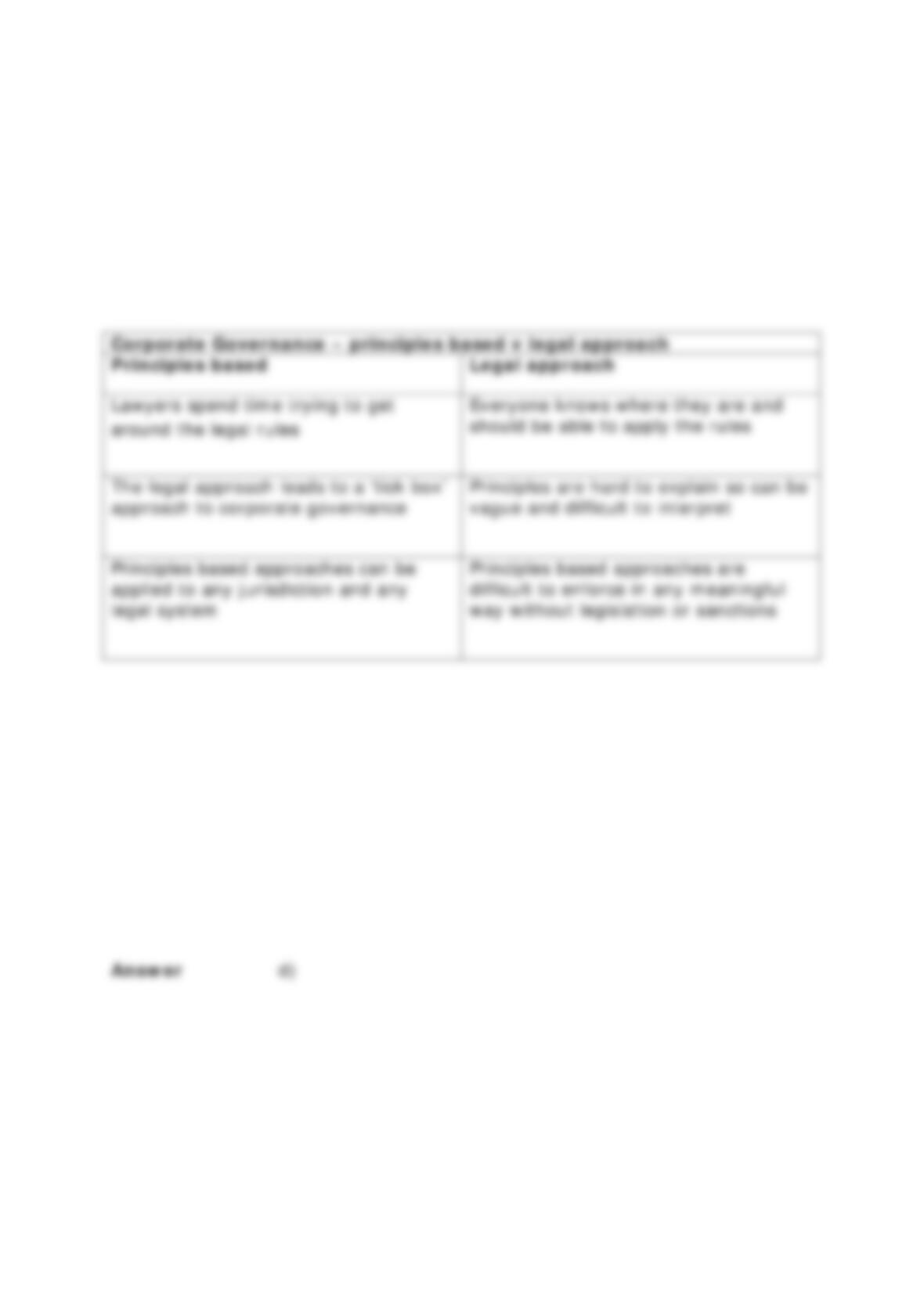
8. State the advantages and disadvantages of a framework approach to
corporate governance as opposed to a legislative approach
Answer
9. The role of the Auditing Practices Board does not include
a) establishing high standards of auditing
b) meeting the developing needs of users of financial
information
c) ensuring public confidence in the auditing process
d) issuing International Accounting Standards
10. State whether the following statements are true or false in respect
of the rules governing audit activity
• The work of the auditing profession is governed solely by the
Companies Act 2006 False
• The Auditing Practices Board has the power to discipline auditors
who perform their work poorly False
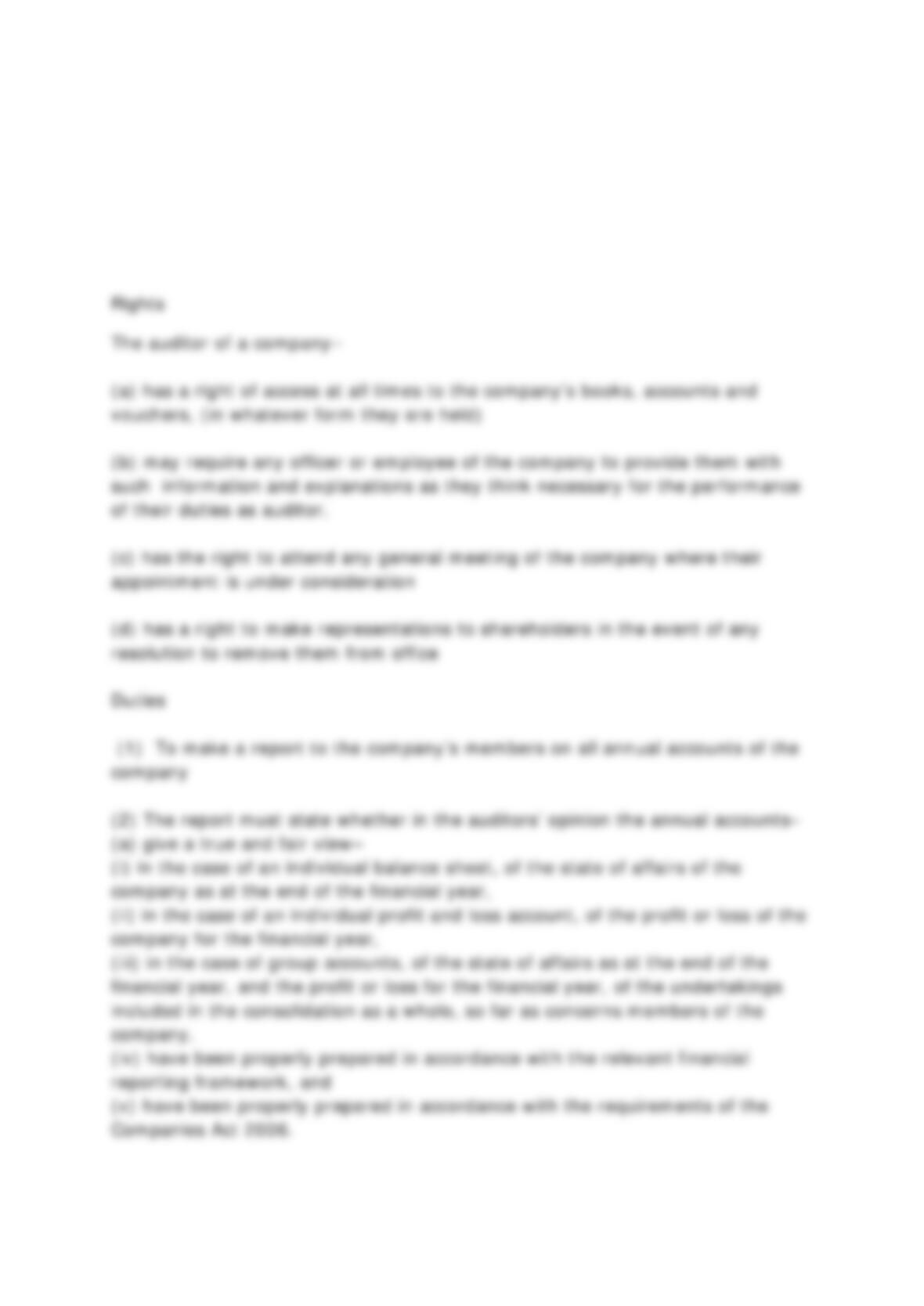
11. Set out the rights and duties of auditors under the Companies Act
2006
12. Which of these is not the function of a Recognised Supervisory Body
a) Admission of members
b) Disciplining members
c) Setting ethical standards
d) Investigating complaints
e) Reviewing audits of public limited companies to maintain auditing
standards
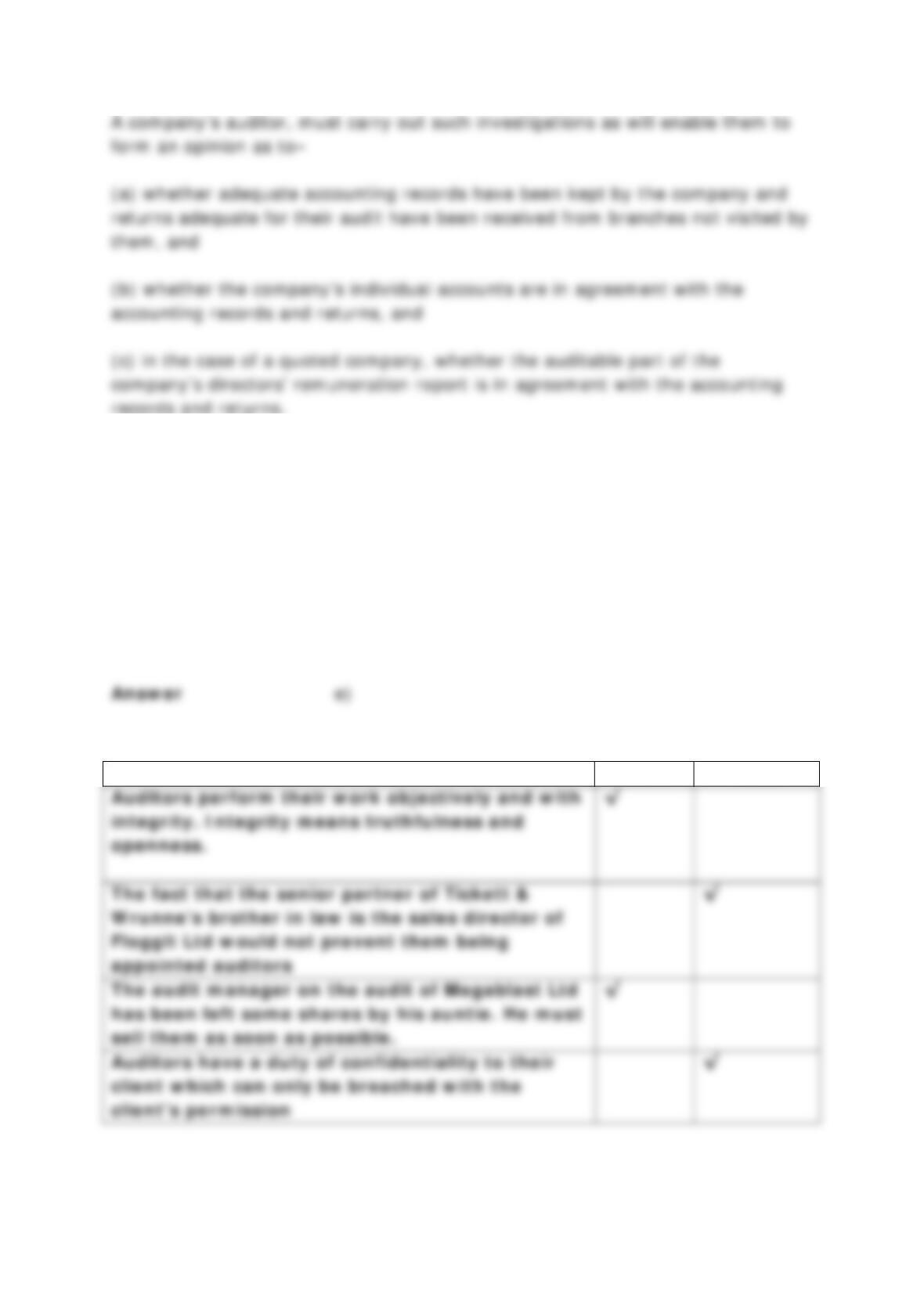
13 Which of the following statements are true
True
False
14 List five threats to auditor independence and provide an example of
each
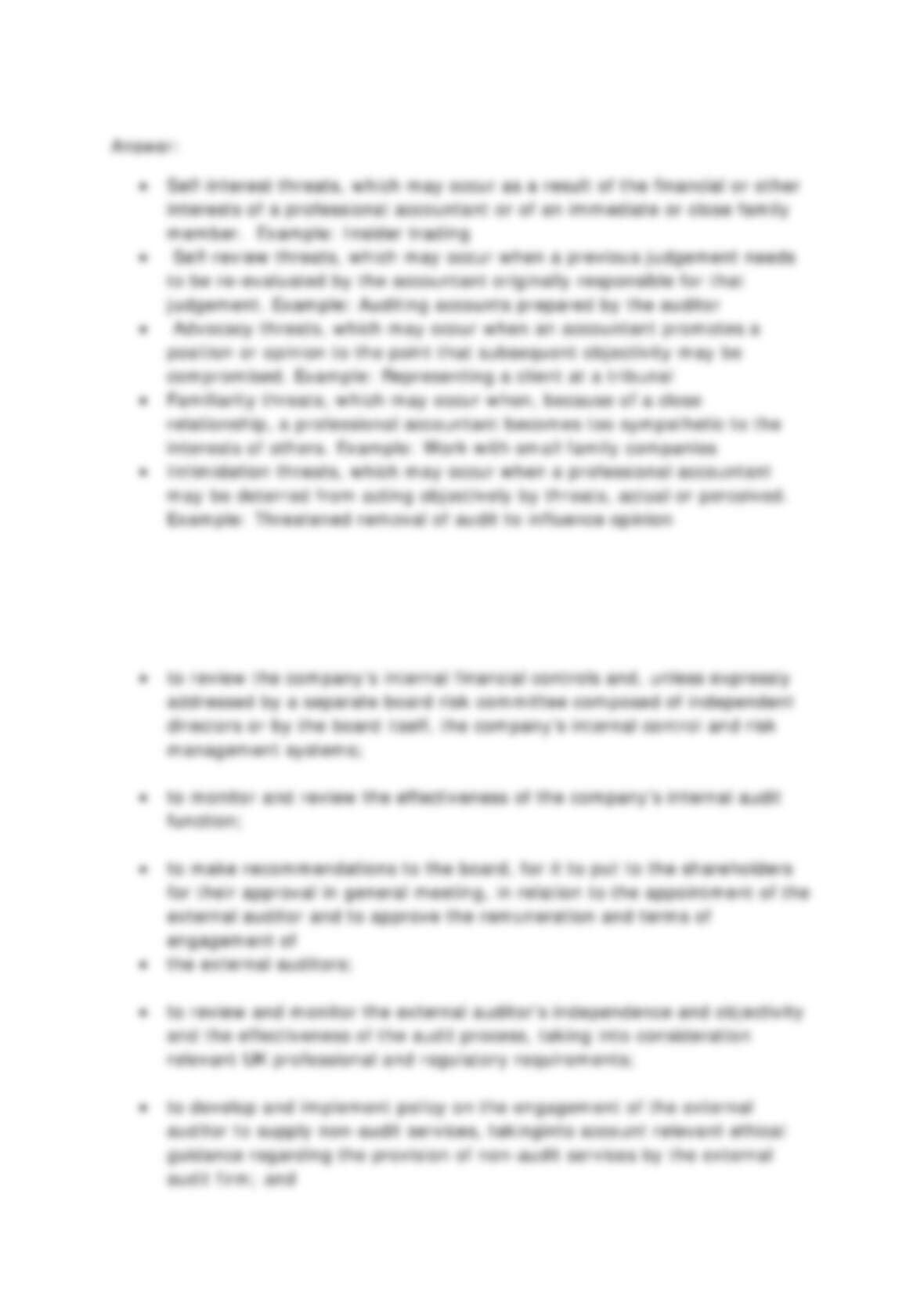
15 Explain in not more than 500 words the role and function of an audit
committee
Answer
16 What is meant by ‘substance over form’?
Answer
17 List the five fundamental ethical principles all auditors must abide by
Answer
Use the information in this scenario to answer questions 18 and 19:
Tickit & Run is a firm of Chartered Certified Accountants is currenbtly
engaged in finalising the audit of Bugle plc, a publicly quoted
incorporated business. The audit partner Hugo Sponge is reviewing the
audit file for the year ended 31 October 2X10. At the front of the file is a
memo from the audit manager recommending the issue of a qualified
audit opinion. Bugle plc’s major customer is known to be in financial
difficulties yet no provision has been made against the material debt
owed to Bugle. Bugle’s financial director is arguing that their customer
has nearly completed development of a new product, sales of which will
enable them to repay all their debts. He claims to have consulted
another firm of accountants who have indicated that a provision might
not be necessary.
Hugo is unhappy with the situation for the following reasons:
(a) He is reasonably certain that, if she issues a qualified opinion, the
directors of Bugle will recommend appointment of the other firm as
auditors.
(b) His firm supplies many other non–audit services to Bugle such as tax
and consultancy which bring in twice as much revenue as the audit and
are more profitable. It is highly unlikely the firm would continue to be
asked to provide these services if the audit is lost. In total, fees paid by
Bugle for the audit and these other services amount to 9% of the audit
firm’s revenues.
(c) He has been the engagement partner for ten years and has no
reason to doubt the integrity of the finance director with whom he has
worked closely over that period of time. He is prepared to believe his
assertion that the debt will be repaid. However, he also accepts that
evidence in the audit file is equally persuasive that the customer is,
currently, in financial difficulty.
He calls the finance director to advise him that he will have no option
but to issue a qualified opinion if the financial statements do not contain
a provision against the debt.
Question 18
a) describe actions auditors can take when being threatened with
removal by the directors.
b) explain how an audit committee can provide additional safeguards to
audit independence in such a situation.
Answer
Question 19
The scenario raises the issue of providing non–audit services to audit
clients.
a. Outline the general rules of ethical conduct which might be
relevant relating to the supply of non–audit services to public
company audit clients.
b. Explain why the provision of non–audit services to audit
clients might be seen as a problem and why it is sometimes
suggested that auditors should not provide such services.
20 What are the preconditions for an audit?
Answer
21 Sparkies has undergone a period of substantial growth following its
establishment five years ago by two electricians who pooled their
redundancy pay. Because of a lack of accounting expertise within the
company it has traditionally looked to its auditors, Tickit & Run, for
accounting services in thepreparation of annual financial statements as
well as for the statutory audit function.
Tickit & Run have also provided advice in connection with the company’s
accounting and internal control systems.
Tickit & Run is a two partner firm of certified accountants and registered
auditors whose clients are mainly sole traders, partnerships and small
limited companies. Although Sparkies was originally atypical small
company client, its growth over the last five years has meant that it now
accounts for approximately 20% of Tickit & Run’s gross fee income and
the company has indicated that it may
wish to issue shares on the stock market in the near future.
Required:
Discuss the extent to which it is acceptable and desirable that Tickit &
Run have in the past provided the three services of statutory audit,
advice in connection with systems, and accountancy services in the
preparation of annual financial statements to Sparkies.
Answer
22.Which of the following would increase, decrease or have no effect on
the auditors’ estimation of inherent risk
23 You have been asked to prepare a presentation on materiality which
will provide guidance to members of staff in conducting limited company
audits.
Include in your presentation
A definition of materiality and performance materiality
The alternative measures that could be employed to determine a
materiality limit for an audit.
Answer
24 Briefly describe three audit strategies
Answer
25 Complete the following internal control procedures
26 An entity uses internal control procedures in order to mitigate the
risks to which the entity is exposed. Listed below are two internal
control procedures which are applicable to an entity’s sales and
receivables system.
Match each internal control procedure with the risk mitigated from the
list below:
• Sales are made to customers who cannot pay
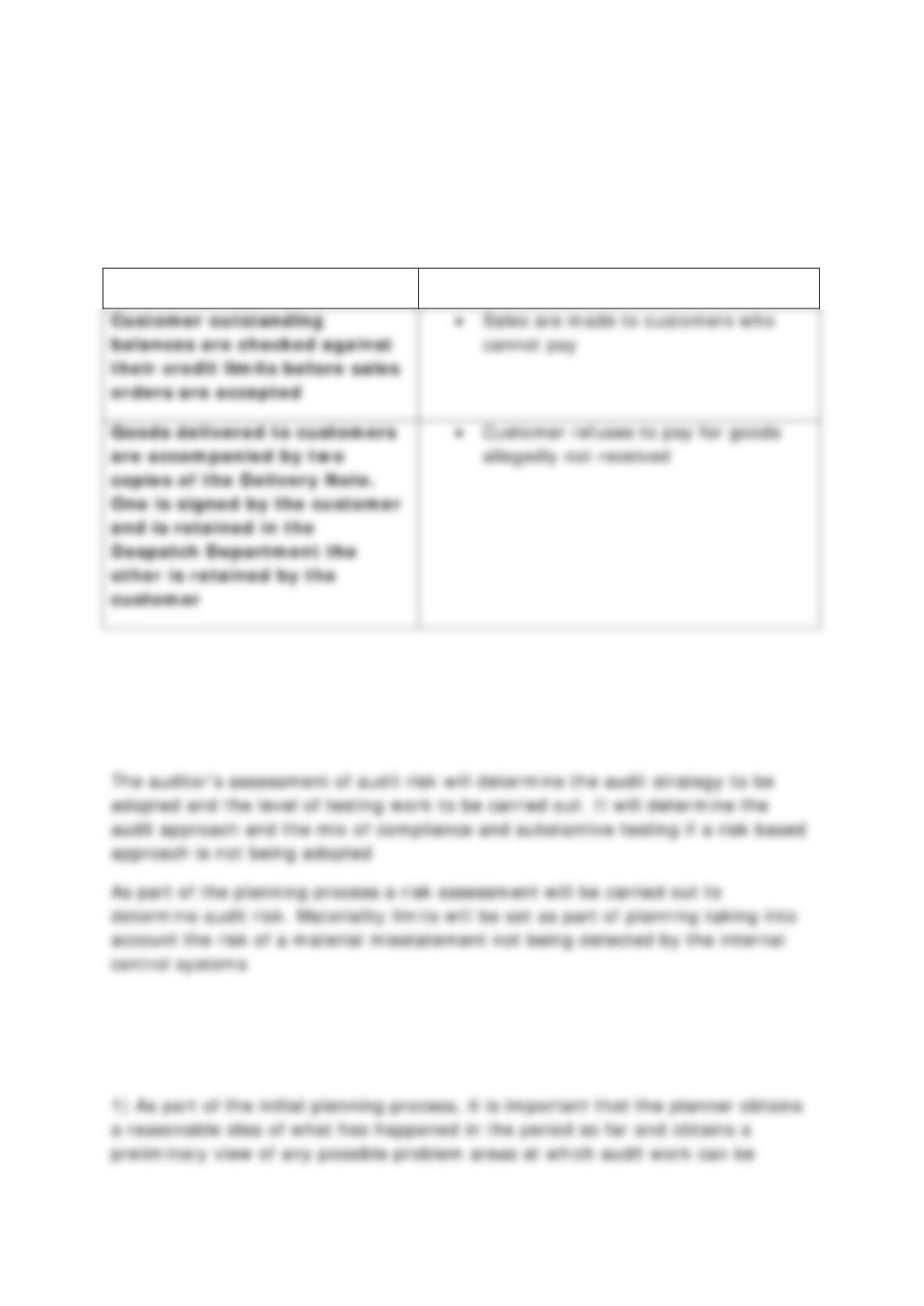
• Sales are not made to existing customers
• Deliveries are not made to bona fide customers
• Customer refuses to pay for goods allegedly not received
• Customer orders not being fulfilled
Internal control procedure
Risk mitigated
27 Outline the relationship between audit risk, materiality limits and
audit planning
Answer
28 List two ways in which analytical procedures can help the auditor in
the planning stage of the audit
Answer
29 Explain the purpose of a ‘hot’ review and distinguish it from a ‘cold’
review
Answer
30 Explain, in not more than 500 words the auditors’ duties with regard
to Money Laundering and the steps they must take in respect of client
activity
Answer