Financial Accounting and Accounting Standards
1 – 13
55. The Financial Accounting Standards Board (FASB) was proposed by the
a. American Institute of Certified Public Accountants.
b. Accounting Principles Board.
c. Study Group on the Objectives of Financial Statements.
d. Study Group on establishment of Accounting Principles (Wheat Committee).
56. Which of the following is true of the Financial Accounting Standards Board?
a. It has issued a series of pronouncements entitled Auditing Standards Updates.
b. It was the forerunner of the current Accounting Principles Board.
c. It is the arm of the Securities and Exchange Commission responsible for setting
financial accounting standards.
d. The members of the FASB are appointed by the Financial Accounting Foundation.
57. The Financial Accounting Foundation
a. oversees the operations of the FASB.
b. oversees the operations of the AICPA.
c. provides information to interested parties on financial reporting issues.
d. works with the Financial Accounting Standards Advisory Council to provide
information to interested parties on financial reporting issues.
58. The major distinction between the Financial Accounting Standards Board (FASB) and its
predecessor, the Accounting Principles Board (APB), is
a. the FASB issues exposure drafts of proposed standards.
b. all members of the FASB are fully remunerated, serve full time, and are independent
of any companies or institutions.
c. all members of the FASB possess extensive experience in financial reporting.
d. a majority of the members of the FASB are CPAs who are drawn from public practice.
59. The Financial Accounting Standards Board employs a “due process” system which
a. is an efficient system for collecting dues from members.
b. enables interested parties to express their views on issues under consideration.
c. identifies the accounting issues that are the most important.
d. requires that all accountants must receive a copy of financial standards.
60. Which of the following is not a publication of the FASB?
a. Statements of Financial Accounting Concepts
b. Accounting Research Bulletins
c. Interpretations
d. Technical Bulletins
Test Bank for Intermediate Accounting, Seventeenth Edition
1 – 14
61. The FASB has issued each of the following pronouncements except
a. Accounting Standards Updates.
b. Financial Accounting Concepts.
c. Accounting Research Bulletins.
d. The FASB has issued each of these pronouncements.
62. The purpose of the Emerging Issues Task Force is to
a. develop a conceptual framework as a frame of reference for the solution of future
problems.
b. lobby the FASB on issues that affect a particular industry.
c. do research on issues that relate to long-term accounting problems.
d. provide implementation guidance within the Codification framework to reduce diversity
in practice on a timely basis.
63. The American Institute of Certified Public Accountants (AICPA) continues to be involved in
all of the following except
a. developing and enforcing professional ethics.
b. developing auditing standards for public companies.
c. providing professional education programs.
d. grading the CPA exam.
65. Which of the following organizations has not been instrumental in the development of
financial accounting standards in the United States?
a. AICPA
b. FASB
c. IASB
d. SEC
66. Which of the following organizations has not published accounting standards?
a. American Institute of Certified Public Accountants.
b. Securities and Exchange Commission.
c. Financial Accounting Standards Board.
d. American Institute of Certified Private Accountants.
67. The purpose of Statements of Financial Accounting Concepts is to
a. establish GAAP.
b. modify or extend an existing FASB Accounting Standards Update.
c. form a conceptual framework for solving existing and emerging problems.
Financial Accounting and Accounting Standards
1 – 15
d. determine the need for FASB involvement in an emerging issue.
P68. Members of the Financial Accounting Standards Board are
a. employed by the American Institute of Certified Public Accountants (AICPA).
b. part-time employees.
c. required to hold a CPA certificate.
d. independent of any other organization.
P69. The following are part of the “due process” system used by the FASB in the evolution of a
typical FASB Accounting Standards Update:
1. Exposure Draft
2. FASB Accounting Standards Update
3. Preliminary Views
The chronological order in which these items are released is as follows:
a. 1, 2, 3.
b. 1, 3, 2.
c. 2, 3, 1.
d. 3, 1, 2.
70. Which of the following is not true of generally accepted accounting principles?
a. GAAP includes detailed practices and procedures as well as broad guidelines of
general application.
b. GAAP is influenced by pronouncements of the SEC.
c. GAAP changes over time as the nature of the business environment changes.
d. GAAP does not have substantial authoritative support.
71. The most significant current source of generally accepted accounting principles is the
a. AICPA.
b. SEC.
c. APB.
d. FASB.
72. Which of the following is not a part of generally accepted accounting principles?
a. FASB Interpretations
b. CAP Accounting Research Bulletins
c. APB Opinions
d. AICPA Research Analysis.
73. Which of the following publications does not qualify as a statement of generally accepted
accounting principles?
a. Statements of financial standards issued by the FASB
b. Accounting interpretations issued by the FASB
Test Bank for Intermediate Accounting, Seventeenth Edition
1 – 16
c. APB Opinions
d. Accounting research studies issued by the AICPA
74. Rule 203 of the Code of Professional Conduct addresses:
a. ethical requirements.
b. financial statements being based on generally accepted accounting principles.
c. advertising to obtain clients.
d. auditing financial statements.
75. What is the purpose of a FASB Staff Position?
a. Provide interpretation of existing standards.
b. Provide a consensus on how to account for new and unusual financial transactions.
c. Provide interpretive guidance.
d. Provide timely guidance on select issues.
76. Which of the following is not considered a component of generally accepted accounting
principles?
a. FASB Implementation Guides.
b. Widely recognized industry practices.
c. Articles published in CPA journals.
d. AICPA Accounting Interpretations.
77. Financial accounting standard-setting in the United States
a. can be described as a social process which reflects political actions of various
interested user groups as well as a product of research and logic.
b. is based solely on research and empirical findings.
c. is a legalistic process based on rules promulgated by governmental agencies.
d. is democratic in the sense that a majority of accountants must agree with a standard
before it becomes enforceable.
78. The purpose of the International Accounting Standards Board is to
a. issue enforceable standards which regulate the financial accounting and reporting of
multinational corporations.
b. develop a uniform currency in which the financial transactions of companies through–
out the world would be measured.
c. promote uniform accounting standards among countries of the world.
d. arbitrate accounting disputes between auditors and international companies.
79. Which of the following is a source of pressure that may influence the accounting standard
setting process?
a. Congress
b. Lobbyists
c. CPA firms
d. All of these answers are correct.
80. What is a possible danger if politics plays too big a role in accounting standard setting?
a. Accounting standards may not be truly generally accepted.
b. Individuals may influence the standards.
c. User groups become active.
d. The FASB delegates its authority to elected officials.
81. What is the “expectations gap”?
a. The difference between what the public thinks the accountant should not do and what
the accountant knows they should do.
b. The difference between what the public thinks the accountant should do and what
Congress says the accountant should do.
c. The difference between what the public thinks the accountant should do and what the
accountants think they can do.
d. The difference between what the accountant should do and what the Courts say the
accountant should be doing.
82. What is not a reason that accounting standards may differ across countries?
a. Governments
b. Language
c. Culture
d. Past practice
83. What would be an advantage of having all countries adopt and follow the same
accounting standards?
a. Agreement.
b. Comparability.
c. Lower preparation costs.
d. Comparability and lower preparation costs.
84. Which of the following is an ethical concern of accountants?
a. Earnings manipulation.
b. Conservative accounting.
c. Industry practices.
d. Managerial Accounting.
Test Bank for Intermediate Accounting, Seventeenth Edition
1 – 18
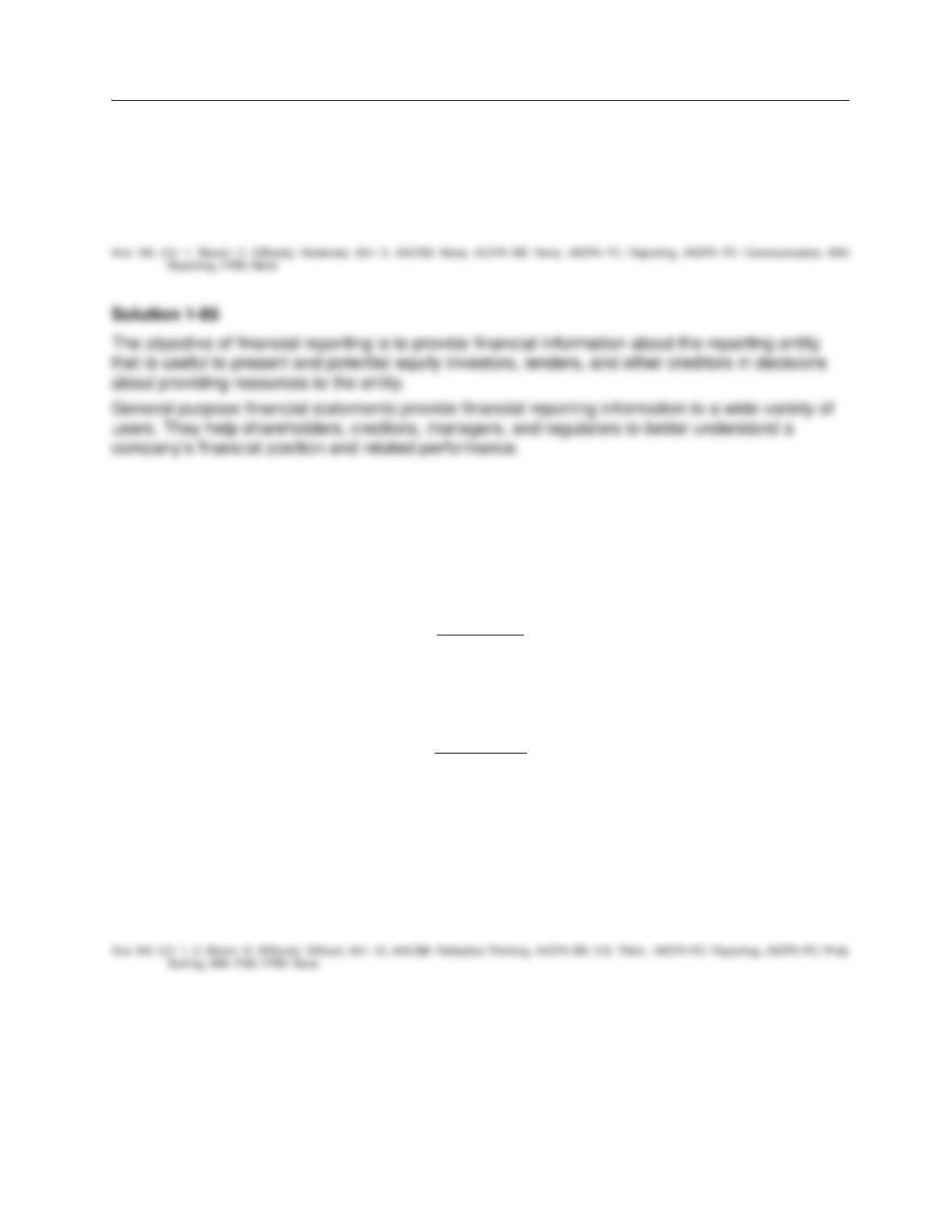
Multiple Choice Answers—Conceptual
Financial Accounting and Accounting Standards
1 – 19
EXERCISES
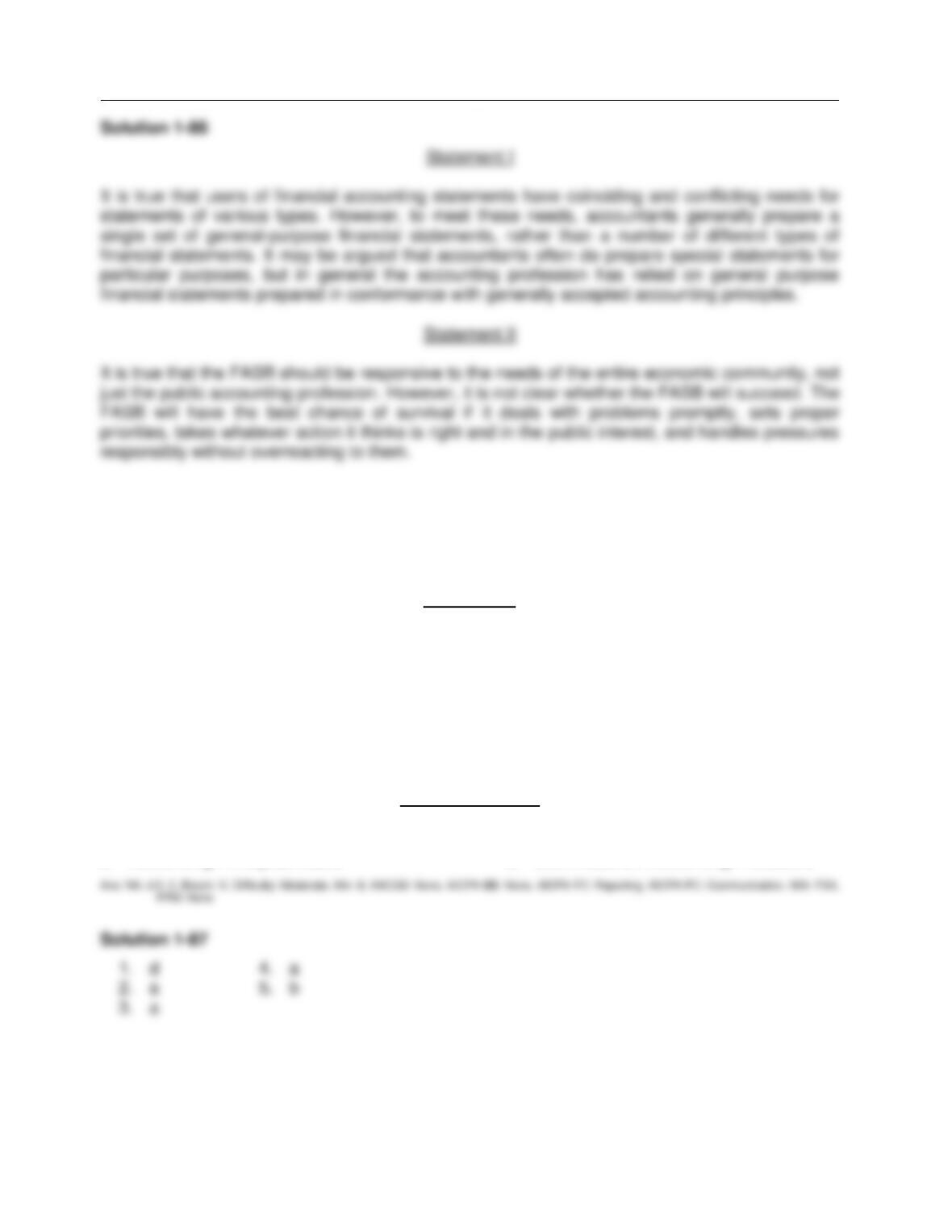
Ex. 1-85—Objective of financial reporting.
What is the objective of financial reporting? How do general-purpose financial statements help
meet this objective.
Ex. 1-86—Development of accounting principles.
Presented below are two independent, unrelated statements regarding the formulation of
generally accepted accounting principles. Each statement contains some incorrect or debatable
statement(s).
Statement I
The users of financial accounting statements have coinciding and conflicting needs for
statements of various types. To meet these needs, and to satisfy the financial reporting
responsibility of management, accountants prepare different sets of financial statements for
different users.
Statement II
The FASB should be responsive to the needs and viewpoints of the entire economic community,
not just the public accounting profession. The FASB therefore will succeed because it will deal
effectively with all interested groups.
Instructions
Evaluate each of the independent statements and identify the areas of fallacious reasoning in
each. Explain why the reasoning is incorrect. Complete your discussion of each statement before
proceeding to the next statement.
Test Bank for Intermediate Accounting, Seventeenth Edition
1 – 20
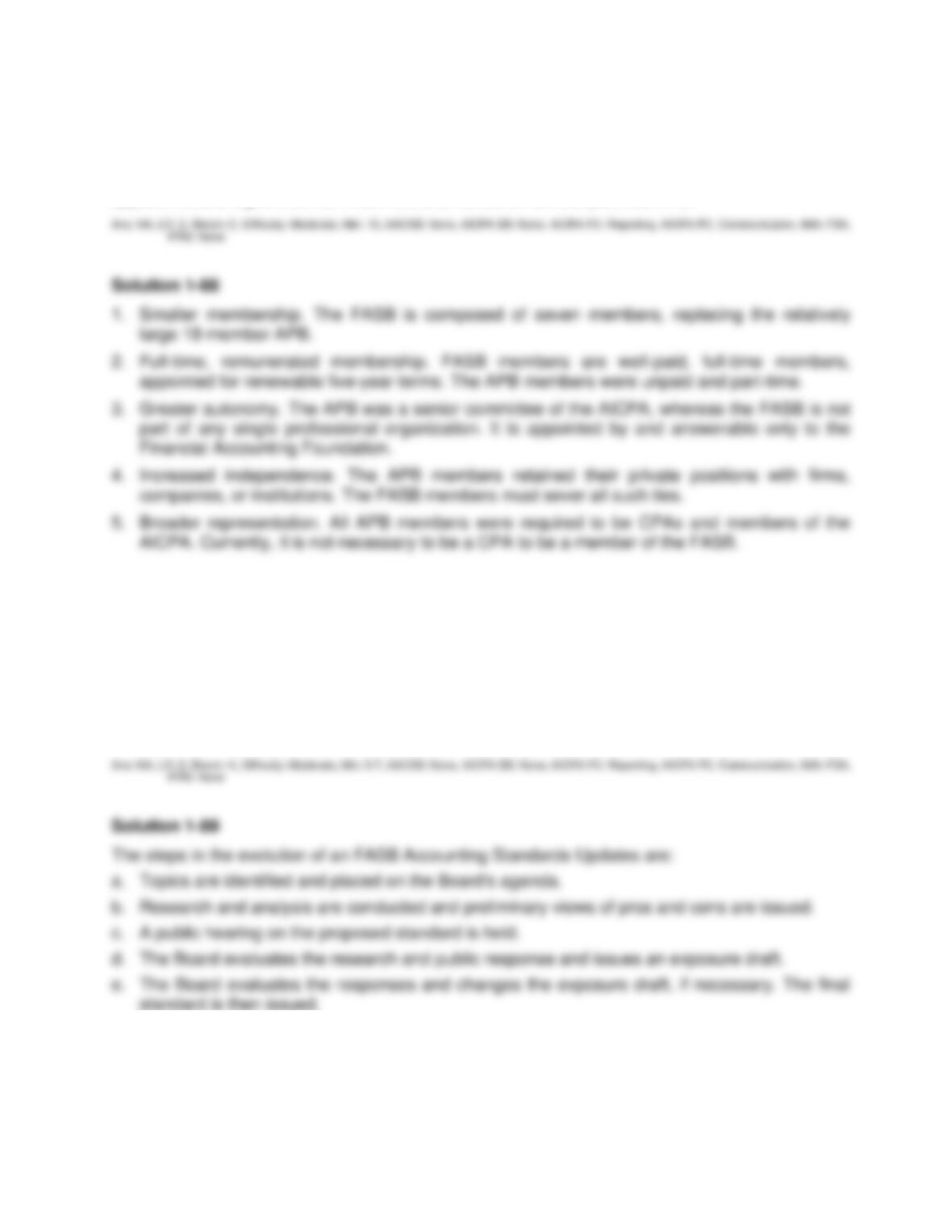
Ex. 1-87—Publications and organizations.
Significant accounting publications are listed below (1-5). Sources or sponsors of accounting
publications are identified next by alphabetical character (a-d). Match the publications with their
sources.
Publications
____ 1. Accounting Research Bulletins (1953-1959)
____ 2. Accounting Standards Updates
____ 3. Emerging Issues Task Force Updates
____ 4. Statements of Financial Accounting Concepts
____ 5. Opinions (1962-1973)
Sources/Sponsors
a. Financial Accounting Standards Board c. The AICPA
b. Accounting Principles Board d. Committee on Accounting Procedure
Financial Accounting and Accounting Standards
1 – 21
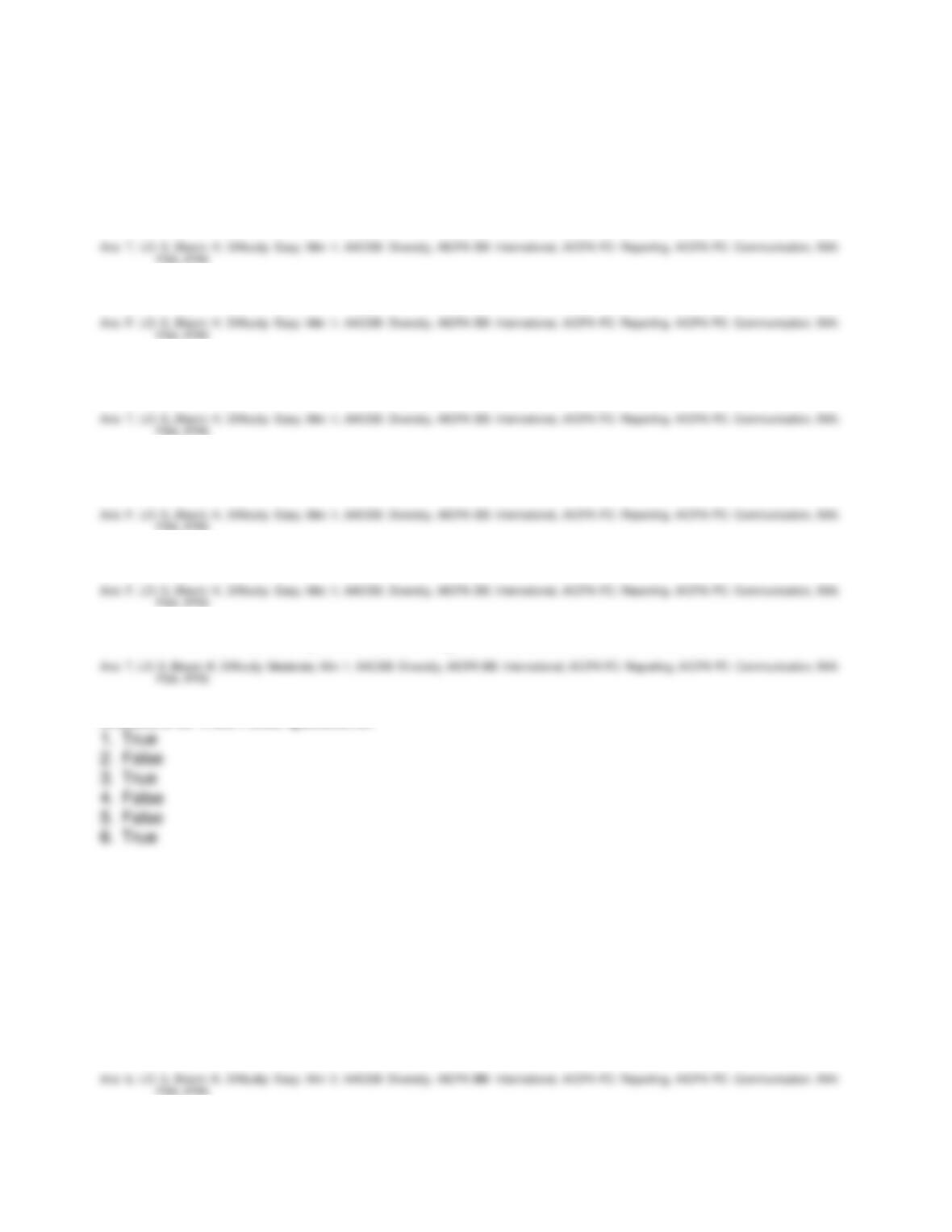
Ex. 1-88—FASB.
The Financial Accounting Standards Board was established because many groups interested in
financial reporting believed that the Accounting Principles Board was not effective. Discuss the
apparent advantages that the FASB has over its earlier counterpart, the APB.
Ex. 1-89—Evolution of a statement of financial accounting standards.
In establishing financial accounting standards, two basic premises of the FASB are (1) The FASB
should be responsive to the needs and viewpoints of the entire economic community, not just the
accounting profession. (2) It should operate in full view of the public through a “due process”
system that gives interested persons ample opportunity to make their views known. To ensure
achievement of these goals, what steps does the FASB follow in the development of a typical
FASB standard?
Test Bank for Intermediate Accounting, Seventeenth Edition
1 – 22
IFRS QUESTIONS
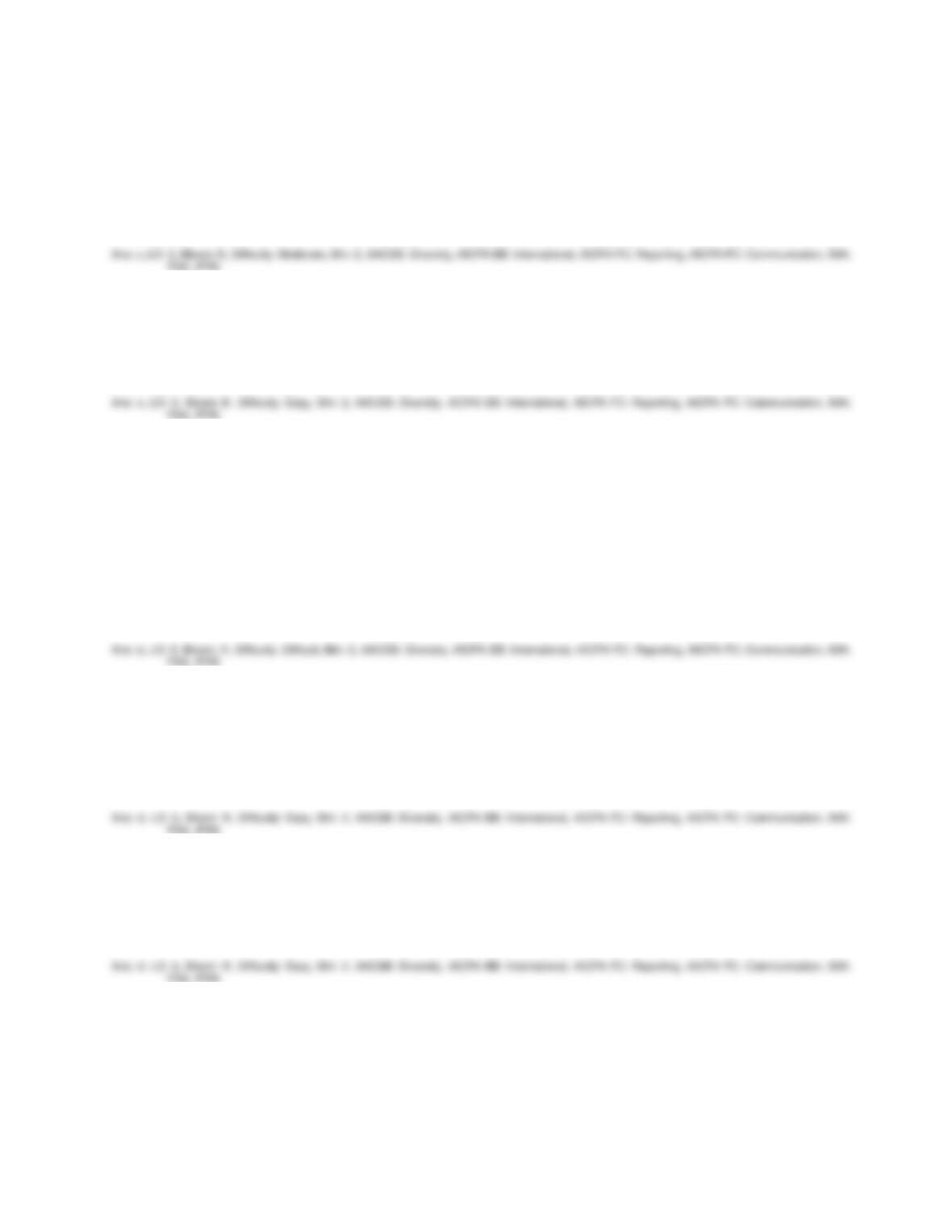
True/False:
1. IFRS includes both International Financial Reporting Standards and International Accounting
Standards.
2. International Financial Reporting Standards preceded International Accounting Standards
3. The standard-setting structure used by the International Accounting Standards Board is very
similar to that used by the Financial Accounting Standards Board.
4. The rules-based standards of IFRS are more detailed than the simpler, principles-based
standards of GAAP.
5. The International Accounting Standards Board has seven members.
6. The IASB relies primarily on IOSCO for regulation and enforcement of its standards.
Answers to True/False questions:
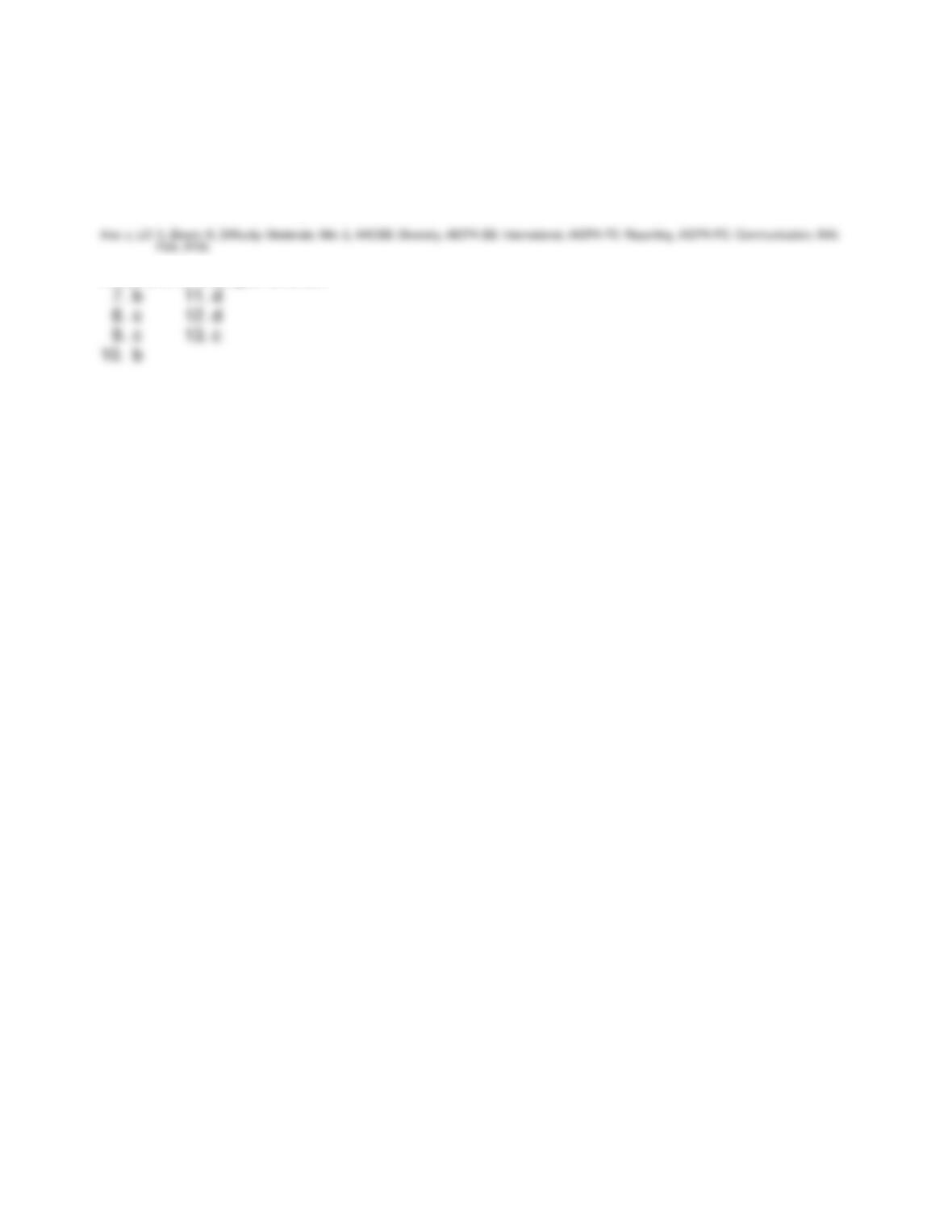
Multiple Choice:
7. Authoritative standards for IFRS include:
a. International Financial Reporting Standards only.
b. International Financial Reporting Standards and International Accounting Standards only.
c. International Financial Reporting Standards, International Accounting Standards and
GAAP only.
d. International Financial Reporting Standards, International Accounting Standards and any
GAAP standard recognized by an organized stock exchange.
Financial Accounting and Accounting Standards
1 – 23
8. Which of these statements regarding the IFRS and GAAP is correct?
a. GAAP is considered to be “principles-based”.
b. GAAP is considered to be less detailed than IFRS.
c. IFRS is considered to be “principles-based” and less detailed than GAAP
d. Both GAAP and IFRS are considered to be “rules-based”, but GAAP tends to be more
complex.
9. The IASB’s standard-setting structure includes all of the following except
a. the Standing Interpretations Committee
b. the Standards Advisory Council
c. the Standards Comparison Committee
d. the Trustees
10. Which of the following organizations have committed to develop high-quality, compatible
accounting standards that could be used for domestic and cross-border financial reporting
a. The Financial Accounting Standards Board (FASB) and the International Organization of
Securities Commission (IOSCO)
b. The Financial Accounting Standards Board (FASB) and the International Accounting
Standards Board (IASB)
c. The International Accounting Standards Board (IASB) and International Organization of
Securities Commission (IOSCO)
d. The International Accounting Standards Board (IASB) and the Standards Advisory Council
(SAC)
11. Which of the following organizations is not among the four international standard-setting
organizations?
a. The International Accounting Standards Committee Foundation (IASCF)
b. The Standards Advisory Council (SAC)
c. The International Financial Reporting Interpretations Committee (IFRIC)
d. The Financial Executives Institute (FEI)
12. Which of the following organizations selects members for the IASB?
a. The Accounting Standards Committee Foundation
b. The Standards Advisory Council
c. The International Financial Reporting Interpretations Committee
d. The International Accounting Standards Committee Foundation
Test Bank for Intermediate Accounting, Seventeenth Edition
1 – 24
13. The purpose of the International Accounting Standards Board is to:
a. regulate stock prices at the international level.
b. develop a uniform currency in which the financial transactions occur.
c. develop a single set of high-quality financial reporting standards.
d. arbitrate accounting disputes between auditors and international companies.
Answers to Multiple Choice: