Listed below are five terms followed by a list of phrases that describe or characterize each of the
terms. Match each phrase with the correct term.
A) Its EITF Issues are GAAP when entered in the Accounting Standards Codification.
B) It is the national organization for CPAs in the United States.
C) It has the authority to set U.S. accounting standards.
D) It established GAAP before the FASB.
E) Undermines representational faithfulness by being inconsistent with neutrality.
133) Financial Accounting Standards Board
134) Accounting Principles Board
135) Conservatism
137) Securities and Exchange Commission
Difficulty: 2 Medium
Topic: Development of accounting and reporting standards; Encouraging high–quality financial reporting; Concepts―Qualitative
characteristics
Learning Objective: 01-03, 01-05, 01-07
Bloom’s: Understand
AACSB: Reflective Thinking
Accessible/AICPA: BB Critical thinking; BB Legal
Listed below are five terms followed by a list of phrases that describe or characterize each of the
terms. Match each phrase with the correct term.
A) Net assets.
B) Transfers of resources in exchange for common and preferred stock.
C) Claims of creditors against the assets of a business.
D) Outflows of resources to generate revenues.
E) Cash dividends.
138) Expenses
139) Equity
140) Distributions to owners
141) Investments by owners
142) Liabilities
Difficulty: 1 Easy
Topic: Concepts―Elements of financial statements
Learning Objective: 01-07 Identify the objective and qualitative characteristics of financial reporting information, and the
elements of financial statements.
Bloom’s: Remember
AACSB: Reflective Thinking
Accessible/AICPA: BB Critical thinking; FN Measurement
Listed below are five terms followed by a list of phrases that describe or characterize each of the
terms. Match each phrase with the correct term.
A) Net outflows from peripheral transactions.
B) Probable future economic benefits controlled by an entity.
C) Results if an asset is sold for more than book value.
D) Increases in equity from the sale of goods and/or services.
E) All changes in equity except owner transactions.
143) Losses
144) Assets
145) Revenues
146) Comprehensive income
147) Gains
Difficulty: 1 Easy
Topic: Concepts―Elements of financial statements
Learning Objective: 01-07 Identify the objective and qualitative characteristics of financial reporting information, and the
elements of financial statements.
Bloom’s: Remember
AACSB: Reflective Thinking
Accessible/AICPA: BB Critical thinking; FN Measurement
Listed below are ten organizations followed by a list of phrases that describe or characterize the
organizations. Match each phrase with the correct organization.
A) FASB’s predecessor.
B) Primary national organization of accountants working in industry.
C) Regulates the financial reporting for public companies.
D) The FASB’s parent organization.
E) National organization of certified public accountants.
F) Sets accounting standards in the United States.
G) Provides timely responses to financial reporting issues.
H) Advises the FASB
I) Sets global accounting standards.
J) Establishes auditing standards in the US for public companies.
148) SEC
149) FASB
150) IASB
151) AICPA
152) EITF
153) PCAOB
154) IMA
155) FASAC
156) APB
157) FAF
Use this information to answer the following questions:
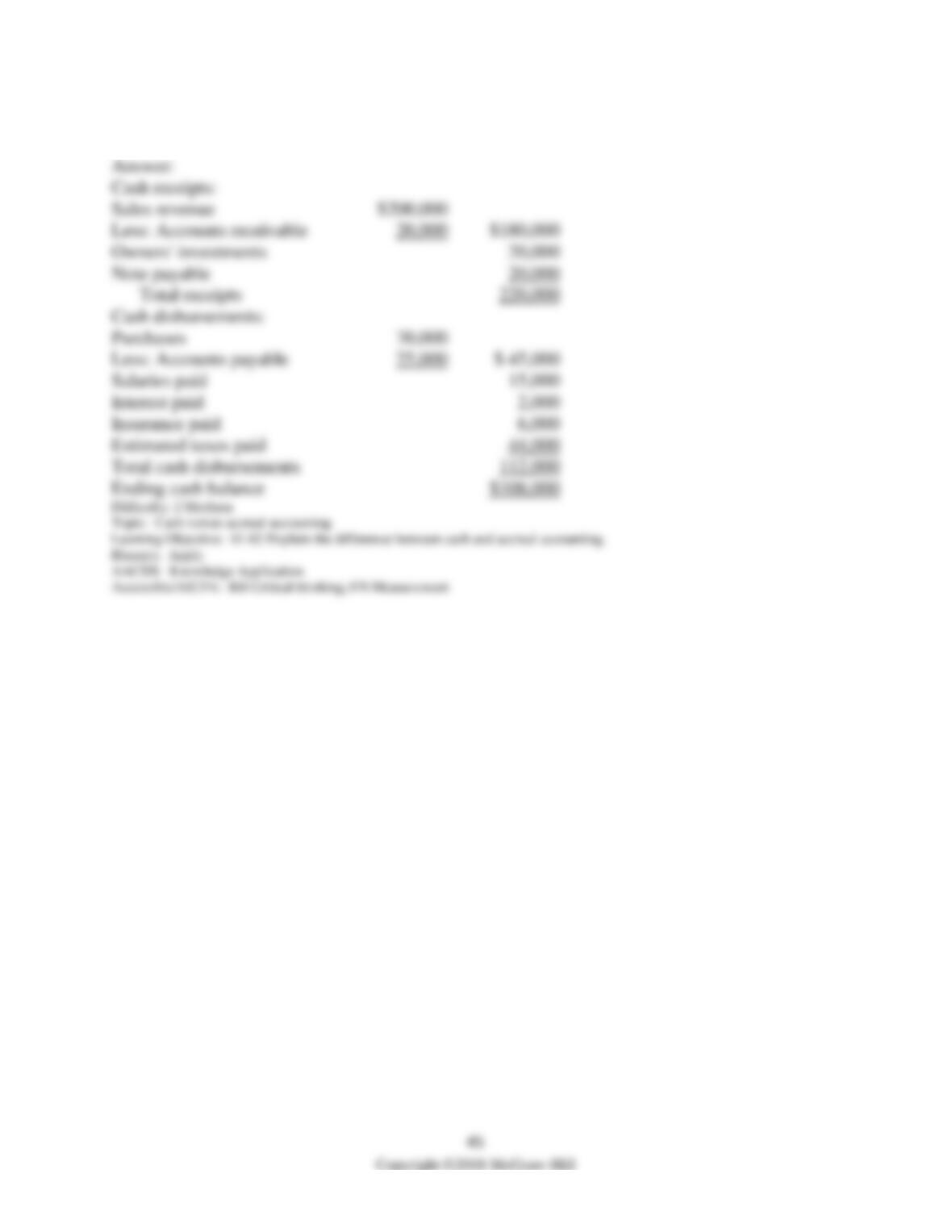
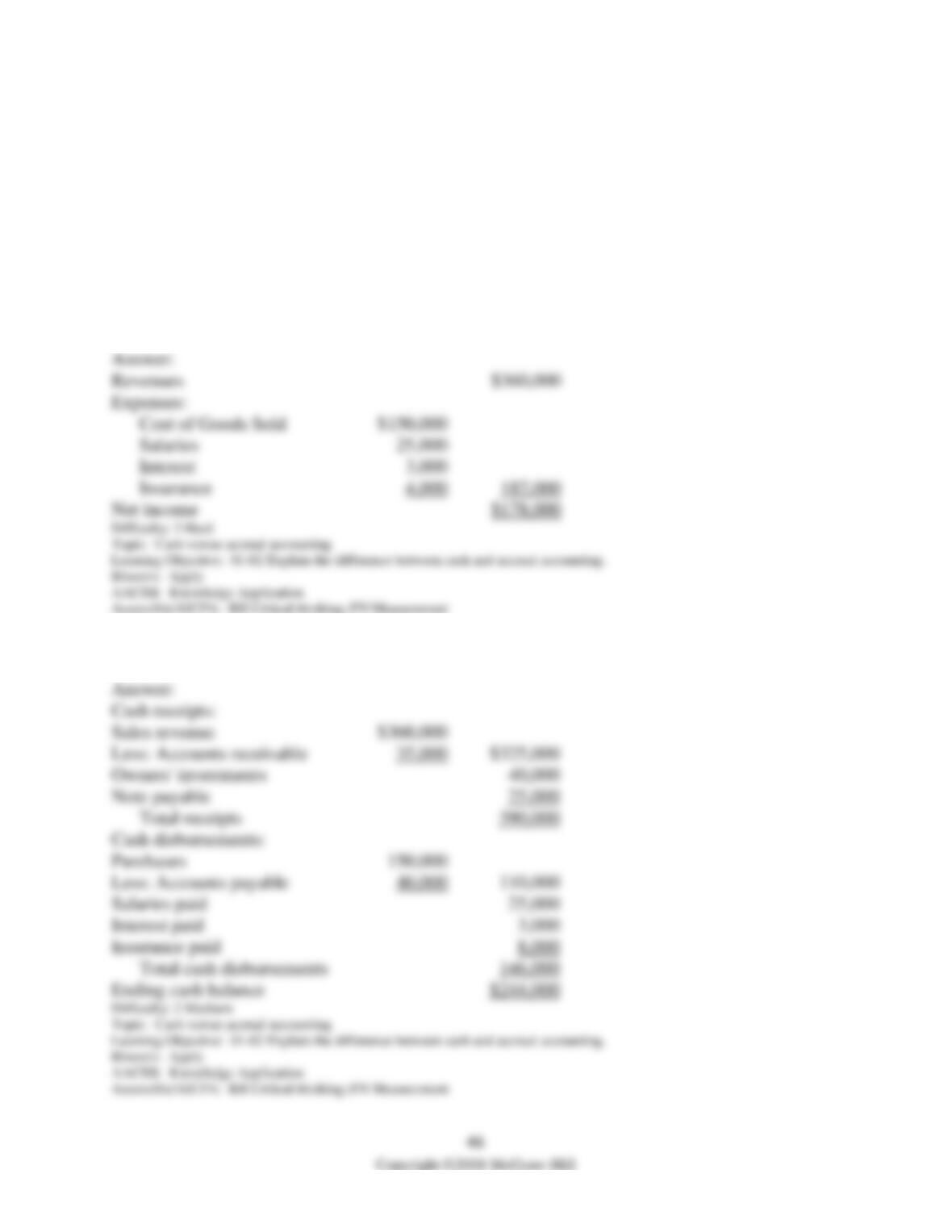
Alpaca Corporation had revenues of $200,000 in its first year of operations. The company has
not collected on $20,000 of its sales and still owes $25,000 on $70,000 of merchandise it
purchased. The company had no inventory on hand at the end of the year. The company paid
$15,000 in salaries. Owners invested $20,000 in the business and $20,000 was borrowed on a
five-year note. The company paid $2,000 in interest that was the amount owed for the year, and
paid $6,000 for a two-year insurance policy on the first day of business. Alpaca has an effective
income tax rate of 40%.
158) Compute net income for the first year for Alpaca Corporation.
159) Compute the cash balance at the end of the first year for Alpaca Corporation.
Use this information to answer the following questions:
Tri Fecta, a partnership, had revenues of $360,000 in its first year of operations. The partnership
has not collected on $35,000 of its sales and still owes $40,000 on $150,000 of merchandise it
purchased. There was no inventory on hand at the end of the year. The partnership paid $25,000
in salaries. The partners invested $40,000 in the business and $25,000 was borrowed on a five-
year note. The partnership paid $3,000 in interest that was the amount owed for the year and paid
$8,000 for a two-year insurance policy on the first day of business.
160) Compute net income for the first year for Tri Fecta.
161) Compute the cash balance at the end of the first year for Tri Fecta.
Use this information to answer the following questions:
The following information ($ in millions) comes from a recent annual report of Amazon.com,
Inc.:
Net sales $10,711
Total assets 4,363
End of year balance in cash 1,022
Total stockholders’ equity 431
Gross profit (Sales – Cost of Sales) 2,456
Net increase in cash for the year 9
Operating expenses 2,067
Net operating cash flow 702
Other income (expense), net (12)
162) Compute Amazon’s balance in cash at the beginning of the year.
163) Compute Amazon’s total liabilities at the end of the year.
164) Compute Amazon’s cost of goods sold for the year.
165) Compute the income before income tax for Amazon.
166) Compare net income (loss) for the year to net cash flow from operating activities. Why are
these amounts different? Briefly explain.
167) For each of the following situations, state whether you agree or disagree with the financial
reporting practice employed, and briefly explain the reason for your answer.
1. Cantor Corporation’s accountant increased the book value of a patent from its original cost of
$1 million to its recently appraised value of $6 million.
2. Stanton Corporation paid for the personal travel of its chief financial officer and charged travel
expense.
3. At the end of its 2018 fiscal year, Dower, Inc., received an order from a customer for $60,000.
The merchandise will ship early in 2019. Because the sale was made to a long-time customer and
the invoice was paid in 2018, the controller recorded the sale in 2018.
4. In the middle of its 2018 fiscal year, Sanguinetti, Inc. paid $12,000 to its insurance company
for one-year comprehensive insurance coverage. Sanguinetti recorded the entire expenditure as
an expense in 2018.
5. The Churchill Pharmaceutical Company included a note in its financial statements that
described a pending lawsuit against the company.
6. The Daily Corporation, a company whose securities are publicly traded, prepares monthly,
quarterly, and annual financial statements for internal use but disseminates to external users only
the annual financial statements.
168) Identify or define the following terms: economic entity, going concern.
169) List the four financial statements most frequently provided to external users.
170) Explain and show an example of how the FASB’s conceptual framework is needed in
formulating standards on controversial topics.
171) What is the SEC and how is it involved with accounting standard-setting?
172) What is the EITF and what is its purpose?
173) Accounting standard-setting has been characterized as a political process. Discuss this
proposition giving an example.
174) What are the key provisions of the Public Company Accounting Reform and Investor
Protection (Sarbanes-Oxley) Act of 2002?
175) What is the value of a company having financial statements audited by an independent
auditor?
176) What provisions did the Public Company Accounting Reform and Investor Protection
(Sarbanes-Oxley) Act of 2002 make for performance of nonaudit services by an audit firm?
177) Briefly describe how materiality is featured in the conceptual framework.
178) Give an example of a violation of the stable monetary unit assumption. How would it affect
the quality of financial statement information?
179) Identify or define the following terms: periodicity, monetary unit.
180) Identify or define the following term: historical cost.
181) How does GAAP define fair value?
182) Over time, accounting standards have developed to reflect changes in the business world as
well as changes in our ability to account for such changes. Using the example of marking assets
and liabilities to their fair value, explain why you would expect accounting standards to change.
183) List and briefly describe the five measurement attributes used commonly in current GAAP.
184) List and briefly describe the three levels of inputs described in the fair-value measurement
hierarchy.
185) Contrast the asset/liability and revenue/expense approaches to accounting standard setting.
186) Contrast the role of the conceptual framework in U.S. GAAP and IFRS.