CHAPTER 1
BASIC FINANCIAL ACCOUNTING REVIEW
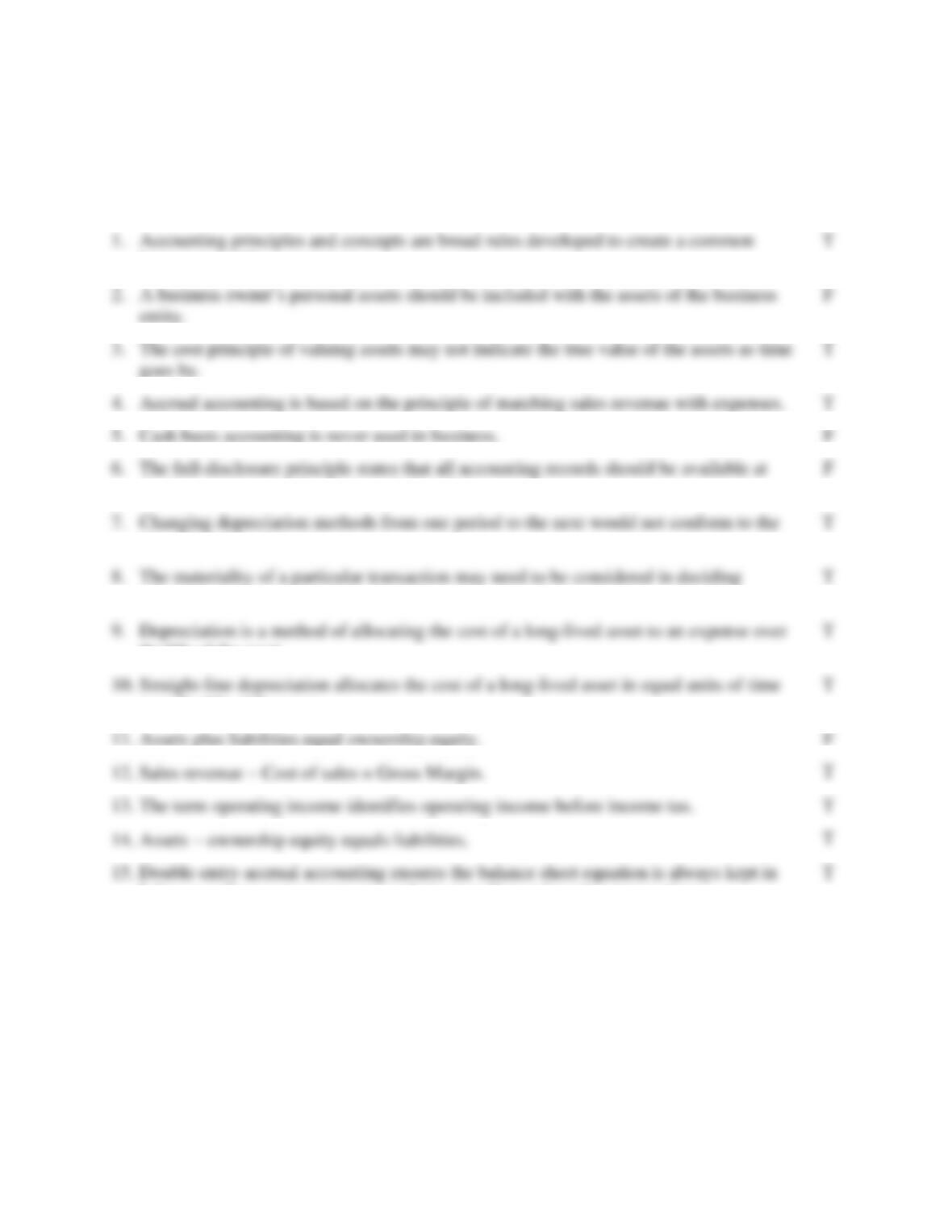
TRUE OR FALSE QUESTIONS
(Correct answer indicated by T for True answers and F for False answers)
language used by accountants.
entity.
goes by.
any time to anyone who wants to look at them.
principle of consistency.
whether or not to conform to other accounting principles.
the life of the asset.
over the life of the asset.
balance, as long as no errors are made in recording and posting transactions.
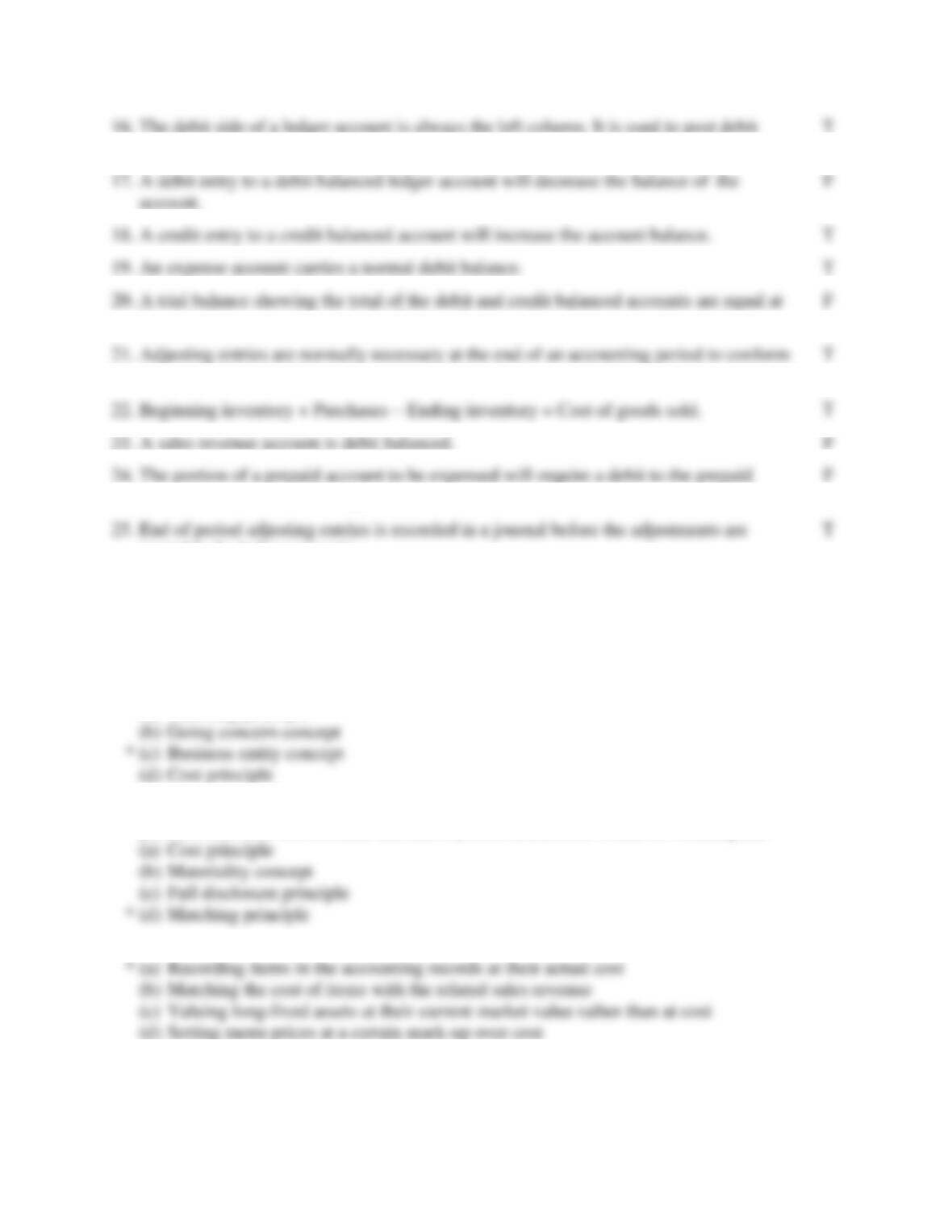
values of a transaction.
account.
the end of an accounting period indicates all entries have been correctly posted.
to the matching principle.
account and a credit to an expense account.
posted to the ledger accounts.
MULTIPLE CHOICE QUESTIONS
(Correct answers indicated by asterisk)
1. A cocktail lounge owner who takes home liquor for private parties at home without reflecting
this in the lounge’s accounting records is violating the:
(a) Matching principle
2. A restaurant that records all purchases of food and beverages as an expense at the time of
purchase and does not consider the end of period inventories would be violating the:
3. The cost principle is concerned with:
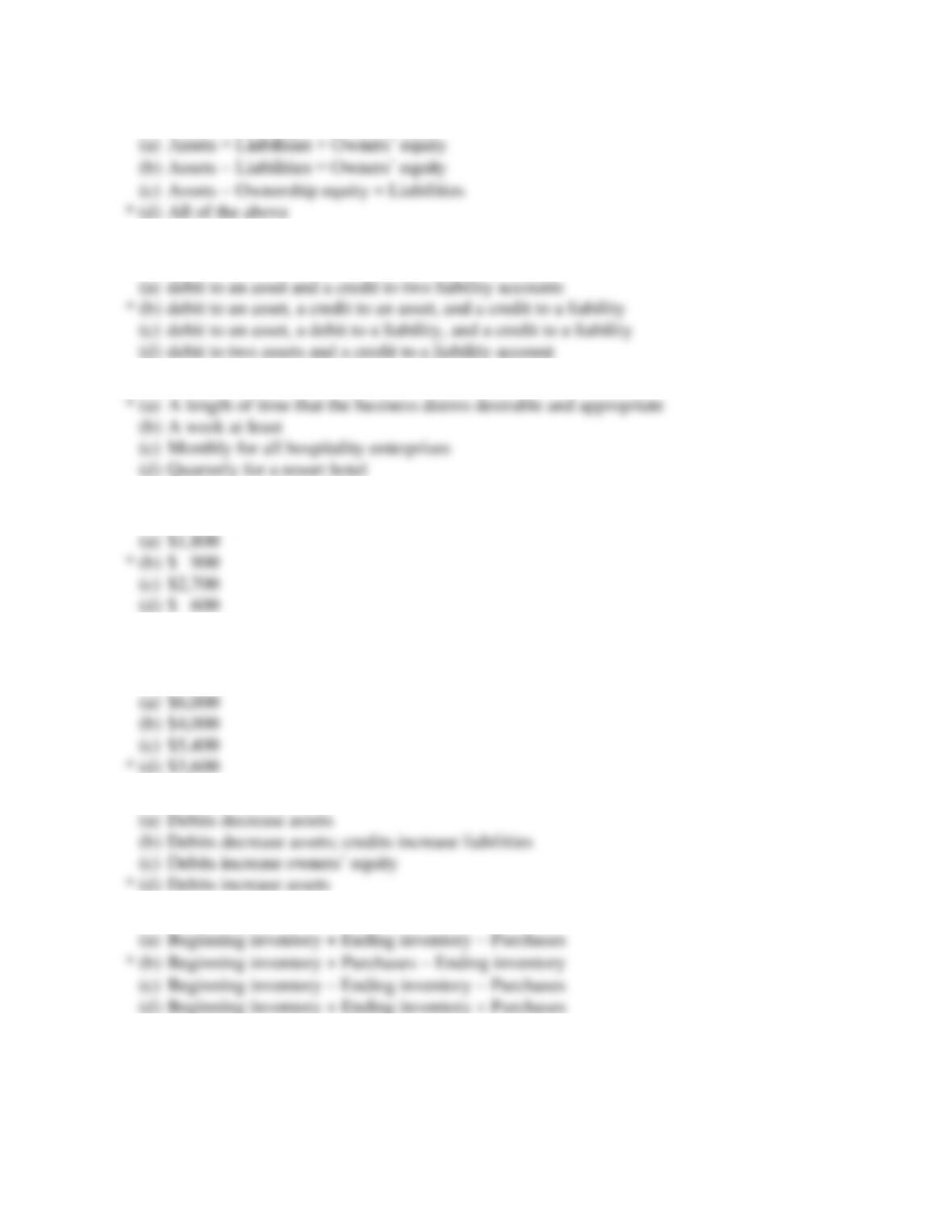
4. The balance sheet equation can be expressed as:
5. A restaurant purchased a new point of sale terminal by paying one-half of its cost in cash and
owing the balance on account. The journal entry requires a:
6. The length of the period of an accounting cycle is:
7. If cash was paid for a two-year $3,600 insurance policy on July 1, the amount of the
insurance expensed on December 31 is:
8. A five-year depreciable asset cost $10,000 and had a residual value of $1,000. What is the
balance of its accumulated depreciation account at the end of two years using straight-line
depreciation?
9. Which of the following is correct?
10. Cost of goods sold is calculated as:
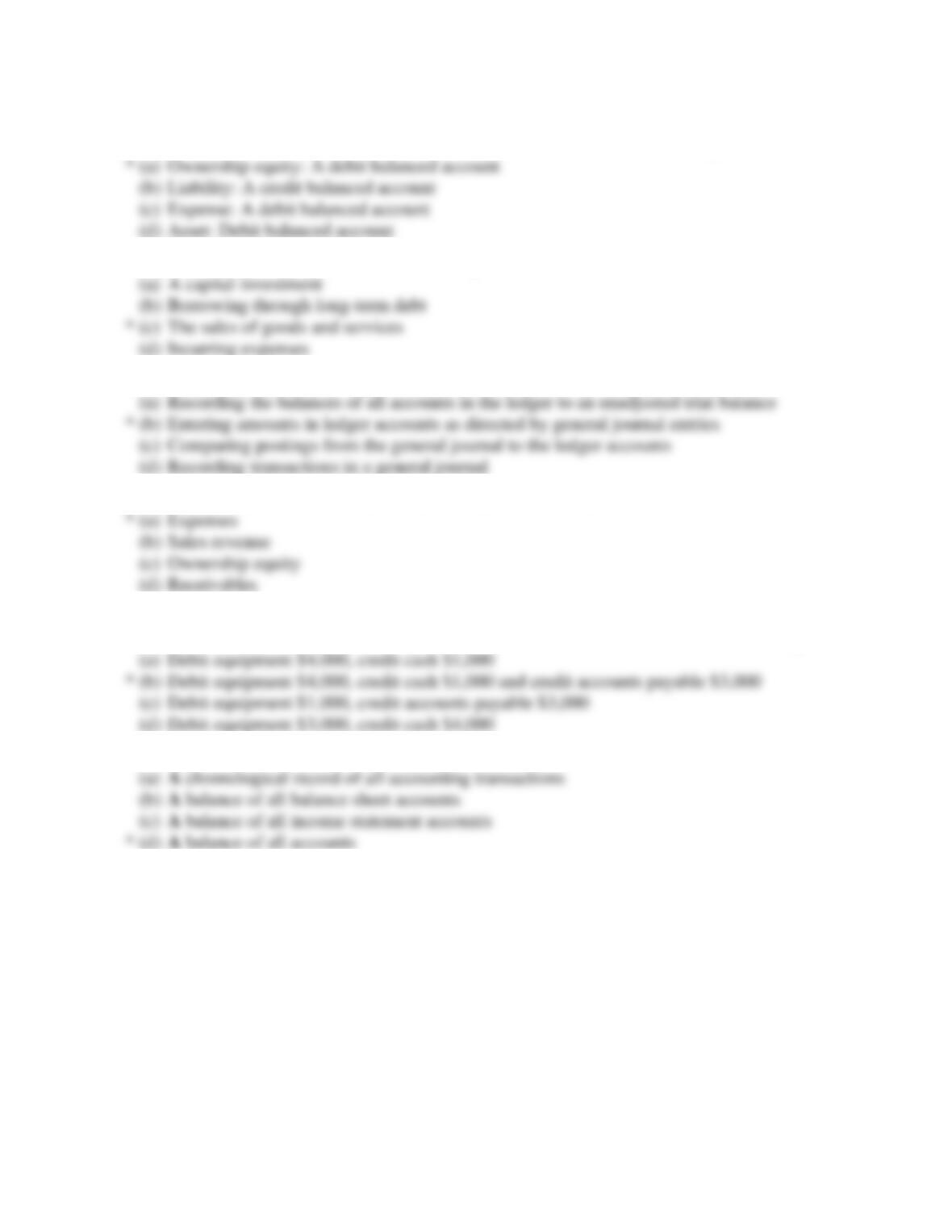
11. The normal balance of each of the five basic categories of balance sheet and income
statement accounts are either debit or credit balanced. Which of the following is not correct?
12. The inflow of assets as a result of business operations occurs from:
13. The posting of a transaction refers to:
14. The outflow of assets as a result of business operations are called:
15. A restaurant purchased an ice machine for $4,000 paying $1,000 in cash with the balance
carried on account. The journal entry to record this transaction is which of the following?
16. A ledger shows: