213.
Explain why ethics are an integral part of accounting.
214.
Describe the three important guidelines for revenue recognition.
215.
Identify the three basic forms of business organizations and their key attributes.
216.
How does the objectivity principle support ethical behavior?
217.
Identify and describe the two main groups involved in establishing generally accepted
accounting principles.
218.
How does the going-concern principle affect reporting asset values of a business?
219.
Describe the income statement and the relation between revenues, expenses, and net
income or loss.
220.
Explain the accounting equation and define its terms.
221.
What distinguishes liabilities from equity?
222.
What is the purpose of return on assets as an analytical tool?
223.
Define risk and return and discuss the relation between them.
1-127
224.
Describe the three types of activities reported on the statement of cash flows.
225.
Identify and describe the four basic financial statements.
Essay Questions
226.
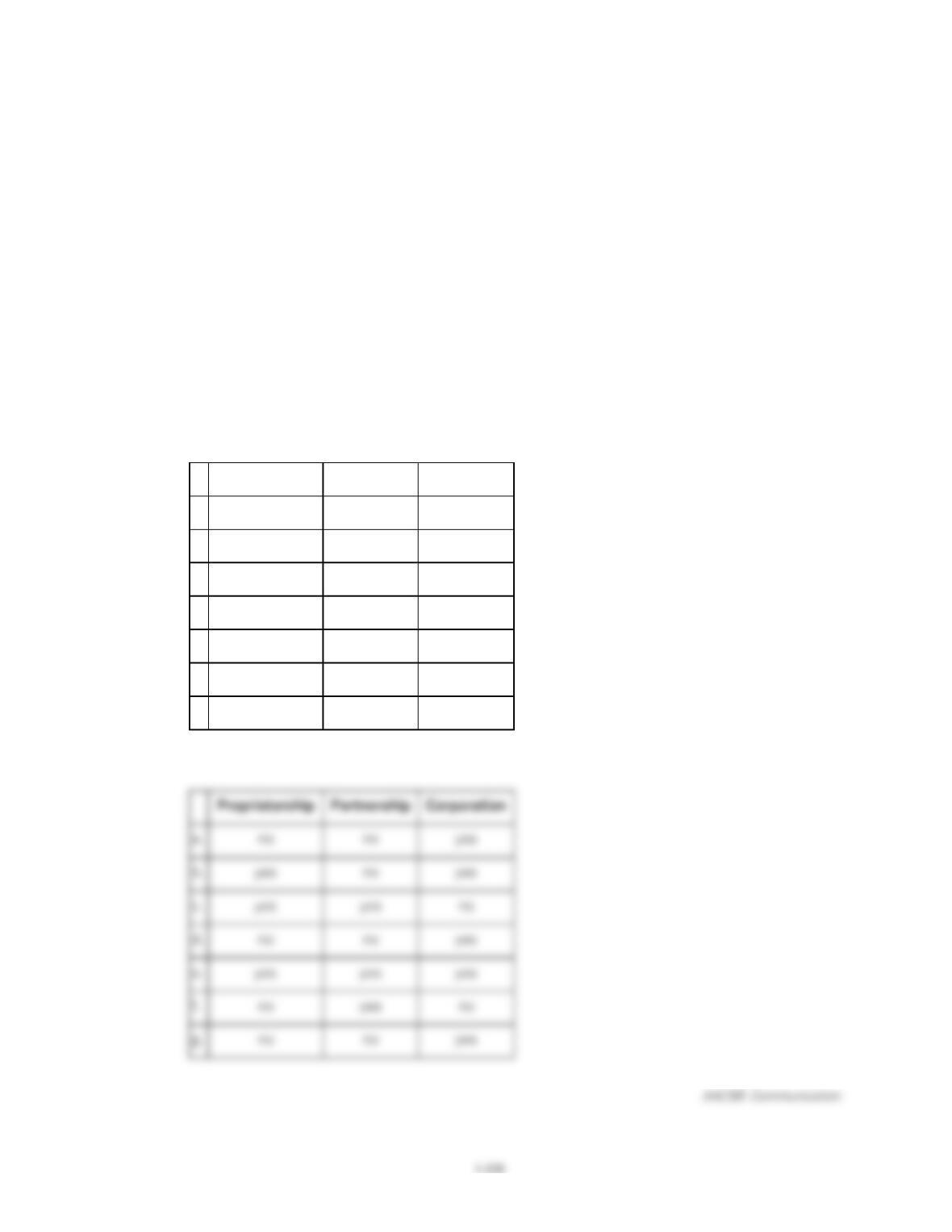
The characteristics below apply to at least one of the forms of business organization.
a. Is a separate legal entity.
b. Is allowed to be owned by one person only.
c. Individual owners are personally liable for debts of the business.
d. Is a separately taxable entity.
e. Is a business entity.
f. May have a contract specifying the division of profits among the partners.
g. Has an unlimited life.
Use the following format to indicate (with a “yes” or “no”) whether or not a characteristic
applies to each type of business organization.
Proprietorship
Partnership
Corporation
a.
b.
c.
d.
e.
f.
g.
d.
e.
f.
g.
227.
A parcel of land is offered for sale at $600,000, is assessed for tax purposes at $500,000,
is recognized by its purchasers as easily being worth $575,000, and is sold for $570,000. At
what amount should the land be recorded in the purchaser’s books? What accounting
principle supports your answer?
228.
You are reviewing the accounting records of Buddy’s Foreign Automotive, Inc., owned by
Bruce Jones. You have uncovered the following situations. List the appropriate accounting
principle related to each independent scenario and suggest a correct action for each.
1. In August, a check for $500 was written to Community Sports. This amount represents
soccer camp for his daughter Cassie.
2. Bruce plans a Going Out of Business Sale for June, since he will be closing the business
for a month-long vacation in July. He plans to reopen August 1 and will continue operating
Buddy’s Foreign Automotive indefinitely.
3. Buddy received a shipment of tools from Ontario, Canada. The invoice was stated in
Canadian dollars.
4. Sandy Lane paid $1,500 for a major repair services. The amount was recorded as
revenue. The parts for the repair must be ordered from overseas and the service won’t be
complete until the following month.
229.
At the beginning of the year, a company had $120,000 worth of liabilities. During the year,
assets increased by $160,000 and at year-end they equaled $360,000. Liabilities
decreased $20,000 during the year. Calculate the beginning and ending values of equity.
230.
At the beginning of the period, a company had $350,000 worth of assets, $110,000 worth
of liabilities, and $240,000 worth of equity. Assume the only change during the period was
a $30,000 purchase of equipment by issuing a note payable. Show the accounting equation
with the appropriate amounts at the end of the period.
231.
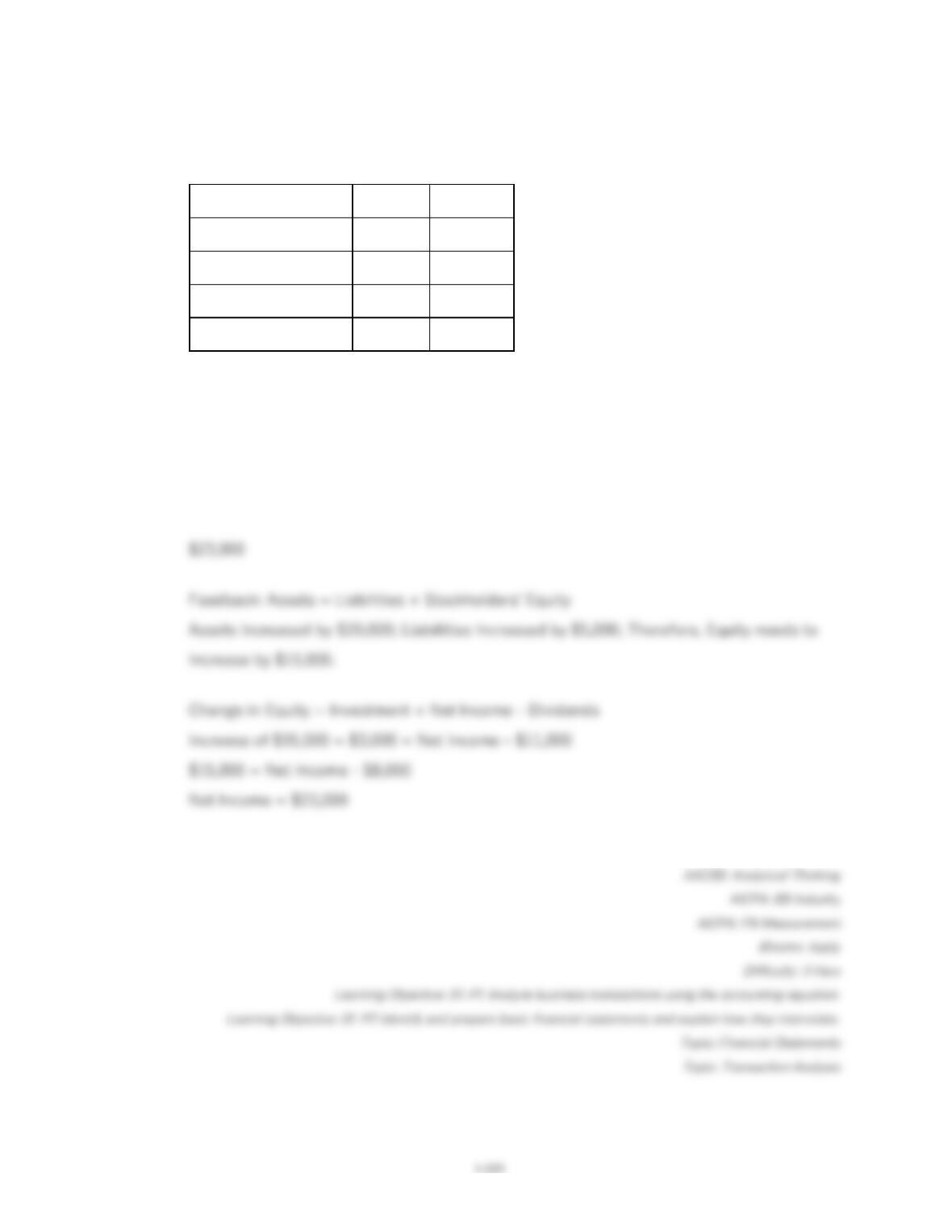
The accounts of Odie Company with the increases or decreases that occurred during the
past year are as follows:
Account
Increase
Decrease
Cash
$25,000
Accounts receivable
($5,000)
Accounts payable
(11,000)
Notes payable
16,000
Except for net income, an investment of $3,000 by the stockholder, and a dividend of
$11,000 by the stockholder, no other items affected the stockholders’ equity balance.
Using the balance sheet equation, compute net income for the past year.
232.
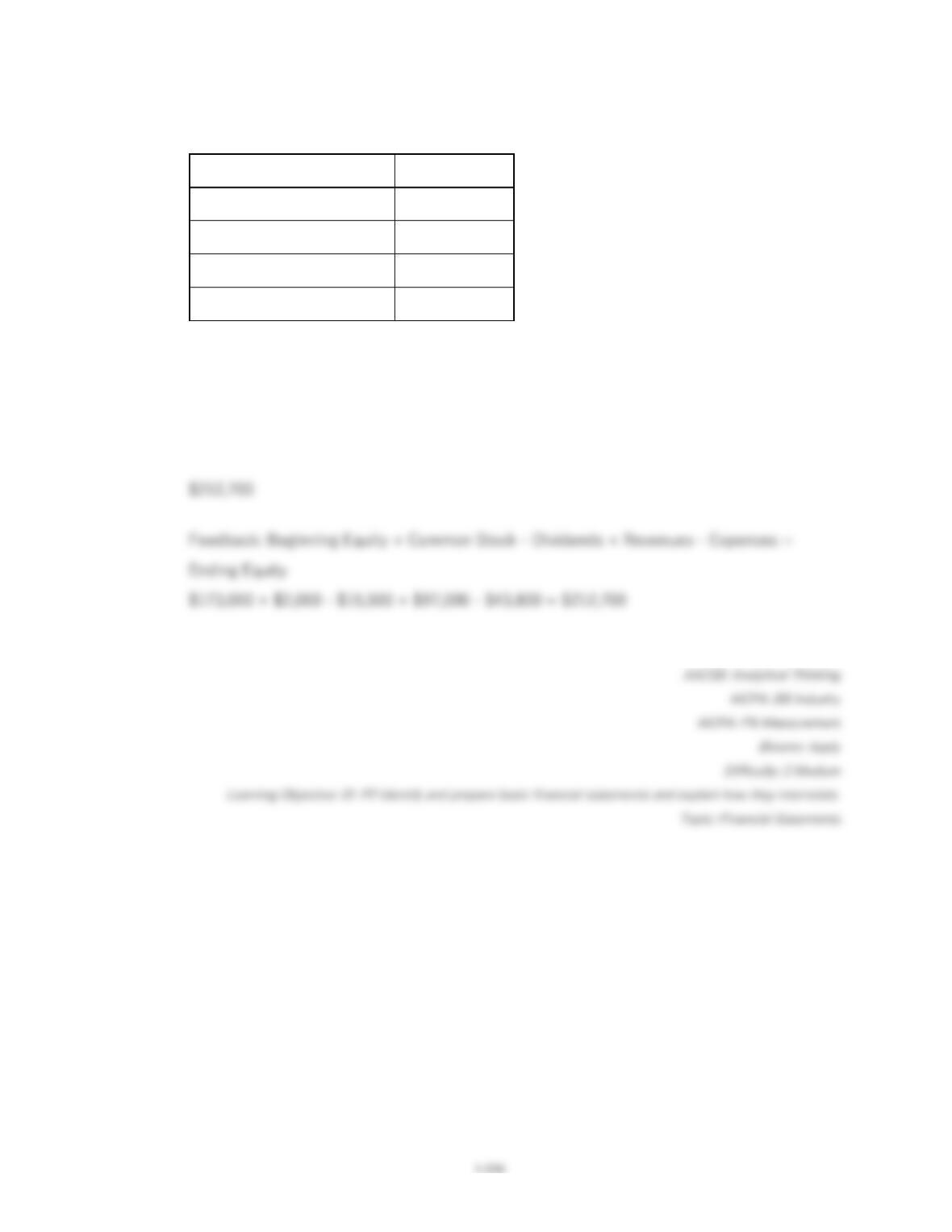
The accounts of Mason Company at the end of the past year report the following amounts:
Accounts
Amount
Dividends
$15,500
Revenues
$97,000
Expenses
$43,800
Common stock
2,000
If the beginning equity for the year was $173,000, calculate the ending equity for Mason
Company.
1-135
233.
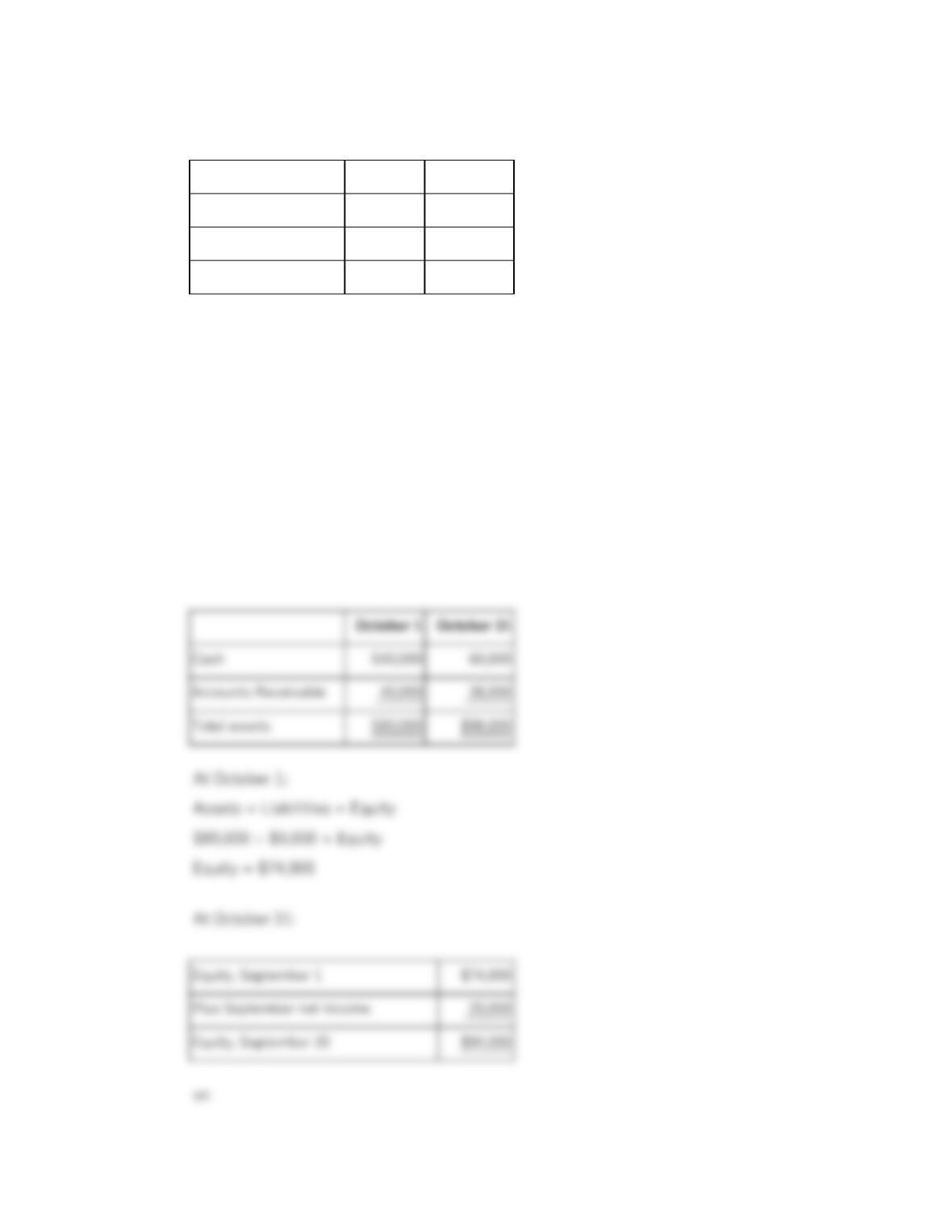
Cornelia’s Closet has the following account balances for the dates given:
October 1
October 31
Cash
$40,000
60,000
Accounts Receivable
40,000
38,000
Accounts payable
6,000
?
Also, its net income, for October 1 through October 31 was $20,000 and there were no
investments or withdrawals by the owner. Determine the equity at both October 1 and
October 31.
October 1st Equity = $74,000; October 31st Equity = $94,000
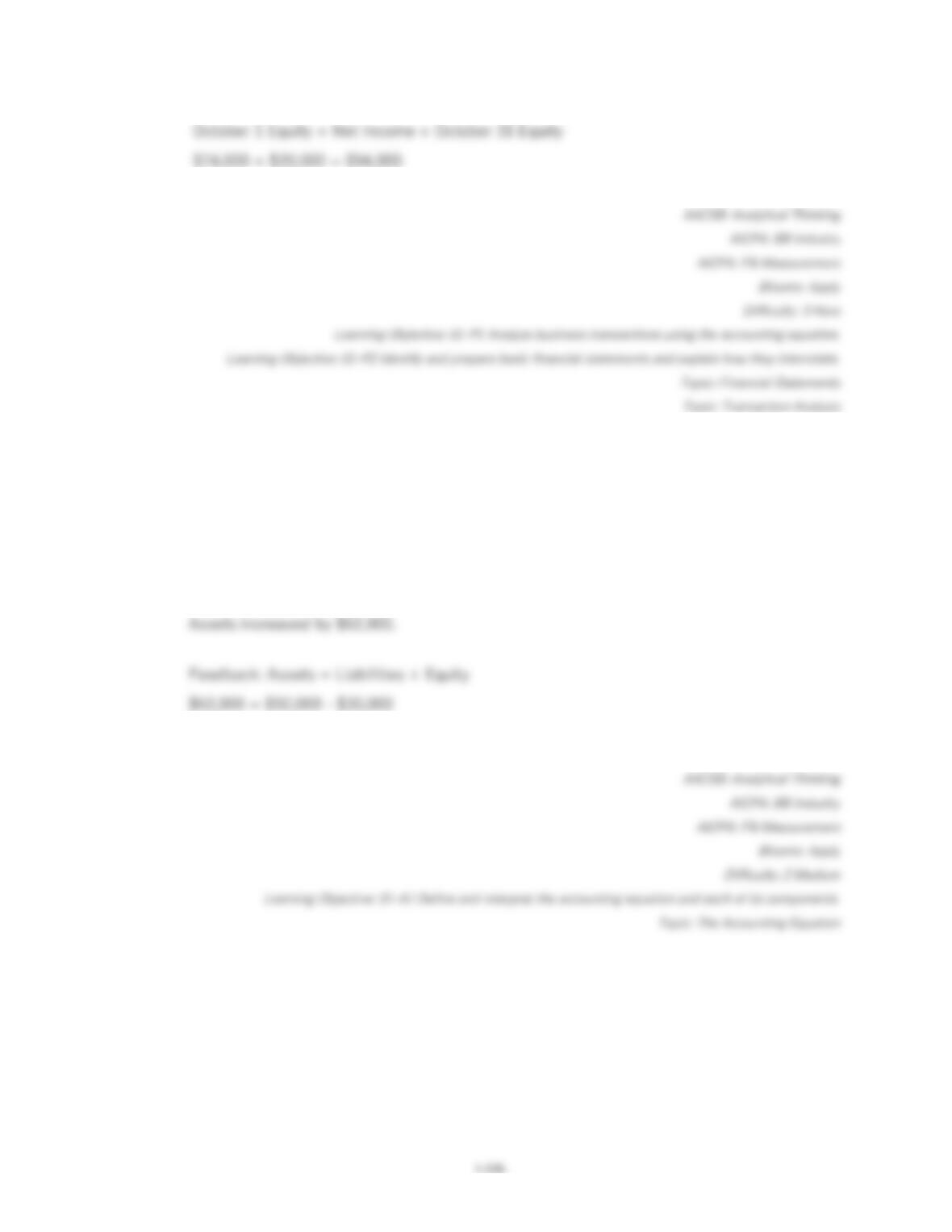
Feedback: Total assets:
60,000
Accounts Receivable
Total assets
$80,000
Equity, September 1
Plus September net income
Equity, September 30
234.
If the liabilities of a company increased $92,000 during a period of time and equity in the
business decreased $30,000 during the same period, did the assets of the company
increase or decrease? By what amount?

1-137
235.
Soo Lin, the sole stockholder, began an Internet Consulting practice organized as a
corporation and completed these transactions during April of the current year:
April
1
Invested $100,000 of her personal
savings into a checking account opened
in the name of the business.
2
Rented office space and paid $1,200
cash for the month of September.
3
Purchased office equipment for $30,000,
paying $8,000 cash and agreeing to pay
the balance in one year.
4
Purchased office supplies for $750 cash.
8
Completed work for a client and
immediately collected $2,700 cash for
the services.
15
Completed $3,600 services for a client
on credit.
20
Received $3,600 from a client for the
work completed on September 15.
30
Paid the office secretary’s monthly
salary, $3,000 cash.
30
The corporation paid a $2,000 dividend.
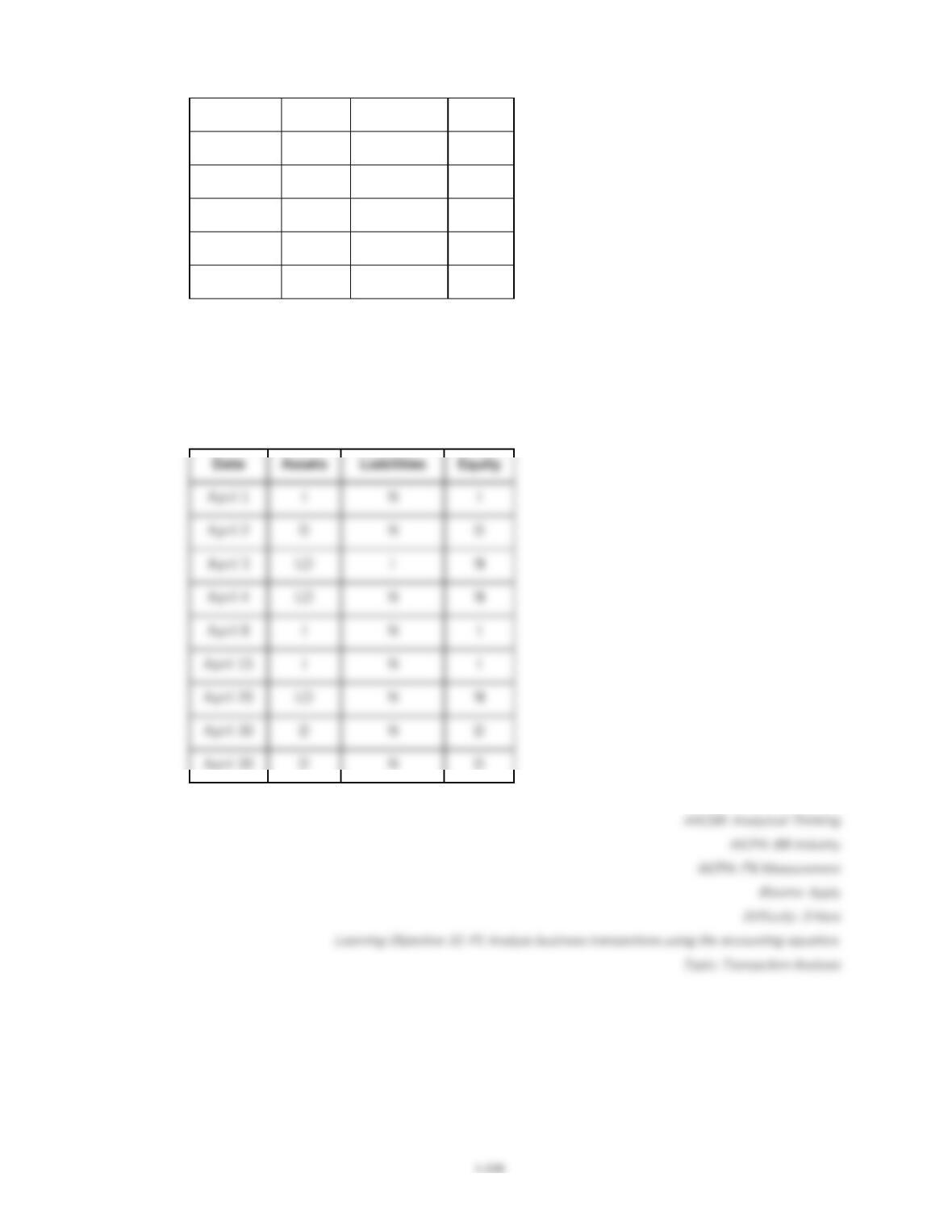
Show the effects of the above transactions on the accounting equation of Soo Lin,
Consultant. Use the following format for your answers. The first item is shown as an
example.
Increase = I Decrease = D No effect = N
Date
Assets
Liabilities
Equity
Example:
April 1
I
N
I

1-139
236.
For each of the following transactions, identify the effects as reflected in the accounting
equation. Use “+” to indicate an increase and “-” to indicate a decrease. Use “A”, “L”, and
“E” to indicate assets, liabilities, and equity, respectively. Part A has been completed as an
example.
a.
L. Chester invested
$100,000 in
a corporation.
+A
+E
b.
Land was purchased for
$50,000. A down
payment of $15,000 cash
was made and a note
was signed for the
balance.
c.
Services were rendered
to customers for cash.
d.
A building was
purchased for cash.
e.
Supplies were purchased
for cash.
f.
Paid the office
secretary’s salary.
g.
The amount owed on the
land from Part (b) was
paid.