6) Ryan withdrew cash from the business to pay his personal cell phone bill. The expanded accounting
equation changes include:
A) increase in both Cash and Withdrawals.
B) decrease in both Cash and Withdrawals.
C) decrease in Cash and increase in Withdrawals.
D) increase in Cash and decrease in Withdrawals.
7) Revenue, Expenses, and withdrawals are subdivisions of:
A) Assets.
B) Liabilities.
C) Owner’s Equity.
D) All of these answers are correct.
8) Which of the following transactions affect Owner‘s Equity?
A) Payment on account
B) Equipment purchase
C) Customer payment
D) A withdrawal
9) When services are rendered but payment is not made, which account would be increased?
A) Accounts Receivable
B) Accounts Payable
C) Cash
D) Supplies Expense
10) If Ol’ Fashioned Toys’ Revenues are less than its Expenses during the accounting period:
A) owner’s withdrawals increase net income.
B) net income causes Liabilities to decrease.
C) the business will incur a net loss.
D) owner’s withdrawals increase Owner’s Equity.
11) If Ol’ Fashioned Toys’ Revenues are greater than its Expenses during the accounting period:
A) Assets will increase more than Liabilities.
B) Liabilities will increase more than Assets.
C) the business will incur a loss.
D) the business will earn a net income.
12) Kim billed her legal clients $12,000 for legal work completed during the month. This transaction will:
A) cause a $12,000 increase in Revenues and Liabilities.
B) cause a $12,000 increase in Revenues and a decrease in cash.
C) cause a $12,000 increase in Assets and Revenues.
D) not be recorded until the cash is collected.
13) Cup’s Inc. paid $15,000 in salaries and wages for February. This transaction will:
A) increase Expenses and decrease Revenue.
B) increase Expenses and increase Liabilities.
C) decrease Assets and increase Expenses.
D) increase Assets and Expenses.
14) Crystal Clear Imagery received and paid a utility bill for $600 for the month of November. This
transaction will:
A) increase Cash and increase Utility Expense.
B) decrease Cash and increase Utility Expense.
C) increase Cash and decrease Utility Expense.
D) increase Utility Expense and decrease Revenue.
15) If a company’s Revenues are higher than its Expenses, it will cause:
A) an increase in Owner’s Equity.
B) a decrease in Owner’s Equity.
C) an increase in Assets.
D) net loss.
16) Expenses:
A) are costs the company incurs in carrying on operations.
B) are a subdivision of Owner’s Equity.
C) record personal Expenses not related to the business.
D) Both A and B are correct.
17) An Expense should be recorded when:
A) the bill is paid.
B) a purchase is made on credit.
C) a bill is received in the mail.
D) All of the above are correct.
18) Revenues should be recorded when:
A) it is earned.
B) payment is received.
C) the invoice is sent to the customer.
D) All of the above are correct.
19) Accounting services were provided to a customer for cash. How would this affect the accounting
equation?
A) Cash and Accounts Receivable increase.
B) Accounts Payable decreased and Capital decreased.
C) Cash and Revenue increase.
D) None of the above are correct.
20) Which accounts are affected when the company pays salaries?
A) Assets and Capital
B) Liabilities and Revenue
C) Assets and Expenses
D) None of the above is correct.
21) Which accounts are affected when the company buys a truck for cash?
A) Assets and Revenue
B) Liabilities and Capital
C) Capital and Liabilities
D) None of the above is correct.
22) Which accounts are affected when the company provides services to a customer on credit?
A) Assets and Capital
B) Liabilities and Revenue
C) Assets and Revenue
D) None of the above is correct.
23) Which accounts are affected when the owner withdraws cash from the business?
A) Assets and Withdrawals
B) Liabilities and Capital
C) Assets and Liabilities
D) None of the above is correct.
24) Which of the following transactions would cause one asset to decrease and another asset to increase?
A) The business provided services to a cash customer.
B) The business bought supplies for cash.
C) The owner withdrew cash from the business.
D) All of the above are correct.
25) Mick’s Mart collects $100 of its accounts receivable. The expanded accounting equation impact is:
A) Cash and Capital increase $100.
B) Cash and Revenue increase $100.
C) Cash increases and Accounts Receivable decreases $100.
D) Accounts Receivable decreases and Capital increases $100.
26) Mark paid $300 cash to partially reduce the amount owed for equipment that was previously bought
on account. This transaction would:
A) increase both Assets and Liabilities.
B) increase Assets and decrease Liabilities.
C) decrease both Assets and Liabilities.
D) decrease Assets and increase Liabilities.
27) Victoria received $1,000 from customers in partial payment for accounting services performed
previously. The recording of this transaction would:
A) increase Cash and Victoria’s Capital $1,000.
B) increase Cash and decrease Accounts Receivable $1,000.
C) increase Cash and increase Accounts Receivable $1,000.
D) decrease Accounts Receivable and increase Victoria’s Capital $1,000.
28) The owner of a business paid the rent with cash. This payment reduces Cash as well as increases the
Expenses of the firm.
29) Accounts Payable results from earning Revenue on account.
30) Expenses are recorded as costs of doing business whether cash was paid or not for Expenses.
31) Owner investment is considered Revenue for the business.
32) When Expenses are greater than Revenue, net loss is the result.
33) The four parts of Owner’s Equity include capital, withdrawals, Revenues, and Expenses.
34) Cash withdrawals by the owner increase both equity and Liabilities.
35) Cash investments by the owner increases both capital and Assets.
36) Revenue and cash will always equal.
37) Withdrawals are business Expenses that are included on the income statement.
38) If Expenses are greater than Revenues, a net income is incurred.
39) Indicate whether each of the following represents (1) Asset, (2) Liability, or (3) Owner’s Equity:
1. ________ Office Supplies
2. ________ Accounts Payable
3. ________ Capital
4. ________ Cash
5. ________ Withdrawal
6. ________ Land
7. ________ Accounts Receivable
8. ________ Expense
9. ________ Equipment
10. ________ Revenue
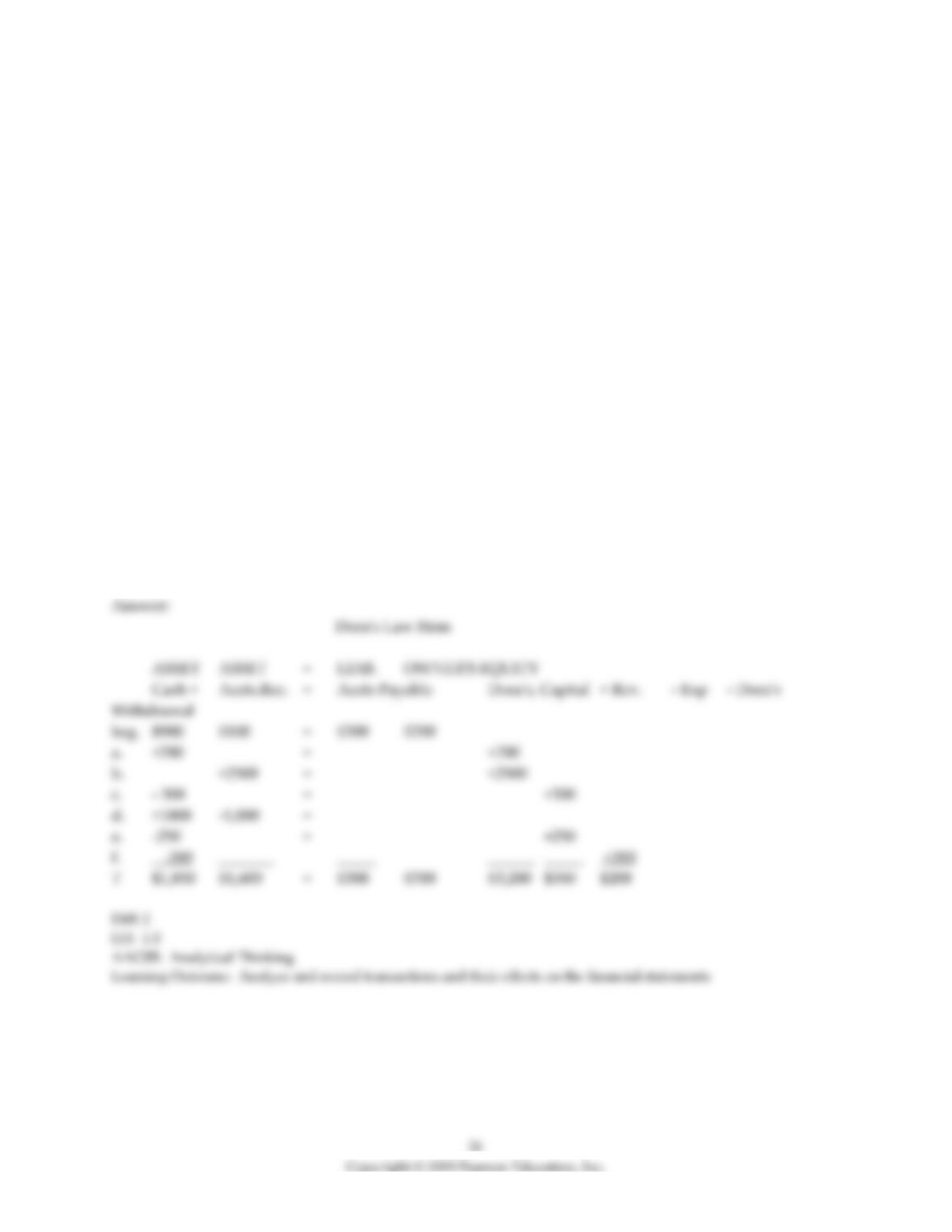
40) Record the following transactions into the expanded accounting equation for the Dora’s Law Firm.
Note that all titles have beginning balances. (You will need to determine the beginning capital balance.)
a. Provided legal services for cash, $700
b. Billed customers for services rendered, $2,500
c. Received and paid the monthly utility bill, $300
d. Collected $100 on account from customers
e. Paid supplies Expense, $250
f. Withdrew $200 cash for personal use
Dora’s Law Firm
ASSETS = LIAB. OWNER’S EQUITY
Cash + Accts.Rec. = Accts Payable Dora’s, Capital + Rev. – Exp – Dora’s
Withdrawal
beg. $900 $100 = $300 ??
a.
b.
c.
d.
e.
f.
T
27
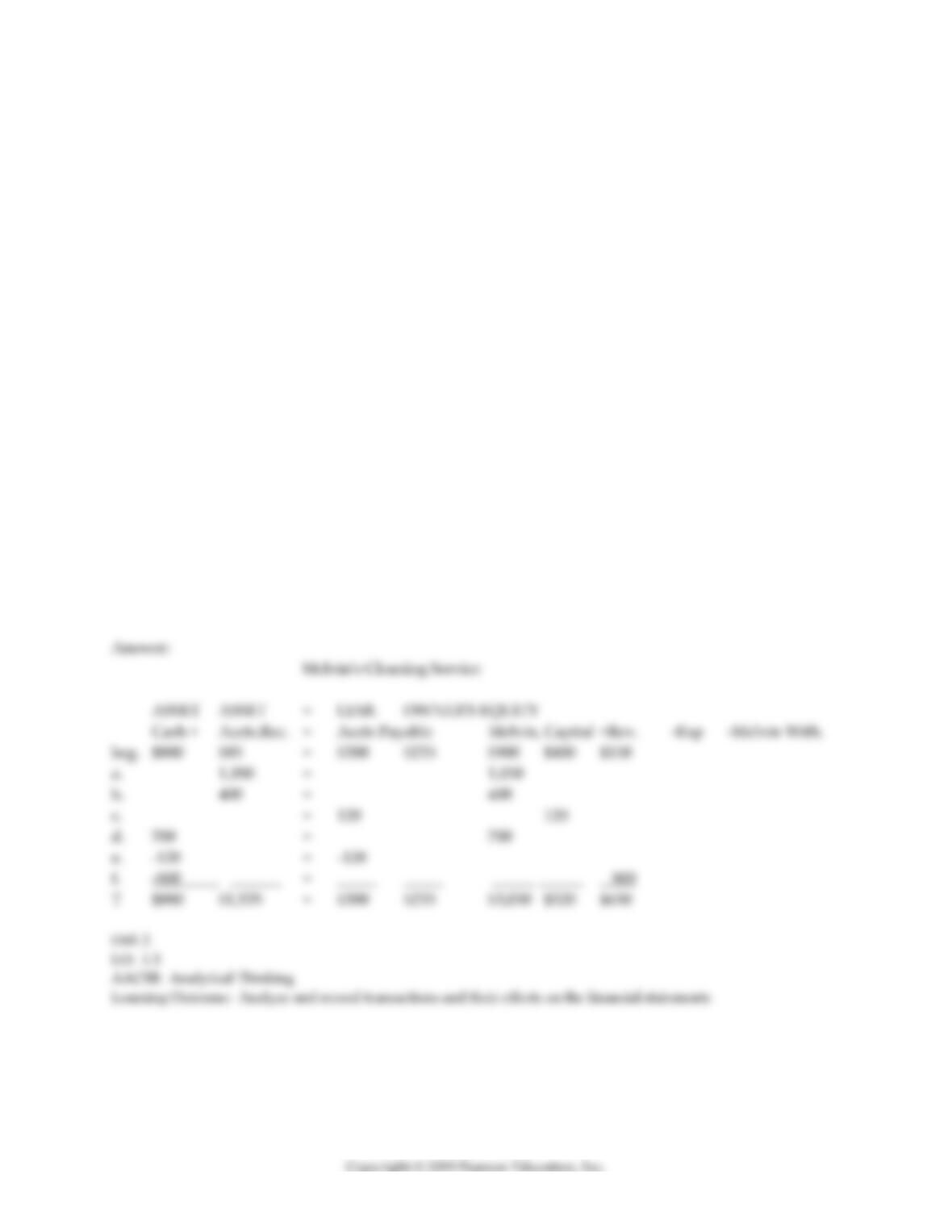
41) Melvin’s Cleaning Service completed the following transactions:
a. Billed clients for service, $1,050.
b. Completed work for clients $400 on account.
c. Received a bill for utilities to be paid later, $120.
d. Collected $700 cash for services performed.
e. Paid the amount due for utilities.
f. Withdrew $500 cash for personal use.
Required: Record the above transactions in the expanded accounting equation. Note that the items have
beginning balances.
Melvin’s Cleaning Service
ASSET ASSET = LIAB. OWNER’S EQUITY
Cash + Accts.Rec. = Accts Payable Melvin, Capital +Rev. -Exp -Melvin With.
beg. $800 $85 = $300 $235 $900 $400 $150
a.
b.
c.
d.
e.
f.
T
1.4 Learning Objective 1-4
1) The increase or decrease in Cash is reported on the:
A) income statement.
B) statement of Owner‘s Equity.
C) balance sheet.
D) All of these are correct.
2) Which financial statement is prepared last?
A) Statement of Owner’s Equity
B) Balance Sheet
C) Income Statement
D) None of the above
3) The financial statement that shows business results in terms of Revenue and Expenses is:
A) Customer Statement.
B) a balance sheet.
C) a statement of Owner’s Equity.
D) None of the above.
4) An accounting report that shows the changes in capital during the accounting period is:
A) a balance sheet.
B) an income statement.
C) a statement of Owner’s Equity.
D) All of these answers are correct.
5) Which of the following items are on both the balance sheet and the statement of Owner’s Equity?
A) Net loss
B) Capital
C) Additional owner’s investments
D) Owner’s withdrawals
6) Which account is NOT included in the asset section of the balance sheet?
A) Supplies
B) Utility Expense
C) Land
D) Computer
7) The income statement is a financial statement showing the change in owners‘ equity.
8) The statement of Owner’s Equity shows the change in Revenue.
9) The statement of Owner’s Equity shows the beginning and the ending capital balance.
10) Total Liabilities are included in the statement of Owner’s Equity.
11) The statement of Owner’s Equity is the link between the income statement and balance sheet.
12) The income statement is completed before the statement of Owners’ Equity.
13) Determine the ending capital balance of a business which had a beginning capital balance of $2,950,
additional investments of $500, withdrawals of $750, Revenue of $3,800, and Expenses of $2,600.
$ ________
14) Determine the beginning capital balance of a business having an ending capital balance of $10,800, no
additional investments, withdrawals of $2,600, and a net income of $4,700.
$ ________
15) Given the following account balances, determine the total Liabilities. Cash $520, Accounts Receivable
$280, supplies $300 and Capital $500.
$ ________
16) Calculate the Total Liabilities if the company has: Assets totaling $600 and Capital of $450.
$ ________

17) Calculate the Total Assets if the company has: Cash $400, Accounts Receivable $200, Accounts
Payable $500, Equipment $300.
$ ________
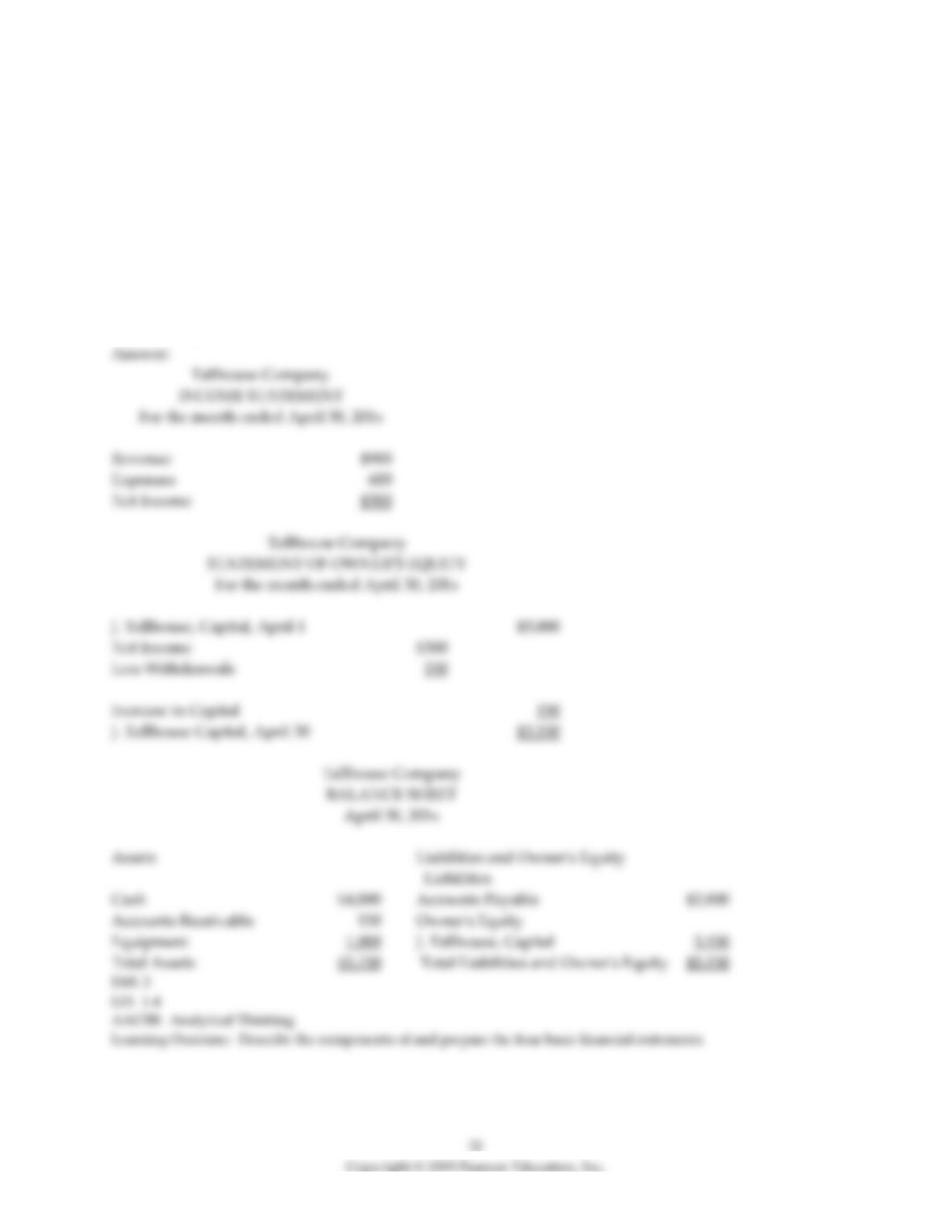
18) Use the following information to prepare 1) an income statement, 2) a statement of Owner’s Equity,
and 3) a balance sheet for the month ended April 30, 201x for Tallhouse Company.
J. Tallhouse, Capital (beg.) $3,000
Revenue 1000
Expenses 300
Withdrawals 150
Cash 4,000
Equipment 1,000
Accounts Receivable 150
Accounts Payable 2,000
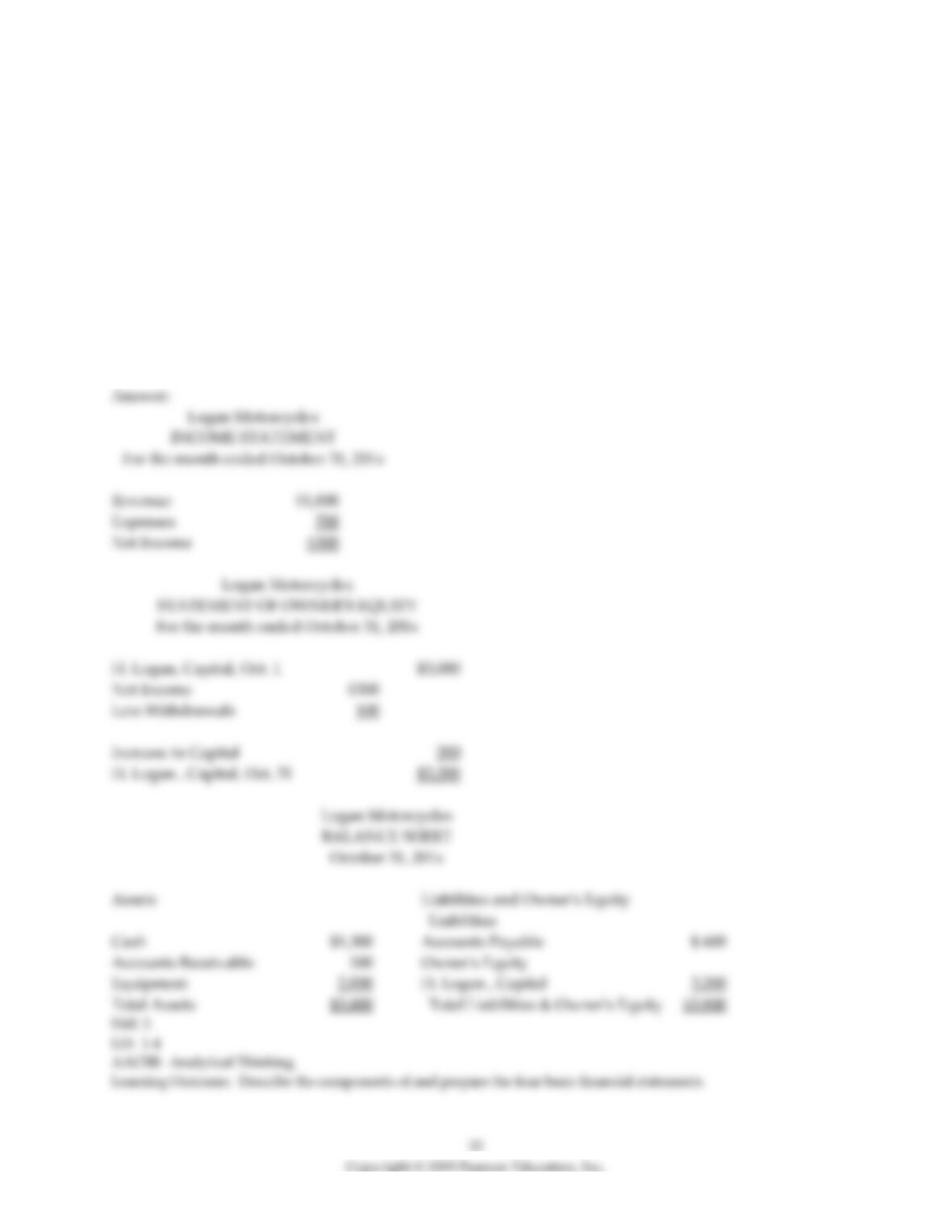
19) Prepare the financial statements for H. Logan of Logan Motorcycles from the following account
balances: 1) an income statement, 2) a statement of Owner’s Equity, and 3) a balance sheet for the month
ended October 31, 201x. You will need to calculate the value of the Accounts Payable account (note:
remember the basic accounting equation).
Cash $1,300
Accounts Receivable 500
Equipment 2,000
Accounts Payable ???
Travis, Capital 3,000
Revenue 1,000
Expenses 700
Travis, Withdrawal 100