c.
decrease by $16,000.
d.
increase by $42,000.
52. Palm Textile Corporation had the following balance sheet accounts and balances:
Accounts Payable
$12,000
Common Stock
?
Accounts Receivable
2,000
Equipment
$14,000
Building
?
Land
14,000
Cash
6,000
Retained Earnings
4,000
If the balance of the Common Stock account were $59,000, what would be the balance of the Building
account?
a.
$29,000
b.
$71,000
c.
$63,000
d.
$39,000
53. Palm Textile Corporation had the following balance sheet accounts and balances:
Accounts Payable
$12,000
Common Stock
?
Accounts Receivable
2,000
Equipment
$14,000
Building
?
Land
14,000
Cash
6,000
Retained Earnings
4,000
If the balance of the Building account were $53,000, what would be the total of liabilities and
stockholders’ equity?
a.
$53,000
b.
$89,000
c.
$83,000
d.
$73,000
54. Palm Textile Corporation had the following balance sheet accounts and balances:
Accounts Payable
$12,000
Common Stock
?
Accounts Receivable
2,000
Equipment
$14,000
Building
?
Land
14,000
Cash
6,000
Retained Earnings
4,000
If the balance of the Building account were $30,000 and if the equipment were sold for $14,000 cash,
what would be the total of stockholders’ equity?
a.
$54,000
b.
$32,000
c.
$30,000
d.
$66,000
55. Palm Textile Corporation had the following balance sheet accounts and balances:
Accounts Payable
$12,000
Common Stock
?
Accounts Receivable
2,000
Equipment
$14,000
Building
?
Land
14,000
Cash
6,000
Retained Earnings
4,000
If the balance of the Building account were $28,000 and $6,000 of Accounts Payable were paid in
cash, what would be the balance of the Common Stock account?
a.
$48,000
b.
$42,000
c.
$64,000
d.
$68,000
56. Palm Textile Corporation had the following balance sheet accounts and balances:
Accounts Payable
$12,000
Common Stock
?
Accounts Receivable
2,000
Equipment
$14,000
Building
?
Land
14,000
Cash
6,000
Retained Earnings
4,000
If the balance of the Building account were $16,000 and $6,000 of Accounts Payable were paid in
cash, what would be the total liabilities and stockholders’ equity?
a.
$28,000
b.
$46,000
c.
$36,000
d.
$38,000
57. Which of the following is a regulatory agency?
a.
International Accounting Standards Board (IASB)
b.
Securities and Exchange Commission (SEC)
c.
Financial Accounting Standards Board (FASB)
d.
Governmental Accounting Standards Board (GASB)
58. The most important body for developing rules on accounting practice is currently the
a.
Governmental Accounting Standards Board (GASB).
b.
Financial Accounting Standards Board (FASB).
c.
Public Company Accounting Oversight Board (PCAOB).
d.
Internal Revenue Service (IRS).
59. Generally accepted accounting principles (GAAP)
a.
are changing continually.
b.
are sound in theory but rarely used in practice.
c.
have eliminated all the weaknesses in accounting practice.
d.
are accounting rules formulated by the Internal Revenue Service (IRS).
60. Standards for state and local governments are established by the
a.
Securities and Exchange Commission (SEC).
b.
Financial Accounting Standards Board (FASB).
c.
Governmental Accounting Standards Board (GASB).
d.
Public Company Accounting Oversight Board (PCAOB).
61. The purpose of an audit is to
a.
determine whether or not a company is a good investment.
b.
comply with income tax regulations.
c.
determine whether or not a company is a good credit risk.
d.
ascertain that the financial statements follow Generally Accepted Accounting Principles
(GAAP).
62. An auditor is impartial and intellectually honest. The principle being followed is
a.
independence.
b.
integrity.
c.
objectivity.
d.
due care.
63. Carrying out professional responsibilities with competence and diligence is called
a.
integrity.
b.
independence.
c.
objectivity.
d.
due care.
64. Which of the following is one of the broad principles underlying the accountant’s code of professional
ethics?
a.
Certification
b.
Integrity
c.
Loyalty
d.
Trust
65. The development of international accounting standards is the primary function of the
a.
Internal Revenue Service (IRS).
b.
American Institute of Certified Public Accountants (AICPA).
c.
International Accounting Standards Board (IASB).
d.
Public Company Accounting Oversight Board (PCAOB).
66. The Public Company Accounting Oversight Board (PCAOB) was created by the
a.
Sarbanes-Oxley Act.
b.
American Institute of Certified Public Accountants (AICPA).
c.
Financial Accounting Standards Board (FASB).
d.
International Accounting Standard Board (IASB).
SHORT ANSWER
1. Distinguish between profitability and liquidity.
2. List the input(s), the major process(es), and the output(s) of an accounting system.
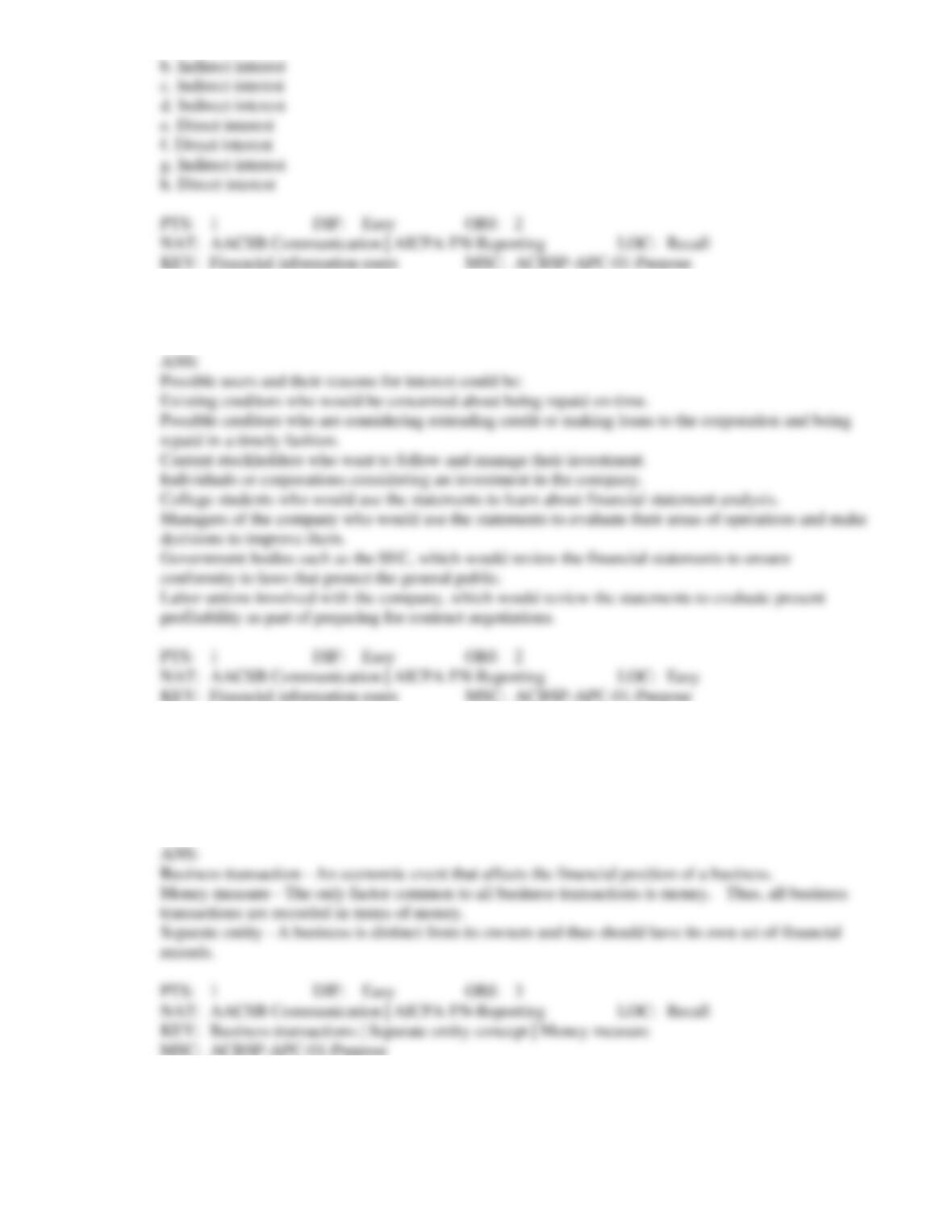
3. State whether each of the following users of financial statements has a direct or an indirect financial
interest in the financial statements.
a. Local taxing authority
b. Financial advisors
c. Customers
d. Governmental regulatory agency
e. Existing creditor
f. Potential investor
g. Economic planners
h. Potential creditor
4. List five possible users of financial statements and state what each would be interested in learning
from its review.
5. Define the following terms:
Business transactions
Money measure
Separate entity
6. Tell whether each of the following words or phrases relates most closely to a business transaction, a
separate entity, or a money measure.
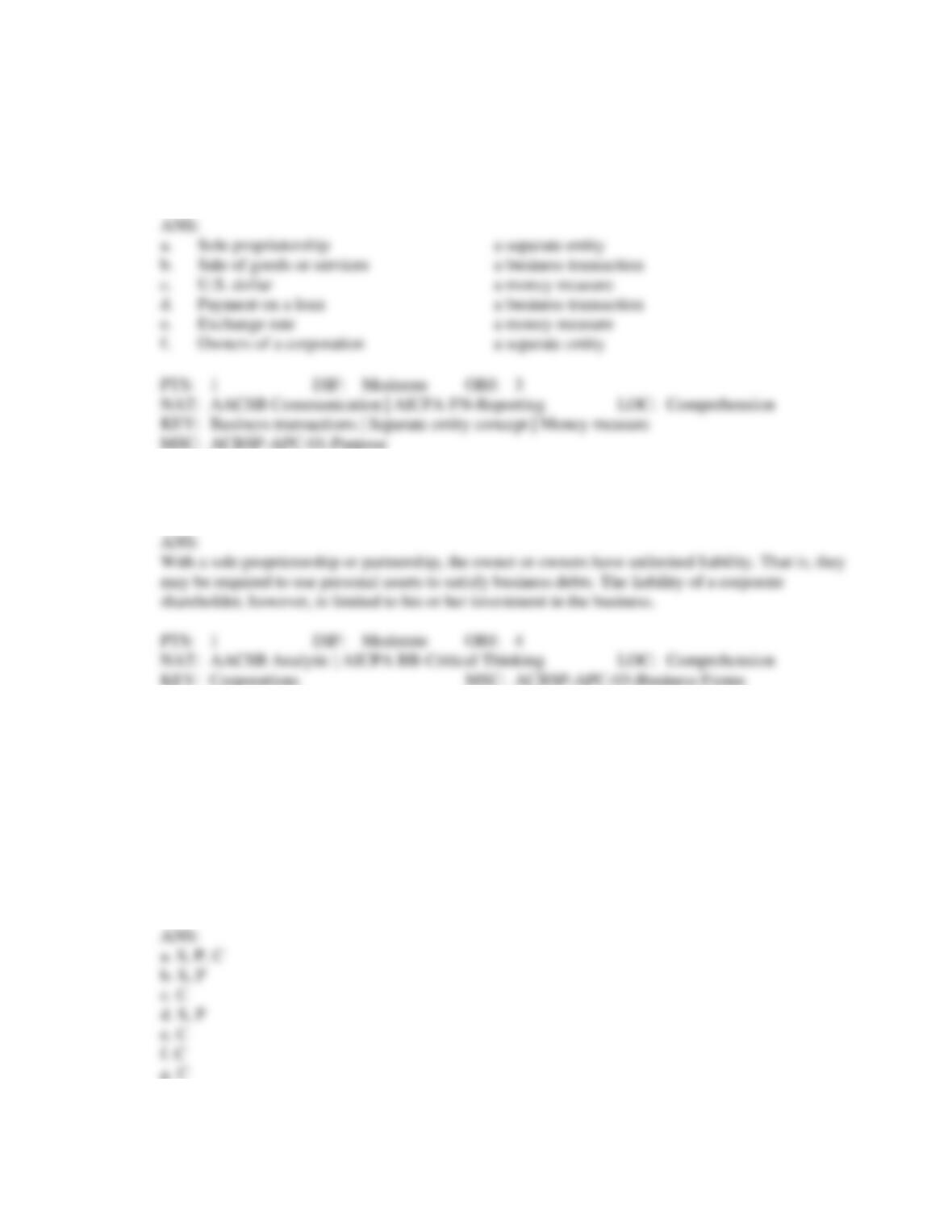
a.
Sole proprietorship
b.
Sale of goods or services
c.
U.S. dollar
d.
Payment on a loan
e.
Exchange rate
f.
Owners of a corporation
7. Why would it be less risky for a wealthy individual to incorporate his or her business rather than to
operate it as a sole proprietorship or partnership?
8. Indicate by letter whether each statement below applies to a sole proprietorship (S), partnership (P), or
corporation (C). You may use more than one business organization for an answer.
________ a. Separate economic unit
________ b. Life limited by death of owner(s)
________ c. Separate legal entity
________ d. Unlimited liability of owner(s)
________ e. Separation of ownership and control
________ f. Transfer of ownership does not affect the continuity of business.
________ g. Ownership evidenced by stock certificates
a.
Sole proprietorship
a separate entity
b.
Sale of goods or services
a business transaction
c.
U.S. dollar
a money measure
d.
Payment on a loan
a business transaction
e.
Exchange rate
a money measure
f.
Owners of a corporation
a separate entity
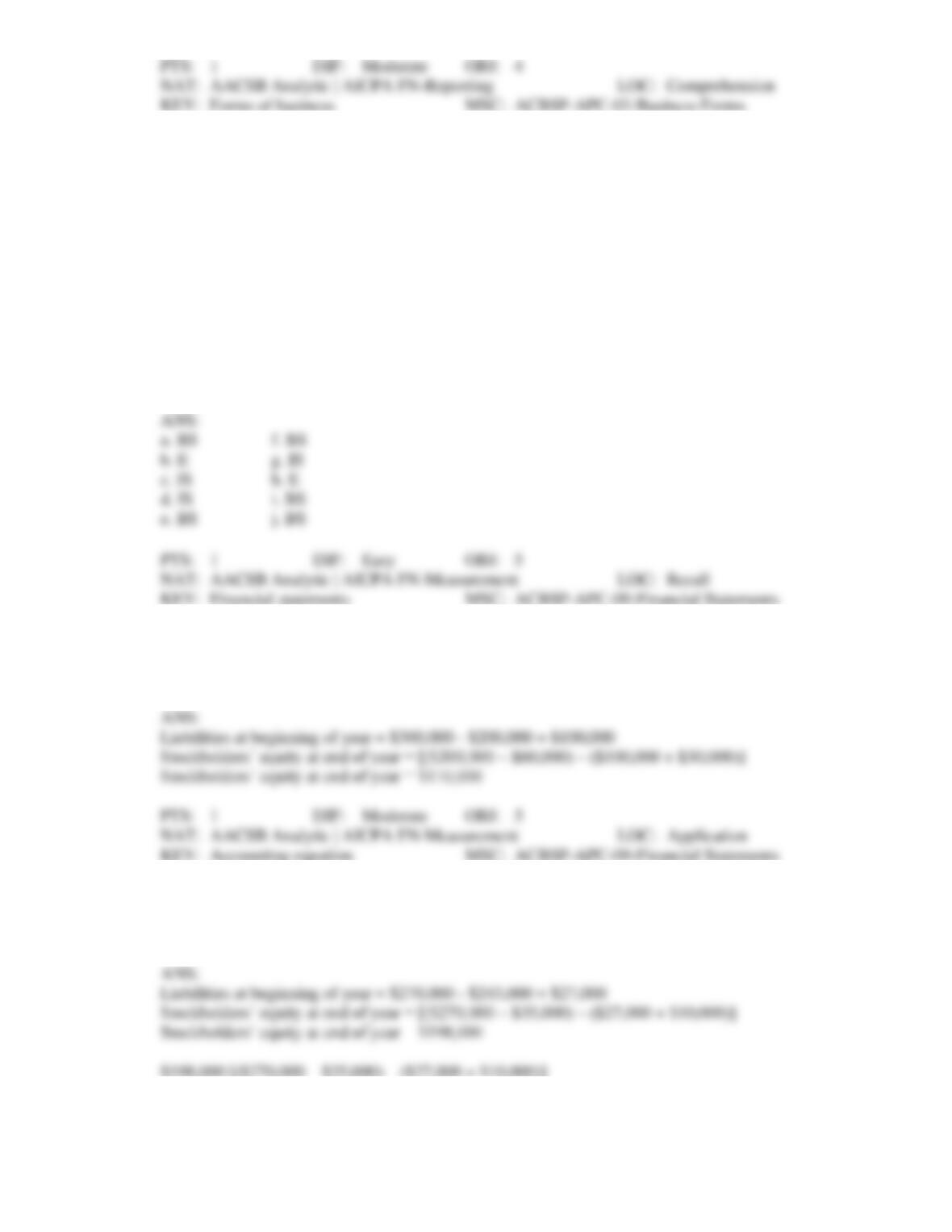
9. Indicate by letter whether each item below would appear on the income statement (IS), balance sheet
(BS), or statement of retained earnings (E).
________ a. Common Stock
________ b. Dividends
________ c. Wages Expense
________ d. Commissions Earned
________ e. Buildings
________ f. Accounts Payable
________ g. Utilities Expense
________ h. Beginning Retained Earnings
________ i. Accounts Receivable
________ j. Notes Payable
10. At the beginning of the year, Catoosa Corporation’s assets were $300,000 and its stockholders’ equity
was $200,000. During the year, assets decreased $60,000 and liabilities increased $30,000. What was
the stockholders’ equity at the end of the year?
11. At the beginning of the year, Fourman Corporation’s assets were $270,000 and its stockholders’ equity
was $243,000. During the year, assets decreased $35,000 and liabilities increased $10,000. What was
the stockholders’ equity at the end of the year?
12. Which three types of transactions affect retained earnings, and how do they affect it?
13. How does the statement of retained earnings relate to the income statement and the balance sheet?
14. Barrett Company’s stockholders’ equity equals one-fourth of the company’s total assets. The company’s
liabilities are $360,000. What is the amount of the company’s stockholders’ equity?
15. Cochran Corporation’s stockholders’ equity equals one-third of the company’s total assets. The
company’s liabilities are $240,000. What is the amount of the company’s stockholders’ equity?
16. Barrow Corporation’s stockholders’ equity equals one-half of the company’s total assets. The
company’s liabilities are $346,000. What is the amount of the company’s stockholders’ equity?
17. What is the responsibility of the auditing firm? Who is responsible for the content of the financial
statements?
18. What is independence, and why is it important for a Certified Public Accountant (CPA) to maintain it
when conducting an audit?
MATCHING
Match each definition with the correct term below.
a.
The group of people who are responsible for ensuring that a company meets its goals of
profitability and liquidity.
b.
A unit of ownership in a corporation.
c.
The inflows and outflows of cash into and out of a business.
d.
An information system that measures, processes, and communicates financial information
about an economic entity.
e.
A set of practices that has been developed to provide guidelines for financial accounting.
f.
The value of one currency in terms of another.
g.
The government body that regulates the issuing, buying, and selling of stocks in the
United States.
h.
The ability to earn enough income to attract and hold investment capital.
i.
The oversight of a corporation’s management and ethics by its board of directors.
j.
The accumulated earnings generated by a business’s income-producing activities less
amounts that have been paid out to the stockholder’s.
k.
Economic events that affect a business’s financial position.
l.
An examination of a company’s financial statements and the accounting systems, controls,
and records that produced them.
1. Accounting
2. Management
3. Cash flows
4. Securities and Exchange Commission
5. Corporate governance
6. Business transactions
7. Exchange rate
8. Profitability
9. Audit
10. Generally Accepted Accounting Principles
11. Retained earnings
12. Share of stock
PROBLEM
1. State whether the following business activities are an operating activity, an investing activity or a
financing activity.
Business Activity
Type of Activity
1.
Hiring employees
2.
Purchasing land
3.
Obtaining a loan from a bank
4.
Paying off a loan
5.
Selling equipment
6.
Selling goods and services
7.
Issuing stock
8.
Paying taxes
Business Activity
Type of Activity
1.
Hiring employees
Operating
2.
Purchasing land
Investing
3.
Obtaining a loan from a bank
Financing
4.
Paying off a loan
Financing
5.
Selling equipment
Investing
6.
Selling goods and services
Operating
7.
Issuing stock
Financing
8.
Paying taxes
Operating
2. Explain why each of the following persons or groups would be interested in seeing the financial
statements of a company. Also state whether each has a direct or indirect financial interest.
a. Potential investor
b. Internal Revenue Service
c. A labor union
d. Securities and Exchange Commission
e. Potential creditor
f. Management
g. Economic planners
3. How do the balance sheets of corporations illustrate the accounting concept of separate entity?
4. In which form of business does CVS operate? List two places where this would be revealed in the
financial statements.
5. Glascock Corporation had a balance in Retained Earnings on December 31, 2012, of $520,000. During
2013, the company reported a net income of $224,000 after taxes. During 2013, the company declared
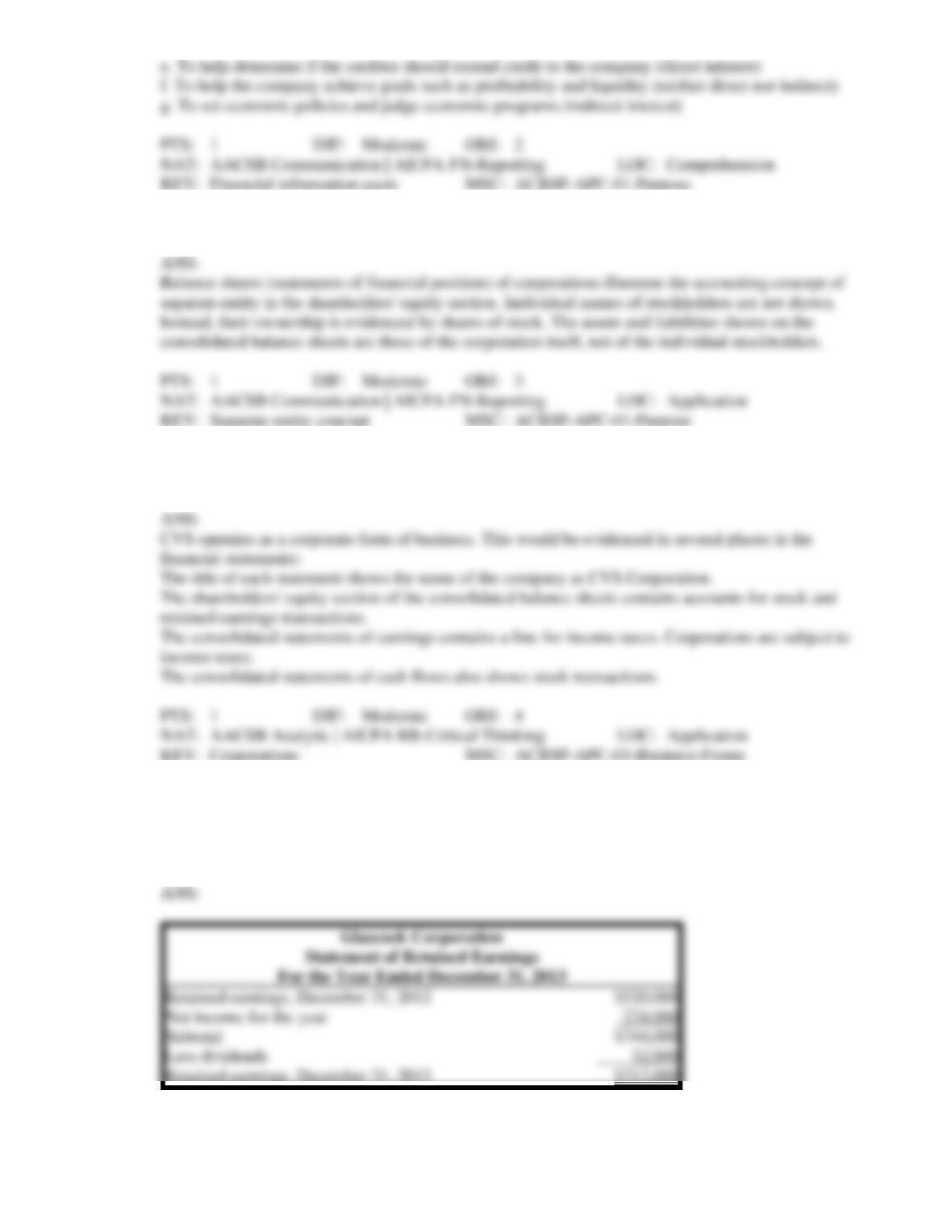
and paid cash dividends totaling $32,000. Prepare the company’s statement of retained earnings for the
year ended December 31, 2013.
6. Lin Wo Corporation had a balance in Retained Earnings on December 31, 2012, of $360,000. During
2013, the company reported a net income of $24,000 after taxes. During 2013, the company declared
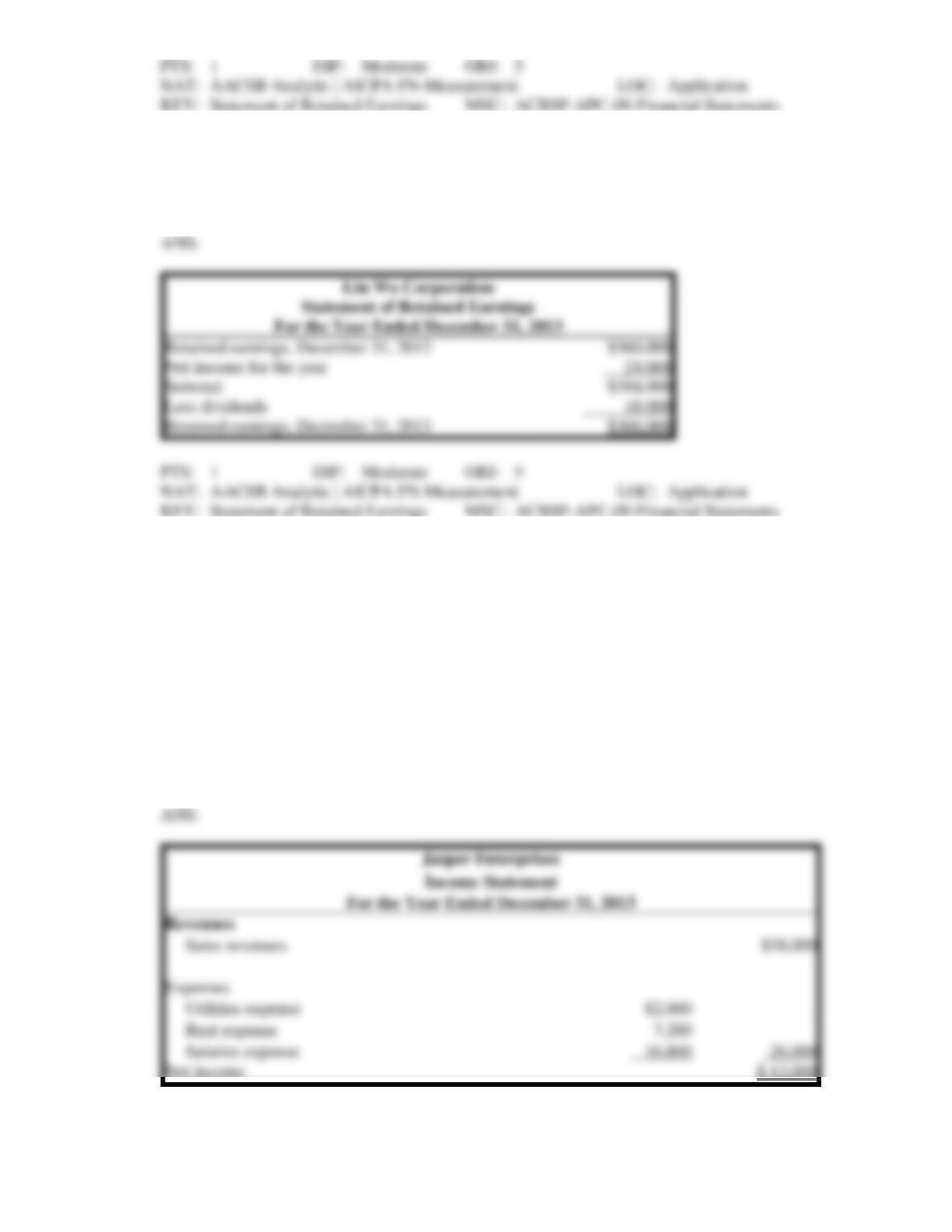
and paid cash dividends totaling $18,000. Prepare the company’s statement of retained earnings for the
year ended December 31, 2013.
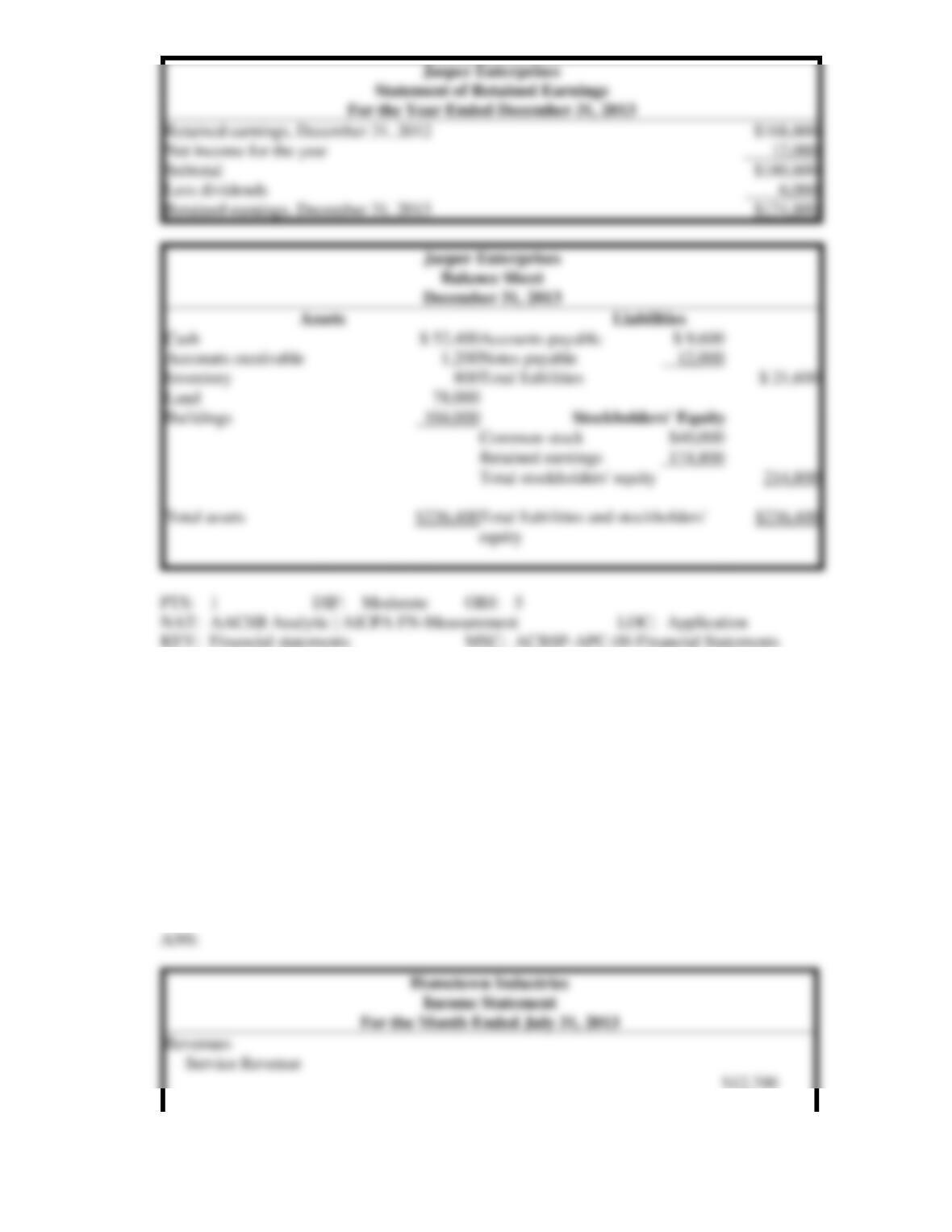
7. Use the following accounts and information to prepare, in good form, an income statement, statement
of retained earnings, and balance sheet for Jasper Enterprises for the year ended December 31, 2013.
Accounts Payable
$9,600
Land
$78,000
Accounts Receivable
1,200
Notes Payable
12,000
Buildings
104,000
Rent Expense
7,200
Cash
52,400
Retained Earnings,
December 31, 2012
168,800
Sales Revenues
38,000
Salaries Expense
16,800
Common Stock
40,000
Inventory
800
Dividends
6,000
Utilities Expense
2,000
Salaries expense
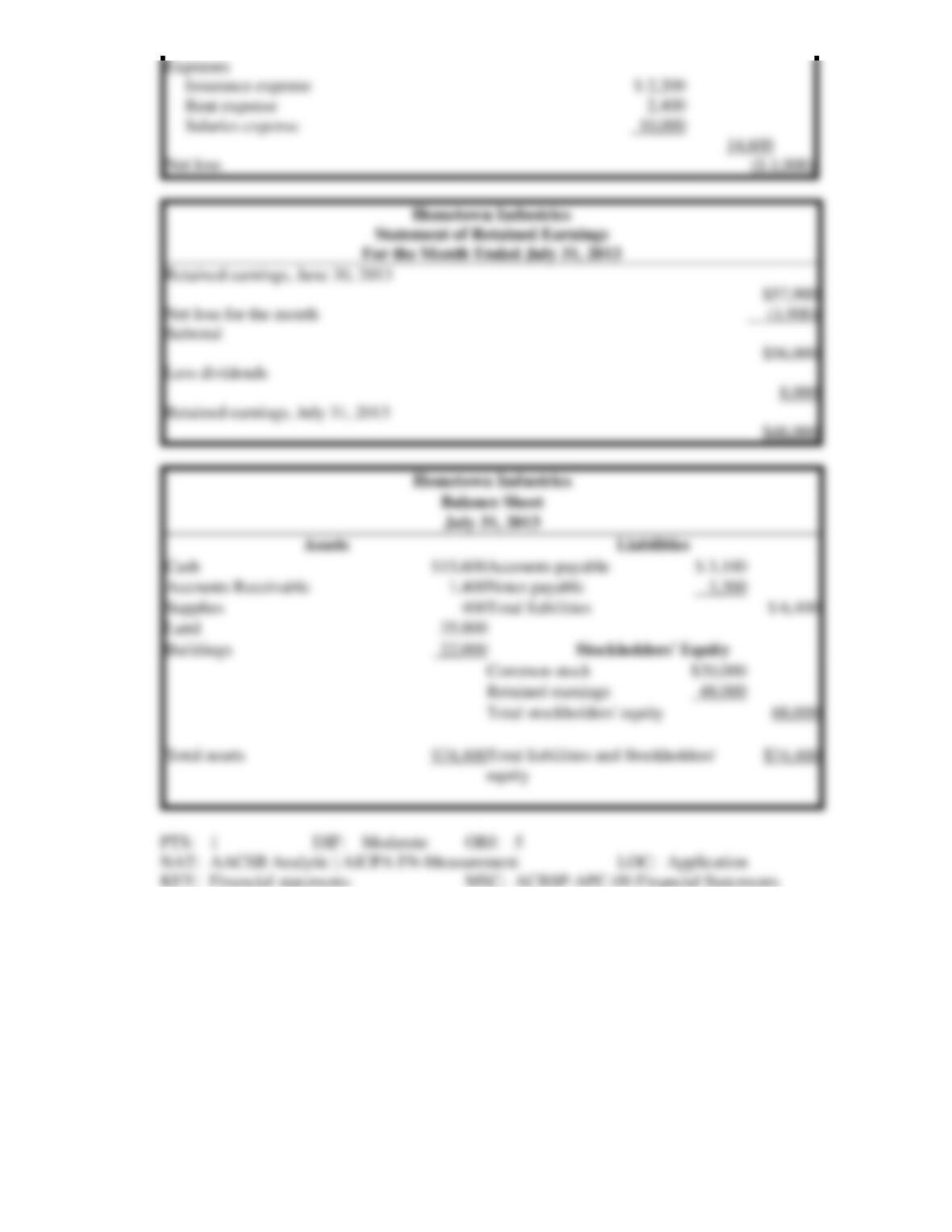
8. Use the following accounts and information to prepare, in good form, an income statement, statement
of retained earnings, and balance sheet for Hometown Industries for the month ended July 31, 2013.
Accounts Payable
$3,100
Land
$35,000
Accounts Receivable
1,400
Notes Payable
3,300
Buildings
22,000
Rent Expense
2,400
Cash
15,600
Retained Earnings, June
30, 2013
57,900
Service Revenue
12,700
Salaries Expense
10,000
Common Stock
20,000
Supplies
400
Dividends
8,000
Insurance Expense
2,200
Revenues
Retained earnings, December 31, 2012
Net income for the year
Subtotal
Less dividends
Cash
Accounts payable
Accounts receivable
Notes payable
Inventory
Total liabilities
Total assets
Total liabilities and stockholders’
9. Use the following information to calculate at, or for the year ended, December 31, 2013 (a) net
income, (b) retained earnings, (c) total liabilities and stockholders’ equity, and (d) accounts receivable.
Supplies
$ 2,000
Cash
$64,000
Wages Expense
28,000
Dividends
32,000
Accounts Payable
44,000
Notes Payable
8,000
Retained Earnings, December 31,
2012
16,000
Patents
14,000
Retained Earnings,
December 31, 2013
?
Expenses
Retained earnings, June 30, 2013
Net loss for the month
Subtotal
Less dividends
Total assets
Total liabilities and Stockholders’
Accounts Receivable
?
Rent Expense
12,000
Common Stock
40,000
Sales Revenue
60,000
10. Use the following information to calculate at, or for the year ended, December 31, 2013, (a) net
income, (b) retained earnings, (c) total assets, and (d) cash.
Salaries Expense
$4,000
Sales Revenue
$20,000
Accounts Payable
7,000
Retained Earnings, December 31,
2013
?
Dividends
6,000
Utilities Expense
2,000
Accounts Receivable
8,000
Retained Earnings, December 31,
2012
16,000
Inventories
22,000
Common Stock
10,000
Cash
?
Salaries Payable
1,000
11. Use the following accounts and balances to prepare a balance sheet for Paulding Company at
December 31, 2013.
Accounts Payable
$20,000
Common Stock
24,000
Cash
9,600
Retained Earnings, Dec. 31, 2013
4,800
Equipment
26,400
Accounts Receivable
12,800
12. Following are the total assets and liabilities at the beginning and end of the year for Maren
Corporation:
Assets
Liabilities
Beginning of the year
$70,000
$45,000
End of the year
130,000
40,000
Determine the net income or loss for the year in each of the following situations:
a. The stockholders made no investments in the business and no dividends were paid during the year.
b. The stockholders made an investment of $20,000 and a dividend of $12,000 was paid during the
year.
13. Selected amounts from the condensed financial statements of Timson Corporation for 2012 and 2013
are presented below with several amounts missing. The 2011 year-end balance of retained earnings is
$82,883.
Income Statement
2013
2012
Revenues
$490,304
$
(a)
Costs and expenses
(h)
(501,295)
Income taxes
(853)
(3,603)
Net income
$__ (i)
$ _ _(b)
Total assets
Total liabilities and stockholders’
Statement of Retained Earnings
Beginning-of-year balance
$ (j)
$ (c)
Net income
3,747
(d)
Dividends
(k)
(3,845)
End-of-year balance
$ (l)
$_ _ (e)
Balance Sheet
Total assets
$ (m)
$246,481
Total liabilities
$110,192
$102,239
Common stock
57,968
56,800
Retained earnings
(n)
$ (f)
Total liabilities and stockholders’ equity
$255,473
$ (g)
a. Determine the missing amounts indicated by the letters. (Hint: You should not try to find them in
alphabetical order.)
b. Given the data presented, did the company’s profitability improve from 2012 to 2013?
14. Following are the definitions of several accounting organizations. For each definition, list the name of
the corresponding organization.
a. Responsible for interpreting and enforcing tax laws
Income Statement
Revenues
$490,304
(a)
Costs and expenses
(h)
Income taxes
(3,603)
Net income
(b)
Statement of Retained Earnings
Beginning-of-year balance
(c)
Net income
3,747
(d)
Dividends
(k)
End-of-year balance
(e)
Balance Sheet
Total assets
(m)
Total liabilities
Common stock
57,968
56,800
Retained earnings
87,313
(n)
87,442
Total liabilities and stockholders’ equity
(g)
b.. Establishes standards for state and local governments
c. Developer of international accounting standards
d. Consists mainly of industrial accountants
e. Protector of the investing public
f. Current authoritative body for developing GAAP
g. The accounting profession’s main organization of certified public accountants