
1-156
transactions on the accounts of the accounting equation by recording increases and
decreases in the appropriate columns in the table below. Do not determine new account
balances after each transaction. Determine the final total for each account and verify that
the equation is in balance.
May
1
S. Verity invested $90,000 cash in the
company.
2
The company purchased $25,000 in office
equipment. It paid $10,000 in cash and
signed a note payable promising to pay
the $15,000 over the next three years.
2
The company rented office space and paid
$3,000 for the May rent.
6
The company installed new vinyl siding for
a customer and immediately collected
$5,000.
7
The company paid a supplier $2,000 for
siding materials used on the May 6 job.
8
The company purchased a $2,500 copy
machine for office use on credit.
9
The company completed work for
additional customers on credit in the
amount of $16,000.
15
The company paid its employees’ salaries
$2,300 for the first half of the month.
17
The company installed new siding for a
customer and immediately collected
$2,400.
20
The company received $10,000 in
payments from the customers billed on
May 9.
28
The company paid $1,500 on the copy
machine purchased on May 8. It will pay
the remaining balance in June.

1-157
31
The company paid its employees’ salaries
$2,400 for the second half of the month.
31
The company paid a supplier $5,300 for
siding materials used on the remaining
jobs completed during May.
31
The company paid $450 for this month’s
utility bill.
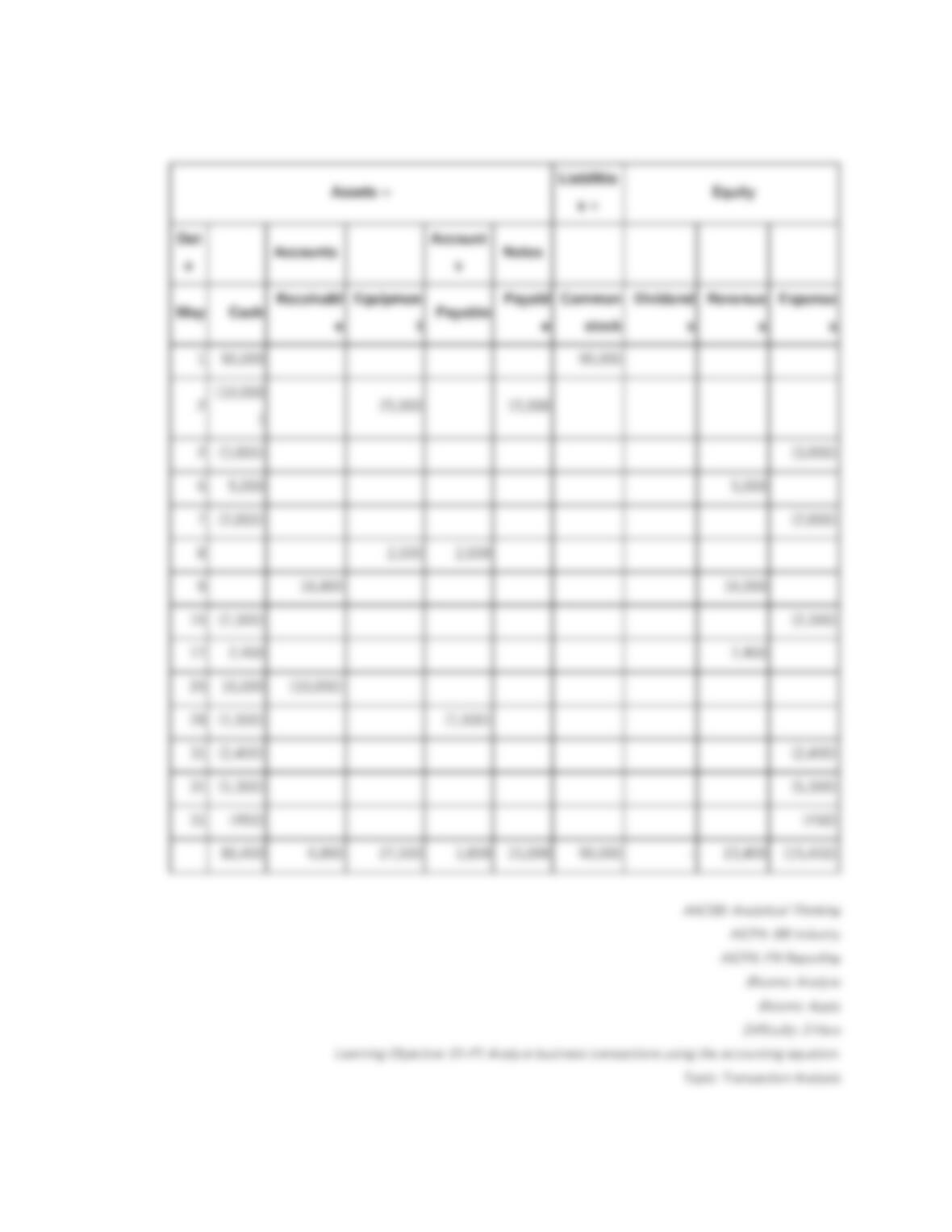
VERITY SIDING CO.
Assets =
Liabilities
+
Equity
Date
Accounts
Accounts
Notes
May
Cash
Receivable
Equipment
Payable
Payable
Common
stock
Dividends
Revenues
Expenses
1
2
2
6
7
8
9
15
17
20
28
31
31
31
$-
$-
$-
$-
$-
$-
$-
$-
$-
1-158
Fill in the Blank Questions
248.
__________________ is an information and measurement system that identifies, records
and communicates relevant, reliable and comparable information about an organization’s
economic activities.
249.
A ____________________ is a business that is owned by only one person.
250.
______________ users of accounting information are not directly involved in running the
organization.
251.
______________ is the area of accounting aimed at serving external users by providing
them with general-purpose financial statements.
252.
Congress passed the ______________________ to help curb financial abuses at companies
that issue their stock to the public.
Topic: Generally Accepted Accounting Principles
253.
_________ are beliefs that separate right from wrong and are considered accepted
standards of good and bad behavior.
254.
The assumption that requires that a business be accounted for separately from its owners
is the __________________ assumption.
255.
The _______________ principle requires that financial information is supported by
independent, unbiased evidence.
256.
The ______________ assumption assumes business will continue operating indefinitely
instead of being closed or sold.
257.
The ________________ assumption states that transactions and events are expressed in
money units.
258.
In accounting, the rule that requires that assets, services, and liabilities be recorded
initially at the cash or cash-equivalent value of what was given up or of the item received
is called the ________________________.
259.
A disadvantage of a sole proprietorship is the fact that the owner has ______________.
260.
There are at least three types of partnerships that limit the partners’ liability. They are 1)
_____________________, 2) ___________________, and 3) ______________________.
261.
There are three major types of business activities. ________________ activities are the
means organizations use to pay for resources such as land, building, and equipment to
carry out plans.
262.
There are three major types of business activities. ________________ activities involve the
acquisition and disposal of resources that an organization uses to acquire and sell its
products or services.
263.
There are three major types of business activities. ______________ activities involve using
resources to research, develop, purchase, produce, distribute, and market products and
services and receiving amounts from selling products and services.
264.
Resources such as cash removed from the business by the business owner for personal
use are called ____________.
265.
____________ are the increases in equity from a company’s sales of products and services
to customers.
266.
A common characteristic of __________ is their ability to yield expected future benefits to a
business.
267.
Creditors’ claims on assets that reflect company obligations to provide assets, products, or
services to others are called ____________________.
268.
The stockholders’ claim on assets, also known as net assets, is called
__________________.
269.
The accounting equation is ______________________________.
270.
The term ___________ refers to a liability that promises a future outflow of resources.
271.
Using the accounting equation, equity is equal to ________________________.
272.
______________________, which is one part of accounting, is the recording of transactions
and events, either manually or electronically.
273.
_________________ is net income divided by average total assets.
274.
Risk is the _________________ about the return an investor expects to earn.
275.
________________________________ explains changes in the stockholders’ claim on the
business’s assets from net income or loss, and dividends over a period of time.
276.
The ____________________ describes a company’s revenues and expenses along with the
resulting net income or net loss over a period of time due to earnings activities.
277.
____________________ is the process undertaken in recent years by the FASB and IASB
aimed at reducing inconsistencies between U.S. GAAP and IFRS.