
Chapter 1: The Role of Accounting in Business
78. Expressing financial data as if a business will continue operating for an indefinite period time
refers to which concept?
a. Business entity concept
b. Going concern concept
c. Objectivity concept
d. Adequate disclosure concept
79. Due to various fraudulent business practices and accounting coverups in the early 2000s,
Congress enacted the Sarbanes-Oxley Act of 2002. The act was responsible for establishing a
new oversight board for public accountants called the:
a. Generally Accepted Accounting Practices for Public Accountants Board.
b. Public Company Accounting Oversight Board.
c. Congressional Accounting Oversight Board.
d. Financial Accounting Standards Board.
80. Which of the following is true of rate of return on assets?
a. It is a measure of a company’s profitability.
b. It is used to evaluate a company’s ability to pay off its shortterm debts.
c. It is used to determine the financial leverage of a company.
d. It is a measure of the optimum capital structure.
81. The return on assets is calculated by .
a. dividing interest expense by average total asset and average current assets
b. dividing net income before taxes and interest expense by average total asset
c. dividing average total asset and interest expense by net income taxes
d. dividing net income before taxes and interest expense by average current assets
82. Return on assets of 4.25% implies:
a. $4.25 return on every $100 of total assets.
b. $4.25 return on every $100 of debt.
c. $4.25 return on every $100 of current assets.
d. $4.25 return on every $100 invested to purchase new assets.
Chapter 1: The Role of Accounting in Business
83. Profitability ratios such as can be used to analyze and assess a company’s financial
performance.
a. fixed assets turnover
b. current ratios
c. dividend payout ratios
d. return on assets
84. Name the three different types of businesses that operate for profit and their respective
characteristics.
85. Name and describe the three forms of businesses and their advantages and disadvantages (if
any).
Chapter 1: The Role of Accounting in Business
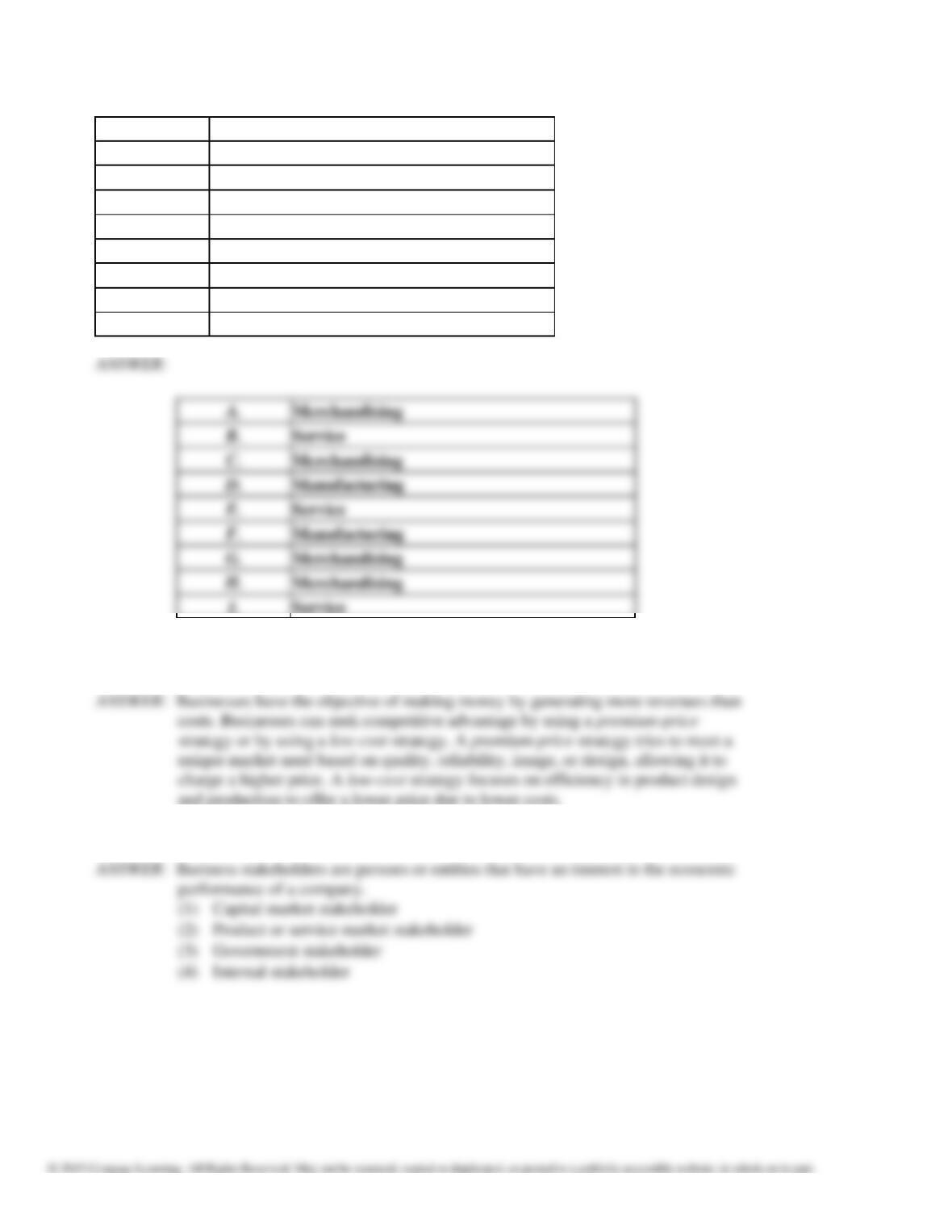
86. For each of the following companies, identify whether it is a service, merchandising, or
manufacturing business.
A.
Dillards
B.
Time Warner Cable
C.
Kohl’s
D.
Ford Motor Co.
E.
Applebee’s
F.
Sylvania
G.
Best Buy
H.
GAP
I.
H & R Block
A.
B.
Service
C.
Merchandising
D.
Manufacturing
E.
Service
F.
Manufacturing
G.
Merchandising
H.
Merchandising
I.
87. How do businesses make money? What strategies can they use to gain a competitive
advantage?
88. Describe business stakeholders. State the classification of business stakeholders.
Chapter 1: The Role of Accounting in Business
89. Indicate whether each of the following activities would be reported on the statement of cash
flows as an operating activity, an investing activity, a financing activity, or does not appear on
the statement of cash flows.
(a) Cash paid for building
(b) Cash paid to suppliers
(c) Cash paid for dividends
(d) Cash received from customers
(e) Cash received from the sale of capital stock.
(f) Cash received from the sale of a building
(g) Borrowed cash from a bank
90. Define accounting and its role in business.
91. What is the basic accounting equation, and which financial statement is prepared from this
equation?
Chapter 1: The Role of Accounting in Business
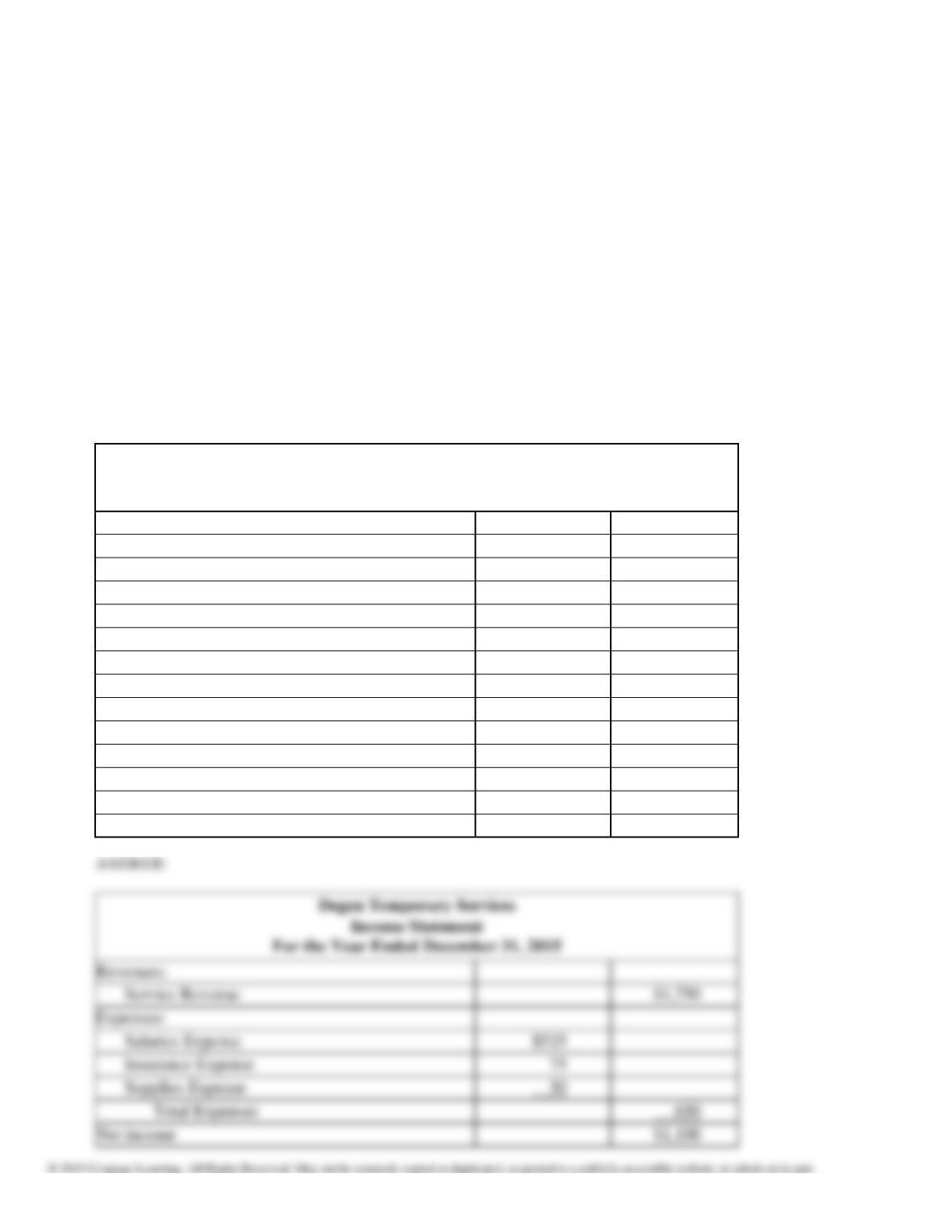
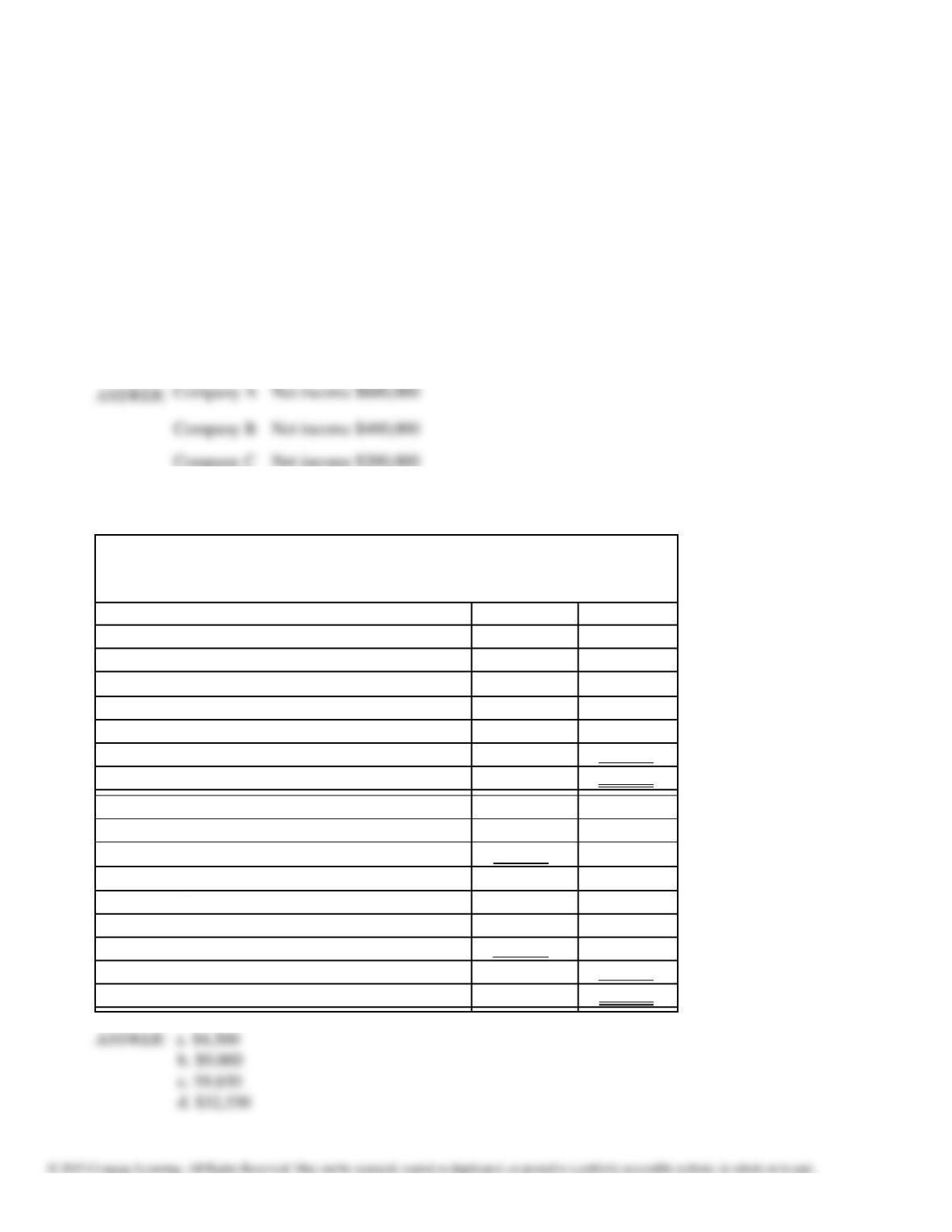
92. Following are the financial statement data for Degen Temporary Services at December 31,
2015. Prepare Degen’s income statement.
Accounts Payable
$ 850
Accounts Receivable
780
Cash
425
Common Stock
600
Dividends
200
Insurance Expense
75
Office Equipment
1,500
Retained Earnings, January 1, 2015
370
Salaries Expense
525
Notes Payable
40
Service Revenue
1,750
Inventory
35
Supplies Expense
50
Degen Temporary Services
Income Statement
For the Year Ended December 31, 2015
Income Statement
For the Year Ended December 31, 2015
Revenues:
Service Revenue
Expenses:
Salaries Expense
Insurance Expense
Chapter 1: The Role of Accounting in Business
93. Three different companies—A, B, and C—have the same balance sheet at the beginning and the
end of a year. These are summarized below:
Total
Total
Beginning of the year
$ 500,000
$250,000
End of the year
$1,200,000
$350,000
Given the data above and the additional information for each company below, determine the
net income (loss) for each company.
Company A No additional investment was made by stockholders, and no dividends
were paid.
Company B Stockholders invested an additional $200,000, and no dividends were paid.
Company C Stockholders invested $450,000, and dividends of $50,000 were paid.
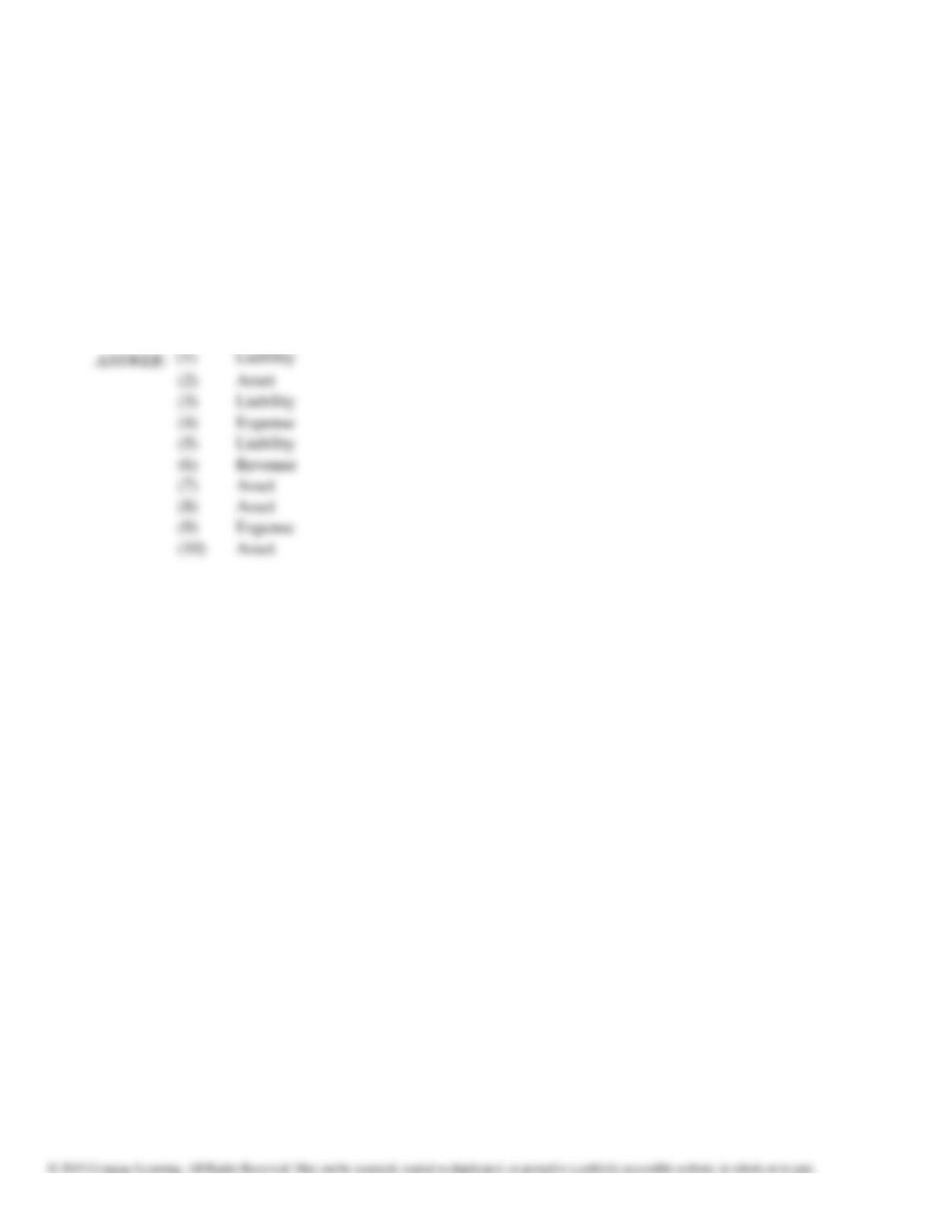
94. Fill in the missing amounts of the following balance sheet:
Prova Company
Balance Sheet
December 31, 2015
Assets
Cash
$ 3,300
Accounts Receivable
2,400
Supplies
(a)
Inventory
5,700
Equipment
7,400
Land
9,250
Total Assets
$32,550
Liabilities
Accounts Payable
$ 850
Notes Payable
(b)
Total Liabilities
$ (c)
Stockholders’ Equity
Common Stock
$18,500
Retained Earnings
4,200
Total Stockholders’ Equity
$22,700
Total Liabilities and Stockholders’ Equity
$ (d)
Chapter 1: The Role of Accounting in Business
95. Classify the following as an asset, liability, revenue, or expense.
(1) Unearned revenue
(2) Office equipment
(3) Wages payable
(4) Salary expense
(5) Dividends payable
(6) Art fees earned
(7) Prepaid rent
(8) Accounts receivable
(9) Income tax expense
(10) Office supplies
Chapter 1: The Role of Accounting in Business
96. Match the following items with the appropriate financial statement:
a. Income statement
b. Balance sheet
c. Retained earnings statement
d. Statement of cash flows
(1) Cash
(2) Salary expense
(3) Unearned revenue
(4) Depreciation expense
(5) Capital stock
(6) Cash flows from operating activities
(7) Accounts receivable
(8) Beginning balance of retained earnings
(9) Notes payable
(10) Accounts payable
(11) Changes in current assets and current liabilities
(12) Total expenses
Chapter 1: The Role of Accounting in Business
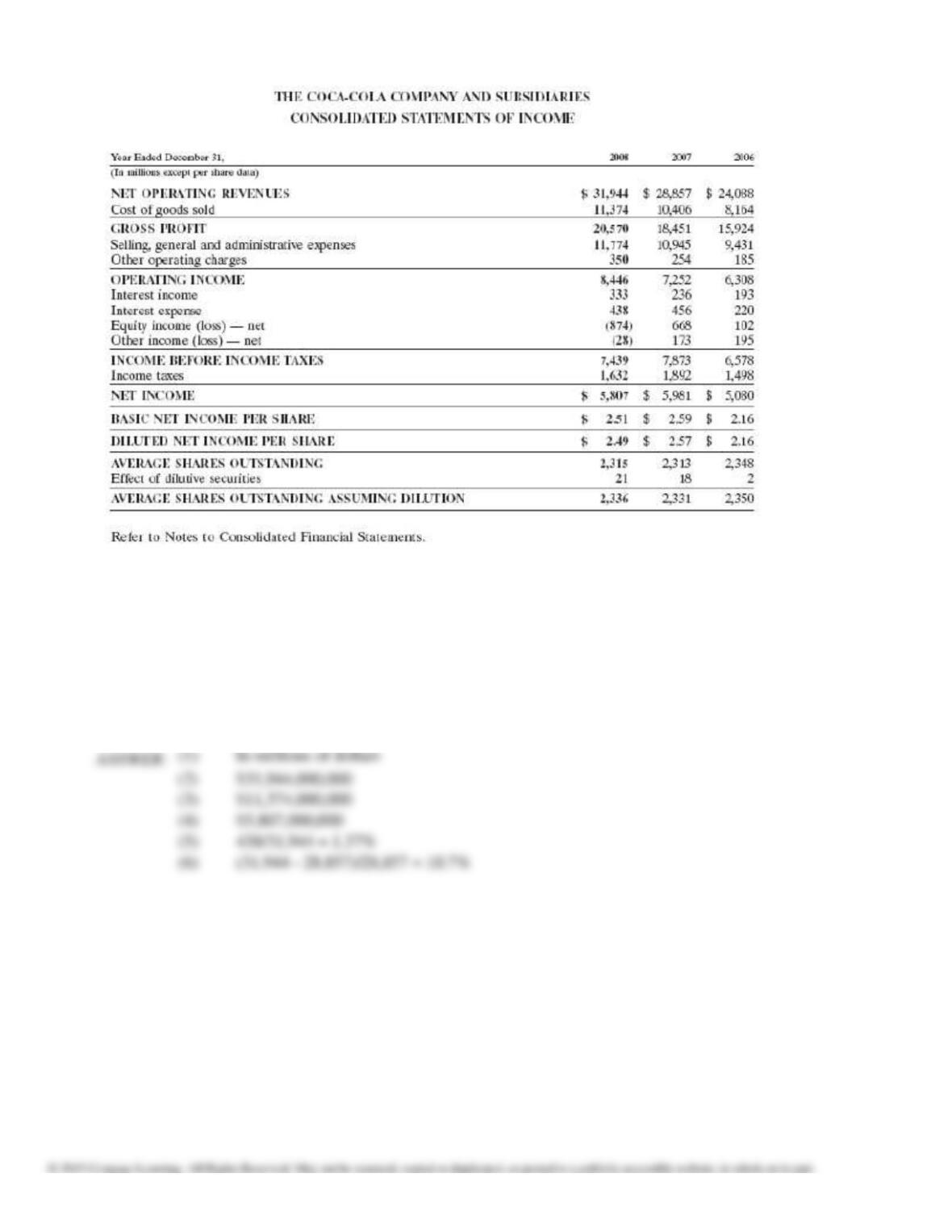
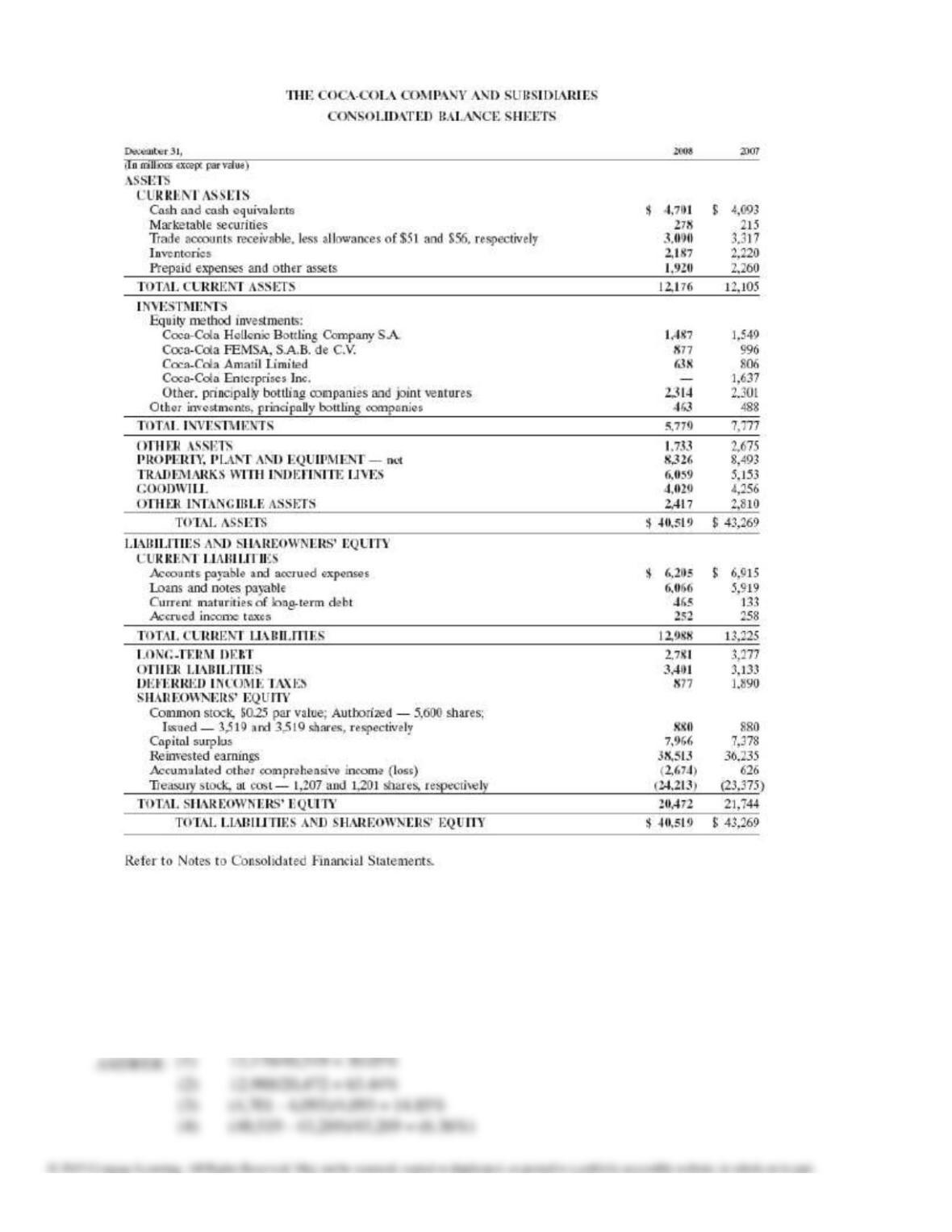
97. Review CokeCola’s financial statements and answer the following questions:
(1) How are Coke’s numbers reported (in what denomination)?
(2) What is Coke’s net operating revenue for 2008?
(3) What is Coke’s cost of goods sold for 2008?
(4) What is Coke’s net income 2008?
(5) What is Coke’s percent of interest expense to net operating revenue on its 2008 income
statement?
(6) What is Coke’s percent of increase in net operating revenue from 2007 to 2008?
Chapter 1: The Role of Accounting in Business
98. Review CokeCola’s financial statements and answer the following questions:
(1) What is Coke’s percent of current assets to total assets on its December 31, 2008 balance
sheet?
(2) What is Coke’s percentage of current liabilities to total stockholders’ equity on its
December 31, 2008 balance sheet?
(3) What is the percentage increase in cash and cash equivalents from 2007 to 2008?
(4) What percentage did total assets decrease from 2007 to 2008?
Chapter 1: The Role of Accounting in Business
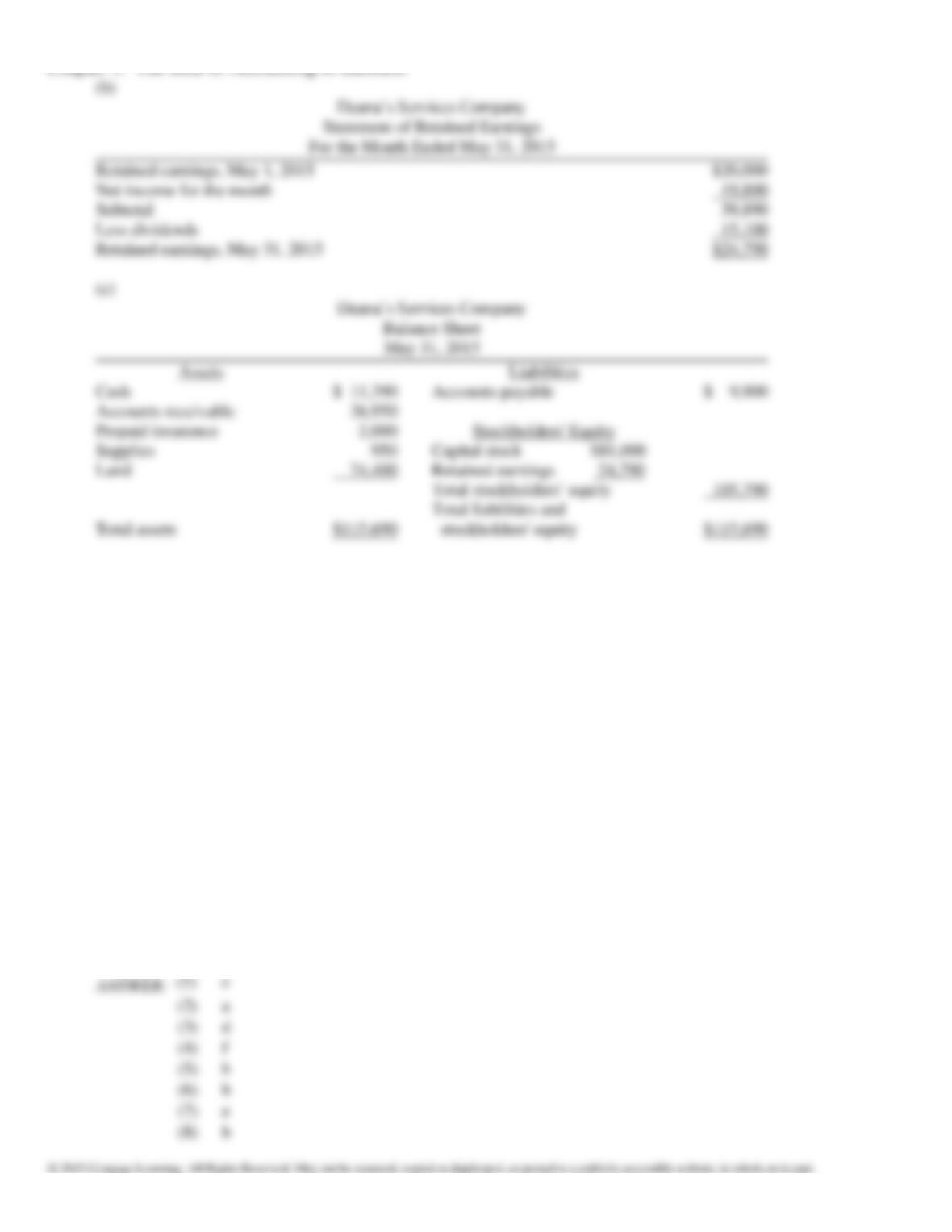
99. On May 31, 2015, Deana’s Services Company had account balances as follows:
Accounts payable
$ 9,900
Accounts receivable
26,950
Cash
11,390
Fees earned
70,800
Insurance expense
1,475
Land
74,400
Miscellaneous expense
1,510
Prepaid insurance
2,000
Rent expense
8,000
Salary expense
35,300
Dividends
15,100
Supplies
950
Supplies expense
825
Utilities expense
3,800
Capital stock
81,000
Retained earnings (beginning balance on May 1, 2015)
20,000
Present, in good form, (a) an income statement for May, (b) a statement of retained earnings
for May, and (c) a balance sheet as of May 31.
100. Match each statement with the appropriate accounting concept. (Some items may not be used.
Others may be used more than once.)
a. Accounting period concept
b. Adequate disclosure concept
c. Business entity concept
d. Cost concept
e. Going concern concept
f. Matching concept
g. Objectivity concept
h. Unit of measure concept
(1) Owners’ transactions are separate from business transactions.
(2) Financial statements are prepared at the end of each year.
(3) Land purchased for $50,000, 10 years ago, is reported on the Balance Sheet at $50,000.
(4) December rent expense paid in January is reported with the December revenues.
(5) All transactions are recorded and reported in dollars.
(6) Providing a summary of significant accounting policies
(7) Assumes that IBM will continue as a corporation forever
(8) The length of time left on debt obligations is shown.

Chapter 1: The Role of Accounting in Business
101. From the following information for BlueInks Corporation, compute the rate on return of
assets.
Net income after tax
$30,548
Taxes
$6,785
Interest expense
$3,545
Total assets at beginning of year
$150,500
Total assets at end of year
$175,684
a. 20.90%
b. 25.06%
c. 22.89%
d. 18.73%