186.
Savvy Sightseeing had beginning equity of $72,000; revenues of $90,000, expenses of
$65,000, and dividends to stockholders of $9,000. Calculate the ending equity.
187.
Doc’s Ribhouse had beginning equity of $52,000; net income of $35,000, and Dividends by
the company of $12,000. Calculate the ending equity.
188.
A company’s balance sheet shows: cash $24,000, accounts receivable $30,000, equipment
$50,000, and equity $72,000. What is the amount of liabilities?
189.
If a company has excess space in its building that it rents to another company for $700,
what is the effect on the accounting equation when the first rent payment is collected?
190.
All of the following are classified as assets
except
:
191.
Which of the following accounts is not included in the calculation of a company’s ending
stockholders’ equity?
192.
All of the following are classified as liabilities
except
:
193.
Billington Corp. borrows $80,000 cash from Second National Bank. How does this
transaction affect the accounting equation for Billington?
194.
If the assets of a company increase by $55,000 during the year and its liabilities increase
by $25,000 during the same year, then the change in equity of the company during the
year must have been:
195.
All of the following are classified as liabilities
except
:
196.
Grandmark Printing pays $2,000 rent to the landlord of the building where its facilities are
located. How does this transaction affect the accounting equation for Grandmark?
197.
Atkins Company collected $1,750 as payment for the amount owed by a customer from
services provided the prior month on credit. How does this transaction affect the
accounting equation for Atkins?
198.
The accounting equation for Ying Company shows a decrease in its assets and a decrease
in its equity. Which of the following transactions could have caused that effect?
199.
The accounting equation for Long Company shows an increase in its assets and an
increase in its liabilities. Which of the following transactions could have caused that
effect?
1-110
200.
In recent years, the FASB and IASB have pursued a process aimed at reducing
inconsistencies and improving comparability between U.S. GAAP and IFRS. This process is
known as:
Matching Questions
201.
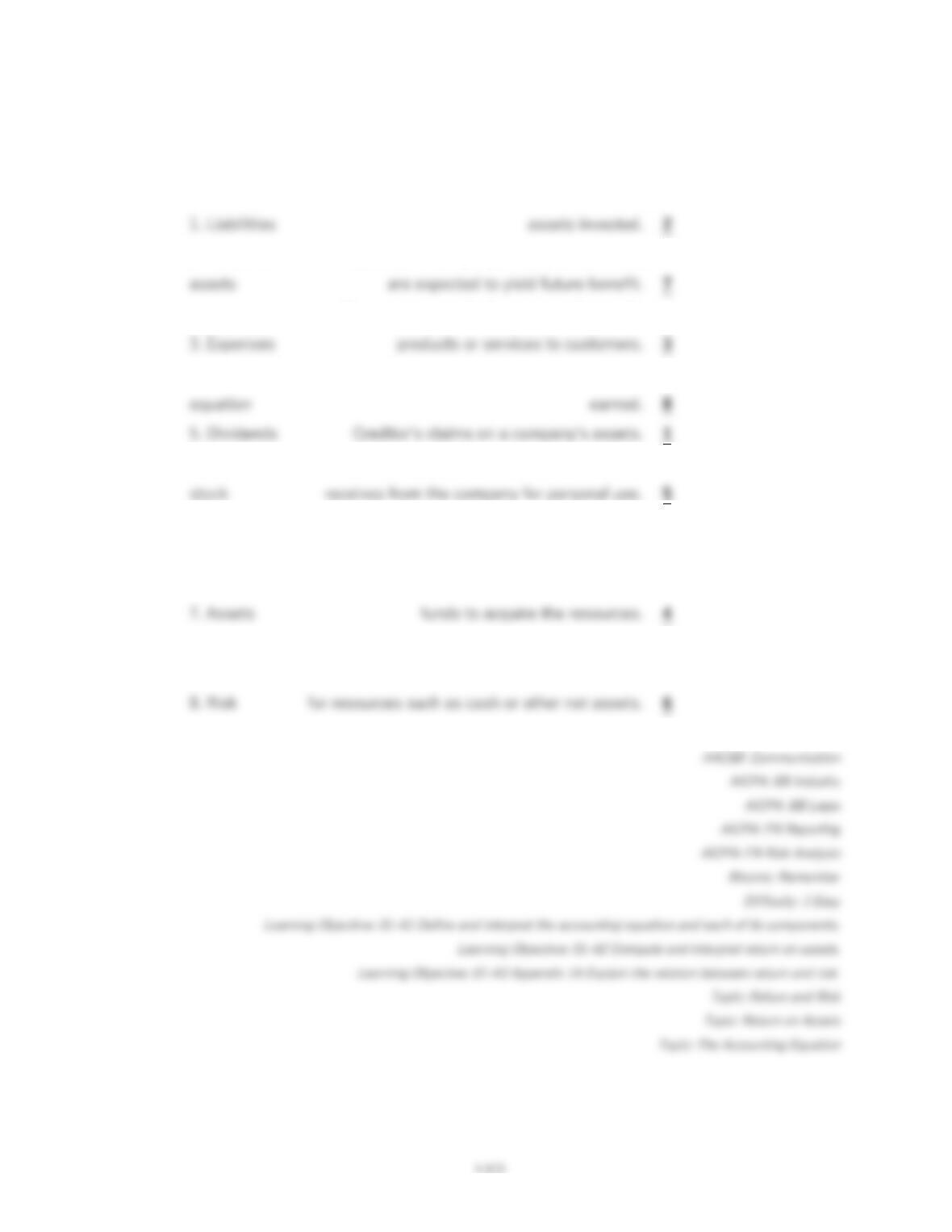
Match each of the following terms with the appropriate definitions
The area of accounting aimed at
serving external users by providing them
with general-purpose financial
Beliefs that distinguish right from
wrong, considered accepted standards of
The part of accounting that involves
recording transactions and events, either
4. Financial
Persons using accounting information
who are directly involved in managing and
An information and measurement
system that identifies, records and
communicates relevant reliable and
comparable information about an
Accounting specialists that have met
educational and experience requirements,
passed an examination and exhibit ethical
characteristics to achieve a professional
7. Certified Public
A model that asserts the factors that
The area of accounting that serves the
9. Managerial
Persons using accounting information
who are not directly involved in running
202.
Match each of the following terms with the appropriate definitions
A financial ratio stated as income divided by
2. Return on
Resources a company owns or controls that
Decreases in equity from costs of providing
4. Accounting
The uncertainty about the return to be
6. Common
Resources such as cash that a stockholder
Expresses the relation of assets, liabilities
and equity in a company, comparing the
resources the company owns to the sources of
The part of contributed capital that reflects
what is received by stockholders in exchange
203.
Match each of the following terms with the appropriate definitions
1. Purchasing
Judge the soundness of a customer
Assess whether an organization is likely
Decide whether to buy, hold, or sell a
Know what, when, and how much to
Assess whether a company has paid all
required taxes and complied with securities
1-114
204.
Match each of the following terms with the appropriate definitions
The concepts and rules that govern
2. Statement of
Presumes that the life of a company can
be divided into periods for reporting
3. Generally
accepted
accounting
A financial statement that reports the
changes in retained earnings over the
reporting period; including increases such
as net income and for decreases such as
A report that describes a company’s
5. Time period
A principle that requires the information
in financial statements to be supported by
6. Objectivity
Prescribes that assets and services to
be recorded initially on a cash or equal–to–
The governmental agency that has the
legal authority to establish accounting
8. Securities and
Exchange
An independent group consisting of
individuals from many countries that
9. Statement of
Prescribes that a company report the
details behind financial statements that
10. Full disclosure
A report that identifies cash receipts and
205.
Match each of the following terms with the appropriate definitions
1. Statement of
A financial statement that lists cash
inflows (receipts) and cash outflows
(payments); the cash flows are arranged by
2. Monetary unit
Happenings, such as changes in market
value, that effect the accounting equation and
3. Revenue
recognition
The principle that assumes transactions
The principle that requires a business to be
5. Income
The principle that revenue is recorded
when earned through providing goods or
6. Business
The relation between a company’s assets,
Describes a company’s revenues and
expenses along with the resulting net income
8. Accounting
Short Answer Questions
206.
Match each of the following business activities 1 through 8 to the appropriate category a,
b, or c.
a. Operating
b. Investing
c. Financing
____ 1. Paid utilities expenses.
____ 2. Withdrawal of funds by stockholders.
____ 3. Purchase of land.
____ 4. Sale of used equipment.
____ 5. Borrowed money from a bank on a long-term note.
____ 6. Paid employee wages.
____ 7. Received investment from owner.
____ 8. Paid an amount due on a long-term bank loan.
Learning Objective: 01-C5 Appendix 1B Identify and describe the three major activities of organizations.
Topic: Business Activities
207.
Match each of the following items 1 through 8 with the financial statement a through d in
which each item would most likely appear. An item may appear on more than one
statement.
a. Income statement
b. Statement of retained earnings
c. Balance sheet
d. Statement of cash flows
_____ 1. Assets.
_____ 2. Dividends.
_____ 3. Revenues.
_____ 4. Cash from investing activities.
_____ 5. Expenses.
_____ 6. Liabilities.
_____ 7. Cash from operating activities.
_____ 8. Cash from financing activities.
208.
Classify the following activities according to the appropriate section of the statement of
cash flows.
a. Operating activity
b. Investing activity
c. Financing activity
____ 1. Cash received from a one-time sale of used office equipment.
____ 2. Cash paid for dividends to stockholders.
____ 3. Cash received from customers.
____ 4. Cash received from owner contributions.
____ 5. Cash paid for utilities.
____ 6. Cash paid for a delivery van to be used in the business.
209.
Explain the role of accounting in the information age.
210.
What is the balance sheet? What is its purpose?
211.
Identify the users and uses of accounting information.
212.
Identify several opportunities in accounting and distinguish between private accounting
and public accounting.