
Name:
Class:
Date:
chapter 1
Indicate whether the statement is true or false.
1. The accounting equation can be expressed as Assets – Liabilities = Owner’s Equity.
a.
True
b.
False
2. Receiving payments on an account receivable increases both equity and assets.
a.
True
b.
False
3. There are four primary financial statements of a proprietorship: the income statement, the statement of owner’s equity,
the balance sheet, and the statement of cash flows.
a.
True
b.
False
4. Net income and net profit do not mean the same thing.
a.
True
b.
False
5. The basic difference between manufacturing and merchandising companies is the completion level of the products they
purchase for resale to customers.
a.
True
b.
False
6. The IASB maintains an electronic database, called the Accounting Standards Codification, which contains all of the
accounting standards that make up GAAP.
a.
True
b.
False
7. The owner’s rights to the assets rank ahead of the creditors’ rights to the assets.
a.
True
b.
False
8. A statement of owner’s equity reports the changes in the owner’s equity for a period of time.
a.
True
b.
False
9. The Sarbanes-Oxley Act established standards for corporate responsibility and disclosure.
a.
True
b.
False
10. Financial accounting reports are relevant only to users within the business.
a.
True
b.
False
11. Proper ethical conduct implies that you only consider what’s in your best interest.

Name:
Class:
Date:
chapter 1
a.
True
b.
False
12. Some of the major fraudulent acts committed by senior executives started as what they considered to be small ethical
lapses that grew out of control.
a.
True
b.
False
13. The excess of revenue over the expenses incurred in earning the revenue is called capital.
a.
True
b.
False
14. The primary role of accounting is to determine the amount of taxes a business will be required to pay to taxing
entities.
a.
True
b.
False
15. Purchasing supplies on account increases liabilities and decreases equity.
a.
True
b.
False
16. Managerial accounting information is used by external and internal users equally.
a.
True
b.
False
17. If total assets increased by $190,000 during a specific period and liabilities decreased by $10,000 during the same
period, the period’s change in total owner’s equity was a $200,000 increase.
a.
True
b.
False
18. An income statement is a summary of the revenues and expenses of a business as of a specific date.
a.
True
b.
False
19. Financial accounting provides information to all users, while the main focus for managerial accounting is to provide
information to the management.
a.
True
b.
False
20. If total assets decreased by $30,000 during a specific period and owner’s equity decreased by $35,000 during the same
period, the period’s change in total liabilities was a $65,000 increase.
a.
True
b.
False
21. An account receivable is a claim against a customer resulting from a sale on account.
a.
True

Name:
Class:
Date:
chapter 1
b.
False
22. A business is an organization in which basic resources or inputs, such as materials and labor, are assembled and
processed to provide outputs in the form of goods or services to customers.
a.
True
b.
False
23. A merchandising business buys products from other businesses to sell to customers.
a.
True
b.
False
24. Generally accepted accounting principles regulate how and what financial information is reported by businesses.
a.
True
b.
False
25. The rights or claims to the assets of a business may be subdivided into rights of creditors and rights of owners.
a.
True
b.
False
26. The unit of measurement concept requires that economic data be recorded in dollars.
a.
True
b.
False
27. No significant differences exist between the accounting standards issued by the FASB and the IASB.
a.
True
b.
False
28. The role of accounting is to provide many different users with financial information to make economic decisions.
a.
True
b.
False
29. Two factors that typically lead to ethical violations are relevance and timeliness of accounting information.
a.
True
b.
False
30. Senior executives cannot be criminally prosecuted for the wrongdoings they commit on behalf of the companies where
they work.
a.
True
b.
False
31. The balance sheet represents the accounting equation.
a.
True
b.
False
32. Cash withdrawals by owners decrease assets and increase equity.
a.
True

Name:
Class:
Date:
chapter 1
b.
False
33. If a building is appraised for $85,000, it is offered for sale at $90,000, and the buyer pays $80,000 cash for it, the
buyer would record the building at $85,000.
a.
True
b.
False
34. Revenue is earned only when money is received.
a.
True
b.
False
35. The statement of cash flows consists of three sections: Cash Flows from (Used for) Operating Activities, Cash Flows
from (Used for) Income Activities, and Cash Flows from (Used for) Equity Activities.
a.
True
b.
False
36. If net income for a proprietorship was $50,000, the owner withdrew $20,000 in cash, and the owner invested $10,000
in cash, the capital of the owner increased by $40,000.
a.
True
b.
False
37. Receiving a bill or otherwise being notified that an amount is owed is not recorded until the amount is paid.
a.
True
b.
False
38. About 90% of the businesses in the United States are organized as corporations.
a.
True
b.
False
39. An account receivable is typically classified as a revenue.
a.
True
b.
False
40. Accounting information users need reports about the economic activities and condition of businesses.
a.
True
b.
False
41. The cost concept is the basis for entering the purchase price into the accounting records.
a.
True
b.
False
42. If the liabilities owed by a business total $300,000 and owner’s equity is equal to $300,000, then the assets also total
$300,000.
a.
True
b.
False

Name:
Class:
Date:
chapter 1
43. The main objective for all business is to maximize unrealized profits.
a.
True
b.
False
44. The higher the ratio of liabilities to owner’s equity, the better able a company is to withstand poor business conditions
and to pay its obligations to creditors.
a.
True
b.
False
45. Assets that are used up during the process of earning revenue are called expenses.
a.
True
b.
False
46. Paying an account payable increases liabilities and decreases assets.
a.
True
b.
False
47. Proprietorships are owned by one owner and provide only services to their customers.
a.
True
b.
False
48. An example of an external user of accounting information is the federal government.
a.
True
b.
False
49. The financial statements of a proprietorship should include the owner’s personal assets and liabilities.
a.
True
b.
False
50. The Financial Accounting Standards Board (FASB) is the authoritative body that has primary responsibility for
developing accounting principles.
a.
True
b.
False
Indicate the answer choice that best completes the statement or answers the question.
51. Many countries outside the United States use financial accounting standards issued by the
a.
AICPA
b.
SEC
c.
IASB
d.
FASB
52. Which of the following is not an asset?
a.
investments
b.
cash
c.
inventory

Name:
Class:
Date:
chapter 1
d.
owner’s equity
53. Which of the following is a guideline for behaving ethically?
I.
Identify the consequences of a decision and its effect on others.
II.
Consider your obligations and responsibilities to those affected by the decision.
III.
Identify your decision based on personal standards of honesty and fairness.
a.
I and II
b.
II and III
c.
I and III
d.
I, II, and III
54. Two common areas of accounting that respectively provide information to internal and external users are
a.
forensic accounting and financial accounting
b.
managerial accounting and financial accounting
c.
managerial accounting and environmental accounting
d.
financial accounting and tax accounting systems
55. Which of the following is most likely to obtain large amounts of resources by issuing stock?
a.
partnership
b.
corporation
c.
proprietorship
d.
government entity
56. The debt created by a business when it makes a purchase on account is referred to as an
a.
account payable
b.
account receivable
c.
asset
d.
expense payable
57. Given the following data:
Dec. 31,Year 2 Dec. 31,Year 1
Total liabilities $128,250 $120,000
Total owner’s equity 95,000 80,000
Compute the ratio of liabilities to owner’s equity for each year. Round to two decimal places.
a.
1.50 and 1.07, respectively
b.
1.35 and 1.50, respectively
c.
1.07 and 1.19, respectively
d.
1.19 and 1.35, respectively
58. The financial statement that presents a summary of the revenues and expenses of a business for a specific period of
time, such as a month or year, is called a(n)
a.
statement of cash flows
b.
statement of owner’s equity
c.
income statement
d.
balance sheet
59. Which of the following accounts is a liability?

Name:
Class:
Date:
chapter 1
a.
Accounts Payable
b.
Accounts Receivable
c.
Wages Expense
d.
Service Revenue
60. Financial reports are used by
a.
management
b.
creditors
c.
investors
d.
All of these choices
61. Owner’s withdrawals
a.
increase expenses
b.
decrease expenses
c.
increase cash
d.
decrease owner’s equity
62. The initials GAAP stand for
a.
general accounting procedures
b.
generally accepted plans
c.
generally accepted accounting principles
d.
generally accepted accounting practices
63. Expenses are recorded when
a.
cash is paid for services rendered
b.
a bill is received in advance of services rendered
c.
assets are used in the process of earning revenue
d.
assets are purchased
64. The _____ concept requires a company to report its economic activities on a regular basis for a specific period.
a.
cost
b.
matching
c.
objectivity
d.
time period
65. The Assets section of the balance sheet normally presents assets in
a.
alphabetical order
b.
the order of largest to smallest dollar amounts
c.
the order in which they will be converted into cash or used in operations
d.
the order of smallest to largest dollar amounts
66. How does paying a liability in cash affect the accounting equation?
a.
assets increase; liabilities decrease
b.
assets increase; liabilities increase

Name:
Class:
Date:
chapter 1
c.
assets decrease; liabilities decrease
d.
liabilities decrease; owner’s equity increases
67. On May 7, Carpet Barn Company offered to pay $83,000 for land that had a selling price of $105,000. On May 15,
Carpet Barn accepted a counteroffer of $95,000. On June 5, the land was assessed at a value of $115,000 for property tax
purposes. On December 10, Carpet Barn Company was offered $135,000 for the land by another company. At what value
should the land be recorded in Carpet Barn Company’s records?
a.
$95,000
b.
$105,000
c.
$115,000
d.
$135,000
68. Which of the following is not a role of accounting in business?
a.
to provide reports to users about the economic activities and conditions of a business
b.
to personally guarantee loans of the business
c.
to provide information to external users to determine the economic performance and condition of the business
d.
to assess the various informational needs of users and design an accounting system to meet those needs
69. Which of the following is true regarding a limited liability company?
a.
makes up 10% of business organizations in the United States
b.
combines the attributes of a partnership and a corporation
c.
provides tax and liability advantages to the owners
d.
All of these choices
70. Donner Company is selling a piece of land adjacent to its business premises. An appraisal reported the market value of
the land to be $220,000. Focus Company initially offered to buy the land for $177,000. The companies settled on a
purchase price of $212,000. On the same day, another piece of land on the same block sold for $232,000. Under the cost
concept, at what amount should the land be recorded in the accounting records of Focus Company?
a.
$177,000
b.
$212,000
c.
$220,000
d.
$232,000
71. The assets and liabilities of a company are $128,000 and $84,000, respectively. Owner’s equity should equal
a.
$212,000
b.
$44,000
c.
$128,000
d.
$84,000
72. Land originally purchased for $30,000 is sold for $62,000 in cash. What is the effect of the sale on the accounting
equation?
a.
assets increase by $62,000; owner’s equity increases by $62,000
b.
assets increase by $32,000; owner’s equity increases by $32,000
c.
assets increase by $62,000; liabilities decrease by $30,000; owner’s equity increases by $32,000
d.
assets increase by $30,000; no change in liabilities; owner’s equity increases by $62,000

Name:
Class:
Date:
chapter 1
73. Which of the following best describes accounting?
a.
records economic data but does not communicate the data to users according to any specific rules
b.
is an information system that provides reports to users regarding economic activities and condition of a
business
c.
is of no use by individuals outside of the business
d.
is used only for filling out tax returns and for financial statements for various type of governmental reporting
requirements
74. If an owner wanted to know how money flowed into and out of the company, which financial statement would the
owner use?
a.
income statement
b.
statement of cash flows
c.
balance sheet
d.
statement of retained earnings
75. Which of the following asset accounts is increased when a receivable is collected?
a.
Accounts Receivable
b.
Supplies
c.
Accounts Payable
d.
Cash
76. Which type of accountant typically practices as an individual or as a member of a public accounting firm?
a.
Certified Public Accountant
b.
Certified Payroll Professional
c.
Certified Internal Auditor
d.
Certified Management Accountant
77. The unit of measure concept
a.
is only used in the financial statements of manufacturing companies
b.
is not important when applying the cost concept
c.
requires that different units be used for assets and liabilities
d.
requires that economic data be reported in yen in Japan or dollars in the United States
78. Which of the following is not a business entity?
a.
entrepreneurship
b.
proprietorship
c.
partnership
d.
corporation
79. Managerial accountants would be responsible for providing information regarding
a.
tax reports to government agencies
b.
profit reports to owners and management
c.
expansion of a product line report to management
d.
consumer reports to customers

Name:
Class:
Date:
chapter 1
80. Most businesses in the United States are
a.
proprietorships
b.
partnerships
c.
corporations
d.
cooperatives
81. Gomez Service Company paid its first installment on a note payable of $2,000. How will this transaction affect the
accounting equation?
a.
increase in liabilities (Notes Payable) and decrease in assets (Cash)
b.
decrease in assets (Cash) and decrease in owner’s equity (Note Payable Expense)
c.
decrease in assets (Cash) and decrease in assets (Notes Receivable)
d.
decrease in assets (Cash) and decrease in liabilities (Notes Payable)
82. The annual accounting period adopted by a company is called its
a.
calendar year
b.
fiscal year
c.
natural business year
d.
natural calendar year
83. Goods purchased on account for future use in the business, such as supplies, are called
a.
prepaid liabilities
b.
revenues
c.
prepaid expenses
d.
liabilities
84. Equipment with an estimated market value of $30,000 is offered for sale at $45,000. The equipment is acquired for
$15,000 in cash and a note payable of $20,000 due in 30 days. The amount used in the buyer’s accounting records to
record this acquisition is
a.
$30,000
b.
$35,000
c.
$15,000
d.
$45,000
85. Which of the following financial statements reports information as of a specific date?
a.
income statement
b.
statement of owner’s equity
c.
statement of cash flows
d.
balance sheet
86. Which of the following is a service business?
a.
Dell Inc.
b.
Wal-Mart Stores, Inc.
c.
Microsoft Corporation
d.
Facebook, Inc.

Name:
Class:
Date:
chapter 1
87. Which of the following groups is considered to be internal users of accounting information?
a.
employees and customers
b.
customers and vendors
c.
employees and managers
d.
government entities and banks
88. The monetary value charged to customers for the performance of services sold is called a(n)
a.
asset
b.
net income
c.
capital
d.
revenue
89. Which of the following concepts relates to separating the reporting of business and personal economic transactions?
a.
cost concept
b.
unit of measure concept
c.
business entity concept
d.
objectivity concept
90. How does the purchase of equipment by signing a note affect the accounting equation?
a.
assets increase; assets decrease
b.
assets increase; liabilities decrease
c.
assets increase; liabilities increase
d.
assets increase; owner’s equity increases
91. Which of the following is not a characteristic of a corporation?
a.
Corporations are organized as a separate legal taxable entity.
b.
Ownership is divided into shares of stock.
c.
Corporations experience an ease in obtaining large amounts of resources by issuing stock.
d.
A corporation’s resources are limited to its individual owners’ resources.
92. Which of the following is not a business transaction?
a.
make a sales offer
b.
sell goods for cash
c.
receive cash for services to be rendered later
d.
pay for supplies
93. If total assets decreased by $88,000 during a period of time and owner’s equity increased by $71,000 during the same
period, then the amount and direction (increase or decrease) of the period’s change in total liabilities would be a(n)
a.
$17,000 increase
b.
$88,000 decrease
c.
$159,000 increase
d.
$159,000 decrease
94. The natural business year for most retail businesses ends on
a.
January 31

Name:
Class:
Date:
chapter 1
b.
March 31
c.
August 31
d.
December 31
95. The following are examples of external users of accounting information except
a.
government entities
b.
customers
c.
creditors
d.
managers
96. Liabilities are reported on the
a.
income statement
b.
statement of owner’s equity
c.
statement of cash flows
d.
balance sheet
97. Transactions affecting owner’s equity include
a.
owner’s investments and payment of liabilities
b.
owner’s investments, owner’s withdrawals, earning of revenues, and incurrence of expenses
c.
owner’s investments, earning of revenues, incurrence of expenses, and collection of accounts receivable
d.
owner’s withdrawals, earning of revenues, incurrence of expenses, and purchase of supplies on account
98. If total liabilities decreased by $46,000 during a period of time and owner’s equity increased by $60,000 during the
same period, the amount and direction (increase or decrease) of the period’s change in total assets would be a
a.
$106,000 increase
b.
$14,000 increase
c.
$14,000 decrease
d.
$106,000 decrease
99. Ramon Ramos has withdrawn $750 from Ramos Repair Company’s cash account to deposit in his personal account.
How does this transaction affect Ramos Repair Company’s accounting equation?
a.
increase in assets (Accounts Receivable) and decrease in assets (Cash)
b.
decrease in assets (Cash) and decrease in owner’s equity (Owner’s Withdrawal)
c.
decrease in assets (Cash) and decrease in liabilities (Accounts Payable)
d.
increase in assets (Cash) and decrease in owner’s equity (Owner’s Withdrawal)
100. For accounting purposes, the business entity should be considered separate from its owners if the entity is
a.
a corporation
b.
a proprietorship
c.
a partnership
d.
All of these choices
101. A business paid $7,000 to a creditor in payment of an amount owed. The effect of the transaction on the accounting
equation was to
a.
increase an asset, decrease another asset

Name:
Class:
Date:
chapter 1
b.
decrease an asset, decrease a liability
c.
increase an asset, increase a liability
d.
increase an asset, increase owner’s equity
102. Which of the following is a manufacturing business?
a.
General Motors
b.
Facebook
c.
American Airlines
d.
Target
103. Within the United States, the dominant body in the primary development of accounting principles is the
a.
American Institute of Certified Public Accountants (AICPA)
b.
American Accounting Association (AAA)
c.
Financial Accounting Standards Board (FASB)
d.
Institute of Management Accountants (IMA)
104. All of the following are general-purpose financial statements except a(n)
a.
balance sheet
b.
income statement
c.
statement of owner’s equity
d.
cash budget
105. Which of the following is not a certification for accountants?
a.
CIA
b.
CMA
c.
CISA
d.
IRS
106. Assets are
a.
always lower than liabilities
b.
equal to liabilities less owner’s equity
c.
the same as expenses because they are acquired with cash
d.
financed by the owner and/or creditors
107. An entity that is organized according to state or federal statutes and in which ownership is divided into shares of
stock is a
a.
proprietorship
b.
corporation
c.
partnership
d.
governmental unit
108. The business entity concept means that
a.
the owner is part of the business entity
b.
an entity is organized according to state or federal statutes

Name:
Class:
Date:
chapter 1
c.
an entity is organized according to the rules set by the FASB
d.
the entity is an individual economic unit for which data are recorded, analyzed, and reported
109. Which of the following is not true of accounting principles?
a.
Financial accountants follow generally accepted accounting principles (GAAP).
b.
Following GAAP allows accounting information users to compare one company to another.
c.
A new accounting principle can be adopted with stockholders’ approval.
d.
The Financial Accounting Standards Board (FASB) has primary responsibility for developing accounting
principles.
110. Which of the following is a business transaction?
a.
purchase inventory on account
b.
plan advertising for upcoming sale
c.
give employees a raise beginning next month
d.
submit estimate for construction project
111. Which of the following groups of companies includes examples of merchandising businesses?
a.
Delta Air Lines, Marriott, Gap Inc.
b.
Gap Inc., Amazon, Nike Inc.
c.
GameStop, Sony, Dell
d.
GameStop, Best Buy, Gap Inc.
112. The asset created by a business when it makes a sale on account is termed
a.
accounts payable
b.
prepaid expense
c.
unearned revenue
d.
accounts receivable
113. Michael Anderson is starting a computer programming business and has deposited an initial investment of $15,000
into the business cash account. Identify how the accounting equation will be affected.
a.
increase in assets (Cash) and increase in liabilities (Accounts Payable)
b.
increase in assets (Cash) and increase in owner’s equity (Michael Anderson, Capital)
c.
increase in assets (Accounts Receivable) and decrease in liabilities (Accounts Payable)
d.
increase in assets (Cash) and increase in assets (Accounts Receivable)
114. Which of the following is the best description of accounting’s role in business?
a.
Accounting provides stockholders with information regarding the market value of the company’s stocks.
b.
Accounting provides information to managers to operate the business and to other users to make decisions
regarding the economic condition of the company.
c.
Accounting helps in decreasing the credit risk of the company.
d.
Accounting is not responsible for providing any form of information to users. That is the role of the
Information Systems Department.
115. Debts owed by a business are referred to as
a.
accounts receivable

Name:
Class:
Date:
chapter 1
b.
expenses
c.
owner’s equity
d.
liabilities
116. On May 20, White Repair Service extended an offer of $108,000 for land that had been priced for sale at $140,000.
On May 30, White Repair Service accepted the seller’s counteroffer of $115,000. On June 20, the land was assessed at a
value of $95,000 for property tax purposes. On July 4, White Repair Service was offered $150,000 for the land by a
national retail chain. At what value should the land be recorded in White Repair Service’s records?
a.
$108,000
b.
$95,000
c.
$140,000
d.
$115,000
117. Donner Company is selling a piece of land adjacent to its business. An appraisal reported the market value of the
land to be $120,000. Focus Company initially offered to buy the land for $107,000. The companies settled on a purchase
price of $115,000. On the same day, another piece of land on the same block sold for $122,000. Under the cost concept,
what amount will be used to record this transaction in Focus Company’s accounting records?
a.
$107,000
b.
$115,000
c.
$120,000
d.
$122,000
118. Abbie Marson is the sole owner and operator of Great Plains Company. As of the end of its accounting period,
December 31, Year 1, Great Plains Company has assets of $940,000 and liabilities of $300,000. During Year 2, Marson
invested an additional $73,000 and withdrew $33,000 from the business. What is the amount of net income during Year 2,
assuming that as of December 31, Year 2, assets were $995,000 and liabilities were $270,000?
a.
$45,000
b.
$50,000
c.
$106,000
d.
$370,000
119. A financial statement user would determine if a company was profitable or not during a specific period of time by
reviewing the
a.
income statement
b.
balance sheet
c.
statement of cash flows
d.
statement of retained earnings
120. Cash investments made by the owner to the business are reported on the statement of cash flows in the
a.
financing activities section
b.
investing activities section
c.
operating activities section
d.
supplemental statement
121. How does receiving a bill to be paid next month for services received affect the accounting equation?
a.
assets decrease; owner’s equity decreases

Name:
Class:
Date:
chapter 1
b.
assets increase; liabilities increase
c.
liabilities increase; owner’s equity increases
d.
liabilities increase; owner’s equity decreases
122. Which of the following is not a characteristic of a corporation?
a.
Corporations are organized as a separate legal taxable entity.
b.
Ownership is divided into shares of stock.
c.
Corporations experience an ease in obtaining large amounts of resources by issuing stock.
d.
A corporation’s resources are limited to its individual owners’ resources.
123. Which of the following is the authoritative body in the United States that has the primary responsibility for
developing accounting principles?
a.
FASB
b.
IRS
c.
SEC
d.
AICPA
124. The objectivity concept requires that
a.
business transactions be consistent with the objectives of the entity
b.
the Financial Accounting Standards Board be fair and unbiased in its deliberations over new accounting
standards
c.
accounting principles meet the objectives of the Securities and Exchange Commission
d.
amounts recorded in the financial statements be based on independently verifiable evidence
125. Revenues are reported when
a.
a contract is signed
b.
cash is received from the customer
c.
work is begun on the job
d.
work is completed on the job
126. Which of the following is not a business transaction?
a.
Erin deposits $15,000 in a bank account in the name of Erin’s Lawn Service.
b.
Erin provided services to customers earning fees of $600.
c.
Erin purchased hedge trimmers for her lawn service agreeing to pay the supplier next month.
d.
Erin pays her monthly personal credit card bill.
127. Four financial statements are usually prepared for a business. The statement of cash flows is usually prepared last.
The statement of owner’s equity (OE), the balance sheet (B), and the income statement (I) are prepared in a certain order
to obtain information needed for the next statement. In what order are these three statements prepared?
a.
I,OE, B
b.
B, I, OE
c.
OE, I, B
d.
B,OE, I
128. The year-end balance of the owner’s capital account appears on

Name:
Class:
Date:
chapter 1
a.
both the statement of owner’s equity and the income statement
b.
only the statement of owner’s equity
c.
both the statement of owner’s equity and the balance sheet
d.
both the statement of owner’s equity and the statement of cash flows
129. Which of the following would not normally operate as a service business?
a.
pet groomer
b.
grocer
c.
lawn care company
d.
styling salon
130. Earning revenue
a.
increases assets, increases owner’s equity
b.
increases assets, decreases owner’s equity
c.
increases one asset, decreases another asset
d.
decreases assets, increases liabilities
131. All of the following statements regarding the ratio of liabilities to owner’s equity are true except
a.
a ratio of 1 indicates that liabilities equal owner’s equity
b.
corporations can use this ratio but substitute total stockholders’ equity for total owner’s equity
c.
the higher this ratio, the better able a business is to withstand poor business conditions and pay creditors
d.
the lower this ratio, the better able a business is to withstand poor business conditions and pay creditors
132. The accounting equation may be expressed as
a.
Assets = Equities − Liabilities
b.
Assets + Liabilities = Owner’s Equity
c.
Assets = Revenues − Liabilities
d.
Assets − Liabilities = Owner’s Equity
133. Karen Meyer owns and operates Crystal Cleaning Company. Recently, Meyer withdrew $10,000 from Crystal
Cleaning, and she contributed $6,000, in her name, to the American Red Cross. The contribution of the $6,000 should be
recorded on the accounting records of which of the following entities?
a.
Crystal Cleaning and the American Red Cross
b.
Karen Meyer’s personal records and the American Red Cross
c.
Karen Meyer’s personal records and Crystal Cleaning
d.
Karen Meyer’s personal records, Crystal Cleaning, and the American Red Cross
134. Profit is the difference between
a.
assets and liabilities
b.
the incoming cash and outgoing cash
c.
the assets purchased with cash contributed by the owner and the cash spent to operate the business
d.
the amounts received from customers for goods or services and the amounts paid for
the inputs used to provide the goods or services

Name:
Class:
Date:
chapter 1
Match each transaction with its effect on the accounting equation. Each letter may be used more than once.
a.
Increase assets, increase liabilities
b.
Increase liabilities, decrease owner’s equity
c.
Increase assets, increase owner’s equity
d.
No effect
e.
Decrease assets, decrease liabilities
f.
Decrease assets, decrease owner’s equity
135. Received cash for services provided
136. Paid the utility bill
137. Investment of land by owner
138. Paid part of an amount owed to a creditor
139. Paid cash for the purchase of a one-year insurance policy
140. Received payment from a customer on account
141. Cash withdrawal by owner
142. Provided a service to a customer on account
143. Purchased supplies on credit
144. Paid wages
145. Cash investment by owner
146. Borrowed money from a bank
147. Purchased equipment for cash
148. Received cash for providing services to customers
149. Used up supplies that were already on hand
Match each of the following users of accounting information to the type of user: internal or external. Each letter may be
used more than once.
a.
Internal user
b.
External user
150. Payroll manager
151. Bank
152. President’s secretary

Name:
Class:
Date:
chapter 1
153. Internal Revenue Service
154. Raw material vendors
155. Social Security Administration
156. Health insurance provider
157. Managerial accountant
Match each of the following characteristics with the form of business entity that it best describes. Each letter may be used
more than once.
a.
Proprietorship
b.
Partnership
c.
Corporation
d.
Limited liability company (LLC)
158. Comprises 70% of business entities in the United States
159. Generates 90% of business revenues
160. Owned by two or more individuals
161. Organized as a separate legal taxable entity
162. Easy and cheap to organize
163. Often used as an alternative to a partnership
164. Used by large business
165. Has the ability to obtain large amounts of resources
166. Offers tax and legal liability advantages for owners
Match each of the following characteristics with the financial statement that it best describes. Each letter may be used
more than once.
a.
Income statement
b.
Balance sheet
c.
Statement of owner’s equity
d.
Statement of cash flows
167. Reports as of a specific date
168. The first statement prepared
169. Has three sections: operating, investing, and financing
170. Reports only revenues and expenses

Name:
Class:
Date:
chapter 1
171. The second statement prepared
172. A formal presentation of the accounting equation
173. The connecting link between the income statement and balance sheet
Match each of the following items to the financial statement(s) where it can be found. Each letter may be used more than
once.
a.
Balance sheet
b.
Income statement
c.
Statement of cash flows
d.
Statement of owner’s equity
174. Increase in owner’s equity
175. Revenues
176. Supplies
177. Land
178. Accounts payable
179. Accounts receivable
180. Operating activities
181. Wages expense
182. Fees earned
183. Net increase in cash
Match each of the following companies with the type of business that best describes it. Each letter may be used more than
once.
a.
Service business
b.
Merchandising business
c.
Manufacturing business
184. Dillard’s
185. Time Warner Cable
186. General Motors
187. Redbox
188. American Airlines
189. Sony

Name:
Class:
Date:
chapter 1
190. Best Buy
191. Banana Republic
192. H&R Block
Match each of the following activities to the section in which it would be reported on the statement of cash flows. Each
letter may be used more than once.
a.
Cash Flows from (Used for) Operating Activities
b.
Cash Flows from (Used for) Investing Activities
c.
Cash Flows from (Used for) Financing Activities
d.
Does not appear on the statement of cash flows
193. Cash paid for building
194. Cash paid to suppliers
195. Cash paid to owner for personal use
196. Cash received from customers
197. Cash received from owner as additional investment in the business
198. Cash received from sale of a building
199. Borrowed cash from a bank
Match each of the following accounts with the account type that best describes it. Each letter may be used more than
once.
a.
Asset
b.
Liability
c.
Owner’s equity
200. Accounts payable
201. Wages expense
202. Joan Smith, Capital
203. Accounts Receivable
204. Joan Smith, Drawing
205. Land
Match each of the following items to its effect on owner’s equity. Each letter may be used more than once.
a.
Increases owner’s equity
b.
Decreases owner’s equity

Name:
Class:
Date:
chapter 1
206. Fees earned
207. Wages expense
208. Withdrawals
209. Lawn care revenue
210. Additional investment in the business
211. Supplies expense
Match each of the following businesses with the type of business that best describes it. Each letter may be used more than
once.
a.
Service business
b.
Manufacturing business
c.
Merchandising business
212. A hospital
213. A dressmaking company
214. A supermarket
215. A modular homebuilder
216. A health club and spa
217. A tax preparation firm
218. A law firm
219. A men’s clothing store
220. A book publisher
221. An automobile dealer
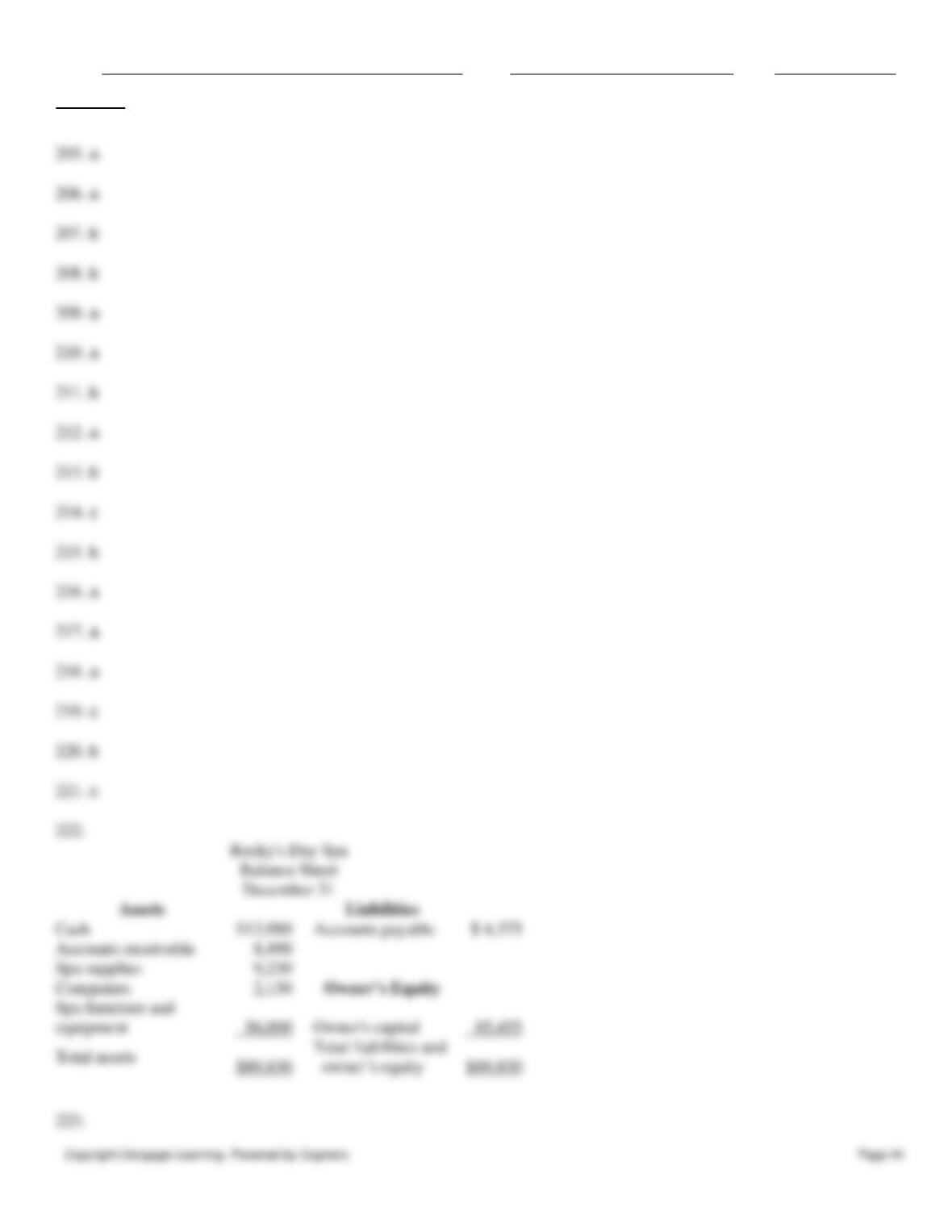
222. The assets and liabilities of Rocky’s Day Spa on December 31 and its revenue and expenses for the year follow. The
capital of the owner was $68,000 on January 1. The owner invested an additional $10,000 during the year.
Accounts payable
$ 4,375
Spa operating expense
$23,760
Accounts receivable
8,490
Office expense
2,470
Cash
???
Spa supplies
9,230
Fees earned
98,435
Wages expense
26,580
Spa furniture and equipment
56,000
Drawing
38,170
Computers
2,130
Prepare a balance sheet for the year ended December 31.

Name:
Class:
Date:
chapter 1
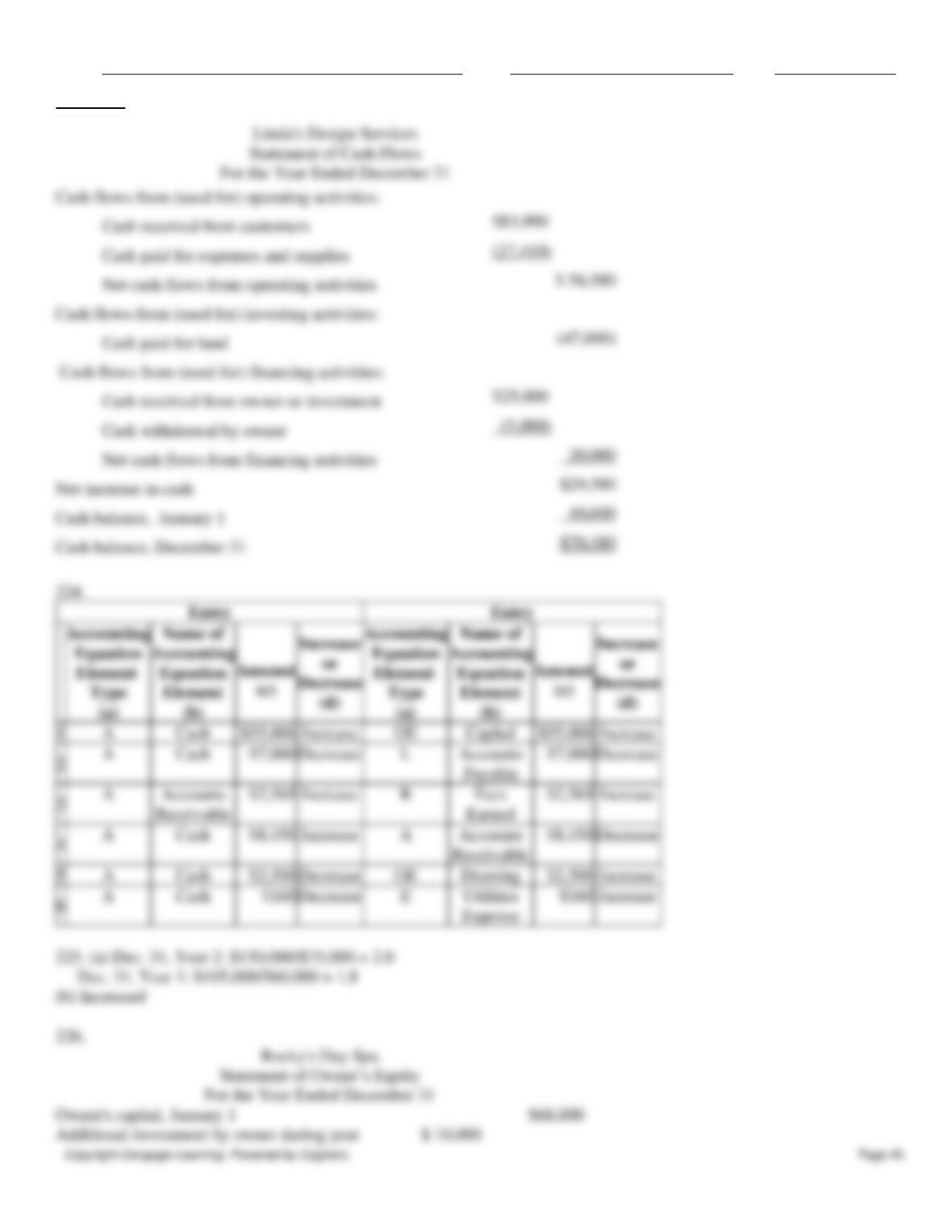
223. A summary of cash flows for Linda’s Design Services for the year ended December 31 is as follows:
Cash receipts:
Cash received from customers
$83,990
Cash received from additional investment by owner
25,000
Cash payments:
Cash paid for expenses and supplies
$27,410
Cash paid for land
47,000
Cash paid to owner for personal use
5,000
Cash balance as of January 1
$40,600
Prepare a statement of cash flows for Linda’s Design Services for the year ended December 31.
224. Daniels Company is owned and operated by Thomas Daniels. The following selected transactions were completed by
Daniels Company during May:
1.
Received cash from owner as additional investment, $55,000.
2.
Paid creditors on account, $7,000.
3.
Billed customers for services on account, $2,565.
4.
Received cash from customers on account, $8,450.
5.
Paid cash to owner for personal use, $2,500.
6.
Paid the utility bill, $160.
Indicate the effect of each transaction on the accounting equation by:
(a)
Accounting equation element type: (A) assets, (L) liabilities, (OE) owner’s equity, (R)
revenue, and (E) expense
b)
Name of accounting equation element
c)
The amount of the transaction
d)
The direction of change (increase or decrease) in the account affected
Note: Each transaction has two entries.
Entry
Entry
Accounting
Equation
Element
Type
(a)
Name of
Accounting
Equation
Element
(b)
Amount
(c)
Increase or
Decrease
(d)
Accounting
Equation
Element
Type
(a)
Name of
Accounting
Equation
Element
(b)
Amount
(c)
Increase or
Decrease
(d)
1
2
3
4
5
6
225. The following data were taken from Miller Company’s balance sheet:
Dec. 31, Year 2 Dec. 31, Year 1
Total liabilities $150,000 $105,000

Name:
Class:
Date:
chapter 1
Total owner’s equity 75,000 60,000
(a) Compute the ratio of liabilities to owner’s equity. Round your answer to one decimal place.
(b) Has the creditors’ risk increased or decreased from December 31, Year 1, to December 31, Year 2?
226. The assets and liabilities of Rocky’s Day Spa on December 31 and its revenue and expenses for the year follow. The
capital of the owner is $68,000 on January 1. The owner invested an additional $10,000 during the year.
Accounts payable
$ 4,375
Spa operating expense
$23,760
Accounts receivable
8,490
Office expense
2,470
Cash
13,980
Spa supplies
9,230
Fees earned
98,435
Wages expense
26,580
Spa furniture and equipment
56,000
Drawing
38,170
Computers
2,130
Prepare a statement of owner’s equity for the current year ended December 31.
227. Ramirez Company received its first electric bill in the amount of $60 which will be paid next month. How will this
transaction affect the accounting equation?
228. Ting Hsu is the owner of Hsu’s Financial Services. At the end of its accounting period, December 31, of Year 1,
Hsu’s has assets of $575,000 and owner’s equity of $335,000. Using the accounting equation and considering each case
independently, determine the following amounts:
(a) Hsu’s liabilities as of December 31 of Year 1.
(b) Hsu’s liabilities as of December 31 of Year 2, assuming that assets increased by $56,000 and
owner’s equity decreased by $32,000.
(c) Net income or net loss during Year 2, assuming that as of December 31, Year 2, assets were $592,000,
liabilities were $450,000, and there were no additional investments or withdrawals.
229. Austin Land Company sold land for $85,000 in cash. The land was originally purchased for $65,000. At the time of
the sale, $40,000 was still owed to Regions Bank. After the sale, Austin Land Company paid off the loan. Explain the
effect of the sale and the payoff of the loan on the accounting equation.
230. (a) A vacant lot acquired for $83,000 cash is sold for $127,000 in cash. What is the effect of the sale on the
total amount of the seller’s (1) assets, (2) liabilities, and (3) owner’s equity?
(b) Assume that the seller owes $52,000 for the land. After receiving the $127,000 cash in (a), the
seller pays the $52,000 owed. What is the effect of the payment on the total amount of the seller’s (1) assets,
(2) liabilities, and (3) owner’s equity?
231. Darnell Company purchased $88,000 of computer equipment from Joseph Company. Darnell Company paid for the
equipment using cash that had been obtained from the initial investment by Donnie Darnell.
Which entity or entities (Darnell Company, Joseph Company, and Donnie Darnell) should record the transaction
involving the computer equipment on their accounting records?
232. Given the following data:
Dec. 31,Year 2 Dec. 31,Year 1
Total liabilities $128,250 $120,000
Total owner’s equity 95,000 80,000
(a) Compute the ratio of liabilities to owner’s equity for each year.

Name:
Class:
Date:
chapter 1
(b) Has the creditors’ risk increased or decreased from December 31, Year 1, to December 31, Year 2?
233. Determine the missing amount designated with an “X” for each of the following:
Assets
Liabilities
Owner’s Equity
(a) $78,500
$37,600
X
(b) X
53,280
$145,000
(c) 49,500
X
34,000
234. Discuss the characteristics of a limited liability company (LLC).
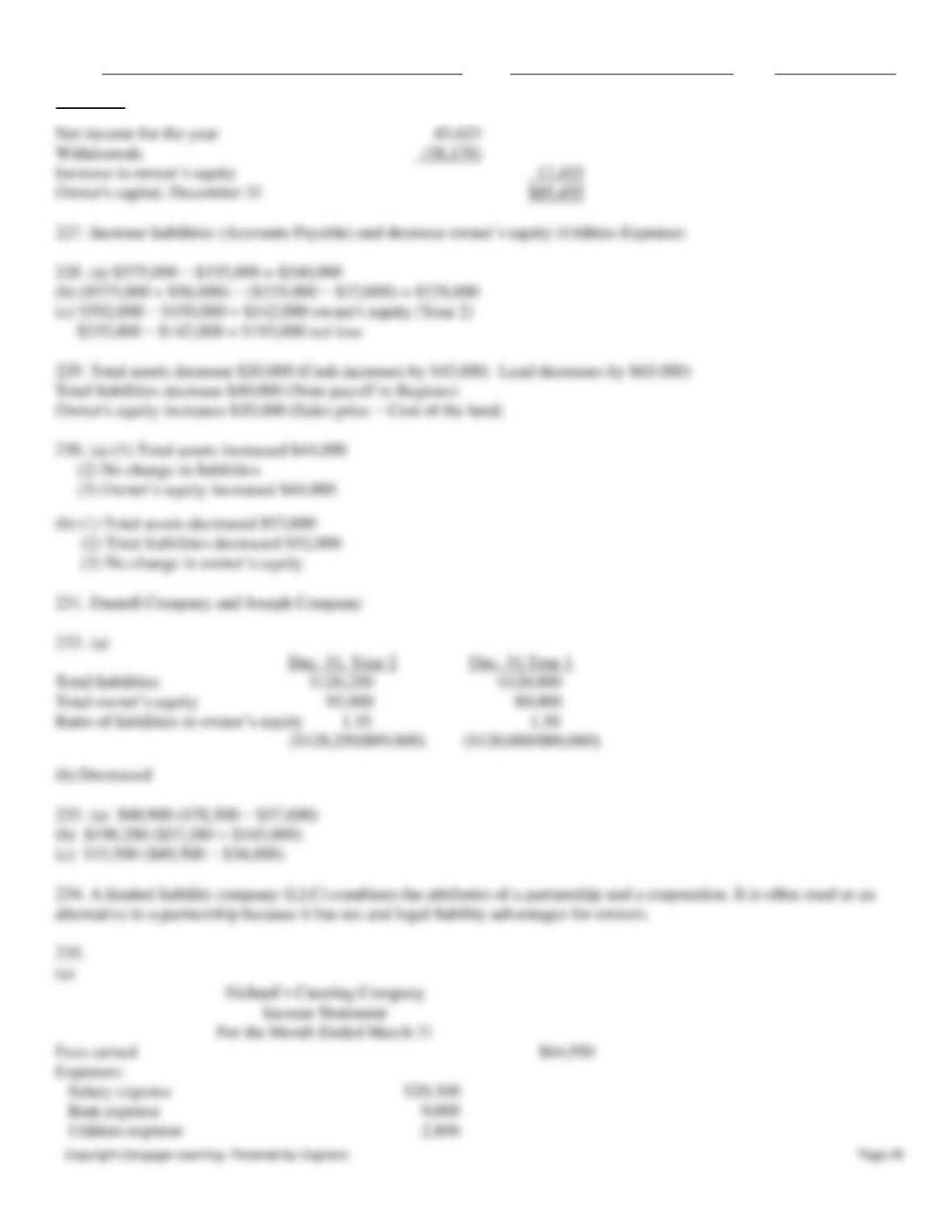
235. On March 1, the amount of Richard Cook’s capital in Richard’s Catering Company was $150,000. During March, he
withdrew $31,000 from the business. The amounts of the various assets, liabilities, revenues, and expenses are as follows:
Accounts payable
$10,250
Accounts receivable
45,950
Cash
23,840
Fees earned
64,950
Insurance expense
1,275
Land
85,400
Miscellaneous expense
1,210
Prepaid insurance
3,000
Rent expense
9,000
Salary expense
20,300
Supplies
900
Supplies expense
525
Utilities expense
2,800
Prepare (a) an income statement for March, (b) a statement of owner’s equity for March, and (c) a balance sheet as of
March 31.
236. Explain the meaning of:
(a) the objectivity concept
(b) the unit of measure concept
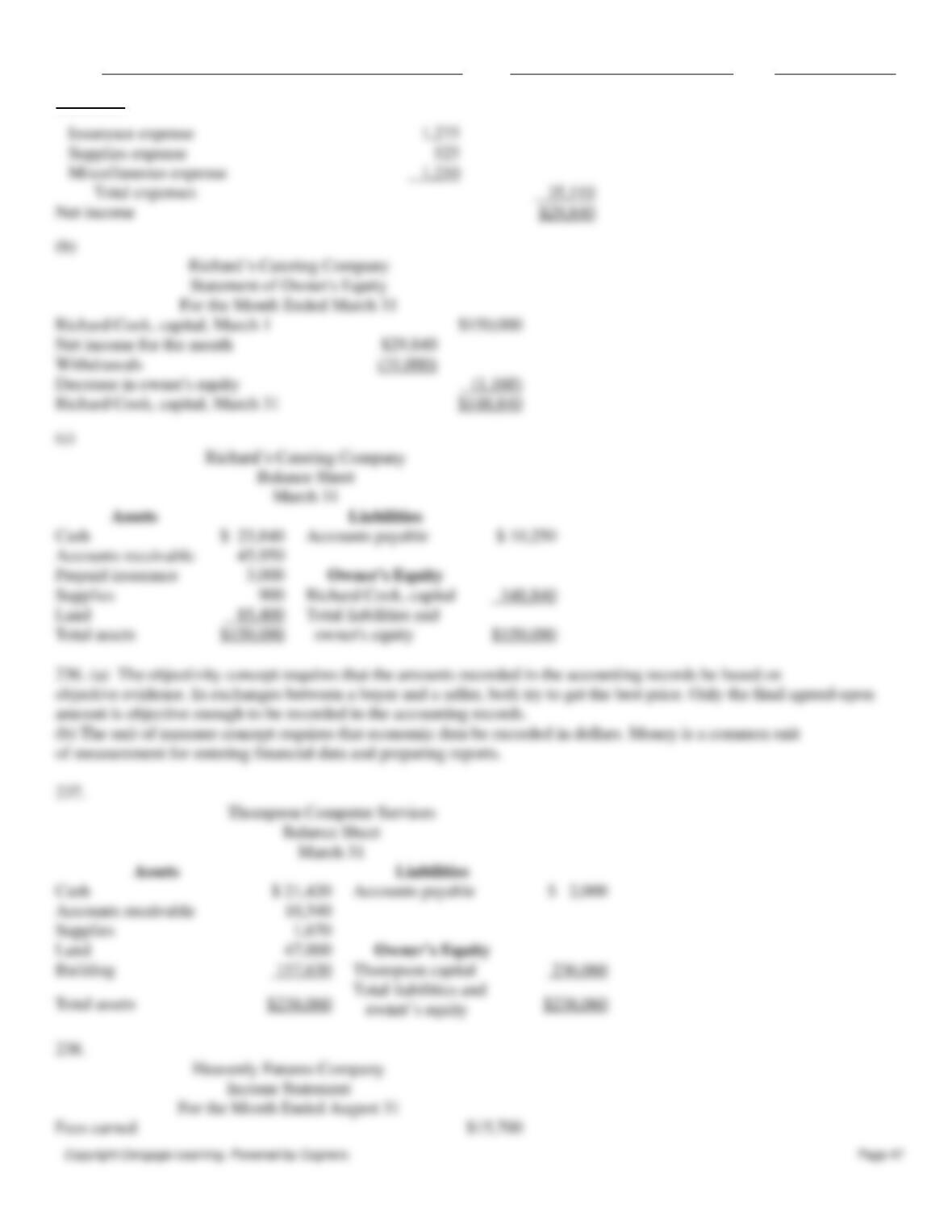
The assets and liabilities of Thompson Computer Services at March 31, the end of the current year, and its revenue and
expenses for the year follow. The capital of the owner was $180,000 at April 1, the beginning of the current year. Mr.
Thompson invested an additional $25,000 in the business during the year.
Accounts payable
$ 2,000
Miscellaneous expense
$ 1,030
Accounts receivable
10,340
Office expense
1,240
Cash
21,420
Supplies
1,670
Fees earned
73,450
Wages expense
23,550
Land
47,000
Drawing
16,570

Name:
Class:
Date:
chapter 1
Building
157,630
237. Prepare a balance sheet for Thompson Computer Services for the current year ended March 31.
238. Using the following data for Heavenly Futures Company, prepare an income statement for the month ended August
31.
Telephone expense
$ 1,150
Cash
3,000
Accounts payable
1,540
Jason Heavenly, drawing
800
Fees earned
15,700
Rent expense
1,400
Supplies
140
Accounts receivable
1,500
Computer equipment
20,000
Jason Heavenly, capital (August 1)
14,320
Wages expense
4,800
Utilities expense
750
Notes payable
2,400
Office expense
420
239. What are the three sections of the statement of cash flows?
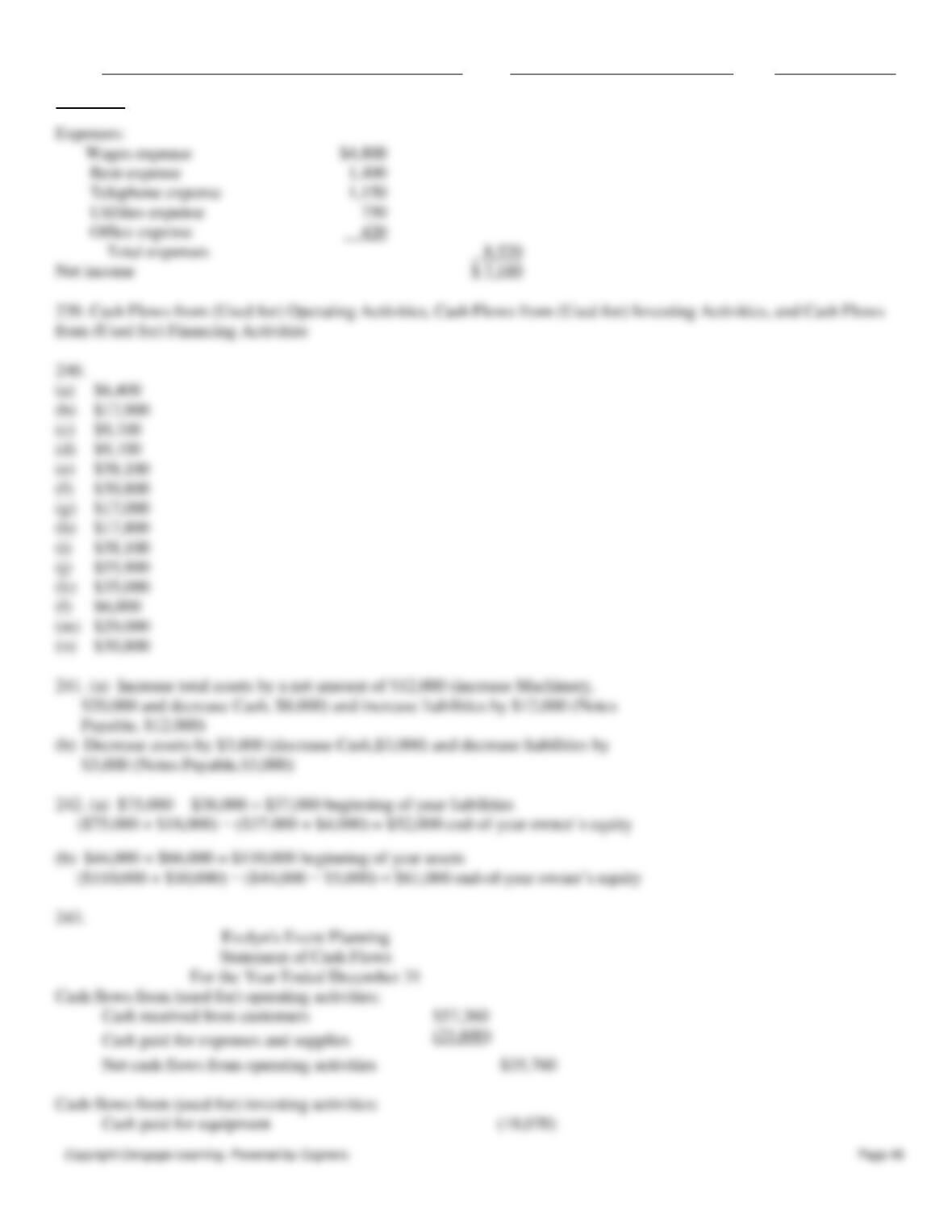
240. Harris Designers began operations on April 1. The following financial statements are for Harris Designers for the
month ended April 30 (the first month of operations). Determine the missing amounts for letters (a) through (o).
Harris Designers
Income Statement
For the Month Ended April 30
Fees earned
$27,000
Expenses:
Wages expense
$5,250
Rent expense
(a)
Supplies expense
4,600
Utilities expense
400
Miscellaneous expense
1,250
Total expenses
(b)
Net income
$ (c)
Harris Designers
Statement of Owner’s Equity
For the Month Ended April 30
Lori Harris, capital, April 1
$ 0
Investment on April 1
$35,000
Net income for April
(d)
Withdrawals
(6,000)
Increase in owner’s equity
(e)
Lori Harris, capital, April 30
$38,100
Harris Designers

Name:
Class:
Date:
chapter 1
Balance Sheet
April 30
Assets
Liabilities
Cash
$ (f)
Accounts payable
$(h)
Supplies
8,100
Owner’s Equity
Land
(g)
Lori Harris, capital
(i)
Total liabilities and
Total assets
$55,900
owner’s equity
$(j)
Harris Designers
Statement of Cash Flows
For the Month Ended April 30
Cash flows from (used for) operating activities:
Cash received from customers
$23,000
Cash paid for expenses and to
(4,200)
Net cash flows from operating activities
$18,800
Cash flows from (used for) investing activities:
Cash paid for acquisition of land
(17,000)
Cash flows from (used for) financing activities:
Cash received as owner’s investment
$ (k)
Cash withdrawal by owner
(l)
Net cash flows from financing activities
(m)
Net increase in cash
$ (n)
Cash balance, April 1
0
Cash balance, April 30
$ (n)
Hint: Use the interrelationships among the financial statements to solve this problem.
241. Simpson Auto Body Repair purchased $20,000 of machinery. The company paid $8,000 in cash at the time of the
purchase and signed a promissory note for the remainder to be paid in four monthly installments.
(a) How will the purchase affect the accounting equation?
(b) How will the payment of the first monthly installment affect the accounting equation (ignore interest)?
242. Use the accounting equation to answer each of the following independent questions.
(a) At the beginning of the year, Norton Company’s assets were $75,000 and its owner’s equity was $38,000. During
the year, assets increased by $18,000 and liabilities increased by $4,000. What was the owner’s equity at the
end of the year?
(b) At the beginning of the year, Turpin Industries had liabilities of $44,000 and owner’s equity of $66,000. If assets
increased by $10,000 and liabilities decreased by $5,000, what was the owner’s equity at the end of the year?
243. A summary of cash flows for Evelyn’s Event Planning for the year ended December 31 is as follows:
Cash receipts:
Cash received from customers
$57,360
Cash received from bank loan
15,000
Cash payments:
Cash paid for expenses and supplies
$21,600
Cash paid for equipment
18,070
Cash paid to the owner for personal use
12,000

Name:
Class:
Date:
chapter 1
Cash balance as of January 1
$15,580
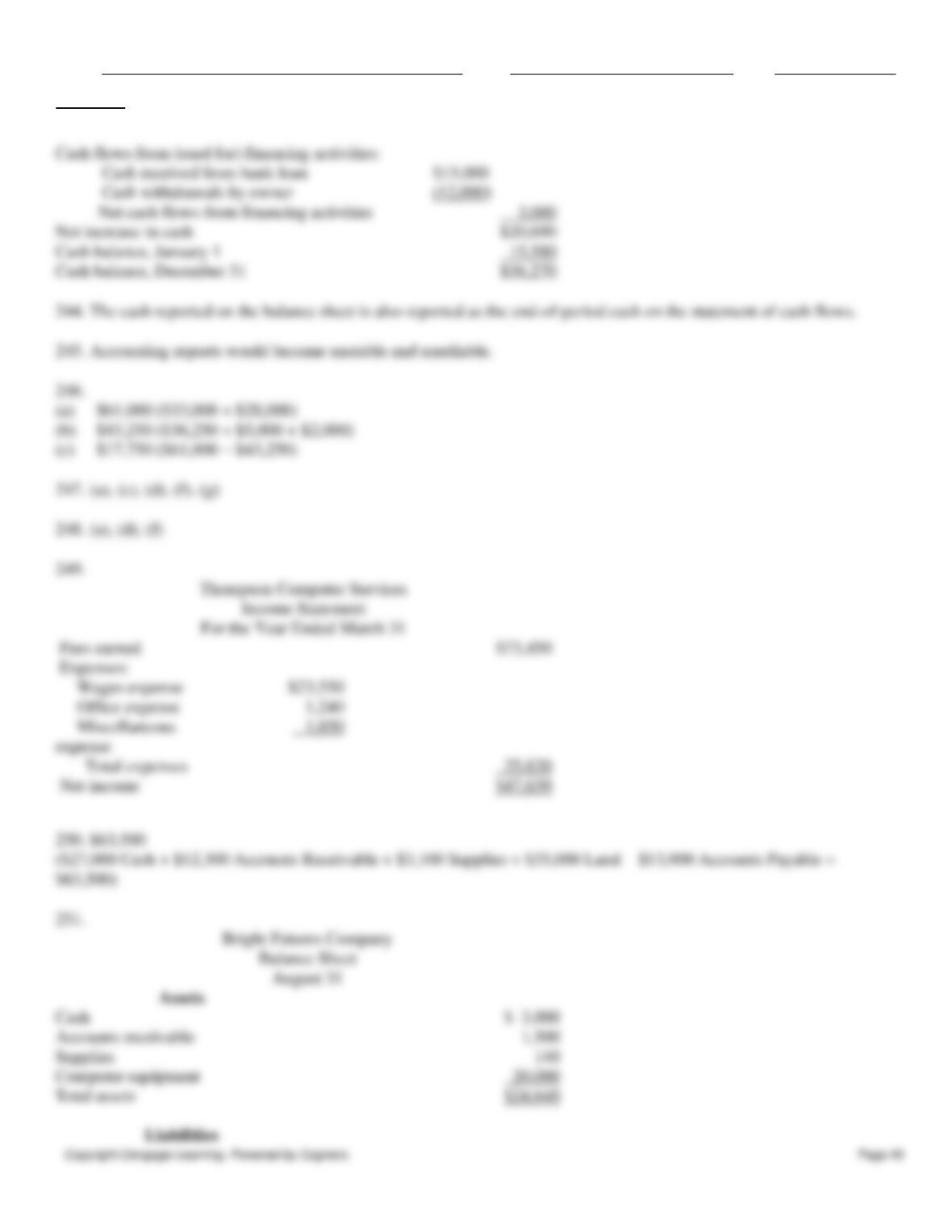
Prepare a statement of cash flows for Evelyn’s Event Planning for the year ended December 31.
244. Explain the interrelationship between the balance sheet and the statement of cash flows.
245. Give the major disadvantage of disregarding the cost concept and constantly revaluing assets based on appraisals and
opinions.
246. The following selected transaction data of a business are for September. Determine the following amounts for
September: (a) total revenue, (b) total expenses, (c) net income.
Service sales charged to customers on account during September
$33,000
Cash received from cash customers for services performed in September
28,000
Cash received from customers on account during September:
Services performed and charged to customers prior to September
13,000
Services performed and charged to customers during September
18,000
Expenses incurred prior to September and paid during September
6,500
Expenses incurred and paid in September
36,250
Expenses incurred in September but not paid in September
5,000
Expenses for supplies used and insurance (not given)
applicable to September
2,000
247. Identify which of the following items would appear on a balance sheet.
(a)
Cash
(b)
Fees earned
(c)
Joe Brown, capital
(d)
Wages payable
(e)
Rent expense
(f)
Prepaid advertising
(g)
Land
248. From the following list of items taken from Lamar’s accounting records, identify those that would appear on the
income statement.
(a)
Rent expense
(b)
Land
(c)
Capital
(d)
Fees earned
(e)
Withdrawal
(f)
Wages expense
(g)
Investment
The assets and liabilities of Thompson Computer Services at March 31, the end of the current year, and its revenue and
expenses for the year follow. The capital of the owner was $180,000 at April 1, the beginning of the current year. Mr.
Thompson invested an additional $25,000 in the business during the year.
Accounts payable
$ 2,000
Miscellaneous expense
$ 1,030
Accounts receivable
10,340
Office expense
1,240
Cash
21,420
Supplies
1,670
Fees earned
73,450
Wages expense
23,550

Name:
Class:
Date:
chapter 1
Land
47,000
Drawing
16,570
Building
157,630
249. Prepare an income statement for the current year ended March 31.
250. On July 1 of the current year, the assets and liabilities of John Wong, DVM, are as follows: Cash, $27,000; Accounts
Receivable, $12,300; Supplies, $3,100; Land, $35,000; Accounts Payable, $13,900. What is the amount of owner’s equity
(John Wong’s capital) as of July 1 of the current year?
251. Using the following data for Bright Futures Company, prepare a balance sheet in report form as of August 31.
Telephone expense
$ 1,150
Cash
3,000
Accounts payable
1,540
Jason Bright, drawing
800
Fees earned
15,700
Rent expense
1,400
Supplies
140
Accounts receivable
1,500
Computer equipment
20,000
Jason Bright, capital (August 1)
14,320
Wages expense
4,800
Utilities expense
750
Notes payable
2,400
Office expense
420
252. Use the following data for Flagger Company to prepare an income statement for the year ended December 31:
Fees earned
$168,000
Cash
$30,000
Accounts receivable
14,000
Selling expenses
44,000
Equipment
42,000
Flagger, capital
36,000
Accounts payable
12,000
Rent expense
51,000
Salaries and wages expense
40,000
Prepaid rent
2,000
Income tax payable
5,000
Income tax expense
18,000
Notes payable
20,000
253. Discuss internal and external users of accounting information. What areas of accounting provide them with
information? Give an example of the type of report each type of user might use.
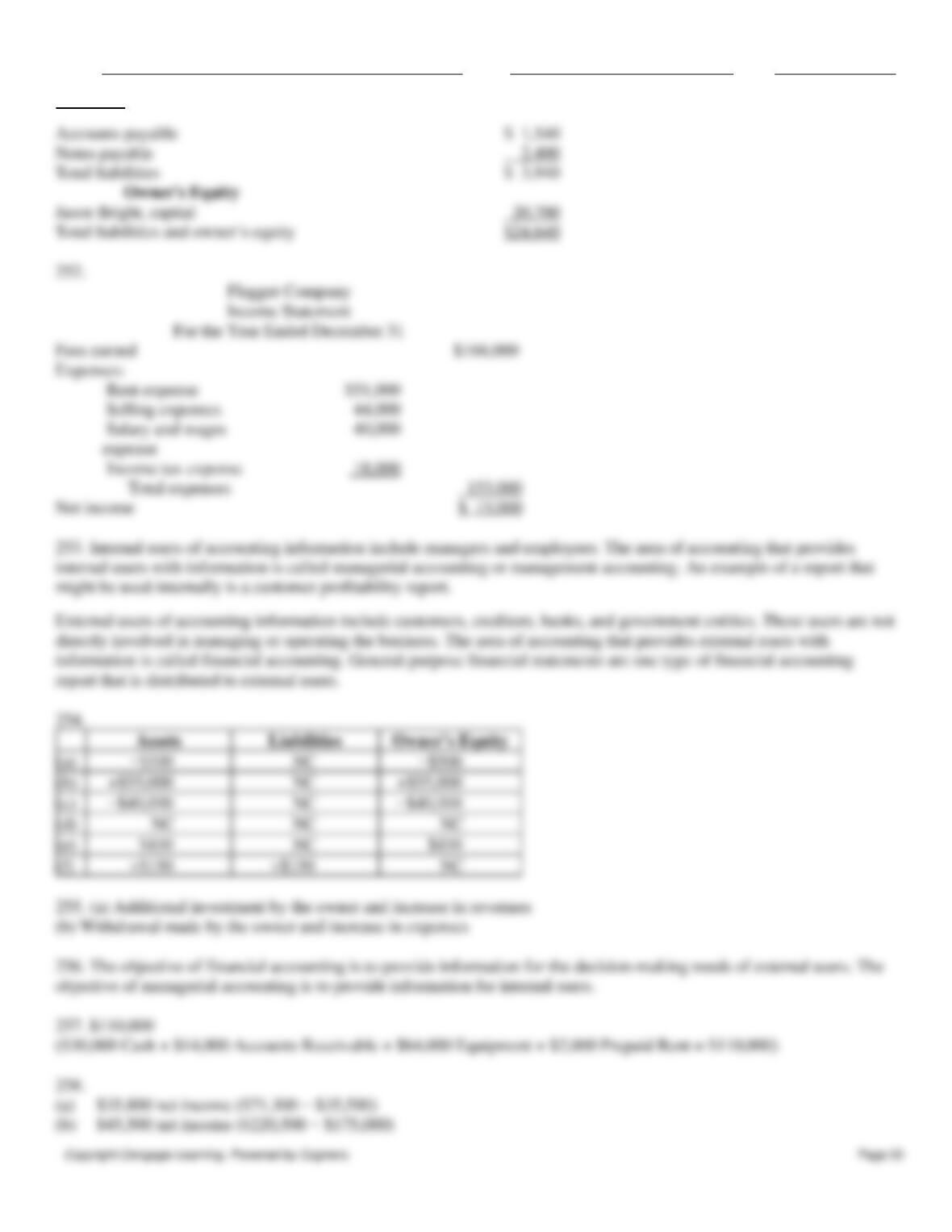
254. Shiny Kar Company had the following transactions. For each transaction, show the effect on the accounting equation
by putting the amount and direction (+, –, or NC for no change) in each box of the following table.
Assets
Liabilities
Owner’s
Equity
(a) Shiny Kar withdrew $500 cash for food
(b) Shiny Kar Company sold 2 cars for a total of $55,000 on
account
(c) The cost of the cars sold in (b) above was $40,000
(d) Shiny Kar received a $35,000 payment for a car
previously sold on account
(e) Shiny Kar paid $450 for advertising

Name:
Class:
Date:
chapter 1
(f) Shiny Kar purchased $150 of cleaning supplies on account
255. There are four transactions that affect owner’s equity.
(a) What are the two types of transactions that increase owner’s equity?
(b) What are the two types of transactions that decrease owner’s equity?
256. What is the major difference between the objective of financial accounting and the objective of managerial
accounting?
The accountant for Scott Industries prepared the following list of accounting equation element balances from the
company’s records for the year ended December 31:
Fees earned
$165,000
Cash
$30,000
Accounts receivable
14,000
Selling expenses
44,000
Equipment
64,000
Scott, capital
27,000
Accounts payable
12,000
Interest revenue
3,000
Salaries and wages expense
40,000
Prepaid rent
2,000
Income tax payable
5,000
Income tax expense
18,000
Notes payable
20,000
Rent expense
20,000
257. Determine the total assets at the end of the current year for Scott Industries.
258. For each of the following, determine the amount of net income or net loss for the year.
(a)
Revenues for the year totaled $71,300 and expenses totaled $35,500. The owner made an
additional investment of $15,000 during the year.
(b)
Revenues for the year totaled $220,500 and expenses totaled $175,000. The owner
withdrew $40,000 during the year.
(c)
Revenues for the year totaled $149,000 and expenses totaled $172,000. The owner
invested an additional $12,000 and withdrew $16,000 during the year.
(d)
Revenues for the year totaled $198,150 and expenses totaled $174,200. The owner
withdrew $35,000 during the year.
The accountant for Scott Industries prepared the following list of accounting equation element balances from the
company’s records for the year ended December 31:
Fees earned
$165,000
Cash
$30,000
Accounts receivable
14,000
Selling expenses
44,000
Equipment
64,000
Scott, capital
27,000
Accounts payable
12,000
Interest revenue
3,000
Salaries and wages expense
40,000
Prepaid rent
2,000
Income tax payable
5,000
Income tax expense
18,000
Notes payable
20,000
Rent expense
20,000
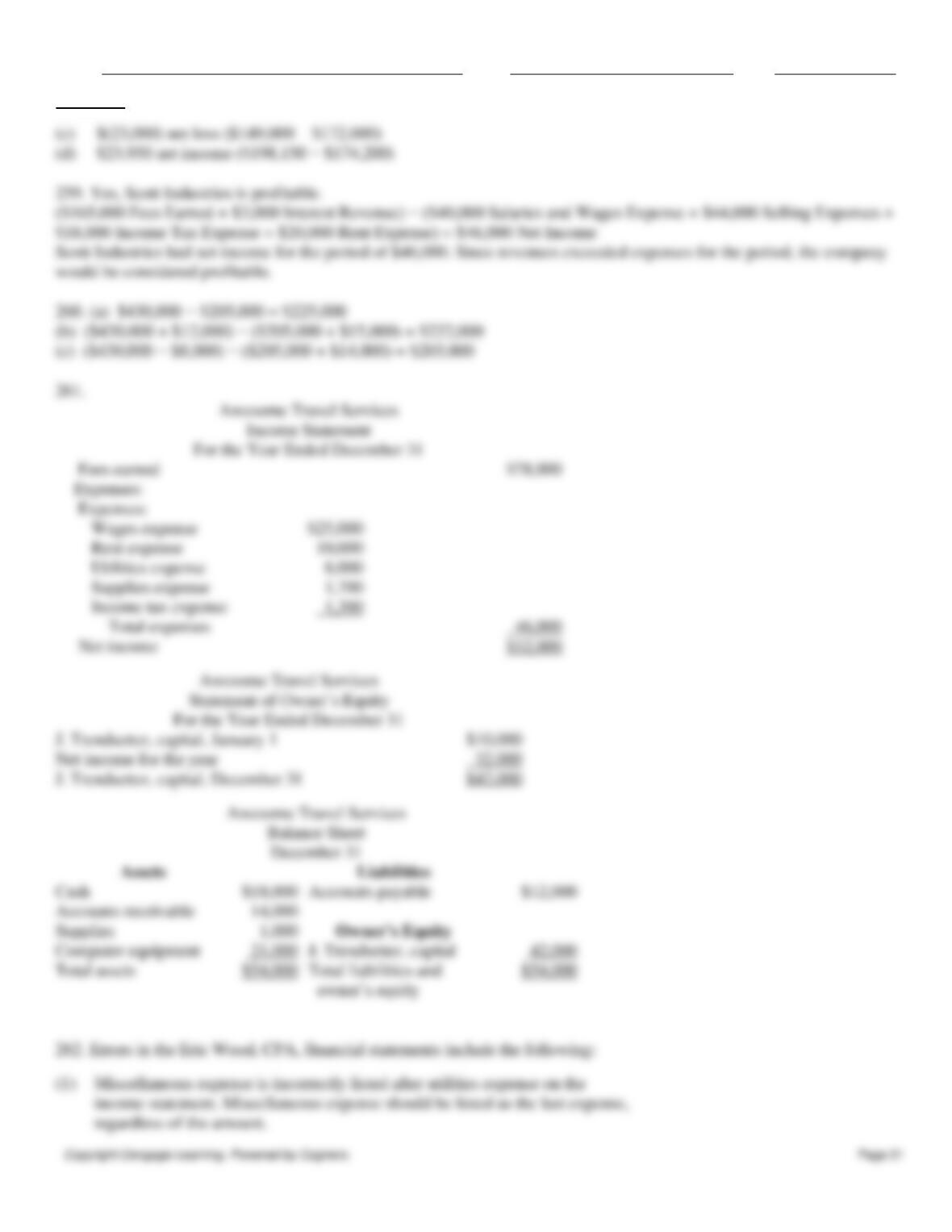
259. Based on the information for Scott Industries, is it profitable? Explain your answer.
260. Martin Blair is the owner and operator of Martin Consultants. At December 31 of the current year, Martin
Consultants has assets of $430,000 and liabilities of $205,000. Using the accounting equation and considering each case
independently, determine the following:

Name:
Class:
Date:
chapter 1
(a) Martin Blair, capital, as of December 31.
(b) Martin Blair, capital, as of December 31 of the next year, assuming that assets increased by $12,000
and liabilities increased by $15,000.
(c) Martin Blair, capital, as of December 31 of the next year, assuming that assets decreased by $8,000
and liabilities increased by $14,000.
261. Using the following data for Awesome Travel Services, prepare an income statement, a statement of owner’s equity,
and a balance sheet for the year ended (or as of) December 31.
Accounts payable
$12,000
J. Trendsetter, capital (January 1)
$10,000
Accounts receivable
14,000
Supplies
1,000
Cash
18,000
Income tax expense
1,300
Computer equipment
21,000
Utilities expense
8,000
Fees earned
78,000
Wages expense
25,000
Rent expense
10,000
Supplies expense
1,700
There were no additional investments or withdrawals by J. Trendsetter during the year.
262. Eric Wood, CPA, was organized on January 1 as a proprietorship. List the errors that you find in the following
financial statements and prepare corrected statements.
Eric Wood, CPA
Income Statement
For the Three Months Ended March 31
Fees earned
$42,000
Expenses:
Salary expense
$9,735
Rent expense
5,200
Advertising expense
3,950
Utilities expense
3,225
Miscellaneous expense
4,000
Answering service expense
2,550
Supplies expense
4,000
Total expenses
28,000
Net income
$14,000
Eric Wood, CPA
Statement of Owner’s Equity
March 31
Eric Wood, capital, January 1
$ 0
Investment on January 1
$20,000
Net income for the three months
14,000
Withdrawals
(5,000)
Increase in owner’s equity
31,000
Eric Wood, capital, March 31
$31,000
Balance Sheet
For the Three Months Ended March 31
Assets
Owner’s Equity
Land
$13,000
Eric Wood, capital
$31,000
Cash
10,860
Liabilities
Accounts payable
2,670
Accounts receivable
2,225
Supplies
925

Name:
Class:
Date:
chapter 1
Total assets
$33,225
Total liabilities and
owner’s equity
$33,225
263. Given the following:
Beginning capital $58,000
Ending capital 30,000
Owner’s withdrawals 25,000
Determine net income or net loss.
264. The total assets and total liabilities of Paul’s Pools, a proprietorship, at the beginning and at the end of the current
fiscal year are as follows:
January 1
December 31
Total assets
$280,000
$475,000
Total liabilities
205,000
130,000
(a)
Determine the amount of net income earned during the year. The owner did not invest
any additional assets in the business during the year and made no withdrawals.
(b)
Determine the amount of net income during the year. The assets and liabilities at the
beginning and end of the year are unchanged from the given amounts. However, the
owner withdrew $53,000 in cash during the year (no additional investments).
(c)
Determine the amount of net income earned during the year. The assets and liabilities
at the beginning and end of the year are unchanged from the given amounts. However,
the owner invested an additional $35,000 in cash in the business in June of the current
fiscal year (no withdrawals).
(d)
Determine the amount of net income earned during the year. The assets and liabilities
at the beginning and end of the year are unchanged from the given amounts. However,
the owner invested an additional $12,000 in cash in August of the current fiscal year
and made 12 monthly cash withdrawals of $1,500 each during the year.
265. The following selected transactions are completed by a proprietorship. Indicate the effects of each transaction on
assets, liabilities, and owner’s equity by inserting “+” for increase and “−” for decrease in the appropriate columns at the
right. If appropriate, you may insert more than one symbol in a column.
A
L
OE
(a)
Paid rent expense
_____
_____
_____
(b)
Purchased supplies on account
_____
_____
_____
(c)
Received cash for providing services to customers
_____
_____
_____
(d)
Billed customers for services on account
_____
_____
_____
(e)
Paid cash to owner for personal use
_____
_____
_____
266. What information does the income statement give to business users?
267. The following selected transactions are completed by a proprietorship. Indicate the effects of each transaction on
assets, liabilities, and owner’s equity by inserting “+” for increase and “−” for decrease in the appropriate columns at the
right. If appropriate, you may insert more than one symbol in a column.
A
L
OE

Name:
Class:
Date:
chapter 1
(a)
Purchased land with cash
_____
_____
_____
(b)
Received cash from customers on account
_____
_____
_____
(c)
Determined the amount of supplies used this month
_____
_____
_____
(d)
Received cash from owner as additional investment
_____
_____
_____
(e)
Paid miscellaneous expense
_____
_____
_____
268. Indicate how the following transactions affect the accounting equation.
(a) The purchase of supplies on account
(b) The purchase of supplies for cash
(c) A withdrawal by the owner to pay personal expenses
(d) Revenues received in cash
(e) Sale made on account
269. Companies like Enron, WorldCom, and Tyco International, Ltd. have been caught in the midst of ethical lapses that
led to fines, firings, and criminal and/or civil prosecution. List and briefly describe three factors that are responsible for
what went wrong in these companies.
270. Krammer Company has liabilities equal to one-fourth of the total assets. Krammer’s owner’s equity is $45,000.
Using the accounting equation, what is the amount of liabilities for Krammer?
271. Bob Johnson is the sole owner of Johnson’s Carpet Cleaning Service. Bob purchased a personal automobile for
$10,000 cash plus he took out a loan for $20,000 in his name. Describe how this transaction is related to the business
entity concept.
272. Determine the missing amount for each of the following:
Assets
Liabilities
Owner’s Equity
(a)
$38,000
$45,000
$30,000
(b)
22,000
53,000
32,000
(c)
273. Company G has a ratio of liabilities to stockholders’ equity of 0.12 and 0.28 for Year 1 and Year 2, respectively. In
contrast, Company M has a ratio of liabilities to stockholders’ equity of 1.13 and 1.29 for the same period.
REQUIRED:
Based on this information, which company’s creditors are more at risk and why? Should the creditors of either company
fear the risk of nonpayment?
274. List the five steps in the process by which accounting provides information to users.
The assets and liabilities of Thompson Computer Services at March 31, the end of the current year, and its revenue and
expenses for the year follow. The capital of the owner was $180,000 at April 1, the beginning of the current year. Mr.
Thompson invested an additional $25,000 in the business during the year.
Accounts payable
$ 2,000
Miscellaneous expense
$ 1,030
Accounts receivable
10,340
Office expense
1,240
Cash
21,420
Supplies
1,670
Fees earned
73,450
Wages expense
23,550
Land
47,000
Drawing
16,570
Building
157,630

Name:
Class:
Date:
chapter 1
275. Prepare a statement of owner’s equity for Thompson Computer Services for the current year ended March 31.
276. Using the following data for Bright Futures Company, prepare a statement of owner’s equity for the month ended
August 31.
Telephone expense
$ 1,150
Cash
3,000
Accounts payable
1,540
Jason Bright, drawing
800
Fees earned
15,700
Rent expense
1,400
Supplies
140
Accounts receivable
1,500
Computer equipment
20,000
Jason Bright, capital (August 1)
14,320
Wages expense
4,800
Utilities expense
750
Notes payable
2,400
Office expense
420
277. Explain the meaning of the business entity concept.
278. Name and describe the four primary financial statements for a proprietorship.
279. The following selected transactions are completed by a proprietorship. Indicate the effects of each transaction on
assets, liabilities, and owner’s equity by inserting “+” for increase and “−” for decrease in the appropriate columns at the
right. If appropriate, you may insert more than one symbol in a column.
A
L
OE
(a)
Received cash from owner as initial investment
_____
_____
_____
(b)
Purchased supplies, paying cash
_____
_____
_____
(c)
Paid creditors on account
_____
_____
_____
(d)
Received cash from customers on account
_____
_____
_____
(e)
Paid utilities expense
_____
_____
_____
280. Collins Landscape Company purchased various landscaping supplies on account to be used for landscape designs for
its customers. How will this business transaction affect the accounting equation?
281. The following selected transactions are completed by a proprietorship. Indicate the effects of each transaction on
assets, liabilities, and owner’s equity by inserting “+” for increase and “−” for decrease in the appropriate columns at the
right. If appropriate, you may insert more than one symbol in a column.
A
L
OE
(a)
Received cash from owner as an additional investment
_____
_____
_____
(b)
Purchased supplies on account
_____
_____
_____
(c)
Paid rent for the current month
_____
_____
_____
(d)
Received cash for services sold to customers
_____
_____
_____
(e)
Paid cash to creditor for purchases in (b)
_____
_____
_____
(f)
Billed customers for services sold on account
_____
_____
_____
(g)
Received cash on account from customers
_____
_____
_____
(h)
Owner withdrew cash for personal use
_____
_____
_____

Name:
Class:
Date:
chapter 1
(i)
Recorded the cost of supplies used during the year
_____
_____
_____
(j)
Paid wages
_____
_____
_____
(k)
Purchased a truck for cash
_____
_____
_____
282. Dave Ryan is the owner and operator of Ryan’s Arcade. At the end of its accounting period, December 31, Ryan’s
Arcade has assets of $450,000 and liabilities of $125,000. Using the accounting equation, determine the following
amounts:
(a)
owner’s equity as of December 31 of the current year
(b)
owner’s equity as of December 31 at the end of the next year, assuming that assets
increased by $65,000 and liabilities increased by $35,000 during the year
283. The assets and liabilities of Rocky’s Day Spa at December 31 and its expenses for the year follow. The capital of the
owner was $68,000 at January 1. The owner invested an additional $10,000 during the year. Net income for the year is
$45,625.
Accounts payable
$ 4,375
Spa operating expense
$23,760
Accounts receivable
8,490
Office expense
2,470
Cash
13,980
Spa supplies
9,230
Fees earned
???
Wages expense
26,580
Spa furniture and equipment
56,000
Drawing
38,170
Computers
2,130
Prepare an income statement for the current year ended December 31.
The accountant for Scott Industries prepared the following list of accounting equation element balances from the
company’s records for the year ended December 31:
Fees earned
$165,000
Cash
$30,000
Accounts receivable
14,000
Selling expenses
44,000
Equipment
64,000
Scott, capital
27,000
Accounts payable
12,000
Interest revenue
3,000
Salaries and wages expense
40,000
Prepaid rent
2,000
Income tax payable
5,000
Income tax expense
18,000
Notes payable
20,000
Rent expense
20,000
284. Determine the total liabilities at the end of the current year for Scott Industries.

Name:
Class:
Date:
chapter 1
Answer Key

Name:
Class:
Date:
chapter 1

Name:
Class:
Date:
chapter 1

Name:
Class:
Date:
chapter 1

Name:
Class:
Date:
chapter 1

Name:
Class:
Date:
chapter 1

Name:
Class:
Date:
chapter 1

Name:
Class:
Date:
chapter 1
Name:
Class:
Date:
chapter 1
Name:
Class:
Date:
chapter 1
Name:
Class:
Date:
chapter 1
Name:
Class:
Date:
chapter 1
Name:
Class:
Date:
chapter 1
Name:
Class:
Date:
chapter 1
Name:
Class:
Date:
chapter 1
Name:
Class:
Date:
chapter 1
Name:
Class:
Date:
chapter 1
Name:
Class:
Date:
chapter 1
Name:
Class:
Date:
chapter 1
Name:
Class:
Date:
chapter 1
Name:
Class:
Date:
chapter 1