CHAPTER 1
FINANCIAL ACCOUNTING AND
ACCOUNTING STANDARDS
IFRS questions are available at the end of this chapter.
TRUE-FALSE—Conceptual
Answer No. Description
MULTIPLE CHOICE—Conceptual
Answer No. Description
Test Bank for Intermediate Accounting, Fifteenth Edition
1 – 2
MULTIPLE CHOICE—Conceptual (cont.)
Answer No. Description
Financial Accounting and Accounting Standards
1 – 3
MULTIPLE CHOICE—Conceptual (cont.)
Answer No. Description
P Note: these questions also appear in the Problem-Solving Survival Guide.
EXERCISES
Item Description
CHAPTER LEARNING OBJECTIVES
1. Identify the major financial statements and other means of financial reporting.
2. Explain how accounting assists in the efficient use of scarce resources.
3. Identify the objective of financial reporting.
4. Explain the need for accounting standards.
5. Identify the major policy-setting bodies and their role in the standard-setting process.
6. Explain the meaning of generally accepted accounting principles (GAAP) and the role of the
Codification for GAAP.
7. Describe the impact of user groups on the rule-making process.
8. Describe some of the challenges facing financial reporting.
9. Understand issues related to ethics and financial accounting.
10. Compare the procedures related to financial accounting and accounting standards under
GAAP and IFRS.

Test Bank for Intermediate Accounting, Fifteenth Edition
1 – 4
SUMMARY OF LEARNING OBJECTIVES BY QUESTIONS
Item
Type
Item
Type
Item
Type
Item
Type
Item
Type
Item
Type
Item
Type
Learning Objective 1
1.
TF
21.
MC
23.
MC
25.
MC
P27.
MC
2.
TF
22.
MC
24.
MC
26.
MC
Learning Objective 2
3.
TF
4.
TF
28.
MC
29.
MC
30.
MC
Learning Objective 3
5.
TF
33.
MC
35.
MC
37.
MC
6.
TF
34.
MC
36.
MC
85.
E
Learning Objective 4
7.
TF
38.
MC
39.
MC
40.
MC
86.
E
Learning Objective 5
8.
TF
43.
MC
49.
MC
55.
MC
61.
MC
67.
MC
89.
E
9.
TF
44.
MC
50.
MC
56.
MC
62.
MC
P68.
MC
10.
TF
45.
MC
51.
MC
57.
MC
63.
MC
P69.
MC
11.
TF
46.
MC
52.
MC
58.
MC
64.
MC
P86.
E
41.
MC
47.
MC
53.
MC
59.
MC
65.
MC
87.
E
42.
MC
48.
MC
54.
MC
60.
MC
66.
MC
88.
E
Learning Objective 6
12.
TF
70.
MC
72.
MC
74.
MC
76.
MC
13.
TF
71.
MC
73.
MC
75.
MC
Learning Objective 7
14.
TF
16.
TF
77.
MC
79.
MC
81.
MC
83.
E
15.
TF
62.
MC
78.
MC
80.
MC
82.
MC
Learning Objective 8
17.
TF
18.
TF
19.
TF
31.
MC
32.
MC
Learning Objective 9
20.
TF
84.
MC
Learning Objective 10 – IFRS QUESTIONS
1.
TF
2.
TF
3.
TF
4.
TF
5.
TF
6.
TF
7.
MC
8.
MC
9.
MC
10.
MC
11.
MC
12.
MC
13.
MC
14.
MC
15.
SA
16.
SA
Note: TF = True-False SA= Short Answer
MC = Multiple Choice
E = Exercise

Financial Accounting and Accounting Standards
1 – 5
TRUE-FALSE—Conceptual
1. Financial accounting is the process of identifying, measuring, analyzing, and communicating
financial information needed by management to plan, evaluate, and control a company’s
operations.
2. Financial statements are the principal means through which a company communicates its
financial information to those outside it.
3. Users of financial reports of a company use the information provided by these reports to
make their capital allocation decisions.
4. An effective process of capital allocation promotes productivity and provides an efficient
market for buying and selling securities and obtaining and granting credit.
5. The objective of financial reporting is to report the plans made by a company to improve the
productivity of its employees.
6. Investors are interested in financial reporting because it provides information that is useful
for making decisions.
7. Users of financial accounting statements have both coinciding and conflicting needs for
information of various types.
8. The Securities and Exchange Commission appointed the Committee on Accounting
Procedure.
9. The passage of a new FASB Accounting Standards Update requires the support of five of
the seven board members.
10. Statements of Financial Accounting Concepts set forth fundamental objectives and
concepts that are used by the FASB in developing future standards of financial accounting
and reporting.
11. The AICPA created the Accounting Principles Board in 1959.
12. The FASB’s Codification creates a new set of GAAP.
13. The AICPA’s Code of Professional Conduct requires that members prepare financial
statements in accordance with generally accepted accounting principles.
14. GAAP is a product of careful logic or empirical findings and is not influenced by political
action.
15. The Public Company Accounting Oversight Board has oversight and enforcement authority
and establishes auditing and independence standards and rules.
16. The expectations gap is due to the difference between what the public thinks accountants
should do and what accountants think they can do.
Test Bank for Intermediate Accounting, Fifteenth Edition
1 – 6
17. Financial reports in the early 21st century did not provide any information about a
company’s soft assets (intangibles).
18. Accounting standards are now less likely to require the recording or disclosure of fair value
information.
19. U.S. companies that list overseas are required to use International Financial Reporting
Standards, issued by the International Accounting Standards Board.
20. Ethical issues in financial accounting are governed by the AICPA.
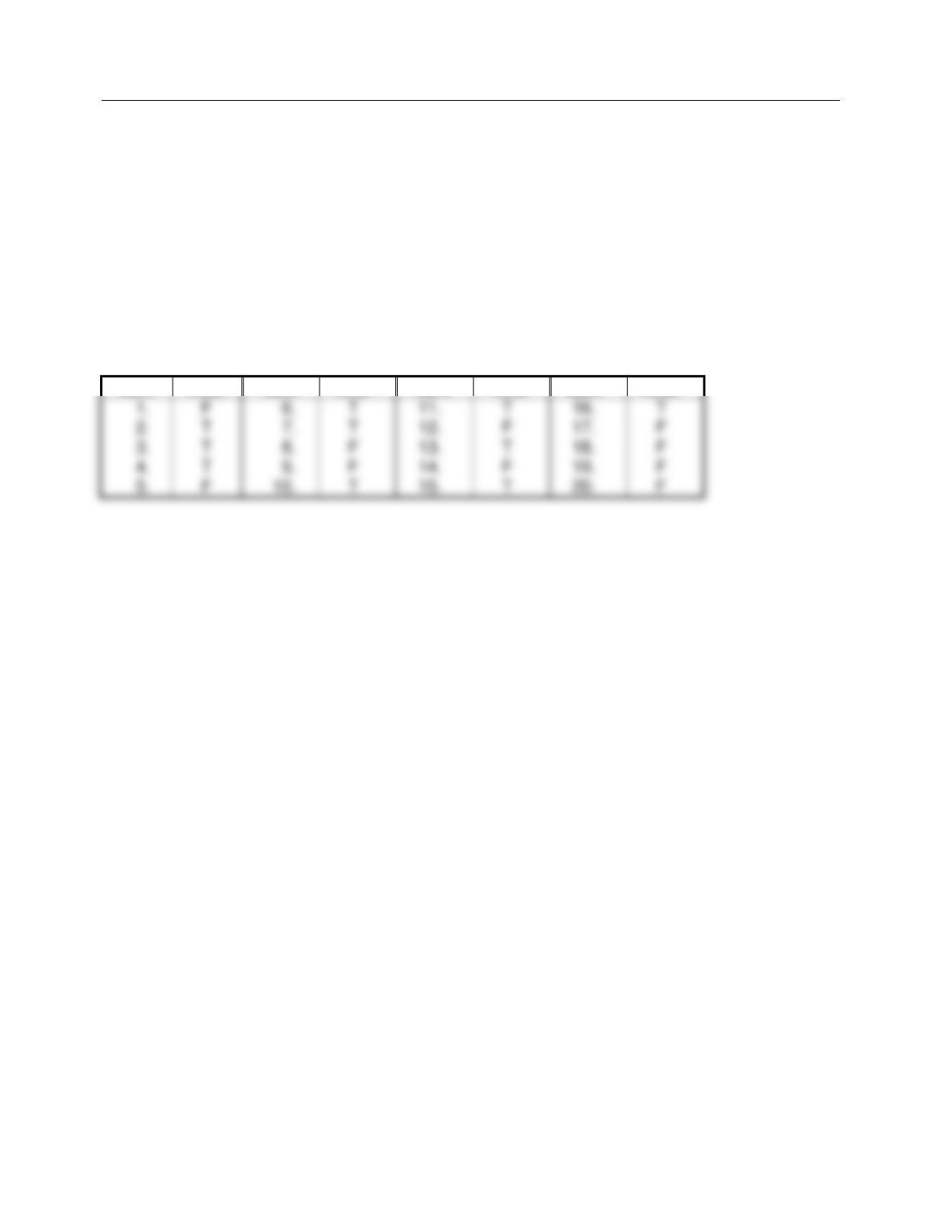
True-False Answers—Conceptual
Item
Ans.
Item
Ans.
Item
Ans.
Item
Ans.
MULTIPLE CHOICE—Conceptual
21. General-purpose financial statements are the product of
a. financial accounting.
b. managerial accounting.
c. both financial and managerial accounting.
d. neither financial nor managerial accounting.
22. Which of the following is not a user of financial reports?
a. Creditors.
b. Government agencies.
c. Unions.
d. All of these are users.
23. The financial statements most frequently provided include all of the following except the
a. balance sheet.
b. income statement.
c. statement of cash flows.
d. statement of retained earnings.
24. The information provided by financial reporting pertains to
a. individual business enterprises, rather than to industries or an economy as a whole or
to members of society as consumers.
b. business industries, rather than to individual enterprises or an economy as a whole or
to members of society as consumers.
c. individual business enterprises, industries, and an economy as a whole, rather than to
members of society as consumers.
d. an economy as a whole and to members of society as consumers, rather than to
individual enterprises or industries.

Financial Accounting and Accounting Standards
1 – 7
25. All the following are differences between financial and managerial accounting in how
accounting information is used except to
a. plan and control company’s operations.
b. decide whether to invest in the company.
c. evaluate borrowing capacity to determine the extent of a loan to grant.
d. All the answer choices are correct.
26. Which of the following represents a form of communication through financial reporting but
not through financial statements?
a. Balance sheet.
b. President’s letter.
c. Income statement.
d. Notes to financial statements.
P27. The process of identifying, measuring, analyzing, and communicating financial information
needed by management to plan, evaluate, and control an organization’s operations is
called
a. financial accounting.
b. managerial accounting.
c. tax accounting.
d. auditing.
28. How does accounting help the capital allocation process attract investment capital?
a. By providing timely, relevant information.
b. By encouraging innovation.
c. By promoting productivity.
d. By providing timely, relevant information and by encouraging innovation.
29. Which of the following helps in determining whether a business thrives?
a. Markets.
b. Free enterprise.
c. Competition.
d. All of these answer choices are correct.
30. Which of the following is related to an effective capital allocation?
a. Promoting productivity.
b. Encouraging innovation.
c. Providing an efficient market for buying and selling securities.
d. All of these answer choices are correct.
31. Financial statements in the early 2000s provide information related to
a. nonfinancial measurements.
b. forward-looking data.
c. hard assets (inventory and plant assets).
d. None of these answer choices are correct.
32. Which of the following is not a major challenge facing the accounting profession?
a. Nonfinancial measurements.
b. Timeliness.
c. Accounting for hard assets.
d. Forward-looking information.

Test Bank for Intermediate Accounting, Fifteenth Edition
1 – 8
33. What is the objective of financial reporting?
a. Provide information that is useful to management in making decisions.
b. Provide information that clearly portrays nonfinancial transactions.
c. Provide information about the reporting entity that is useful to present and potential
equity investors, lenders, and other creditors.
d. Provide information that excludes claims to the resources.
34. Primary users for general-purpose financial statements include
a. creditors.
b. employees.
c. investors.
d. both creditors and investors.
35. Which of the following will be of interest to investors in decision-making?
a. Assessing the company’s ability to generate net cash inflows.
b. Assessing management’s ability to protect and enhance the capital providers’
investments.
c. Both assessing the company’s ability to generate net cash inflows and assessing
management’s ability to protect and enhance the capital provider’s investments.
d. Assessing the company’s ability to collect debts.
36. Accrual accounting is used because
a. cash flows are considered less important.
b. it provides a better indication of a company’s ability to generate cash flows than the
cash basis.
c. it recognizes revenues when cash is received and expenses when cash is paid.
d. None of the answer choices are correct.
37. Which perspective is adopted as a part of the objective of general-purpose financial
reporting?
a. A decision-usefulness perspective.
b. A proprietary perspective.
c. An entity perspective.
d. A financial reporting perspective.
38. Which of the following is a requirement for an accounting principle to be called “generally
accepted”?
a. An authoritative accounting rule-making body has established it in an official
pronouncement.
b. The principle has been accepted as appropriate because of its universal application.
c. An authoritative accounting rule-making body has established it and it has been
accepted because of its universal application.
d. None of the answer choices are correct.
39. A common set of accounting standards and procedures are called
a. financial accounting standards.
b. generally accepted accounting principles.
c. objectives of financial reporting.
d. statements of financial accounting concepts.

Financial Accounting and Accounting Standards
1 – 9
40. Which of the following is a general limitation of “general purpose financial statements”?
a. General purpose financial statements may not be the most informative for a specific
enterprise.
b. General purpose financial statements are not comparable.
c. General purpose financial statements do not fairly present a company’s financial
operations.
d. None of the answer choices are correct.
41. What is the relationship between the Securities and Exchange Commission and
accounting standard setting in the United States?
a. The SEC requires all companies listed on an exchange to submit their financial
statements to the SEC.
b. The SEC coordinates with the AICPA in establishing accounting standards.
c. The SEC has a mandate to establish accounting standards for enterprises under its
jurisdiction.
d. The SEC reviews financial statements for compliance.
42. What is due process in the context of standard setting at the FASB?
a. The FASB operates in full view of the public.
b. Public hearings are held on proposed accounting standards.
c. Interested parties can make their views known.
d. All of the answer choices are correct.
43. Which of the following organizations has been responsible for setting U.S. accounting
standards?
a. The Accounting Principles Board.
b. The Committee on Accounting Procedure.
c. The Financial Accounting Standards Board.
d. All of the answer choices are correct.
44. Why did the AICPA create the Accounting Principles Board?
a. The SEC disbanded the previous standard setting organization.
b. The previous standard setting organization did not provide a structured set of
accounting principles.
c. No such organization existed in the past.
d. None of the answer choices are correct.
45. Which organization was responsible for issuing Accounting Research Bulletins?
a. The Accounting Principles Board.
b. The Committee on Accounting Procedure.
c. The SEC.
d. The FASB.
46. A characteristic of generally accepted accounting principles include:
a. a common set of standards and principles.
b. standards and principles are based a federal statutes.
c. acceptance requires an affirmative vote of Certified Public Accountants.
d. practices that become accepted for at least a year by all industry members.

Test Bank for Intermediate Accounting, Fifteenth Edition
1 – 10
47. Characteristics of generally accepted accounting principles include all of the following
except
a. authoritative accounting that the rule-making body has established as a principle of
reporting.
b. standards are considered useful by the profession.
c. each principle is approved by the SEC.
d. practice has become universally accepted over time.
48. Why was it believed that accounting standards that were issued by the Financial
Accounting Standards Board would carry more weight?
a. Smaller membership.
b. The FASB board members were well-paid.
c. The FASB board members were CPAs.
d. Due process.
49. The passage of a new FASB Accounting Standards Update requires the support of
a. seven Board members.
b. three Board members.
c. four Board members.
d. five Board members.
50. What is the purpose of Emerging Issues Task Force?
a. Provide interpretation of existing standards.
b. Provide a consensus on how to account for new and unusual financial transactions.
c. Provide interpretive guidance.
d. Provide timely guidance on select issues.
51. Which organization is responsible for issuing Emerging Issues Task Force Statements?
a. The FASB
b. The CAP
c. The APB
d. The SEC
52. The role of the Securities and Exchange Commission in the formulation of accounting
principles can be best described as
a. consistently primary.
b. consistently secondary.
c. sometimes primary and sometimes secondary.
d. non-existent.
53. The body that has the power to prescribe the accounting practices and standards to be
employed by companies that fall under its jurisdiction is the
a. FASB.
b. AICPA.
c. SEC.
d. APB.

Financial Accounting and Accounting Standards
1 – 11
54. Companies that are listed on a stock exchange are required to submit their financial
statements to the
a. AICPA.
b. APB
c. FASB.
d. SEC.
55. The Financial Accounting Standards Board (FASB) was proposed by the
a. American Institute of Certified Public Accountants.
b. Accounting Principles Board.
c. Study Group on the Objectives of Financial Statements.
d. Study Group on establishment of Accounting Principles (Wheat Committee).
56. Which of the following is true of the Financial Accounting Standards Board
a. It has issued a series of pronouncements entitled Auditing Standards Updates.
b. It was the forerunner of the current Accounting Principles Board.
c. It is the arm of the Securities and Exchange Commission responsible for setting
financial accounting standards.
d. The members of the FASB are appointed by the Financial Accounting Foundation.
57. The Financial Accounting Foundation
a. oversees the operations of the FASB.
b. oversees the operations of the AICPA.
c. provides information to interested parties on financial reporting issues.
d. works with the Financial Accounting Standards Advisory Council to provide informa–
tion to interested parties on financial reporting issues.
58. The major distinction between the Financial Accounting Standards Board (FASB) and its
predecessor, the Accounting Principles Board (APB), is
a. the FASB issues exposure drafts of proposed standards.
b. all members of the FASB are fully remunerated, serve full time, and are independent
of any companies or institutions.
c. all members of the FASB possess extensive experience in financial reporting.
d. a majority of the members of the FASB are CPAs drawn from public practice.
59. The Financial Accounting Standards Board employs a “due process” system which
a. is an efficient system for collecting dues from members.
b. enables interested parties to express their views on issues under consideration.
c. identifies the accounting issues that are the most important.
d. requires that all accountants must receive a copy of financial standards.
60. Which of the following is not a publication of the FASB?
a. Statements of Financial Accounting Concepts
b. Accounting Research Bulletins
c. Interpretations
d. Technical Bulletins

Test Bank for Intermediate Accounting, Fifteenth Edition
1 – 12
61. FASB Technical Bulletins
a. are similar to FASB Interpretations in that they establish enforceable standards under
the AICPA’s Code of Professional Ethics.
b. are issued monthly by the FASB to deal with current topics.
c. are not expected to have a significant impact on financial reporting in general and
provide guidance when it does not conflict with any broad fundamental accounting
principle.
d. were recently discontinued by the FASB because they dealt with specialized topics
having little impact on financial reporting in general.
62. The purpose of the Emerging Issues Task Force is to
a. develop a conceptual framework as a frame of reference for the solution of future
problems.
b. lobby the FASB on issues that affect a particular industry.
c. do research on issues that relate to long-term accounting problems.
d. issue statements which reflect a consensus on how to account for new and unusual
financial transactions that need to be resolved quickly.
63. The American Institute of Certified Public Accountants (AICPA) continues to be involved in
all of the following except
a. developing and enforcing professional ethics.
b. developing auditing standards for public companies.
c. providing professional education programs.
d. All of the answer choices are correct.
P64. Which of the following pronouncements were issued by the Accounting Principles Board?
a. Accounting Research Bulletins
b. APB Opinions
c. APB Statements of Position
d. Statements of Financial Accounting Concepts
65. Which of the following organizations has not been instrumental in the development of
financial accounting standards in the United States?
a. AICPA
b. FASB
c. IASB
d. SEC
66. Which of the following organizations has not published accounting standards?
a. American Institute of Certified Public Accountants.
b. Securities and Exchange Commission.
c. Financial Accounting Standards Board.
d. All of these have published accounting standards.
67. The purpose of Statements of Financial Accounting Concepts is to
a. establish GAAP.
b. modify or extend an existing FASB Accounting Standards Update.
c. form a conceptual framework for solving existing and emerging problems.
d. determine the need for FASB involvement in an emerging issue.

Financial Accounting and Accounting Standards
1 – 13
P68. Members of the Financial Accounting Standards Board are
a. employed by the American Institute of Certified Public Accountants (AICPA).
b. part-time employees.
c. required to hold a CPA certificate.
d. independent of any other organization.
P69. The following are part of the “due process” system used by the FASB in the evolution of a
typical FASB Accounting Standards Update:
1. Exposure Draft
2. FASB Accounting Standards Update
3. Preliminary Views
The chronological order in which these items are released is as follows:
a. 1, 2, 3.
b. 1, 3, 2.
c. 2, 3, 1.
d. 3, 1, 2.
70. Which of the following is true of generally accepted accounting principles?
a. GAAP includes detailed practices and procedures as well as broad guidelines of
general application.
b. GAAP is influenced by pronouncements of the SEC and IRS.
c. GAAP changes over time as the nature of the business environment changes.
d. All of these answer choices are correct.
71. The most significant current source of generally accepted accounting principles is the
a. AICPA.
b. SEC.
c. APB.
d. FASB.
72. Which of the following is not a part of generally accepted accounting principles?
a. The FASB Interpretations
b. The CAP Accounting Research Bulletins
c. The APB Opinions
d. All of these are part of generally accepted accounting principles.
73. Which of the following publications does not qualify as a statement of generally accepted
accounting principles?
a. Statements of financial standards issued by the FASB
b. Accounting interpretations issued by the FASB
c. APB Opinions
d. Accounting research studies issued by the AICPA
74. Rule 203 of the Code of Professional Conduct addresses:
a. ethical requirements.
b. financial statements being based on generally accepted accounting principles.
c. advertising to obtain clients.
d. auditing financial statements.

Test Bank for Intermediate Accounting, Fifteenth Edition
1 – 14
75. What is the purpose of a FASB Staff Position?
a. Provide interpretation of existing standards.
b. Provide a consensus on how to account for new and unusual financial transactions.
c. Provide interpretive guidance.
d. Provide timely guidance on select issues.
76. Which of the following is not considered a component of generally accepted accounting
principles?
a. FASB Implementation Guides.
b. Widely recognized industry practices.
c. Articles published in CPA journals.
d. AICPA Accounting Interpretations.
77. Financial accounting standard-setting in the United States
a. can be described as a social process which reflects political actions of various
interested user groups as well as a product of research and logic.
b. is based solely on research and empirical findings.
c. is a legalistic process based on rules promulgated by governmental agencies.
d. is democratic in the sense that a majority of accountants must agree with a standard
before it becomes enforceable.
78. The purpose of the International Accounting Standards Board is to
a. issue enforceable standards which regulate the financial accounting and reporting of
multinational corporations.
b. develop a uniform currency in which the financial transactions of companies through–
out the world would be measured.
c. promote uniform accounting standards among countries of the world.
d. arbitrate accounting disputes between auditors and international companies.
79. Which of the following is a source of pressure that may influence the accounting standard
setting process?
a. Congress.
b. Lobbyist.
c. CPA firms.
d. All of these answers are correct.
80. What is a possible danger if politics plays too big a role in accounting standard setting?
a. Accounting standards that are not truly generally accepted.
b. Individuals may influence the standards.
c. User groups become active.
d. The FASB delegates its authority to elected officials.
Financial Accounting and Accounting Standards
1 – 15
81. What is the “expectations gap”?
a. The difference between what the public thinks the accountant should not do and what
the accountant knows they should do.
b. The difference between what the public thinks the accountant is doing and what
Congress says the accountant is doing.
c. The difference between what the public thinks the accountant should do and what the
accountant thinks they can do.
d. The difference between what the accountant is doing and what the Courts say the
accountant should be doing.
82. What is not a reason that accounting standards may differ across countries?
a. Governments.
b. Language.
c. Culture.
d. Past practice.
83. What would be an advantage of having all countries adopt and follow the same
accounting standards?
a. Agreement.
b. Comparability.
c. Lower preparation costs.
d. Comparability and lower preparation costs.
84. Which of the following is an ethical concern of accountants?
a. Earnings manipulation.
b. Conservative accounting.
c. Industry practices.
d. None of these answers are correct.
Multiple Choice Answers—Conceptual
Test Bank for Intermediate Accounting, Fifteenth Edition
1 – 16
EXERCISES
Ex. 1-85—Objective of financial reporting.
What is the objective of financial reporting? How do general-purpose financial statements help
meet this objective.
Ex. 1-86—Development of accounting principles.
Presented below are three independent, unrelated statements regarding the formulation of
generally accepted accounting principles. Each statement contains some incorrect or debatable
statement(s).
Statement I
The users of financial accounting statements have coinciding and conflicting needs for
statements of various types. To meet these needs, and to satisfy the financial reporting
responsibility of management, accountants prepare different sets of financial statements for
different users. Statement II
The FASB should be responsive to the needs and viewpoints of the entire economic community,
not just the public accounting profession. The FASB therefore will succeed because it will deal
effectively with all interested groups.
Statement III
The Securities and Exchange Commission is very concerned about financial reporting and has
formulated a committee called the Accounting Standards Executive Committee (AcSEC). This will
provide input to the FASB. In addition, after each FASB Statement is issued, the AcSEC issues
Statements of Position stating its position on the FASB statement.
Instructions
Evaluate each of the independent statements and identify the areas of fallacious reasoning in
each. Explain why the reasoning is incorrect. Complete your discussion of each statement before
proceeding to the next statement.
Financial Accounting and Accounting Standards
1 – 17
Solution 1-86
Statement I
Statement II
Statement III
Ex. 1-87—Publications and organizations.
Significant accounting publications are listed below (1-8). Sources or sponsors of accounting
publications are identified next by alphabetical character (a-e). Match the publications with their
sources. Publications
____ 1. Accounting Research Bulletins (1953-1959)
____ 2. Accounting Standards Updates
____ 3. Statements of Position (SOPs)
____ 4. Statements of Financial Accounting Concepts
____ 5. Opinions (1962-1973)
Sources/Sponsors
a. Financial Accounting Standards Board d. Committee on Accounting Procedure
b. Accounting Standards Executive Committee e. Accounting Principles Board
c. The AICPA
Test Bank for Intermediate Accounting, Fifteenth Edition
1 – 18
Solution 1-87
Ex. 1-88—FASB.
The Financial Accounting Standards Board was established because many groups interested in
financial reporting believed that the Accounting Principles Board was not effective. Discuss the
apparent advantages that the FASB should have over its earlier counterpart, the APB.
Solution 1-88
Ex. 1-89—Evolution of a statement of financial accounting standards.
In establishing financial accounting standards, two basic premises of the FASB are (1) The FASB
should be responsive to the needs and viewpoints of the entire economic community, not just the
accounting profession. (2) It should operate in full view of the public through a “due process”
system that gives interested persons ample opportunity to make their views known. To ensure
achievement of these goals, what are the steps taken in the evolution of an FASB Statement of
Financial Accounting Standards?
Solution 1-89

Financial Accounting and Accounting Standards
1 – 19
IFRS QUESTIONS
True/False:
1. IFRS includes both International Financial Reporting Standards and International Accounting
Standards.
2. International Financial Reporting Standards preceded International Accounting Standards
3. The standard-setting structure used by the International Accounting Standards Board is very
similar to that used by the Financial Accounting Standards Board.
4. The rules-based standards of IFRS are more detailed than the simpler, principles-based
standards of U.S. GAAP.
5. The International Accounting Standards Board has seven members.
6. The internal control standards applicable to Sarbanes–Oxley (SOX) apply only to large public
companies listed on U.S. exchanges.
Multiple Choice:
7. Authoritative standards for IFRS include:
a. International Financial Reporting Standards only.
b. International Financial Reporting Standards and International Accounting Standards only.
c. International Financial Reporting Standards, International Accounting Standards and U.S.
GAAP only.
d. International Financial Reporting Standards, International Accounting Standards and any
GAAP standard recognized by an organized stock exchange.
8. Which of these statements regarding the IFRS and U.S. GAAP is correct?
a. U.S. GAAP is considered to be “principles-based”.
b. U.S. GAAP is considered to be less detailed than IFRS.
c. IFRS is considered to be “principles-based” and less detailed than U.S. GAAP
d. Both U.S. GAAP and IFRS are considered to be “rules-based”, but U.S. GAAP tends to be
more complex.
9. The IASB’s standard-setting structure includes all of the following except
a. the Standing Interpretations Committee
b. the Standards Advisory Council
c. the Standards Comparison Committee
d. the Trustees
Test Bank for Intermediate Accounting, Fifteenth Edition
1 – 20
10. Which of the following organizations have committed to develop high-quality, compatible
accounting standards that could be used for domestic and cross-border financial reporting
a. The Financial Accounting Standards Board (FASB) and the International Organization of
Securities Commission (IOSCO)
b. The Financial Accounting Standards Board (FASB) and the International Accounting
Standards Board (IASB)
c. The International Accounting Standards Board (IASB) and International Organization of
Securities Commission (IOSCO)
d. The International Accounting Standards Board (IASB) and the Standards Advisory Council
(SAC)
11. Which of the following organizations is not among the four international standard-setting
organizations?
a. The International Accounting Standards Committee Foundation (IASCF)
b. The Standards Advisory Council (SAC)
c. The International Financial Reporting Interpretations Committee (IFRIC)
d. The Financial Executives Institute (FEI)
12. Which of the following organizations selects members for the IASB?
a. The Accounting Standards Committee Foundation
b. The Standards Advisory Council
c. The International Financial Reporting Interpretations Committee
d. The International Accounting Standards Committee Foundation
13. The IASB consists of _________ part-time members.
a. seven
b. two
c. three
d. five
14. The purpose of the International Accounting Standards Board is to:
a. regulate stock prices at the international level.
b. develop a uniform currency in which the financial transactions occur.
c. develop a single set of high-quality financial reporting standards.
d. arbitrate accounting disputes between auditors and international companies.
Short Answer:
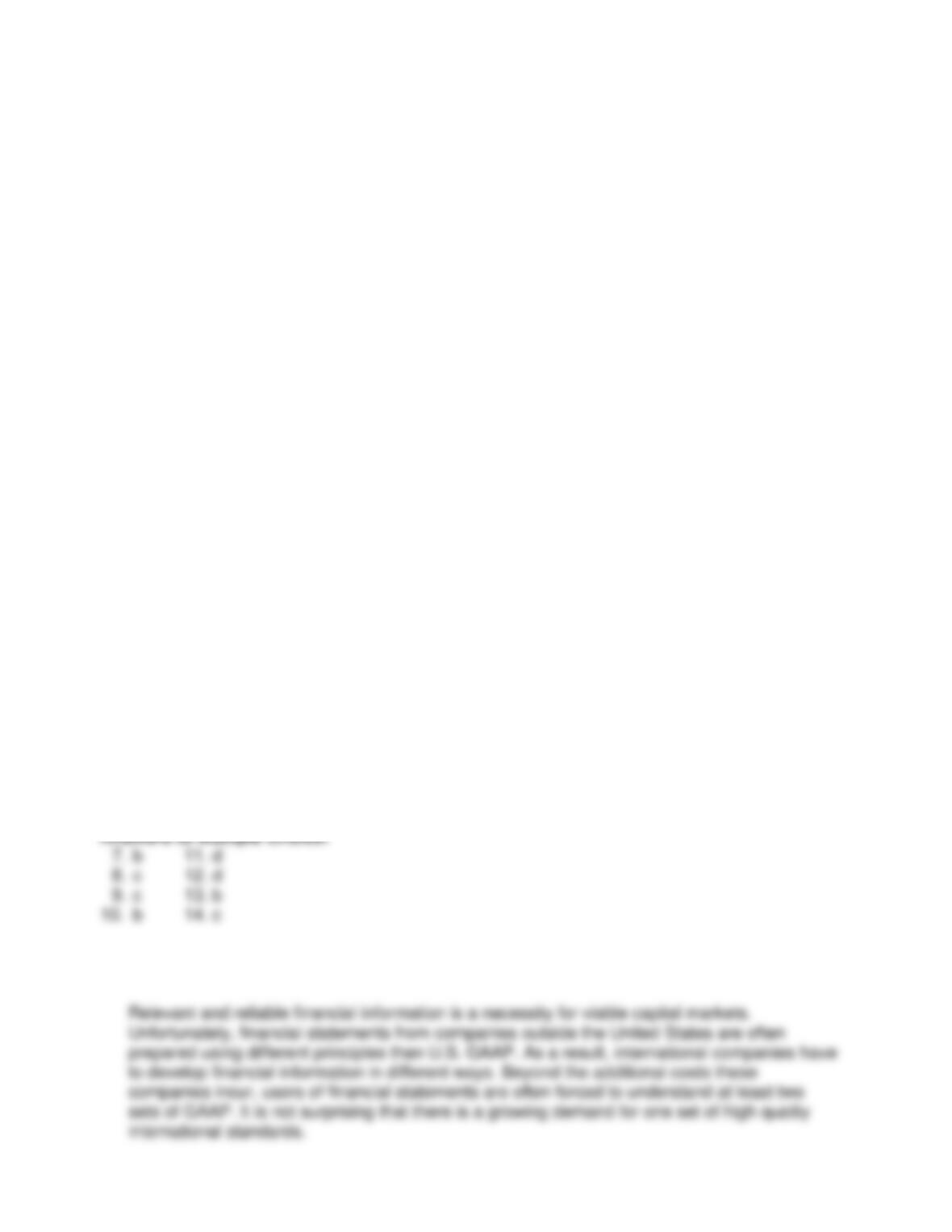
15. Why would it be advantageous for U.S. GAAP and International GAAP to be the same?
Financial Accounting and Accounting Standards
1 – 21
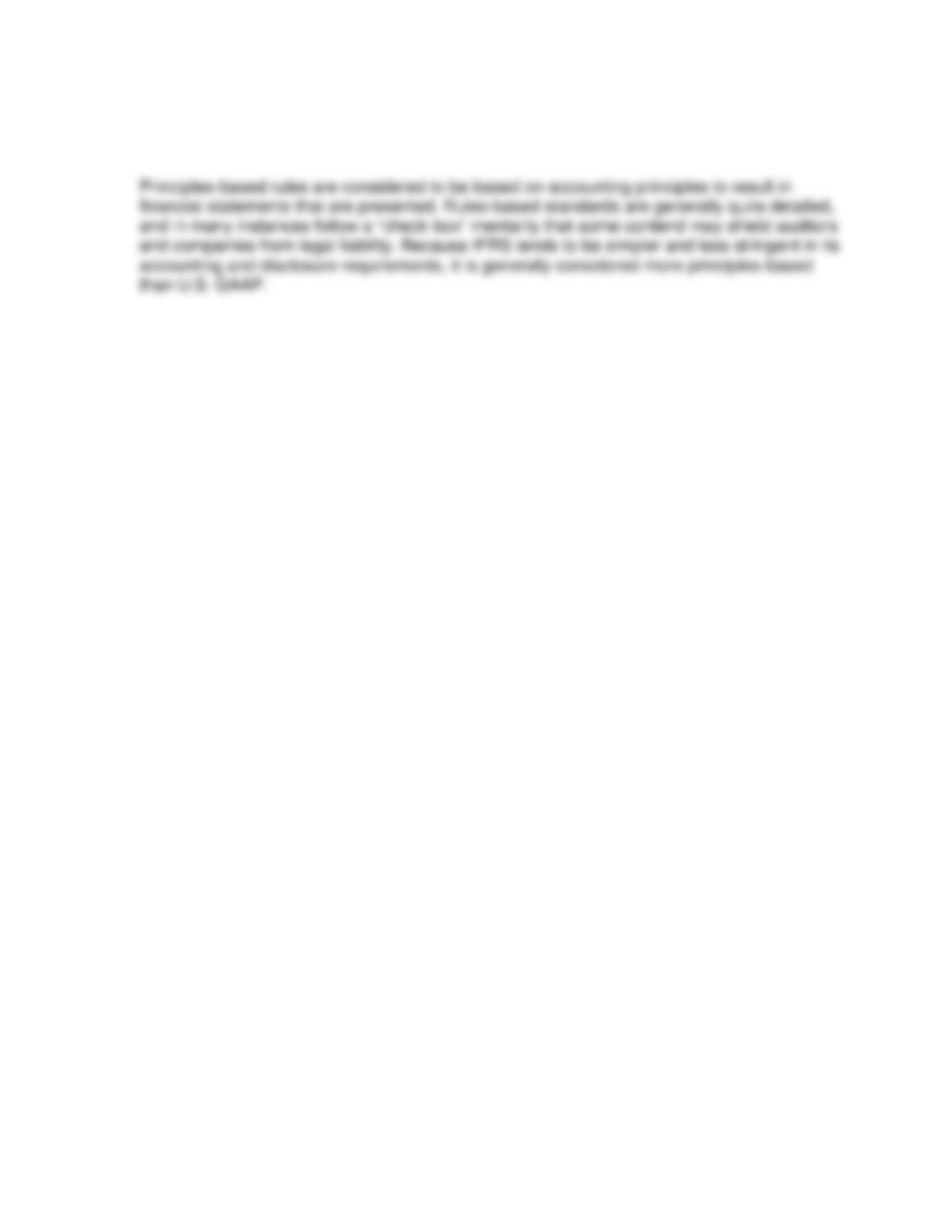
16. What is the difference between principles-based and rules-based accounting rules? Is IFRS
more principles-based than U.S. GAAP? Explain.