140. The manager of a profit center of a large electronics manufacturing corporation made
some projections regarding sales and profits for the upcoming final quarter of the year. The
managers’ performance evaluation and compensation depended significantly on his ability to meet
budget goals. The manager discovered that the final quarter would have to be a particularly good
quarter in order to meet these goals. He decided to implement a sales program offering liberal
payment terms in order to pull some sales that would normally occur next year into the current
year. Customers accepting delivery in the fourth quarter would not have to pay the invoice for 140
days. Also, he sold some equipment that was not being used and realized a significant profit on
the sale.
Are these actions ethical? Why or why not?
141. The controller of one division of a large diversified firm is compensated by salary plus
bonus. The bonus is a significant part of total compensation, and is based directly on the profits of
the division. Thus, the controller has an incentive to find ways to increase profits, including the
delay of discretionary expenses such as research and development, delay of maintenance and
repair of manufacturing equipment, and delay of sales promotions.
Is finding ways to increase profits as described above unethical? Why or why not? Who is to
blame, if anyone?

1-94
142. Brookside Shoe Company, a manufacturer of women’s shoes, recently implemented a
quality improvement program aimed at streamlining the manufacturing process. Carl Anderson
industrial engineer and a resident expert on process improvement, was assigned the task of
implementing the program.
Anderson’s first task was to educate all the employees involved with the production process. He
sent a memo to representatives in product design and development, materials management
(including purchasing), marketing, distribution, customer service and accounting, in addition to
those in the production department, inviting them to attend an information session on the
improvement program.
He began the meeting by thanking all those who were present (over 35 in number) and spent the
first hour explaining the need for such a program. Soon after, the attendees were engaged in a
discussion. Several questions were raised during the discussion. Among these, three questions
stood out.
1. What is the need for including members from design, marketing, and other functional areas
when the improvement program’s focus is on streamlining the manufacturing process?
2. What is the role of the cost management expert in this program?
3. Finally, why should the machine operators be involved, as they are not engineers?
Consider the three questions that stood out in the discussion. Assume the role of Carl Anderson
and prepare a response addressing the questions.
1-96
143. Sandra Pilsden, the Vice-President for Human Resources in Learning, Inc. was concerned
about a recent memo she had recently received from the CEO’s office regarding the possibility of
outsourcing the payroll function to Salary Experts, a growing provider of a variety of human
resource services. She was shocked that the CEO’s office had discussed this matter with the
Board of Directors, but failed to consult her.
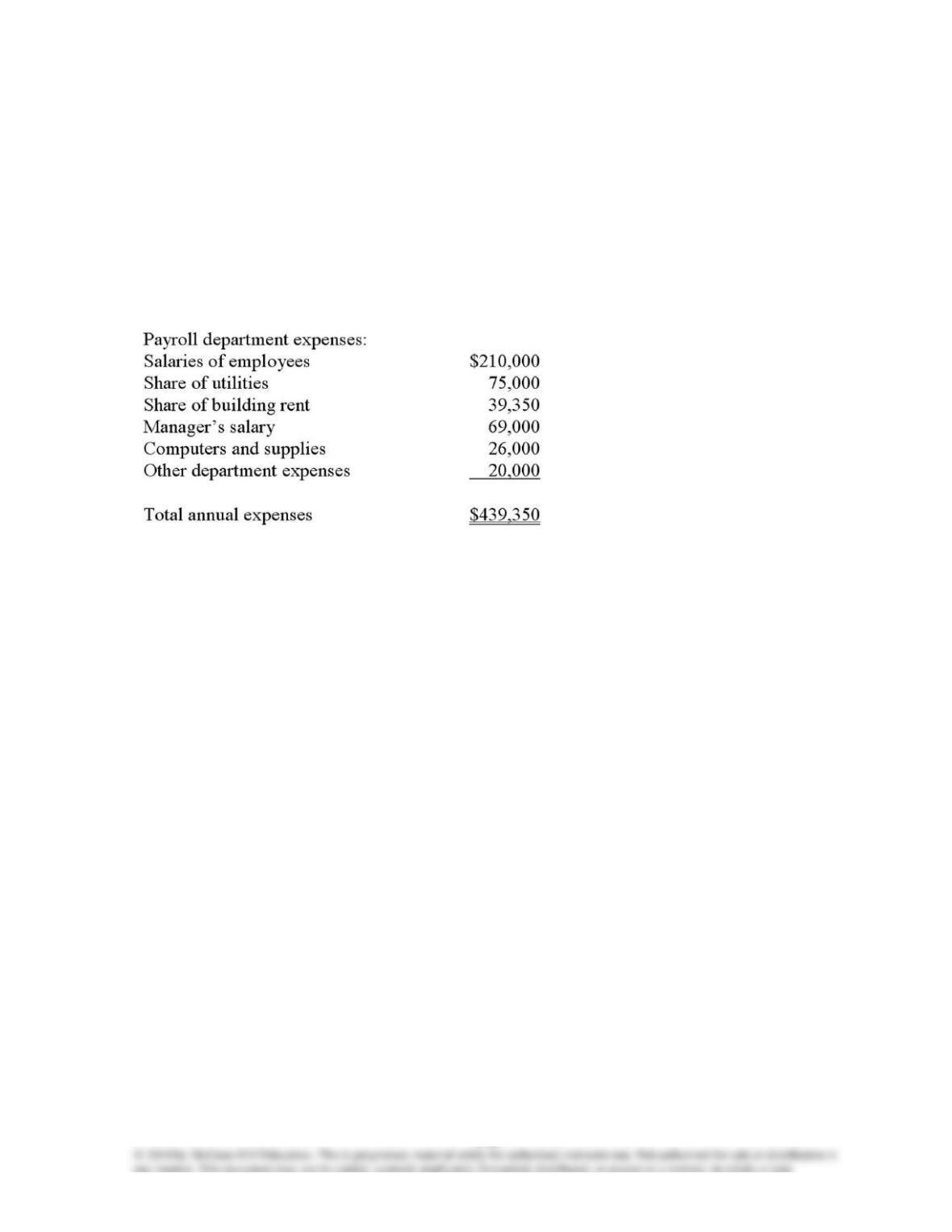
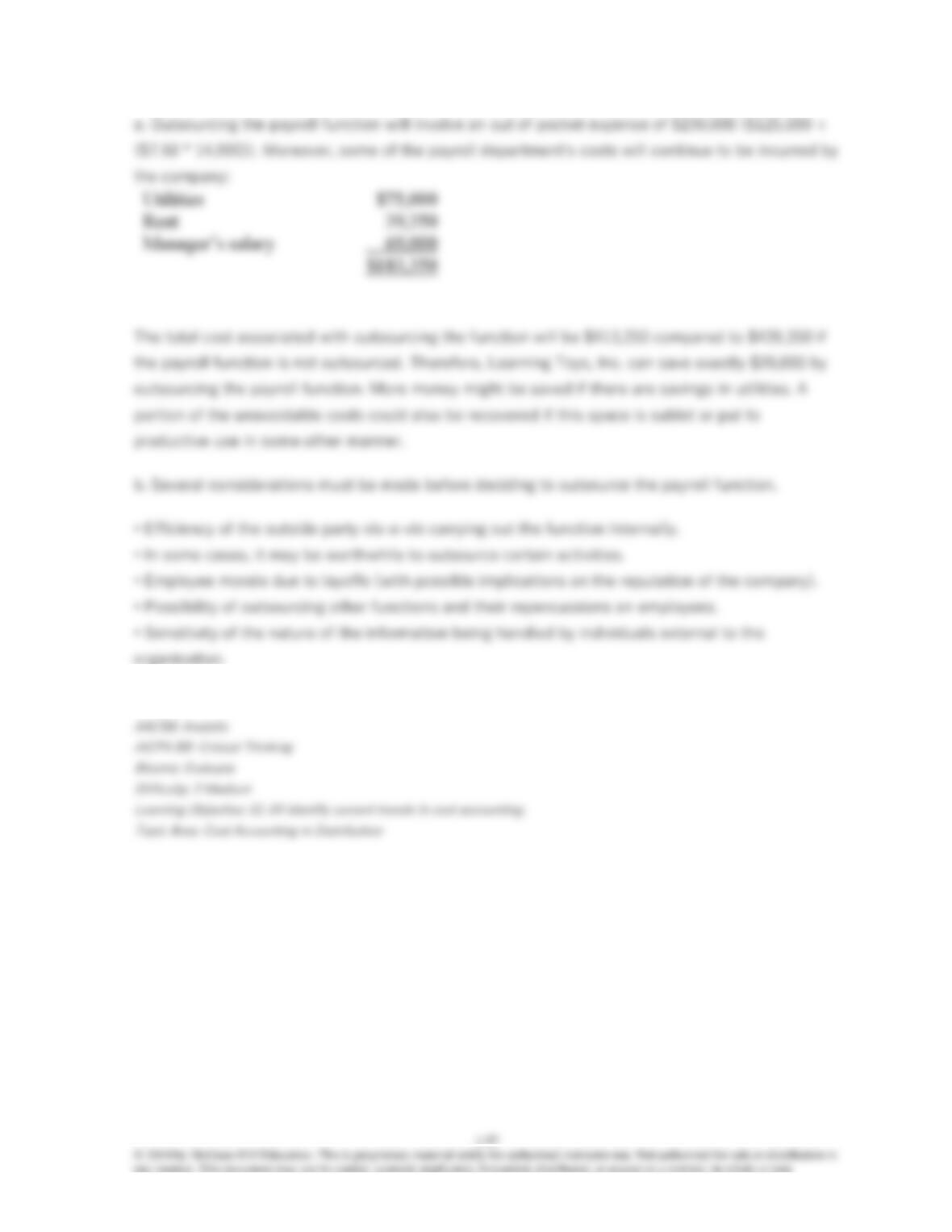
Linden was preparing for a meeting with the CEO. In reading the memo and its attachments,
Linden observed the following comparison of costs in a report prepared by the controller’s office:
Pilsden also noted that Salary Experts quoted a fixed fee of $125,000 and variable processing
costs of $7.50 per employee transaction. She did not believe that the company will actually save
money by outsourcing the payroll function. For one, she did not think that the company will
actually save all of the above mentioned amounts. She knew that the payroll department manager
could not be removed from the company because he had to oversee the payroll function and serve
as a liaison with the outside company. However, all other employees in the department would
likely not be required.
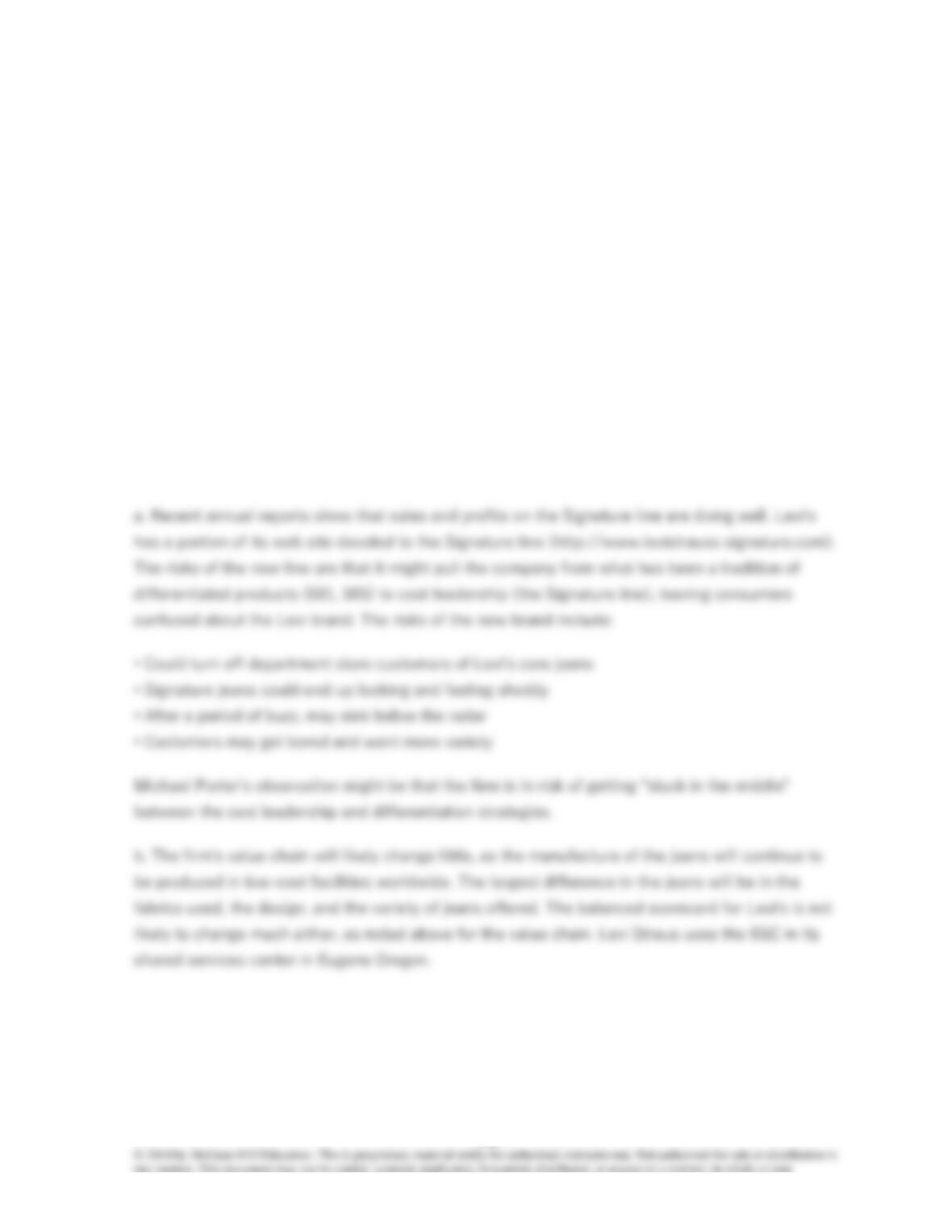
a. Assume Learning Toys has 14,000 employees on its payroll. Can the company save money by
outsourcing the payroll function?
b. What are the pros and cons of outsourcing the payroll function?
1-98
144. Levis Strauss and Co., maker of Levi’s familiar 501 and 505 brands of jeans, also make a
“Signature” brand that was introduced several years ago for discount retailers such as Wal-Mart.
Levi’s strategy with the new jeans was to sell a competitively priced pair. The jeans were to be
about one-half the price of the familiar 501 and 505 jeans. To get costs down Levi’s would:
• Use cheaper fabrics and materials.
• Shun costly mass-market advertising.
• Strictly limit the number of fits, styles, and colors.
• The Signature brand had a good first year of sales; assume that results for the second year and
later are not yet in.
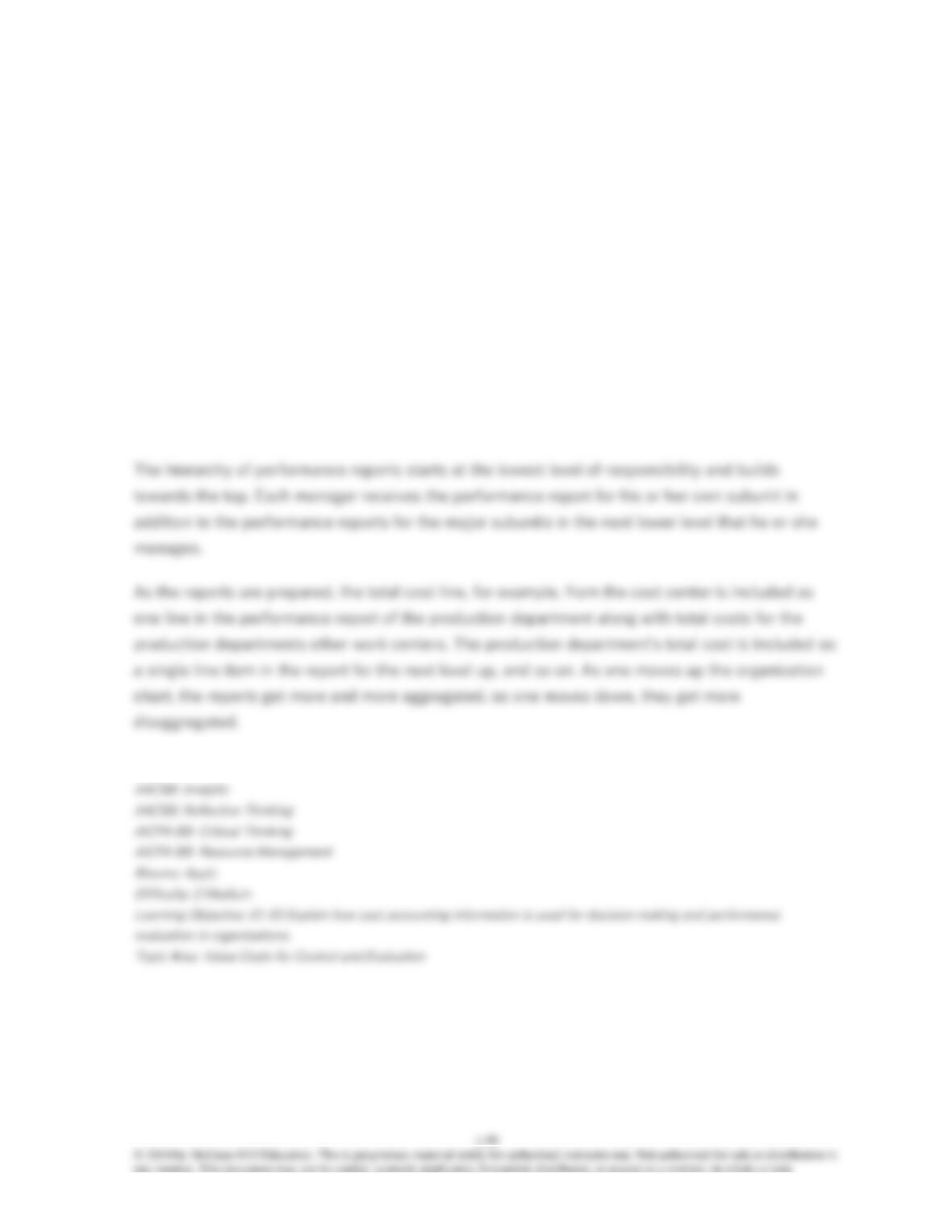
a. Assess the new strategy at Levi. What do you think are the potential benefits and risks?
b. How will the firm’s value chain and balanced scorecard change as a result of the new strategy?
145. Mr. Lee is the production Manufacturing Manager of Cathy Company. It is the beginning of
the month and he storms into the controllers department, clutching a large folder of reports. “Why
am I getting so many reports? I don’t need them nor do I want all the details. I’ve delegated
responsibility to my managers so I don’t have to worry about details. You’ve got to do something
about this, John.”
John, the controller, starts to think about the problem that seems to have come about as the
company decentralized with many layers of responsibility. He has a vague memory of something
he learned from his old cost accounting class and has called you, his former professor, for some
advice or suggestions in order to reduce the paper flow.
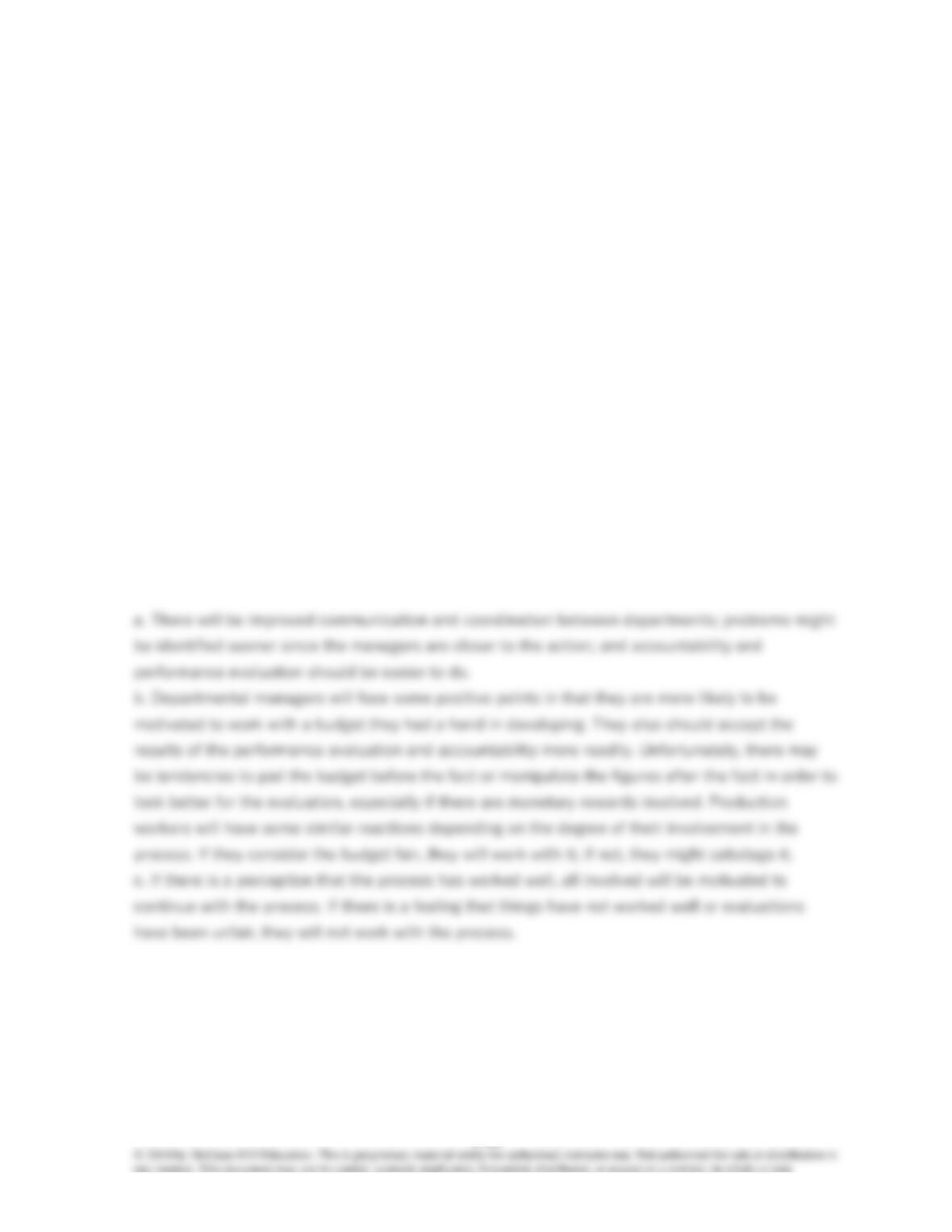
Briefly describe the concept of the hierarchy of performance reports.
1-100
146. Adair Company has been busy over the first few years of its existence in penetrating its
market and gaining a respectable market share. To facilitate this, Mr. Adair, the CEO, and his
controller, Mr. Brown, have been developing the annual master budgets. To date this approach
has worked well.
Adair has been acquired by a company in a related business but will continue to operate as an
independent subsidiary. The CFO of the acquiring company, Mr. Horwitz, has suggested to Mr.
Adair that, since it was expected that his company would continue to grow, it adopt a
departmental budgeting system; a suggestion Mr. Adair agreed to readily. Mr. Horwitz explained to
Adair’s departmental managers the concepts of a departmental participative budgeting system
and their involvement. The managers were encouraged to take the information and come back
with suggestions which could then be put into a formal budget process.
a. What benefits will accrue to Adair under this new budgeting system?
b. What behavioral issues might arise for departmental managers and for production workers?
c. What is the most probable long-term reaction of Adair’s people to the participative budget
system?
147. Traditionally, companies in the United States have employed a “push” manufacturing
style. Studies in Activity Based Management and Quality Control have indicated that this
approach is filled with many non-value-added activities, which increase overall costs and reduce
profits. The “push” style is being replaced with a “pull” approach.
Briefly describe the major differences between the push and pull approaches. What non-value
added activities are eliminated in a pull manufacturing system?
1-102
148. The New York Times recently reported that a number of publicly-held corporations have
been accused of illegally doctoring hourly employees’ time records. Examples included:
• Workers sued Family Dollar and Pep Boys, accusing managers of deleting hours from their time
records.
• More than a dozen former Wal-Mart employees said in interviews and depositions that
managers had altered time records to shortchange employees.
• The Department of Labor reached two back-pay settlements with Kinko’s photocopy centers
after finding that managers had erased time for 13 employees.
When interviewed, many of the managers cited pressure from upper–management and the impact
of their actions on their own compensation as underlying causes for their actions. All of the
companies strongly denied encouraging such illegal and unethical behavior by managers.
Compensation experts interviewed agreed that the companies’ incentive performance systems
may have contributed to the managers’ behavior. (
New
York
Times
, April 4, 2004)
a. Explain how the incentive performance systems of the above named companies could have
contributed to this illegal behavior by managers.
b. Discuss the ethical issues involved in the design of incentive performance systems. In
designing a performance-based incentive system, what measures should companies take to avoid
illegal and unethical behavior by supervisors?