210) Which of the following accounts is not included in the calculation of net income?
A) Services revenue.
B) Wages expense.
C) Rent expense.
D) Cash.
E) Rent revenue.
211) Which of the following combinations results in a net loss reported on the income statement?
A) Total revenues of $80,000 and total expenses of $74,000.
B) Total revenues of $70,000 and total expenses of $74,000.
C) Total revenues of $60,000 and total expenses of $52,000.
D) Total revenues of $20,000 and total expenses of $16,000.
E) Total revenues of $40,000 and total expenses of $31,000.
212) Which of the following combinations results does not result in the same amount of net
income reported on the income statement?
A) Total revenues of $80,000 and total expenses of $60,000.
B) Total revenues of $170,000 and total expenses of $150,000.
C) Total revenues of $60,000 and total expenses of $40,000.
D) Total revenues of $70,000 and total expenses of $60,000.
E) Total revenues of $40,000 and total expenses of $20,000.
213) Match the following terms with the appropriate definition.
a. Financial accounting
b. Ethics
c. Recordkeeping
d. Internal users
e. Accounting
f. Certified Public Accountant (CPA)
g. Fraud triangle
h. Managerial accounting
i. External users
____ 1. An information and measurement system that identifies, records and communicates
relevant reliable and comparable information about an organization’s business activities.
____ 2. The part of accounting that involves recording transactions and events, either
electronically or manually.
____ 3. Persons using accounting information who are not directly involved in running the
organization.
____ 4. Persons using accounting information who are directly involved in managing and
operating the organization.
____ 5. The area of accounting that serves the decision-making needs of internal users.
____ 6. The area of accounting aimed at serving external users by providing them with general-
purpose financial statements.
____ 7. Accounting specialists that have met educational and experience requirements, passed an
examination and exhibit ethical characteristics to achieve a professional certification.
____ 8. Beliefs that distinguish right from wrong, considered accepted standards of good and bad
behavior.
____ 9. A model that asserts the factors that must exist for a person to commit fraud.
214) Match each of the following terms with the most appropriate definition.
a. Return on assets
b. Assets
c. Expenses
d. Risk
e. Liabilities
f. Dividends
g. Accounting equation
h. Contributed capital
____ 1. The uncertainty about the return to be earned.
____ 2. Resources such as cash that a stockholder puts into the company.
____ 3. A financial ratio stated as income divided by assets invested.
____ 4. Creditor’s claims on a company’s assets.
____ 5. Decreases in equity from costs of providing products or services to customers.
____ 6. Resources such as cash that a company distributes to stockholders for personal use.
____ 7.Resources a company owns or controls that are expected to yield future benefit.
____ 8. Expresses the relation of assets, liabilities and equity in a company, comparing the
resources the company owns to the sources of funds to acquire the resources.
215) The following is a list of selected users of accounting information. Match the appropriate
user to the following decisions they make with accounting information.
a. Suppliers
b. Lenders
c. Shareholders
d. Purchasing Managers
e. Regulators
____ 1. Know what, when, and how much to purchase.
____ 2. Judge the soundness of a customer before making sales on credit.
____ 3. Assess whether a company has paid all required taxes and complied with securities rules.
____ 4. Assess whether an organization is likely to repay its loans with interest.
____ 5. Decide whether to buy, hold, or sell a company’s stock.
216) Match the following definitions with terms 1 through 8. Place the letter that identifies the
best definition in the blank space next to the term.
____ 1. Generally accepted accounting principles
____ 2. Time period assumption
____ 3. Statement of retained earnings
____ 4. Balance sheet
____ 5. Income statement
____ 6. Measurement (Cost) principle
____ 7. Securities and Exchange Commission
____ 8. IASB
____ 9. Full disclosure principle
____ 10. Statement of cash flows
a. Prescribes that assets and services to be recorded initially on a cash or equal-to-cash basis.
b. Describes a company’s revenues and expenses and computes net income or loss over a period
of time.
c. An independent group consisting of individuals from many countries that identify preferred
accounting practices.
d. Presumes that the life of a company can be divided into periods for reporting purposes.
e. The concepts and rules that govern financial accounting.
f. A financial statement that reports the changes in equity over the reporting period, excluding
stockholder investments.
g. A report that identifies cash receipts and cash payments over a period of time.
h. Prescribes that a company report the details behind financial statements that would impact
user decisions.
i. The governmental agency that has the legal authority to establish accounting rules.
j. A report that describes a company’s financial position at a point in time.
217) Match the following definitions with the terms 1 through 9. Place the letter that identifies
the best definition in the blank space next to the term.
____ 1. Statement of cash flows
____ 2. Events
____ 3. Monetary unit principle
____ 4. Business entity principle
____ 5. Revenue recognition principle
____ 6. Accounting equation
____ 7. Income statement
____ 8. Expenses
____ 9. Liabilities
a. The relation between a company’s assets, liabilities, and equity.
b. Happenings, such as changes in market value, that effect the accounting equation and are
reliably measured.
c. The principle that assumes transactions and events can be expressed in money units.
d. Describes a company’s revenues and expenses along with the resulting net income or loss over
a period of time.
e. A financial statement that lists cash inflows (receipts) and cash outflows (payments); the cash
flows are arranged by operating, investing, and financing activities.
f. Creditor’s claims on assets.
g. The cost of assets or services used to earn revenue.
h. The principle that requires a business to be accounted for separately from its owners.
i. The principle that revenue is recorded when earned through providing goods or services.
218) Identify each of the following business activities 1 through 6 into the appropriate category
a, b, and c.
a. Operating
b. Investing
c. Financing
____ 1. Paid utilities expenses.
____ 2. Dividends paid to stockholders.
____ 3. Purchase of land.
____ 4. Sale of used equipment.
____ 5. Borrowed money from a bank on a long-term note.
____ 6. Paid employee wages.
____ 7. Received investment from stockholders in exchange for common stock.
____ 8. Paid an amount due on a long-term bank loan.
219) Match each of the following items 1 through 8 with the financial statement a through d in
which each item would most likely appear. An item may appear on more than one statement.
a. Income statement
b. Statement of retained earnings.
c. Balance sheet
d. Statement of cash flows
____ 1. Assets.
____ 2. Dividends
____ 3. Revenues.
____ 4. Cash from investing activities.
____ 5. Expenses.
____ 6. Liabilities.
____ 7. Cash from operating activities.
____ 8. Cash from financing activities.
220) Classify the following activities according to the appropriate section of the statement of
cash flows.
a. Operating activity
b. Investing activity
c. Financing activity
____ 1. Cash received from a one-time sale of used office equipment.
____ 2. Cash paid for dividends.
____ 3. Cash received from customers.
____ 4. Cash received from stockholder contributions.
____ 5. Cash paid for utilities.
____ 6. Cash paid for a delivery van to be used in the business.
221) Explain the role of accounting in the information age.
222) What is the balance sheet? What is its purpose?
223) Identify the users and uses of accounting information.
224) Identify several opportunities in accounting and distinguish between private accounting and
public accounting.
225) Explain why ethics are an integral part of accounting.
226) Describe the two important guidelines for revenue recognition.
227) Identify the four basic forms of business organizations and their key attributes.
228) Identify and describe the two main groups involved in establishing generally accepted
accounting principles.
229) How does the going-concern principle affect reporting asset values of a business?
230) Describe the income statement and the relation between revenues, expenses, and net income
or loss.
231) Explain the accounting equation and define its terms.
232) What distinguishes liabilities from equity?
233) What is the purpose of return on assets as an analytical tool?
234) Define risk and return and discuss the relation between them.
235) Describe the three types of activities reported on the statement of cash flows.
236) Identify and describe the four basic financial statements:
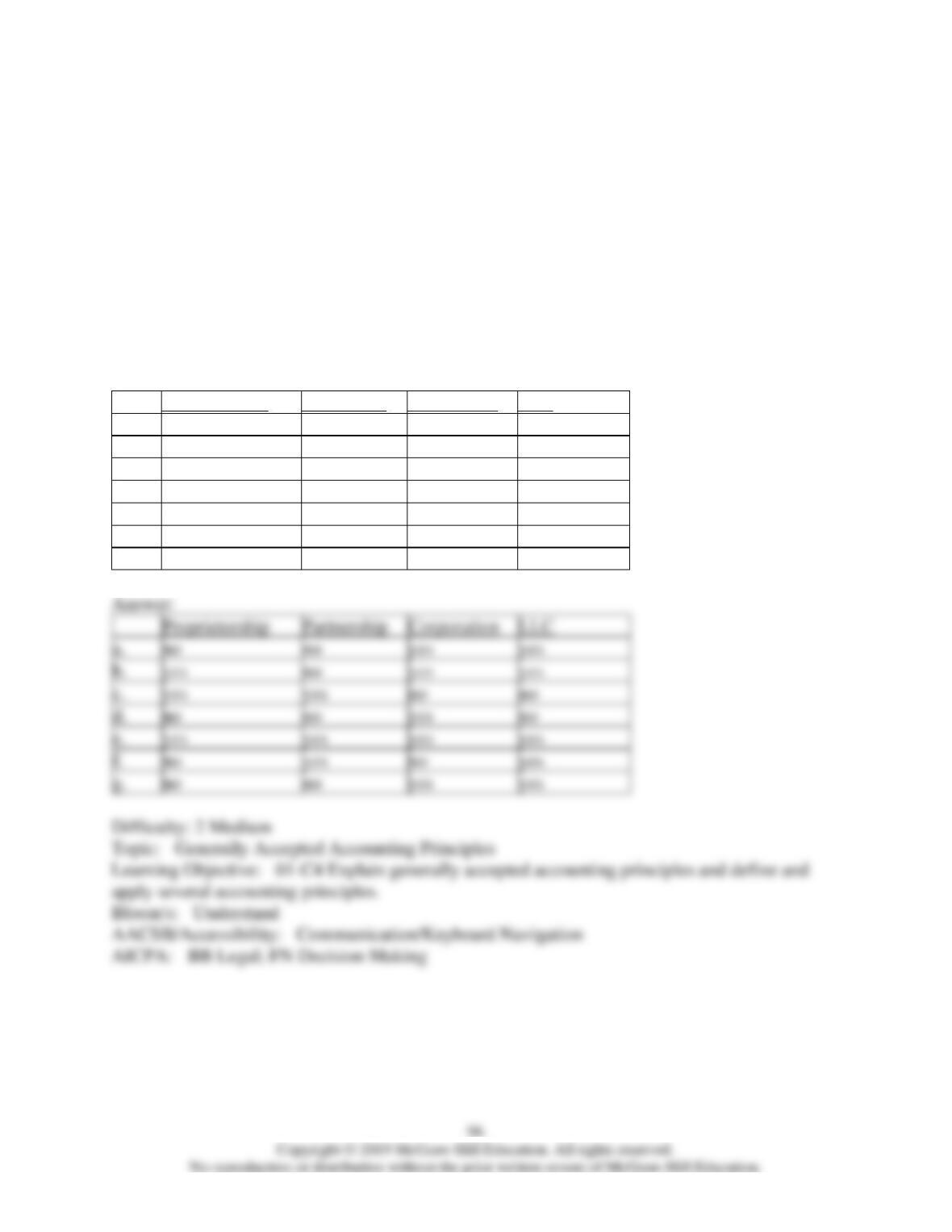
237) The characteristics below apply to at least one of the forms of business organization.
a. Is a separate legal entity.
b. Is allowed to be owned by one person only.
c. Owner or owners are personally liable for debts of the business.
d. Is a separately taxable entity.
e. Is a business entity.
f. May have a contract specifying the division of profits among the owners.
g. Has an unlimited life
Use the following format to indicate (with a “yes” or “no”) whether or not a characteristic applies
to each type of business organization.
Proprietorship
Partnership
Corporation
LLC
a.
b.
c.
d.
e.
f.
g.
Proprietorship
Partnership
Corporation
LLC
a.
no
no
yes
b.
no
c.
yes
no
d.
no
no
yes
e.
yes
yes
f.
no
yes
no
g.
no
no
yes
238) A parcel of land is offered for sale at $600,000, is assessed for tax purposes at $500,000, is
recognized by its purchasers as easily being worth $575,000, and is sold for $570,000. At what
amount should the land be recorded in the purchaser’s books? What accounting principle
supports your answer?
239) You are reviewing the accounting records of Buddy’s Foreign Automotive, owned by a
single stockholder, Bruce Jones. You have uncovered the following situations. List the
appropriate accounting principle related to each independent scenario and suggest a correct
action for each.
1. In August, a check for $500 was written to Community Sports. This amount represents soccer
camp for his daughter Cassie.
2. Bruce plans a Going Out of Business Sale for June, since he will be closing the business for a
month-long vacation in July. He plans to reopen August 1 and will continue operating Buddy’s
Foreign Automotive indefinitely.
3. Buddy received a shipment of tools from Ontario, Canada. The invoice was stated in Canadian
dollars.
4. Sandy Lane paid $1,500 for a major repair services. The amount was recorded as revenue. The
parts for the repair must be ordered from overseas and the service won’t be complete until the
following month.
240) At the beginning of the year, a company had $120,000 worth of liabilities. During the year,
assets increased by $160,000 and at year-end they equaled $360,000. Liabilities decreased
$20,000 during the year. Calculate the beginning and ending values of equity.
241) At the beginning of the period, a company had $350,000 worth of assets, $110,000 worth of
liabilities, and $240,000 worth of equity. Assume the only change during the period was a
$30,000 purchase of equipment by issuing a note payable. Show the accounting equation with
the appropriate amounts at the end of the period.
242) The accounts of Odie Company with the increases or decreases that occurred during the
past year are as follows:
Account Increase Decrease
Cash……………………………………… $25,000
Accounts receivable ……………….. $(5,000)
Accounts payable …………………… (11,000)
Notes payable ………………………… 16,000
Except for net income, an investment of $3,000 by stockholders, and a cash dividend of $11,000
to stockholders, no other items affected stockholders’ equity. Using the balance sheet equation,
compute net income for the past year.
243) The accounts of Mason Company at the end of the past year report the following amounts:
Accounts Amount
Dividends……. $15,500
Revenues…………………………… $97,000
Expenses……………………………. $43,800
Stock issuances………………….. 2,000
If the beginning equity for the year was $173,000, calculate the ending equity for Mason
Company.