10) Hamilton Lawn Service incurred $500 labor expense and promised to pay the labor agency within 30 days.
Which of the following accounts decreased?
A) Accounts payable
B) Owner’s capital
C) Supplies
D) Accounts receivable
11) Martin Supply Service paid $350 cash to a materials supplier that it owed from the previous month. What is the
effect of the cash payment on accounts of the business?
A) Materials account increases; Owner’s capital account decreases.
B) Cash account decreases; Accounts payable increases.
C) Accounts payable increases; Owner’s capital account decreases.
D) Cash account decreases; Accounts payable decreases.
12) Martin Supply Service paid $350 cash to a materials supplier that it owed from the previous month. Which of
the following accounts decreases?
A) Accounts receivable
B) Accounts payable
C) Owner’s capital
D) Rent expense
13) Martin Supply Service received $1,000 cash from a customer which was owed to the business from the previous
month. What is the effect of the cash receipt on the accounts of the business?
A) Accounts receivable decreases; Owner‘s capital account decreases.
B) Cash account increases; Accounts receivable decreases.
C) Accounts payable increases; Owner’s capital account decreases.
D) Cash increases; Accounts payable decreases.
14) Martin Supply Service received $1,000 cash from a customer which was owed to the business from the previous
month. Which of the following accounts decreases?
A) Cash
B) Owner’s capital
C) Accounts payable
D) Accounts receivable
15) The proprietor of Martin Supply Service took a $5,000 cash withdrawal. What is the effect of the withdrawal on
the accounts of the business?
A) Cash account decreases; Owner‘s capital account decreases.
B) Cash account increases; Accounts receivable decreases.
C) Accounts payable increases; Owner’s capital account decreases.
D) Cash account increases; Owner’s capital account decreases.
16) The proprietor of Martin Supply Services took a $5,000 cash withdrawal. Which of the following accounts
decreased?
A) Office supplies
B) Accounts payable
C) Accounts receivable
D) Owner’s capital
17) Ace Builders had the following transactions in June: Earned $4,000 “on account;” collected $3,000 from a
customer that was owed from a previous month; incurred $500 of repair expense and paid cash to the repairman;
paid $1,200 to a supplier that it owed from the previous month; paid out $800 in cash drawings to the owner. What
is the combined effect on Owner’s capital of the June transactions?
A) Down $2,700
B) Down $5,700
C) Up $2,700
D) Down $4,500
18) Ace Builders had the following transactions in June: Earned $4,000 “on account;” collected $3,000 from a
customer which was owed from a previous month; incurred $500 of repair expense and paid cash to the repairman;
paid $1,200 to a supplier that it owed from the previous month; paid out $800 in cash drawings to the owner. What
is the combined effect on Cash of the June transactions?
A) Up $500
B) Down $5,700
C) Down $2,700
D) Up $4,500
19) Ace Builders had the following transactions in June: Earned $4,000 “on account;” collected $3,000 from a
customer which was owed from a previous month; incurred $500 of repair expense and paid cash to the repairman;
paid $1,200 to a supplier that it owed from the previous month; paid out $800 in cash drawings to the owner. How
much was the Net income in June?
A) $500
B) $5,700
C) $2,700
D) $3,500
20) ABC Delivery Service had the following transactions in June: Earned $4,000 cash for services rendered;
collected $2,500 from a customer “on account;” paid out $200 cash for plumbing services; received $3,500 of
supplies and promised to pay one month later; paid out $1,000 in cash drawings to the owner. What is the
combined effect on Owner’s capital of the June transactions?
A) Up $2,800
B) Down $300
C) Down $6,300
D) Up $5,300
21) ABC Delivery Service had the following transactions in June: Earned $4,000 cash for services rendered;
collected $2,500 from a customer “on account;” paid out $200 cash for plumbing services; received $3,500 of
supplies and promised to pay one month later; paid out $1,000 in cash drawings to the owner. What is the
combined effect on Cash of the June transactions?
A) Up $1,800
B) Down $300
C) Down $6,300
D) Up $5,300
22) ABC Delivery Service had the following transactions in June: Earned $4,000 cash for services rendered;
collected $2,500 from a customer “on account;” paid out $200 cash for plumbing services; received $3,500 of
supplies and promised to pay one month later; paid out $1,000 in cash drawings to the owner. How much was Net
income in June?
A) $5,300
B) $2,800
C) $6,300
D) $3,800
Learning Objective 1-9
1) The balance sheet of a business represents the account balances as of a particular date in time.
2) By looking at a statement of owner’s equity, you can evaluate the effect of drawings on the ending balance in
owner’s equity.
3) Beginning owner’s capital was $25,000. Ending owner’s capital is $37,000. No contributions were made during
the year. Drawings were $23,000. What was net income or loss for the year?
A) Net income of $16,000
B) Net loss of $35,000
C) Net loss of $14,000
D) Net income of $35,000
4) Net income is $34,000. Beginning owner’s capital is $29,000. Ending owner’s capital is $55,000. No capital
contributions were made during the year. What was the amount of drawings?
A) $18,000
B) $8,000
C) $60,000
D) $5,000
5) Beginning owner’s capital is $20,000. No capital contributions were made during the year. Drawings were
$7,000. Ending owner’s capital is $37,000. What was net income?
A) $24,000
B) $13,000
C) $10,000
D) $27,000
6) Financial statements are prepared after an entity’s transactions are analyzed and recorded. Which of the following
reports is NOT one of the required financial statements?
A) Statement of cash flows
B) Balance sheet
C) Statement of drawings
D) Income statement
7) The statement of owner’s equity shows the changes in Owner’s capital. Which one of these statements is TRUE?
A) Decreases in Owner’s equity result from owner investments.
B) Decreases in Owner‘s equity result from net losses.
C) Decreases in Owner‘s equity result from net income.
D) Decreases in Owner’s equity result from revenues earned.
8) The income statement presents a summary of an entity’s revenues and expenses for a period of time. Which of the
following statements is TRUE?
A) There is net income when total revenues are greater than total expenses.
B) There is a net loss when total expenses are greater than total revenue.
C) There is a net loss when withdrawals are made.
D) Both A and B are true.
9) The balance sheet, or statement of financial position, is like a snapshot of the entity. Which of the following items
are included on the balance sheet?
A) Revenues
B) Expenses
C) Assets
D) Drawings
10) Each financial statement includes a heading giving three pieces of data. Which of the following items is NOT
included in these headings?
A) Name of the financial statement
B) Date or time period covered
C) Name of the preparer of the statement
D) Name of the business
11) Which of the following financial statements reports expenses in decreasing order of their amounts, with
the largest expense first?
A) Statement of cash flows
B) Income statement
C) Statement of owner’s equity
D) Balance sheet
12) Which of the following financial statements uses net income or net loss taken directly from the income
statement?
A) Statement of owner’s equity
B) Statement of cash flow
C) Balance sheet
D) Statement of expenditures
13) Which of the following financial statements reports that total assets equals total liabilities plus total owner’s
equity?
A) Statement of owner’s equity
B) Statement of cash flows
C) Income statement
D) Balance sheet
14) Which of the following financial statements reports cash receipts and cash payments during a period of time?
A) Statement of cash flows
B) Balance sheet
C) Income statement
D) Statement of owner’s equity
15) Which of the following financial statements reports an increase or decrease in net cash during the time period
covered?
A) Income statement
B) Statement of owner’s equity
C) Statement of cash flows
D) Balance sheet
16) The financial statements should be prepared in what order?
A) Income statement, statement of owner’s equity, balance sheet, statement of cash flows
B) Statement of owner’s equity, balance sheet, income statement, statement of cash flows
C) Balance sheet, statement of owner‘s equity, income statement, statement of cash flows
D) Balance sheet, income statement, statement of owner‘s equity, statement of cash flows
17) Which of the following amounts appears on both the income statement and statement of owner’s equity?
A) Ending capital
B) Total revenues
C) Net income
D) Drawings
18) Which of the following amounts appears on both the statement of owner’s equity and the balance sheet?
A) Ending capital
B) Total assets
C) Total revenues
D) Net income
19) Which of the following amounts appears on both the income statement and the balance sheet?
A) Total assets
B) Net income
C) Ending owner‘s equity
D) None of the above amounts appear on both
20) Which of the following financial statements shows the changes in Owner’s capital during a period of time?
A) Income statement
B) Statement of owner’s equity
C) Statement of cash flows
D) Balance sheet
21) Which of the following financial statements lists the entity’s assets, liabilities, and owner’s equity as of a specific
date?
A) Balance sheet
B) Statement of owner’s equity
C) Income statement
D) Statement of cash flows
22) On the financial statements, which line item connects the balance sheet to the statement of cash flows?
A) Owner’s equity (ending balance)
B) Net income
C) Total assets
D) Cash (ending balance)
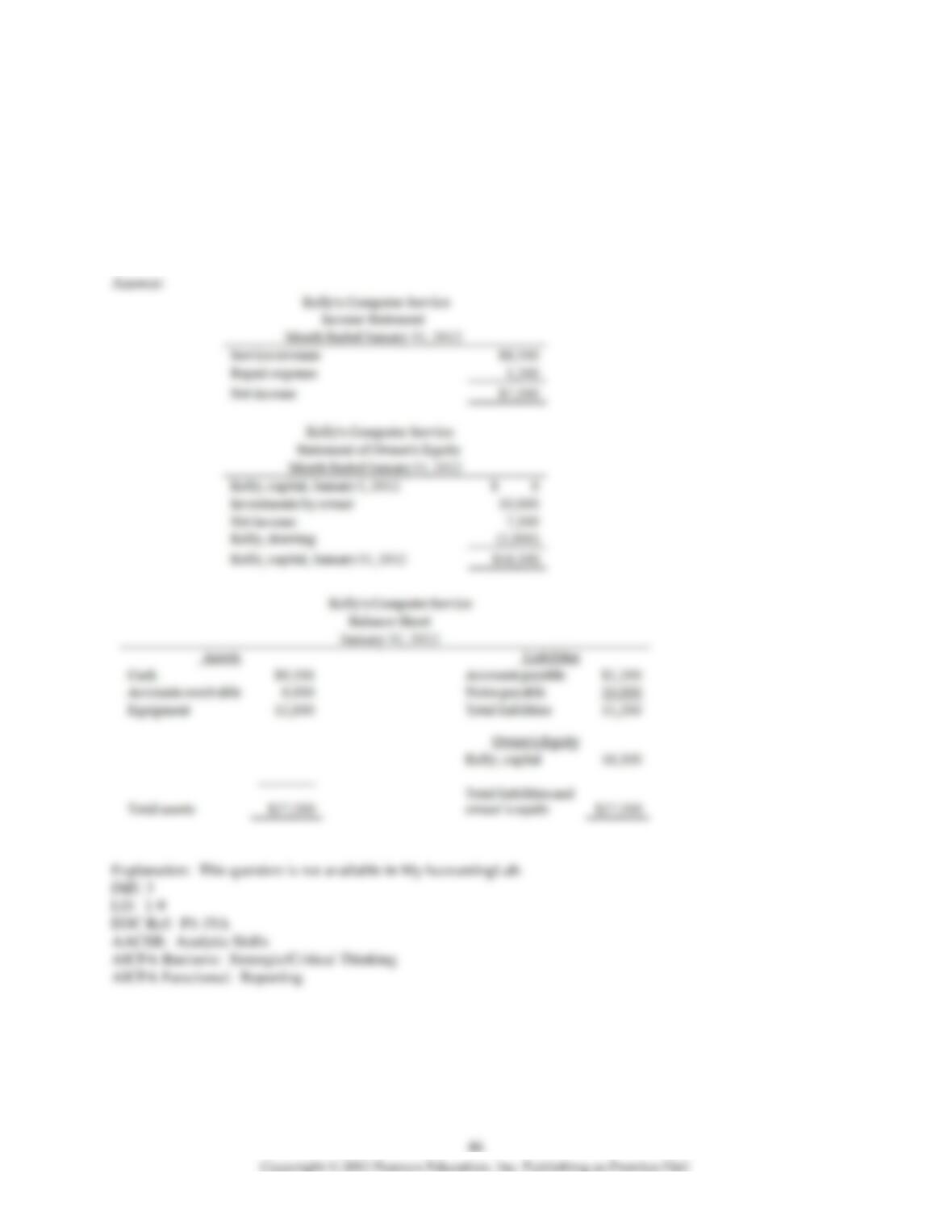
23) On Jan. 1, 2012, William Kelly started Kelly‘s Computer Service by investing $10,000. On Jan. 3, the business
borrowed $10,000 from a creditor and executed a Note payable with the principal and interest to be due in one year.
On Jan. 5, the business purchased $12,000 of equipment for cash. On Jan. 8, Kelly’s rendered service to his first
corporate client and earned $2,500 in cash. On Jan. 12, Kelly’s incurred repair expense of $1,200 and promised to
pay the repair contractor the following month. On Jan. 18, Kelly’s rendered service to a new client in the amount of
$6,000 “on account,” (the client promised to pay the following month). At the end of January, Kelly took a
withdrawal of $1,000. Please prepare an income statement for the month of January, a statement of owner’s equity
for the month of January, and a balance sheet at Jan. 31, 2012.
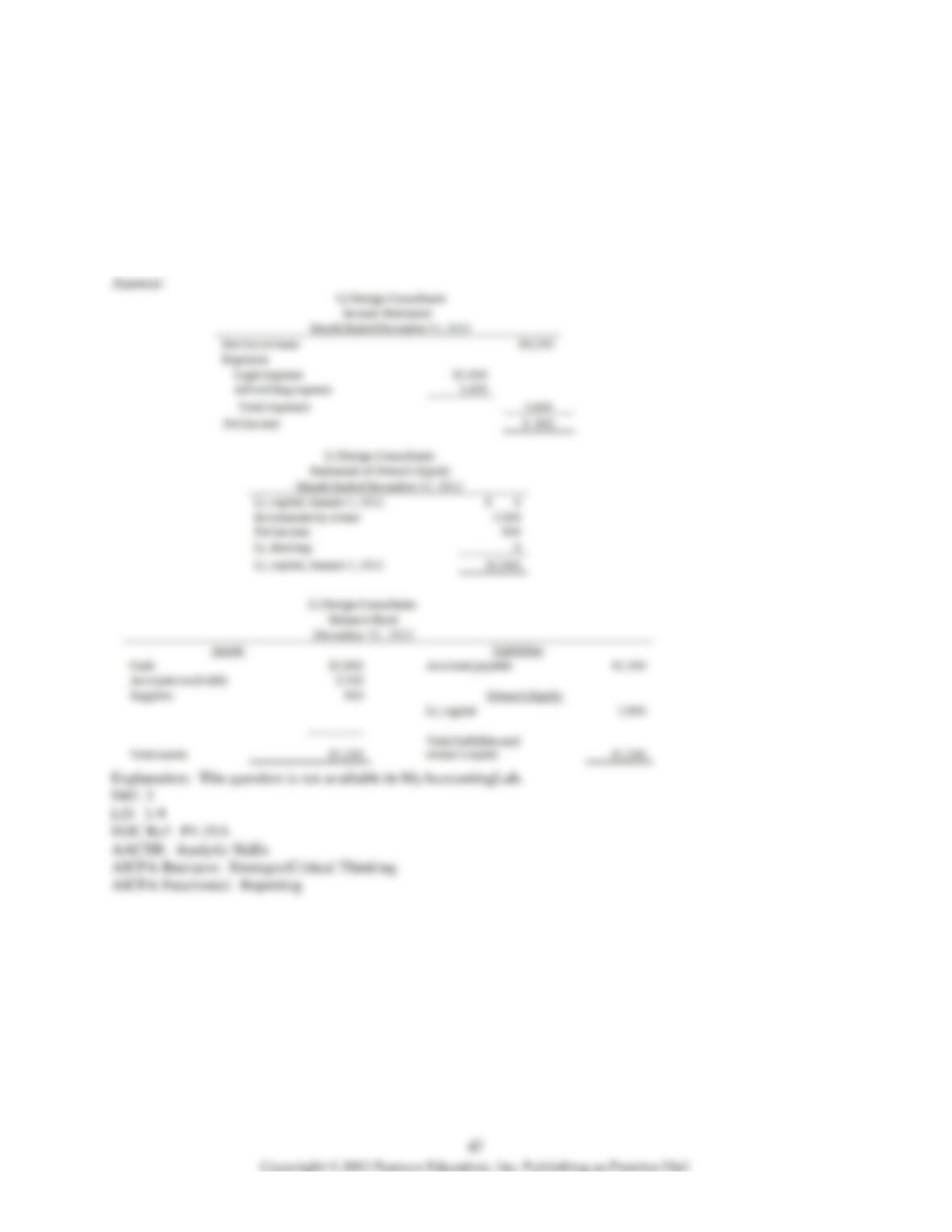
24) Alice Li started Li Design Consultants and invested $5,000 into the business. On Dec. 12, she rendered services
to three clients “on account” with total revenues earned of $4,500. She then incurred advertising expense on four
different websites and promised to pay a total of $1,600 at a later date. On Dec. 15, she purchased $900 of office
supplies for cash. On Dec. 20, she received $1,000 in cash payment from her first client and deposited it into the
business account. On Dec. 22, she incurred $2,000 for legal expense and paid cash. On Dec. 31, she made a
payment of $300 to one of the websites that she owed for advertising provided earlier in the month. No withdrawals
were taken in December. Please prepare an income statement for the month of December, a statement of owner’s
equity for the month of December, and a balance sheet at Dec. 31, 2012.
Learning Objective 1-10
1) The income statement shows whether or not a business can generate enough cash to pay its liabilities.
2) The balance sheet shows whether or not a business is earning a profit.
3) You can evaluate business performance in terms of profitability by analyzing which financial statement?
A) Income statement
B) Balance sheet
C) Statement of cash flows
D) None of the above
4) You can evaluate the economic resources, debt, and overall financial position of a company in which of the
following financial statements?
A) Income statement
B) Balance sheet
C) Statement of cash flows
D) Statement of owner’s equity
5) The explanation of why the net income differs from change in cash balance for the period is explained in which of
the following statements?
A) Income statement
B) Balance sheet
C) Statement of owner’s equity
D) Statement of cash flows
6) If an analyst wants to know how likely it is that a business would be able to pay off all its debts, which of the
following statements would be MOST useful?
A) Income statement
B) Balance sheet
C) Statement of owner’s equity
D) Statement of cash flows
7) If an analyst wants to know how likely it is that a company would be able to earn a profit, which of the following
statements would be MOST useful?
A) Income statement
B) Balance sheet
C) Statement of owner’s equity
D) Statement of cash flows
8) The relative proportion of economic resources and obligations would be shown by the balance sheet.