27) The portion of net income that the company has kept over a period of years and not used for
dividends is called:
A) common stock.
B) retained earnings.
C) revenue.
D) gross profit.
28) A company sells travel mugs online for $9. They purchase the mugs for $5 and charge the customers
$1 for shipping and handling. Cost of goods sold per mug is:
A) $4.
B) $1.
C) $5.
D) $6.
29) A net loss occurs when:
A) not enough cash exists.
B) total revenues exceed total expenses.
C) total expenses and losses exceed total revenues and gains.
D) total revenues and dividends exceed total expenses and losses.
30) The balance sheet is also known as the:
A) statement of profit and loss.
B) operating statement.
C) assets statement.
D) statement of financial position.
31) The balance sheet reports information about:
A) revenues, expenses, and equity.
B) liabilities, equity, and expenses.
C) assets, revenues, and liabilities.
D) assets, liabilities, and equity.
32) On the statement of retained earnings:
A) a net loss is shown in parenthesis as a deduction.
B) net income decreases retained earnings.
C) dividends declared increase retained earnings.
D) a deficit ending balance is not allowed.
33) The net income shown on the income statement also appears on the:
A) balance sheet and statement of operations.
B) statement of retained earnings.
C) statement of cash flows, if the indirect method is used.
D) B and C.
34) The balance sheet shows the:
A) amount of net income or net loss.
B) beginning balance in retained earnings.
C) ending balance in retained earnings.
D) amount of cash dividends paid to stockholders.
35) With regard to cash dividends:
A) they must be paid on a yearly basis.
B) the Board of Directors of the corporation determines if a dividend will be paid.
C) developmental-stage companies will pay large dividends to their shareholders.
D) a corporation must have enough additional paid-in capital and cash to pay dividends.
36) Which financial statement must be prepared before the others?
A) Statement of cash flows
B) Income statement
C) Balance sheet
D) Statement of retained earnings
37) A company’s balance sheet:
A) is dated for a period of time.
B) has three main categories of assets.
C) has two main categories of liabilities.
D) lists liabilities before assets.
38) Current assets are assets expected to be converted to cash, sold, or consumed during the next:
A) 12 months or within the business’s operating cycle if longer than a year.
B) 12 months or within the business’s operating cycle if less than a year.
C) 6 months.
D) 24 months.
39) Equipment would appear on the:
A) balance sheet with long-term assets.
B) income statement with revenues.
C) income statement with operating expenses.
D) balance sheet with current assets.
40) Accumulated depreciation is normally associated with which asset on the Balance Sheet?
A) Inventory
B) Accounts receivable
C) Intangible assets
D) Fixed assets
41) The order in which current assets are typically listed is:
A) accounts receivable, inventory, cash and cash equivalents,prepaid expenses.
B) cash and cash equivalents, accounts receivable, prepaid expenses, inventory.
C) cash and cash equivalents, accounts receivable, inventory, prepaid expenses.
D) prepaid expenses, cash and cash equivalents, accounts receivable, inventory.
42) Notes payable (due in 60 days) would appear on the balance sheet as a:
A) current liability.
B) current asset.
C) long-term asset.
D) long-term liability.
43) Which statement below is FALSE?
A) Income taxes payable are tax debts owed to the government.
B) Accrued liabilities can include liabilities for salaries and utilities.
C) An asset always represents a future benefit.
D) Prepaid expenses include accrued interest payable.
44) The current portion of a long-term note payable is classified on the balance sheet as a:
A) current asset.
B) current liability.
C) long-term asset.
D) long-term liability.
45) Which of the following is a CORRECT statement about long-term assets?
A) Accumulated depreciation increases the cost of fixed assets on the balance sheet.
B) Intangible assets are long-term assets with no physical substance.
C) Long-term investments can never be sold by the company.
D) Other long-term assets include supplies.
46) Which statement about the statement of cash flows is FALSE?
A) Operating activities should be the company’s main source of cash.
B) Purchases and sales of long-term assets are financing cash flows.
C) The payment of a dividend is a financing cash flow.
D) The payment of a note payable is a financing activity.
47) What is the proper order for the different categories of cash flows reported on the statement of cash
flows?
A) financing activities, investing activities, and operating activities
B) operating activities, investing activities, and financing activities
C) operating activities, financing activities, and investing activities
D) investing activities, financing activities, and operating activities
48) All of the following would be considered investing activities on the statement of cash flows EXCEPT
for:
A) purchase of land for cash.
B) the sale of equipment for cash.
C) the payment of cash dividends.
D) the purchase of equipment for cash.
49) Examples of financing activities on the statement of cash flows do NOT include:
A) payment of note payable.
B) payment of dividends.
C) repurchase of company’s own stock.
D) loaning money to an employee.
50) Which of the following would be considered a financing activity that decreases cash on the
statement of cash flows?
A) The company pays a long-term loan.
B) The company sells common stock.
C) The company purchases a building.
D) The company pays its monthly utility bill.
51) A company’s main source of cash should be:
A) operating activities.
B) financing activities.
C) investing activities.
D) all of the above.
52) On a statement of cash flows, cash receipts are reported as:
A) positive amounts.
B) negative amounts.
C) in parenthesis.
D) operating activities only.
53) All of the following line items are found on the income statement EXCEPT for:
A) cost of goods sold.
B) interest expense.
C) operating expense.
D) dividends declared.
54) All of the following line items are found on the balance sheet EXCEPT for:
A) current portion of long-term borrowings.
B) accounts payable.
C) treasury stock.
D) dividends declared.
55) All of the following line items are found on the statement of cash flows EXCEPT for:
A) net cash used in investing activities.
B) net cash provided in operating activities.
C) net cash used in financing activities.
D) total stockholders’ equity.
56) Current assets as reported on the balance sheet do NOT include:
A) cash equivalents.
B) inventory.
C) prepaid insurance.
D) goodwill.
57) Current liabilities as reported on the balance sheet do NOT include:
A) current maturities of long-term debt.
B) income taxes payable.
C) salaries payable.
D) treasury stock.
58) Stockholders’ equity as reported on the balance sheet does NOT include:
A) short-term investments.
B) common stock.
C) retained earnings.
D) additional paid-in capital.
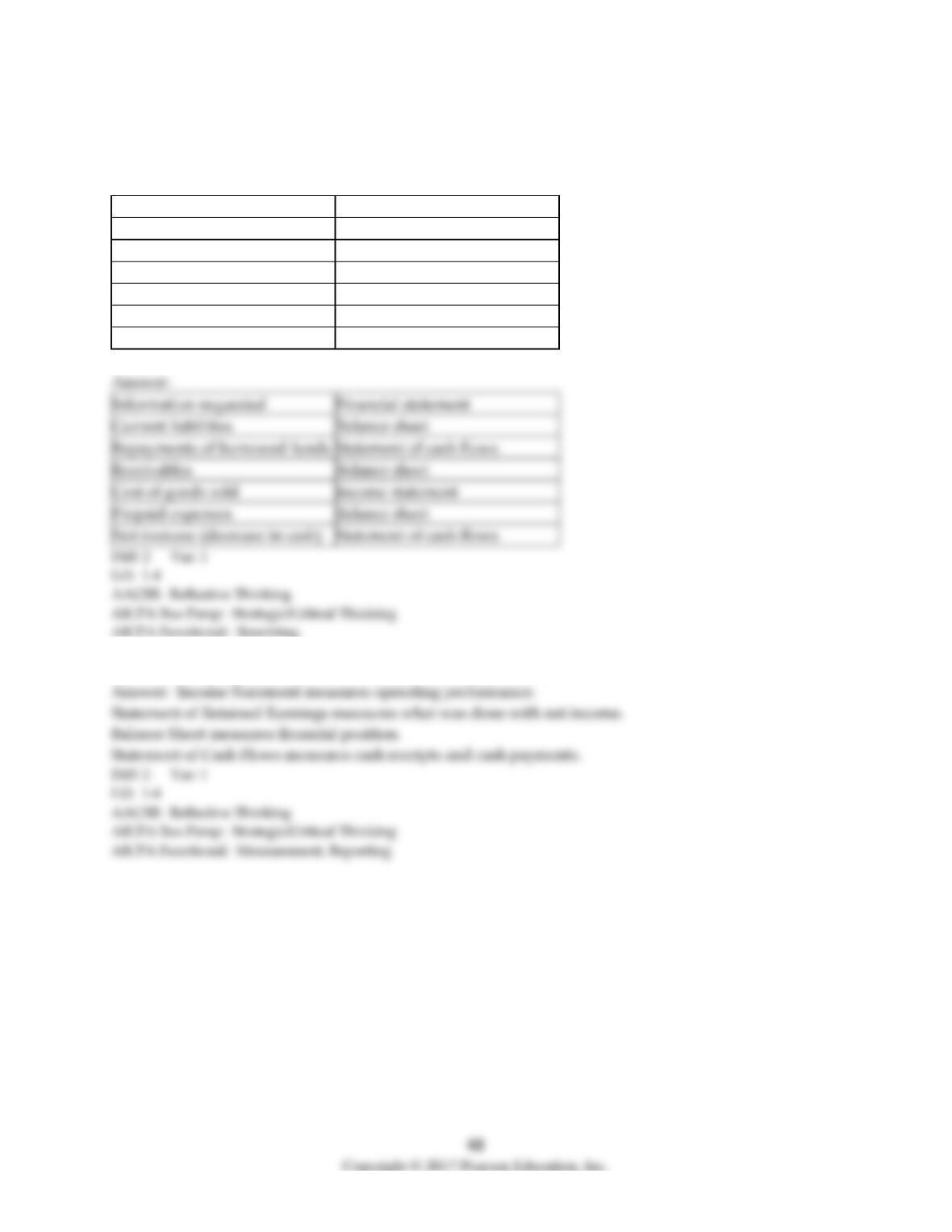
59) Baker Corporation operates retail stores and has decided to expand its operations. The company
must decide where to locate and how to finance the expansion. Identify the financial statement where
the decision makers can find the following information about Baker.
Information requested
Financial statement
Current liabilities
Repayments of borrowed funds
Receivables
Cost of goods sold
Prepaid expenses
Net increase (decrease in cash)
Information requested
Financial statement
Current liabilities
Balance sheet
Repayments of borrowed funds
Statement of cash flows
Receivables
Balance sheet
Cost of goods sold
Income statement
Prepaid expenses
Balance sheet
Net increase (decrease in cash)
Statement of cash flows
60) List the required financial statements and state what each measures.
1) Revenues and expenses are reported on both the income statement and the statement of retained
earnings.
2) The statement of retained earnings shows both the beginning and ending balances of retained
earnings.
3) Each category of the statement of cash flows results in net cash provided or net cash used.
4) The ending balance of Retained Earnings is reported on the:
A) Balance Sheet.
B) Statement of Retained Earnings.
C) Income Statement.
D) A and B.
5) The ending balance of Cash and Cash Equivalents is reported on the:
A) Balance Sheet.
B) Statement of Retained Earnings.
C) Statement of Cash Flows.
D) A and C.
6) The Income Statement is used to prepare the:
A) Statement of Retained Earnings only.
B) Statement of Cash Flows only.
C) Balance Sheet only.
D) Statement of Retained Earnings and Statement of Cash Flows.
7) The Statement of Retained Earnings is used to prepare the:
A) Income Statement.
B) Statement of Assets.
C) Statement of Cash Flows.
D) Balance Sheet.
8) The ending balance of cash and cash equivalents is found on the Statement of Cash Flows and the:
A) Statement of Retained Earnings.
B) Balance Sheet.
C) Income Statement.
D) Statement of Stockholders’ Equity.
9) The Statement of Retained Earnings is used to prepare the:
A) Income Statement.
B) Statement of Earnings and Distributions.
C) Statement of Cash Flows.
D) Balance Sheet.
10) The Balance Sheet is used to prepare the:
A) Income Statement.
B) Statement of Retained Earnings.
C) Statement of Cash Flows.
D) Statement of Stockholders’ Equity.
11) Dividends declared are reported on the:
A) Income Statement.
B) Statement of Retained Earnings.
C) Balance Sheet.
D) Statement of Assets.
12) The net loss for a company is reported on the:
A) Statement of Cash Flows.
B) Statement of Retained Earnings.
C) Income Statement.
D) all of the above.
13) Potter Company reports the following line items:
Long-Term Notes Payable
$50,000
Accounts Receivable
$28,000
Accounts Payable
$37,000
Building
$55,000
Cash and Cash Equivalents
$80,000
Salaries Expense
$25,500
Common Stock
$26,000
Interest Payable
$1,500
Land
$40,000
Short-term Investments
$5,000
Income Taxes Payable
$10,000
Equipment
$59,500
Supplies
$5,000
Service Revenue
$104,000
Supplies Expense
$20,000
Utilities Expense
$11,500
Income Tax Expense
$13,000
What is net income?
A) $26,000
B) $34,000
C) $59,500
D) $104,000
14) Connar Company reports the following accounts and balances at year end:
Long-Term Notes Payable
$150,000
Accounts Receivable
$31,000
Accounts Payable
$37,000
Building
$55,000
Cash and Cash Equivalents
$82,000
Salaries Expense
$20,500
Common Stock
$22,000
Interest Payable
$1,500
Land
$40,000
Short-term Investments
$7000
Income Taxes Payable
$14,000
Equipment
$59,500
Supplies
$7000
Service Revenue
$99,000
Supplies Expense
$18,000
Utilities Expense
$8,500
Income Tax Expense
$10,000
What is the total amount of current assets at the end of the year?
A) $82,000
B) $113,000
C) $127,000
D) $141,000
15) Wetzel Company has the following accounts and balances at the end of the fiscal year:
Long-Term Notes Payable
$152,000
Accounts Receivable
$30,000
Accounts Payable
$39,000
Building
$55,000
Cash and Cash Equivalents
$73,000
Salaries Expense
$20,500
Common Stock
$27,000
Interest Payable
$5500
Land
$42,000
Short-term Investments
$29,000
Income Taxes Payable
$15,000
Equipment
$59,500
Supplies
$30,000
Service Revenue
$99,000
Supplies Expense
$38,000
Utilities Expense
$28,500
Income Tax Expense
$21,000
What is the total amount of liabilities at the end of the year?
A) $59,500
B) $110,500
C) $211,500
D) $219,000
16) Kolander Company has the following accounts and balances at the end of the year:
Long-Term Notes Payable
$60,000
Accounts Receivable
$30,000
Accounts Payable
$39,000
Building
$57,000
Cash and Cash Equivalents
$84,000
Common Stock
$123,000
Interest Payable
$1500
Land
$43,000
Short-term Investments
$7000
Income Taxes Payable
$13,000
Equipment
$64,500
Supplies
$5000
What is the amount of Retained Earnings at the end of the year?
A) $54,000
B) $113,500
C) $167,500
D) $177,000
6 Learning Objective 1-6
1) The three factors that influence business and accounting decisions are economic, legal, and financial.
2) The decision framework for making ethical judgments provides general guidance for everyone,
regardless of profession or industry.
3) The American Institute of Certified Public Accountants (AICPA) Code of Professional Conduct
contains basic principles that can only be applied to CPAs.
4) The American Institute of Certified Public Accountants (AICPA) Code of Professional Conduct
contains basic principles that provide guidance to all of its members in the performance of their
professional duties.
5) The three factors that influence business and accounting decisions are:
A) judgment, cost/benefit analysis, and cultural backgrounds.
B) minimizing costs, maximizing profits and cost/benefit tradeoff.
C) economic, legal, and ethical.
D) legal implications, socioeconomic backgrounds, profit maximization.
6) The ________ factor recognizes that while certain actions might be both economically profitable and
legal, they still may not be right.
A) economic
B) legal
C) profitability
D) ethical
7) Complicating factors for a global business include:
A) what is legal in one country may not be legal in another country.
B) what is ethical in one country may not be ethical in another country.
C) a foreign government threatening to take over the company’s plant.
D) all of the above.
8) The economic factor in decision making requires the decision maker to:
A) maximize the economic benefit to the decision maker.
B) maximize the economic benefit to the corporation or nonprofit entity.
C) maximize the corporation’s profits.
D) minimize the corporation’s costs.
9) Regarding the decision framework for making ethical accounting judgments, state the guidelines for
each of the following decisions.
1. What is the issue?
2. Who are the stakeholders, and what are the consequences of the decision to each?
10) The American Institute of Certified Public Accountants (AICPA) Code of Professional Conduct
contains basic principles that provide guidance to all members in the performance of their professional
duties. List three of these principles. Briefly discuss how each of these three principles affects AICPA
members.