103. Accounting information is used by creditors to decide whether to invest in a company’s
stock.
104. The primary functions of financial accounting are to measure business activities of a
company and to communicate those measurements to internal parties for decision-making
purposes.
105. Financing activities are transactions involving externals sources of funding.
106. Investing activities include the purchase and sale of (1) long-term resources and (2) any
resources not directly related to a company’s normal operations.
107. Operating activities include transactions that relate to the primary operations of the
company.
108. A corporation is an entity that is legally separate from its owners.
109. Cash, inventory, supplies, and buildings are examples of liabilities.
110. Amounts owed to suppliers, workers, governments, and utility companies are examples
of liabilities.
111. If total assets of a company equal $12,000 and total stockholders’ equity equals $4,000,
then total liabilities equal $8,000.
112. If total liabilities of a company equal $16,000 and total stockholders’ equity equals
$9,000, then total assets equal $7,000.
113. The accounting equation shows that a company’s resources equal creditors’ and owners’
claims to those resources.
114. The costs of advertising, utilities, and salaries in the current reporting period are
examples of liabilities.
115. The difference between revenues and expenses is referred to as net income or net loss.
116. If a company reports revenues of $17,000 and expenses of $12,000, then net income
equals $5,000.
117. Expenses are regular cash payments by a corporation to its stockholders.
118. Dividends represent a return of the company’s profits to its owners, the stockholders.
119. One of the differences between a partnership and a corporation is that owners of a
partnership have limited liability.
120. Limited liability means the stockholders are not held personally responsible for the
financial obligations of the corporation.
121. One advantage of the corporate form of business is double taxation.
122. Double taxation refers to a corporation’s income being taxed twice—first when the
company earns it and pays corporate income taxes on it, and then again when stockholders
pay personal income taxes on any amounts the firm distributes to them as dividends.
123. Financial statements are periodic reports published by the company for the purpose of
providing information to managers.
124. The balance sheet is a financial statement that reports the company’s revenues and
expenses over an interval of time.
125. The statement of stockholders’ equity is a financial statement that summarizes the
changes in stockholders’ equity over an interval of time.
126. The two primary components of stockholders’ equity include common stock and
revenue.
127. Common stock represents an external source of stockholders’ equity, whereas retained
earnings represents an internal source.
128. Retained earnings represents the cumulative amount of net income earned over the life of
the company that has not been distributed to stockholders as dividends.
129. Dividends are considered an expense in running the business and reported in the income
statement.
130. All cash transactions reported in the statement of cash flows are classified as either (1)
operating activities, (2) investing activities, or (3) financing activities.
131. Investing cash flows generally include cash receipts and cash payments for transactions
involving revenues and expenses.
132. Operating cash flows generally include cash transactions for the purchase and sale of
investments and productive long-term assets.
133. Financing cash flows include cash transactions with lenders, such as borrowing money
and repaying debt, and with stockholders, such as issuing stock and paying dividends.
134. Any transaction that affects the income statement ultimately affects the balance sheet
through the balance of retained earnings.
135. Financial accounting has an impact on everyday business decisions as well as wide-
ranging economic consequences.
136. Investors and creditors rely heavily on financial accounting information in making
investment and lending decisions.
137. In general, if a company’s net income is increasing, so will its stock price.
138. The rules of financial accounting are called Generally Accepted Accounting Principles
(GAAP).
139. Today, financial accounting and reporting standards in the United States are established
primarily by the Financial Accounting Standards Board (FASB).
140. The 1933 Securities Act and the 1934 Securities Exchange Act were designed to restore
investor confidence in financial accounting following the stock market crash in 1929.
141. The 1934 act gives the Securities and Exchange Commission (SEC) the power to require
companies with publicly traded securities to prepare periodic financial statements for
distribution to investors and creditors.
142. The role of auditors is to help ensure that management has in fact appropriately applied
Generally Accepted Accounting Principles (GAAP) in preparing the company’s financial
statements.
143. Auditors are trained individuals hired by a company as an independent party to express a
professional opinion of the accuracy of that company’s financial statements.
144. The primary objective of financial reporting is to provide useful information to managers
in making decisions.
145. Public accounting firms are professional service firms that traditionally have focused on
three areas: auditing, tax preparation/planning, and business consulting.
146. The Financial Accounting Standards Board’s conceptual framework does not prescribe
Generally Accepted Accounting Principles. It provides an underlying foundation for the
development of accounting standards and interpretation of accounting information.
147. Match each account classification with its example.
1. Assets
2. Liabilities
3. Revenues
4. Dividends
5. Expenses
6. Stockholders’ equity
A) Land owned by a company.
B) Amounts owned to the bank.
C) Common stock issued to investors.
D) Payments made to stockholders.
E) Cleaning services provided to customers.
F) Workers’ salaries for the current period.
148. Match each business activity with its example.
1. Financing
2. Investing
3. Operating
A) Receive investments from stockholders.
B) Purchase office building.
C) Pay utilities.
149. Match each financial statement with the accounts reported in it.
1. Income statement
2. Balance sheet
3. Statement of stockholders’ equity
A) Revenues and expenses.
B) Dividends.
C) Assets and liabilities.
150. Match each qualitative characteristic with its definition.
1. Completeness
2. Neutrality
3. Verifiability
4. Confirmatory
value
5. Timeliness
6. Predictive value
A) Information provides feedback on past activities.
B) All information necessary to describe an item is
reported.
C) Information is presented in time to make useful
decisions.
D) Measurements that independent parties would
agree upon.
E) Information that does not bias the decision maker.
F) Information is useful in helping to forecast future
outcomes.

be.
151. Define accounting. Describe the two primary functions of financial accounting and its
role in our society.
152. Indicate whether a company would classify the transaction as financing, investing, or
operating.
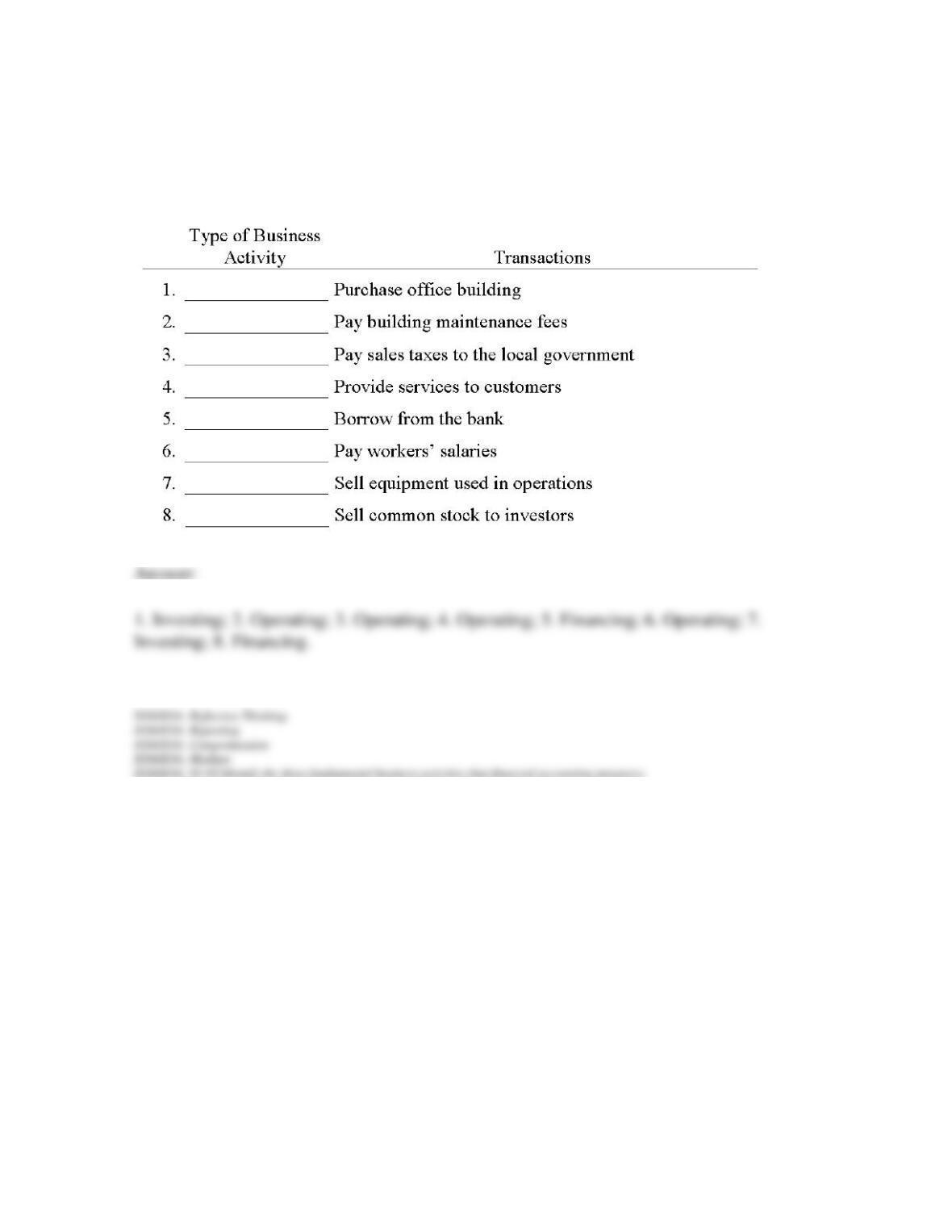
153. Below are typical transactions for a company. Indicate whether each transaction is
classified as a financing, investing, or operating activity.
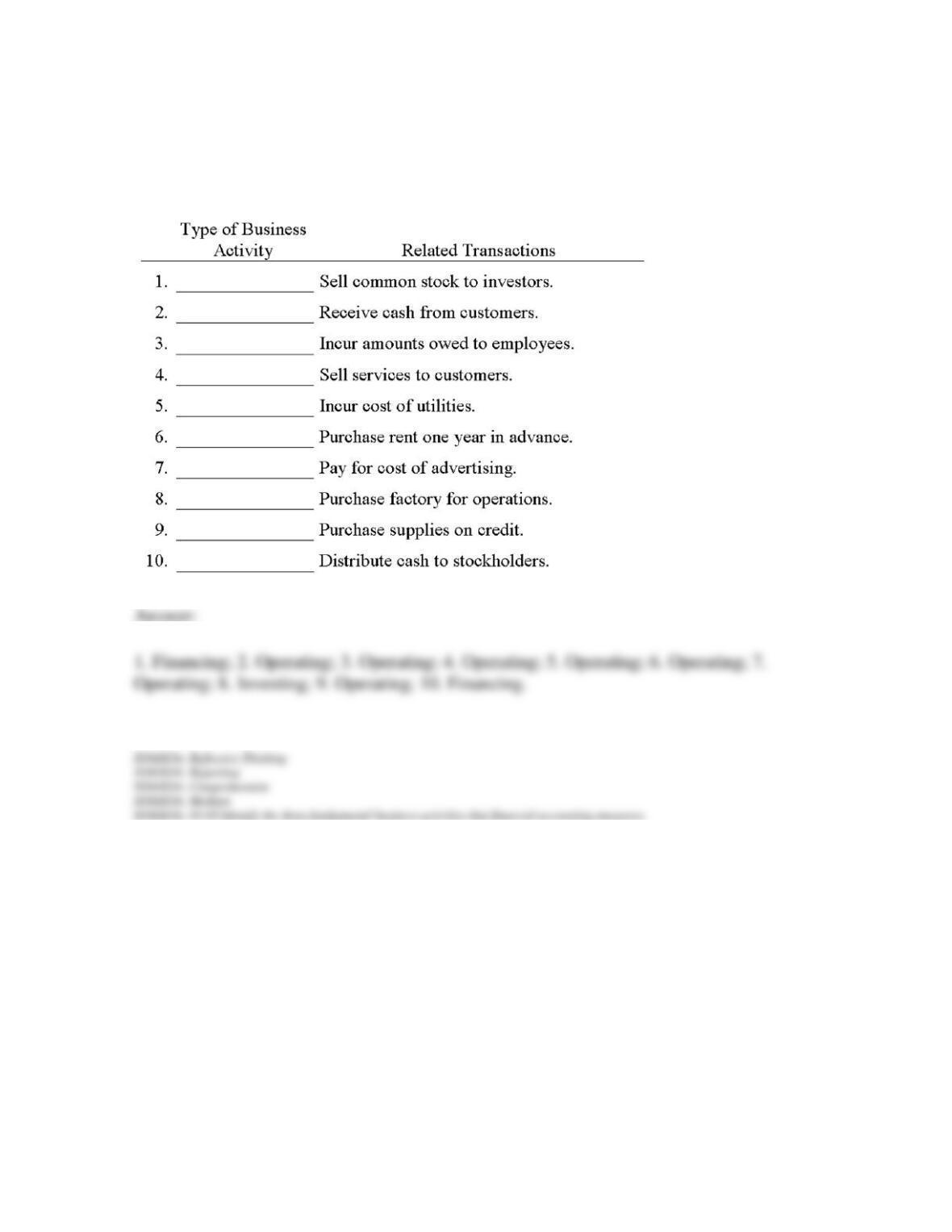
154. Below are typical transactions for a company. Indicate whether each transaction is
classified as a financing, investing, or operating activity.
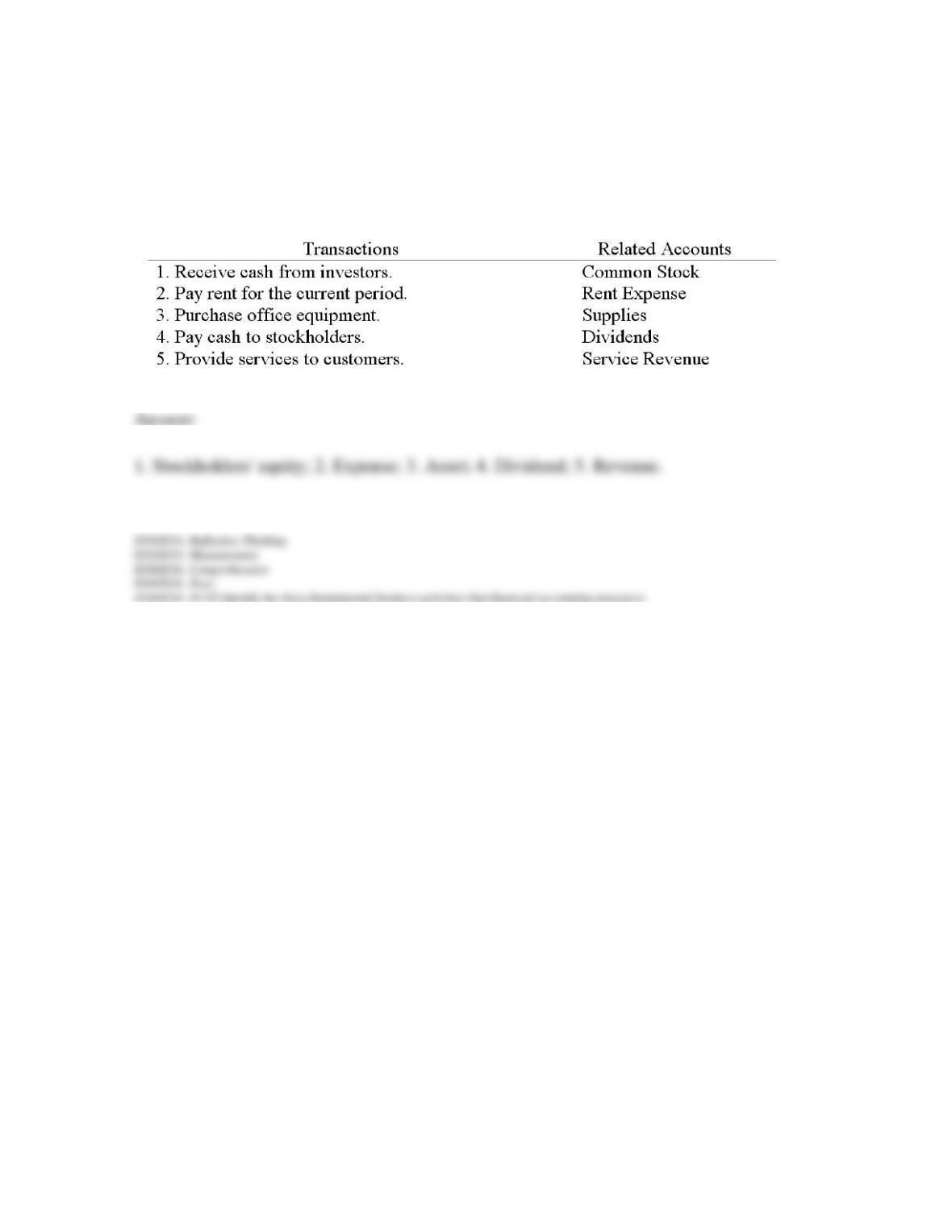
155. For each transaction, indicate whether a company would classify the related account as
an asset, liability, stockholders’ equity, dividend, revenue, or expense.