
Chapter 1 – The Changing Role of Managerial Accounting in a Dynamic Business Environment
1-1
Chapter 1
The Changing Role of Managerial Accounting in a Dynamic Business
Environment
Answer Key
True / False Questions
1. Two things that all organizations have in common are a set of goals and information needed
by managers.
2. The role of managerial accounting in organizations is the same as it has been over many
years.
Chapter 1 – The Changing Role of Managerial Accounting in a Dynamic Business Environment
1-2
3. Controlling involves the coordination of daily business functions within an organization.
4. Decision making requires managers to choose among the available alternatives.
5. The balanced scorecard is an important managerial accounting tool for short-run
competitiveness.
Chapter 1 – The Changing Role of Managerial Accounting in a Dynamic Business Environment
1-3
6. In most situations, managerial accounting reports solve decision problems.
7. Middle-level managers would likely be considered internal users of accounting information
rather than external users.
8. Measuring the performance of managers and subunits is not an objective of managerial
accounting.
Chapter 1 – The Changing Role of Managerial Accounting in a Dynamic Business Environment
1-4
9. The nature of managerial accounting reports is to focus on the enterprise in its entirety.
10. Line positions are indirectly involved in operational activities.

Chapter 1 – The Changing Role of Managerial Accounting in a Dynamic Business Environment
1-5
11. The position of chief financial officer (CFO) is typically a staff position.
12. A controller is normally involved with preparing financial statements.
13. The treasurer typically is responsible for raising capital and safeguarding the
organization’s assets.
Chapter 1 – The Changing Role of Managerial Accounting in a Dynamic Business Environment
1-6
14. The value chain is a managerial accounting tool that primarily assists in the valuation of
assets.
15. All companies define the value chain in the same way.
16. The upper limit on the production of goods and services if everything works perfectly is
known as practical capacity.
Chapter 1 – The Changing Role of Managerial Accounting in a Dynamic Business Environment
1-7
17. Non-value-added costs are the costs of activities that can be eliminated with no
deterioration of product quality, performance, or perceived value.
18. The largest managerial accounting professional association in the U.S. is the Chartered
Institute of Management Accountants.
19. The CMA is a professional certification that managerial accountants can earn to validate
their skills and the specialized knowledge that they possess.
Chapter 1 – The Changing Role of Managerial Accounting in a Dynamic Business Environment
1-8
20. All financial professionals, including managerial accountants, have an obligation to
themselves, their colleagues, and their organizations to adhere to high standards of ethical
conduct.
21. Legitimate ethical issues rarely impact the managerial accountant.
Chapter 1 – The Changing Role of Managerial Accounting in a Dynamic Business Environment
1-9
Multiple Choice Questions
22. Which of the following statements about managerial accountants is false?
23. Which of the following is not an action performed in combination with information to
pursue the goals of managerial accounting?
Chapter 1 – The Changing Role of Managerial Accounting in a Dynamic Business Environment
1-10
24. Which of the following is correct regarding the changing role of managerial accounting?
A. The managerial accountant is crunching more numbers than ever before in leading-edge
companies.
25. The day-to-day work of management teams will typically comprise all of the following
activities except:
Chapter 1 – The Changing Role of Managerial Accounting in a Dynamic Business Environment
1-11
26. Which of the following functions is best described as choosing among available
alternatives?
27. Which of the following managerial functions involves a detailed financial and operational
description of anticipated operations?
Chapter 1 – The Changing Role of Managerial Accounting in a Dynamic Business Environment
1-12
28. Which of the following involves the coordination of daily business functions within an
organization?
29. Wembley Company has set various goals, and management is now taking appropriate
action to ensure that the firm achieves these goals. One such action is to reduce outlays for
overhead, which have exceeded budgeted amounts. Which of the following functions best
describes this process?
Chapter 1 – The Changing Role of Managerial Accounting in a Dynamic Business Environment
1-13
30. In pursuing its goals, an organization does all of the following except:
31. Which of the following business models considers financial, customer, internal operating,
and other measures in the evaluation of performance?
Chapter 1 – The Changing Role of Managerial Accounting in a Dynamic Business Environment
1-14
32. Which of the following perspectives is normally absent in a balanced scorecard?
A. Financial.
33. Managerial accounting activity comprises a set of tools, systems and perspectives that add
value to an organization by supporting five major objectives. Which one of these is not a
supporting objective?
Chapter 1 – The Changing Role of Managerial Accounting in a Dynamic Business Environment
1-15
34. Because managerial accounting reports rarely solve decision problems, what function does
a managerial accountant use to assist managers in understanding issues contained within the
information produced?
35. Which of the following is not an objective of managerial accounting?
Chapter 1 – The Changing Role of Managerial Accounting in a Dynamic Business Environment
1-16
36. The role of managerial accounting information in assisting management is a(n):
37. Employee empowerment involves encouraging and authorizing workers to take initiatives
to:
Chapter 1 – The Changing Role of Managerial Accounting in a Dynamic Business Environment
1-17
38. The process of encouraging and authorizing workers to take appropriate initiatives to
improve the overall firm is commonly known as:
39. Managerial accounting:
Chapter 1 – The Changing Role of Managerial Accounting in a Dynamic Business Environment
1-18
40. Managerial accounting:
41. All of the following entities would have a need for managerial accounting information
except:
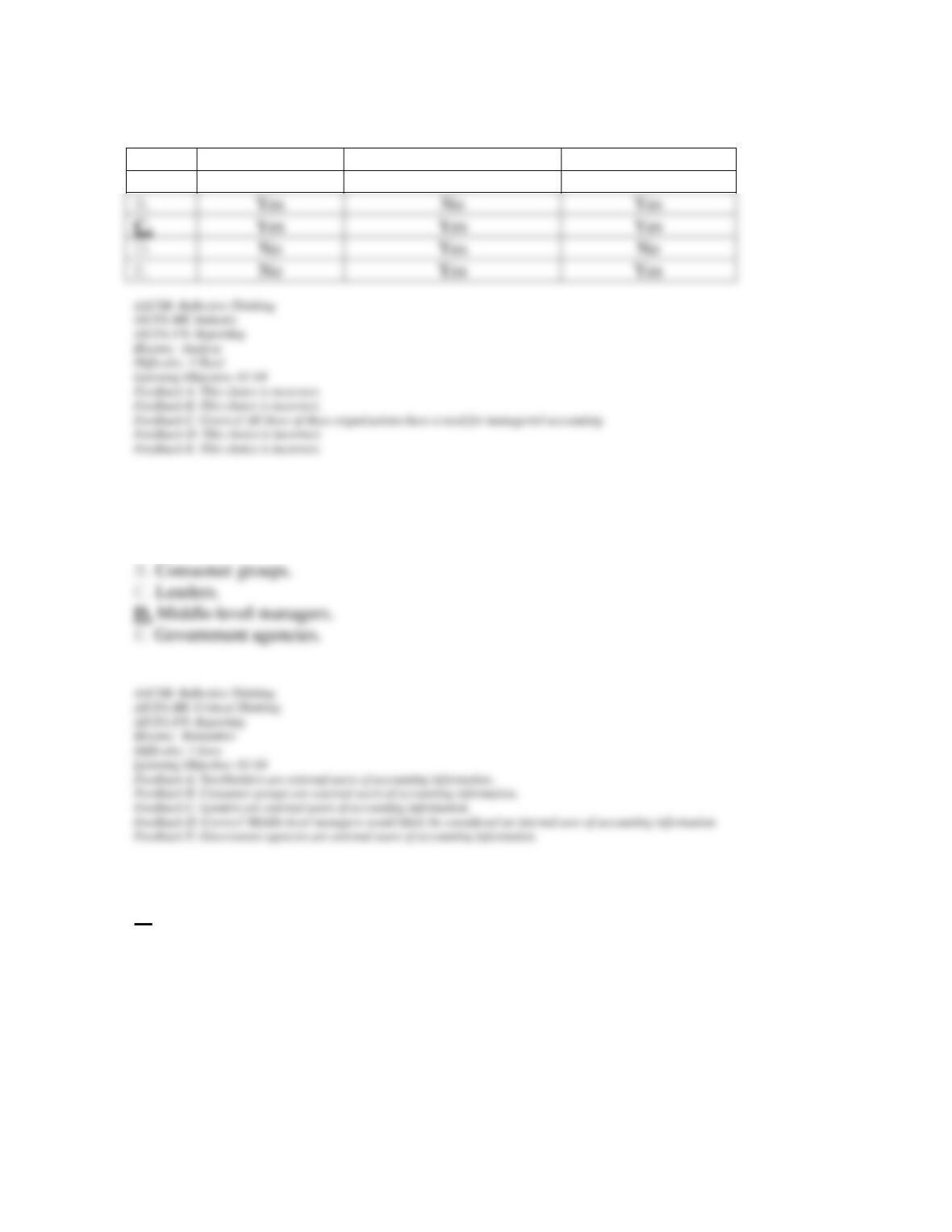
42. Which of the following choices correctly depicts whether Ocean Co., State University,
and Enrique Inc. would have a need for managerial accounting?
Chapter 1 – The Changing Role of Managerial Accounting in a Dynamic Business Environment
1-19
Ocean Co.
State University
Enrique Inc.
A.
Yes
Yes
No
43. Which of the following would likely be considered an internal user of accounting
information rather than an external user?
A. Stockholders.
44. Financial accounting focuses primarily on reporting:
A. to parties outside of an organization.
B. to parties within an organization.
C. to an organization’s board of directors.
D. to financial institutions.
E. for financial institutions.
AACSB: Reflective Thinking
Yes
Yes
Yes
D.
Yes
No
Yes
Chapter 1 – The Changing Role of Managerial Accounting in a Dynamic Business Environment
45. Which of the following characteristic(s) relate(s) more to managerial accounting than to
financial accounting?
A. A focus on reporting to personnel within an organization.
46. Which of the following statements represents a similarity between financial and
managerial accounting?
A. Both are useful in providing information for external users.