Financial Accounting: IFRS, 11e, GE
Harrison/Horngren/Thomas/Tietz/Suwardy
Test Item File
Chapter 1: Conceptual Framework and Financial Statements
1.1-1 Bookkeeping is a type of accounting used primarily by proprietorships.
1.1-2 Bookkeeping is the mechanical part of accounting.
1.1-3 The major forms of business organizations are proprietorships, partnerships, and for-profit organizations.
1.1-4 Limited Liability Partnerships (LLPs) have at least one general partner with unlimited liability for all
partnership debts.
1.1-5 In an LLP, each partner is liable for partnership debts only to the extent of their investment in the
partnership plus their share of the liabilities.
1.1-6 All business owners are personally liable for the debts of their businesses.
1.1-7 The business records of a proprietorship should include the proprietor’s personal finances.
1.1-8 Mutual agency of a partnership means that each partner may conduct business in the name of the
partnership and can legally bind all the partners without limit for the partnership’s debts.
1.1-9 Financial accounting provides budgeting information to a company’s managers.
1.1-10 Managerial accounting information is used mainly by external users.
1.1-11 Accounting:
A) measures business activities.
B) processes data into reports and communicates the data to decision makers.
C) is often called the language of business.
D) is all of the above.
1.1-12 The two types of accounting are:
A) profit and nonprofit.
B) financial and managerial.
C) internal and external.
D) bookkeeping and decision-oriented.
1.1-13 Management accounting:
A) includes information such as budgets and forecasts.
B) is used to make strategic decisions for the entity.
C) must be relevant to decision makers within the entity.
D) is all of the above.
1.1-14 What type of accounting provides information for decision makers outside the entity?
A) Bookkeeping
B) Managerial accounting.
C) Internal auditing.
D) Financial accounting.
1.1-15 Who ultimately controls a corporation?
A) Board of Directors
B) The Chief Executive Officer (CEO)
C) The shareholders
D) The President
1.1-16 Financial statements are:
A) standard documents issued by outside consultants who are hired to analyze key operations of the
business in financial terms.
B) the business documents that companies use to report the results of their financial activities to various
user groups.
C) reports created by management that states it is responsible for the acts of the corporation.
D) the mechanical part of accounting.
1.1-17 For which form of business ownership are the owners of a business legally distinct from the business?
A) Corporation
B) Partnership
C) Proprietorship
D) All of the above
1.1-18 Characteristics of a sole proprietor include:
A) multiple owners.
B) limited personal liability for all business debts.
C) a distinct entity, separate from its owner for accounting purposes.
D) formation under state law.
1.1-19 A partnership:
A) is a taxpaying entity.
B) is not a distinct entity, separate from its owners for accounting purposes.
C) has mutual agency.
D) has limited liability for the partners.
1.1-20 A limited-liability partnership is made up of:
A) partners.
B) sole proprietors.
C) members.
D) shareholders.
1.1-21 Advantages of a corporation include:
A) a single owner.
B) the double taxation of distributed profits.
C) limited liability of the shareholders.
D) mutual agency.
1.1-22 All of the following are forms of business organizations EXCEPT for the:
A) proprietorship.
B) limited liability partnership.
C) limited proprietorship.
D) corporation.
1.1-23 An entity that is organized according to state legislation and in which ownership units are called shares is
a:
A) proprietorship.
B) corporation.
C) partnership.
D) limited liability partnership.
1.1-24 For accounting purposes, the business entity should be considered separate from its owners if the business
is organized as a:
A) proprietorship.
B) corporation.
C) partnership.
D) any of the above.
1.1-25 International Financial Reporting Standards, or IFRS, are the rules and procedures established by the
International Accounting Standards Board, or the IASB.
1.1-26 Since we live in a global economy, all countries have adopted the same accounting standards for business
transactions.
1.1-27 No major differences exist between the accounting standards issued by the FASB and the IASB.
1.1-28 The International Accounting Standards Board is responsible for establishing:
A) the code of professional conduct for accountants.
B) the International Accounting Standards.
C) generally accepted accounting principles.
D) the International Financial Reporting Standards.
1.1-29 The acronym GAAP stands for:
A) generally acceptable authorized pronouncements.
B) government authorized accountant principles.
C) generally accepted accounting principles.
D) government audited accounting pronouncements.
1.1-30 Accountants follow guidelines for professional measurement and disclosure of financial information
called:
A) IASB.
B) IFRS.
C) FASB.
D) SEC.
1.1-31 International financial reporting standards are set by the:
A) IASB.
B) GAAP.
C) FASB.
D) SEC.
1.2-32 The IASB:
A) is working towards a convergence of standards with the FASB.
B) will not accept FASB rules.
C) does not want US companies to adopt IFRS standards.
D) feels that the global use of IFRS will significantly increase costs of doing global business.
1.2-33 The heading John Smith, Capital, indicates the owners’ equity of a:
A) proprietorship.
B) corporation.
C) not-for-profit.
D) regulatory body.
1.2-1 Users of accounting information include investors, creditors, and regulatory bodies.
1.2-2 An example of a regulatory body that uses accounting information is the Securities and Exchange
Commission or SEC (in the US)..
1.2-3 One overall objective of accounting is to provide financial information that is useful to potential capital
providers who are making investment and lending decisions.
1.2-4 To be relevant, accounting information must be capable of making a difference to the decision maker.
1.2-4
1.2-5 The entity assumption is the most basic accounting concept.
1.2-6 The going-concern assumption assumes that the entity will liquidate and not continue its operations.
1.2-7
Cost is a verifiable measure that is relatively free from bias.
1.2-8 A conceptual framework lays the foundation for resolving the “big” issues in accounting.
1.2-9 Comparability means uniformity, and continuing to use the same accounting principles and polivies when
more relevant and reliable alternative exists.
1.2-10 To be useful, accounting information must have the fundamental qualitative characteristics of:
A) understandability, timeliness, reliability and relevance.
B) timeliness, comparability, reliability and relevance.
C) materiality, understandability, timeliness and comparability.
D) understandability, comparability, reliability and relevance.
1.2-11 All of the following are characteristics of useful accounting information EXCEPT:
A) comparability.
B) relevance
C) informative.
D) reliability.
1.2-12 When information is important enough to the informed user, so that, if it was omitted or erroneous, it
would make a difference in the user’s decision, it is:
A) comparable.
B) material
C) timely.
D) understandable.
1.2-13 Accounting information is subject to the constraints of:
A) balance between qualitative characteristics, comparability and consistency.
B) balance between qualitative characteristics, reliability and relevance.
C) timeliness, benefits versus cost and balance between qualitative characteristics.
D) timeliness, benefit versus cost, relevance and reliability.
1.2-14 The accounting assumption that states that the business, rather than its owners, is the reporting unit is the:
A) entity assumption.
B) going concern assumption.
C) stable-monetary-unit assumption.
D) historical cost assumption.
1.2-15 The accrual assumption of accounting:
A) ensures that accounting records and statements are based on the most reliable data available.
B) holds that the entity will remain in operation for the foreseeable future.
C) ensures that transactions and events are recognized when they occur.
D) enables accountants to ignore the effect of inflation in the accounting records.
1.2-16 The going-concern assumption of accounting:
A) enables accountants to ignore the effect of inflation in the accounting records.
B) holds that the entity will remain in operation long enough to use its existing assets.
C) maintains that each organization, or section of an organization, stands apart from other organizations
and individuals.
D) ensures that accounting records and statements are based on the most reliable data available.
1.2-17 The qualitative characteristic of a financial statement stating that accounting information must be
sufficiently transparent so that it makes sense to users of the information is:
A) relevance.
B) reliability.
C) understandability.
D) comparability.
1.2-18 The relevant measure of the value of the assets of a company that is going out of business is the:
A) book value.
B) current market value.
C) historical cost.
D) recorded value.
1.2-19 The CEO of a business owns a residence in Flagstaff. The company the CEO works for owns a factory
in Chandler. Which of these properties is considered an asset(s) of the business?
A) The Flagstaff residence only
B) The Chandler factory only
C) Both the Flagstaff and Chandler properties
D) Neither the Flagstaff nor Chandler properties
1.2-20 An Oklahoma City business paid $15,000 cash for equipment used in the business. At the time of
purchase, the equipment had a list price of $20,000. When the balance sheet was prepared, the value of
the equipment was $22,000. What is the relevant measure of the value of the equipment?
A) Historical cost, $15,000
B) Fair market cost, $20,000
C) Current market cost, $22,000
D) $15,000 on the day of purchase, $22,000 on balance sheet date
1.2-21 An office building is appraised for $250,000 and offered for sale at $260,000. The buyer pays $245,000
for the building. The building should be recorded on the books of the buyer at:
A) $250,000.
B) $260,000.
C) $245,000.
D) some other amount.
1.2-22 Liabilities are divided into “outsider claims” and “insider claims.”
1.2-23 “Net assets”, as shareholders’ equity is often referred to, represents the residual amount of business assets
which can be claimed by the owners.
1.2-24 Shareholders’ equity is the shareholders’ interest in the assets of the corporation.
1.2-25 The economic resources of a business that are expected to produce a benefit in the future are:
A) liabilities.
B) assets.
C) owners’ equity.
D) expenses.
1.2-26 Which of the following best describes a liability? Liabilities are:
A) a form of paid-in capital.
B) future economic benefits to which a company is entitled.
C) debts payable to outsiders called creditors.
D) economic obligations to owners to be paid at some future date by the corporation.
1.2-27 The owners’ interest in the assets of a corporation is known as:
A) capital.
B) shareholders’ equity.
C) long-term assets.
D) operating expenses.
1.3-28 Revenues are:
A) decreases in assets resulting from delivering goods or services to customers.
B) increases in liabilities resulting from delivering goods or services to customers.
C) increases in retained earnings resulting from delivering goods or services to customers.
D) decreases in retained earnings resulting from delivering goods or services to customers.
1.3-29 Expenses are:
A) increases in liabilities resulting from purchasing assets.
B) increases in assets resulting from operations.
C) increases in retained earnings resulting from operations.
D) decreases in retained earnings resulting from operations.
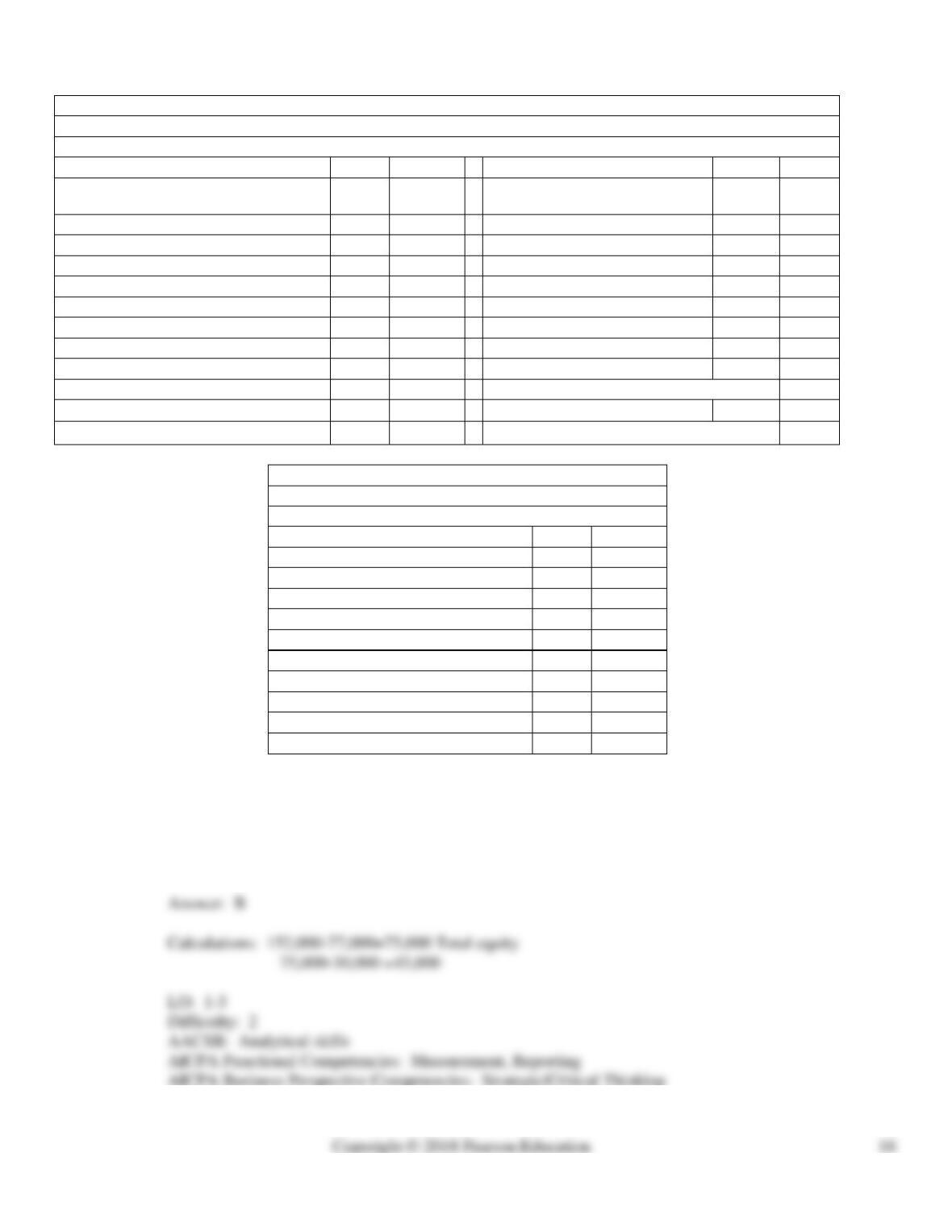
1.2-30 Use the following Balance Sheet and Income Statement to answer the question.
Jane Austin Bookstore
Balance Sheet
December 31, 20X6
Assets
Liabilities and Shareholders’
Equity
Cash and equivalents
$5,000
Accounts payable
$10,000
Accounts Receivable
12,000
Taxes payable
4,500
Inventory
25,000
Other liabilities
2,500
Prepaid expenses
3,000
Mortgage payable
60,000
Land
54,000
Total liabilities
77,000
Building
63,000
Accumulated depreciation—Building
????
51,000
Capital
30,000
Trucks
20,000
Retained earnings
???
Accumulated depreciation—Trucks
18,000
2,000
Total shareholders’ equity
???
Total Assets
$152,000
Total Liabilities and
Shareholders’ Equity
????
Jane Austin Bookstore
Income Statement
For the Year Ended December 31, 20X6
Book sales
$100,000
Cost of goods sold
???
Gross profit
???
Operating expenses:
Selling and administrative expenses
14,000
Depreciation expense
8,000
Total Operating expenses
22,000
Income from operations
13,000
Income tax (35%) expense
4,550
Net income
$8,450
What is the Retained earnings shown on the Balance Sheet for 20X6?
A) $15,000
B) $45,000
C) $75,000
D) $77,000
1.3-1 The accounting equation expresses the idea that Resources – Insider claims = Outsider claims.
1.3-2 The financial statements are based on the accounting equation.
1.3-3 The word “payable” always signifies a liability.
1.3-4 The accounting equation must always be in balance.
1.3-5 A net loss occurs when:
A) not enough cash exists.
B) total revenues exceed total expenses.
C) total expenses exceed total revenues.
D) total revenues and dividends exceed total expenses.
1.3-6 Dividends never affect net income.
1.3-7 Expenses are increases in retained earnings that result from operations.
1.3-8 Dividend payments are NOT classified as expenses.
1.3-9 The calculation of ending retained earnings considers beginning retained earnings, current net income or
net loss and dividends.
1.3-10 The owners’ equity of proprietorships and corporations are the same.