Chapter 01 – Financial Statements and Business Decisions
1. A business entity’s accounting system creates financial accounting reports which are
provided to external decision makers.
2. Business managers utilize managerial accounting reports to plan and manage the daily
operations.
3. The balance sheet includes assets, liabilities and stockholders’ equity as of a point in time.
Chapter 01 – Financial Statements and Business Decisions
4. Revenue is recognized within the income statement during the period in which cash is
collected.
5. Total assets are $37,500, total liabilities are $20,000 and contributed capital is $10,000;
therefore, retained earnings are $7,500.
6. The income statement is a measure of an entity’s economic performance for a period of
time.
Chapter 01 – Financial Statements and Business Decisions
7. The accounting equation states that Assets = Liabilities + Stockholders’ Equity.
8. A decision maker who wants to understand a company’s financial statements must carefully
read the notes to the financial statements because the notes provide useful supplemental
information.
9. The financial statement that shows an entity’s economic resources and claims against those
resources is the balance sheet.
10. Assets are initially recorded on the balance sheet at the total cost paid to acquire the asset.
11. Stockholders’ equity on the balance sheet consists of contributed capital and retained
earnings.
12. The amount of cash paid by a business for dividends would be reported on the statement
of cash flows as an operating activity.
Chapter 01 – Financial Statements and Business Decisions
13. A company’s retained earnings balance increased $50,000 last year; therefore, net income
last year must have been $50,000.
14. The statement of retained earnings explains the change in the retained earnings balance
caused by stockholder investments and dividend declarations.
Chapter 01 – Financial Statements and Business Decisions
15. The Financial Accounting Standards Board (FASB) has been given the authority by the
Securities and Exchange Commission (SEC) to develop generally accepted accounting
principles.
16. In the United States, the Securities and Exchange Commission (SEC) is considering the
adoption of International Financial Reporting Standards (IFRS).
Chapter 01 – Financial Statements and Business Decisions
17. The primary responsibility for the content of the financial statements lies with the external
auditor.
18. An audit examines the financial statements provided by management to ensure that they
represent what they claim and to make sure that they are in compliance with Generally
Accepted Accounting Principles.
19. The auditor can be held liable for malpractice in situations where the investors suffered
losses while relying on the financial statements.
Chapter 01 – Financial Statements and Business Decisions
20. One of the advantages of a corporation when compared to a partnership is the limited
liability of the owners.
21. Which of the following describes the primary objective of the balance sheet?
Chapter 01 – Financial Statements and Business Decisions
22. During the fiscal year ended 2010, a company had revenues of $400,000, expenses of
$280,000, and an income tax rate of 30 percent. What was the company’s 2010 net income?
23. Atlantic Corporation reported the following amounts at the end of the first year of
operations: contributed capital $200,000; sales revenue $800,000; total assets $600,000;
dividends declared $40,000; and total liabilities $320,000. What are Atlantics’ retained
earnings at the end of the year and how much expenses were incurred during the year?
Chapter 01 – Financial Statements and Business Decisions
24. Which of the following best describes the balance sheet?
25. Which of the following statements is correct?
Chapter 01 – Financial Statements and Business Decisions
26. Which of the following correctly describes the various financial statements?
27. Which of the following accounts would not be reported on the balance sheet?
Chapter 01 – Financial Statements and Business Decisions
28. Which of the following would not be found on the statement of cash flows?
29. Which of the following accounts is not a liability on the balance sheet?
Chapter 01 – Financial Statements and Business Decisions
30. What financial statement would you look at to determine the dividends declared by a
business?
31. Which financial statement would you utilize to determine whether a company will be able
to pay liabilities which are due in 30 days?
Chapter 01 – Financial Statements and Business Decisions
32. Which of the following is considered to be an expense on the income statement?
33. Which of the following best describes assets?
Chapter 01 – Financial Statements and Business Decisions
34. Which of the following accounts would be reported as assets on the balance sheet?
35. Which of the following statements describes the balance sheet?
Chapter 01 – Financial Statements and Business Decisions
36. Which of the following best describes liabilities and stockholders’ equity?
37. Which of the following equations is the balance sheet equation?
Chapter 01 – Financial Statements and Business Decisions
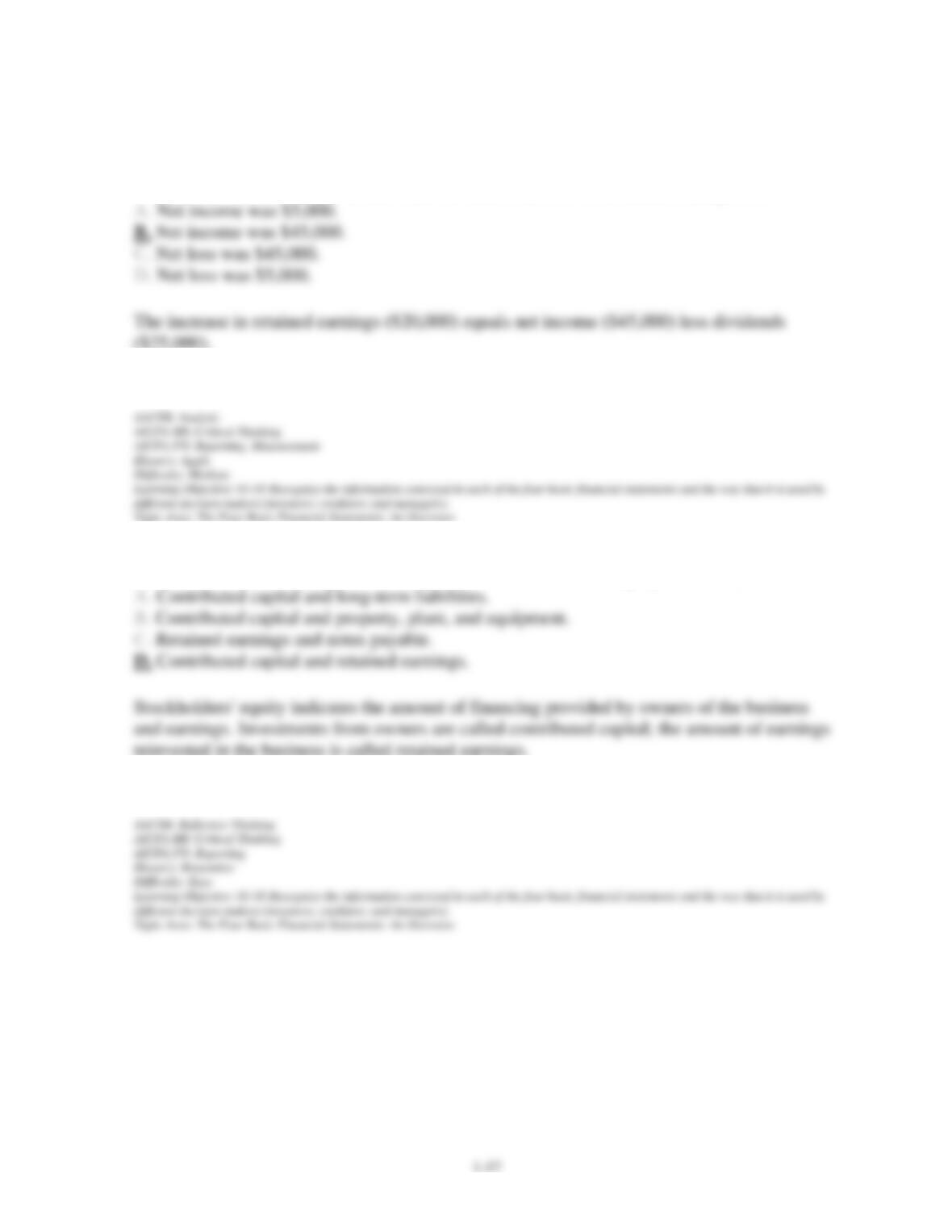
38. Willie Company’s retained earnings increased $20,000 during 2010. What was Willie’s
2010 net income or loss given that Willie declared $25,000 of dividends during 2010?
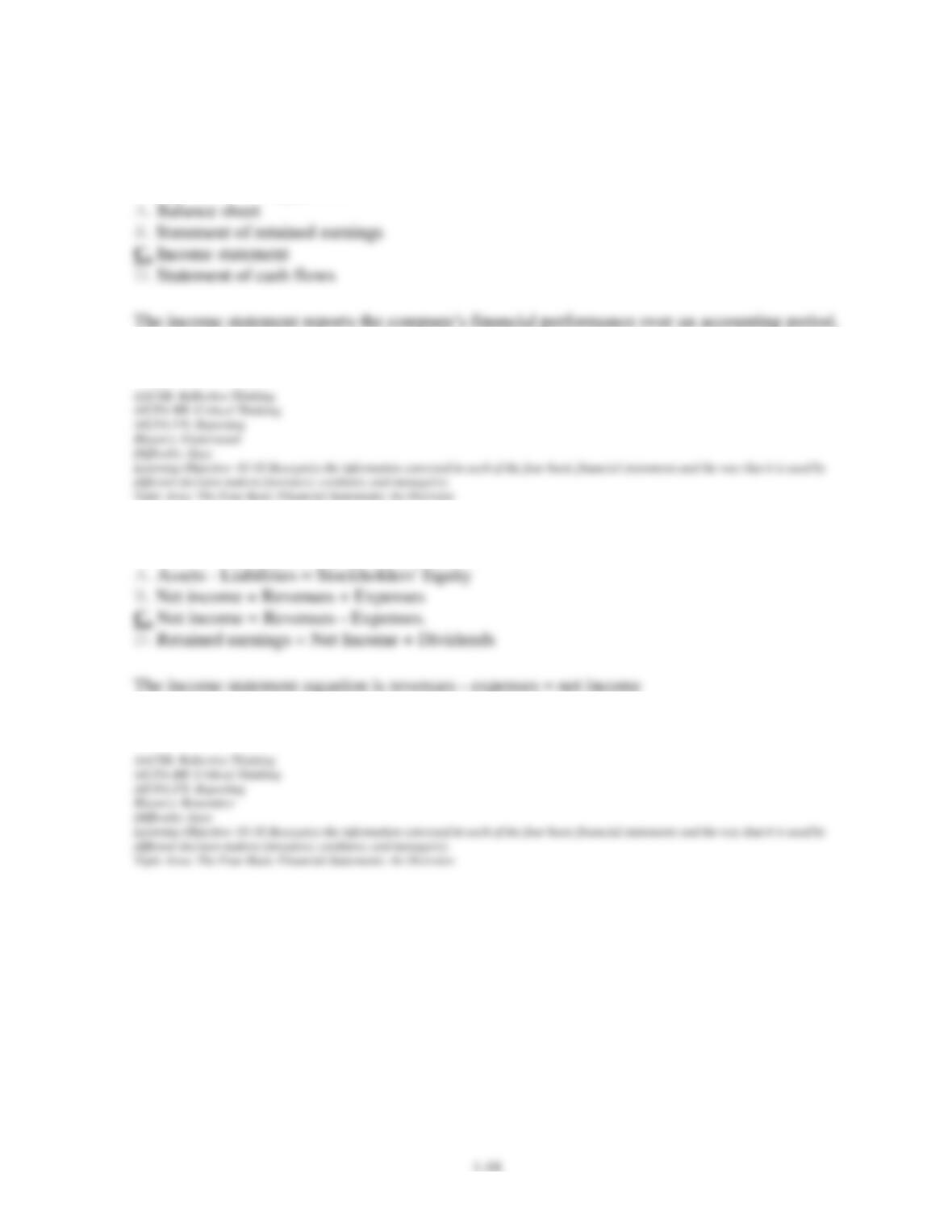
39. Which of the following are the components of stockholders’ equity on the balance sheet?
Chapter 01 – Financial Statements and Business Decisions
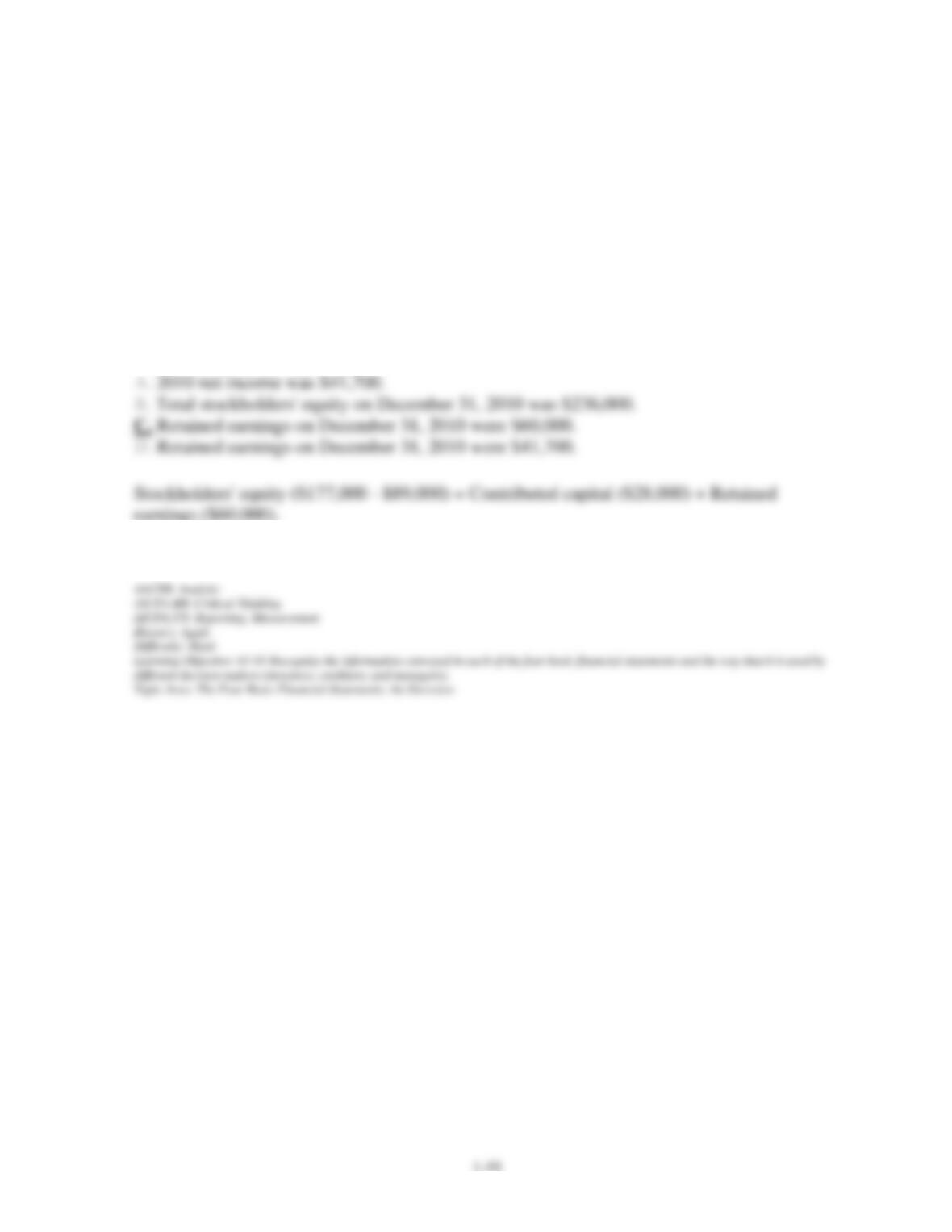
40. Which financial statement would you use to determine a company’s earnings performance
during an accounting period?
41. Which of the following equations best describes the income statement?
Chapter 01 – Financial Statements and Business Decisions
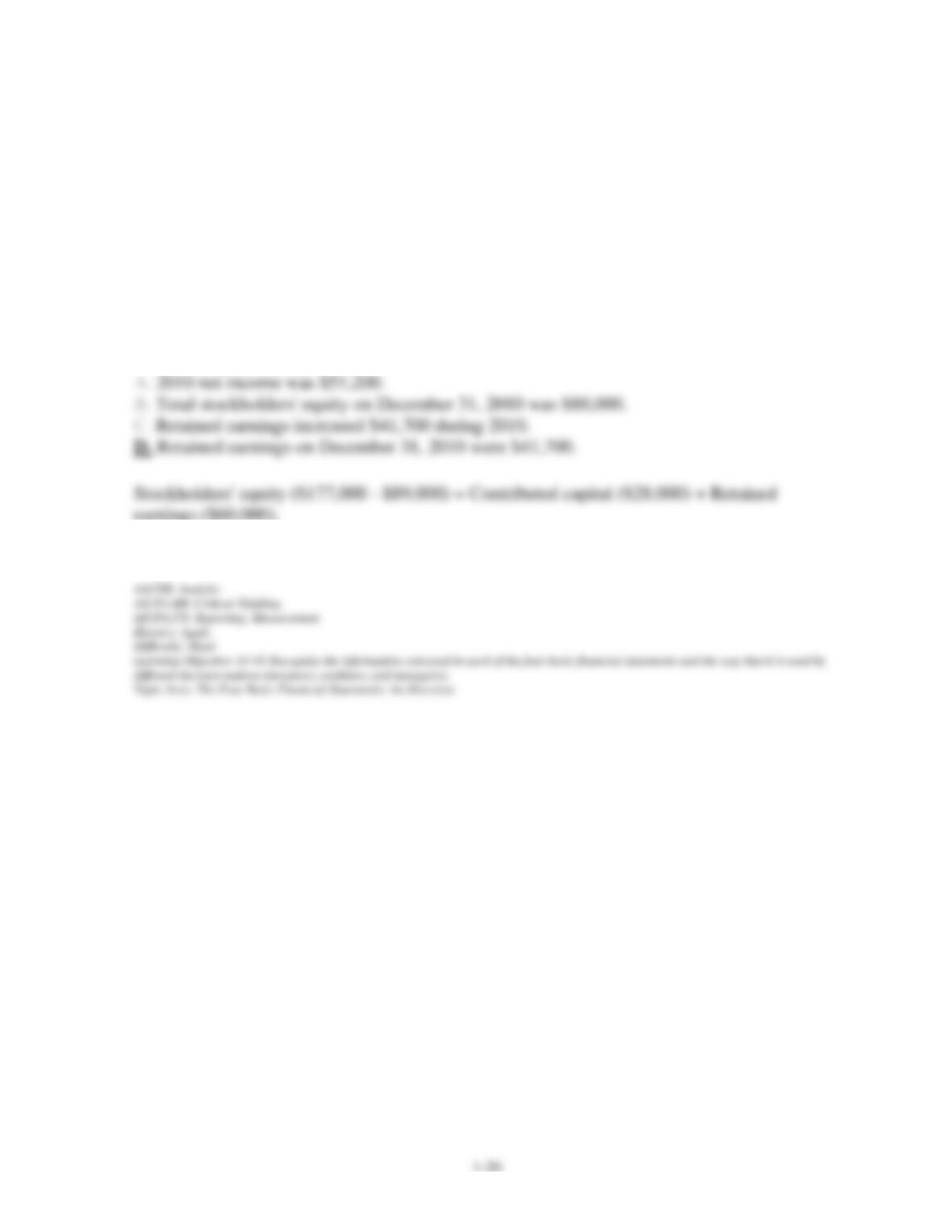
42. Lena Company has provided the following data (ignore income taxes):
2010 revenues were $99,000.
2010 expenses were $47,800.
Dividends declared and paid during 2010 totaled $9,500.
Total assets on December 31, 2010 were $177,000.
Total liabilities on December 31, 2010 were $89,000.
Contributed capital on December 31, 2010 was $28,000.
Which of the following is correct?
Chapter 01 – Financial Statements and Business Decisions
43. Lena Company has provided the following data (ignore income taxes):
2010 revenues were $99,000.
2010 expenses were $47,800.
Dividends declared and paid during 2010 totaled $9,500.
Total assets on December 31, 2010 were $177,000.
Total liabilities on December 31, 2010 were $89,000.
Contributed capital on December 31, 2010 was $28,000.
Which of the following is not correct?