1. IFRS stands for:
2. Which of the following characteristics of a country most likely affects the extent of
companies’ financial disclosure practices?
3. Which of the following is not a reason why accounting differs across countries?
4. Countries that have different rules for financial accounting and tax accounting, rely more
on equity financing, and have historical political and economic ties with Great Britain are
referred to as what types of countries?
5. Countries that have similar rules for financial accounting and tax accounting, rely more on
debt financing, and have historical political and economic ties with Germany are referred to as
what types of countries?
6. When a country establishes financial reporting rules that closely resemble tax reporting
rules, reported accounting profits tend to be:
7. One motivation for reducing differences in accounting practices across countries is to:
8. The body primarily responsible for establishing a single set of global accounting standards
is the:
9. The Norwalk Agreement:
10. For which of the following topics is accounting under both U.S. GAAP and IFRS
essentially the same?
11. Which inventory cost flow assumption is allowed under U.S. GAAP but not under IFRS?
12. Which of the following statements is true regarding revaluation of property, plant, and
equipment to fair value?
13. Compared to that in the U.S, the cost to companies in other countries of documenting
14. Why are some U.S. companies opposed to elimination of the LIFO inventory method?
15. Assuming rising costs, the switch from LIFO to FIFO or average cost would most likely
have what effect(s)?
16. Suppose a company has research costs of $100,000 and development costs of $200,000
for the year. Under IFRS, what amount would be reported as an expense in the current year’s
income statement?
17. Suppose a company has research costs of $100,000 and development costs of $200,000
for the year. Under U.S. GAAP, what amount would be reported as an expense in the current
year’s income statement?
18. Would a company be more likely to report a contingent liability under U.S. GAAP or
IFRS?
19. Suppose a severe storm floods a company’s headquarters, causing damages to the building
of $300,000 and destruction of inventory of $200,000. Because of the unusual nature of this
event, the company had no flood insurance to cover these losses. Under IFRS, how much
would the company report as an extraordinary loss in the current year’s income statement?
20. Suppose a severe storm floods a company’s headquarters, causing damages to the building
of $300,000 and destruction of inventory of $200,000. Because of the unusual nature of this
event, the company had no flood insurance to cover these losses. Under U.S. GAAP, how
much would the company report as an extraordinary loss in the current year’s income
statement?
21. Suppose a company pays interest of $10,000 for the year on borrowed amounts due in two
years. Under IFRS, what is the most the company can report as cash outflows from financing
activities?
22. In common law countries (such as the U.S., the U.K., and Canada), greater emphasis is
placed on public information than in code law countries (such as France and Germany).
23. For countries whose tax standards are closely tied to financial reporting standards
(Continental Europe and Japan), accounting earnings tend to be lower so companies can
minimize tax payments.
24. In countries where debt financing is more common (Japan) compared to equity financing,
there is greater emphasis on reporting the ability of the company to earn profits for its
investors rather than the ability to repay debt.
25. Some countries are more secretive (Brazil and Switzerland), leading to fewer financial
disclosures.
26. More economically developed economies (the U.S. and the U.K.) have a need for more
complex accounting standards.
27. Convergence of accounting practices is expected to increase the flow of investment across
borders.
28. The primary objective of the IASB is to develop accounting standards in the U.S.
29. By late 2007, over 100 jurisdictions, including China, Australia, and all of the countries in
the European Union (EU), either require or permit the use of IFRS.
30. The Norwalk Agreement formalizes the commitment between the FASB and IASB to the
convergence of U.S. GAAP and IFRS.
31. The FIFO inventory method is not allowed under IFRS.
32. IFRS allows, but does not require, revaluation of property, plant and equipment to fair
value.
33. Under U.S. GAAP, development expenditures are capitalized, while under IFRS, these
expenditures must be expensed immediately.
34. Under IFRS, inventory write-downs due to using the lower-of-cost-or-market rule are
allowed to be reversed in a future year if the market value subsequently increases.
35. When preparing a statement of cash flows, IFRS allows companies to report cash outflows
from interest payments as either operating or financing cash flows, while U.S. GAAP requires
these outflows to be reported as only operating activities.
36. When preparing a statement of cash flows, IFRS allows companies to report cash inflows
from interest and dividends as either operating or investing cash flows, while U.S. GAAP
requires these inflows to be reported as only operating activities.
37. Listed below are seven reasons why accounting practices differ across countries followed
by a list of descriptions. Match each description with the best reason placing the number
designating the reason in the space provided.
1. Inflation
2. Political and
economic ties
3. Economic
development
4. Culture
5. Sources of
financing
6. Legal system
7. Tax laws
A) The extent of public disclosure depends on the
secretiveness of society.
B) In some countries, asset values increase rapidly
because of the general price level changes.
C) Countries share business activities and have
political connections.
D) Some countries rely more heavily on debt capital
than on equity capital to fund operations.
E) Common law countries rely more heavily on public
information.
F) More developed economies have more complex
business transactions.
G) Alignment between financial reporting and tax
reporting rules.

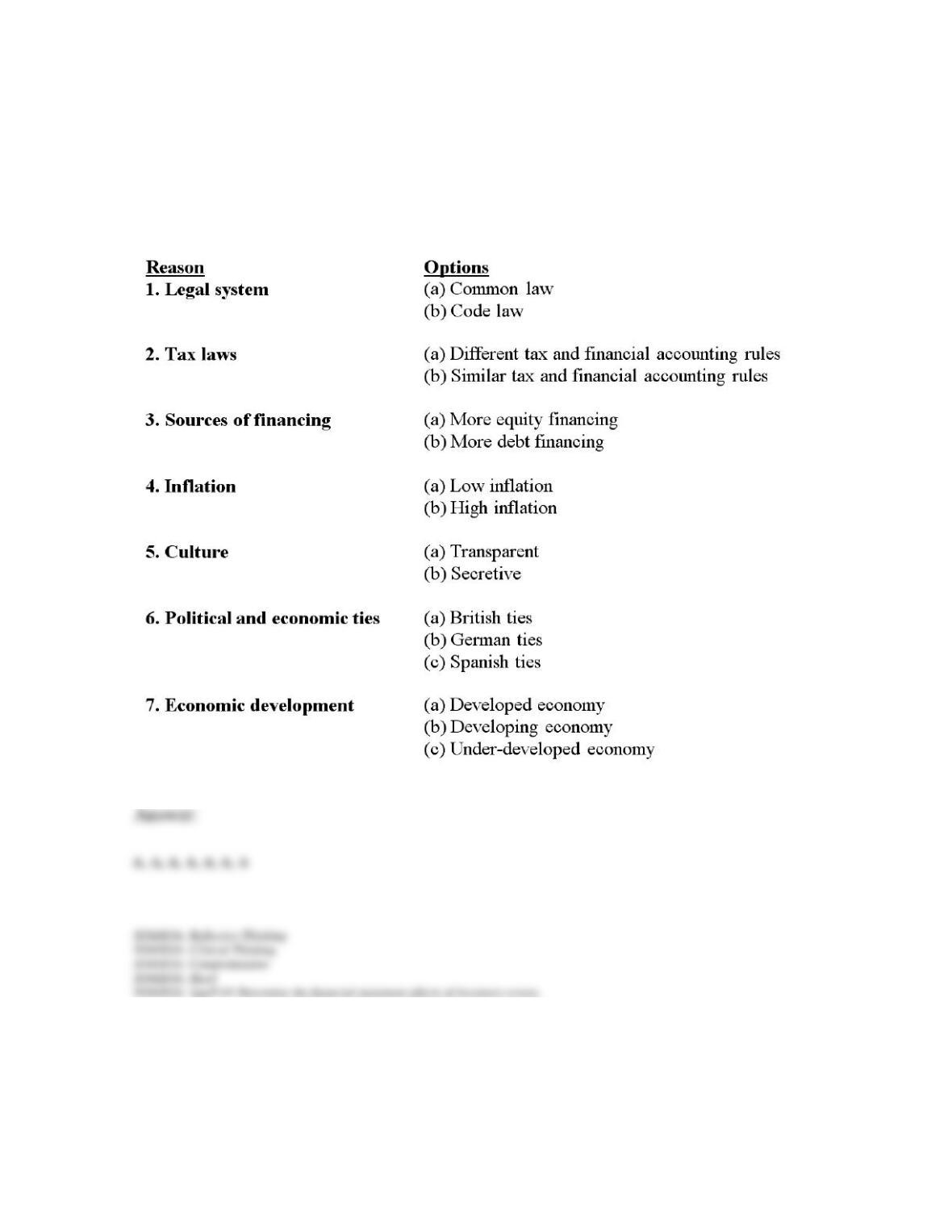
38. Below are seven reasons for differences in accounting practices among countries. For each
reason, at least two options are provided. For each reason, select the option that best describes
the United States.
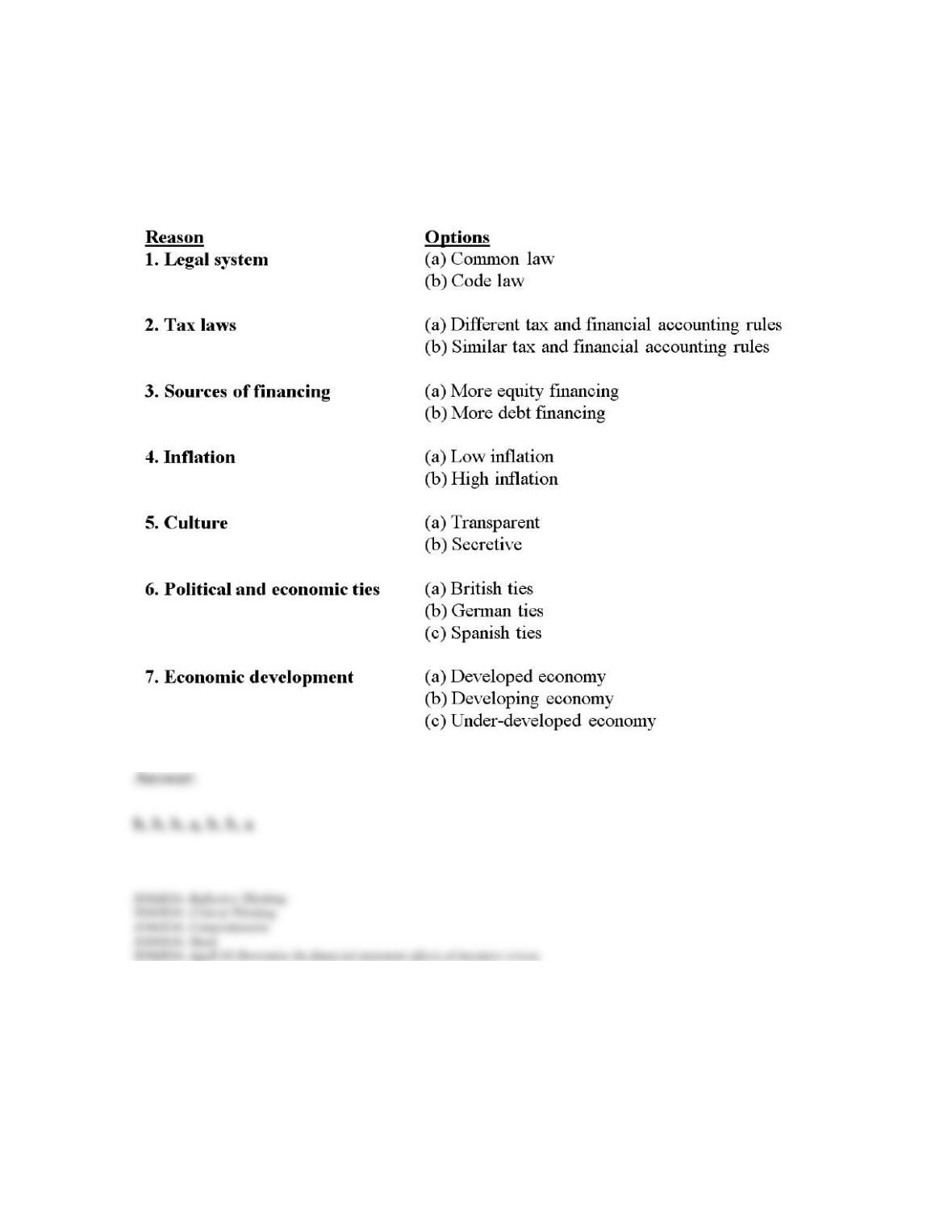
39. Below are seven reasons for differences in accounting practices among countries. For each
reason, at least two options are provided. For each reason, select the option that best describes
Germany.
40. How is the organization responsible for standard setting in the U.K. different from that in
France? Which of these organizations is closer to the FASB in the U.S.?
41. Describe at least five reasons why accounting practices differ across countries. Which
reason do you think is most important? Explain why.
42. Which inventory cost flow assumption is allowed under U.S. GAAP but not under IFRS?
Explain why some U.S. companies will lobby strongly to keep this method as an allowable
alternative.
43. What does it mean to revalue a long-term asset? How do U.S. GAAP and IFRS differ
regarding revaluation of long-term assets?
44. How is preferred stock reported differently under U.S. GAAP and IFRS? Do you think
preferred stock is a liability or an equity item? Why?
1.#