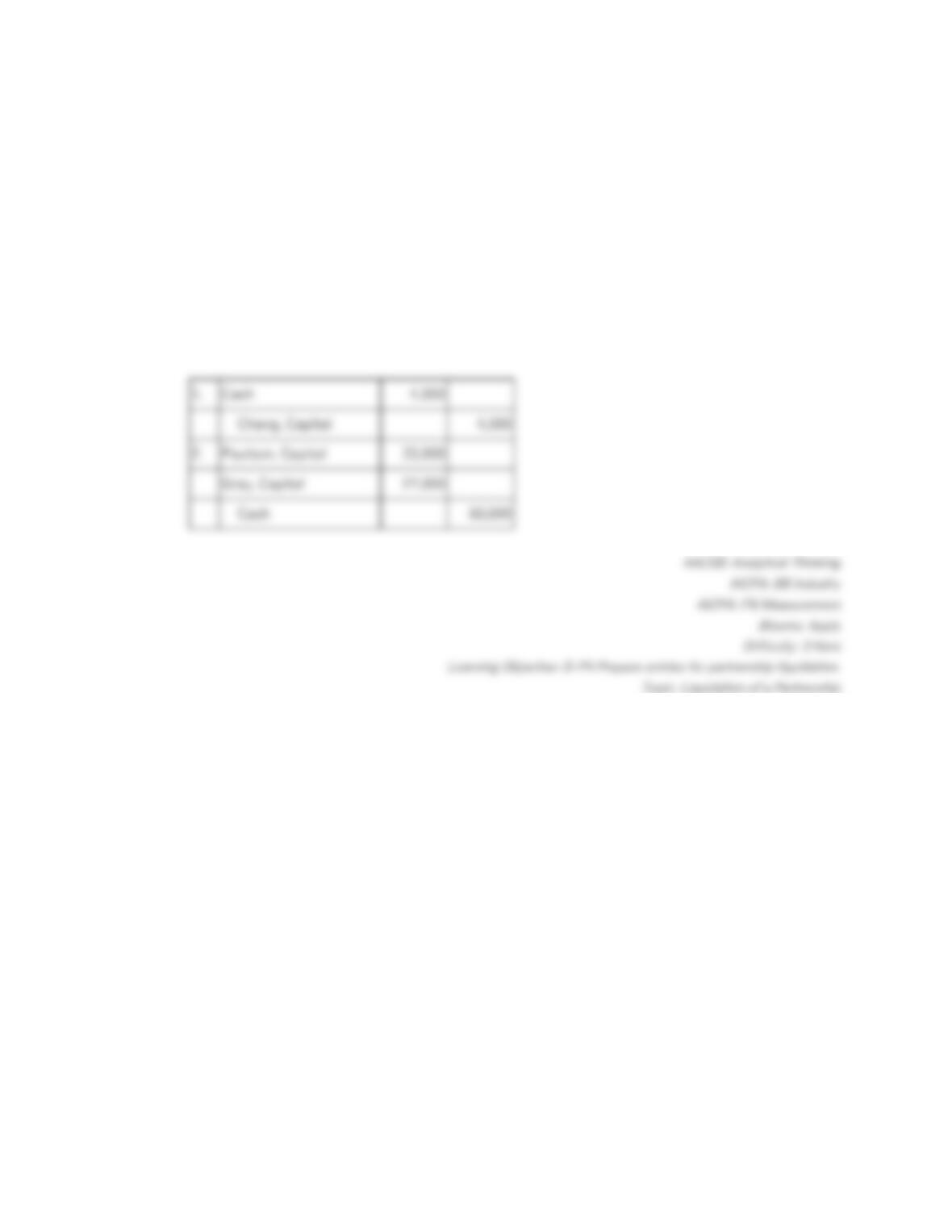
144.
The Redtail Partnership agrees to dissolve. The cash balance after selling all assets and
paying all liabilities is $56,000. The final capital account balances are: Paulson, $33,000;
Gray, $27,000; and Chang, ($4,000). Chang agrees to pay $4,000 cash from personal funds
to settle his deficiency. The partners have agreed to share income and losses equally.
Prepare the journal entries to record the transactions required to dissolve this partnership.
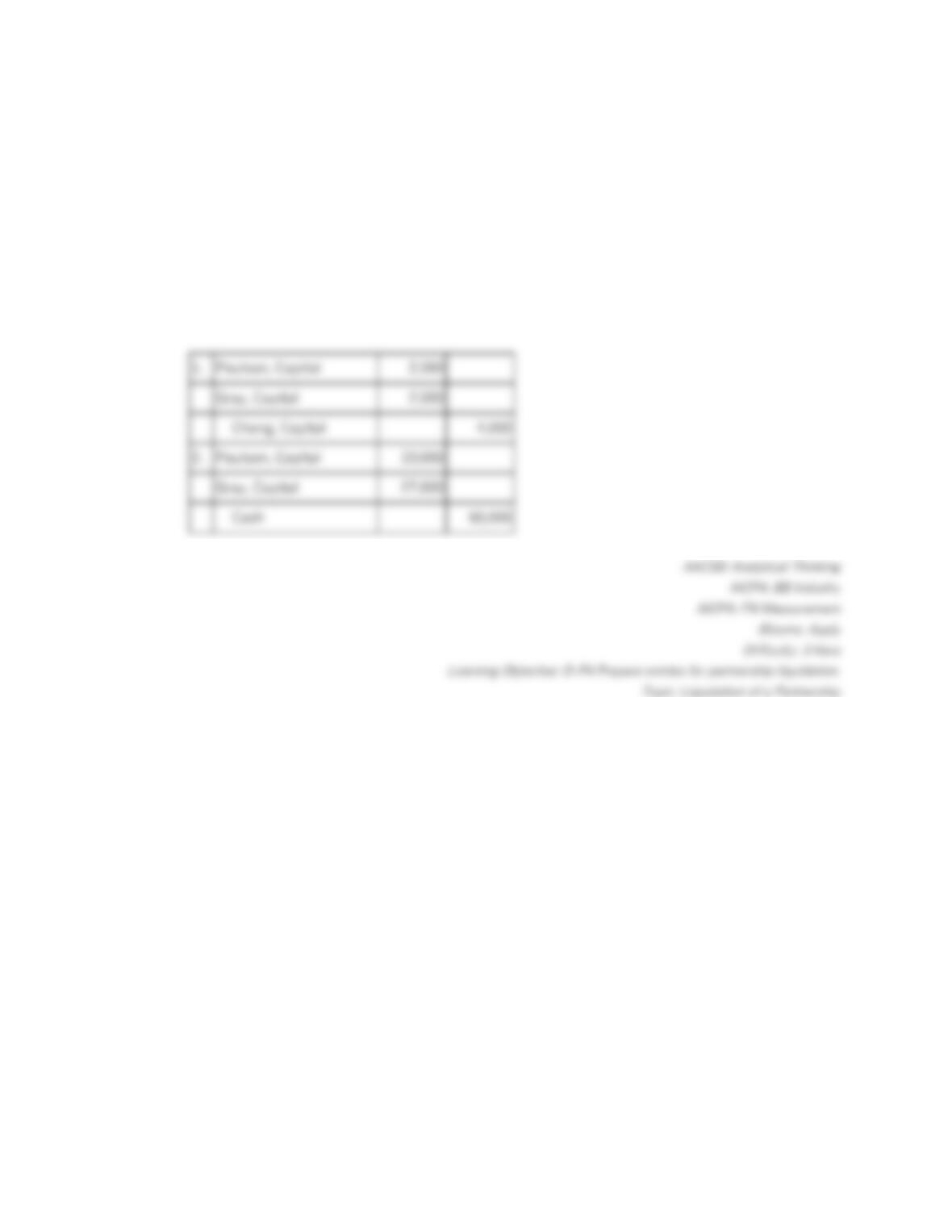
145.
The Redtail Partnership agrees to dissolve. The cash balance after selling all assets and
paying all liabilities is $60,000. The final capital account balances are: Paulson, $35,000;
Gray, $29,000; and Chang, ($4,000). Chang is unable to pay the capital deficiency. The
partners have agreed to share income and losses equally. Prepare the journal entries to
record the transactions required to dissolve this partnership.
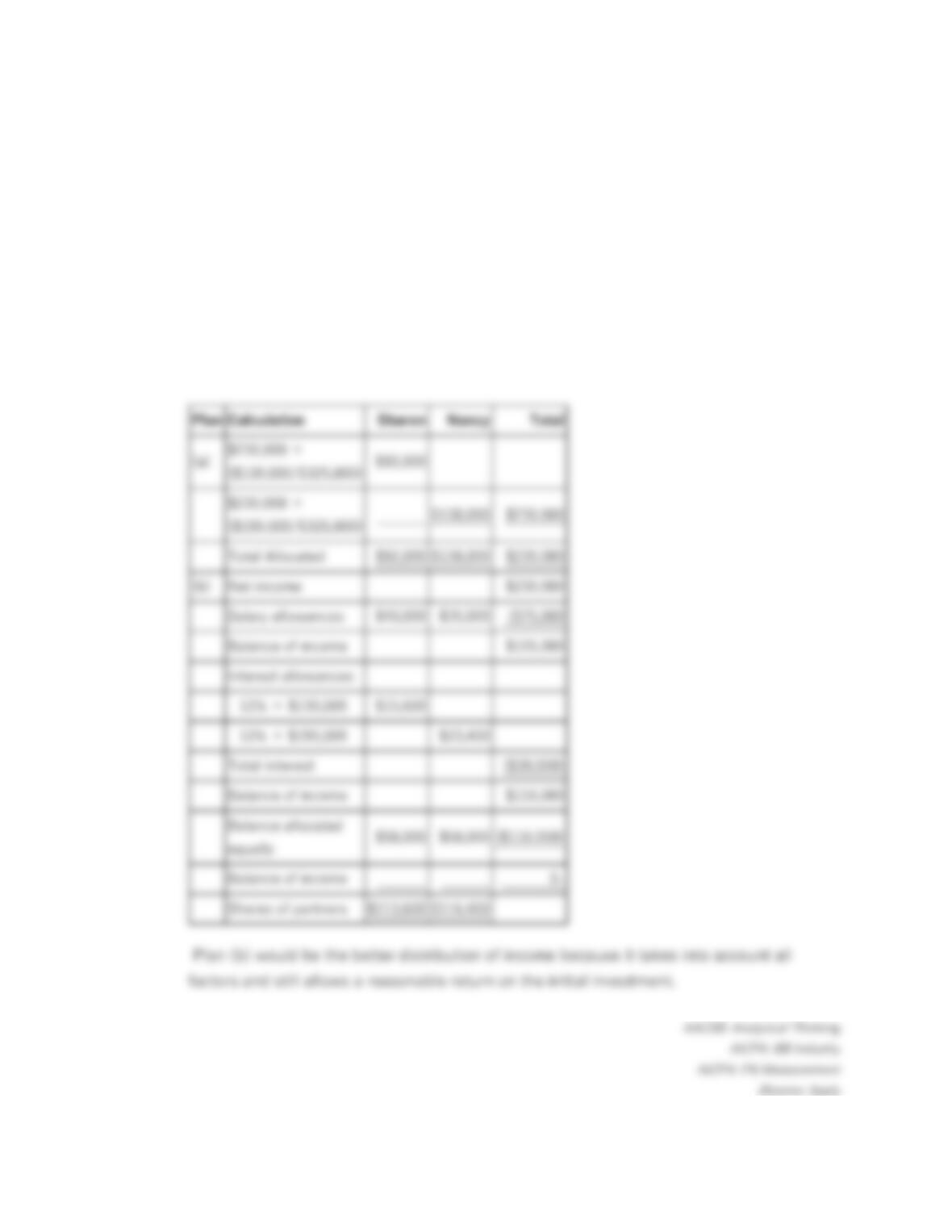
146.
Sharon and Nancy formed a partnership by making capital contributions of $130,000 and
$195,000 respectively. They predict annual partnership income of $230,000 and are
considering the following alternative plans of sharing income and loss: (a) in the ratio of
their initial capital investments; or (b) salary allowances of $40,000 to Sharon and $35,000
to Nancy; interest allowances of 12% on their initial capital investments; and the balance
shared equally. Assuming that both partners put about the same amount of time into the
business, which method of allocating income would be best?
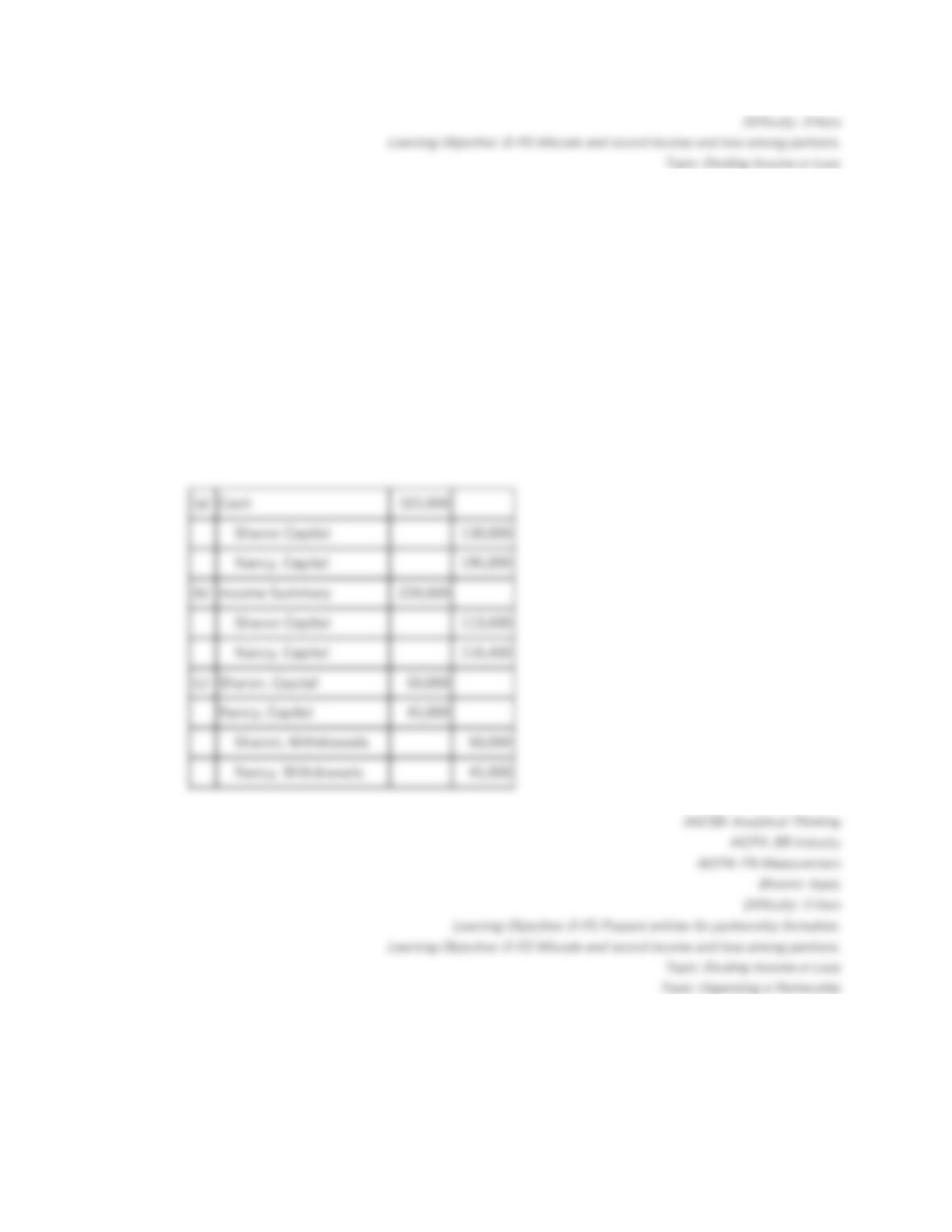
147.
Sharon and Nancy formed a partnership by making capital contributions of $130,000 and
$195,000 respectively. The annual partnership income of $230,000 is to be allocated
assuming a salary allowance of $40,000 to Sharon and $35,000 to Nancy; interest
allowances of 12% on their initial capital investments; and the balance shared equally.
Prepare the entries to record the initial capital investments, the allocation of net income,
and close the partner’s withdrawal accounts assuming that Sharon withdrew $50,000 and
Nancy withdrew $45,000.
148.
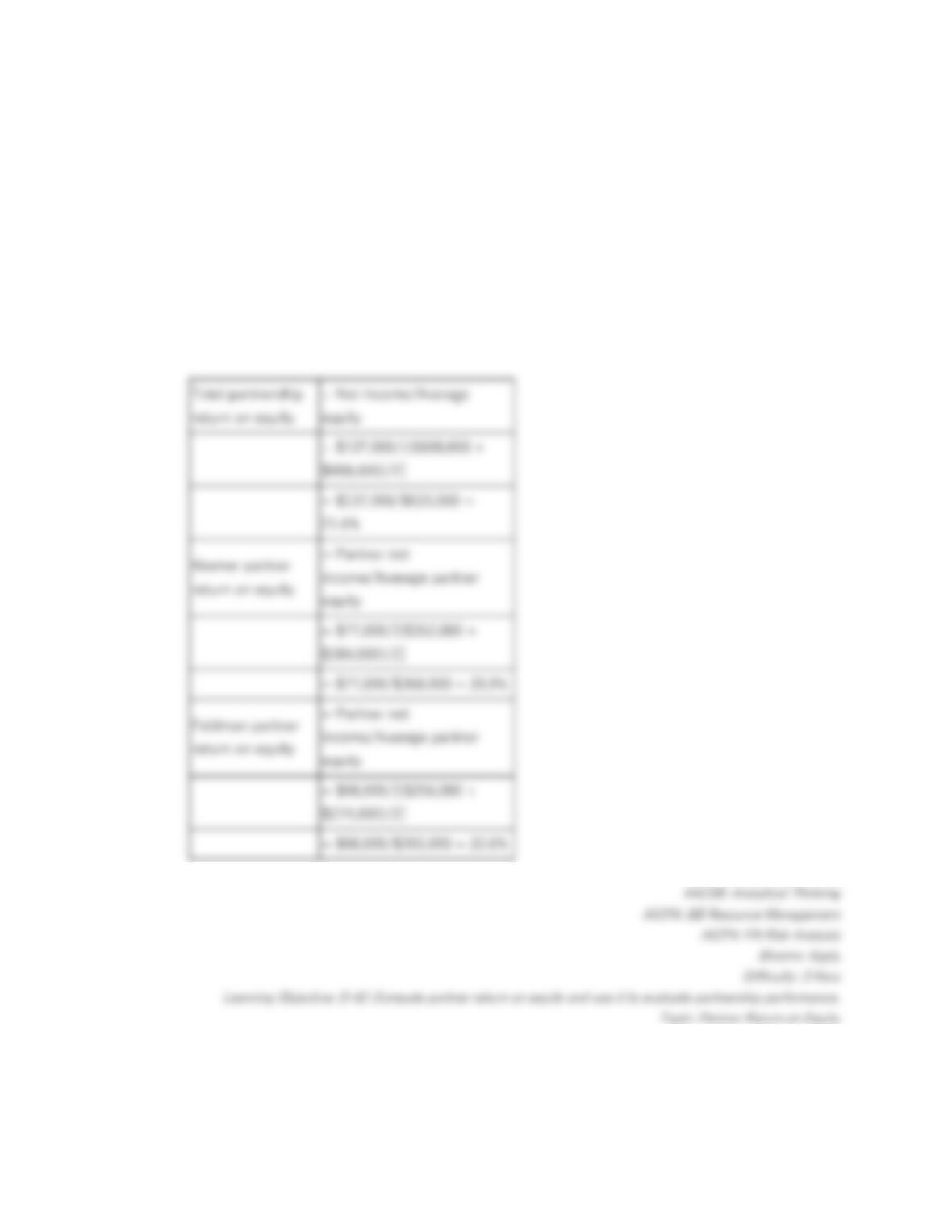
Kramer and Feldman Company is organized as a partnership. At the prior year–end,
Kramer’s equity balance was $352,000 and Feldman’s was $256,000. For the current year,
partnership net income is $137,000 ($77,000 allocated to Kramer and $60,000 allocated to
Feldman); withdrawals are $87,000 ($45,000 for Kramer and $42,000 for Feldman).
Compute the total partnership return on equity and the individual partner return on equity
ratios.
149.
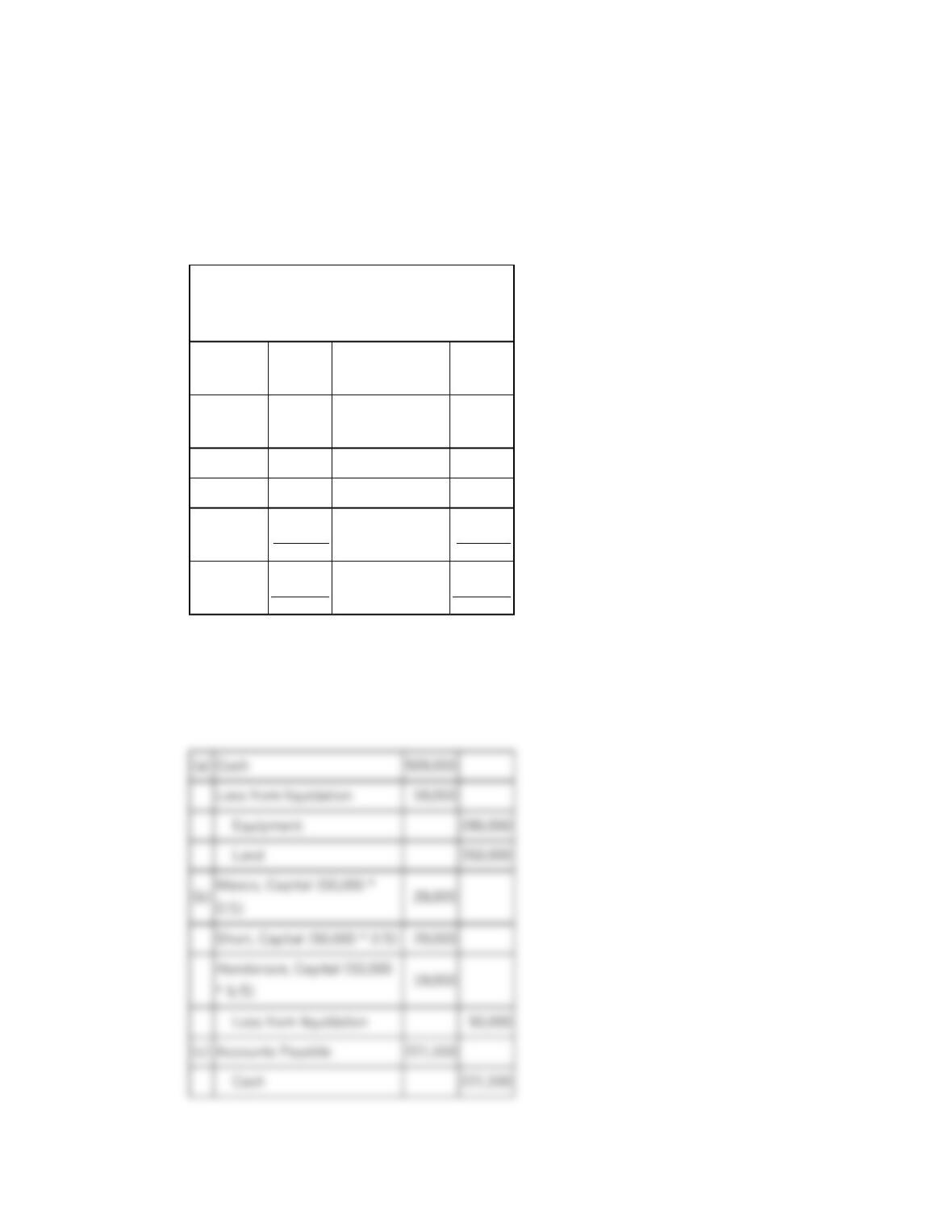
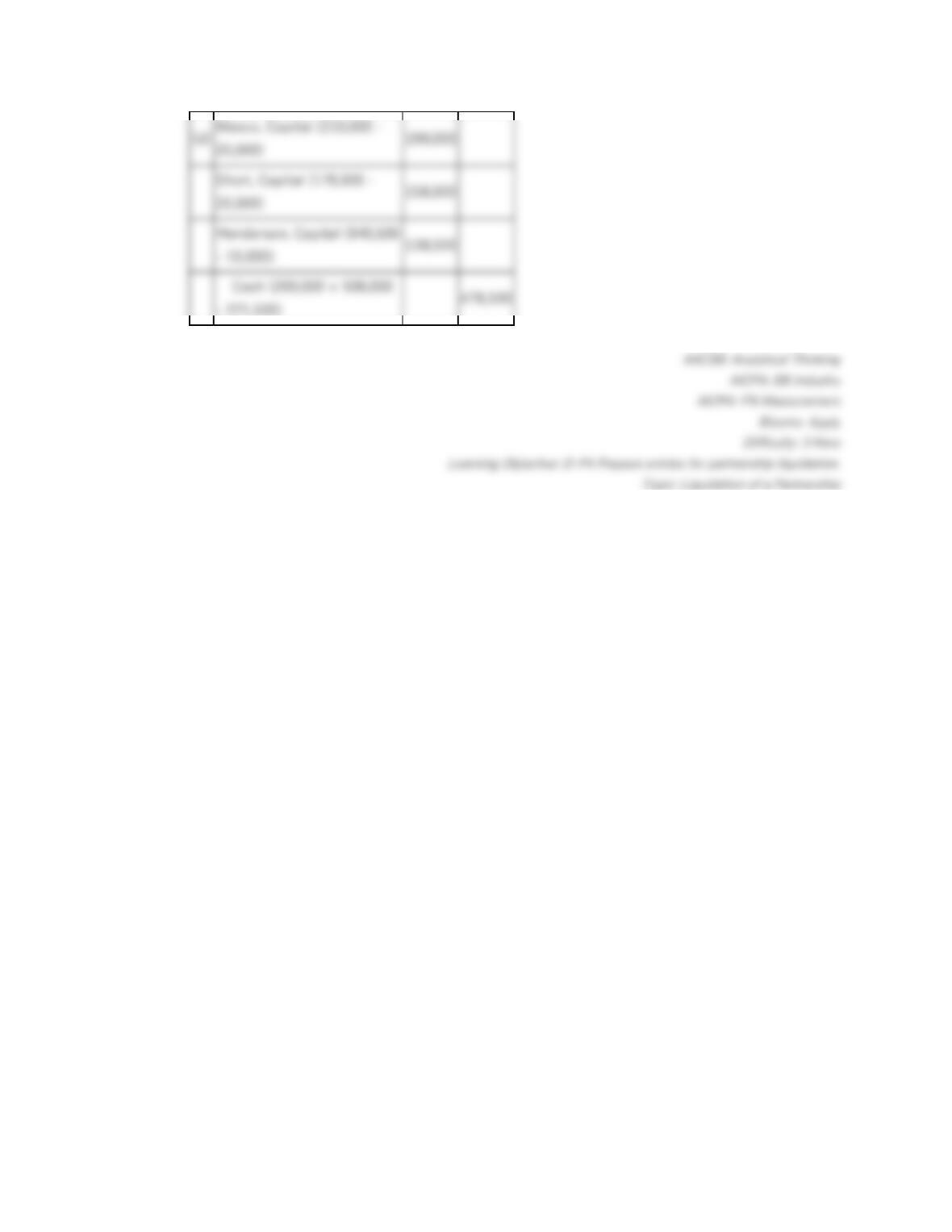
Masco, Short, and Henderson who are partners in the MSH Company share income and
loss in a 2:2:1 ratio. They plan to liquidate their partnership. At liquidation, their balance
sheet appears as follows. Prepare journal entries for (a) the sale of land and equipment
sold as a package for $500,000, (b) the allocation of the gain or loss, (c) the payment of
the liabilities, and (d) the distribution of cash to the individual partners.
MSH Company
Balance Sheet
January 31
Assets
Liabilities and
Equity
Cash
$200,000
Accounts
Payable
$221,500
Equipment
200,000
Masco, Capital
210,000
Land
350,000
Short, Capital
178,000
Henderson,
Capital
140,500
Total
assets
$750,000
Total liabilities
and equity
$750,000
(a)
Cash
2/5)
Short, Capital (50,000 * 2/5)
20,000
Henderson, Capital (50,000
(c)
150.
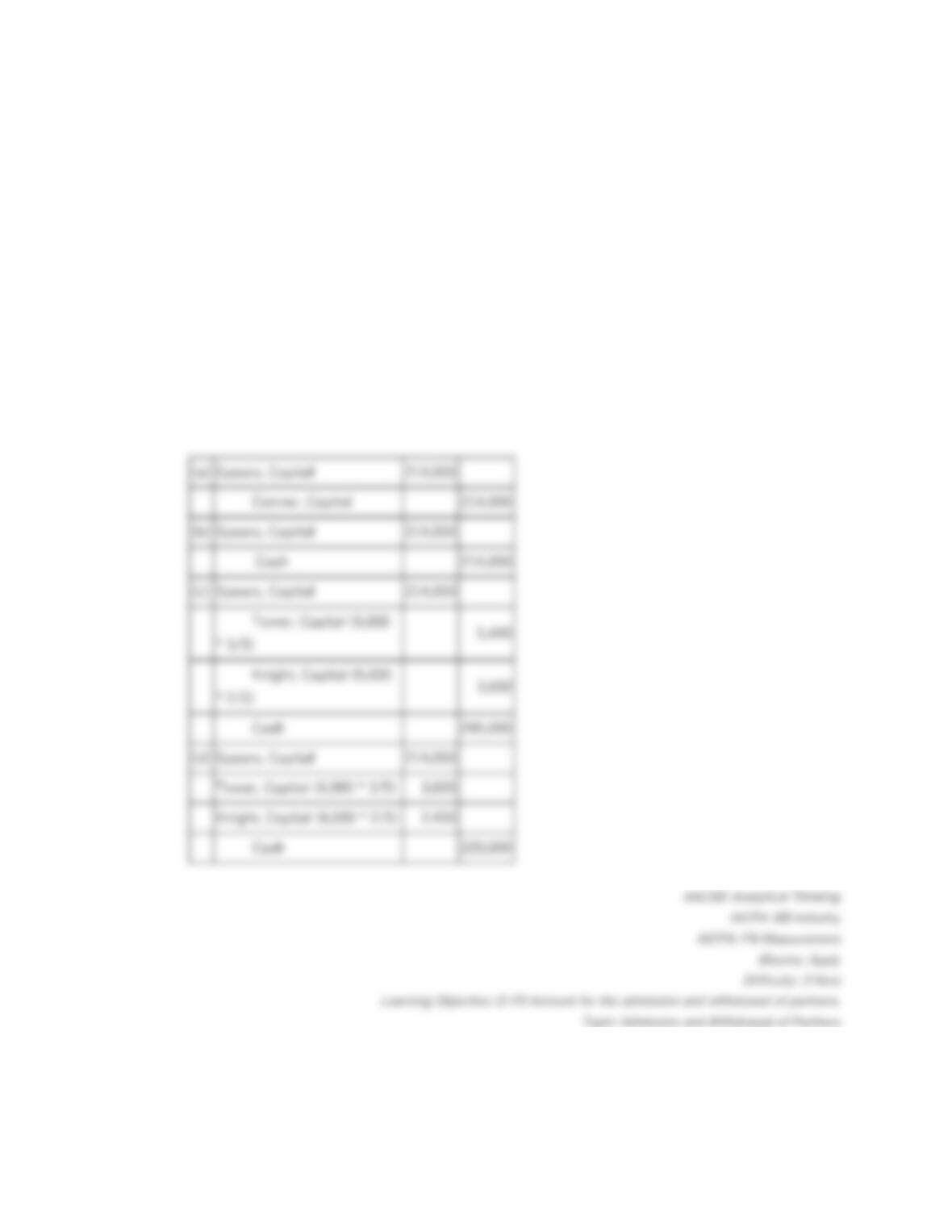
Tower, Knight, and Spears are partners who share income and loss in a 3:2:2 ratio. The
partnership’s capital balances are as follows: Tower, $332,000; Knight, $124,000; and
Spears, $214,000. Spears decides to withdraw from the partnership, and the partners
agree not to have the assets revalued upon Spears’ retirement. Prepare journal entries to
record Spears’ withdrawal from the partnership under each of the following separate
assumptions: Spears (a) sells his interest to Conner for $200,000 after Tower and Knight
approve the entry of Conner as a partner; (b) is paid $214,000 in partnership cash for his
equity; (c) is paid $205,000 in partnership cash for his equity; (d) is paid $220,000 in
partnership cash for his equity.
151.
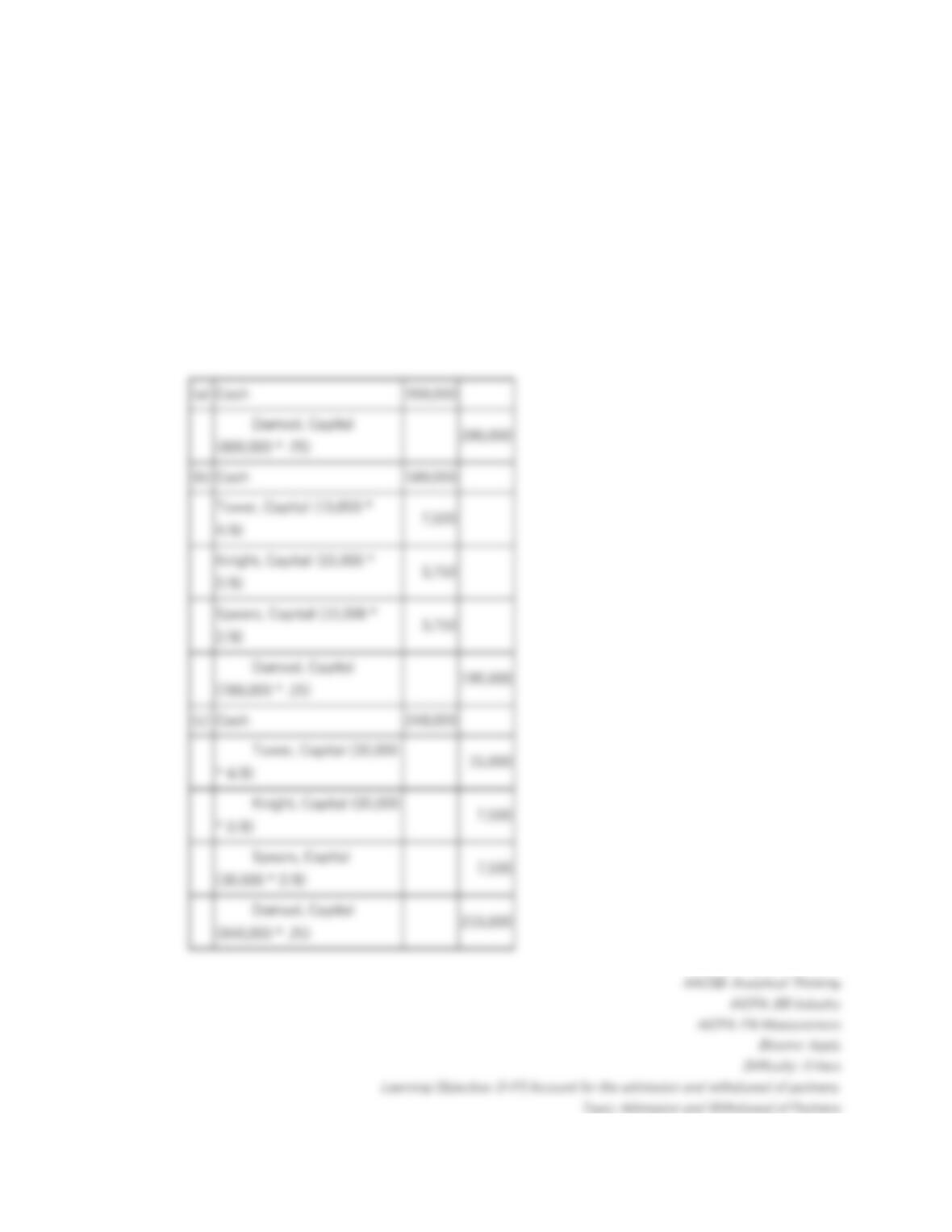
Tower, Knight, and Spears are partners who share income and loss in a 4:2:2 ratio. The
partnership’s capital balances are as follows: Tower, $292,000; Knight, $114,000; and
Spears, $194,000. Damsel is admitted to the partnership on March 1 with a 25% equity.
Prepare the journal entries to record Damsel’s entry into the partnership under each of the
following separate assumptions: Damsel invests (a) $200,000; (b) $180,000; and (c)
$240,000.
152.
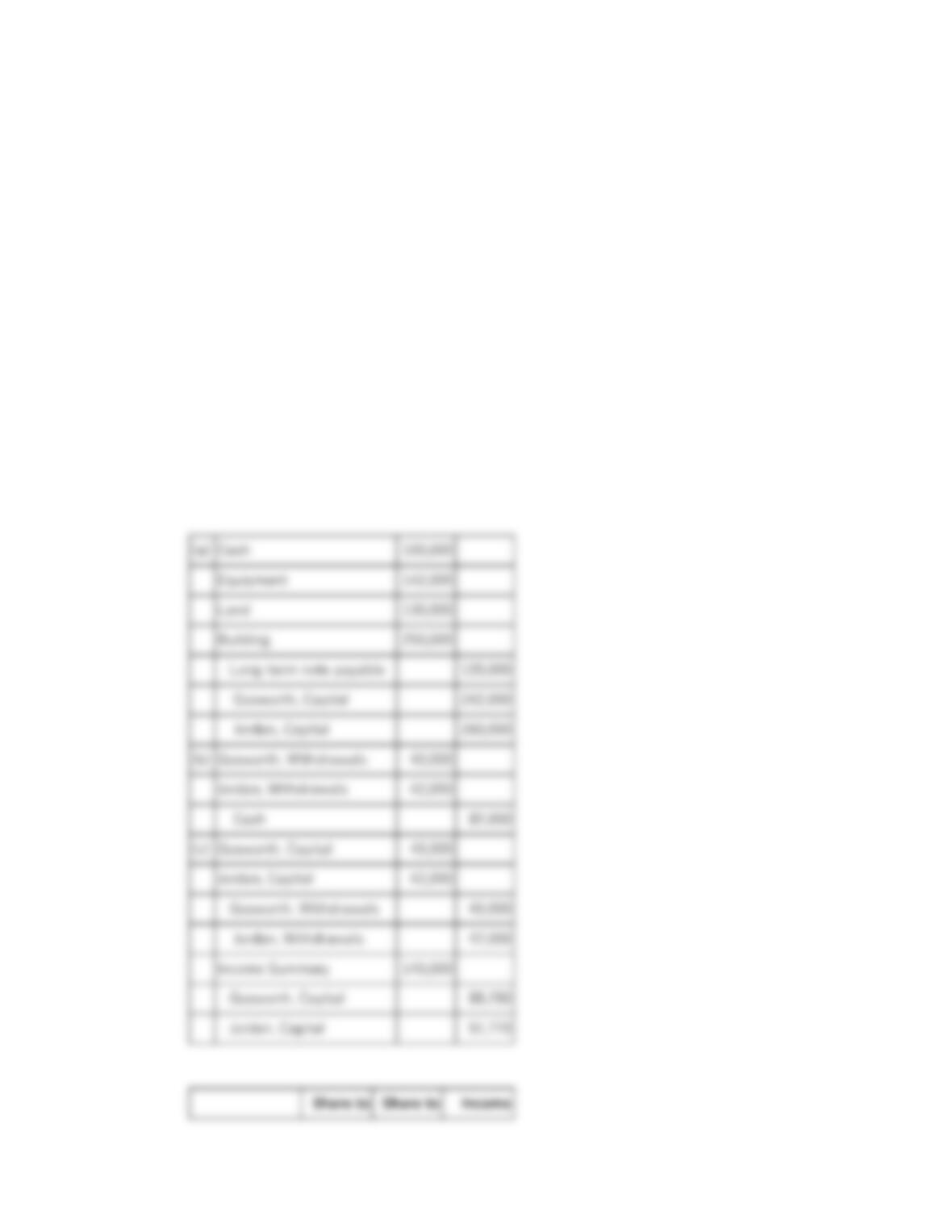
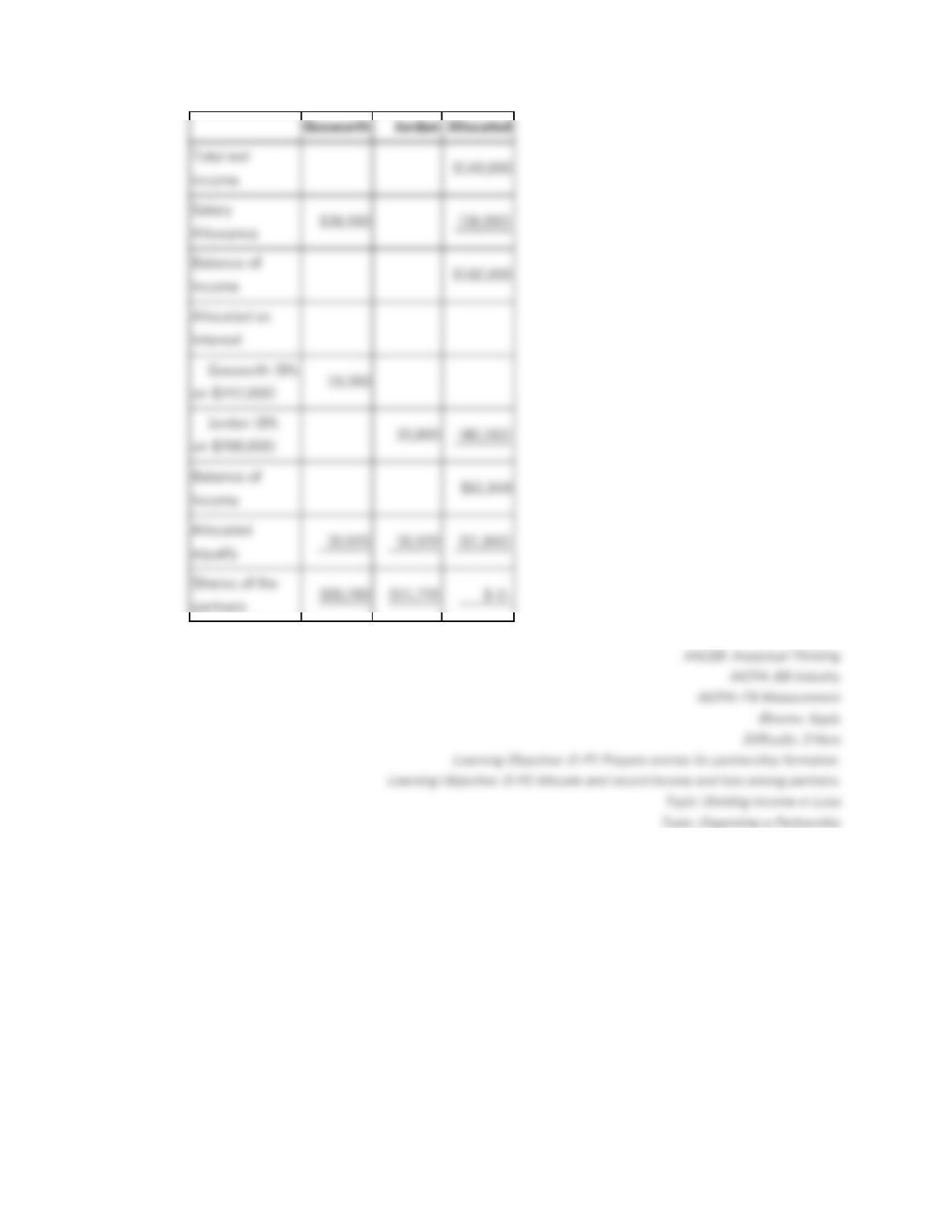
On May 1, Gosworth and Jordan formed a partnership. Gosworth contributed cash of
$100,000 and equipment valued at $142,000. Jordan contributed land valued at $130,000
and a building valued at $250,000. The partnership also assumed responsibility for
Jordan’s $120,000 long-term note payable associated with the land and building. The
partners agreed to share income as follows: Gosworth is to receive a salary allowance of
$38,000, both are to receive an annual interest allowance of 8% of their beginning-year
capital investments, and any remaining income or loss is to be shared equally. During the
year, Gosworth withdrew $40,000 and Jordan withdrew $42,000 cash. After the adjusting
and closing entries are made to the revenue and expense accounts at the end of the year,
the Income Summary account had a credit balance of $140,000. Prepare the journal
entries to record (a) the partners’ initial capital investments, (b) their cash withdrawals,
and (c) closing of both the Withdrawals and Income Summary accounts.
153.
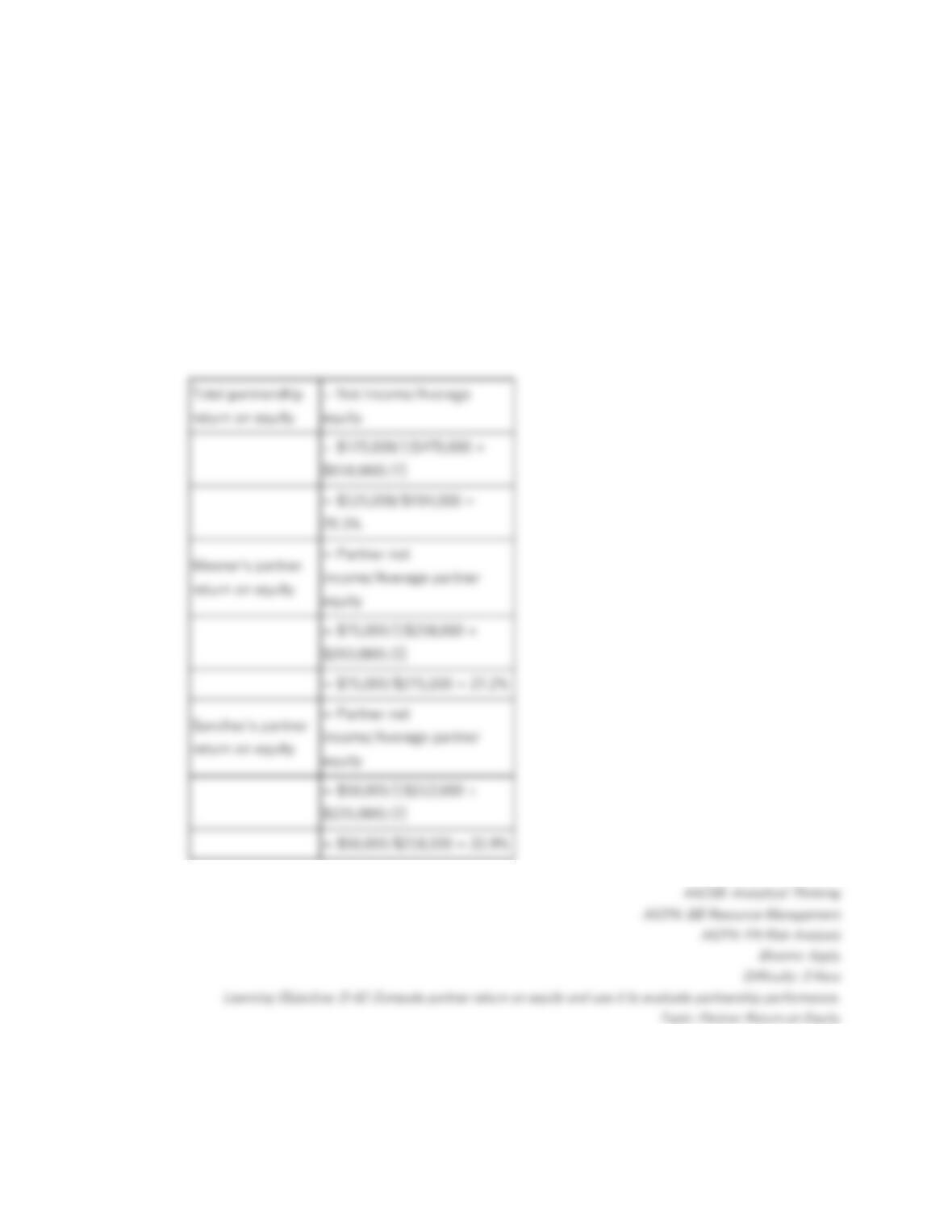
Mesner’s and Sanchez’s company is organized as a partnership. At the prior year-end,
Mesner’s equity balance was $258,000 and Sanchez’s was $212,000. For the current year,
partnership net income is $125,000 ($75,000 allocated to Mesner and $50,000 allocated to
Sanchez); withdrawals are $77,000 ($40,000 for Mesner and $37,000 for Sanchez).
Compute the total partnership return on equity and the individual partner return on equity
ratios.
Fill in the Blank Questions
154.
The life of a partnership is ____________________ in duration.
155.
A ________________ is an unincorporated association of two or more people to pursue a
business for profit as co-owners.
156.
__________________ means that partners can commit or bind the partnership to any
contract within the scope of the partnership business.
157.
__________________ implies that each partner in a partnership can be called on to
personally pay a partnership’s debts.
158.
A partnership that has at least two classes of partners, general and limited, allows the
limited partners to have no personal liability beyond the amounts they invest in the
partnership, and the limited partners have no active role except as specified in the
partnership agreement is a ___________________ partnership.
159.
A partnership designed to protect innocent partners from malpractice or negligence claims
resulting from the acts of other partners is a ________________________ partnership.
160.
A relatively new form of business organization that protects partners with limited liability,
allows limited partners to assume an active management role, and is taxed as a
partnership is a ______________________________.
161.
Partners in a partnership are not taxed on their withdrawals, but rather on
_____________________________.
162.
Partner net income divided by average partner equity equals ______________________.
163.
When a partner invests in a partnership, his/her capital account is __________ for the
invested amount.
164.
During the closing process, partner’s capital accounts are _______________ for their share
of net income and _________________ for their share of net loss.
165.
During the closing process, each partner’s withdrawals account is closed to
_________________________.
166.
If partners agree on how to share income, but say nothing about losses, then losses are
shared ___________________.
167.
A partner can be admitted into a partnership by _________________________ or by
__________________________________.
168.
If a partner withdraws from a partnership and the recorded value of his or her equity is
overstated, then a bonus goes to _________________________; if the recorded value of the
withdrawing partner’s equity is understated, then a bonus goes to ____________________.
169.
At least one partner having a debit balance in his/her capital account at the point of the
final distribution of cash is known as a _________________________.