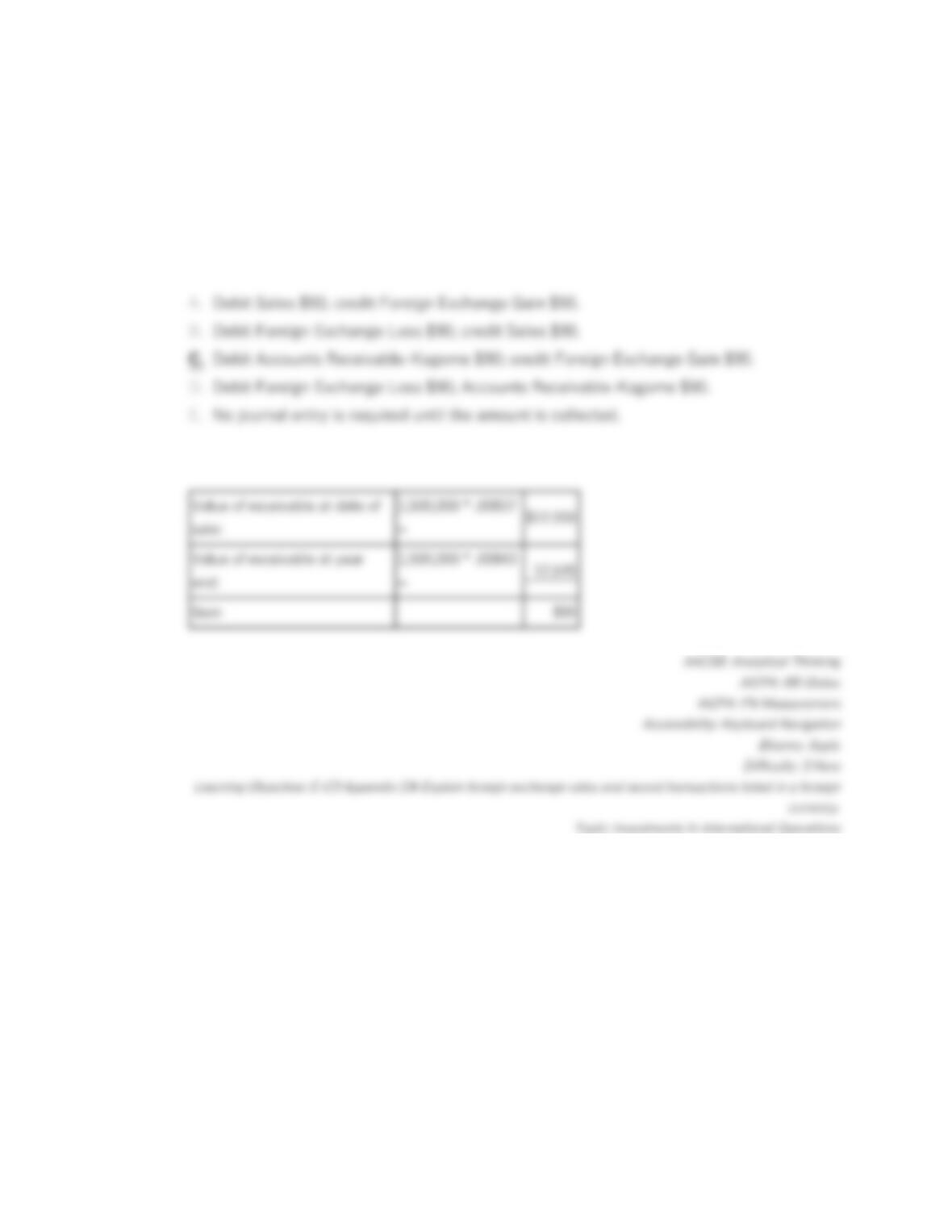
127.
On November 12, Higgins, Inc., a U.S. Company, sold merchandise on credit to Kagome of
Japan at a price of 1,500,000 yen. The exchange rate was $0.00837 per yen on the date of
sale. On December 31, when Higgins prepared its financial statements, the exchange rate
was $0.00843. Kagome paid in full on January 12, when the exchange rate was $0.00861.
On December 31, Higgins should prepare the following journal entry:
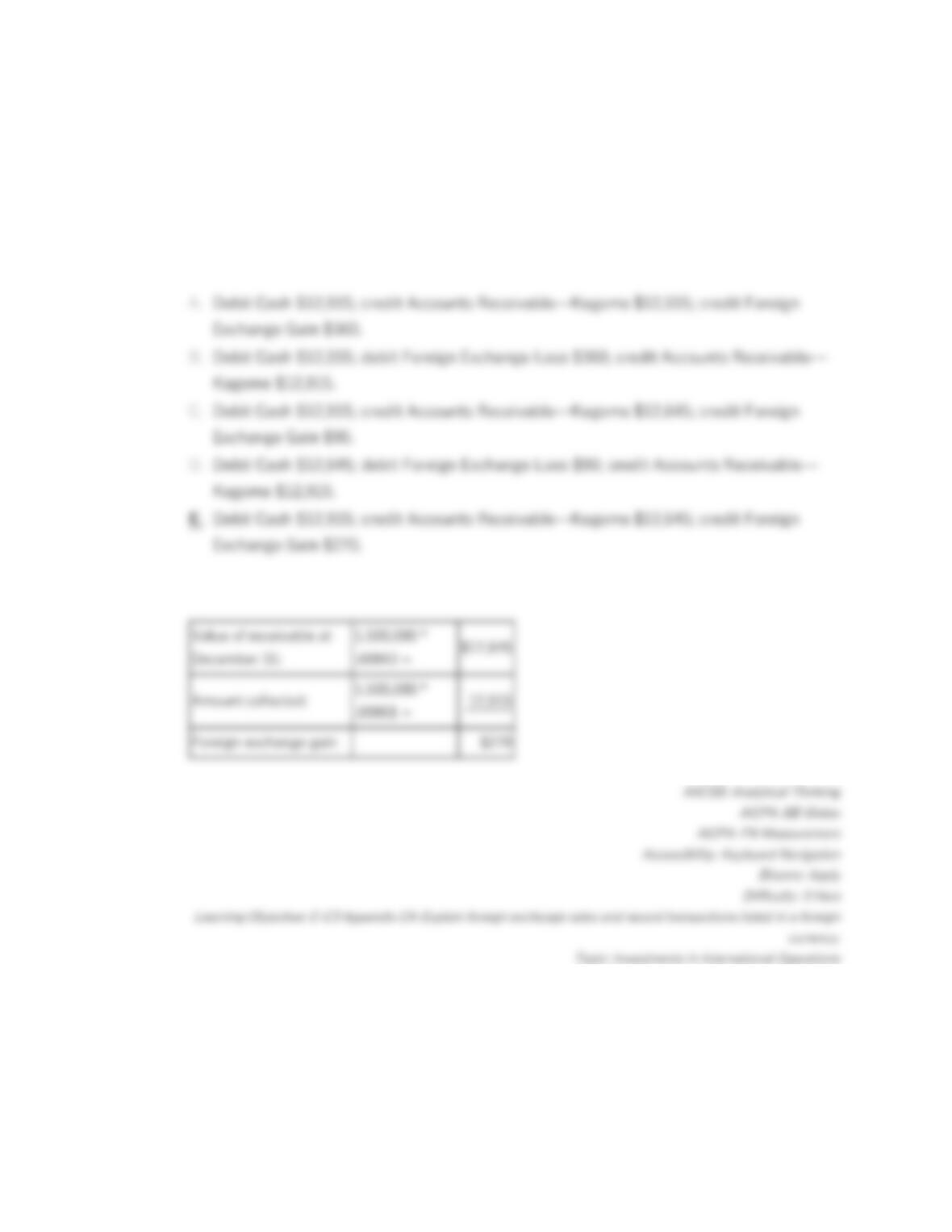
128.
On November 12, Higgins, Inc., a U.S. Company, sold merchandise on credit to Kagome of
Japan at a price of 1,500,000 yen. The exchange rate was $0.00837 on the date of sale. On
December 31, when Higgins prepared its financial statements, the exchange rate was
$0.00843. Kagome paid in full on January 12, when the exchange rate was $0.00861. On
January 12, Higgins should prepare the following journal entry:
129.
All of the following statements regarding accounting for noninfluential securities under
U.S. GAAP and IFRS are true
except
:
130.
All of the following statements regarding accounting for influential securities under U.S.
GAAP and IFRS are true
except
:
131.
All of the following statements regarding accounting for trading securities under U.S.
GAAP are true
except
:
132.
All of the following statements regarding accounting for trading securities under U.S.
GAAP are true
except
:
133.
All of the following statements regarding other comprehensive income are true
except
:
134.
Landmark Corp. buys $300,000 of Schroeter Company’s 8% five-year bonds at par value on
September 1. Interest payments are made semiannually. All of the following regarding
accounting for the securities are true
except
:
135.
Landmark Corp. buys $300,000 of Schroeter Company’s 8% five-year bonds payable at par
value on September 1. Interest payments are made semiannually. Landmark plans to hold
the bonds for the five year life. The journal entry to record the purchase should include:
136.
Landmark buys $300,000 of Schroeter Company’s 8% five-year bonds payable at par value
on September 1. Interest payments are made semiannually on March 1 and September 1.
The journal entry Landmark should record to accrue interest earned at year-end
December 31 is:
137.
Landmark Corp. buys $300,000 of Schroeter Company’s 8% five-year bonds payable at par
value on September 1. Interest payments are made semiannually. Landmark plans to hold
the bonds for the five year life. When the bonds mature, the journal entry to record the
proceeds will be:
138.
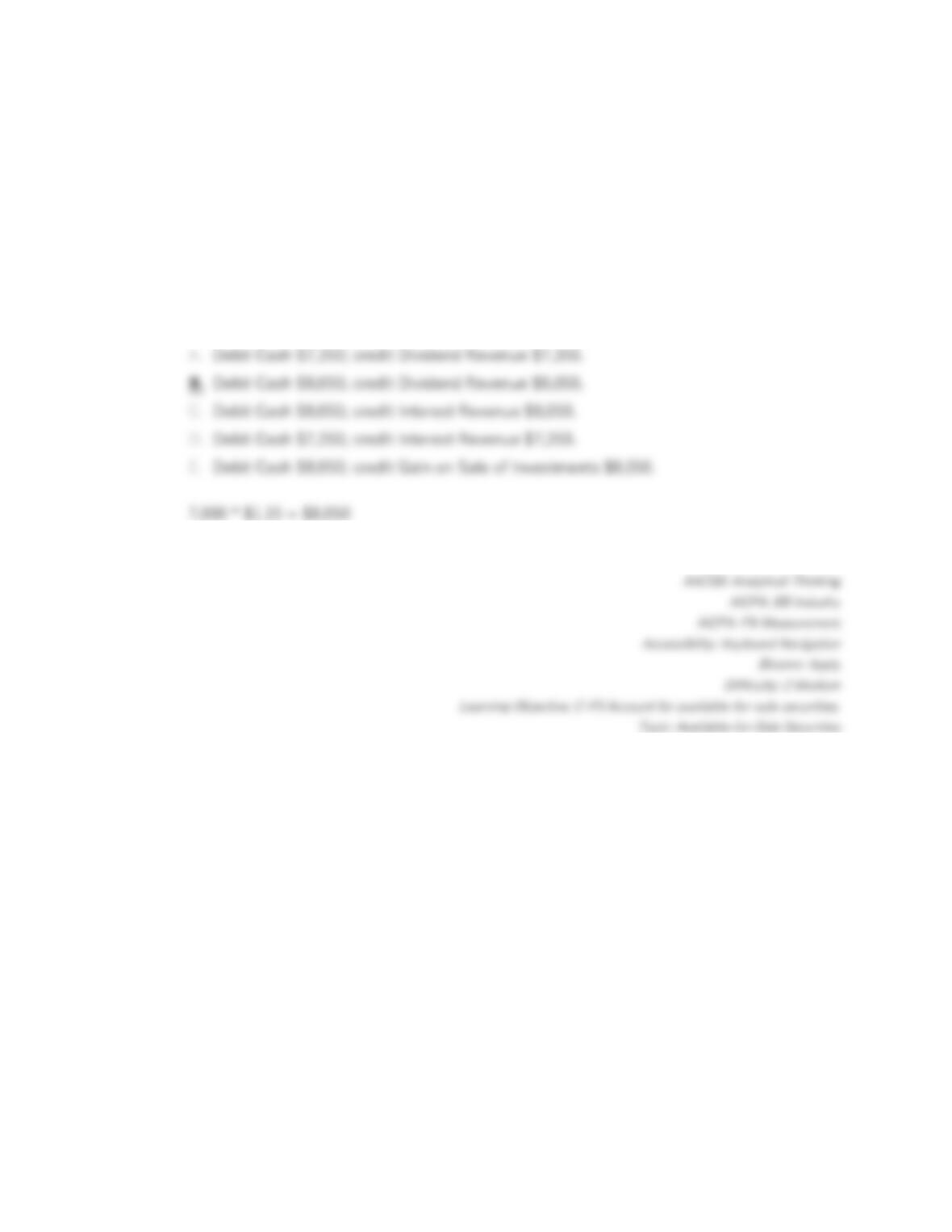
On February 15, Jewel Company buys 7,000 shares of Marcelo Corp. common stock at
$28.53 per share plus a brokerage fee of $400. The stock is classified as available–for-sale
securities. On March 15, Marcelo declares a dividend of $1.15 per share payable to
stockholders of record on April 15. Jewel received the dividend on April 15 and ultimately
sells half of the Marcelo stock on November 17 of the current year for $29.30 per share
less a brokerage fee of $250. The journal entry to record the purchase on February 15 is:
139.
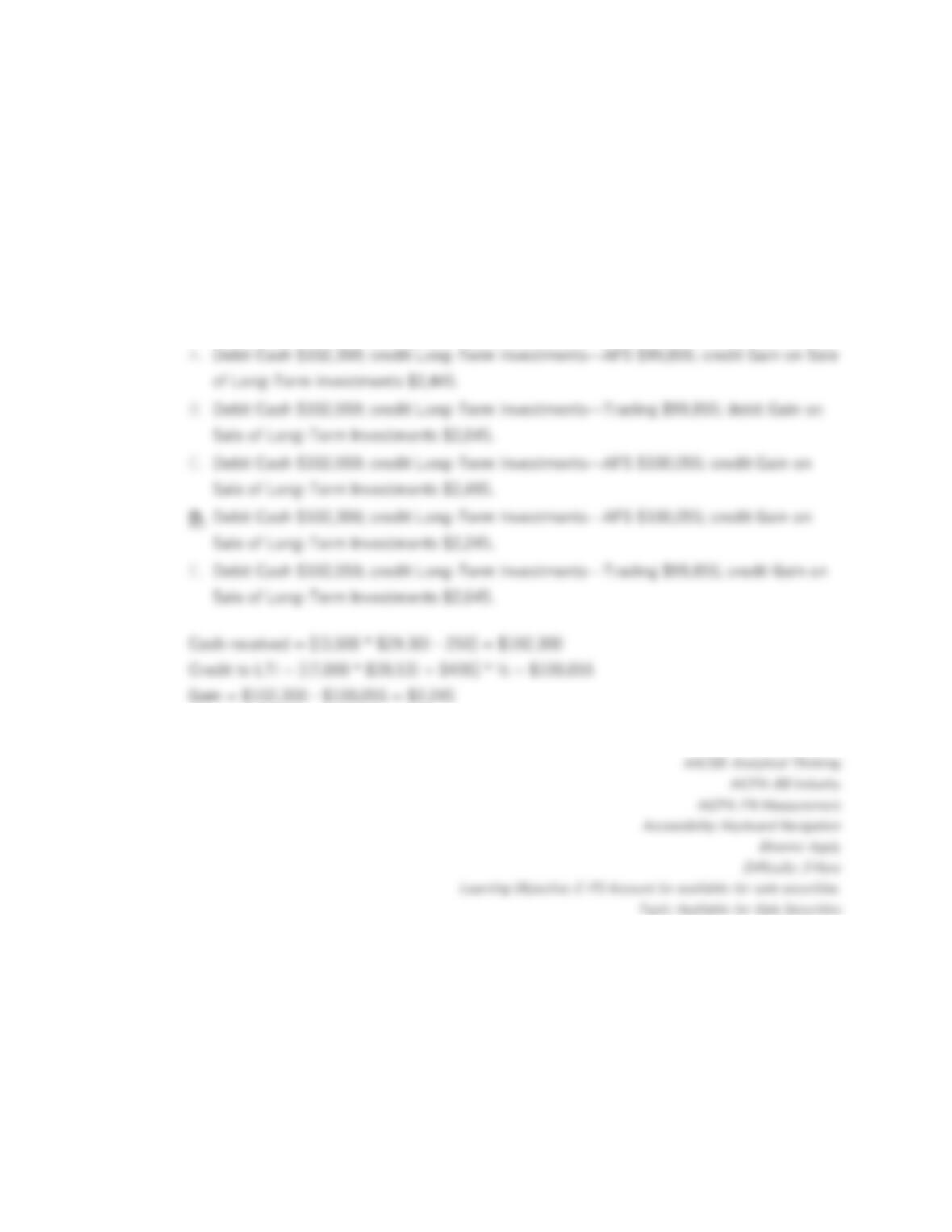
On February 15, Jewel Company buys 7,000 shares of Marcelo Corp. common stock at
$28.53 per share plus a brokerage fee of $400. The stock is classified as available–for-sale
securities. On March 15, Marcelo Corp. declares a dividend of $1.15 per share payable to
stockholders of record on April 15. Jewel Company received the dividend on April 15 and
ultimately sells half of the Marcelo Corp. stock on November 17 of the current year for
$29.30 per share less a brokerage fee of $250. The journal entry to record the dividend on
April 15 is:
140.
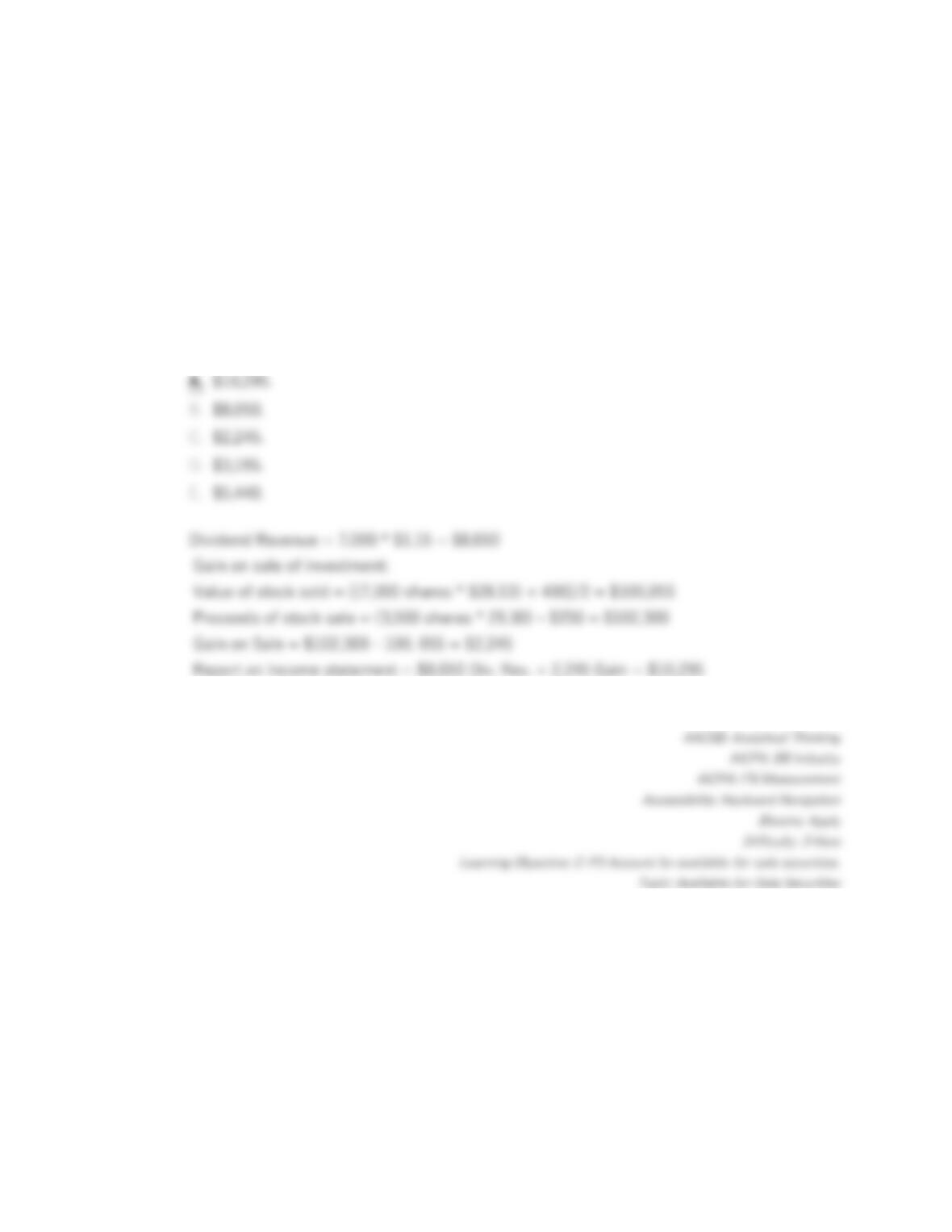
On February 15, Jewel Company buys 7,000 shares of Marcelo Corp. common stock at
$28.53 per share plus a brokerage fee of $400. The stock is classified as available–for-sale
securities. On March 15, Marcelo Corp. declares a dividend of $1.15 per share payable to
stockholders of record on April 15. Jewel Company received the dividend on April 15 and
ultimately sells half of the Marcelo Corp. stock on November 17 of the current year for
$29.30 per share less a brokerage fee of $250. The journal entry to record the sale of the
3,500 shares of stock on November 17 is:
141.
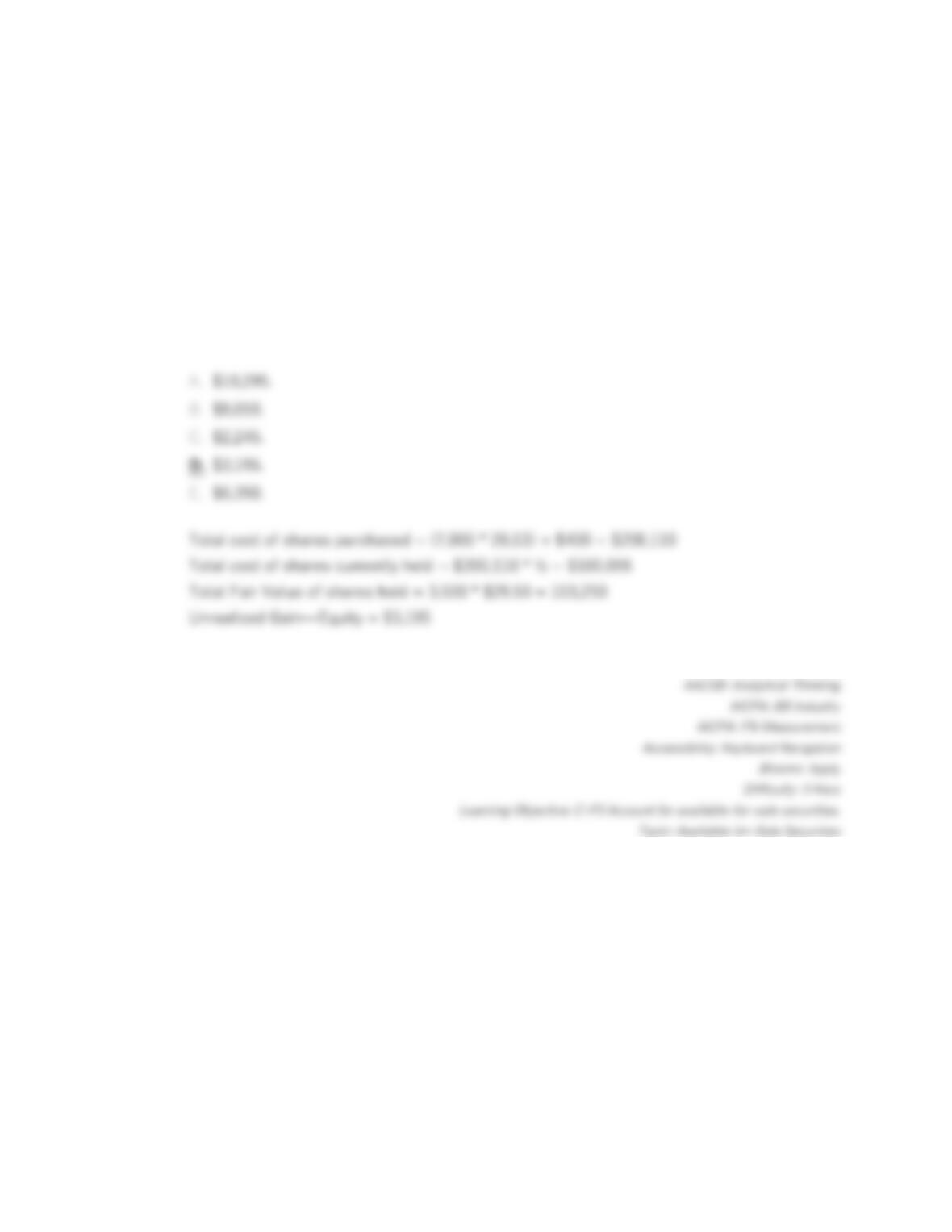
On February 15, Jewel Company buys 7,000 shares of Marcelo Corp. common stock at
$28.53 per share plus a brokerage fee of $400. The stock is classified as available–for-sale
securities. On March 15, Marcelo Corp. declares a dividend of $1.15 per share payable to
stockholders of record on April 15. Jewel Company received the dividend on April 15 and
ultimately sells half of the Marcelo Corp. stock on November 17 of the current year for
$29.30 per share less a brokerage fee of $250. The fair value of the remaining shares is
$29.50 per share. The amount that Jewel Company should report on its year-end
December 31 income statement related to the investment in Marcelo Corp. is:
142.
On February 15, Jewel Company buys 7,000 shares of Marcelo Corp. common at $28.53
per share plus a brokerage fee of $400. The stock is classified as available–for-sale
securities. On March 15, Marcelo Corp. declares a dividend of $1.15 per share payable to
stockholders of record on April 15. Jewel Company received the dividend on April 15 and
ultimately sells half of the Marcelo Corp. stock on November 17 of the current year for
$29.30 per share less a brokerage fee of $250. The fair value of the remaining shares is
$29.50 per share. The amount that Jewel Company should report in the equity section of
its year-end December 31 balance sheet for its investment in Marcelo Corp. is:
143.
On February 15, Jewel Company buys 7,000 shares of Marcelo Corp. common at $28.53
per share plus a brokerage fee of $400. The stock is classified as available–for-sale
securities. On March 15, Marcelo Corp. declares a dividend of $1.15 per share payable to
stockholders of record on April 15. Jewel Company received the dividend on April 15 and
ultimately sells half of the Marcelo Corp. stock on November 17 of the current year for
$29.30 per share less a brokerage fee of $250. The fair value of the remaining 3,500
shares is $29.50 per share. The amount that Jewel Company should report in the asset
section of its year-end December 31 balance sheet for its investment in Marcelo Corp. is:
144.
Financial statements that show the financial position, results of operations, and cash
flows of all entities under the parent company’s control, including all subsidiaries are
known as:
145.
The two business entities involved in an investment in securities with controlling
influence, for which consolidated financial statements are prepared, are known as:
146.
On May 26, Clark Co. purchased 1,000 of Langston Corporation stock at $20 per share plus
a $75 brokerage fee. These shares are categorized as trading securities. The journal entry
to record the purchase is:
147.
On May 26, Clark Co. purchased 1,000 of Langston Corporation stock at $20 per share plus
a $75 brokerage fee. These shares are categorized as trading securities. Clark received a
$1,500 quarterly cash dividend on the Langston shares. The journal entry to record the
dividend is:
Matching Questions
148.
Match the following terms with the appropriate definitions.
1. Return on total
An accounting method for long-term
investments in equity when the investor
Debt and equity securities not classified
3. Available-for–
A corporation controlled by another
company when the controlling company
owns more than 50% of the investee’s
4. Long-term
Investments in equity and debt
securities that are not readily convertible to
cash or are not intended to be converted to
A company that owns a more than 50%
6. Held-to–maturity
A measure of operating efficiency,
computed as net income divided by
7. Trading
Financial statements that show the
financial position, results of operations,
and cash flows of all entities under the
parent’s control, including those of any
8. Unrealized gain
Debt securities that a company intends
9. Consolidated
financial
Debt and equity securities that a
company intends to actively manage and
Change in market value that is not yet
Short Answer Questions
149.
Identify each of the following investments as either in debt (D) securities or equity (E)
securities:
1.
AutoZone stock
2.
Dow Chemical corporate bonds
3.
Mutual fund global stock
investment
4.
U.S. treasury bonds
5.
Detroit municipal bonds
6.
Walmart corporate notes
7.
Swiss government bonds
8.
Bank of America preferred stock
9.
IBM corporate note
10.
Los Angeles school district bonds
150.
Explain the difference between short-term and long-term investments. Cite examples of
each.
151.
Discuss the reasons companies make investments.
152.
Identify the classifications for non-influential investments in securities. What are the
accounting basics for non-influential investments in securities, including acquisition,
dividends earned, and disposition?
153.
What are the accounting basics for debt securities, including recording their acquisition,
interest earned, and their disposal?