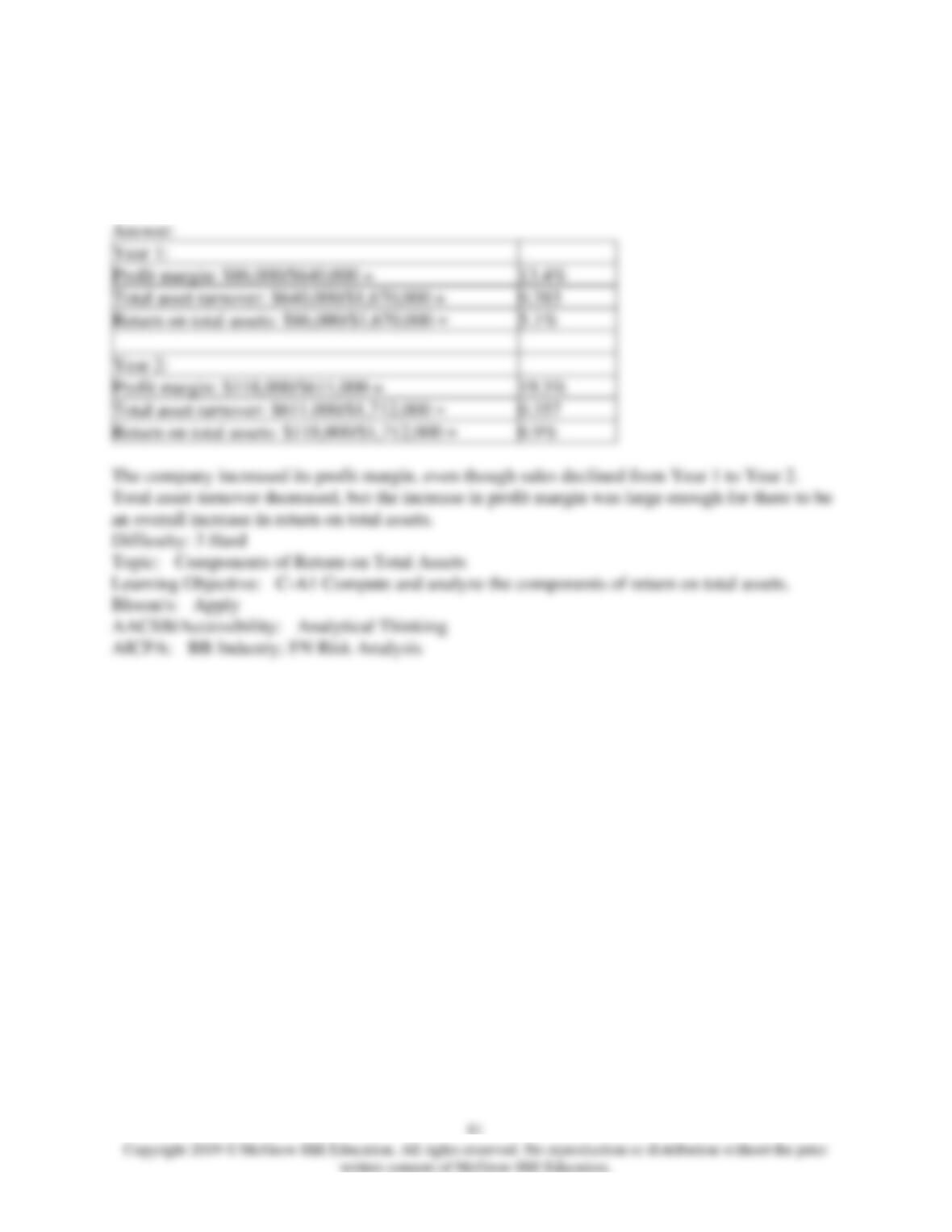
177) A company had net income of $86,000 in Year 1 and $118,000 in Year 2. Its net sales were
$640,000 in Year 1 and $611,000 in Year 2. Its average total assets in Year 1 were $1,670,000
and $1,712,000 in Year 2. Calculate the profit margin, total asset turnover and return on total
assets for both years. Comment on the results.
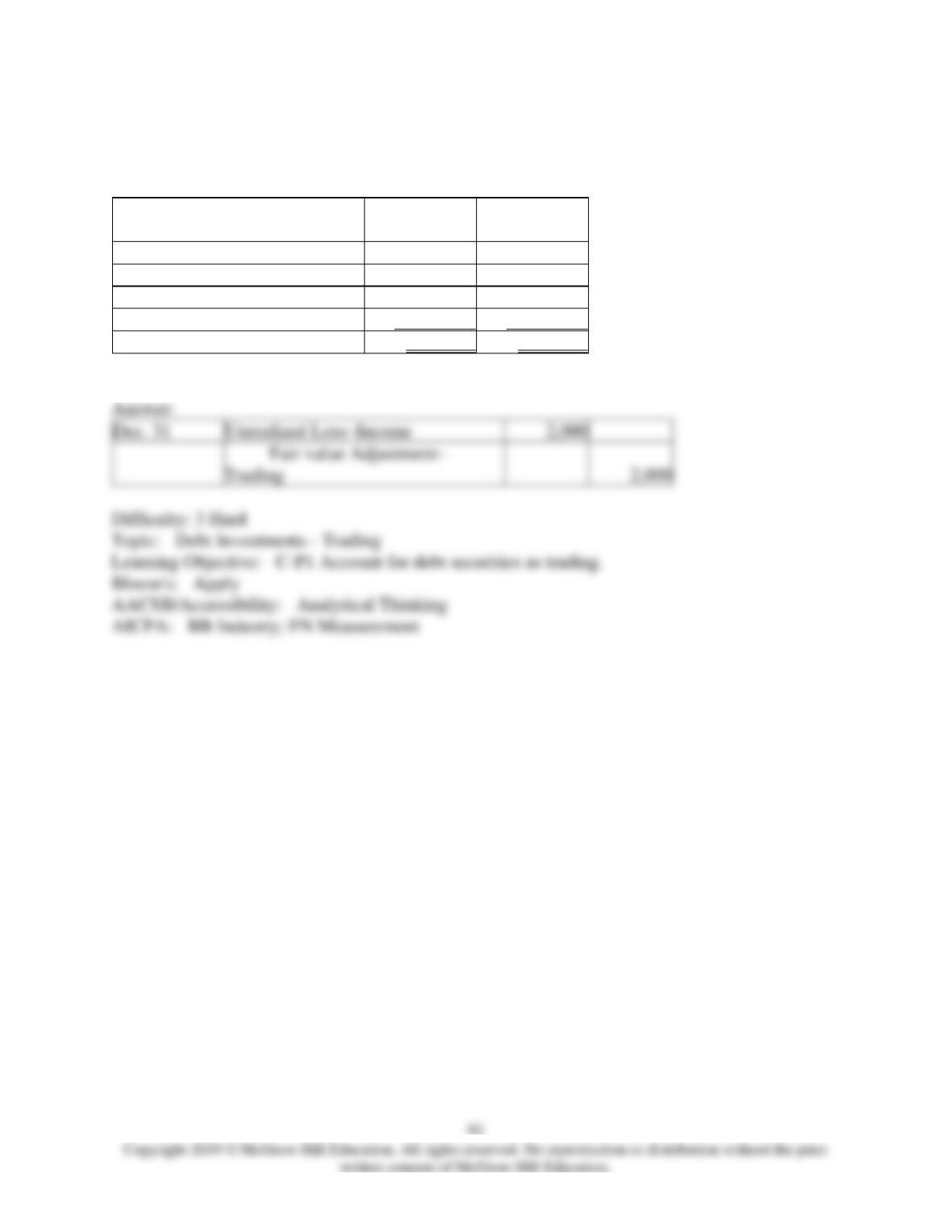
178) Hubbard Company had the following trading securities in its portfolio at December 31. The
Fair Value Adjustment–Trading account had a balance of zero prior to any year-end adjustment.
Prepare the appropriate adjusting journal entry for this portfolio.
Short-Term Debt Investments
Cost
Fair Value
XBM
$ 24,500
$ 25,900
Micro
51,000
48,600
Outel
62,300
61,000
Dull
29,900
30,200
Totals
$167,700
$165,700
Dec. 31
Unrealized Loss–Income
2,000
Trading
2,000
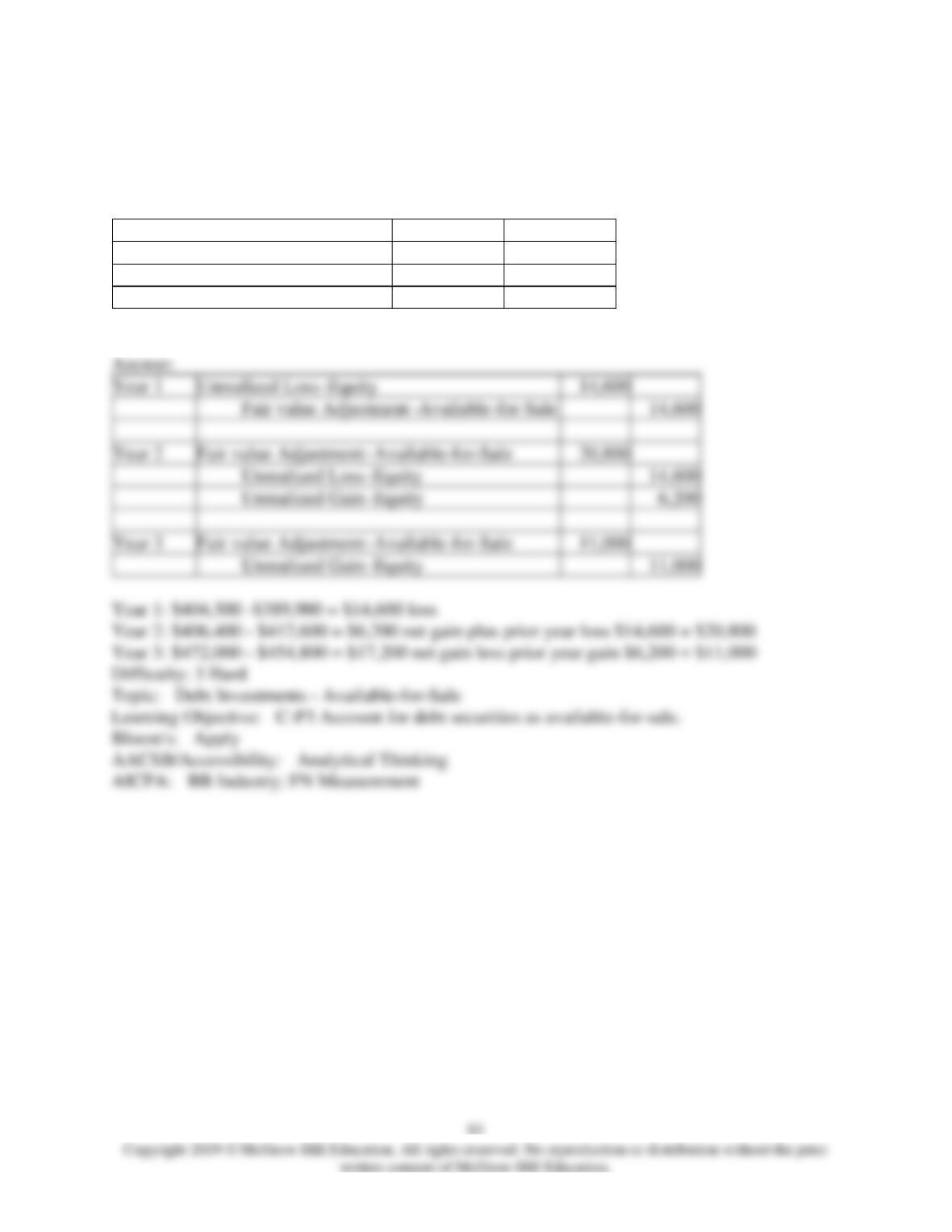
179) Element Company had the following long-term available-for-sale securities in its portfolio
at December 31 for each of the years listed. The year-end cost and fair values for its portfolio
follow. Beginning with Year 1, prepare the appropriate journal entry to record each year-end
market adjustment for these securities.
Available-for-Sale Securities
Cost
Fair Value
Year 1
$ 404,500
$ 389,900
Year 2
406,400
412,600
Year 3
454,800
472,000
Year 1
Unrealized Loss–Equity
Year 2
Fair value Adjustment–Available-for-Sale
Year 3
Fair value Adjustment–Available-for-Sale
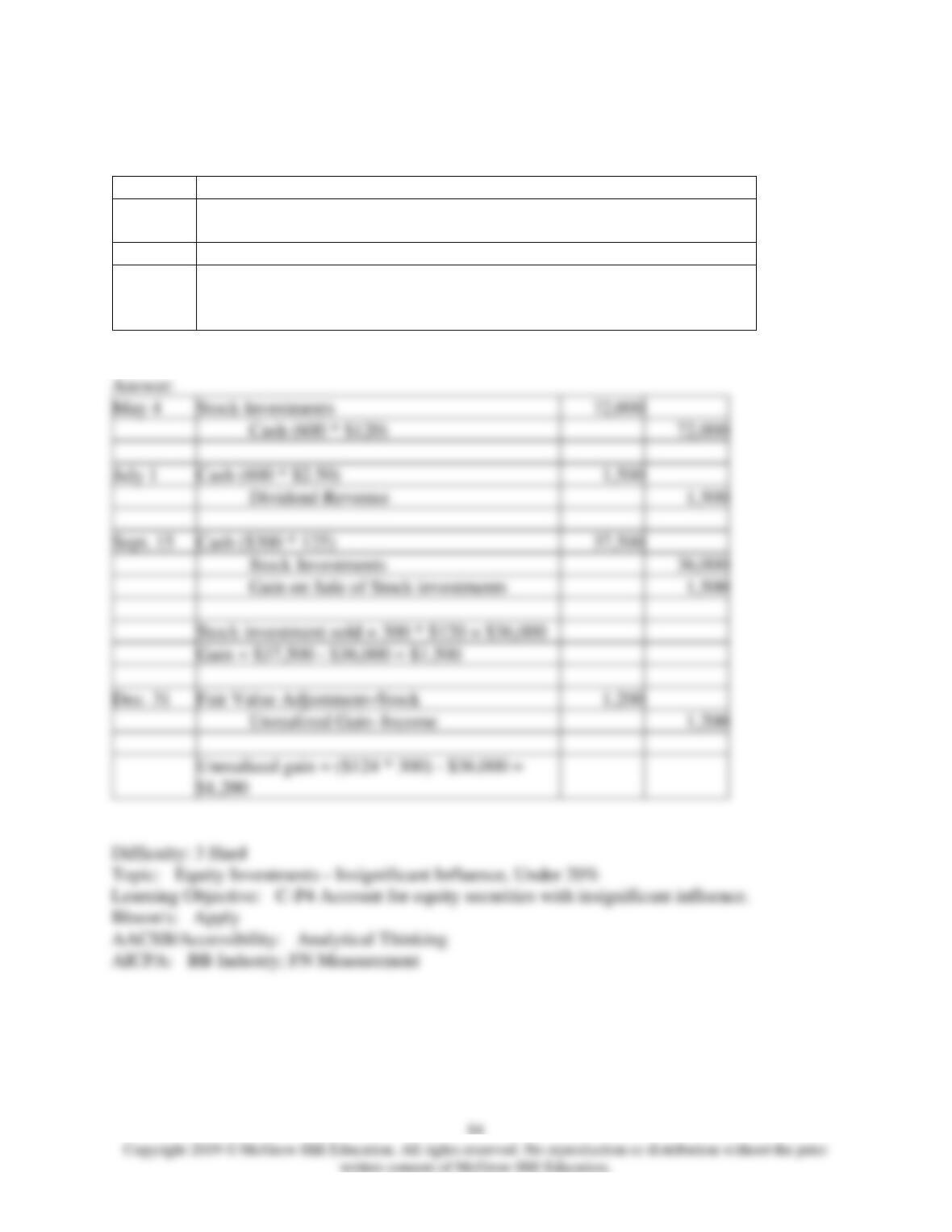
180) Scotsland Company had the following transactions relating to stock investments with
insignificant influence during the year. Prepare the required journal entries for these transactions.
May 4
Scotsland purchased 600 shares of Lobe Company stock at $120 per share.
July 1
Scotsland received a $2.50 per share cash dividend on the Lobe Company
stock.
Sept. 15
Sold 300 shares of Lobe Company stock for $125 per share.
Dec. 31
The fair value of the Lobe Company stock (the only investment that
Scotsland owns) is $124 per share. The balance of the Fair Value
Adjustment–Stock account had a zero balance prior to adjustment.
May 4
Stock Investments
July 1
Cash (600 * $2.50)
Sept. 15
Cash ($300 * 125)
Stock investment sold = 300 * $120 = $36,000
Gain = $37,500 – $36,000 = $1,500
Dec. 31
Fair Value Adjustment–Stock
Unrealized gain = ($124 * 300) – $36,000 =
$1,200

85
181) Mire Corporation had the following transactions involving stock investments with
insignificant influence during the year. Prior to these transactions, Mire had never had any
investments. Prepare the required journal entries to record these transactions.
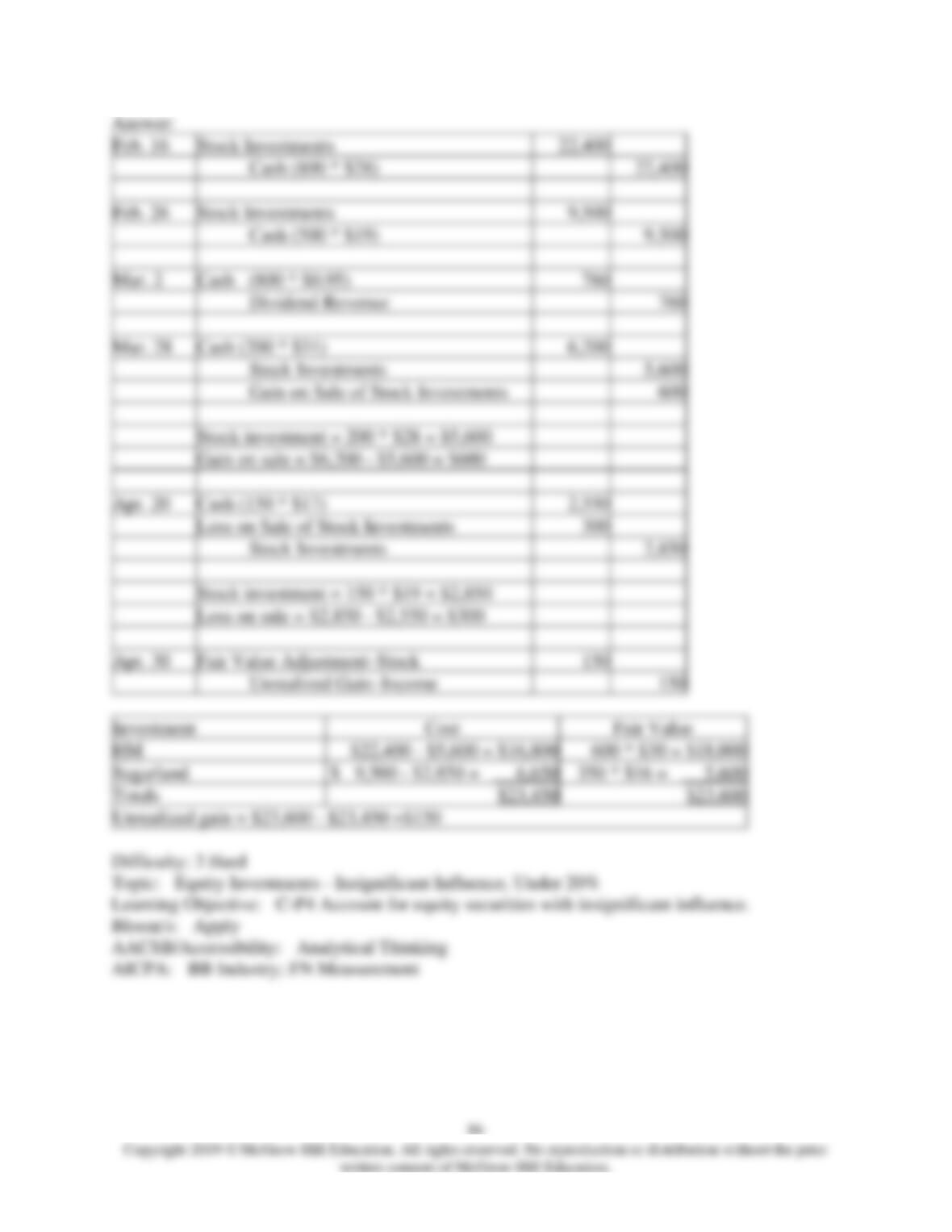
Feb. 16
Purchased 800 shares of HM Corporation stock at $28 per.
Feb. 26
Purchased 500 shares of Sugarland Co. stock at $19 per share.
Mar. 2
Received a $0.95 per share dividend from the HM Corporation.
Mar. 28
Sold 200 shares of HM Corporation stock for $31 per share.
Apr. 20
Sold 150 shares of Sugarland Co. stock at $17 per share.
Apr. 30
The company is preparing quarterly financial statements; prepare an
adjusting entry for the fair value adjustment on the stock investments.
At April 30, the HM stock has a fair value of $30 per share, and the
Sugarland stock has a fair value of $16 per share.
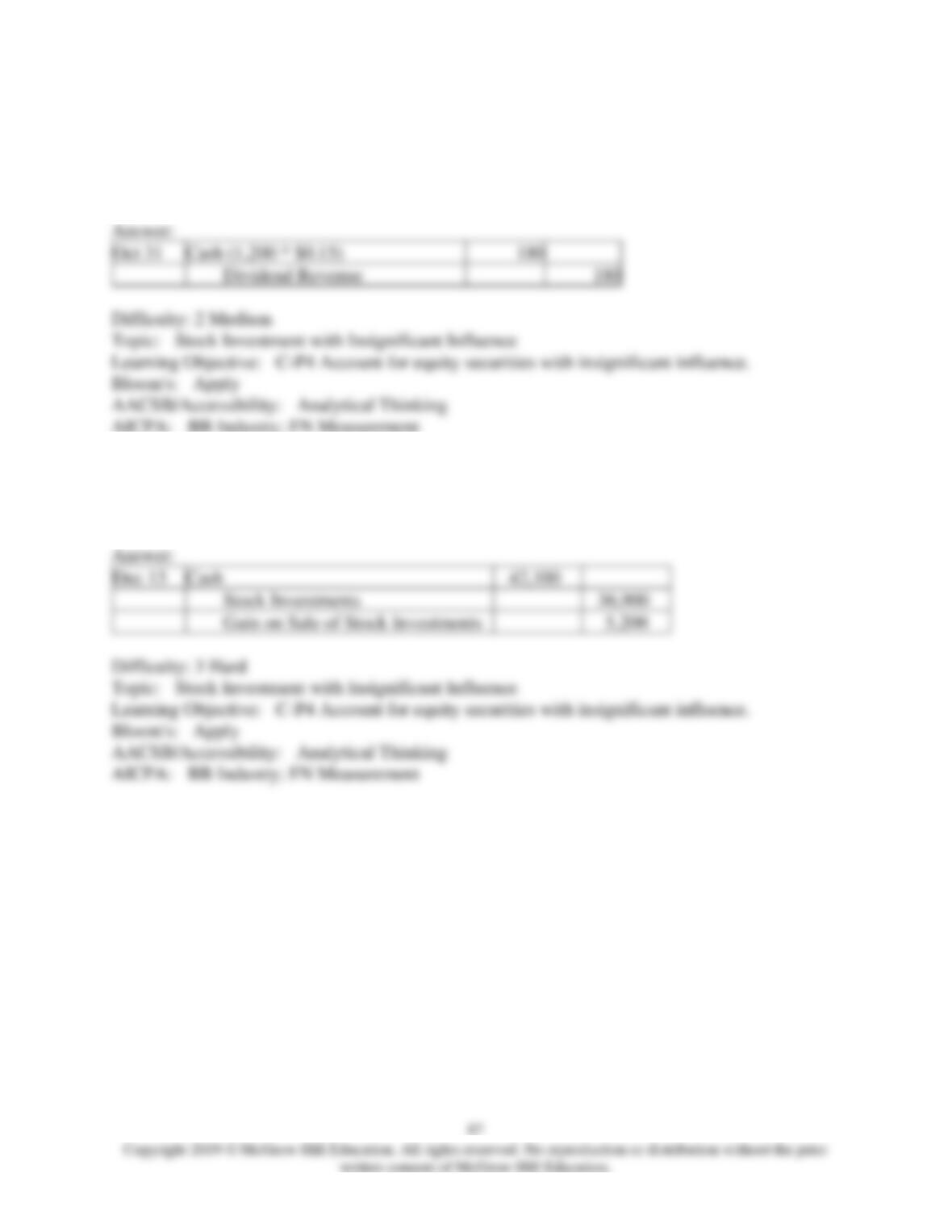
182) On October 31, Augustas Co. received cash dividends of $0.15 per share from its
investment in Lamb Corp.’s common stock. Augustas owned 1,200 shares of Lamb Corp.’s stock
on October 31 and the investment is considered a stock investment with insignificant influence.
Prepare the investor’s journal entry to record the receipt of the cash dividends.
183) Landers, Inc., held 1,500 of Shipman Company common stock with a cost of $36,900. The
investment is considered a stock investment with insignificant influence. Landers sold the shares
on December 13 for $42,100 cash. Prepare Lander’s journal entry to record this sale.
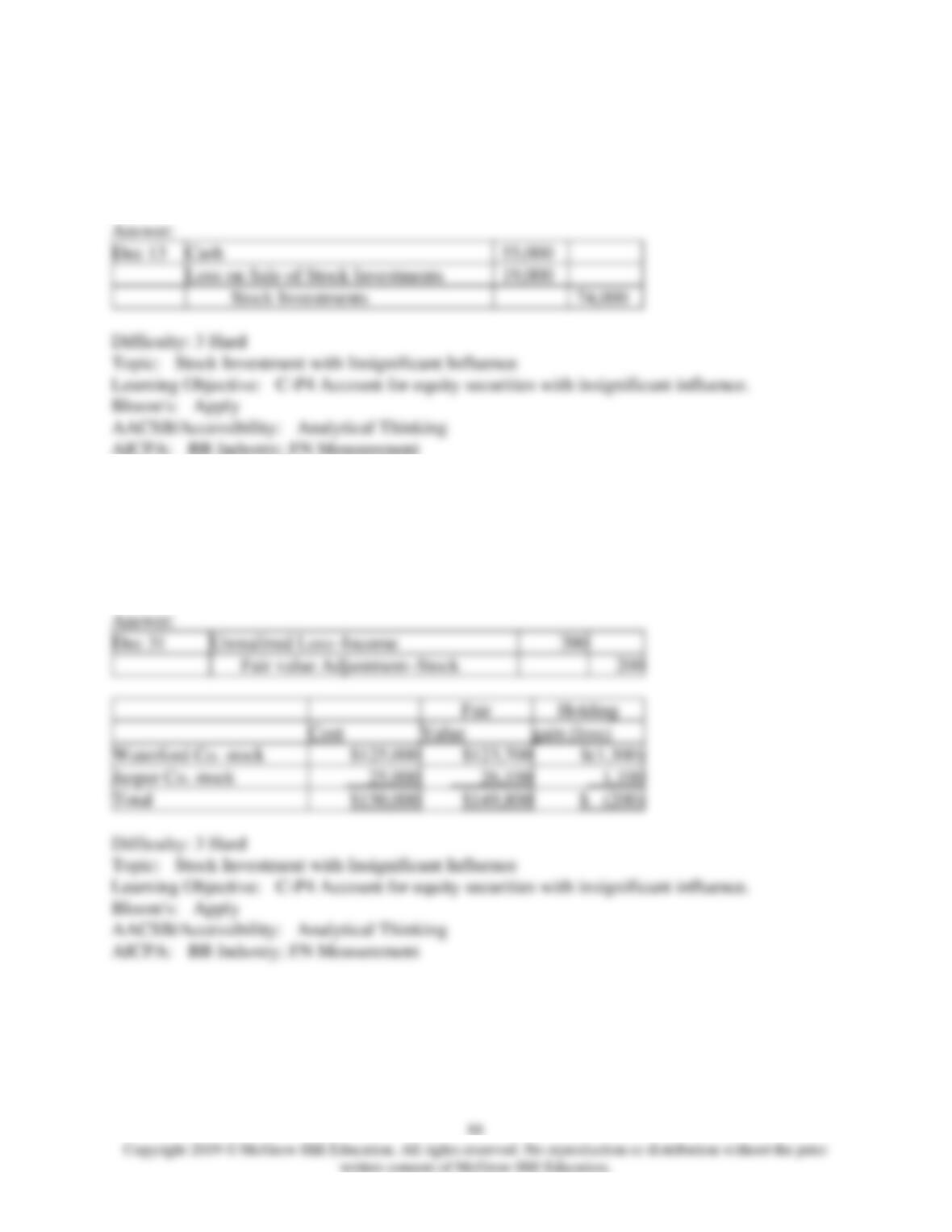
184) Washington Corp. held 1,500 of Vashon Company common stock with a cost of $74,387.
The investment is considered a stock investment with insignificant influence. Washington sold
the shares on December 13 for $55,275 cash. Prepare Washington’s journal entry to record this
sale.
185) In the current year, Logic Co. purchased stock of Waterford Co. with a cost of $125,000
and a year-end fair value of $123,700. Logic also purchased 1,500 shares of Jasper Co. common
stock with a cost of $25,000 and a year-end fair value of $26,100. These investments are
considered stock investments with insignificant influence. Prepare the journal entry to record any
necessary fair value adjustment to the stock investments as of its December 31 year-end.
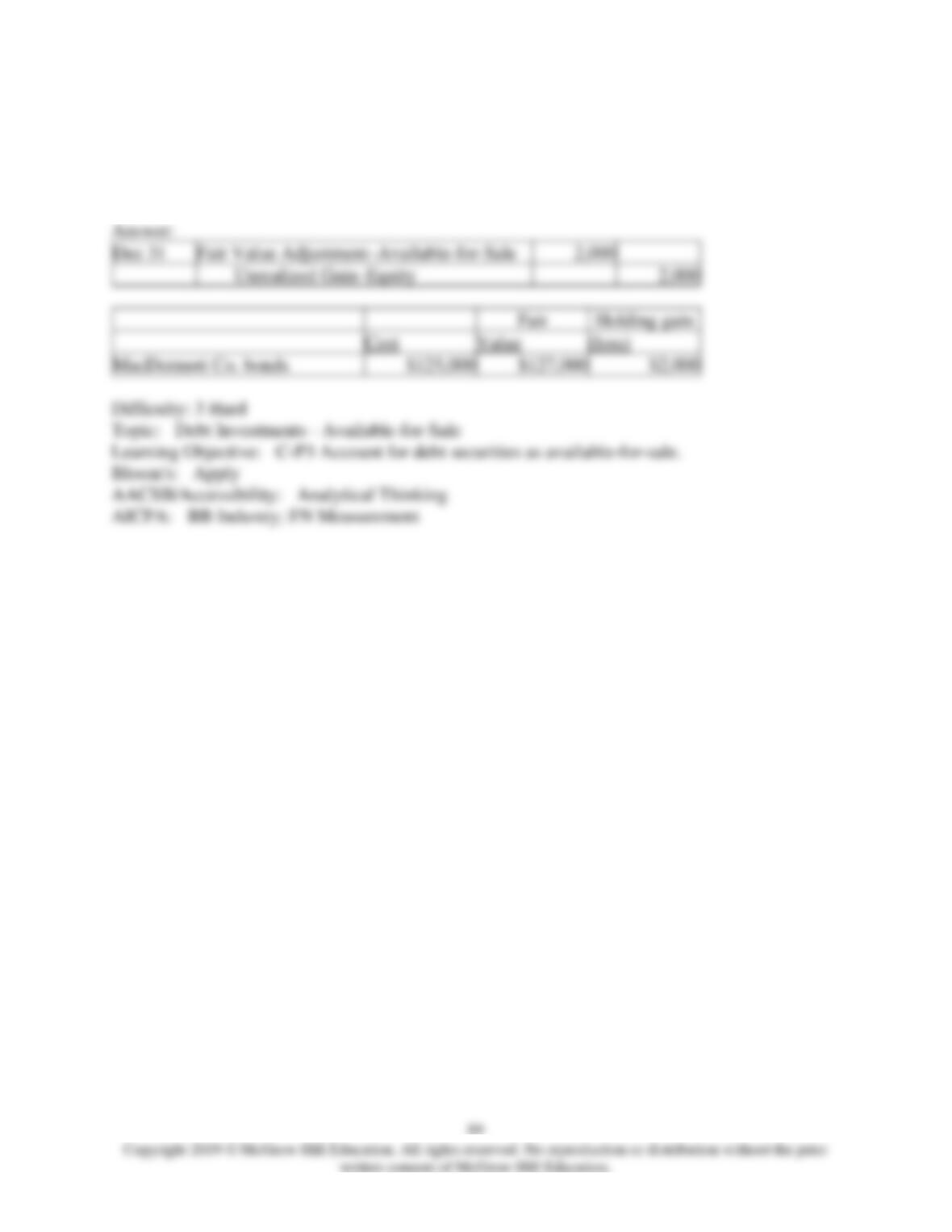
186) In the current year, Largo Co. purchased bonds of MacDermott Corp. with a cost of
$125,000 and a year-end fair value of $127,000. These are classified as long-term available-for-
sale debt securities. Prepare the journal entry to record any necessary fair value adjustment to the
debt investments as of December 31.

90
187) Barzetti had no investments prior to the current year. It had the following transactions
during the year involving stock investments with insignificant influence and also held-to–
maturity debt securities. Prepare Barzetti’s journal entries to record the transactions and events
associated with these investment purchases.
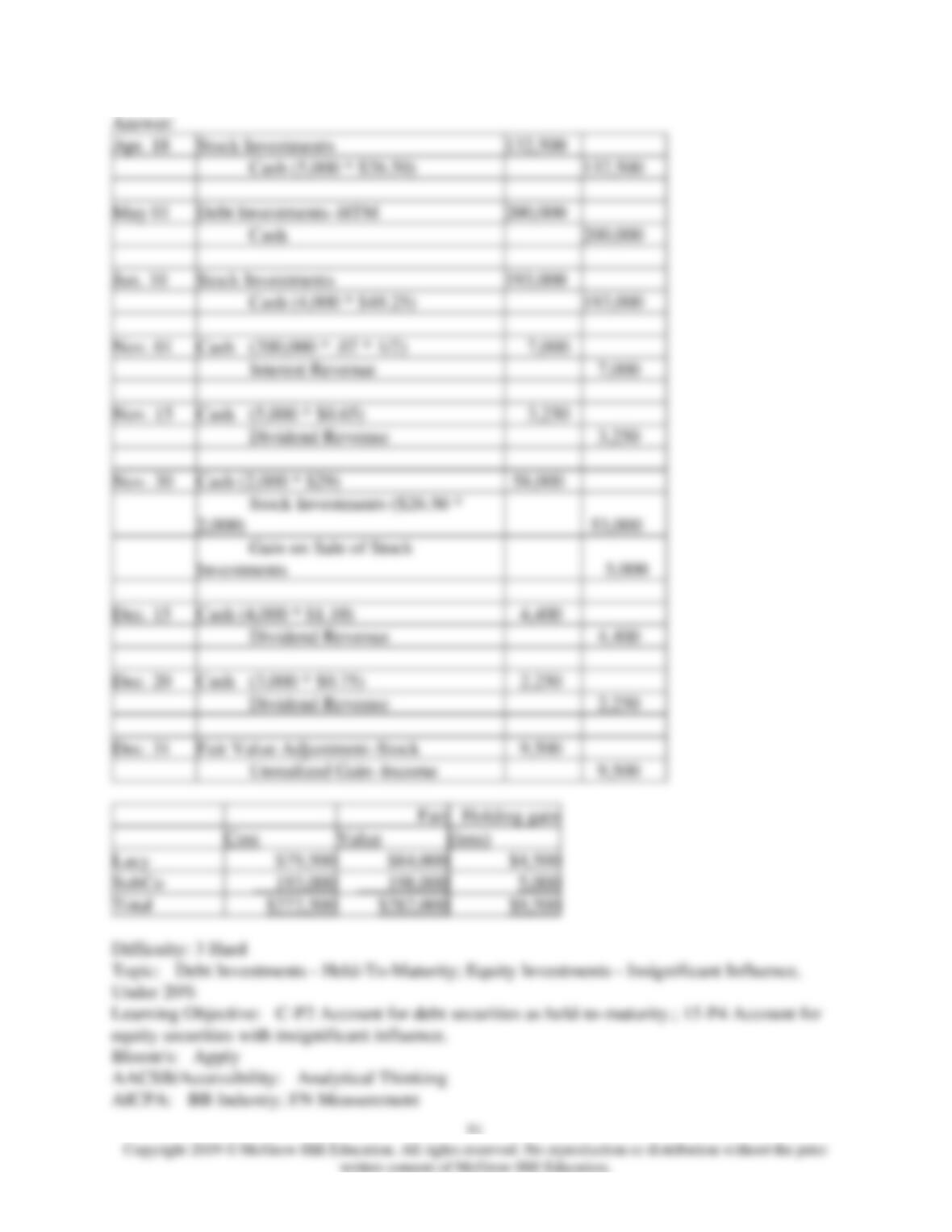
Apr. 18
Purchased 5,000 shares of Lacy Co. stock at $26.50.
May 01
Purchased $200,000 of Butcher’s 7%, two-year bonds payable at par
value. Interest payments are paid semiannually on November 1 and May
1. It is the company’s intent to hold the bonds until maturity.
Jun. 10
Purchased 4,000 shares of SubCo stock at $48.25.
Nov. 01
Received a check for the first semiannual interest payment on the
Butcher’s bonds.
Nov. 15
Received a $0.65 per share cash dividend on the Lacy Co. shares.
Nov. 30
Sold 2,000 shares of Lacy Co. stock at $29.
Dec. 15
Received a $1.10 per share cash dividend on the SubCo shares.
Dec. 20
Received a $0.75 per share cash dividend on the remaining Lacy Co.
shares.
Dec. 31
Prepare an adjusting entry to record the fair value adjustment on the stock
investments. At December 31, the Lacy Co. stock has a fair value of $28
per share, and the SubCo stock has a fair value of $49.50 per share.
188) Weston Company had the following stock investments with insignificant influence in its
portfolio at December 31, Year 1. Weston had several investment transactions during year 2.
(1) Determine the amount Weston should report on its December 31, Year 1 balance sheet for its
stock investments.
(2) Determine the amount Weston should report on its December 31, Year 2 balance sheet for its
stock investments.
(3) Prepare the necessary adjusting entry to record the fair value adjustment at December 31,
Year 2.
Stock Investments
Cost
Fair Value
40,000 shares of Beach common stock
$ 497,500
$ 488,900
15,000 shares of Danfield common stock
410,200
412,600
18,000 shares of Cardinal common stock
399,600
382,500
Jan. 22
Sold 9,000 shares of Cardinal common stock for $202,150.
Nov. 01
Purchased 12,000 shares of Cliff common stock for $223,950. The
shares represent a 10% ownership.
Dec. 31
At December 31, Year 2, the fair values of its investments are: Beach,
$502,500; Danfield, $411,800; Cardinal, $203,100; Cliff, $224,750.
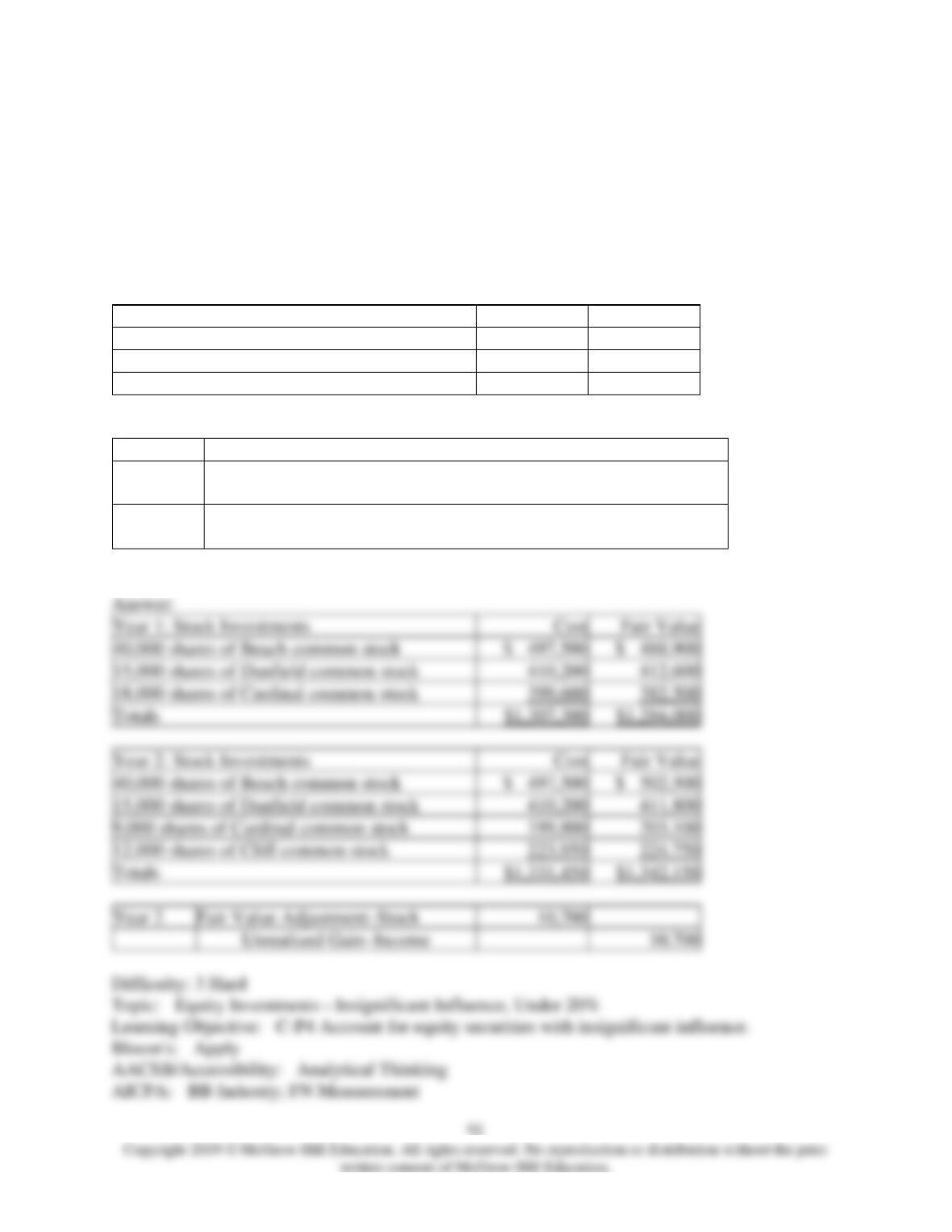
Year 1: Stock Investments
Cost
Fair Value
40,000 shares of Beach common stock
$ 497,500
$ 488,900
15,000 shares of Danfield common stock
410,200
412,600
18,000 shares of Cardinal common stock
399,600
382,500
Totals
Year 2: Stock Investments
Cost
Fair Value
40,000 shares of Beach common stock
$ 497,500
$ 502,500
15,000 shares of Danfield common stock
410,200
411,800
9,000 shares of Cardinal common stock
199,800
203,100
12,000 shares of Cliff common stock
223,950
224,750
Totals
Year 2
Fair Value Adjustment–Stock
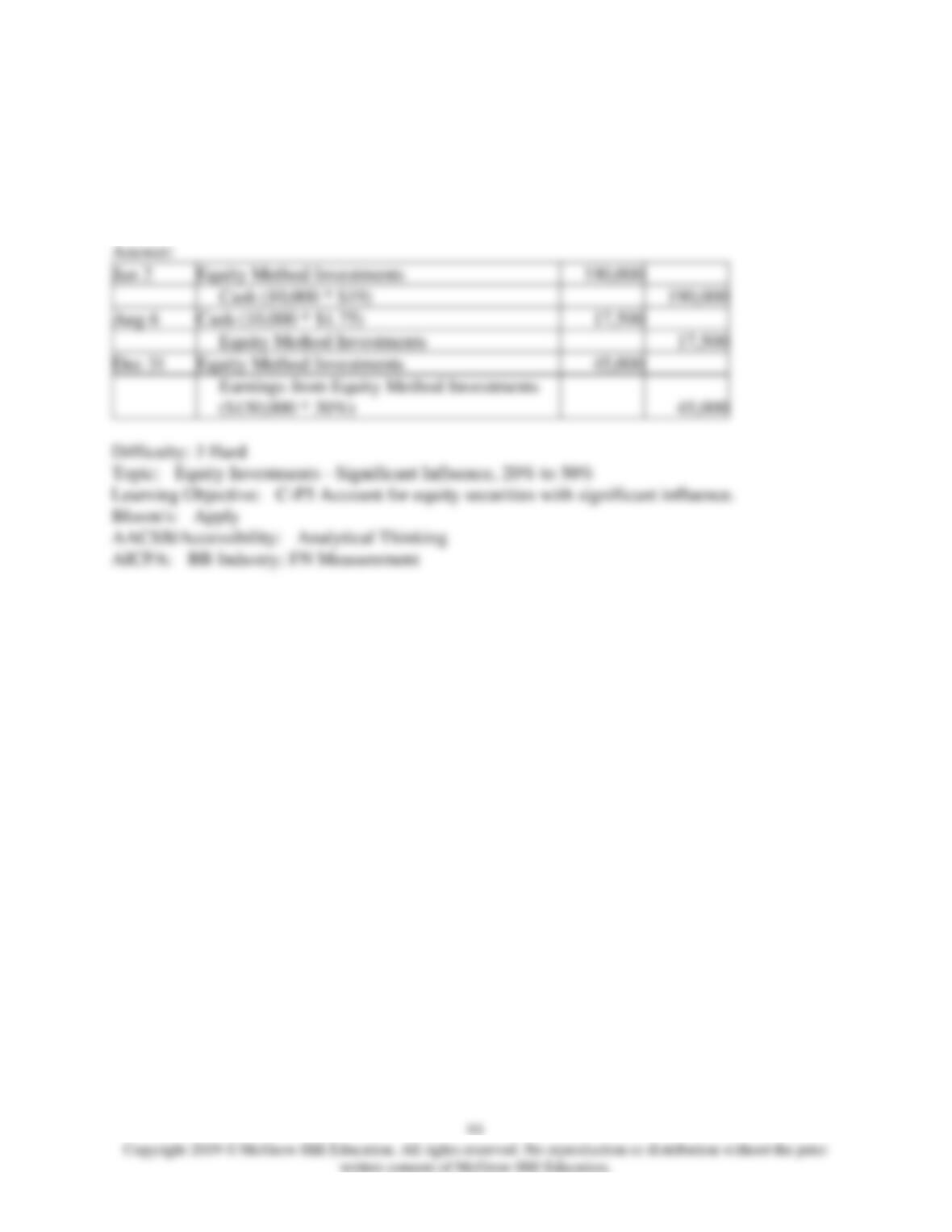
189) On January 2, Froxel Company purchased 10,000 shares of Sandia Corp. common stock at
$19 per share. This represents 30% of Sandia Corp.’s outstanding stock. On August 6, Sandia
Corp. declared and paid cash dividends of $1.75 per share, and on December 31 it reported net
income of $150,000. Prepare the necessary entries for Froxel to account for these transactions
and events.