Financial and Managerial Accounting, 8e (Wild)
Appendix C Investments
1) Long-term investments are usually held as an investment of cash for use in current operations.
2) Land used in the company’s operations is reported as a long-term investment.
3) Short-term investments are also called marketable securities.
4) Equity securities reflect a creditor relationship such as investments in notes, bonds, and
certificates of deposit.
5) Cash equivalents are investments that are readily converted to known amounts of cash and
mature within three months.
6) Short-term investments are intended to be converted into cash within the longer of one year or
the operating cycle of the business, and are readily convertible to cash.
7) Long-term investments include investments in land or other assets not used in a company’s
operations.
8) Debt securities are recorded at cost when purchased.
9) Debt securities are recorded at cost when purchased, and interest revenue for investments in
debt securities is recorded when earned.
10) Any cash dividends received from stock investments with insignificant influence are
recorded as Dividend Expense.
11) When a stock investment with insignificant influence is sold, the sale proceeds are compared
with the cost, and if the cost is greater than the proceeds, a gain on the sale of the security is
recorded.
12) A company received dividends of $0.35 per share on 300 shares of stock it holds as a stock
investment with insignificant influence. The journal entry to record this transaction would be to
debit Cash for $105 and credit Dividend Revenue for $105.
13) An investor purchased $50,000 of 10-year bonds it intends to hold to maturity. The investor’s
journal entry to record the purchase is a debit to Debt Investments—HTM for $50,000 and a
credit to Cash for $50,000.
14) A company holds $40,000 of 7% bonds as a held-to-maturity security. The journal entry to
record receipt of a semiannual interest payment includes a debit to Cash for $2,800 and a credit
to Interest Revenue for $2,800.
15) If a company has a controlling influence over another company, the controlling investor is
called the parent, and the investee company is called the subsidiary.
16) When an investor company owns between 20% and 50% of the voting stock of an investee
company, it has a controlling influence.
17) The consolidation method is used to account for long-term investments in equity securities
with controlling influence.
18) When the cost of a short-term held-to-maturity debt security is different from the maturity
value, the difference is amortized over the remaining life of the security.
19) Trading debt securities are reported as long-term assets.
20) Comprehensive income refers to all changes in equity during a period except those from
owners’ investments and dividends.
21) Consolidated financial statements show the financial statements of all entities under the
parent’s control, including all subsidiaries.
22) When consolidated financial statements are prepared, the parent company uses the equity
method and reports the subsidiaries as investment accounts on the balance sheet.
23) Equity securities giving an investor significant influence over an investee are always
considered short-term investments.
24) If the exchange rate for Canadian and U.S. dollars is 0.7382 to 1, this implies that 2 Canadian
dollars can be purchased for $1.48 U.S. dollars.
25) Multinational corporations can be U.S. companies with operations in other countries.
26) Foreign exchange rates fluctuate due to many factors including changing political and
economic conditions.
27) The price of one currency stated in terms of another currency is called a foreign exchange
rate.
28) Return on total assets can be separated into the profit margin and total asset turnover.
29) Profit margin is net sales divided by operating income.
30) Profit margin reflects the percent of net income in each dollar of net sales.
31) All companies desire a low return on total assets.
32) A company has net income of $130,500. Its net sales were $1,740,000 and its average total
assets were $2,750,000. Its profit margin equals 7.5%.
33) A company has net income of $130,500. Its net sales were $1,740,000 and its average total
assets were $2,750,000. Its total asset turnover equals 4.7%.
34) A company should report its portfolio of trading debt securities at its fair value.
35) Trading securities are debt securities a company plans to hold long-term, possibly until
maturity.
36) Trading debt securities are always reported as current assets.
37) Unrealized gains and losses on trading debt securities are reported on the income statement.
38) Held-to–maturity securities are equity securities a company intends to hold until dividends
have been paid.
39) Investments in held-to-maturity debt securities are always current assets.
40) Accounting for long-term investments in held-to-maturity securities requires companies to
record interest revenue as it is earned.
41) If a long-term investment in an equity security gives the investor significant influence over
the investee, the investment is always classified as short-term.
42) Long-term investments in debt securities not classified as trading or held-to-maturity
securities are classified as available-for-sale securities.
43) Management’s intent determines whether an available-for-sale security is classified as long-
term or short-term.
44) Any unrealized gain or loss for the portfolio of available-for-securities is reported in the
equity section of the balance sheet.
45) The account, Fair Value Adjustment—Available-for-Sale, is reported as an adjunct asset on
the balance sheet.
46) When individual AFS securities are sold, the difference between the cost of the individual
securities sold and the net proceeds (sale price less fees) is recorded as a gain or loss on sale of
debt investments.
47) Available-for-sale securities are actively managed like trading securities because the
company intends to trade them for profit in the short term.
48) Available-for-sale securities are reported at fair value on the balance sheet.
49) Any unrealized gain or loss for the portfolio of available-for-sale securities is reported on the
income statement in the other gain or loss section.
50) On May 1, Jorge Co. purchases notes of Radiotech for $25,000. This investment is
considered to be an available-for-sale debt investment. This is the company’s first and only
investment in available-for-sale debt securities. On July 31 (Jorge’s year-end), the notes had a
fair value of $28,000. Jorge should record a credit to Unrealized Gain—Equity for $3,000.
51) On May 15, Tumbleweed, Inc. purchased notes of Dansell Corp. for $80,000. This is
considered to be an available-for-sale debt investment. This is the company’s first and only
investment in available-for-sale debt securities. On Tumbleweed’s September 30 year-end, the
notes had a fair value of $85,000. The $5,000 difference in fair value must be reported on
Tumbleweed’s income statement as a $5,000 unrealized gain.
52) An investor presumed to have significant influence owns between 20% and 50% of another
company’s voting stock.
53) The cost method of accounting, which does not adjust for changes in fair value, is used to
account for long-term investments in equity securities with insignificant influence.
54) When using the equity method for investments in equity securities, the investor records the
receipt of cash dividends as revenue.
55) Hamasaki Company owns 30% of CDW Corp. stock and has significant influence. Hamasaki
received $6,500 in cash dividends from its investment in CDW. The entry to record receipt of
these dividends includes a debit to Cash for $6,500 and a credit to Equity Method Investments
for $6,500.
56) When using the equity method, receipt of cash dividends increases the book value of an
investment in equity securities.
57) To prepare consolidated financial statements when a U.S. parent company has an
international subsidiary, the international subsidiary’s financial statements must be translated into
U.S. dollars.
58) If a U.S. company’s credit sale to an international customer allows payment to be made in a
foreign currency, the sale transaction is recorded using the exchange rate on the date of sale.
59) If a U.S. Company’s credit sale to an international customer allows payment to be made in a
foreign currency, the same exchange rate must be used for the date of sale and the cash payment
date.
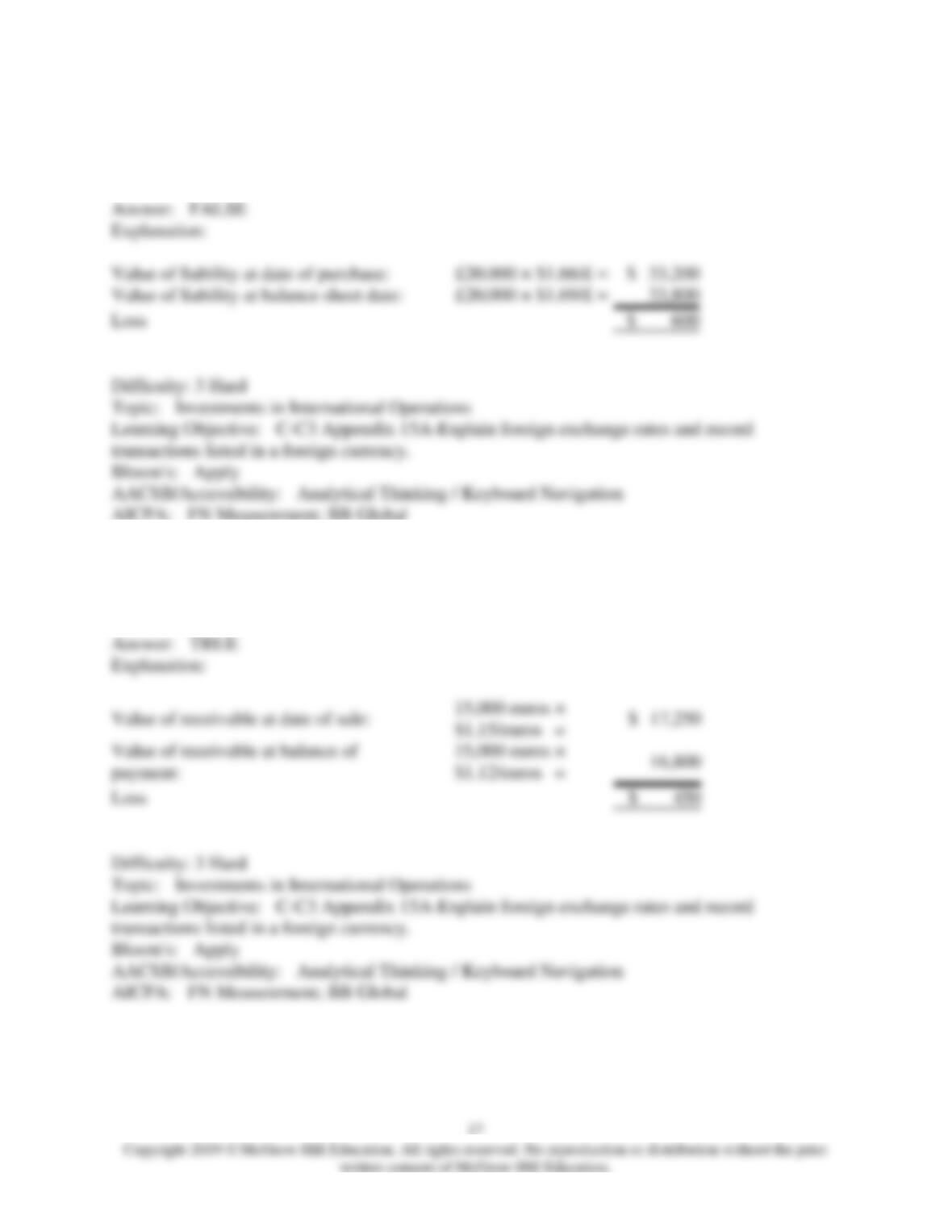
60) Kim Manufacturing purchased on credit £20,000 worth of parts from a British company
when the exchange rate was $1.66 per British pound. At the year-end balance sheet date, the
exchange rate increased to $1.69. Kim must record a gain of $600.
61) Maroon Company sold supplies in the amount of €15,000 (euros) to a French company when
the exchange rate was $1.15 per euro. At the time of payment, the exchange rate decreased to
$1.12. Maroon must record a loss of $450.
62) Long-term investments:
A) Are current assets.
B) Can include funds designated for a special purpose, or investments in land not used in the
company’s operations.
C) Must be readily convertible to cash.
D) Are expected to be converted into cash within one year.
E) Include only equity securities.
63) Short-term investments include:
A) Securities that management intends to convert to cash within the longer of one year or the
current operating cycle, and are readily convertible to cash.
B) Funds earmarked for a special purpose such as bond sinking funds.
C) Stocks not intended to be converted into cash.
D) Bonds not intended to be converted into cash.
E) Sinking funds not intended to be converted into cash.
64) Long-term investments are reported in the:
A) Current asset section of the balance sheet.
B) Intangible asset section of the balance sheet.
C) Non-current section of the balance sheet called long-term investments.
D) Plant assets section of the balance sheet.
E) Equity section of the balance sheet.
65) Long-term investments include:
A) Investments that are not readily convertible to cash or not intended to be converted to cash in
the short term.
B) Investments in marketable stocks that are intended to be converted into cash in the short-term.
C) Investments in marketable bonds that are intended to be converted into cash in the short-term.
D) Only investments readily convertible to cash.
E) Investments intended to be converted to cash within one year.
66) Strickland Corporation has invested in debt securities. Strickland intends to actively buy and
sell this investment for profit. This investment is classified as:
A) an available-for-sale security.
B) a held-to-maturity security.
C) a trading security.
D) a significant influence security.
E) a controlling influence security.
67) All of the following statements regarding stock investments with insignificant influence are
true except for:
A) They are recorded at cost when acquired.
B) They are valued at fair value.
C) They report realized gain (or loss) in a permanent asset account, Fair Value Adjustment—
Stock.
D) They report any unrealized gain (or loss) in the income statement.
E) They are adjusted to fair value at the end of each period.