
42
110) Carpark Services began operations in 20X1 and maintains long-term investments in
available-for-sale debt securities. The year-end cost and fair values for its portfolio of debt
securities follows. The year-end adjusting entry to record the unrealized gain/loss at December
31, 20X2 is:
Available-for-Sale Securities
Cost
Fair Value
December 31, 20X1
$
250,000
$
241,000
December 31, 20X2
$
340,000
$
350,000
A) Debit Unrealized Gain – Equity $10,000; Credit Fair Value Adjustment – Available-for-Sale
(LT) $10,000.
B) Debit Fair Value Adjustment – Available-for-Sale (LT) $19,000; Credit Unrealized Loss –
Equity $9,000; Credit Unrealized Gain – Equity, $10,000.
C) Debit Fair Value Adjustment – Available-for-Sale (LT) $10,000; Credit Unrealized Gain –
Equity, $10,000.
D) Debit Fair Value Adjustment – Available-for-Sale (LT) $10,000; Credit Unrealized Loss –
Equity $10,000.
E) Debit Fair Value Adjustment – Available-for-Sale (LT) $19,000; Credit Unrealized Gain –
Equity $19,000.
111) Trading (debt) securities are:
A) Recorded at cost and then reported at cost over the life of the investment.
B) Reported at historical cost and then adjusted for the amortized amount of any difference
between cost and maturity value.
C) Recorded at cost and then reported at fair value on the balance sheet.
D) Intended to be held to maturity.
E) Always classified as Long-Term Investments.
112) All of the following are true for available-for-sale debt securities except for:
A) Recorded at cost when acquired.
B) Earn interest that is reported in the income statement.
C) Classified as either short-term or long-term securities.
D) Reported at fair value on the balance sheet.
E) Actively managed like Trading Securities.
113) J.P. Industries purchased Yang’s notes for $143,375 as a long-term investment. The
investment is classified as available-for-sale. J.P.’s entry to record the purchase transaction would
include a:
A) Credit to Short-Term Investments-AFS for $143,375.
B) Credit to Long-Term Investments-AFS for $143,375.
C) Credit to Notes Payable for $143,375.
D) Debit to Equity Investments-AFS for $143,375.
E) Debit to Debt Investments-AFS for $143,375.
114) Lessington Corporation purchases 4,000 shares of Gonzalez Company common stock for
$150,000 cash. Gonzalez has 500,000 shares of stock currently outstanding. Lessington’s entry to
record the purchase would include a:
A) Debit to Stock Investments for $150,000.
B) Credit to Common Stock for $150,000.
C) Credit Equity Method Investment $150,000.
D) Debit to Long-Term Investments-AFS for $150,000.
E) Debit to Equity Method Investment for $150,000.
115) Six months ago, a company purchased stock investments with insignificant influence for
$70,000. This is the company’s first and only purchase of stock. The current year-end fair value
of the stock is $68,500. The company should record a:
A) Debit to Unrealized Loss—Income for $1,500.
B) Debit to Unrealized Gain—Equity for $1,500.
C) Debit to Investment Revenue for $1,500.
D) Credit to Dividend Revenue for $1,500.
E) Credit to Investment Revenue for $1,500.
116) On July 31, Potter Co. purchased 2,000 shares of GigaTech stock for $16,000. GigaTech
has 100,000 shares currently outstanding. This is the company’s first and only stock investment.
On October 31, which is Potter’s year-end, the stock had a fair value of $20,000. Potter should
record a:
A) Credit to Unrealized Gain-Income for $4,000.
B) Credit to Fair Value Adjustment-Stock for $4,000.
C) Credit to Investment Revenue for $4,000.
D) Debit to Unrealized Loss-Income for $4,000.
E) Debit to Unrealized Gain-Equity for $4,000.
117) On March 15, Alan Company purchased 10% of Cameo Corp.’s stock for $35,000. This is
the company’s first and only stock investment. On Alan’s June 30 year-end, the stock had a fair
value of $34,000. Alan should do which of the following:
A) Record a debit to the Fair Value Adjustment-Stock account.
B) Record a debit to the Unrealized Loss—Income account.
C) Report a decrease in the Gain on Sale of Investment income statement account.
D) Report an increase in the asset section of the balance sheet.
E) Record a credit to the Unrealized Gain—Income account.
118) If a company owns more than 20% of the stock of another company and the stock is being
held as a long-term investment, which method would the investor normally use to account for
this investment?
A) Equity method.
B) Fair value method.
C) Historical cost method.
D) Cost with amortization method.
E) Effective method.
119) MotorCity, Inc. purchased 40,000 shares of Shaw common stock for $232,000. This
represents 40% of the outstanding stock. The entry to record the transaction includes a:
A) Debit to Debt Investments for $232,000.
B) Debit to Equity Method Investments for $232,000.
C) Credit to Equity Method Investments for $232,000.
D) Debit to Long-Term Investments-HTM for $232,000.
E) Debit to Short-Term Investment-AFS for $232,000.
120) Segmental Manufacturing owns 35% of Glesson Corp stock. Glesson pays a total of
$47,000 in cash dividends for the period. Segmental’s entry to record the cash dividend received
from Glesson would include a:
A) Credit to Equity Method Investments for $16,450.
B) Debit to Equity Method Investments for $16,450.
C) Debit to Cash for $47,000.
D) Credit to Cash for $16,450.
E) Credit to Investment Revenue for $47,000.
121) Zhang Corp. owns 40% of Magnor Company’s common stock. Magnor pays $97,000 in
total cash dividends to its shareholders. Zhang’s entry to record the cash dividend received from
Magnor would include a:
A) Debit to Dividends for $97,000.
B) Debit to Dividends for $38,800.
C) Debit to Equity Method Investments for $97,000.
D) Credit to Equity Method Investments for $38,800.
E) Credit to Cash for $97,000.
122) McVeigh Corp. owns 40% of Gondor Company’s common stock. McVeigh received
$41,200 in cash dividends from Gondor. The entry to record the cash dividend received from
Gondor would include a:
A) Debit to Dividends for $103,000.
B) Credit to Equity Method Investments for $41,200.
C) Debit to Dividend Revenue for $41,200.
D) Credit to Equity Method Investments for $103,000.
E) Credit to Cash for $41,200.
123) Marjam Company owns 41,000 shares of MacKenzie Company’s 100,000 outstanding
shares of common stock. MacKenzie Company pays $25,000 in total cash dividends to its
shareholders. Marjam’s entry to record the cash dividend received from MacKenzie would
include a:
A) Debit to Dividend Revenue for $10,250.
B) Debit to Interest Revenue for $10,250.
C) Credit to Equity Method Investments for $10,250.
D) Credit to Equity Method Investments for $25,000.
E) Credit to Dividend Revenue for $25,000.
124) Bharrat Corporation purchased 40% of Ferris Corporation for $100,000 on January 1. On
October 17 of the same year, Ferris Corporation declared total cash dividends of $12,000. At
year-end, Ferris Corporation reported net income of $60,000. The balance in the Bharrat’s Equity
Method Investments—Ferris account at December 31 should be:
A) $80,800.
B) $100,000.
C) $95,200.
D) $119,200.
E) $124,000.
125) Madison Corporation purchased 40% of Jay Corporation for $125,000 on January 1. On
June 20 of the same year, Jay Corporation declared total cash dividends of $30,000. At year-end,
Jay Corporation reported net income of $150,000. The balance in Madison’s Equity Method
Investments—Jay Corporation account as of December 31 should be:
A) $77,000.
B) $125,000.
C) $173,000.
D) $197,000.
E) $370,000.
126) Pravis Corporation owns 30% of Kuster Corporation. Pravis Corporation received $9,000 in
cash dividends from Kuster Corporation. The entry to record receipt of these dividends is:
A) Debit Cash, $9,000; credit Equity Method Investments, $9,000.
B) Debt Equity Method Investment, $9,000; credit Cash, $9000.
C) Debit Cash, $9,000; credit Interest Revenue, $9,000.
D) Debit Unrealized Gain-Income, $9,000; credit Cash, $9,000.
E) Debit Cash, $9,000; credit Dividend Revenue, $9,000.
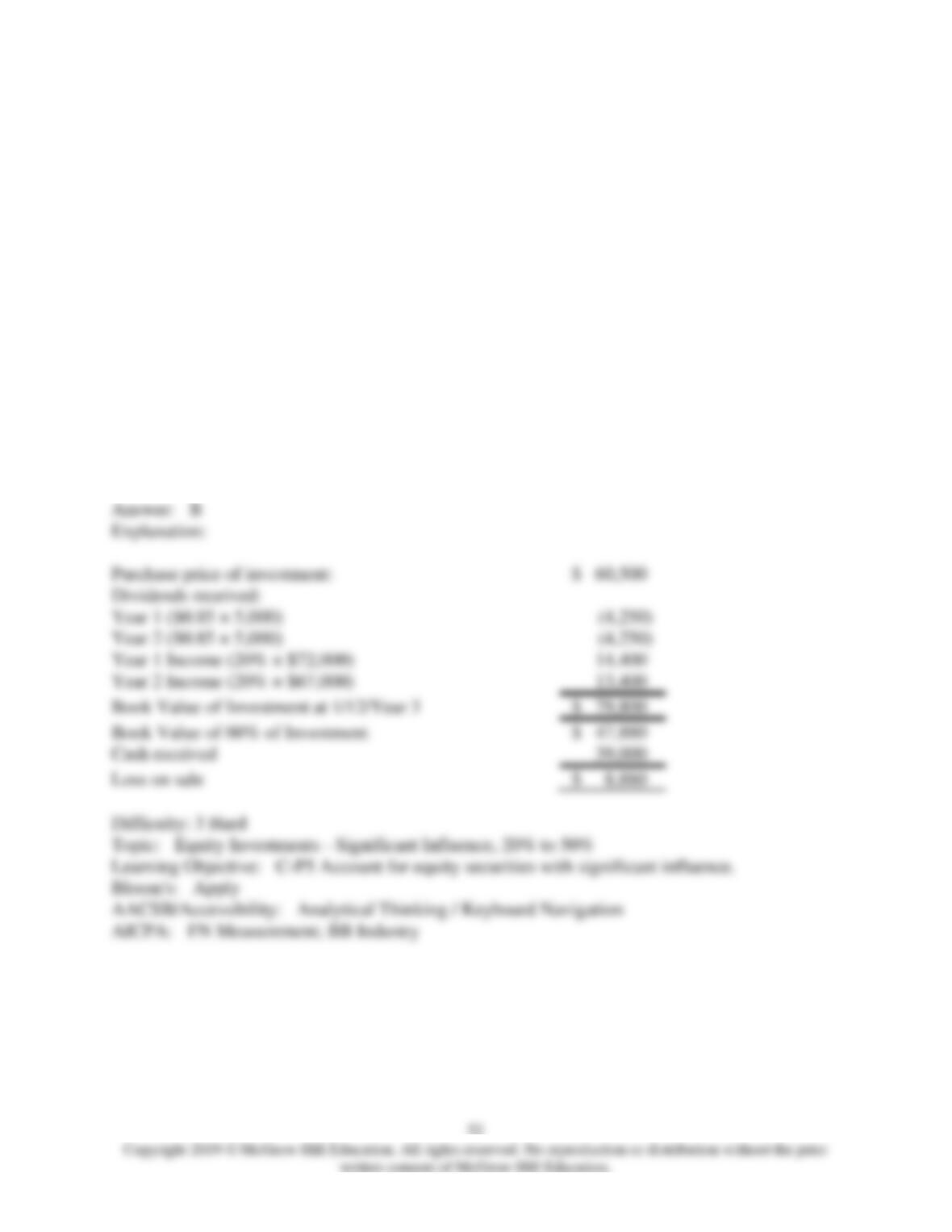
127) On January 4, Year 1, Barber Company purchased 5,000 shares of Convell Company for
$60,500. Convell Company has a total of 25,000 shares of common stock outstanding and it is
presumed the Barber Company will have a significant influence over Convell. During each of the
next two years, Convell declared and paid cash dividends of $0.85 per share, and its net income
was $72,000 and $67,000 for Year 1 and Year 2, respectively. The January 2, Year 3, entry to
record Barber’s sale of 3,000 shares of Convell Company stock, which represents 60% of
Barber’s total investment, for $39,000 cash, should be:
A) Debit Cash $39,000; debit Loss on Sale of Stock Investment $8,200; credit Equity Method
Investments $47,280.
B) Debit Cash $39,000; debit Loss on Sale of Stock Investment $8,880; credit Equity Method
Investments $47,880.
C) Debit Cash $39,000; credit Gain on Sale of Stock Investment $2,700; credit Equity Method
Investments $36,300.
D) Debit Cash $39,000; credit Gain on Sale of Stock Investment $8,750; credit Equity Method
Investments $30,250.
E) Debit Cash $39,000; debit Loss on Sale of Stock Investment $21,500; credit Equity Method
Investments $60,500.
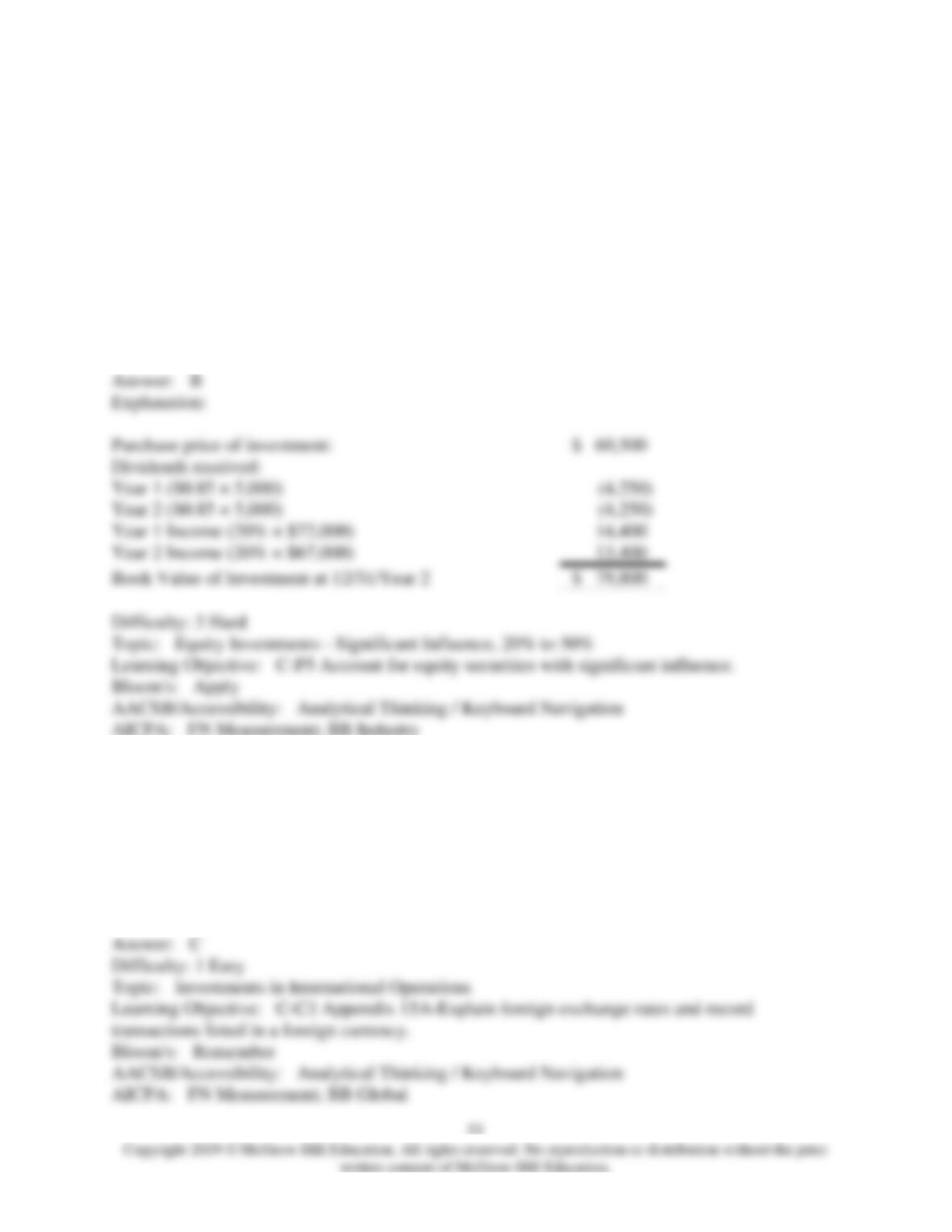
128) On January 2, Year 1, Barber Company purchased 5,000 shares of Convell Company for
$60,500. Convell Company has a total of 25,000 shares of common stock outstanding and it is
presumed the Barber Company will have a significant influence over Convell. During each of the
next two years, Convell declared and paid cash dividends of $0.85 per share, and its net income
was $72,000 and $67,000 for Year 1 and Year 2, respectively. What is the book value of Barber’s
investment in Convell at the end of Year 2?
A) $60,500.
B) $79,800.
C) $52,000.
D) $88,300.
E) $87,300.
129) A U.S. company makes a sale to a foreign customer receivable in 30 days in the customer’s
currency. The sale would be recorded by the U.S. company on the date:
A) Of sale using a projected estimate of the U.S. dollar value at payment date.
B) Of sale using a 30-day average U.S. dollar value.
C) Of sale using the current dollar value.
D) Of sale using the foreign currency value.
E) When payment is received.
130) When a U.S. company makes a credit sale to an international customer and the sale terms
are for payment in a foreign currency, the foreign exchange rate used to record the sale is the
exchange rate:
A) Thirty days from the date of sale.
B) At the end of the seller’s fiscal year.
C) At the end of the buyer’s fiscal year.
D) On the date final payment is made.
E) On the date of the sale.
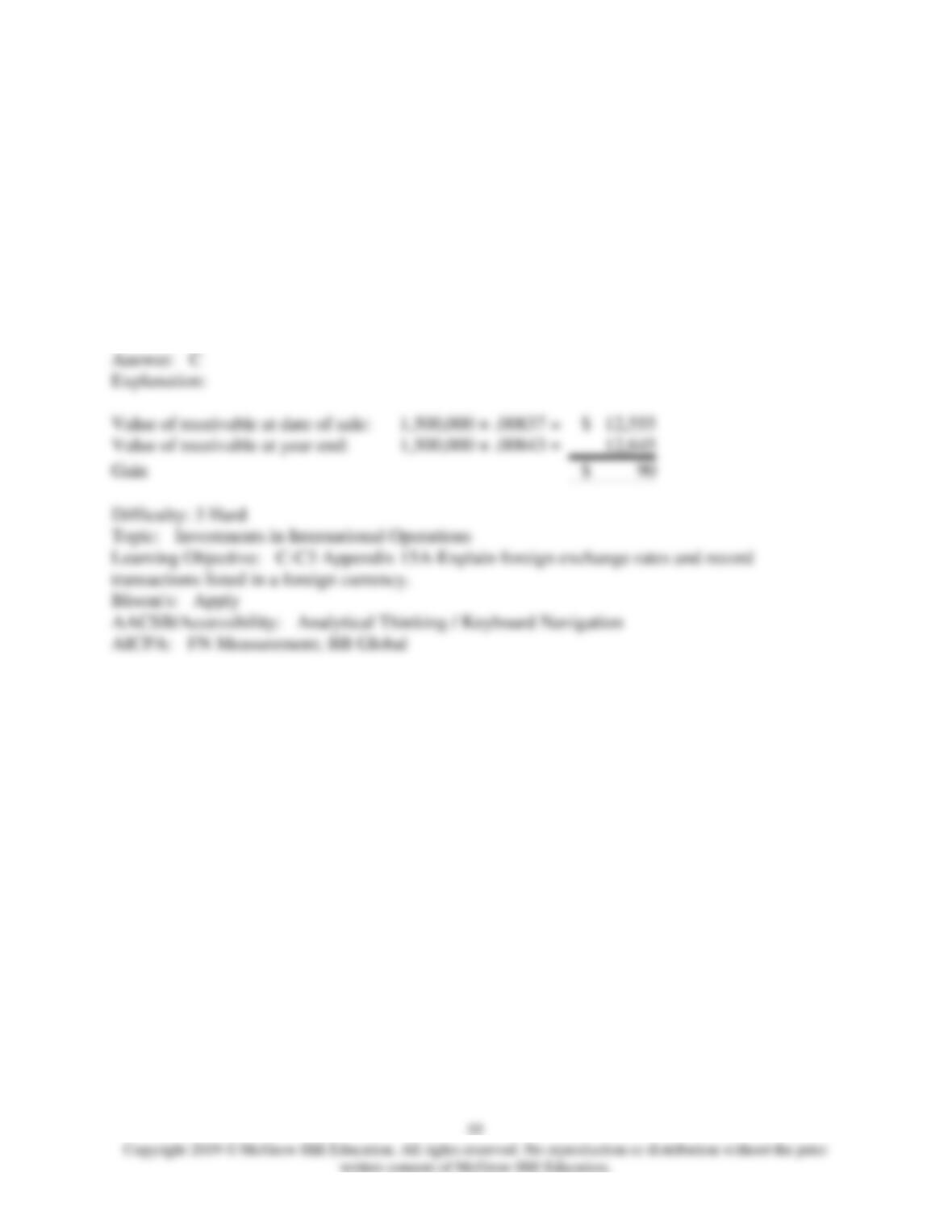
131) On June 18, Wyman Company (a U.S. Company) sold merchandise to the Nielsen
Company of Denmark for €60,000 (Euros), with a payment due in 60 days. If the exchange rate
was $1.35 per euro on the date of sale and $1.14 per euro on the date of payment, Wyman
Company should recognize a foreign exchange gain or loss in the amount of:
A) $60,000 gain.
B) $60,000 loss.
C) $68,400 loss.
D) $12,600 gain.
E) $12,600 loss.
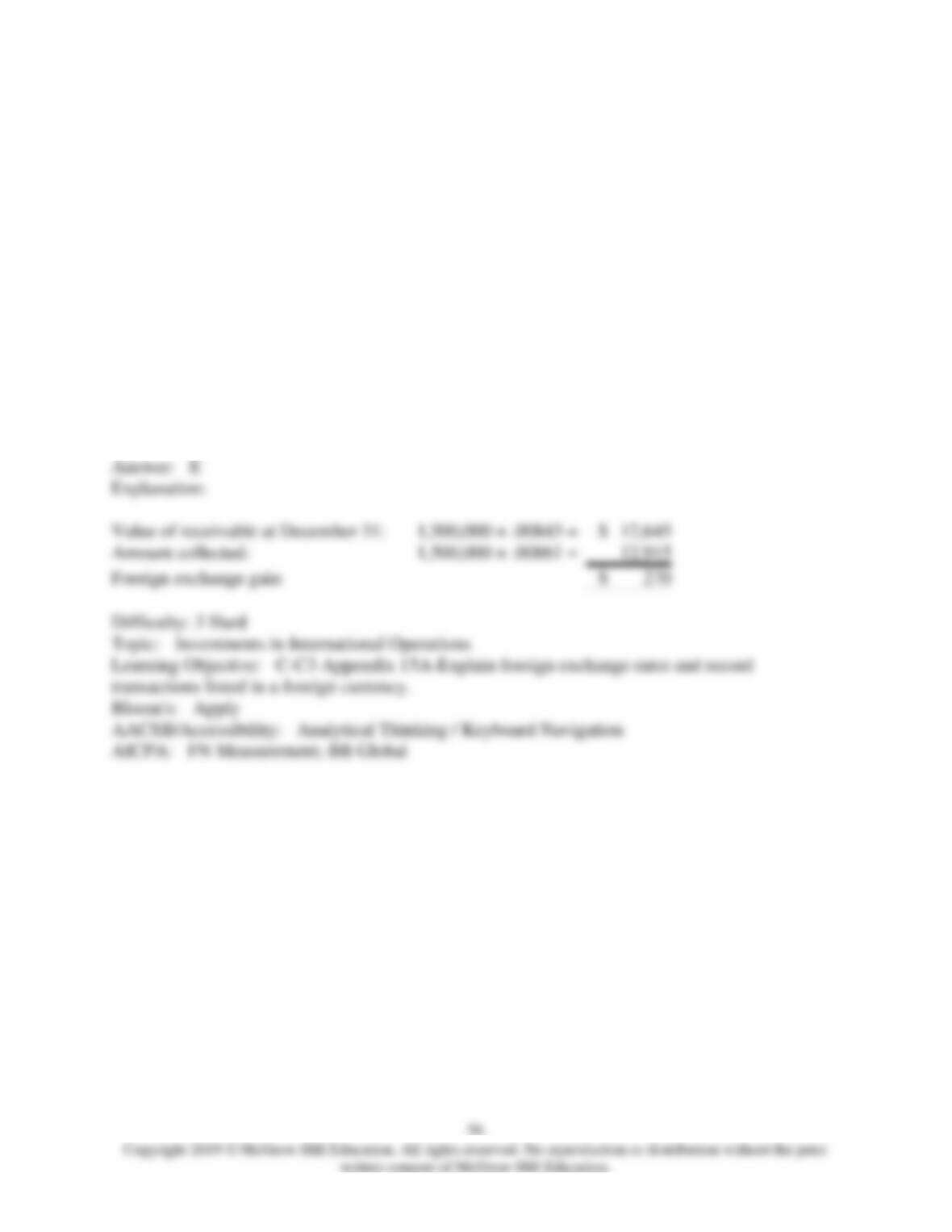
132) On November 12, Higgins, Inc., a U.S. Company, sold merchandise on credit to Kagome of
Japan at a price of 1,500,000 yen. The exchange rate was $0.00837 per yen on the date of sale.
On December 31, when Higgins prepared its financial statements, the exchange rate was
$0.00843. Kagome paid in full on January 12, when the exchange rate was $0.00861. On
December 31, Higgins should prepare the following journal entry:
A) Debit Sales $90; credit Foreign Exchange Gain $90.
B) Debit Foreign Exchange Loss $90; credit Sales $90.
C) Debit Accounts Receivable-Kagome $90; credit Foreign Exchange Gain $90.
D) Debit Foreign Exchange Loss $90; Accounts Receivable-Kagome $90.
E) No journal entry is required until the amount is collected.
133) On November 12, Higgins, Inc., a U.S. Company, sold merchandise on credit to Kagome of
Japan at a price of 1,500,000 yen. The exchange rate was $0.00837 on the date of sale. On
December 31, when Higgins prepared its financial statements, the exchange rate was $0.00843.
Kagome paid in full on January 12, when the exchange rate was $0.00861. On January 12,
Higgins should prepare the following journal entry:
A) Debit Cash $12,915; credit Accounts Receivable-Kagome $12,555; credit Foreign Exchange
Gain $360.
B) Debit Cash $12,555; debit Foreign Exchange Loss $360; credit Accounts Receivable-Kagome
$12,915.
C) Debit Cash $12,915; credit Accounts Receivable-Kagome $12,645; credit Foreign Exchange
Gain $90.
D) Debit Cash $12,645; debit Foreign Exchange Loss $90; credit Accounts Receivable-Kagome
$12,915.
E) Debit Cash $12,915; credit Accounts Receivable-Kagome $12,645; credit Foreign Exchange
Gain $270.
134) All of the following statements regarding accounting for equity investments with
controlling influence are true except:
A) These investments are accounted for using fair values with unrealized gains and losses
reported in other comprehensive income.
B) The parent uses the consolidation method.
C) The controlling investor is called the parent.
D) Consolidated financial statements show the financial statements of all entities under the
parent’s control, including all subsidiaries.
E) An investor who owns more than 50% of a company’s voting stock has control over the
investee.
135) All of the following statements regarding accounting for stock investments with
insignificant influence under U.S. GAAP are true except:
A) When an investor owns less than 20% of voting stock, the investor is presumed to have
insignificant influence.
B) Stock investments with insignificant influence are reported at fair value.
C) The investment account equals the acquisition cost plus the share of investee income plus the
share of investee dividends.
D) Stock investments with insignificant influence are classified as either short or long term based
on managers’ intent and the stock’s marketability.
E) Any unrealized gain (or loss) from a change in the fair value of stock investments is reported
on the income statement.
136) All of the following statements regarding accounting for trading debt securities under U.S.
GAAP are true except:
A) The entire portfolio of trading securities is reported at fair value.
B) An unrealized gain or loss from a change in fair value is reported in the income statement.
C) An unrealized gain or loss is recorded with an adjusting entry when the securities are sold.
D) An unrealized gain or loss is recorded with an adjusting entry at the end of each period.
E) Unrealized gains and losses are recorded in a temporary account that is closed to Income
Summary at the end of each period.
137) All of the following statements regarding accounting for trading debt securities under U.S.
GAAP are true except:
A) The entire portfolio of trading securities is reported at fair value.
B) An unrealized gain or loss from a change in fair value is reported in the income statement.
C) A realized gain or loss is recorded when the securities are sold and reported in the income
statement.
D) When the period-end fair value adjustment for the portfolio of trading securities is computed,
it includes the cost and fair value of any securities sold.
E) Any prior period fair value adjustment to the portfolio is not used to compute the gain or loss
from sale of individual transactions.
138) All of the following statements regarding other comprehensive income are true except:
A) Other comprehensive income includes unrealized gains and losses on available-for-sale
securities.
B) Other comprehensive income is not considered when calculating comprehensive income.
C) Other comprehensive income includes foreign currency adjustments.
D) Other comprehensive income is added or subtracted to net income to determine
comprehensive income.
E) Accumulated other comprehensive income is defined as the cumulative impact of other
comprehensive income.
139) Landmark Corp. buys $300,000 of Schroeter Company’s 8%, 5-year bonds, at par value on
September 1. Interest payments are made semiannually. All of the following regarding
accounting for these securities are true except:
A) The debt securities should be recorded at cost, $300,000.
B) The securities will have a maturity value of $300,000.
C) The semiannual interest payment amount is $12,000.
D) The semiannual interest payment amount is $24,000.
E) Interest Revenue should be credited when interest is earned.
140) Landmark Corp. buys $300,000 of Schroeter Company’s 8%, 5-year bonds payable, at par
value on September 1. Interest payments are made semiannually. Landmark plans to hold the
bonds for the 5-year life. The journal entry to record the purchase should include:
A) A debit to Debt Investments—AFS $300,000.
B) A debit to Debt Investments—Trading $300,000.
C) A debit to Debt Investments—HTM $300,000.
D) A debit to Stock Investments—HTM $300,000.
E) A debit to Cash $300,000.
141) Landmark buys $300,000 of SRW Company’s 8%, 5-year bonds payable, at par value on
July 1. Interest payments are made semiannually on December 31 and June 30. The journal entry
Landmark should make to record interest earned at year-end December 31 is:
A) Debit Cash $12,000, credit Interest Revenue $12,000.
B) Debit Cash $24,000, credit Interest Revenue $24,000.
C) Debit Cash $8,000, credit Interest Revenue $8,000.
D) Debit Interest Receivable $12,000, credit Interest Revenue $12,000.
E) Debit Interest Revenue $12,000, credit Cash $12,000.