Topic: Basics of Investments
154.
What is comprehensive income and how is it usually reported in the financial statements?
155.
Explain how investors report investments in equity securities when the investor has a
controlling influence over an investee.
156.
Define the foreign exchange rate between two currencies. Explain its effect on business
transactions conducted in a foreign currency.
157.
Define the return on total assets and explain how it is used to measure a company’s
financial performance.
158.
Explain how to record the sale of trading securities.
159.
Explain how to account for held-to-maturity debt securities at and after acquisition and
how they are reported in the financial statements.
160.
Explain how to account for available–for-sale debt and equity securities at and after
acquisition and how they are reported in financial statements.
161.
Explain how equity securities having significant influence are accounted for and reported
in the financial statements. Include a discussion of the criterion for these securities in
terms of an investee’s voting stock.
162.
Explain how transactions (both sales and purchases) in a foreign currency are recorded
and reported.
Essay Questions
163.
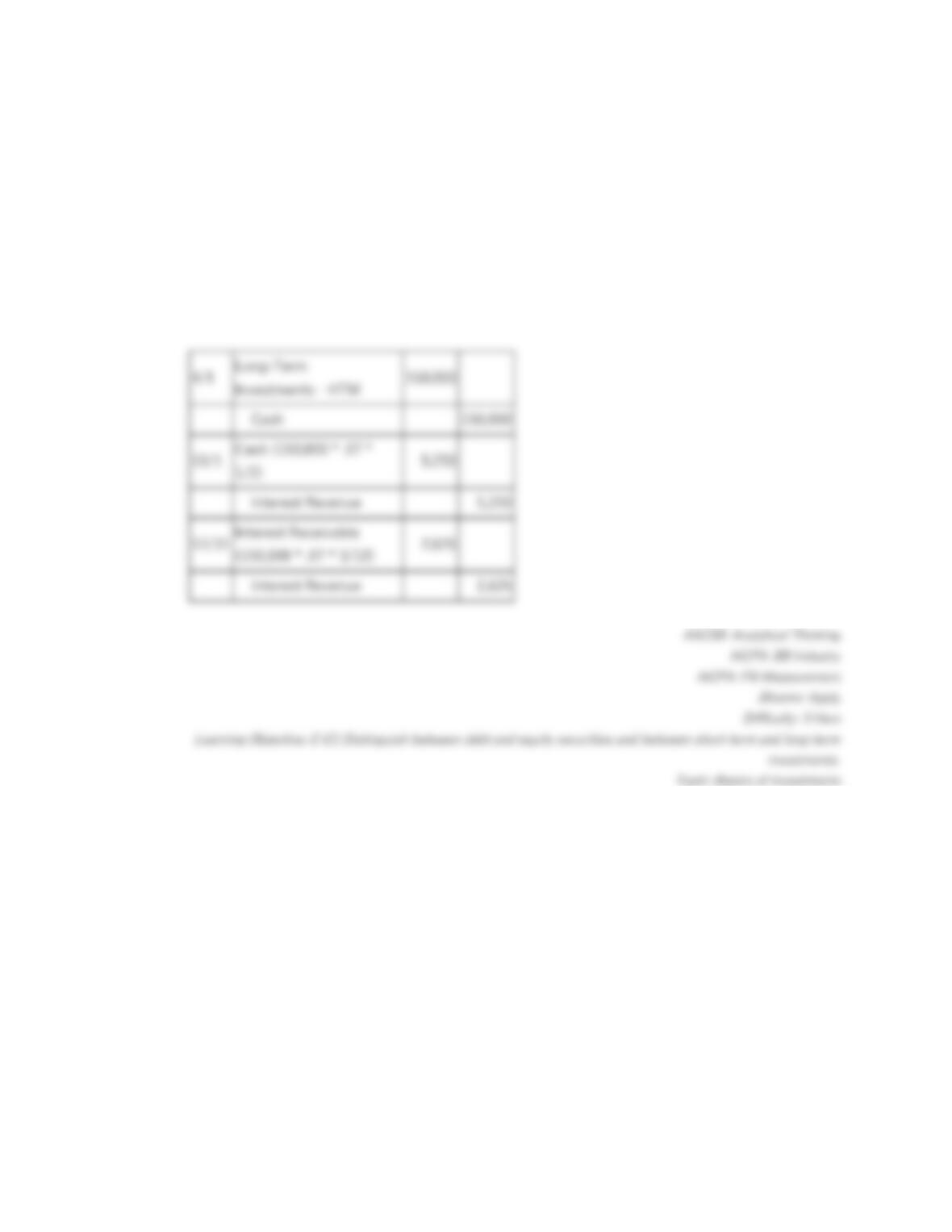
On April 1 of the current year, a company paid $150,000 cash to purchase 7%, 10-year
bonds with a par value of $150,000; interest is paid semiannually each April 1 and October
1. The company intends to hold these bonds until they mature. Prepare the journal entries
to record the bond purchase, the receipt of the first semiannual interest payment on
October 1 of the current year, and the accrual of interest for the year-end December 31.
164.
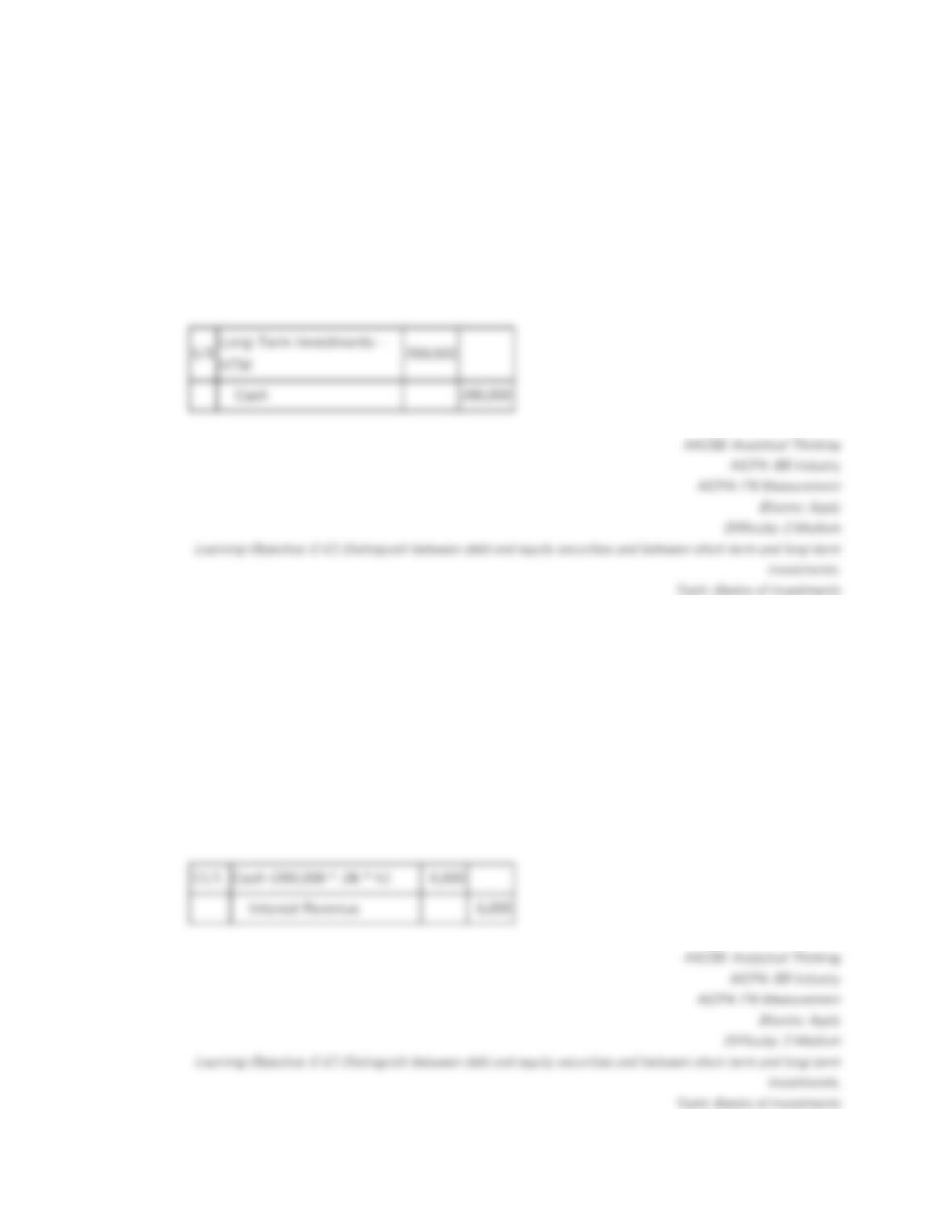
On May 1 of the current year, a company paid $200,000 cash to purchase 6%, 10-year
bonds with a par value of $200,000; interest is paid semiannually each May 1 and
November 1. The company intends to hold these bonds until they mature. Prepare the
journal entry to record the bond purchase.
165.
On May 1 of the current year, a company paid $200,000 cash to purchase 6%, 10-year
bonds with a par value of $200,000; interest is paid semiannually each May 1 and
November 1. The company intends to hold these bonds until they mature. Prepare the
journal entry to record the receipt of the first semiannual interest payment on November 1.
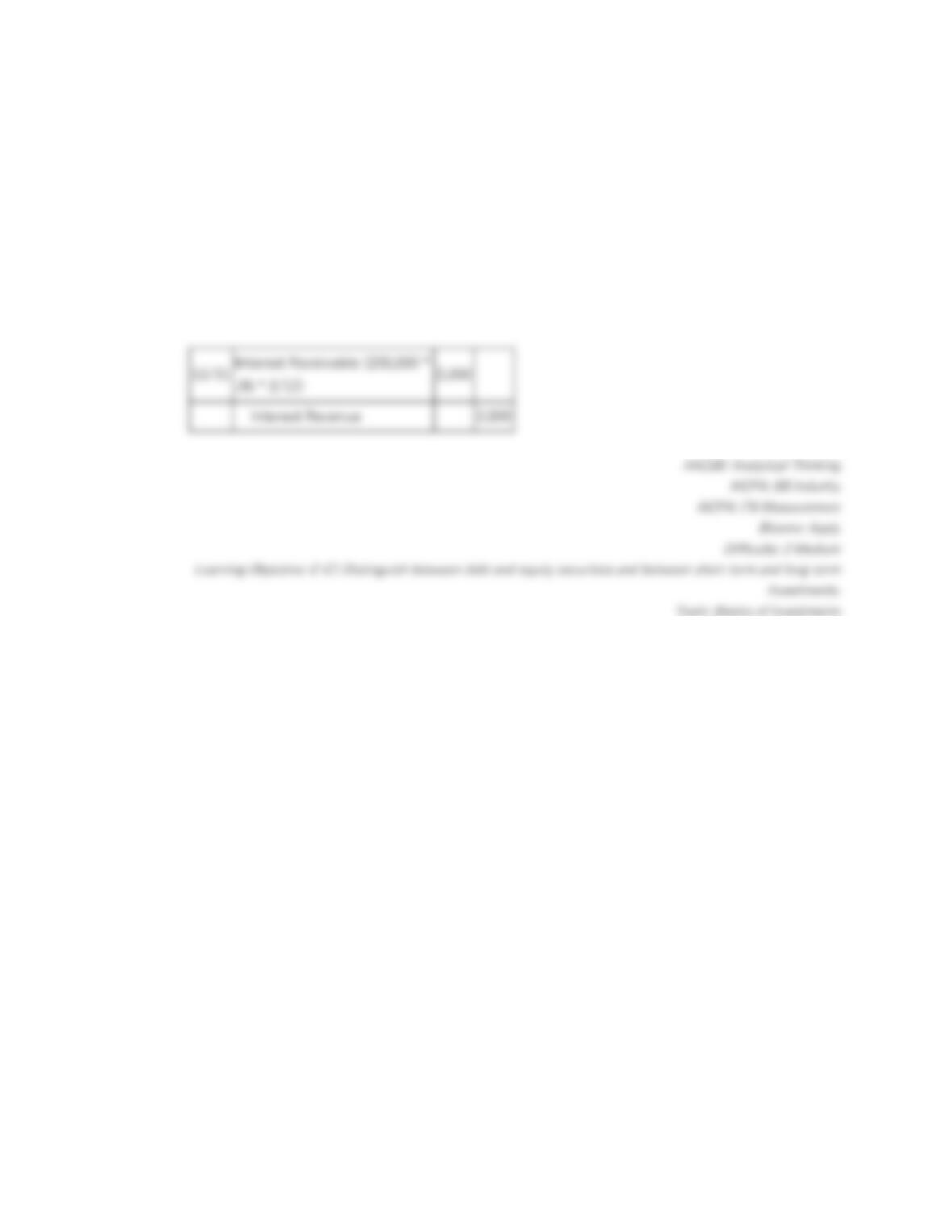
166.
On May 1 of the current year, a company paid $200,000 cash to purchase 6%, 10-year
bonds with a par value of $200,000; interest is paid semiannually each May 1 and
November 1. The company intends to hold these bonds until they mature. Prepare the
journal entry for the accrual of interest for the year-end December 31.
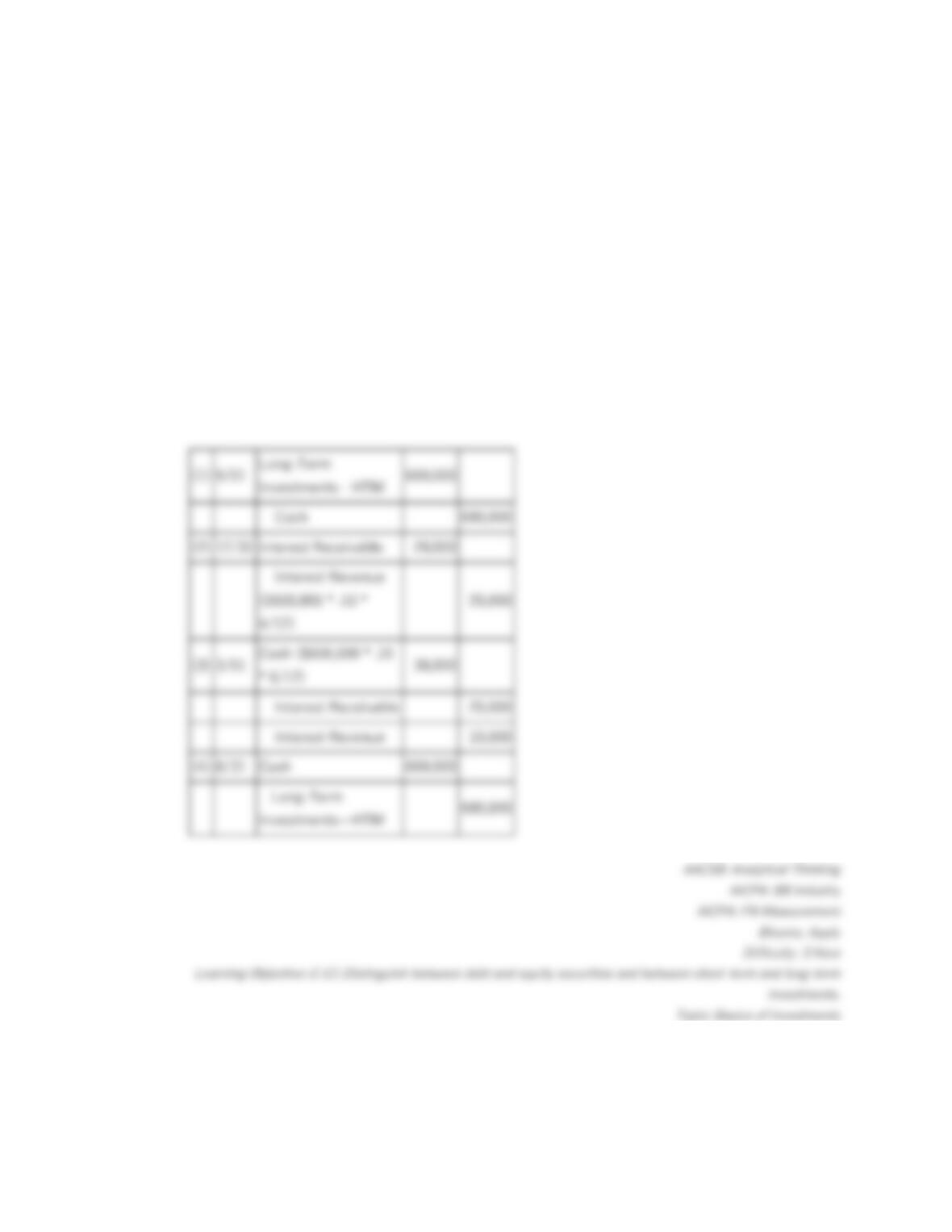
167.
A company paid $600,000 for 10% bonds with a par value of $600,000 on September 1. The
bonds pay 5% interest semiannually on September 1 and March 1. The company intends to
hold the bonds until they mature. Prepare the journal entries for the following dates and
transactions related to this bond acquisition.
(1) Bonds purchased on September 1.
(2) Year-end adjusting entry, December 31.
(3) Receipt of semiannual interest March 1.
(4) Redemption of the bonds at maturity on August 31.
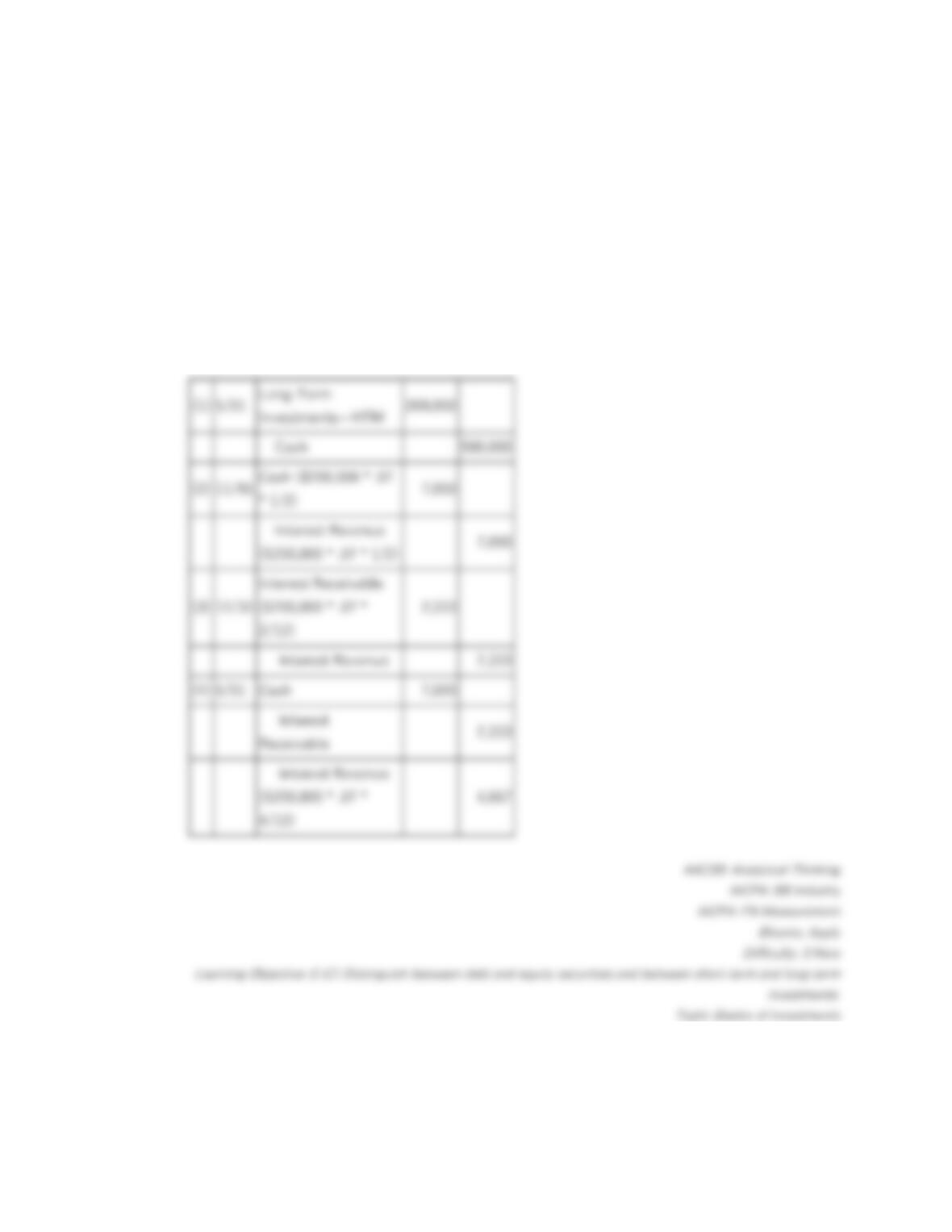
168.
On May 1 of the current year, a company paid $200,000 to purchase 7%, 10-year bonds
with a par value of $200,000; interest is paid semiannually on May 1 and November 1. The
company intends to hold the bonds until they mature. Prepare the journal entries to record
(1) the bond purchase, (2) the receipt of the first semiannual interest payment on
November 1 of the current year, (3) the accrual of interest for year-end December 31, and
(4) the receipt of the second semiannual payment on May 1.
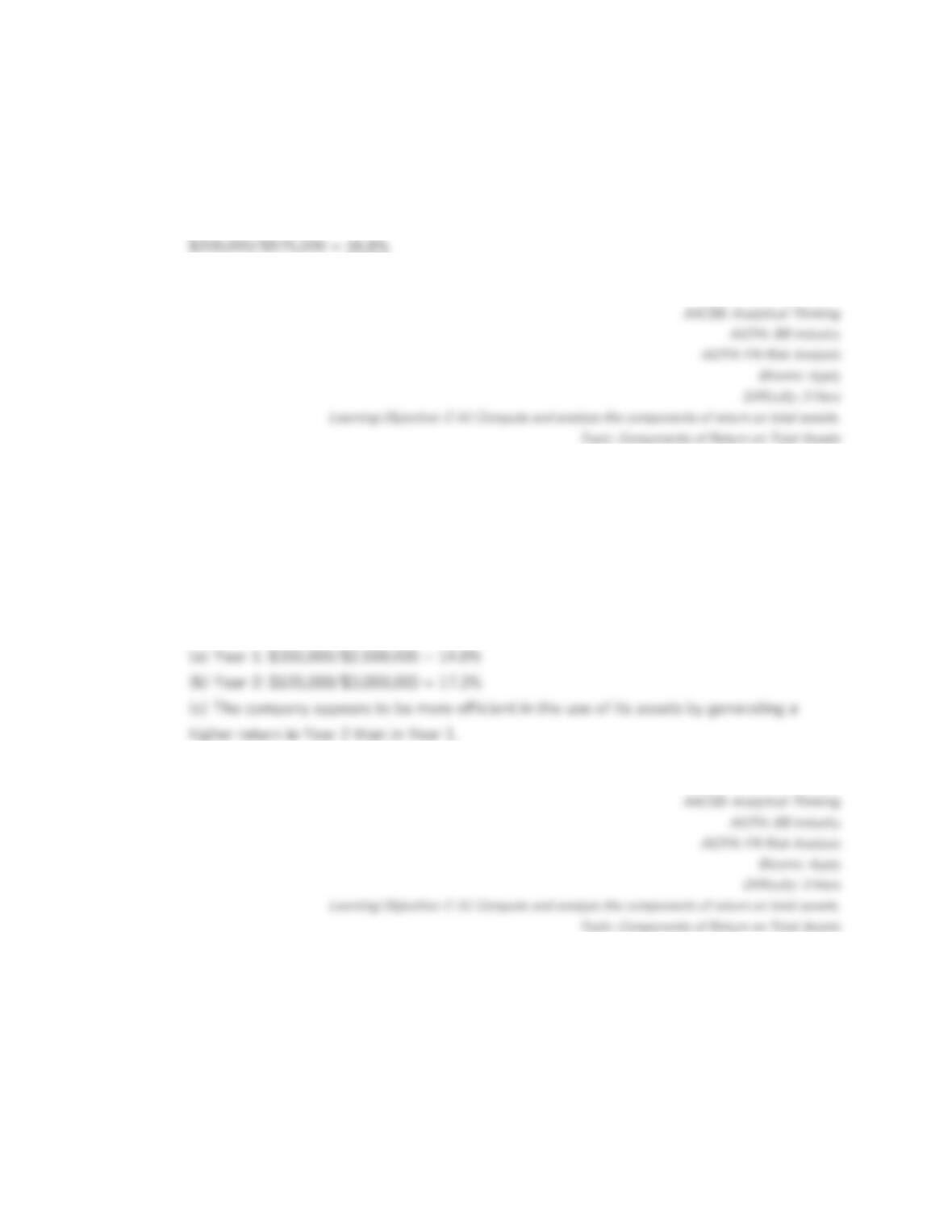
169.
A company reported net sales of $850,000, net income of $200,000 and average total
assets of $575,000. Calculate its return on total assets.
170.
A company had net income of $350,000 in Year 1 and $520,000 in Year 2. The company
had average total assets of $2,500,000 in Year 1 and $3,000,000 in Year 2. Calculate the
return on total assets for Year 1 and Year 2. Comment on the results, did the company’s
performance improve?
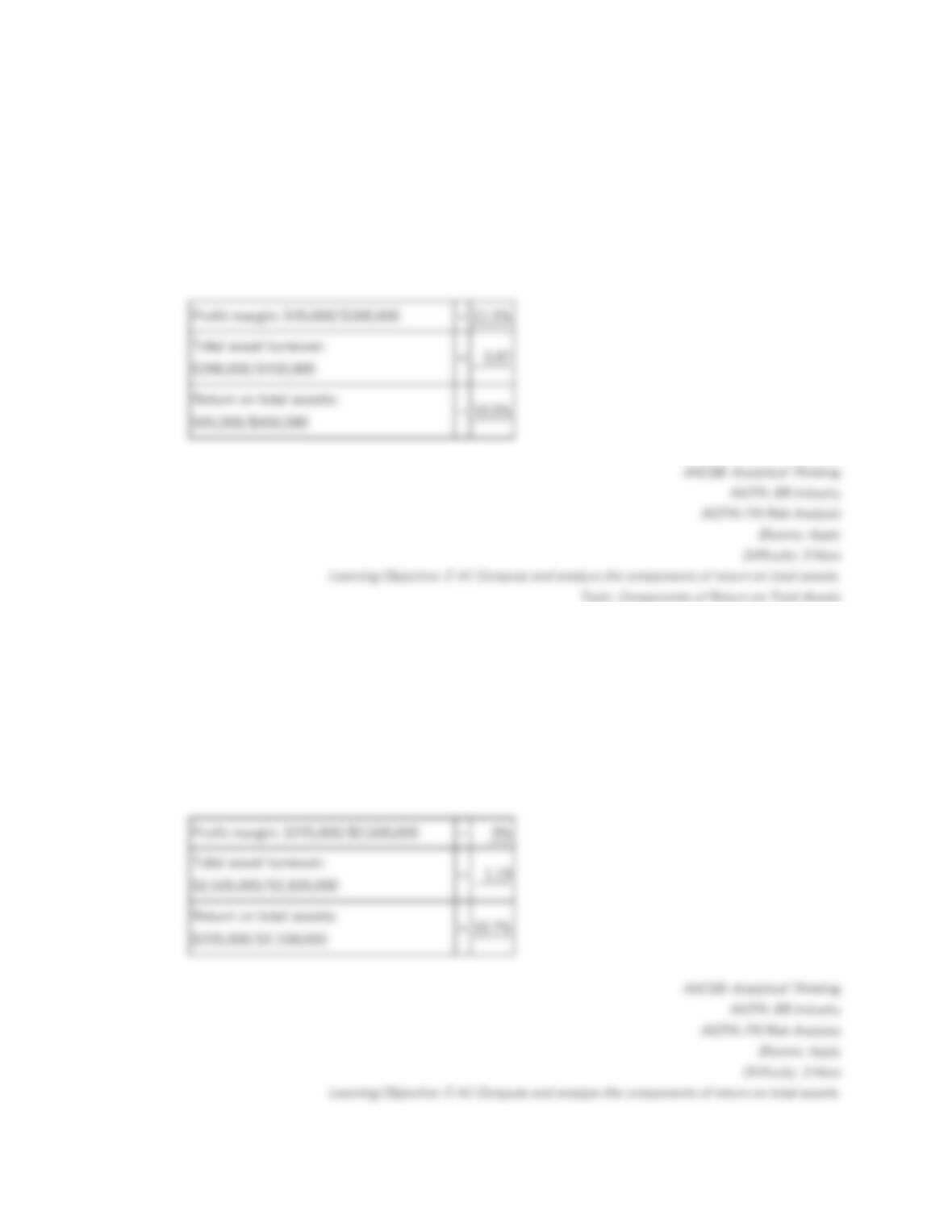
171.
A company had net income of $45,000, net sales of $390,000, and average total assets of
$450,000 for the current year. Calculate the company’s profit margin, total asset turnover,
and return on total assets.
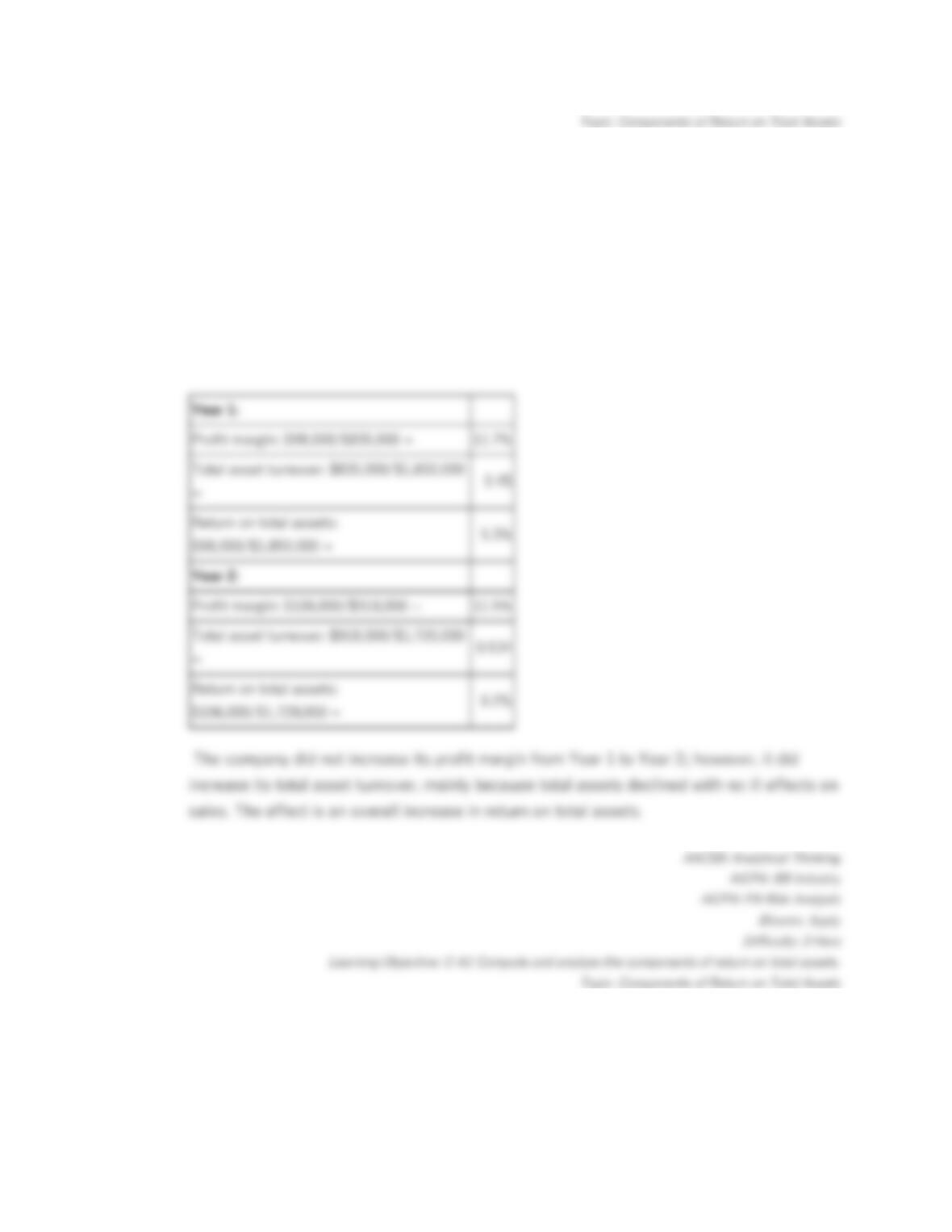
172.
A company reported net income of $225,000, net sales of $2,500,000, and average total
assets of $2,100,000 for the current year. Calculate this company’s profit margin, total
asset turnover, and return on total assets.
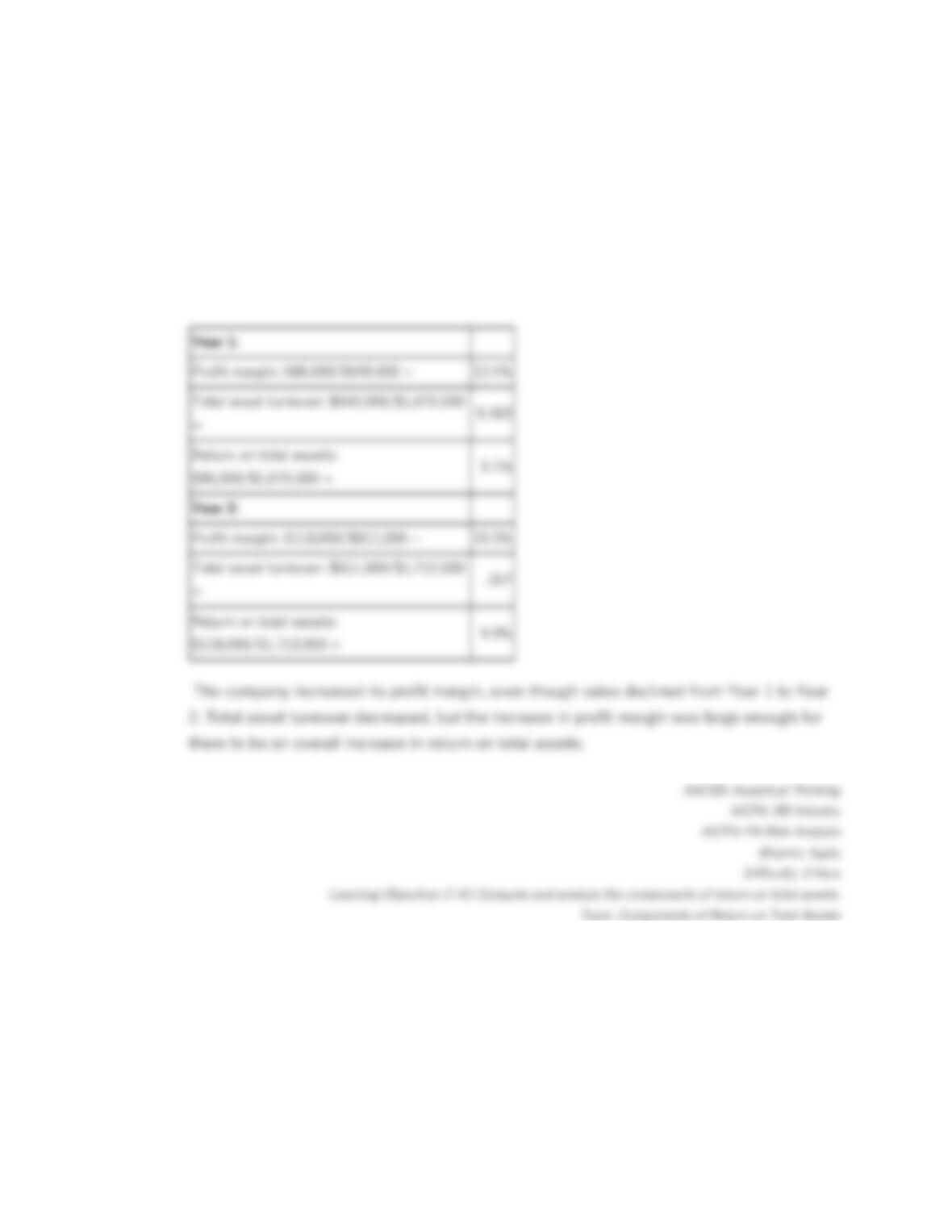
173.
A company reported net income for Year 1 of $98,000 and $106,000 for Year 2. It also
reported net sales of $835,000 in Year 1 and $918,000 in Year 2. The company’s average
total assets in Year 1 were $1,850,000 and $1,720,000 in Year 2. Calculate the company’s
profit margin, total asset turnover and return on total assets for Year 1 and Year 2.
Comment on the results.
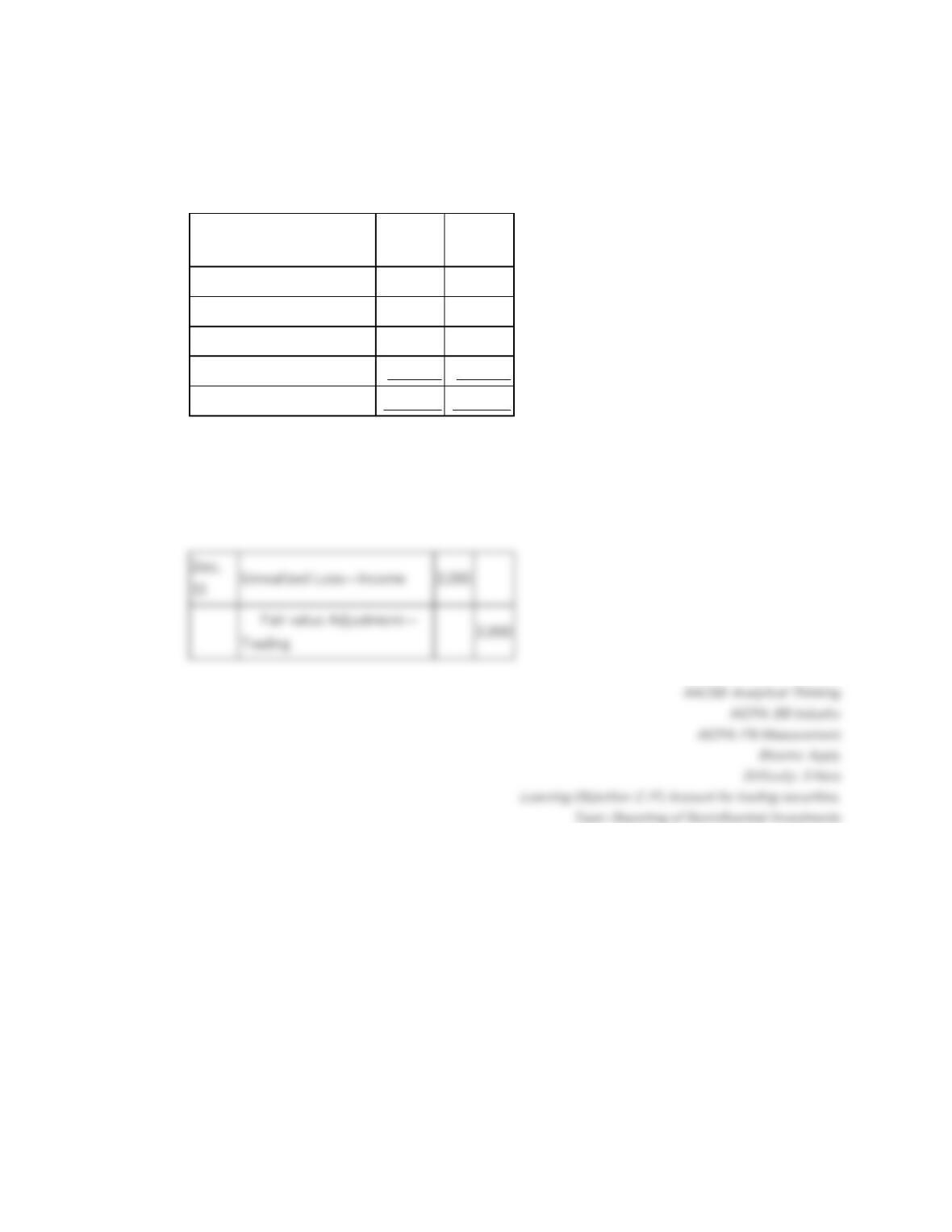
174.
A company had net income of $86,000 in Year 1 and $118,000 in Year 2. Its net sales were
$640,000 in Year 1 and $611,000 in Year 2. Its average total assets in Year 1 were
$1,670,000 and $1,712,000 in Year 2. Calculate the profit margin, total asset turnover and
return on total assets for both years. Comment on the results.
175.
Hubbard Company had the following trading securities in its portfolio at December 31. The
Fair Value Adjustment—Trading account had a balance of zero prior to year-end
adjustment. Prepare the appropriate adjusting journal entry.
Short-Term Investments
Cost
Fair
Value
XBM
$24,500
$25,900
Micro
51,000
48,600
Outel
62,300
61,000
Dull
29,900
30,200
Total
$167,700
$165,700
176.
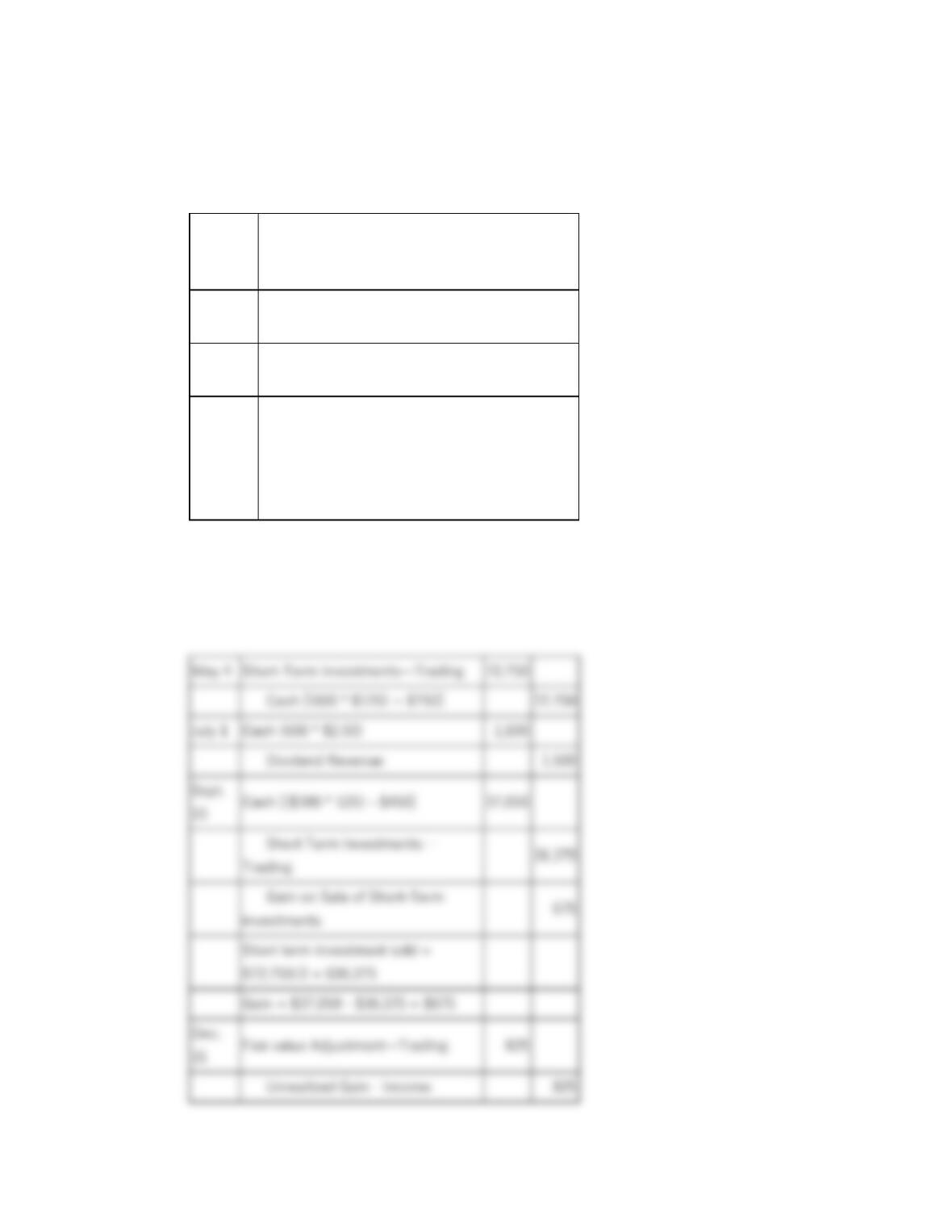
Element Company had the following long-term available-for-sale securities in its portfolio
at December 31 for each of the years listed. The year-end cost and fair values for its
portfolio follow. Beginning with Year 1, prepare the appropriate journal entry to record
each year-end market adjustment for these securities.
Available-for-Sale
Securities
Cost
Fair
Value
Year 1
$404,500
$389,900
Year 2
406,400
412,600
Year 3
454,800
472,000
Unrealized Gain—Equity
6,200
177.
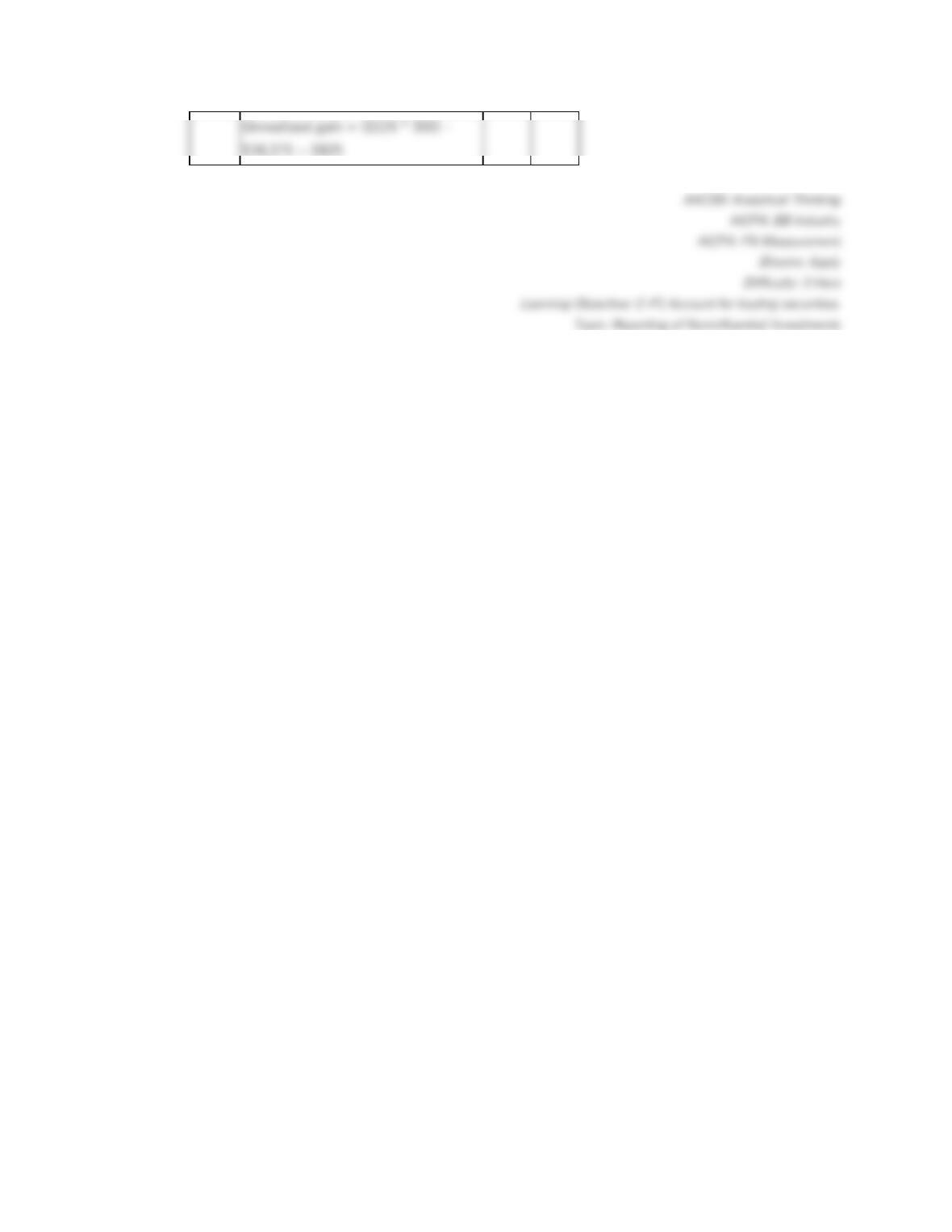
Scotsland Company had the following transactions relating to investments in trading
securities during the year. Prepare the required general journal entries for these
transactions.
May 4
Scotsland purchased 600 shares of Lobe
Company stock at $120 per share plus a $750
brokerage fee.
July 1
Scotsland received a $2.50 per share cash
dividend on the Lobe Company stock.
Sept. 15
Sold 300 shares of Lobe Company stock for
$125 per share, less a $450 brokerage fee.
Dec. 31
The fair value of the Lobe Company stock (the
only investment that Scotsland owns) is $124
per share. The balance of the Fair value
Adjustment—Trading account had a zero
balance prior to adjustment.
May 4
Short-Term Investments—Trading
Cash [(600 * $120) + $750]
July 1
Cash (600 * $2.50)
Dividend Revenue
Sept.
Short Term Investments—
Gain on Sale of Short-Term
Short term investment sold =
Gain = $37,050 – $36,375 = $675
Dec.
178.
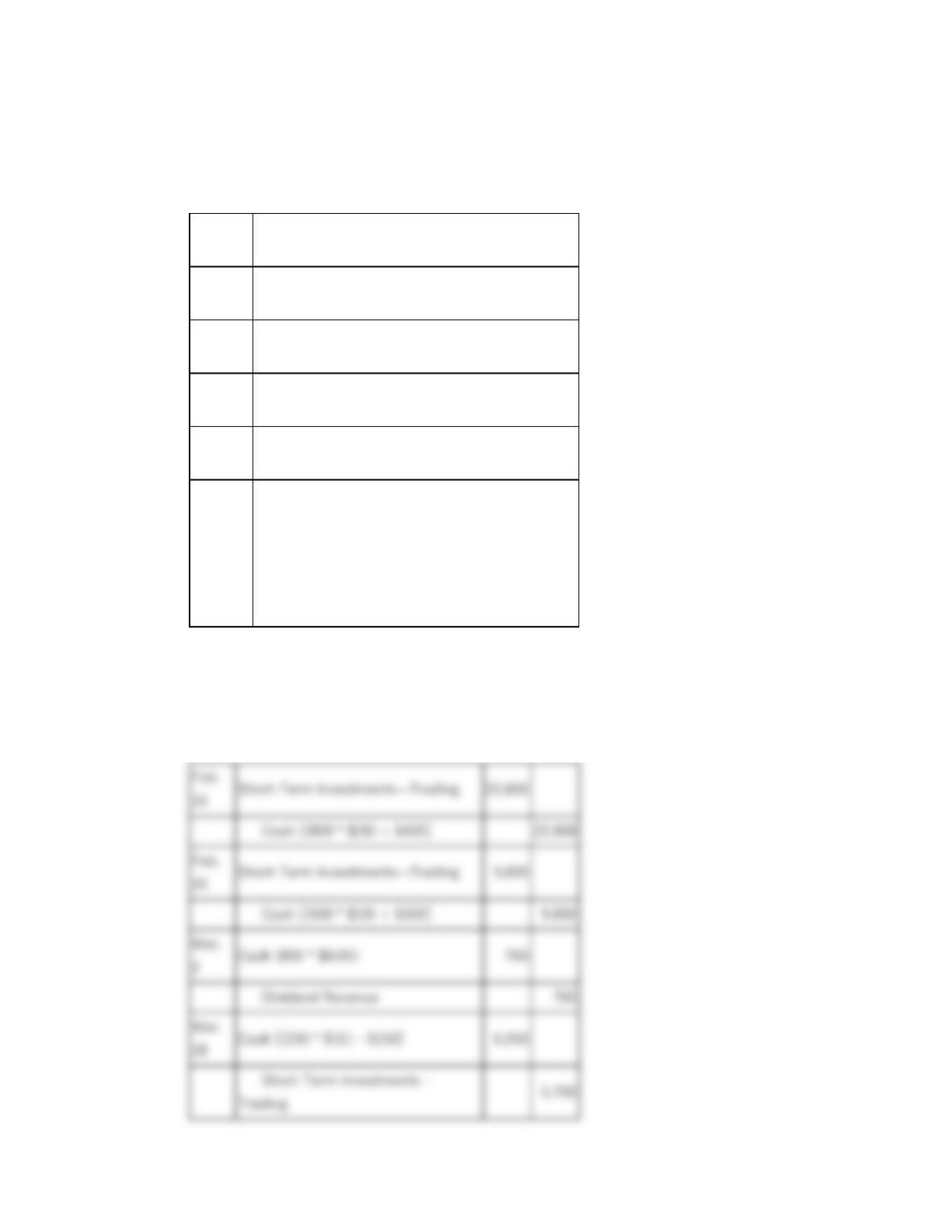
Mire Corporation had the following transactions involving investments in trading securities
during the year. Prior to these transactions, Mire never had any investments in trading
securities. Prepare the required general journal entries to record these transactions.
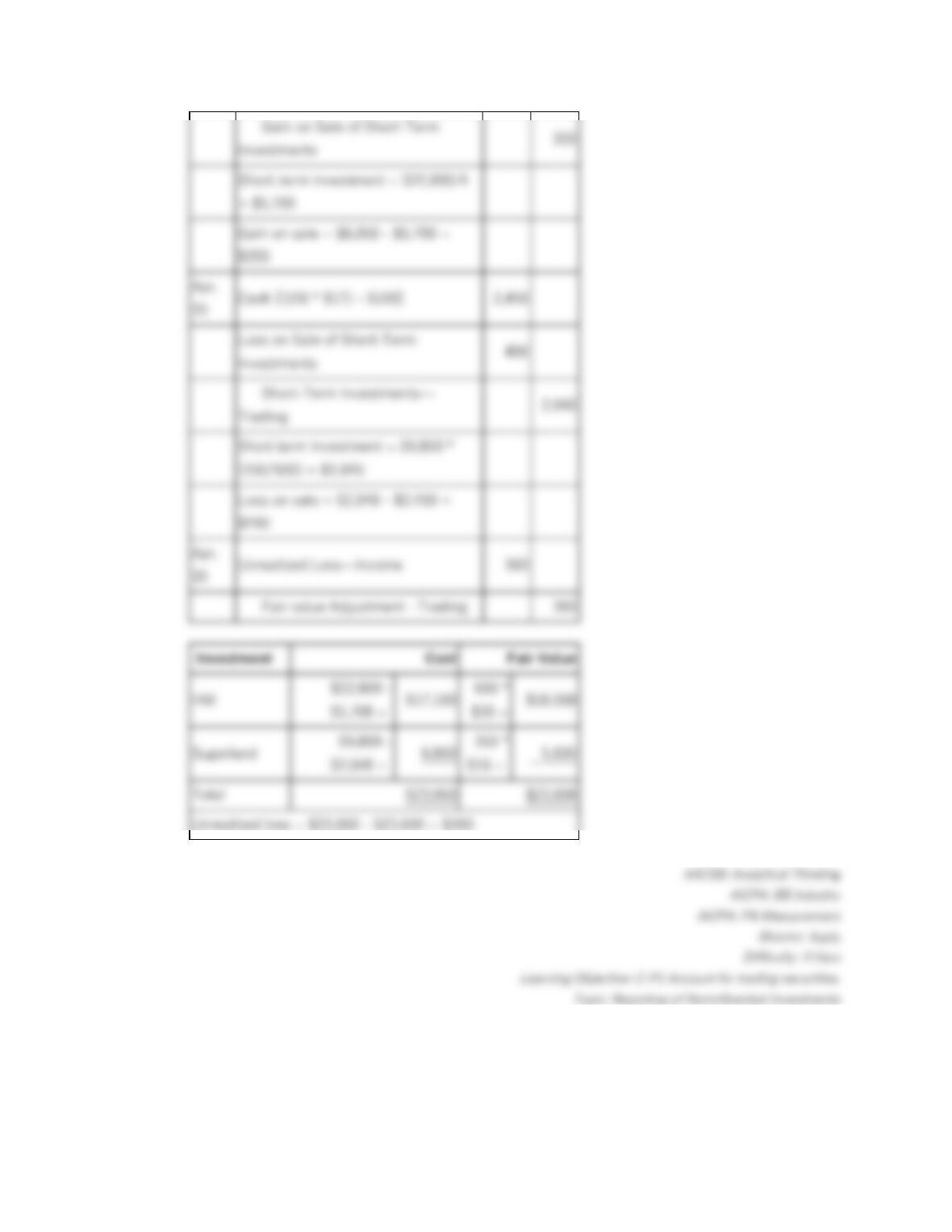
Feb. 16
Purchased 800 shares of HM Corporation stock
at $28 per share plus a $400 brokerage fee.
Feb. 26
Purchased 500 shares of Sugarland Co. stock at
$19 per share plus a $300 brokerage fee.
Mar. 2
Received a $0.95 per share dividend from the HM
Corporation.
Mar. 28
Sold 200 shares of HM Corporation stock for $31
per share less a $150 brokerage fee.
Apr. 20
Sold 150 shares of Sugarland Co. stock at $17
per share less a $100 brokerage fee.
Apr. 30
The company is preparing quarterly financial
statements; prepare an adjusting entry for the
fair value adjustment on the trading securities. At
April 30, the HM stock has a fair value of $30 per
share, and the Sugarland stock has a fair value of
$16 per share.
Feb.
Short-Term Investments—Trading
Feb.
Short-Term Investments—Trading
Cash [(500 * $19) + $300]
Mar.
Cash (800 * $0.95)
Mar.
Cash [(200 * $31) – $150]