94.
Canberry Corporation had net income of $80,000, beginning total assets of $640,000 and
ending total assets of $580,000. Its return on total assets is:
95.
A company has net income of $250,000, net sales of $2,000,000, and average total assets
of $1,500,000. Its return on total assets equals:
96.
A company had net income of $2,660,000, net sales of $25,000,000, and average total
assets of $8,000,000. Its return on total assets equals:
97.
A company had net income of $43,000, net sales of $380,500, and average total assets of
$220,000. Its profit margin and total asset turnover were, respectively:
98.
A company had a profit margin of 10.5% and total asset turnover of 1.84. Its return on total
assets was:
99.
A company had net income of $40,000, net sales of $300,000, and average total assets of
$200,000. Its profit margin and total asset turnover were respectively:
100.
Investments can be classified as all but which of the following?
101.
Investments in debt and equity securities that the company actively manages and trades
for profit are referred to as short-term investments in:
102.
Investments in trading securities:
103.
A decrease in the fair value of a security that has not yet been realized through an actual
sale of the security is called a(n):
104.
Held-to-maturity securities are:
105.
Available-for-sale debt securities are:
106.
All of the following are true for Available–for-sale equity securities except:
107.
J.P. Industries purchased 2,000 shares of Yang’s common stock for $143,000 as a long–
term investment. The investment is classified as available–for-sale securities. The par
value of the stock was $1 per share. J.P. paid $375 in commissions on the transaction.
J.P.’s entry to record the purchase transaction would include a:
108.
Lessington Corporation purchases 4,000 shares of Gonzalez Company common stock for
$150,000 as a long-term investment. The investment is classified as available-for-sale
securities. Gonzalez has 500,000 shares of stock currently outstanding and the par value
of the stock is $1 per share. Lessington’s entry to record the purchase transaction would
include a:
109.
Six months ago, a company purchased an investment in stock for $70,000. The investment
is classified as available-for-sale securities. The current fair value of the stock is $68,500.
The year-end adjusting entry for this investment should include a:
110.
On July 31, Potter Co. purchased 2,000 shares of GigaTech stock for $16,000. The
investment is classified as available–for-sale securities. On October 31, which is Potter’s
year-end, the stock had a fair value of $20,000. Potter should record a:
111.
On March 15, Alan Company purchased 10,000 shares of Cameo Corp. stock for $35,000.
The investment is classified as available-for-sale securities. On June 30, the stock had a
fair value of $34,000. Alan should do which of the following?
112.
If a company owns more than 20% of the stock of another company and the stock is being
held as a long-term investment, which method would the investor normally use to account
for this investment?
113.
MotorCity, Inc. purchased 40,000 shares of Shaw common stock for $232,000. This
represents 40% of the outstanding stock. The entry to record the transaction includes a:
114.
Segmental Manufacturing owns 35% of Glesson Corp stock. Glesson pays a total of
$47,000 in cash dividends for the period. Segmental’s entry to record the dividend
transaction would include a:
115.
Zhang Corp. owns 40% of Magnor Company’s common stock. Magnor pays $97,000 in total
cash dividends to its shareholders. Zhang‘s entry to record this transaction should include
a:
116.
McVeigh Corp. owns 40% of Gondor Company’s common stock. McVeigh received $41,200
in cash dividends from Gondor. The entry to record this transaction should include a:
117.
Marjam Company owns 51,000 shares of MacKenzie Company’s 100,000 outstanding
shares of common stock. MacKenzie Company pays $25,000 in total cash dividends to its
shareholders. Marjam’s entry to record this transaction should include a:
118.
Bharrat Corporation purchased 40% of Ferris Corporation for $100,000 on January 1. On
October 17 of the same year, Ferris Corporation declared total cash dividends of $12,000.
At year-end, Ferris Corporation reported net income of $60,000. The balance in the
Bharrat Corporation’s Long-Term Investment-Ferris account at December 31 should be:
119.
Madison Corporation purchased 40% of Jay Corporation for $125,000 on January 1. On
June 20 of the same year, Jay Corporation declared total cash dividends of $30,000. At
year-end, Jay Corporation reported net income of $150,000. The balance in Madison
Corporation’s Long-Term Investment-Jay Corporation account as of December 31 should
be:
120.
Pravis Corporation owns 30% of Kuster Corporation. Pravis Corporation received $9,000 in
cash dividends from Kuster Corporation. The entry to record receipt of these dividends is:
121.
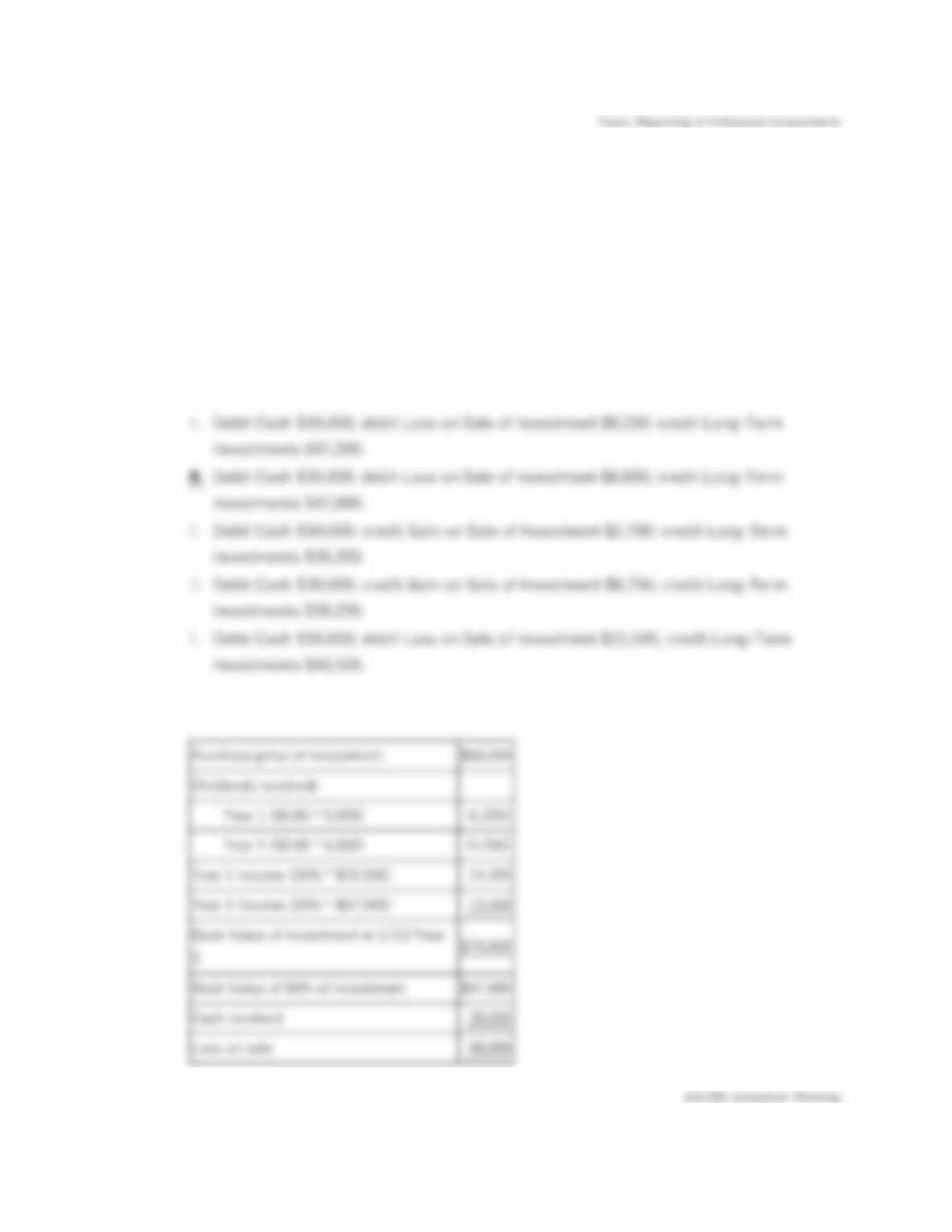
On January 4, Year 1, Barber Company purchased 5,000 shares of Convell Company for
$59,500 plus a broker’s fee of $1,000. Convell Company has a total of 25,000 shares of
common stock outstanding and it is presumed the Barber Company will have a significant
influence over Convell. During each of the next two years, Convell declared and paid cash
dividends of $0.85 per share, and its net income was $72,000 and $67,000 for Year 1 and
Year 2, respectively. The January 12, Year 3, entry to record Barber’s sale of 3,000 shares
of Convell Company stock, which represents 60% of Barber’s total investment, for $39,000
cash should be:
122.
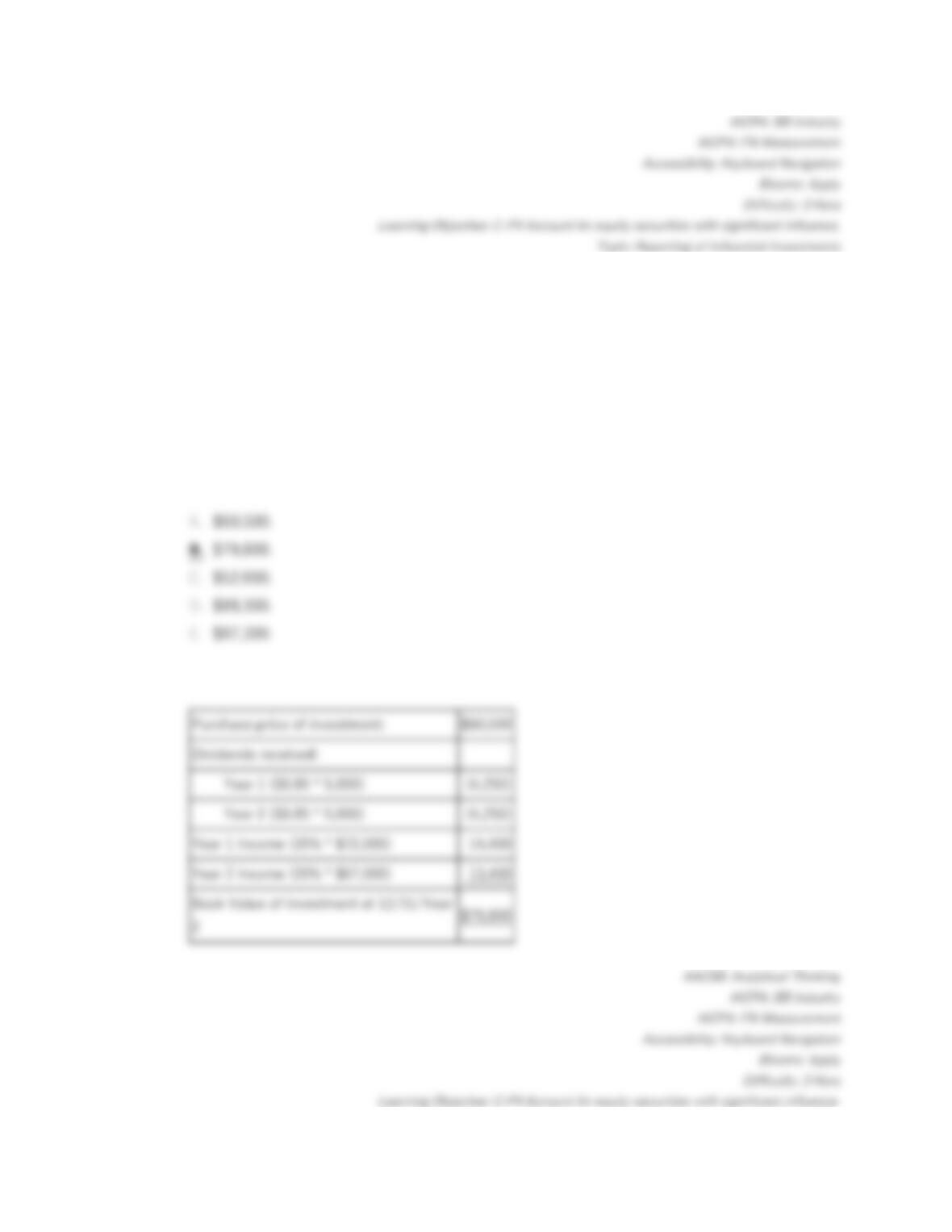
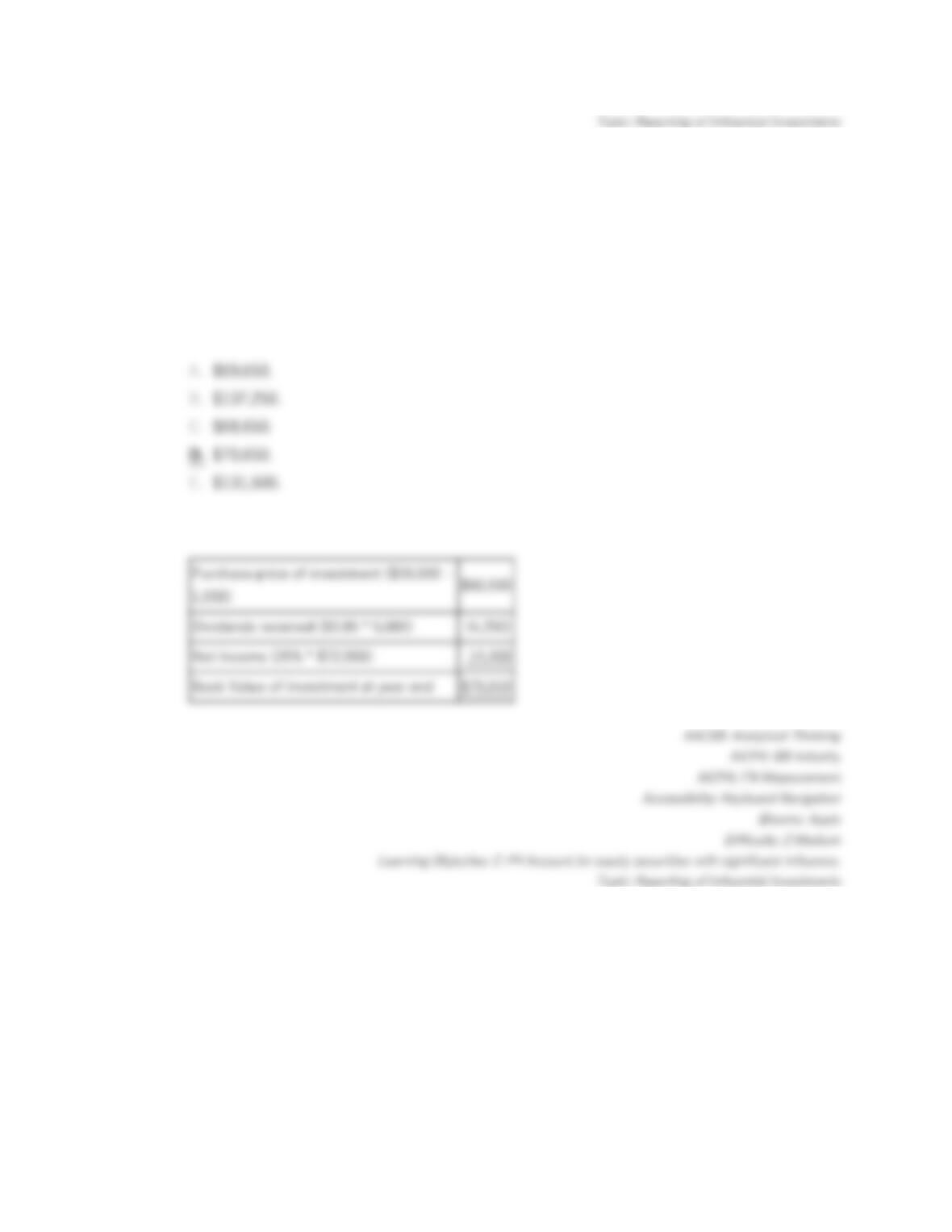
On January 4, Year 1, Barber Company purchased 5,000 shares of Convell Company for
$59,500 plus a broker’s fee of $1,000. Convell Company has a total of 25,000 shares of
common stock outstanding and it is presumed the Barber Company will have a significant
influence over Convell. During each of the next two years, Convell declared and paid cash
dividends of $0.85 per share, and its net income was $72,000 and $67,000 for Year 1 and
Year 2, respectively. What is the book value of Barber’s investment in Convell at the end of
Year 2?
123.
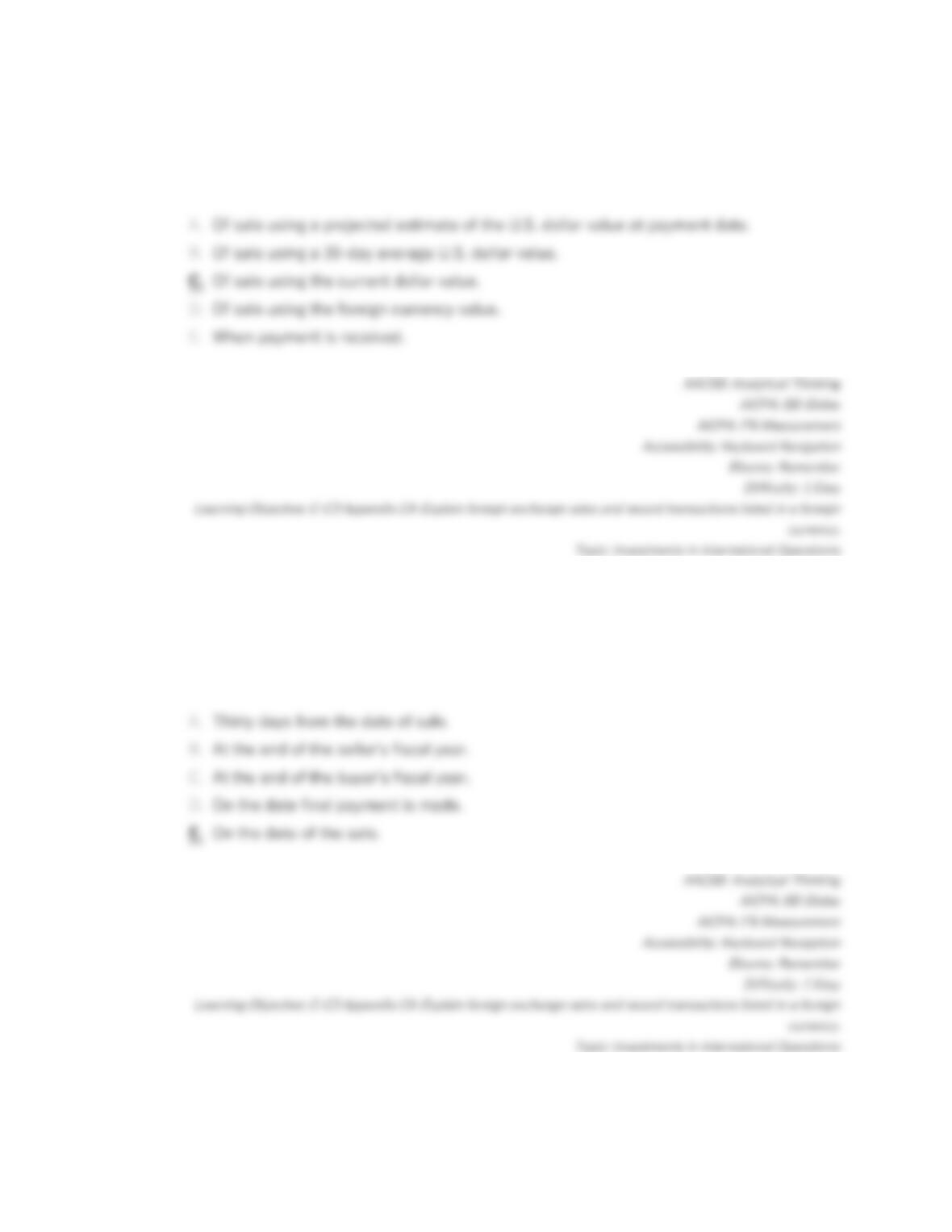
On January 4, Barber Company purchased 5,000 shares of Convell Company for $59,500
plus a broker’s fee of $1,000. Convell Company has a total of 25,000 shares of common
stock outstanding and it is presumed the Barber Company will have a significant influence
over Convell. During the next years, Convell declared and paid cash dividends of $0.85 per
share, and its net income was $72,000. What is the book value of Barber’s investment in
Convell at the end of this first year?
124.
A U.S. company makes a sale to a foreign customer with payment receivable in 30 days in
the customer’s currency. The sale would be recorded by the U.S. company on the date:
125.
When a U.S. company makes a credit sale to an international customer and the sale terms
are for payment in a foreign currency, the foreign exchange rate used to record the sale is
the exchange rate:
126.
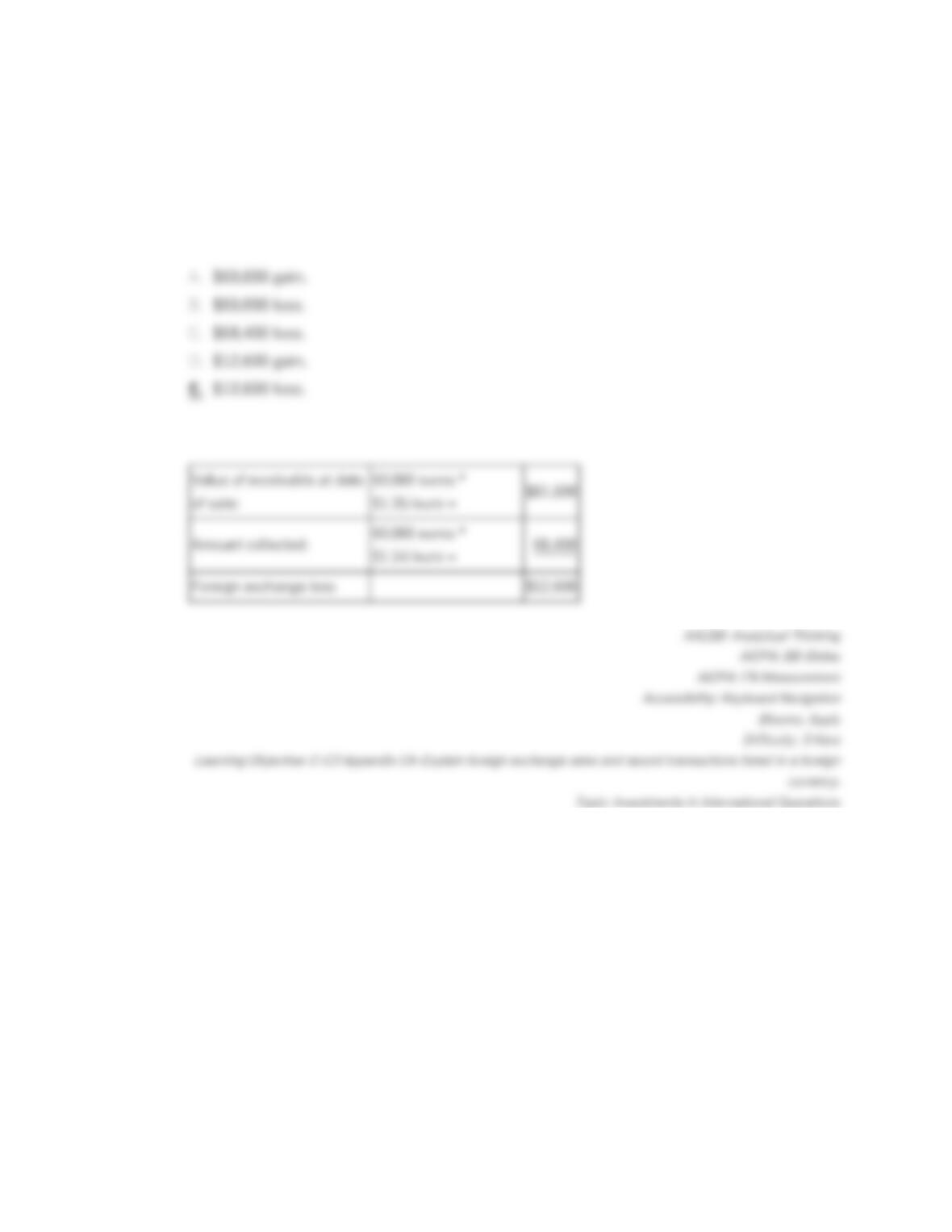
On June 18, Wyman Company (a U.S. Company) sold merchandise to the Nielsen Company
of Denmark for €60,000 (Euros), with a payment due in 60 days. If the exchange rate was
$1.35 per euro on the date of sale and $1.14 per euro on the date of payment, Wyman
Company should recognize a foreign exchange gain or loss in the amount of: