1. The concept that interest causes the value of money received today to be greater than the
value of that same amount of money received in the future is referred to as the:
2. The value today of receiving an amount in the future is referred to as the:
3. The value that an amount today will grow to in the future is referred to as the:
4. Reba wishes to know how much would be in her savings account in five years if she
deposits a given sum in an account that earns 6% interest. She should use a table for the:
5. LeAnn wishes to know how much she should set aside now at 7% interest in order to
accumulate a sum of $5,000 in four years. She should use a table for the:
6. Samuel is trying to determine what it’s worth today to receive $10,000 in four years at a 7%
interest rate. He should use a table for the:
7. Below are excerpts from interest tables for 8% interest.
Column 2 is an interest table for the:
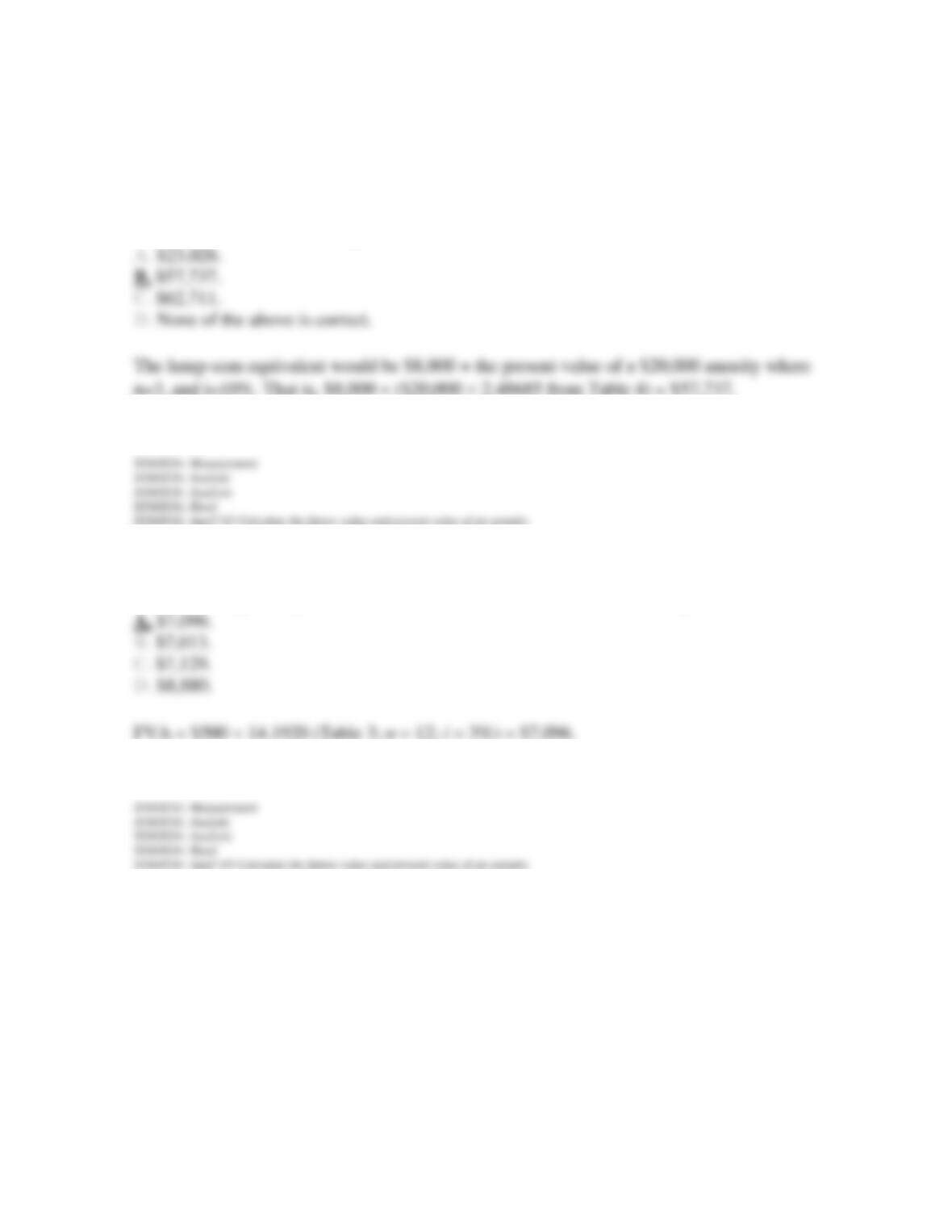
8. Below are excerpts from interest tables for 8% interest.
Column 3 is an interest table for the:
9. How much will $25,000 grow to in seven years, assuming an interest rate of 12%
compounded annually?
10. How much will $8,000 grow to in five years, assuming an interest rate of 8% compounded
quarterly?
11. What is the value today of receiving $2,500 at the end of three years, assuming an interest
rate of 9% compounded annually?
12. What is the value today of receiving $5,000 at the end of six years, assuming an interest
rate of 8% compounded semiannually?
13. Davenport Inc. offers a new employee a lump-sum signing bonus at the date of
employment. Alternatively, the employee can take $30,000 at the date of employment and
another $50,000 two years later. Assuming the employee’s time value of money is 8%
annually, what lump-sum at employment date would make her indifferent between the two
options?
14. Today, Thomas deposited $100,000 in a three-year, 12% CD that compounds quarterly.
What is the maturity value of the CD?
15. Carol wants to invest money in a 6% CD that compounds semiannually. Carol would like
the account to have a balance of $50,000 five years from now. How much must Carol deposit
to accomplish her goal?
16. Shane wants to invest money in a 6% CD that compounds semiannually. Shane would like
the account to have a balance of $100,000 four years from now. How much must Shane
deposit to accomplish his goal?
17. Bill wants to give Maria a $500,000 gift in seven years. If money is worth 6%
compounded semiannually, what is Maria’s gift worth today?
18. At the end of the next four years, a new machine is expected to generate net cash flows of
$8,000, $12,000, $10,000, and $15,000, respectively. What are the cash flows worth today if a
19. Monica wants to sell her share of an investment to Barney for $50,000 in three years. If
money is worth 6% compounded semiannually, what would Monica accept today?
20. How much must be invested now at 9% interest to accumulate to $10,000 in five years?
21. The value today of receiving a series of payments in the future is referred to as the:
22. The value that a series of payments will grow to in the future is referred to as the:
23. A series of equal periodic payments is referred to as:
24. How much will $5,000 invested at the end of each year grow to in six years, assuming an
interest rate of 7% compounded annually?
25. How much will $1,000 invested at the end of each year grow to in 20 years, assuming an
interest rate of 10% compounded annually?
26. What is the value today of receiving $5,000 at the end of each year for the next 10 years,
assuming an interest rate of 12% compounded annually?
27. What is the value today of receiving $3,000 at the end of each year for the next three
years, assuming an interest rate of 3% compounded annually?
28. Tammy wants to buy a car that costs $10,000 and wishes to know the amount of the
monthly payments, which will be made at the end of the month, with interest of 12% on the
unpaid balance. She should use a table for the:
29. George Jones is planning on a cruise for his 70th birthday party. He wants to know how
much he should set aside at the end of each month at 6% interest to accumulate the sum of
$4,800 in five years. He should use a table for the:
30. Zulu Corporation hires a new chief executive officer and promises to pay her a signing
bonus of $2 million per year for 10 years, starting at the end of the first year. The value of this
signing bonus is:
31. Sandra won $5,000,000 in the state lottery which she has elected to receive at the end of
each month over the next thirty years. She will receive 7% interest on unpaid amounts. To
determine the amount of her monthly check, she should use a table for the:
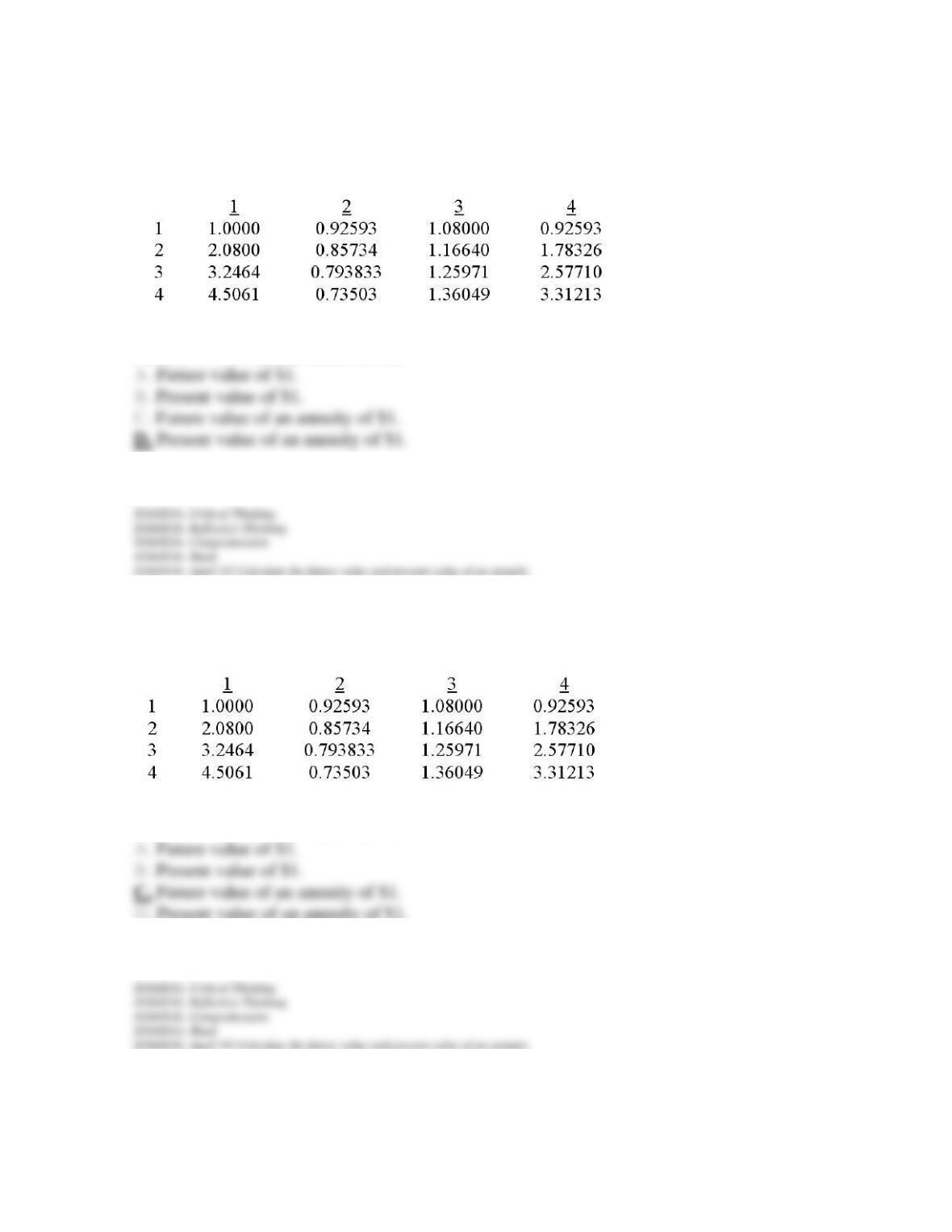
32. Below are excerpts from interest tables for 8% interest.
Column 4 is an interest table for the:
33. Below are excerpts from interest tables for 8% interest.
Column 1 is an interest table for the:
34. Quaker State Inc. offers a new employee a lump-sum signing bonus at the date of
employment. Alternatively, the employee can take $8,000 at the date of employment plus
$20,000 at the end of each of his first three years of service. Assuming the employee’s time
value of money is 10% annually, what lump-sum at employment date would make him
indifferent between the two options?
35. At the end of each quarter, Patti deposits $500 into an account that pays 12% interest
compounded quarterly. How much will Patti have in the account in three years?
36. Miller borrows $300,000 to be paid off in three years. The loan payments are semiannual
with the first payment due in six months, and interest is at 6%. What is the amount of each
payment?
37. Claudine Corporation will deposit $5,000 into a money market account at the end of each
year for the next five years. How much will accumulate by the end of the fifth and final
payment if the account earns 9% interest?
38. What is the value today of receiving five annual payments of $500,000, beginning one
year from now, assuming an 11% discount rate?
39. The value of $1 today is worth more than $1 one year from now.
40. The time value of money is a concept which means that the value of $1 increases over
time.
41. Simple interest is interest earned on the initial investment only.
42. If you put $500 into a savings account that pays simple interest of 8% per year and then
withdraw the money two years later, you will earn interest of $80.
43. If you put $600 into a savings account that pays simple interest of 10% per year and then
withdraw the money two years later, you will earn interest of $126.
44. Compound interest is interest you earn on the initial investment and on previous interest.